Maths · Grades 1–2
Free telling time worksheets
Four telling time worksheets: read nine analog clocks to the hour, read nine clocks showing o'clock and half past, then draw the hands for o'clock times and for half hours. For grades 1 and 2.
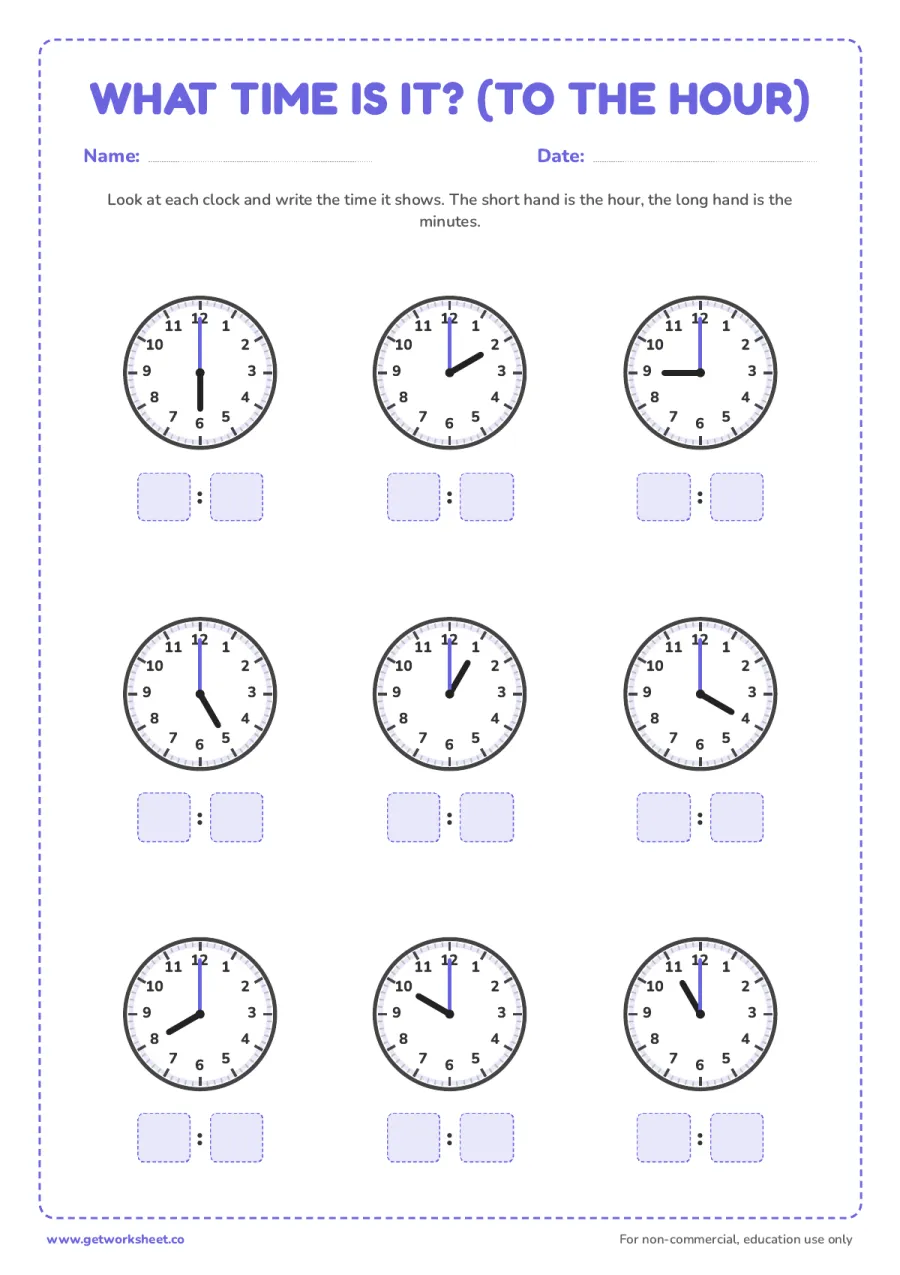
Telling time to the hour
Nine analog clocks showing o'clock times; write each time in digital form. Free printable PDF.
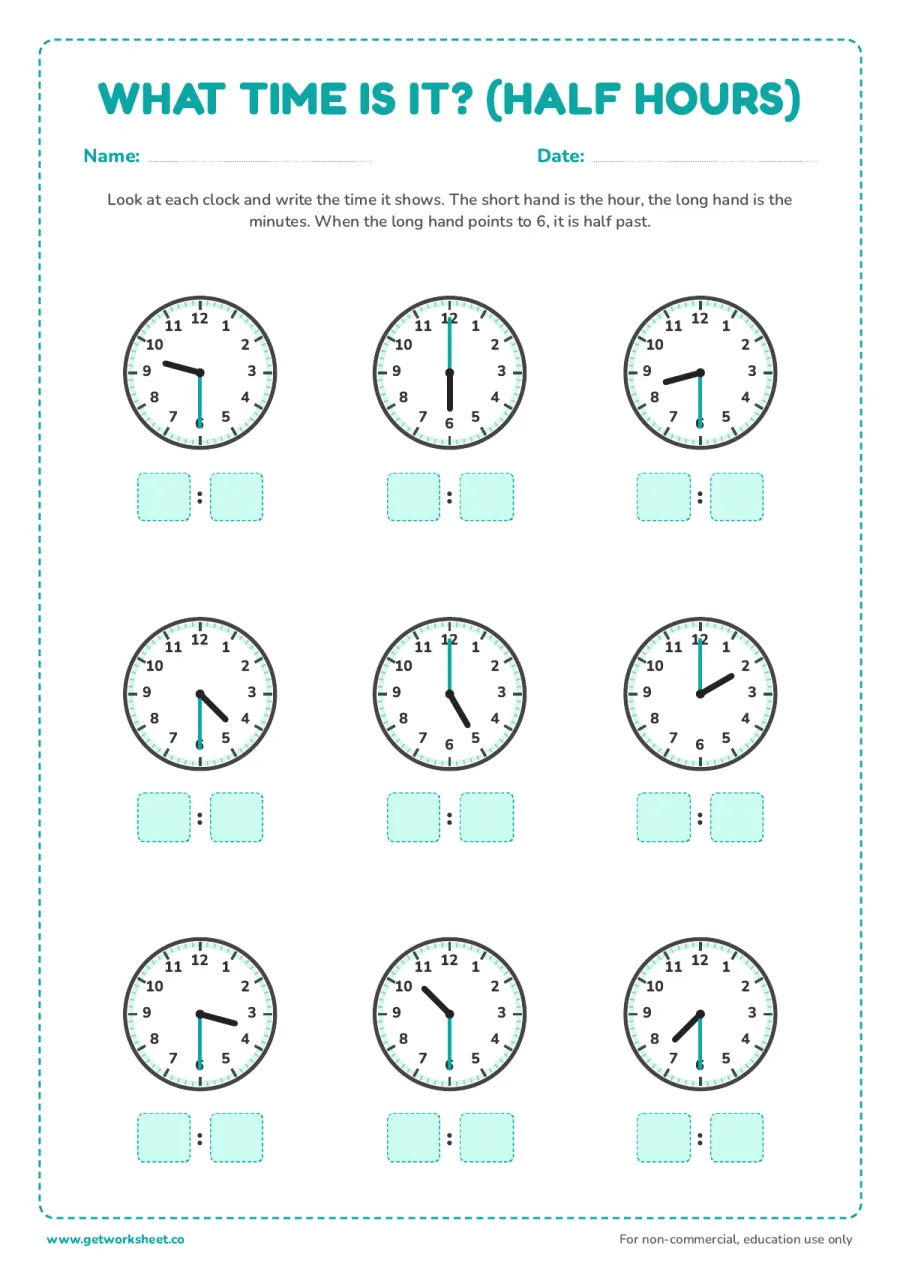
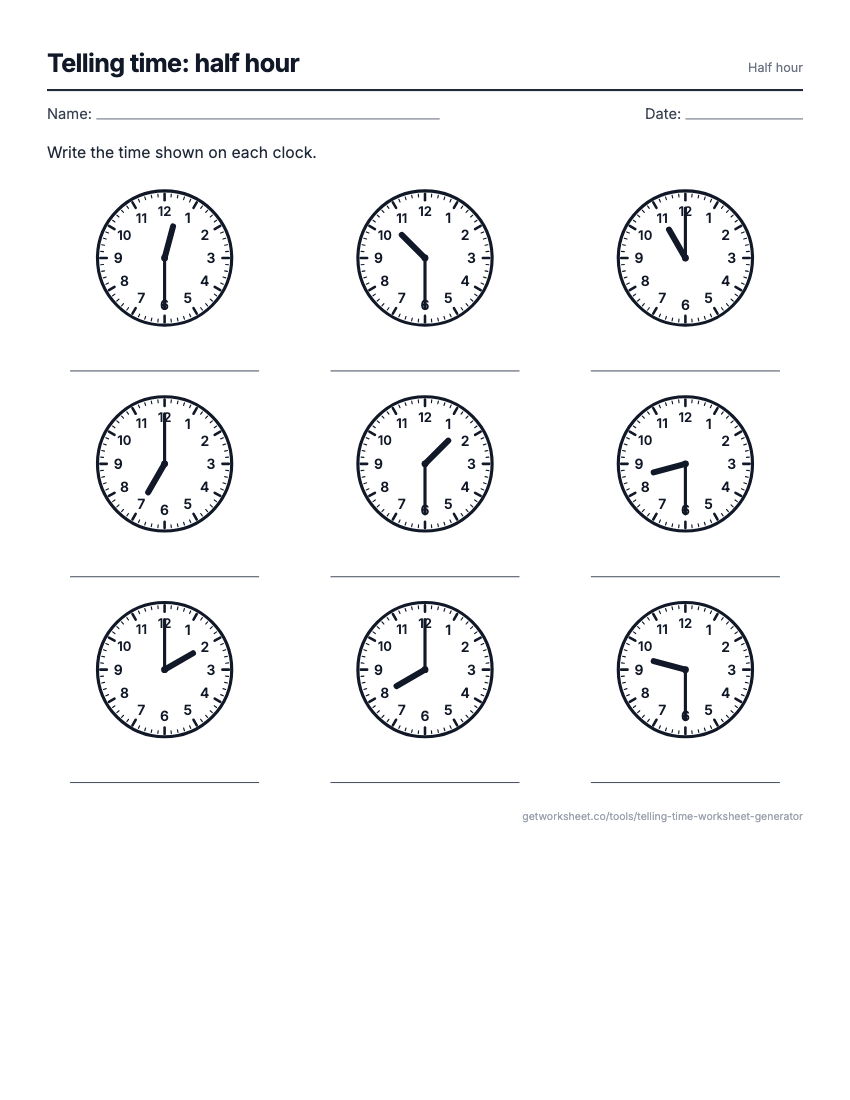
Telling time to the half hour
Nine analog clocks showing o'clock and half past times; write each time. Free printable PDF.
Whole set
All 4 sheets in one PDF
Instant and ad-free. No account needed.
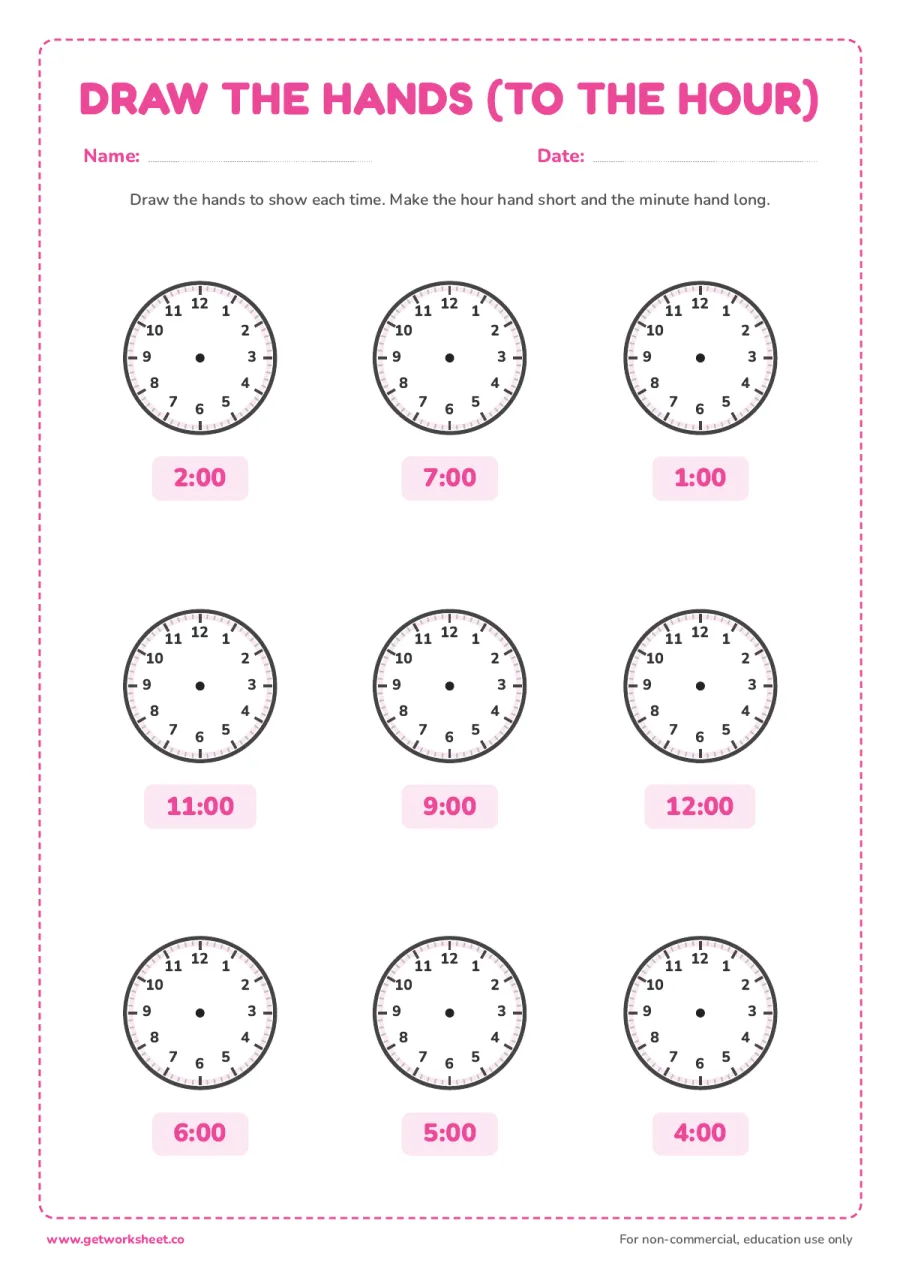
Draw the hands: time to the hour
Read each o'clock time and draw the hour and minute hands on the blank clock. Free printable PDF.
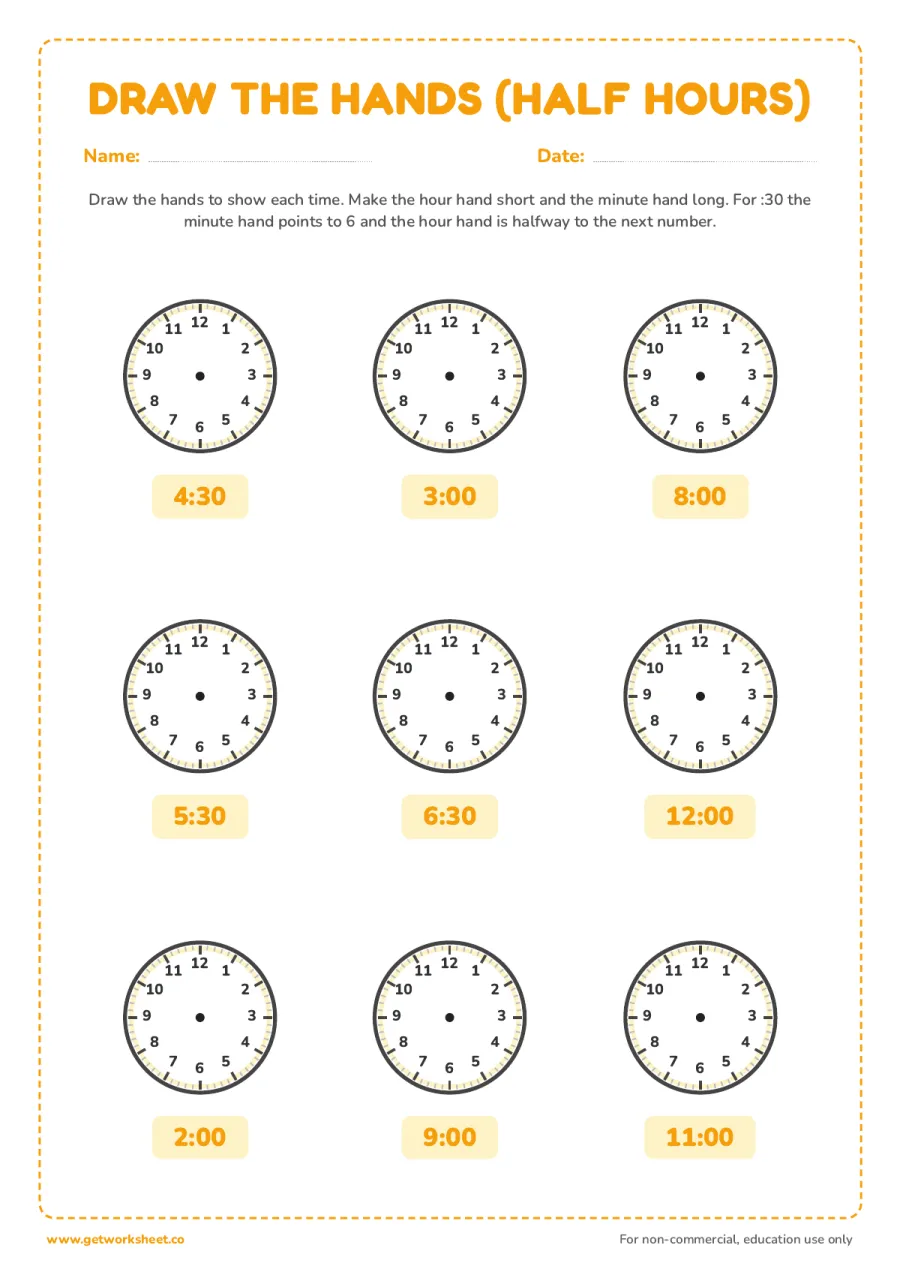
Draw the hands: half hours
Read each time to the hour or half hour and draw the hands. Free printable PDF.
AI worksheet generator
Make a worksheet like this for your class
The 4 sheets above are fixed. The generator writes a new telling time worksheet for your grade, with the question types and count you choose, in about 20 seconds. Pick a grade to start:
What you get
- A fresh set of questions on telling time, not a copy of the sheets above
- Multiple choice, fill in the blanks, true or false, open ended
- Answer key and print-ready PDF with Pro
Free account, 1 worksheets a week. No card.
These four telling time worksheets cover the two steps every curriculum starts with, times to the hour and times to the half hour, in both directions. Sheet one shows nine analog clocks at o'clock times; the child writes each time in digital form, such as 7:00. Sheet two shows nine clocks mixing o'clock and half past times, where the minute hand points to 6 and the hour hand sits between two numbers. Sheet three reverses the task: the o'clock time is written under a blank clock and the child draws the hour and minute hands. Sheet four does the same for times to the hour or half hour, which is the hardest of the four because the hour hand must be placed between two numbers.
Reading an analog clock is a skill children still need, and it is also the first place they meet a number line that wraps around. Drawing the hands is the better test of understanding, because the child has to decide where each hand goes and how long it should be rather than reading a picture.
What Students Will Practice
- Telling the short hour hand from the long minute hand
- Reading o'clock times on sheet one and writing them as digits (7:00)
- Reading half past times on sheet two, where the minute hand points to 6 and the hour hand sits between two numbers
- Drawing hands of the right length pointing to the right place on sheets three and four
- Connecting the analog clock face with the digital way of writing the same time
Free printable makers
Make your own telling time sheets
Type your own words or numbers and print in about 30 seconds. No account, no AI, answer key where it applies.
 Telling time worksheet generatorAnalogue clocks to read, draw, match or add time to, with answer key. Free to print.
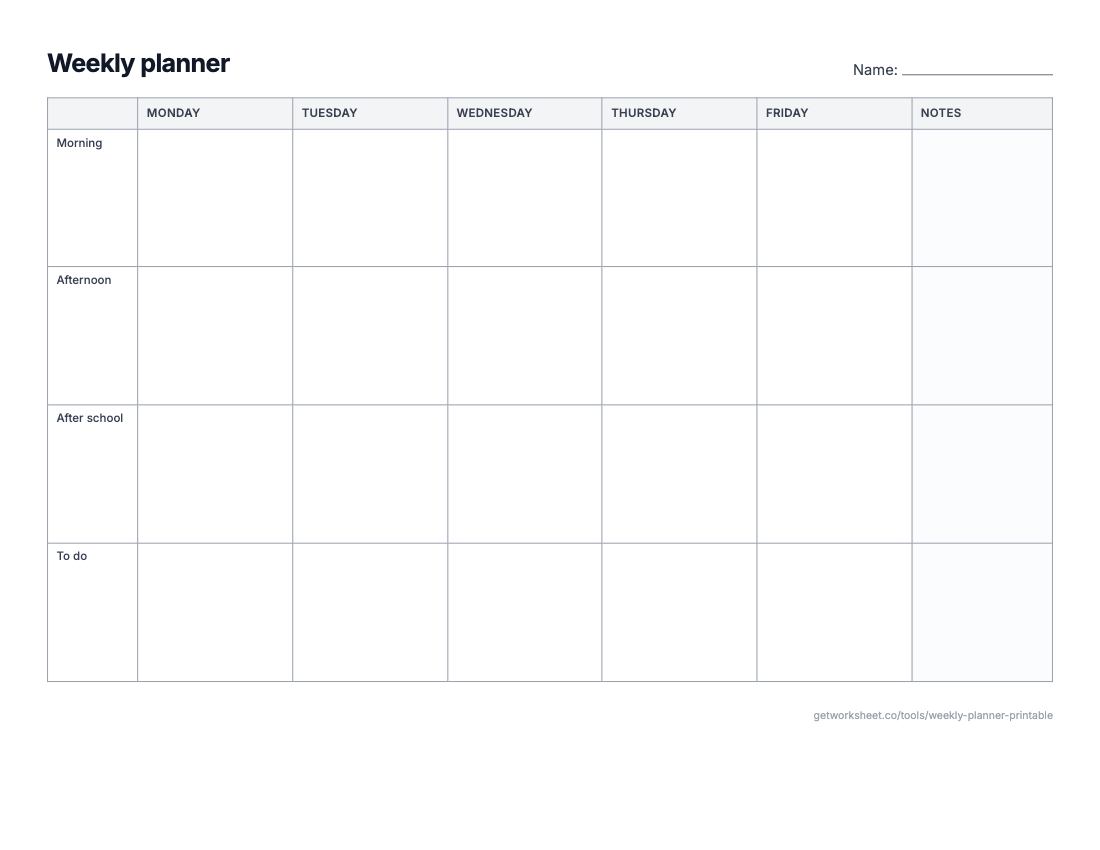 Weekly planner and calendar makerWeekly planner, monthly calendar, daily schedule or lesson-plan grid on one sheet. Free to print.
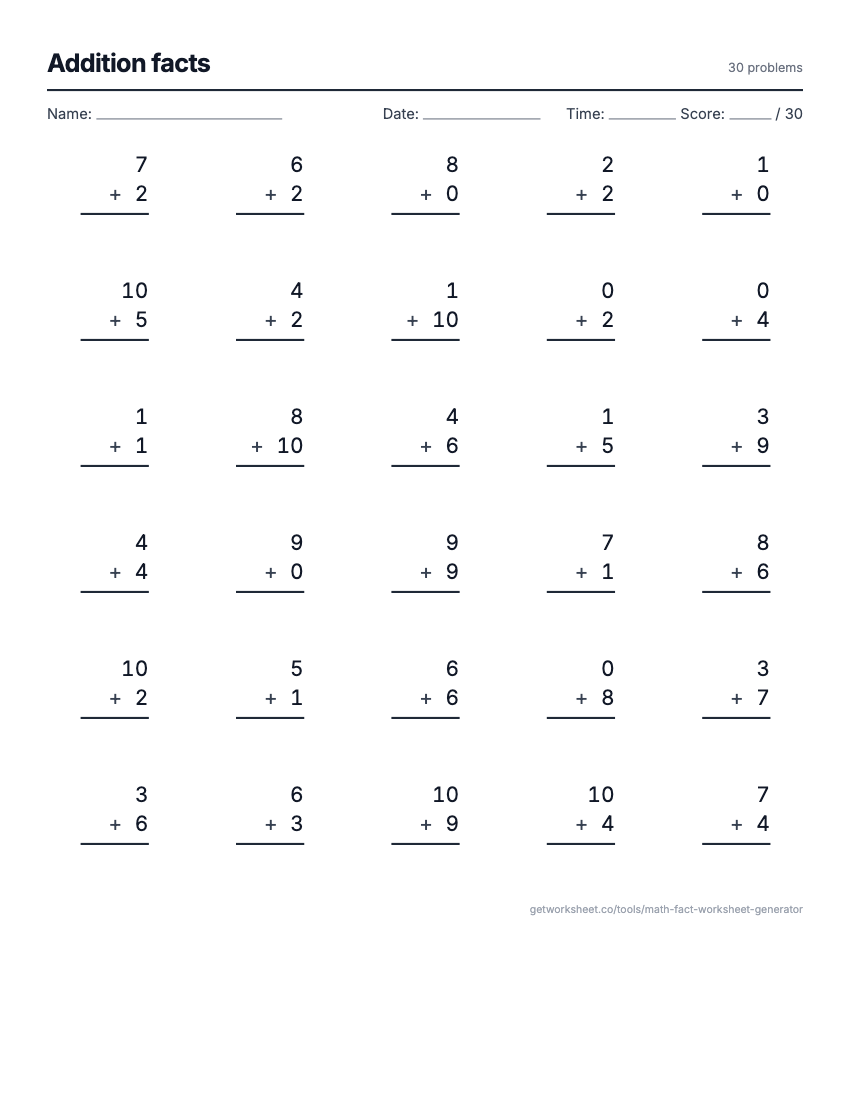 Math fact worksheet generatorAddition to division drills with an answer key. Free to print.
AI worksheet generator
Need a different telling time worksheet?
Generate a custom telling time worksheet: pick the grade, question types and count, and print it in about 20 seconds. Free accounts get 1 generation a week.
How to Use These Worksheets
Print at 100% on A4 or US Letter paper. A real analog clock or a toy clock with movable hands beside the worksheet helps a great deal.
- Sheet one: read to the hour. The minute hand always points to 12. Ask “which number is the short hand pointing at?” and write that number followed by :00.
- Sheet two: read to the half hour. Mix of o’clock and half past. When the long hand points to 6, it is :30, and the short hand will be halfway between two numbers. The time takes the smaller number: halfway between 3 and 4 is 3:30, not 4:30.
- Sheet three: draw to the hour. Read the time under each blank clock and draw the hands. Insist on a short hour hand and a long minute hand; the length is what makes the clock readable.
- Sheet four: draw to the half hour. The hardest sheet. For 8:30 the minute hand points at 6 and the hour hand sits between 8 and 9.
- Say it three ways. “Half past three”, “three thirty”, “3:30”. Children hear all three in daily life and should know they mean the same thing.
Common Mistakes to Watch For
- Reading the hour hand as the number it is closest to: At 3:30 the hour hand is closer to 4, so children write 4:30. Teach “the hour hand has not reached 4 yet, so it is still 3”.
- Drawing both hands the same length: Then no one can read the clock. Check lengths before checking positions.
- Reading the minute hand as the minute number: The long hand on 6 means 30 minutes, not 6 minutes. Counting round by 5s from 12 shows why.
- Writing 3:6 for half past three: Model the digital form with two digits for minutes every time.
Frequently Asked Questions
What age are these telling time worksheets for?
Times to the hour are usually taught at age 5 to 6 (kindergarten and first grade) and half hours at age 6 to 7 (first grade). Second grade moves on to quarter hours and five-minute intervals.
Should children learn analog or digital time first?
Analog first. The clock face shows how time passes and why 30 minutes is half an hour. Digital time is just reading numbers, and children pick it up quickly once the analog idea is secure. These sheets use both together.
Why is drawing the hands harder than reading them?
Reading a clock lets a child guess from the picture. Drawing the hands means deciding where each hand goes and how long it is, which tests whether they understand what each hand does.
What comes after the half hour?
Quarter past and quarter to, then times to five minutes, then elapsed time (how long between two times). Our quarter hour worksheets are the next step.
More Time and Counting Practice
Continue with the telling time to the quarter hour worksheets. The minute marks on a clock follow the five times table, so the 5 times table worksheets and skip counting worksheets reinforce the same pattern. Younger children still learning their numbers to 12 can use the number tracing worksheets first.
Free library
Related collections
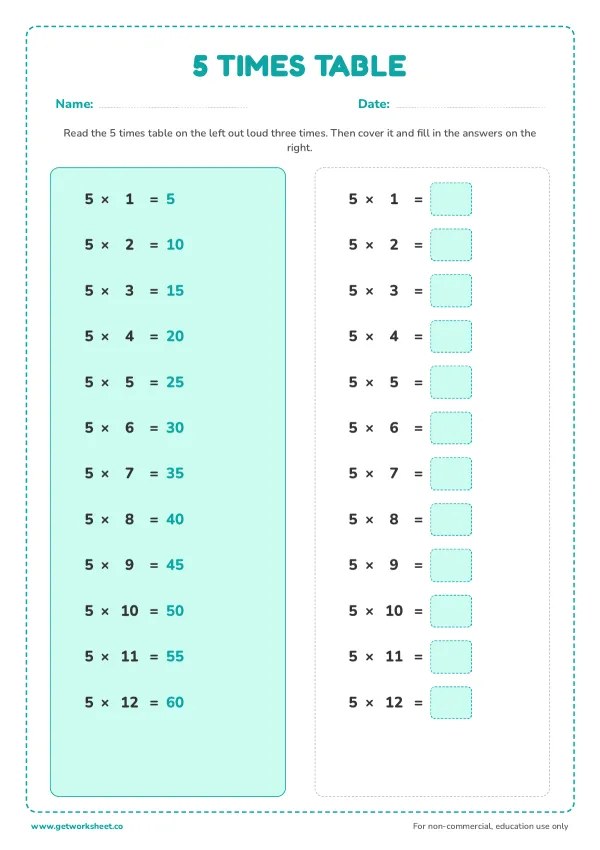
Free 5 times table worksheets
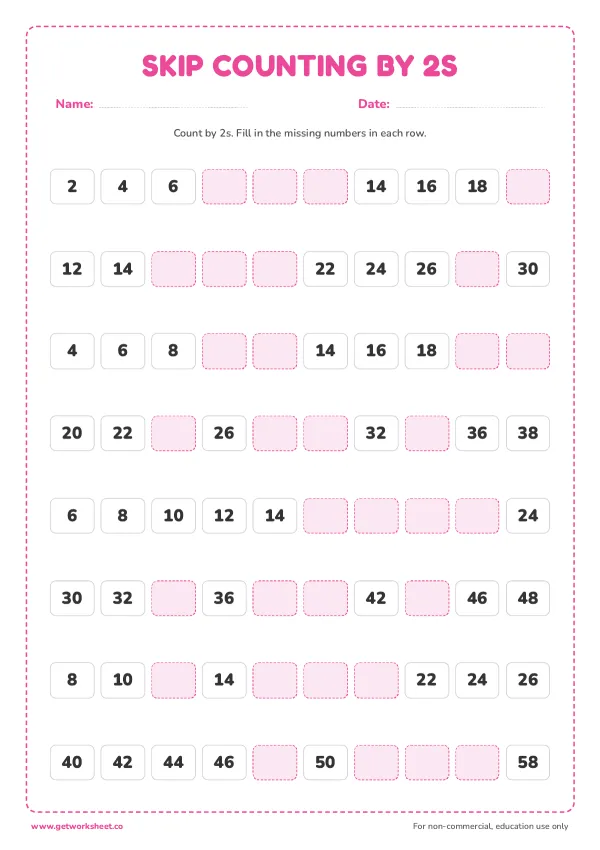
Free skip counting worksheets
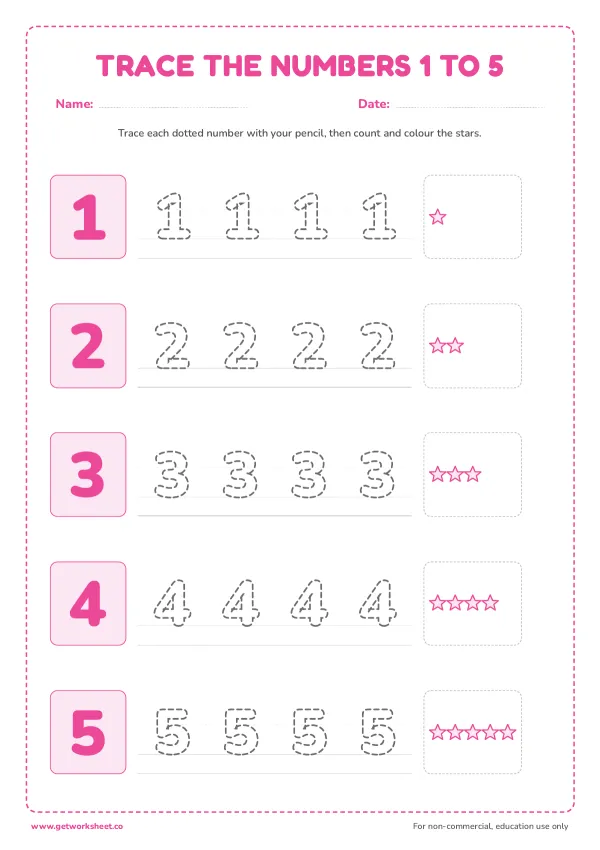
Free number tracing worksheets (1-20)
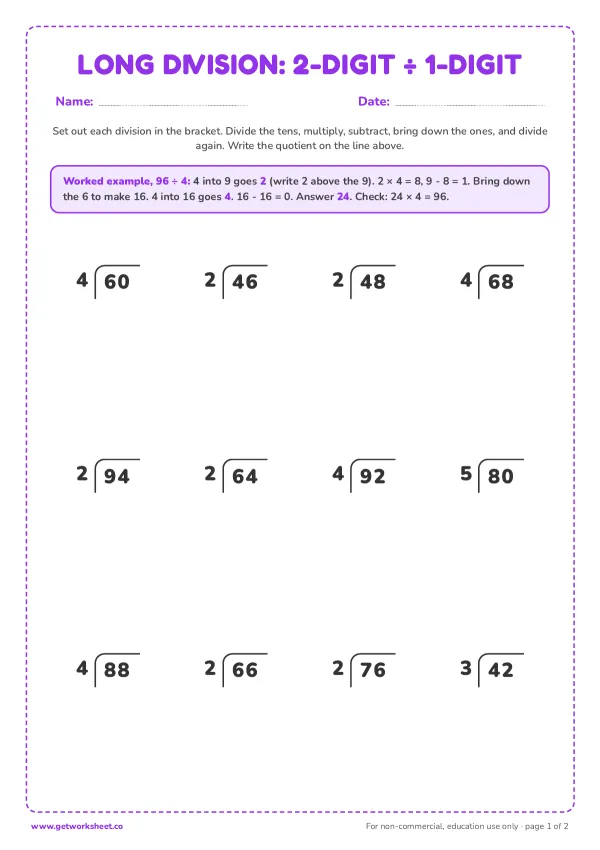
Free long division worksheets
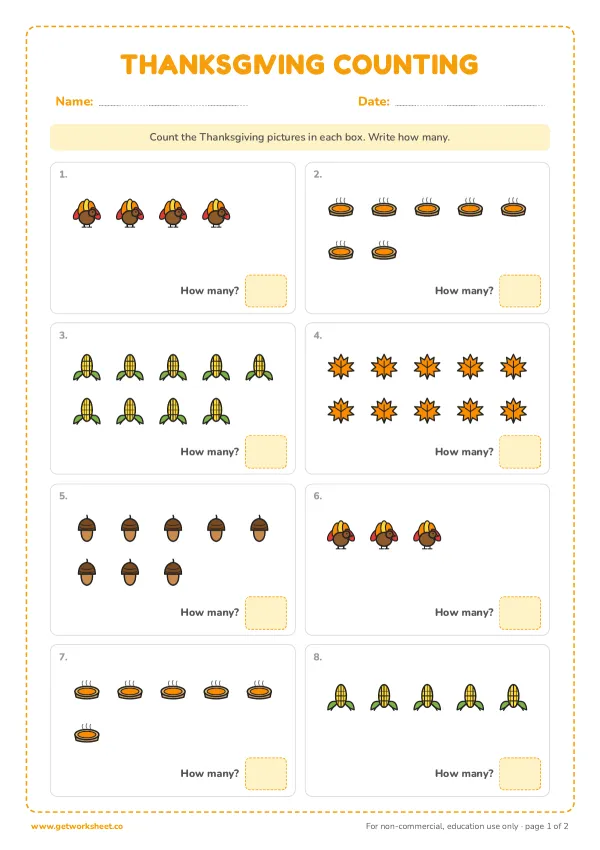
Free Thanksgiving math worksheets
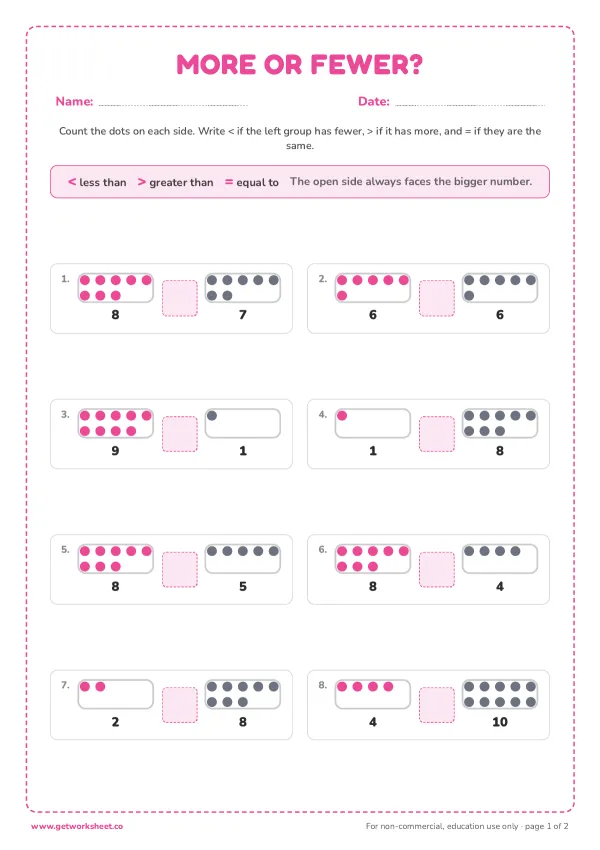
Free greater than less than worksheets
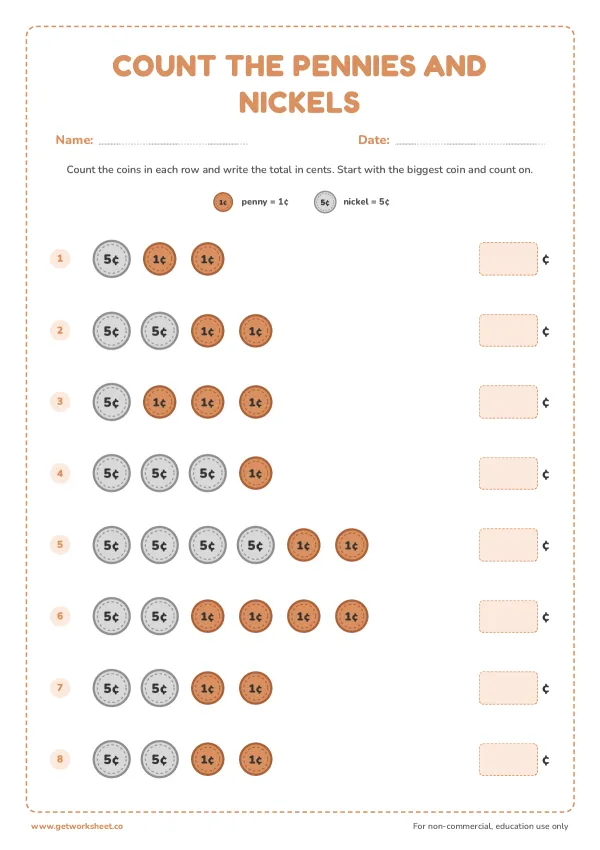
Free counting money worksheets (US coins)
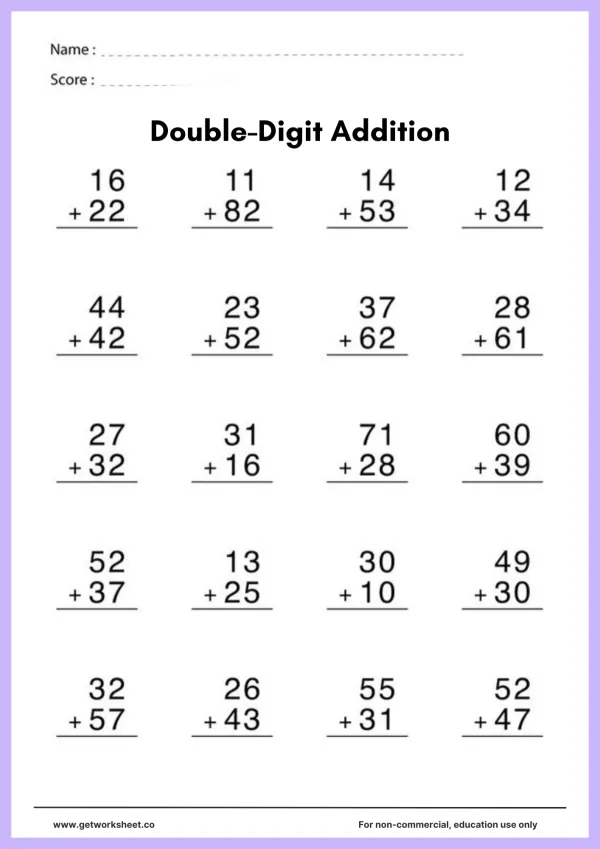
Free 2-digit addition worksheets
More worksheets
- Free math word problems worksheets (grades 1 to 5)
- Free fractions worksheets
- Free place value worksheets
- Free printable multiplication charts
- Free angles worksheets
- Free number line printables
- Free graph paper printables
- Free heart tracing worksheets
- Free Montessori math worksheets: one from every material
- Free shape tracing worksheets
- Free Halloween math worksheets
- Free number 20 tracing worksheets