Maths · Preschool–Kindergarten
Free number tracing worksheets (1-20)
Four number tracing sheets for preschool and kindergarten: trace 1 to 5 and 6 to 10 five times each, then 11 to 15 and 16 to 20 four times each, and count and color the matching stars on every row.
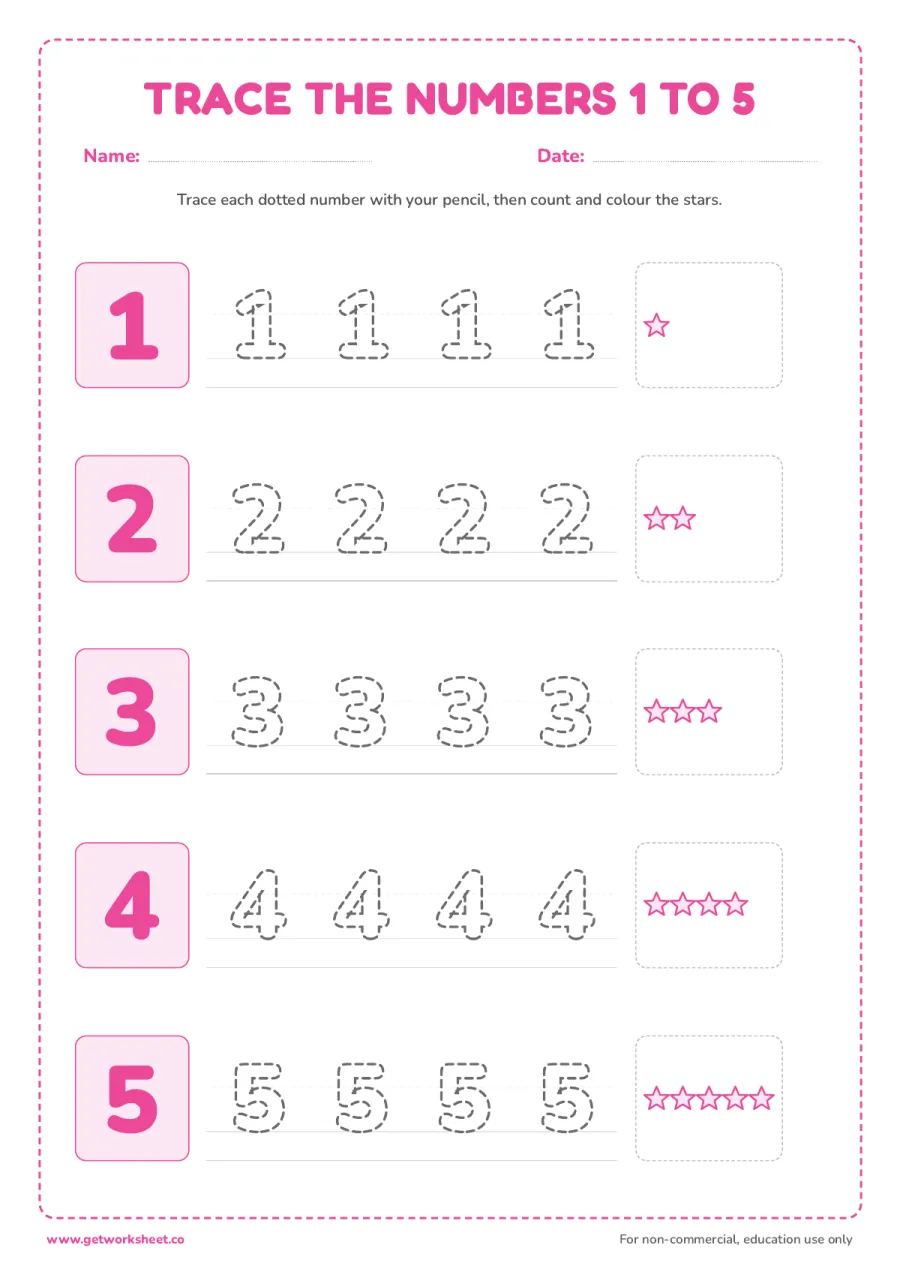
Trace numbers 1 to 5 five times, then colour the stars
Trace the dotted numerals 1, 2, 3, 4 and 5 five times each along a row, then count and colour the matching number of stars.
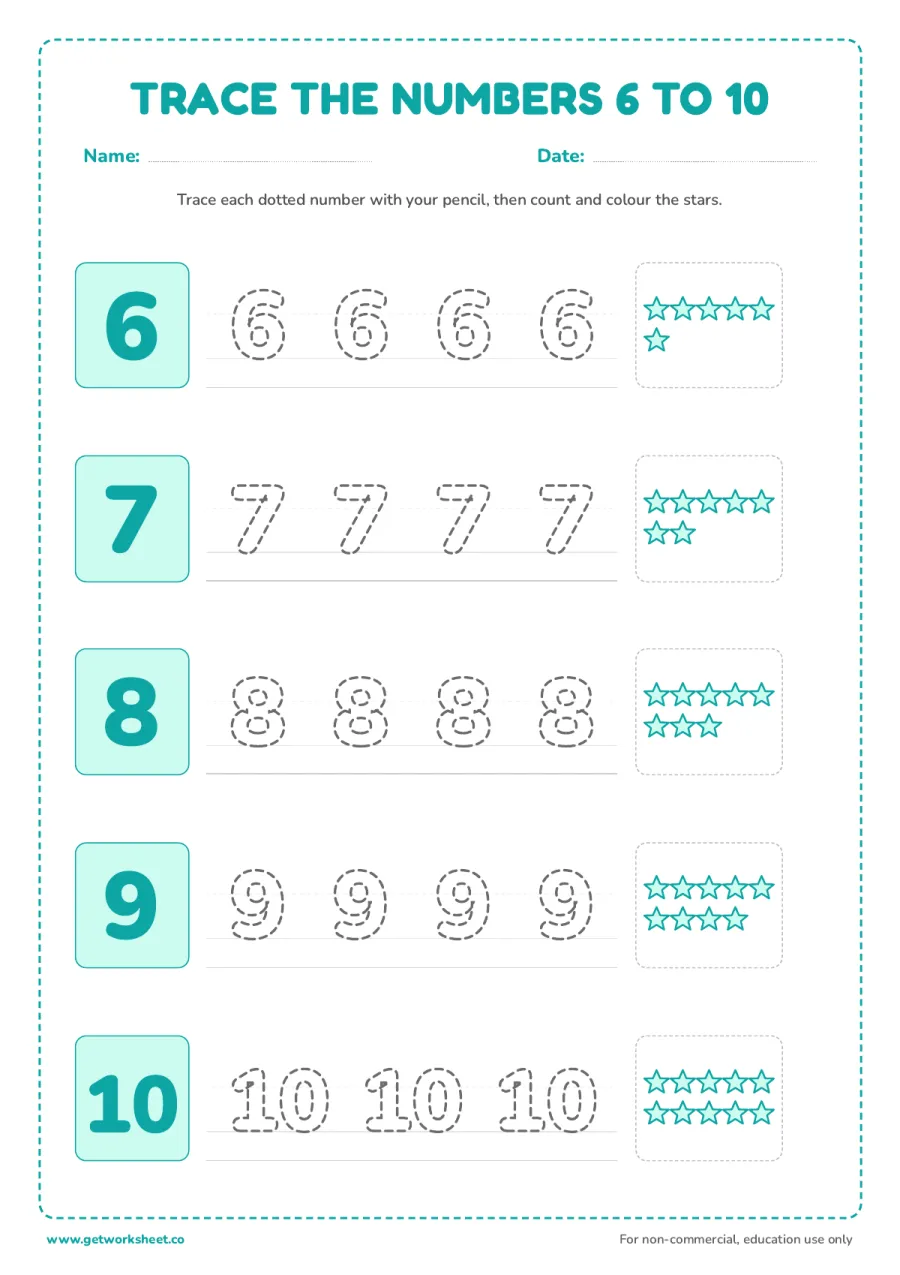
Trace numbers 6 to 10 five times, then colour the stars
Trace the dotted numerals 6, 7, 8, 9 and 10 along a row (five tries each, four for 10), then count and colour the stars.
Whole set
All 4 in one PDF
- Every sheet on this page, one file
- No ads, no countdowns, print as often as you like
- Instant download, ad-free, no account needed
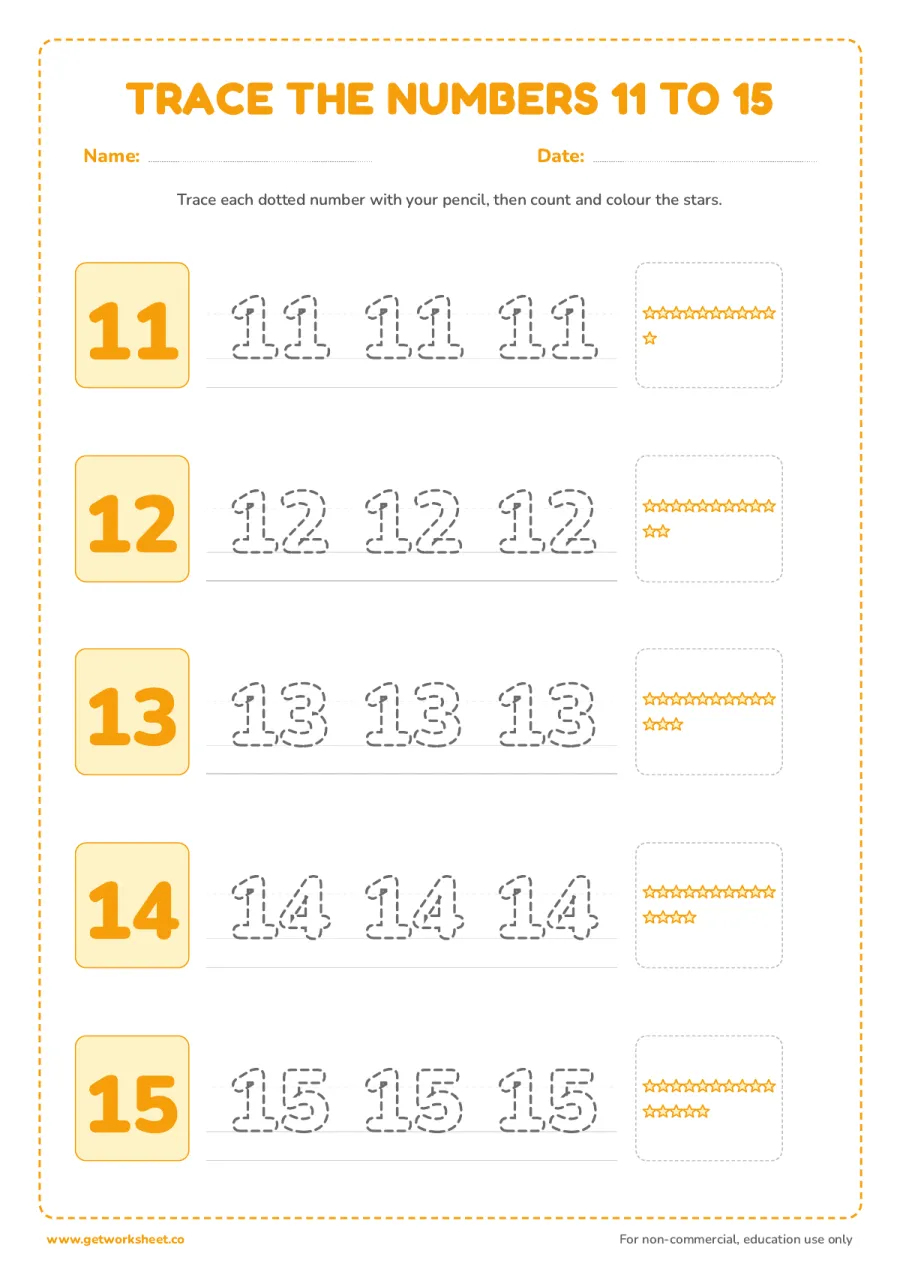
Trace numbers 11 to 15 four times, then colour the stars
Trace the dotted two-digit numerals 11, 12, 13, 14 and 15 four times each along a row, then count and colour the stars.
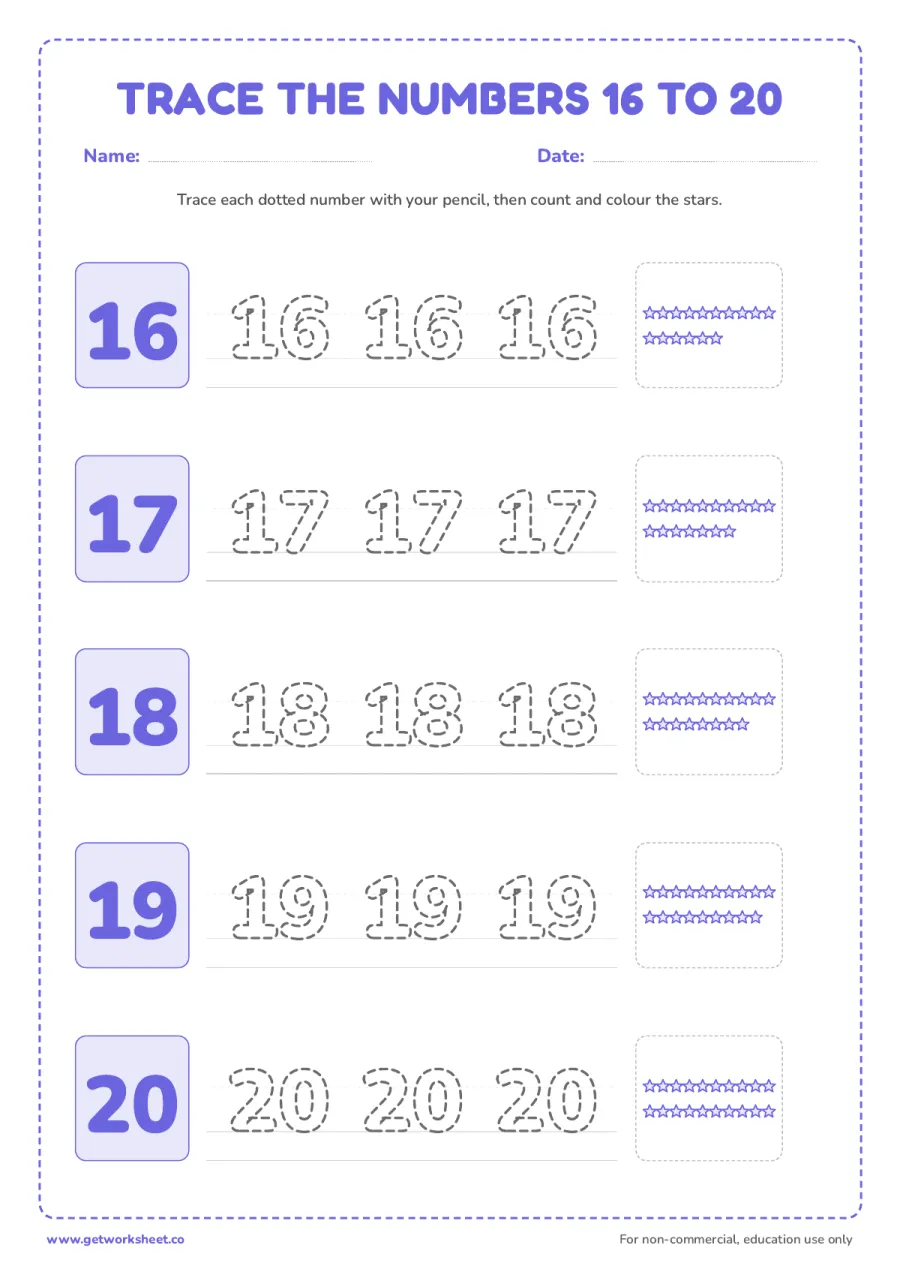
Trace numbers 16 to 20 four times, then colour the stars
Trace the dotted two-digit numerals 16, 17, 18, 19 and 20 four times each along a row, then count and colour the stars.
AI worksheet generator
Make a worksheet like this for your class
The 4 sheets above are fixed. The generator writes a new number tracing (1-20) worksheet for your grade, with the question types and count you choose, in about 20 seconds. Pick a grade to start:
What you get
- A fresh set of questions on number tracing (1-20), not a copy of the sheets above
- Multiple choice, fill in the blanks, true or false, open ended
- Answer key and print-ready PDF with Pro
Free account, 1 worksheets a week. No card.
Number tracing is the bridge between recognizing a number and being able to write it. These four worksheets take children from 1 to 20 in blocks of five. Sheet one covers 1 to 5 and sheet two covers 6 to 10: each numeral is traced five times along a dotted row (four times for 10), and then the child counts and colors the matching number of stars. Sheets three and four move to the two-digit numbers 11 to 15 and 16 to 20, traced four times each, again with stars to count and color on every row. The star box keeps every numeral tied to a quantity, so 7 is always seven things and not just a shape.
The first two sheets suit preschool children who are learning to hold a pencil and form single digits. The last two are for kindergarten children, or younger children who already write 1 to 10 confidently and are ready to write a tens digit followed by a ones digit.
What Students Will Practice
- Tracing the numerals 1 to 20 along dotted guidelines, four or five times per number, to build stroke memory
- Counting a set of stars and coloring exactly that many, so each written numeral matches a quantity
- Writing two-digit numbers left to right, tens digit first, on the 11 to 20 sheets
- Keeping numerals a consistent size along a row
- Building pencil grip, hand strength and fine motor control through short, repeated strokes
Free printable makers
Make your own number tracing (1-20) sheets
Type your own words or numbers and print in about 30 seconds. No account, no AI, answer key where it applies.
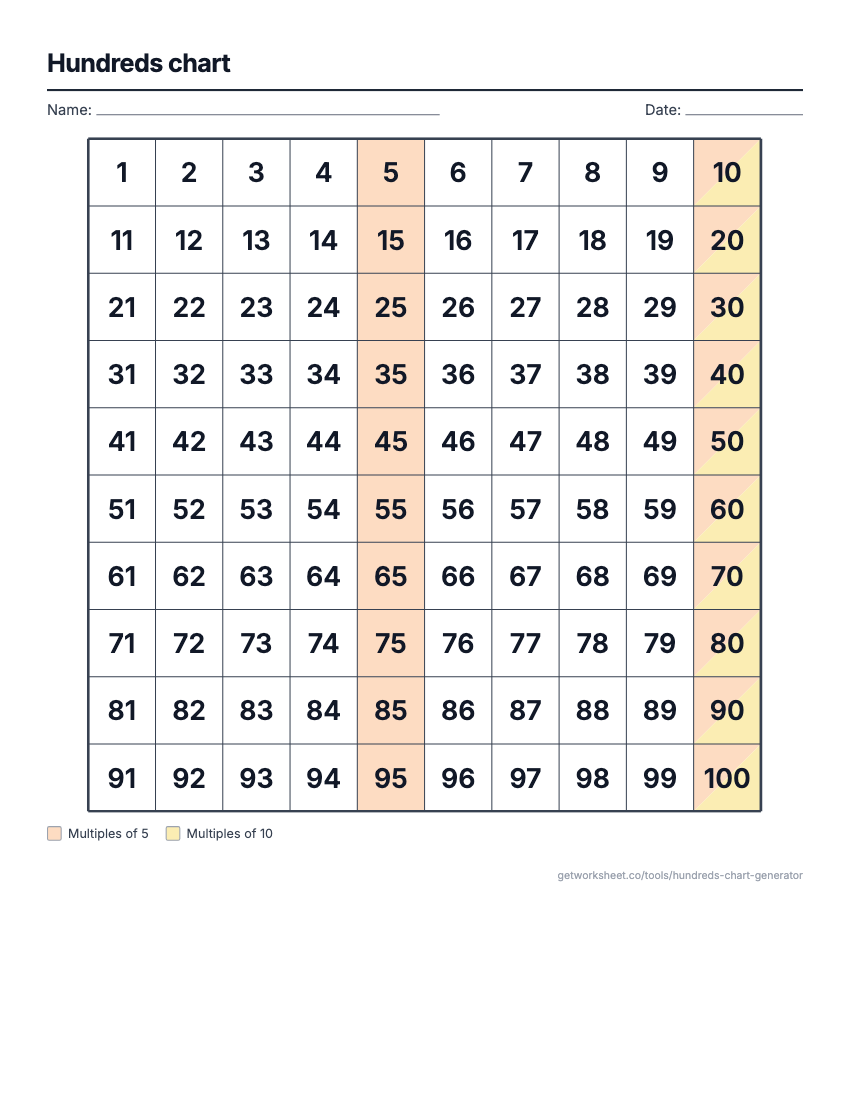 Hundreds chart generator1-100, 1-120 or 0-99, blank or missing numbers, skip-count colours, odd/even. Free to print.
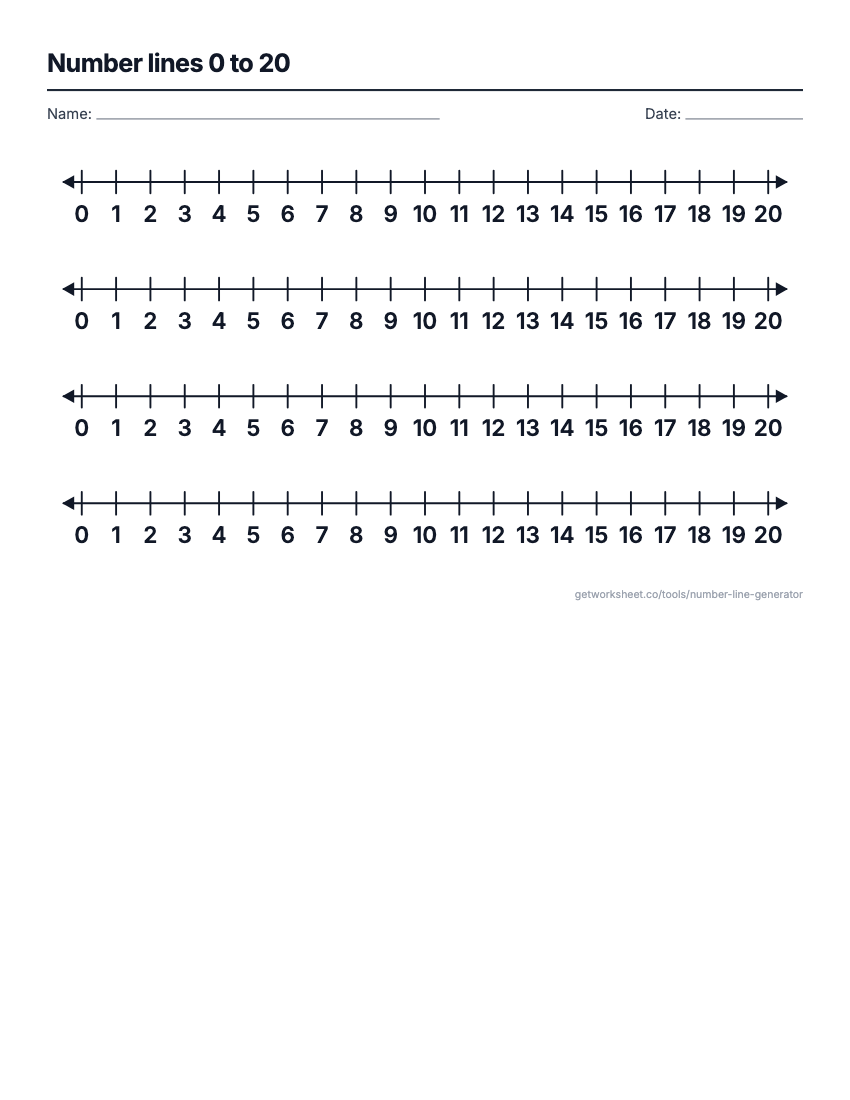 Number line generatorAny range and step, fractions and decimals, blank or missing numbers with a key. Free to print.
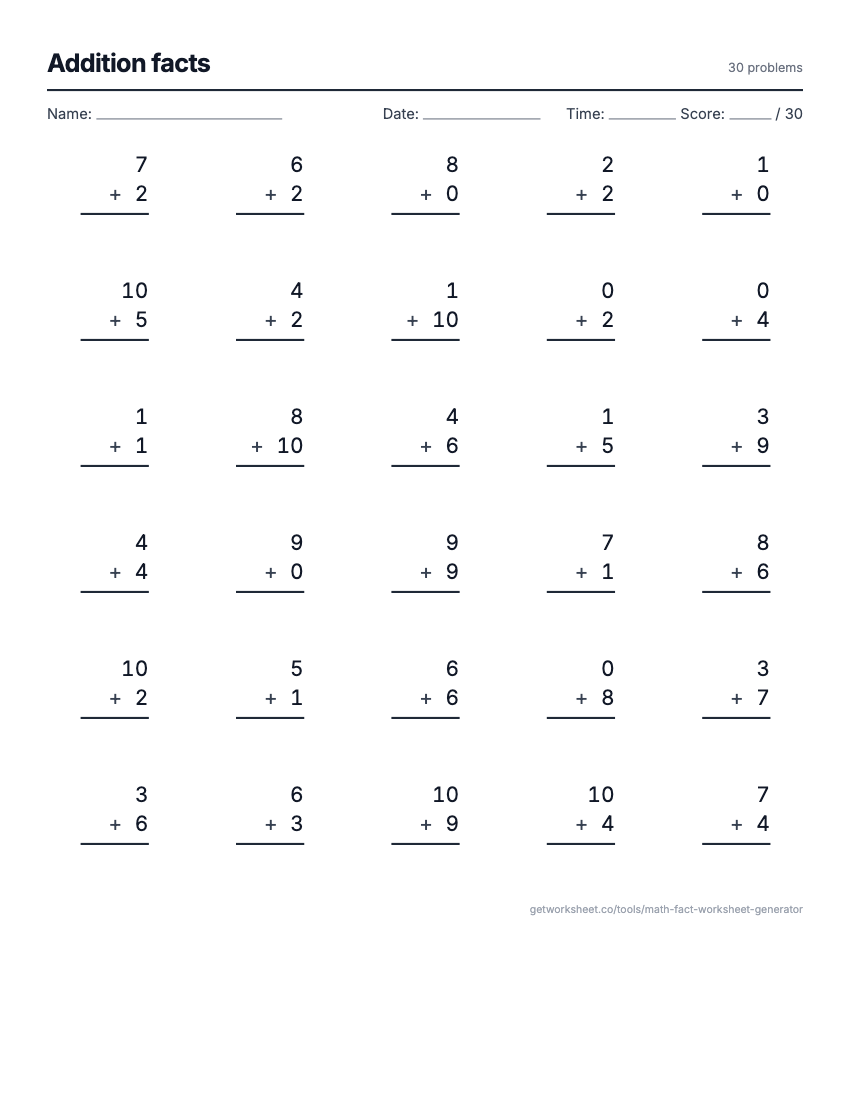 Math fact worksheet generatorAddition to division drills with an answer key. Free to print.
AI worksheet generator
Need a different number tracing (1-20) worksheet?
Generate a custom number tracing (1-20) worksheet: pick the grade, question types and count, and print it in about 20 seconds. Free accounts get 1 generation a week.
Teaching tips and common mistakes
How to Use These Worksheets
Print at 100% on A4 or US Letter. Each sheet is designed for one short session of 5 to 10 minutes.
- Start with the model number. Have your child point to the big colored number, say its name, and trace it in the air with a finger before picking up the pencil. Saying the number while writing it strengthens the link between the symbol and the sound.
- Trace, then count. After the four dotted numbers, move to the star box. Counting the stars out loud and coloring them keeps the activity concrete: the child sees that “7” means seven things, not just a shape.
- Work in order. Use sheet one (1 to 5) until the strokes are smooth before moving to 6 to 10. Only introduce 11 to 20 once your child can write 1 to 10 from memory.
- Use the blank line. The faint line under each row is for independent practice. Ask your child to write the number two or three times without the dots once tracing feels easy.
- Repeat with different tools. Slip the page into a plastic sleeve and use a dry-erase marker so the same sheet can be reused, or trace with a finger in a tray of salt first for a multi-sensory warm-up.
Common Mistakes to Watch For
- Starting at the bottom: Most numerals start at the top. If a child begins 1, 4 or 7 from the baseline, place a small dot at the top as a starting point.
- Reversals: 2, 3, 5, 6, 7 and 9 are often flipped. This is normal up to age six or seven; gently model the correct direction rather than correcting every attempt.
- Floating numbers: Numbers that drift above the baseline are a sign the child is not yet using the line as a guide. Point to the line and ask, “Where does the number sit?”
- Writing 11 to 20 backwards: Children sometimes write the ones digit first because they hear it first in words like “fourteen”. Say the number as “one ten and four” while tracing to reinforce the order.
Frequently Asked Questions
What age are these number tracing worksheets for?
Sheets one and two (numbers 1 to 10) suit children aged 3 to 5 in preschool or pre-K. Sheets three and four (11 to 20) are aimed at kindergarten, usually ages 5 to 6, or younger children who already write 1 to 10 confidently.
Should my child trace or write the numbers freehand first?
Trace first. Dotted numbers give the hand a path to follow and build the motor memory of each stroke. Once the traced numbers look smooth, move to the blank line under each row for freehand practice.
How many numbers should we practice in one sitting?
One sheet (five numbers) is enough for a single session. Young children tire quickly when tracing, and five focused numbers beat twenty rushed ones. Revisit the same sheet on a different day before moving on.
Can I reuse the worksheets?
Yes. Put the printed sheet inside a clear plastic sleeve and use a dry-erase marker, or simply print another copy. The PDFs are free for personal, classroom and homeschool use.
Why do the sheets include stars to count?
Writing a numeral only matters if the child knows what it stands for. Counting and coloring the matching number of stars connects the symbol to a quantity, which is the skill Common Core K.CC.A.3 describes as representing a number of objects with a written numeral.
More Pre-Writing Practice
Children who are still building pencil control may find shapes easier than numbers to begin with. Try our circle tracing worksheets, square tracing worksheets and triangle tracing worksheets, or the line tracing worksheets. To keep working on counting, see the count and color worksheets, missing number worksheets and our printable number flashcards.
One page per number
Every number from 1 to 20 also has its own set of five worksheets: a model digit with a how-to-write cue and rows to trace, the number word, a ten frame, a counting sheet and a page to write it without help. Go straight to the number your child is on: 1, 2, 3, 4, 5, 6, 7, 8, 9, 10, 11, 12, 13, 14, 15, 16, 17, 18, 19, 20. Come back to the four sheets on this page when you want several numbers on one sheet for revision.
Free library
Related collections
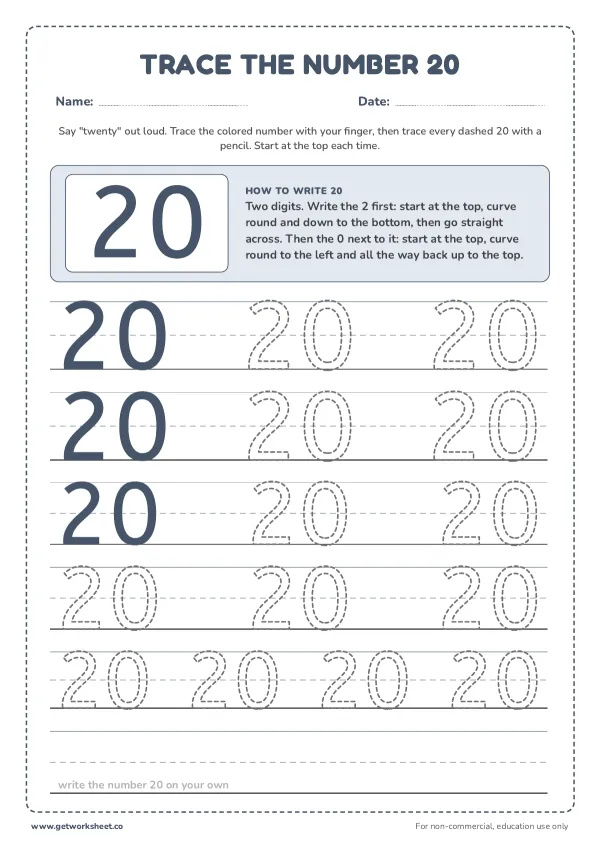
Free number 20 tracing worksheets
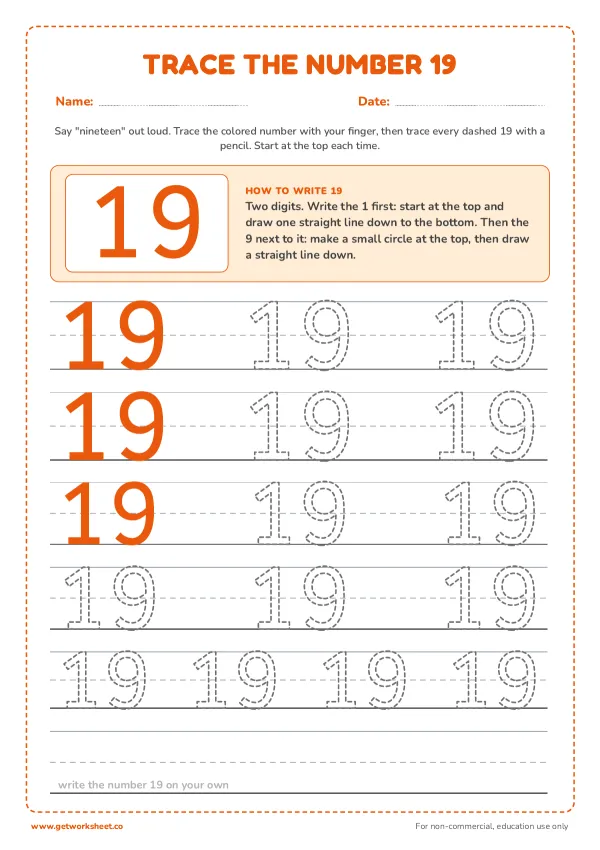
Free number 19 tracing worksheets
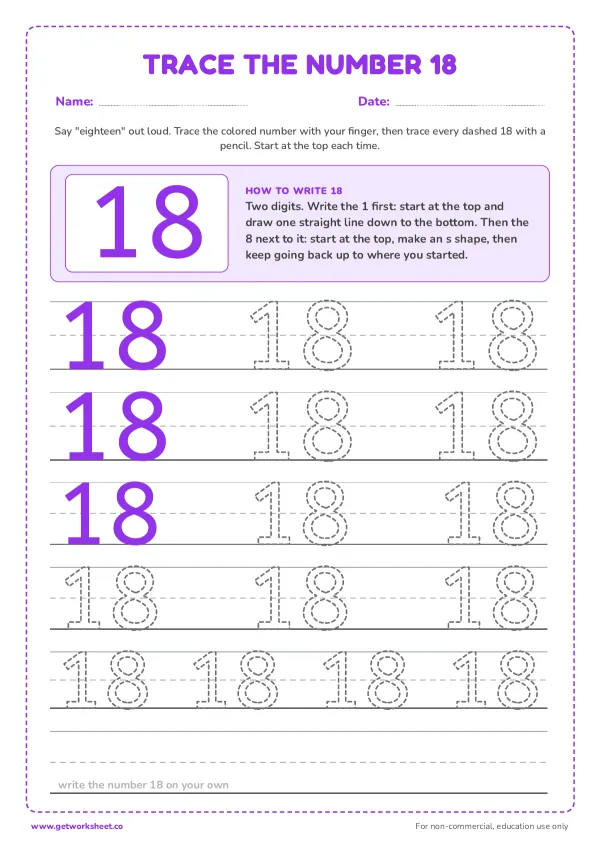
Free number 18 tracing worksheets
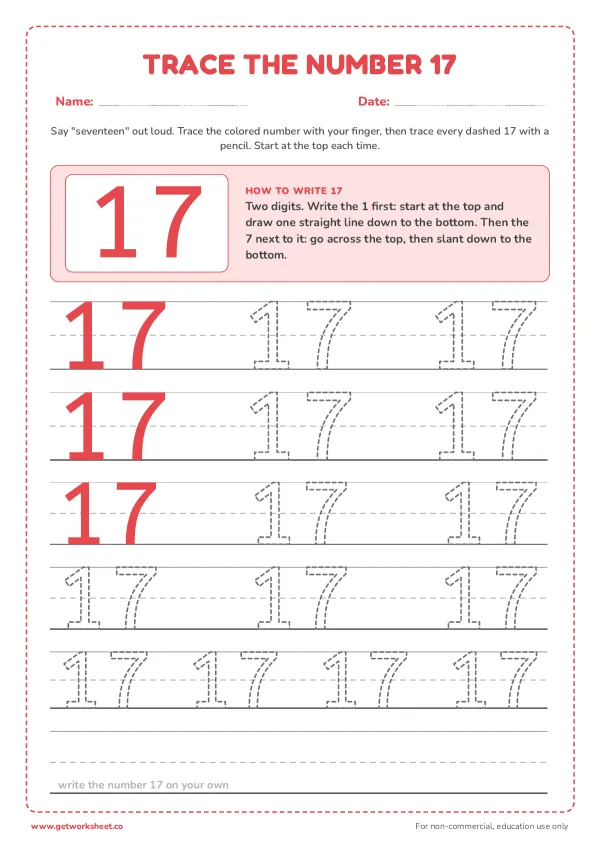
Free number 17 tracing worksheets
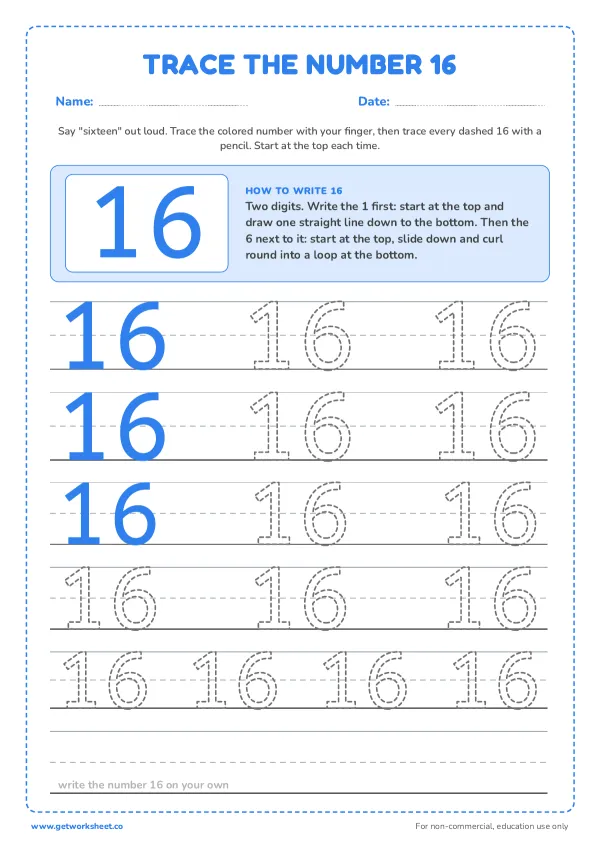
Free number 16 tracing worksheets
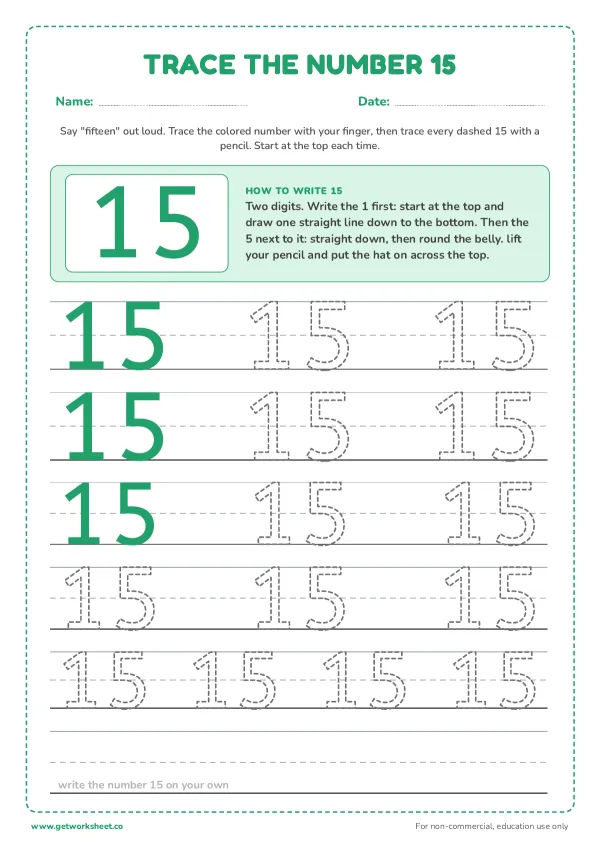
Free number 15 tracing worksheets
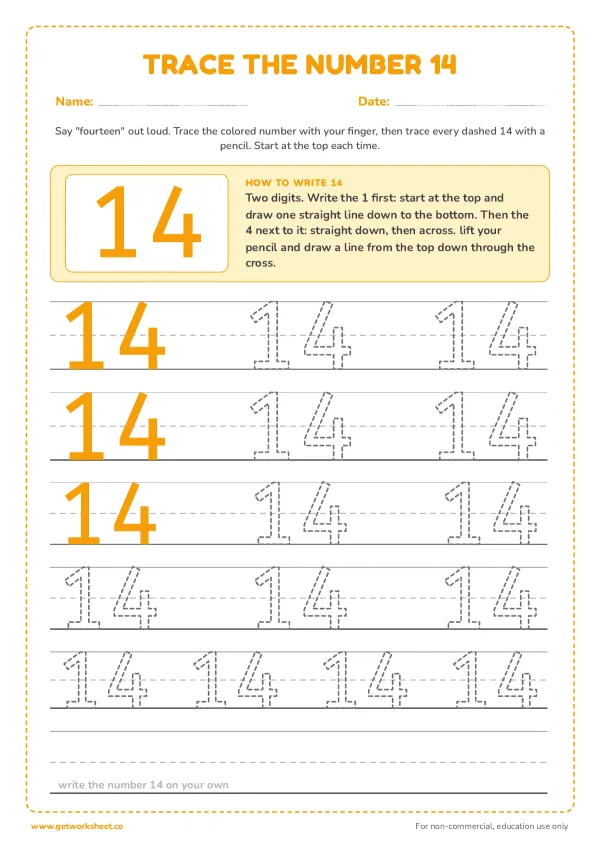
Free number 14 tracing worksheets
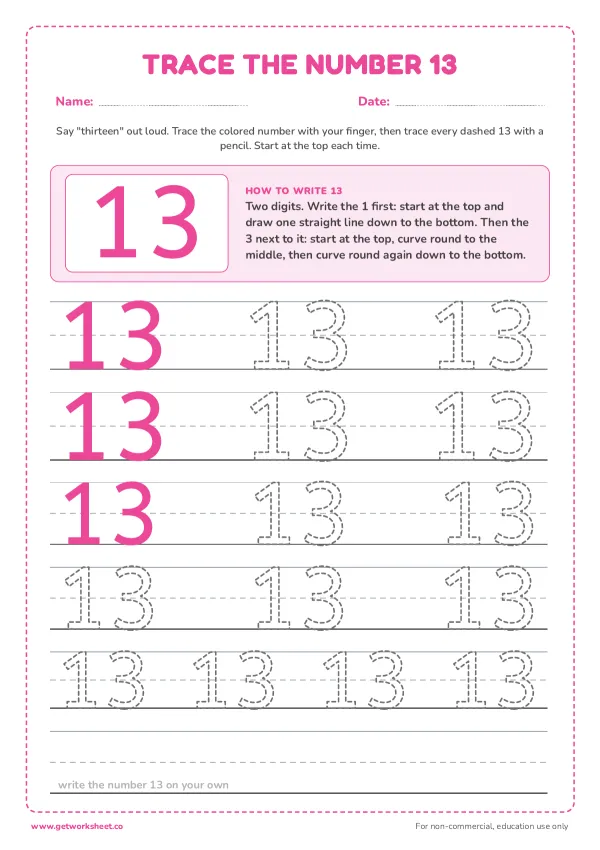
Free number 13 tracing worksheets
More worksheets
- Free number 12 tracing worksheets
- Free number 11 tracing worksheets
- Free number 10 tracing worksheets
- Free number 9 tracing worksheets
- Free number 8 tracing worksheets
- Free number 7 tracing worksheets
- Free number 6 tracing worksheets
- Free number 5 tracing worksheets
- Free number 4 tracing worksheets
- Free number 3 tracing worksheets
- Free number 2 tracing worksheets
- Free number 1 tracing worksheets