Free printable maker
Name Tracing Worksheet Generator
Type a name, print a tracing sheet. Dashed, dotted or grey letters on handwriting lines, a blank row to write on after each traced row, and one page per child. Free, no account.
getworksheet.co/tools/name-tracing-generator
Using the sheets
Getting the most from a name tracing worksheet
A child's own name is the first word most of them want to write, which is why name tracing is the usual starting point for handwriting in pre-K and kindergarten. The point of the sheet is not neat copies but the sequence of strokes: where each letter starts, which direction the pencil moves, and where the letter sits between the lines. Watch the first row rather than the last one.
Start with grey solid letters if the child is three or four or has weak pencil control. A wide grey letter is a target to stay inside, so the child succeeds early. Move to dashed outlines once they can keep a line roughly on a path; the dashes break the letter into short strokes and show direction. Dotted letters are the lightest hint and suit children who know the shapes but still want a guide. Turn on the blank row after each traced row as soon as tracing is easy: trace once, then write once from memory, and compare.
Keep the guide lines on. The dotted midline tells the child how tall the small letters are (a, e, o reach it; b, d, l pass it), and the baseline is the one line children most often ignore. Three large rows are more useful than six small ones for a four year old; by the end of kindergarten most children manage the medium size with five or six rows.
Three ways teachers use this generator beyond names: a sight-word sheet (type eight words, one per line, with a blank row after each), a spelling-list sheet for the week in the small size, and a sentence sheet using the sentence line (“My name is {name}.”) so the name appears inside a short sentence with capital, spaces and a full stop. Switching the letters to UPPERCASE gives a capital-letter practice page from the same list.
For a class set, type the whole register (ten names per batch), print once, and you have one page per child with their name on it; children recognise their own sheet before they can read anyone else's. Print on Letter or A4, or save the PDF to send home as homework. Laminated sheets with a dry-erase marker survive a term of daily tracing.
If you want ready-made pages instead, the name tracing worksheets and handwriting worksheets collections cover letter formation and lined practice, and the sight words worksheets pick up where name writing leaves off.
How it works
How to make a name tracing worksheet
Three steps from a list of names to a stack of printed pages.
- 1
Type the names
One per line, up to 10. Keep the capitals as typed, or switch everything to Title case, UPPERCASE or lowercase.
- 2
Pick the style
Dashed outline, dotted or grey solid letters; large, medium or small; 1 to 6 traced rows, with a blank writing row after each if you want trace-then-write.
- 3
Print
Letter or A4. Each name prints on its own page. Save as PDF from the print dialog to send home or reuse.
Good to know
Questions, answered
Yes. Type the names, choose the letter style and print or save as a PDF. There is no account, no watermark and no limit on how many sheets you make. The letters are drawn in your browser; nothing is uploaded.
Up to 10 names or words at a time, one per line, each on its own page. For a whole class, make a second batch and print again. Each page holds up to 6 traced rows per name, with an optional blank writing row after each one.
US Letter (8.5 × 11 in) and A4. Pick the size in the builder before you print and the page is laid out for it. Use "Save as PDF" in the print dialog to keep a copy or send it home.
Dashed outlines are the classic tracing style and suit most 3 to 5 year olds: the child traces the dashes with a pencil or marker. Dotted letters are lighter and work once a child knows the shapes. Grey solid letters are easiest to trace for the youngest children or for pupils with fine-motor difficulties, because there is a wide target to stay inside. Fewer rows at a larger size beats more rows at a small size.
Andika, a typeface designed for children learning to read and write. It has the simple single-storey a and g, a straight y and a clear difference between capital I, lowercase l and the digit 1, so the shapes a child traces match the shapes they are taught to write.
More free printable makers
More sheets you can make right now
Each of these builds the printable in your browser: no account, no AI, no weekly limit, an answer key where one applies.
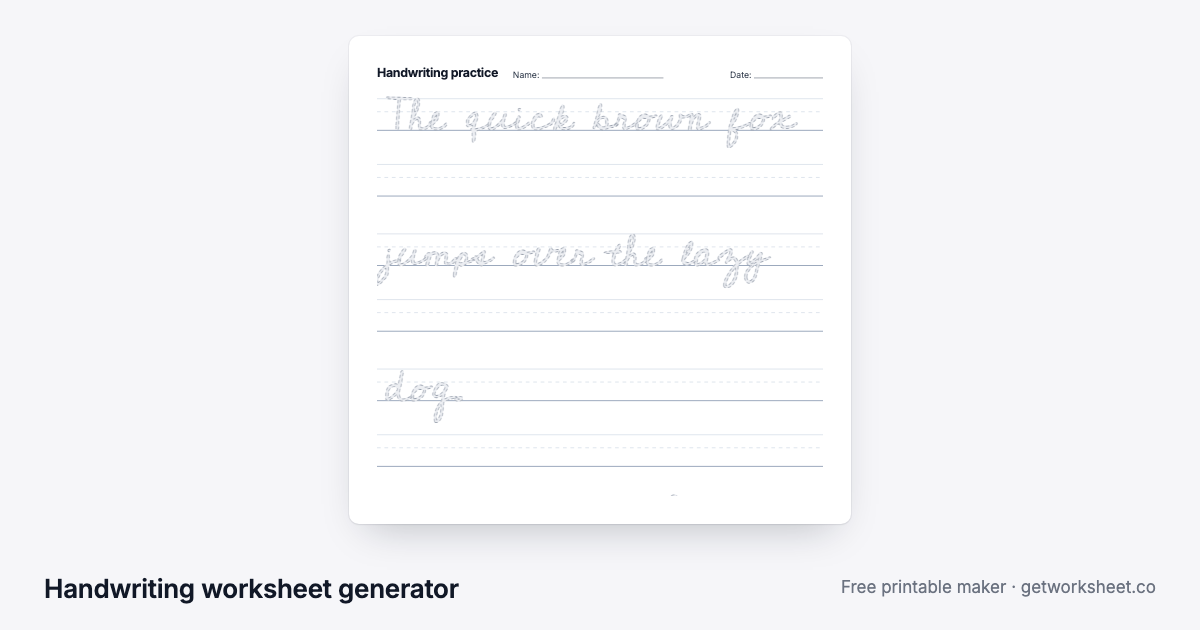 Handwriting worksheet generatorYour sentences as print or cursive tracing rows on guide lines. Free to print.
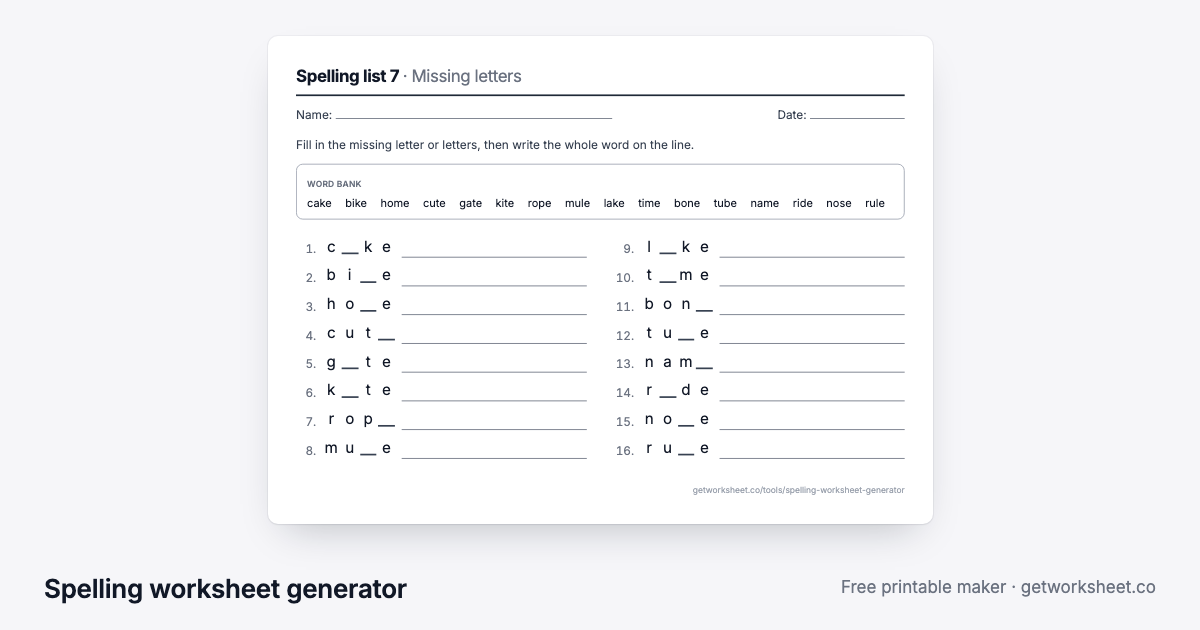 Spelling worksheet generatorTest sheet, scramble, missing letters, ABC order and key from one word list. Free to print.
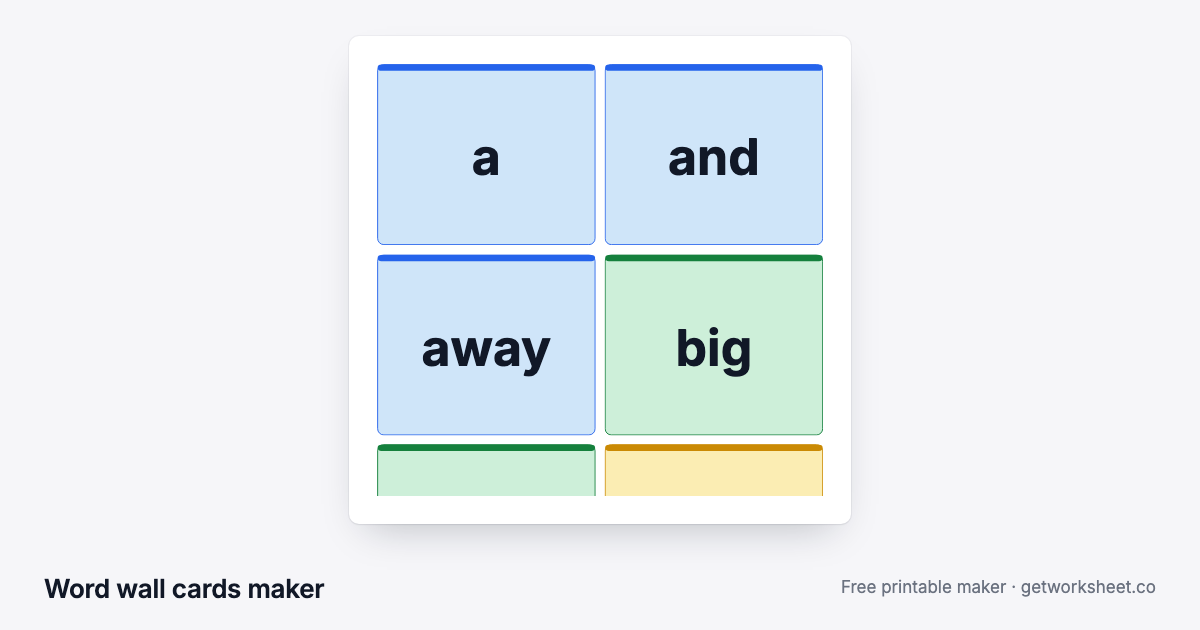 Word wall cards makerDolch, Fry or your own words as big-print cards, colour-coded, with A-Z headers. Free to print.
- Worksheet generatorCustom worksheets for any topic, grade and question type.
- Lesson plan generatorStandards-aligned plans with objectives, activities and assessment.
- Report card commentsPersonalised, professional comments for every student.
- Rubric makerClear criteria and scoring levels for any assignment.
- IEP goal generatorMeasurable goals in minutes, then probe worksheets for each one.
- IEP worksheet generatorPaste a goal, get practice probes and a progress record sheet.