Greater Than Less Than Worksheets
Free greater than less than worksheets with answer keys. Practice comparing numbers using >, <, and = symbols — printable PDFs for grades K-3.
Comparing numbers is one of the first real math skills kids learn — figuring out which of two numbers is bigger, smaller, or if they're equal. These worksheets help students master the greater than (>), less than (<), and equal to (=) symbols through visual comparisons, number line activities, and increasingly challenging number pairs. The classic "alligator mouth" trick works great: the mouth always opens toward the bigger number.
What Students Will Practice
- Comparing single-digit numbers using >, <, and = (e.g., 7 > 3, 2 < 9, 5 = 5)
- Comparing two-digit and three-digit numbers by examining place value (e.g., 47 vs. 53 — compare the tens digit first)
- Using number lines to determine which number is greater (numbers farther right are always larger)
- Comparing groups of objects by counting and then using the correct symbol
- Ordering three or more numbers from least to greatest and greatest to least
- Understanding that the symbols have a direction — the pointed end faces the smaller number, the open end faces the larger number
Number comparison is a foundational math standard from kindergarten through 3rd grade. It builds the number sense required for estimation, rounding, ordering data, and understanding place value deeply.

Greater Than Less Than Worksheet
Free printable greater than less than worksheets with answer keys. Perfect for extra practice at home or in the classroom to boost math skills.
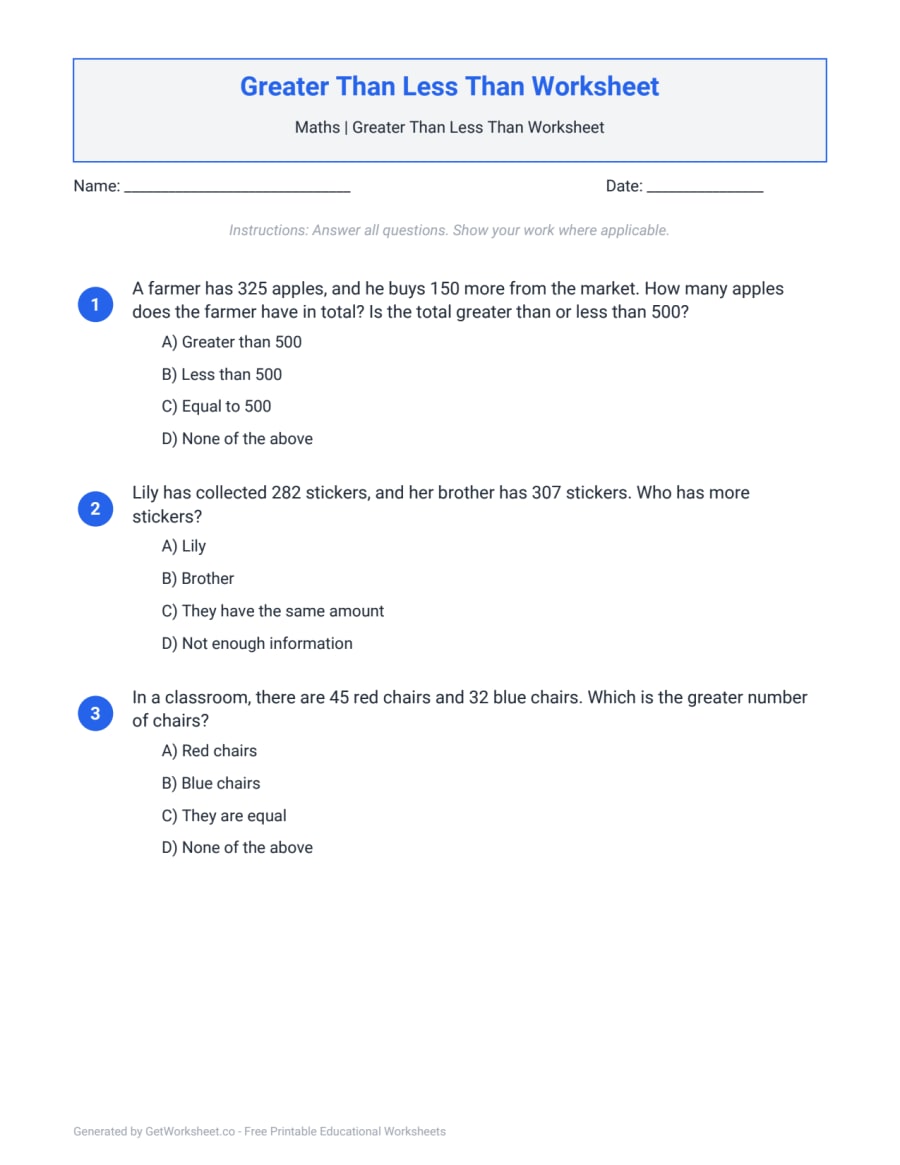
Greater Than Less Than Worksheet
Free printable greater than less than worksheets with answer keys. Perfect for homework, extra practice, or enhancing math skills at home.
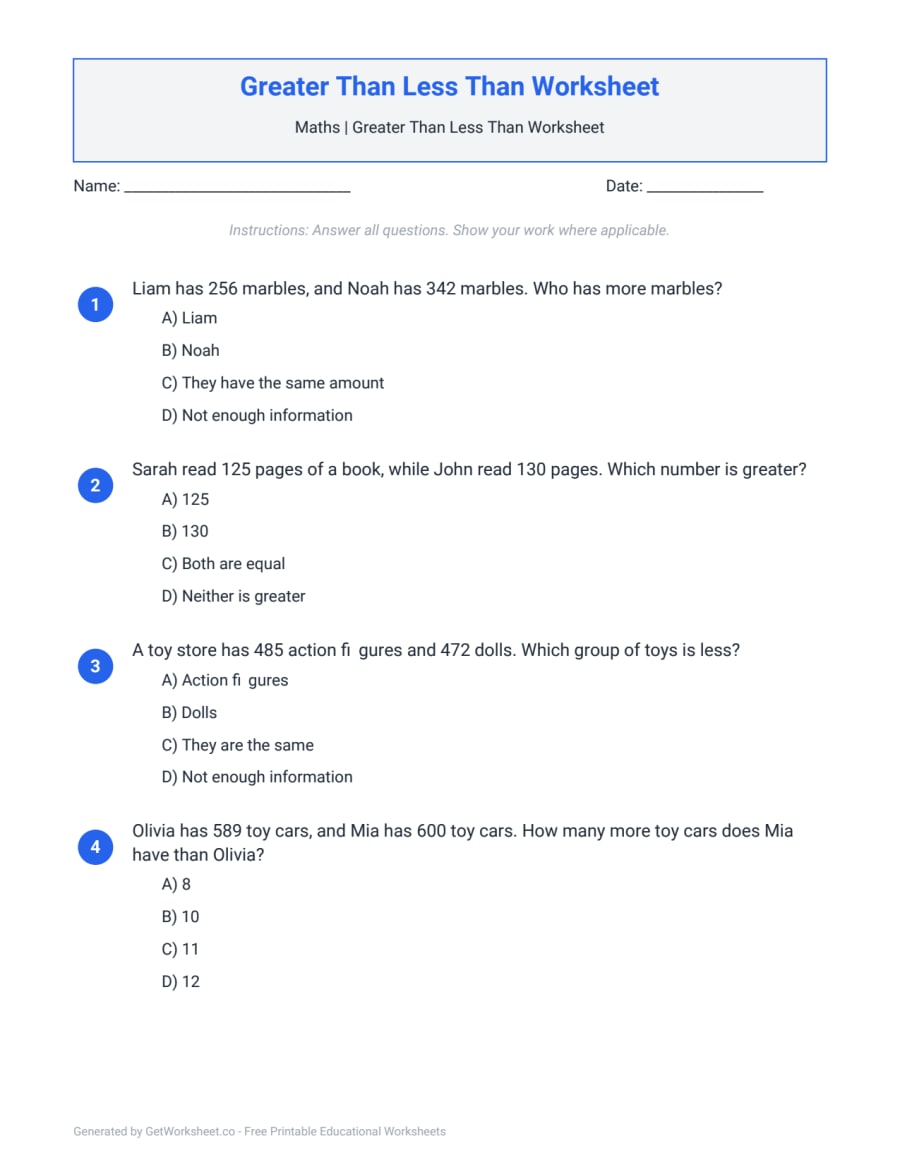
Greater Than Less Than Worksheet
Free printable greater than less than worksheets with answer keys. Perfect for homework, extra practice, or reinforcing math skills at home.
How to Use These Worksheets
Start concrete, then move to abstract — that's the key sequence for comparison skills.
- For younger students (K-1), use the picture-based worksheets first — comparing groups of stars, apples, or blocks. Count each group, write the number, then place the symbol. This connects the abstract symbol to a concrete visual difference they can see and count.
- Teach the "alligator mouth" memory trick: the alligator always eats the bigger number. Draw a little alligator around the > or < symbol. Once students visualize this, they rarely put the symbol backwards. It's simple and it works.
- For two-digit and three-digit comparisons, teach students to compare from left to right, starting with the largest place value. In 472 vs. 469, compare the hundreds first (both 4), then the tens (7 vs. 6 — 7 wins). You don't even need to look at the ones digit. This place-value comparison strategy is essential for larger numbers.
- Mix in equals signs regularly. Students sometimes forget that = is an option and try to force every pair into > or <. Include problems like 34 vs. 34, or 2+3 vs. 5, where the correct answer is =.
Common Mistakes to Watch For
- Reversing the symbol direction: Writing 3 > 7 instead of 3 < 7. The alligator trick fixes this — the open end always faces the bigger number. If your child consistently reverses symbols, spend extra time on the visual mnemonic.
- Comparing digits instead of the whole number: A student might say 9 > 12 because 9 is bigger than 1 or 2. They're comparing individual digits rather than the complete numbers. Use a number line to show that 12 is farther along than 9, so 12 is greater.
- Ignoring place value in multi-digit numbers: Comparing 308 vs. 29, a student might say 29 is bigger because the digits 2 and 9 add up to more. Reinforce: 308 has a 3 in the hundreds place, and 29 has a 0 in the hundreds place. Always start with the leftmost digit.
- Thinking bigger digits always mean bigger numbers: Students may believe 89 > 102 because 8 and 9 are bigger digits. The number of digits matters — a three-digit number is always greater than a two-digit number. Teach this as a quick first check.
Frequently Asked Questions
When should my child learn greater than and less than?
Basic comparison (which group has more?) starts in pre-K and kindergarten. The formal symbols (>, <, =) are introduced in 1st grade. Comparing multi-digit numbers using place value is a 2nd-3rd grade skill. By end of 3rd grade, students should compare numbers up to 1,000 fluently.
My child understands "bigger" and "smaller" but can't remember the symbols. What helps?
The alligator (or crocodile, or Pac-Man) trick is the most effective memory aid. The open side of the symbol always faces the larger number. You can also teach it as an arrow: the symbol points at the smaller number. Pick one metaphor and use it consistently.
Should my child use a number line for comparisons?
Yes, especially at first. A number line makes comparison physical — the number farther to the right is always greater. Once your child internalizes this left-to-right ordering, they can drop the number line and compare mentally. But the number line is an excellent tool for building intuition.
How do these worksheets prepare my child for harder math?
Comparison is everywhere in math: ordering fractions, understanding negative numbers, solving inequalities in algebra, interpreting data in graphs. The underlying skill — determining relative size — is used in virtually every math topic from 4th grade onward. Strong comparison skills now prevent confusion later.
After mastering whole number comparison, students progress to comparing fractions, comparing decimals, and eventually working with inequalities on number lines — all of which build directly on the > and < skills practiced here.