Maths · Kindergarten to Grade 3
Free Montessori geometric solids worksheets
Seven free printable worksheets on the ten Montessori geometric solids: sphere, ovoid, ellipsoid, cube, cuboid, cylinder, cone, triangular prism, square-based pyramid and triangular-based pyramid. Covers the vocabulary, counting flat faces, curved surfaces, edges and vertices, sorting by roll, slide and stack, the flat shapes each solid is built from, everyday objects and net matching, with answer keys.
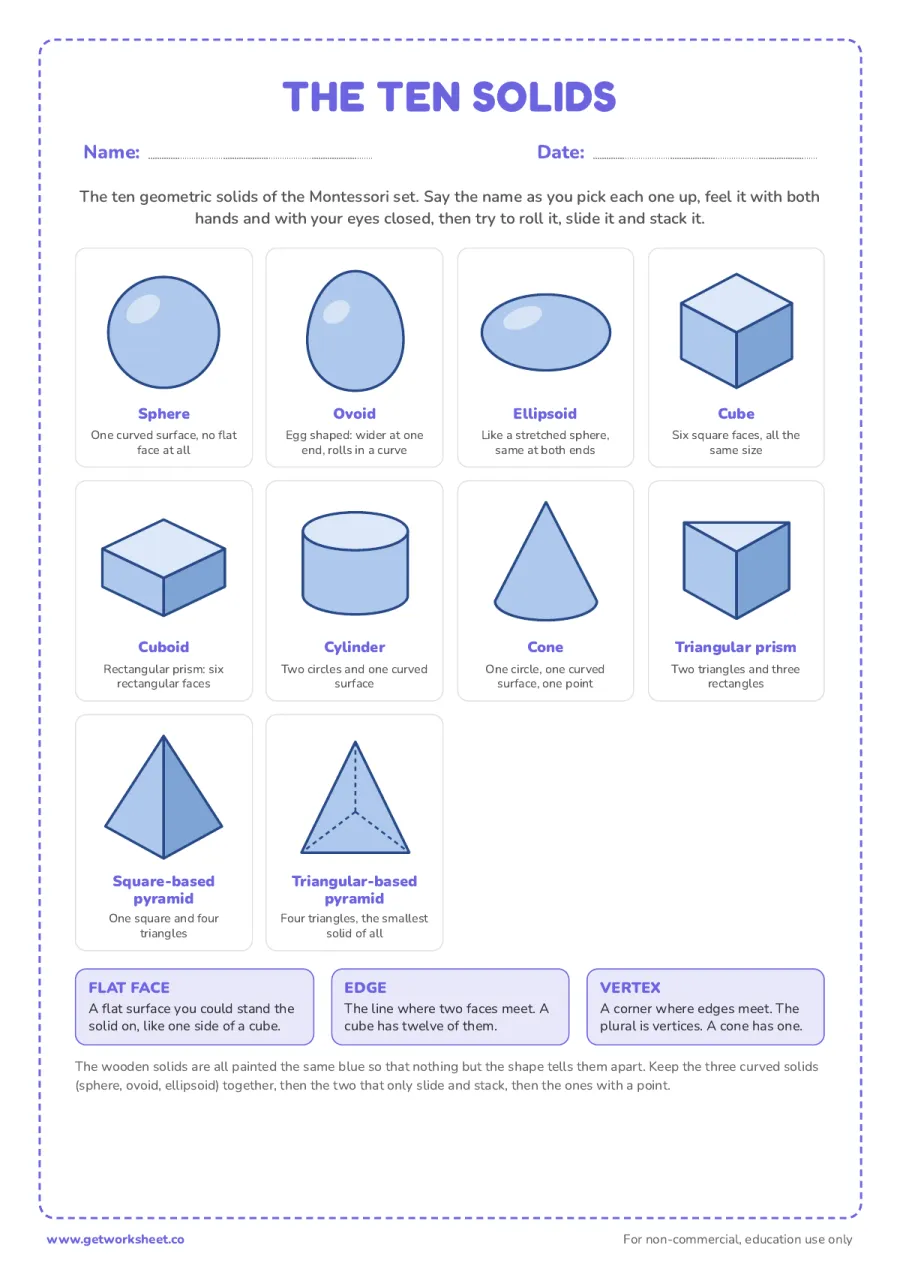
The ten Montessori geometric solids
Reference page: sphere, ovoid, ellipsoid, cube, cuboid, cylinder, cone, triangular prism, square-based pyramid and triangular-based pyramid drawn and named, with the meaning of face, edge and vertex. Free printable PDF.
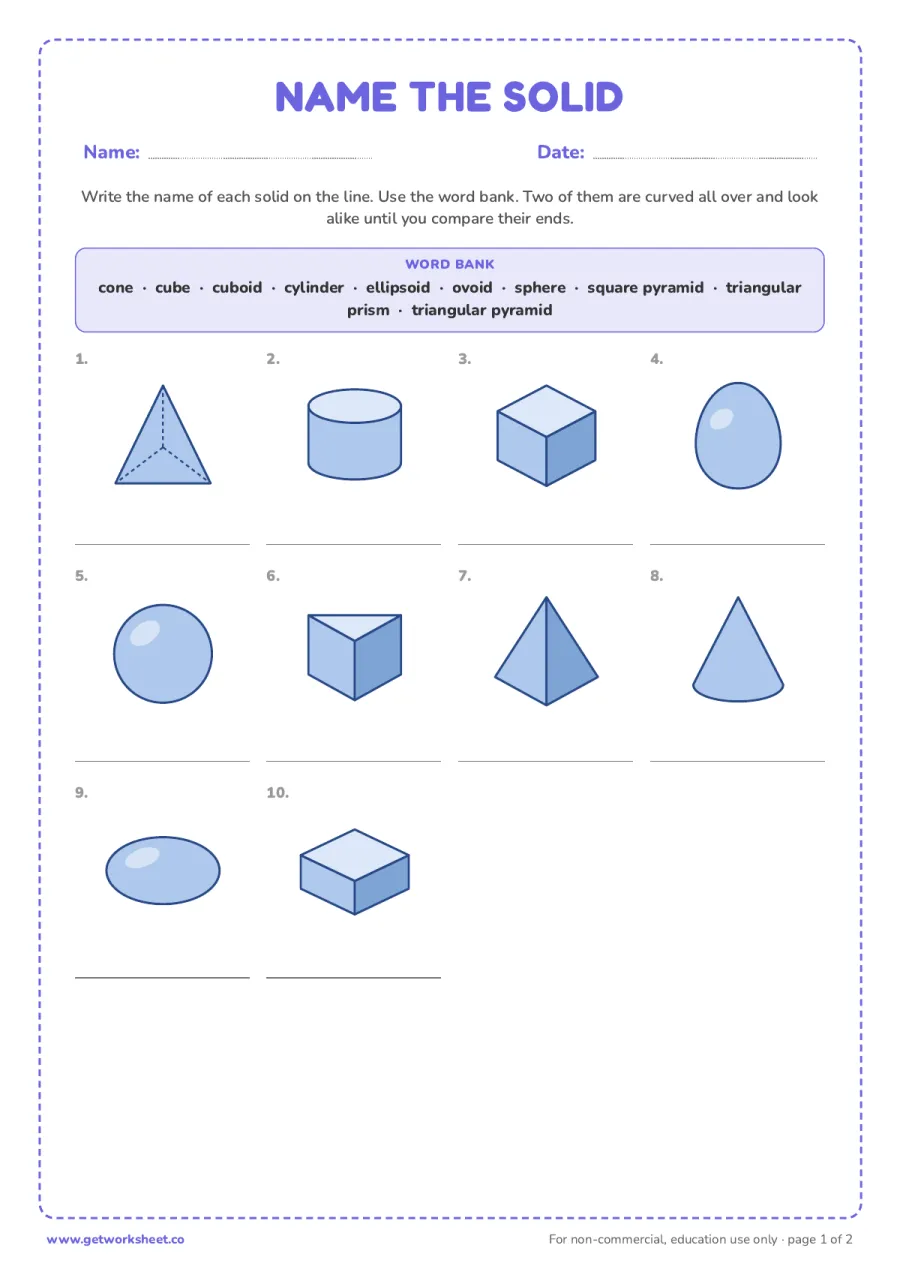
Name the solid (answer key)
Ten drawings of the Montessori solids in mixed order with a word bank: write the name of each one. Answer key on page 2. Free printable PDF.
Complete pack
All 7 + 5 bonus, one PDF
- The 7 free sheets on this page
- 5 bonus sheets you will not find anywhere else
- Instant download, ad-free, no account needed
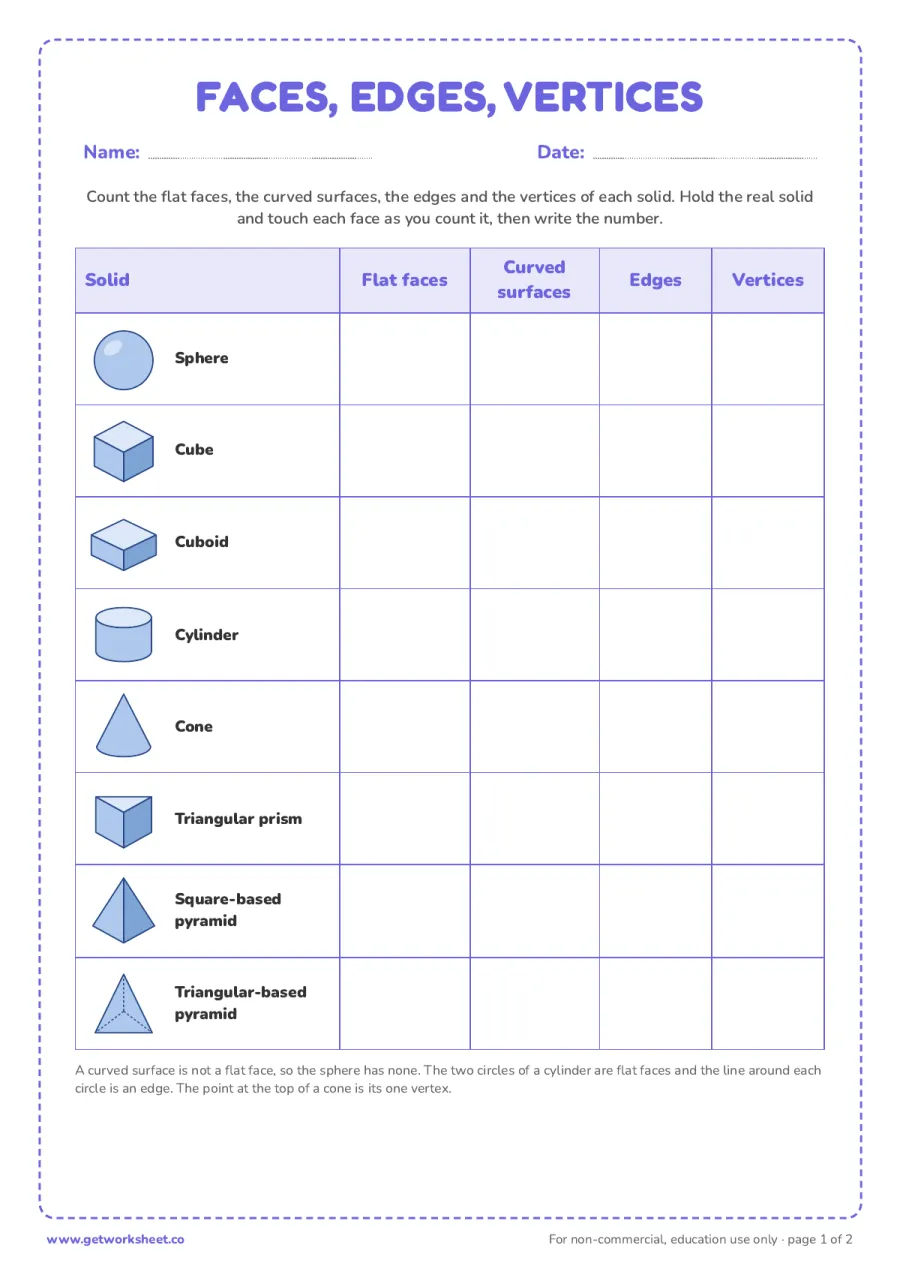
Faces, edges and vertices table (answer key)
Table for eight solids: count the flat faces, curved surfaces, edges and vertices of the sphere, cube, cuboid, cylinder, cone, triangular prism and both pyramids. Answer key on page 2. Free printable PDF.
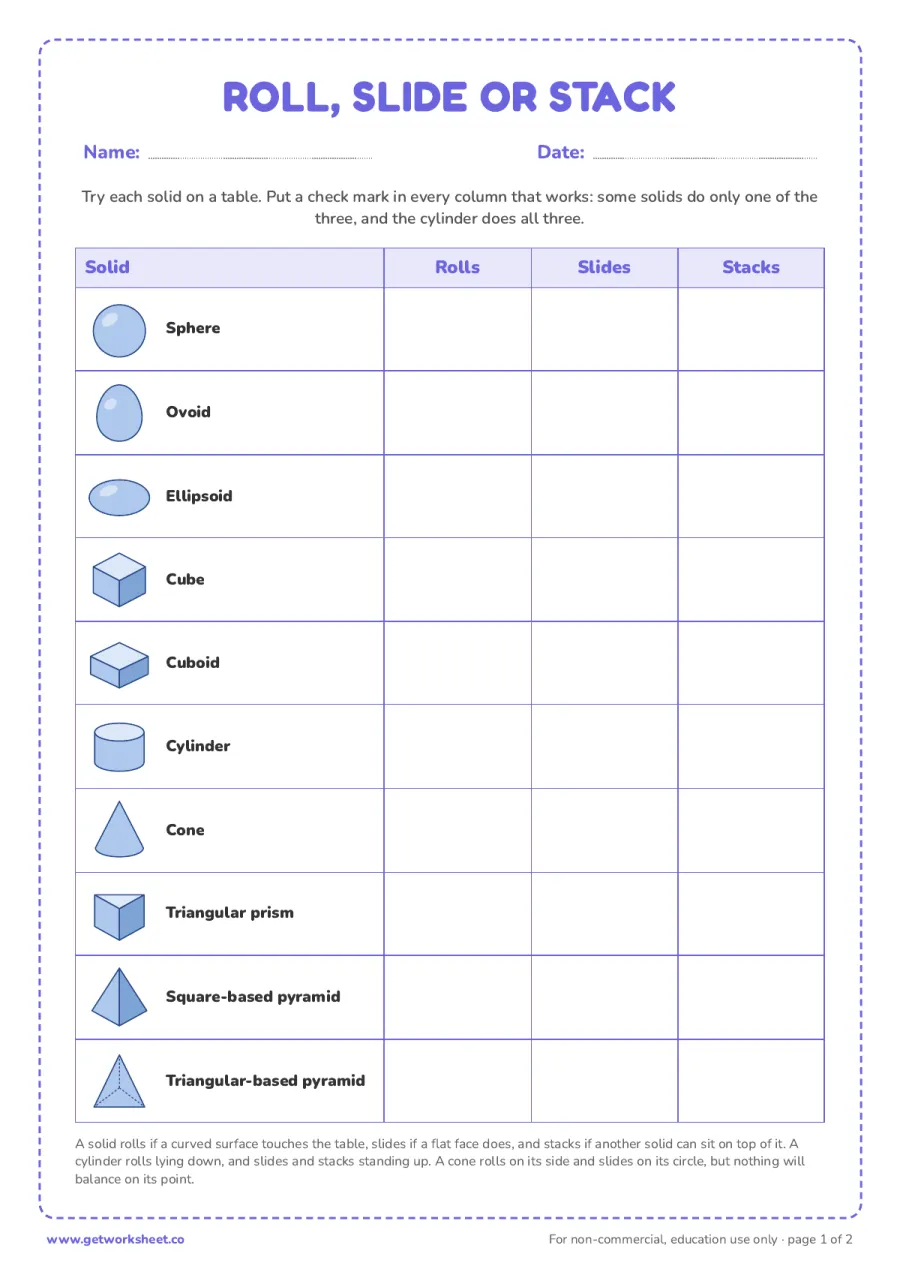
Roll, slide or stack? (answer key)
Check-mark table for all ten solids: which ones roll, which slide and which stack. Answer key on page 2. Free printable PDF.
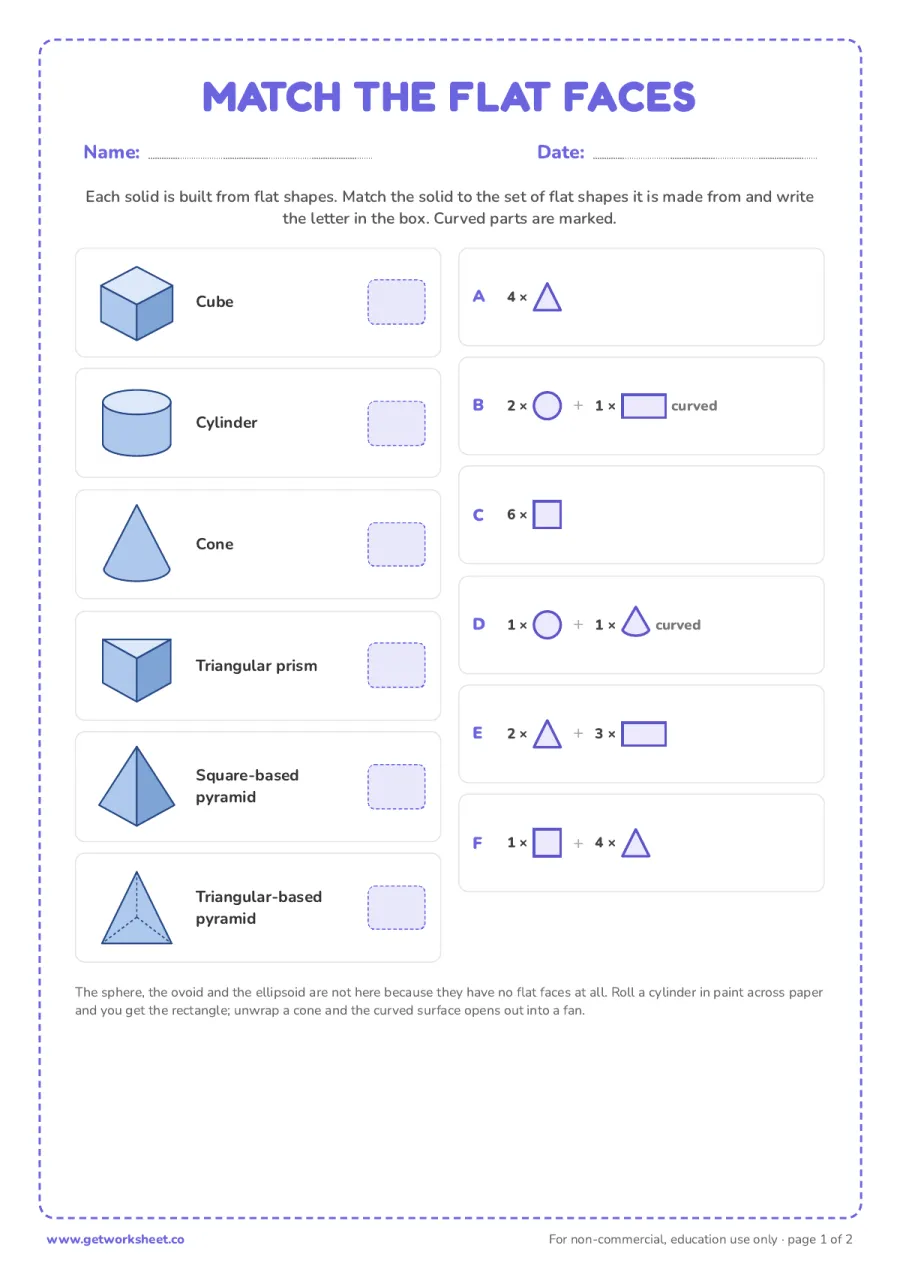
Match the solid to its flat faces (answer key)
Six solids and six sets of flat shapes (6 squares, 2 circles and a rectangle, 1 square and 4 triangles and so on): write the letter of the set each solid is made from. Answer key on page 2. Free printable PDF.
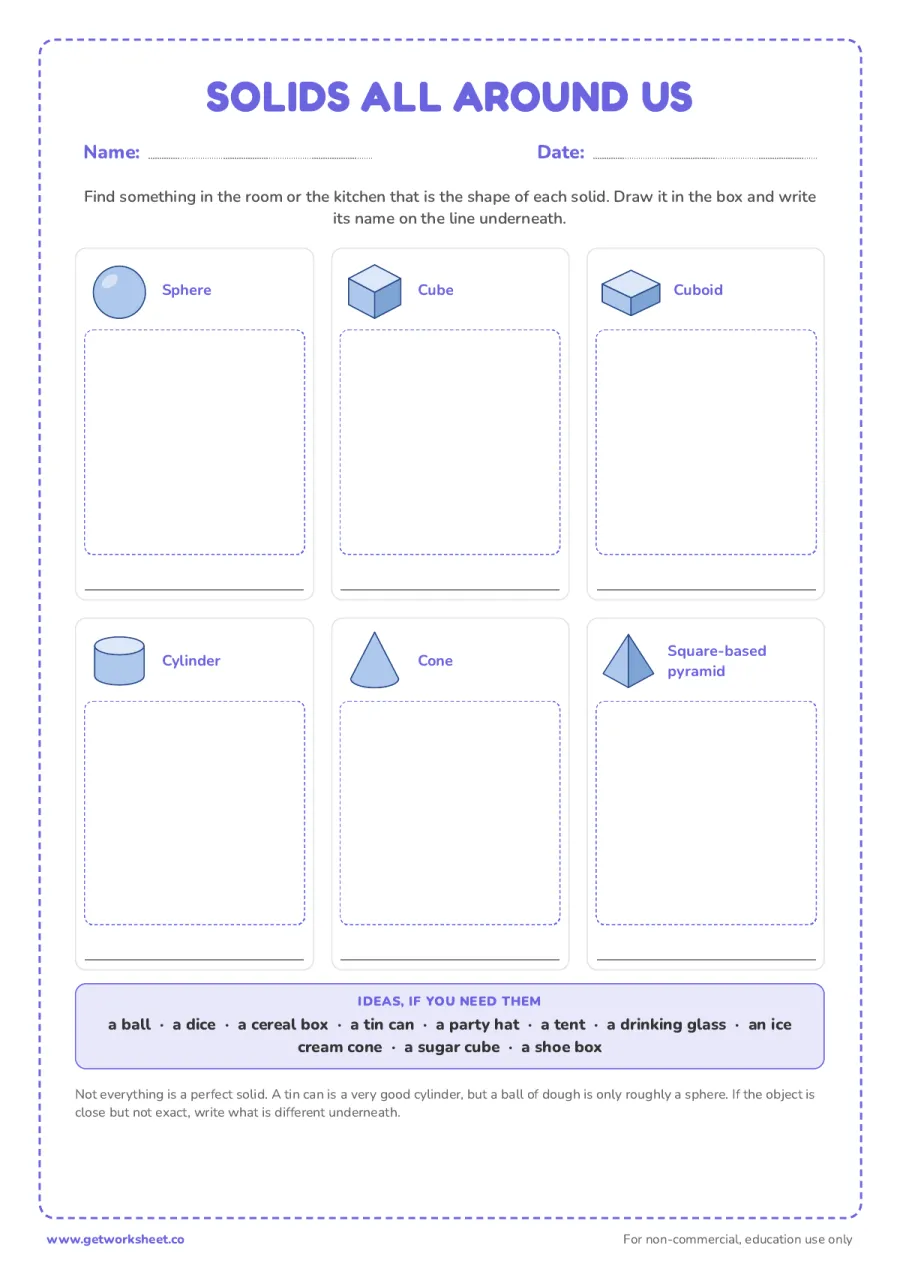
Find the solids in the real world
Six solids (sphere, cube, cuboid, cylinder, cone, square pyramid), each with a box to draw an everyday object of that shape and a line to name it. Free printable PDF.
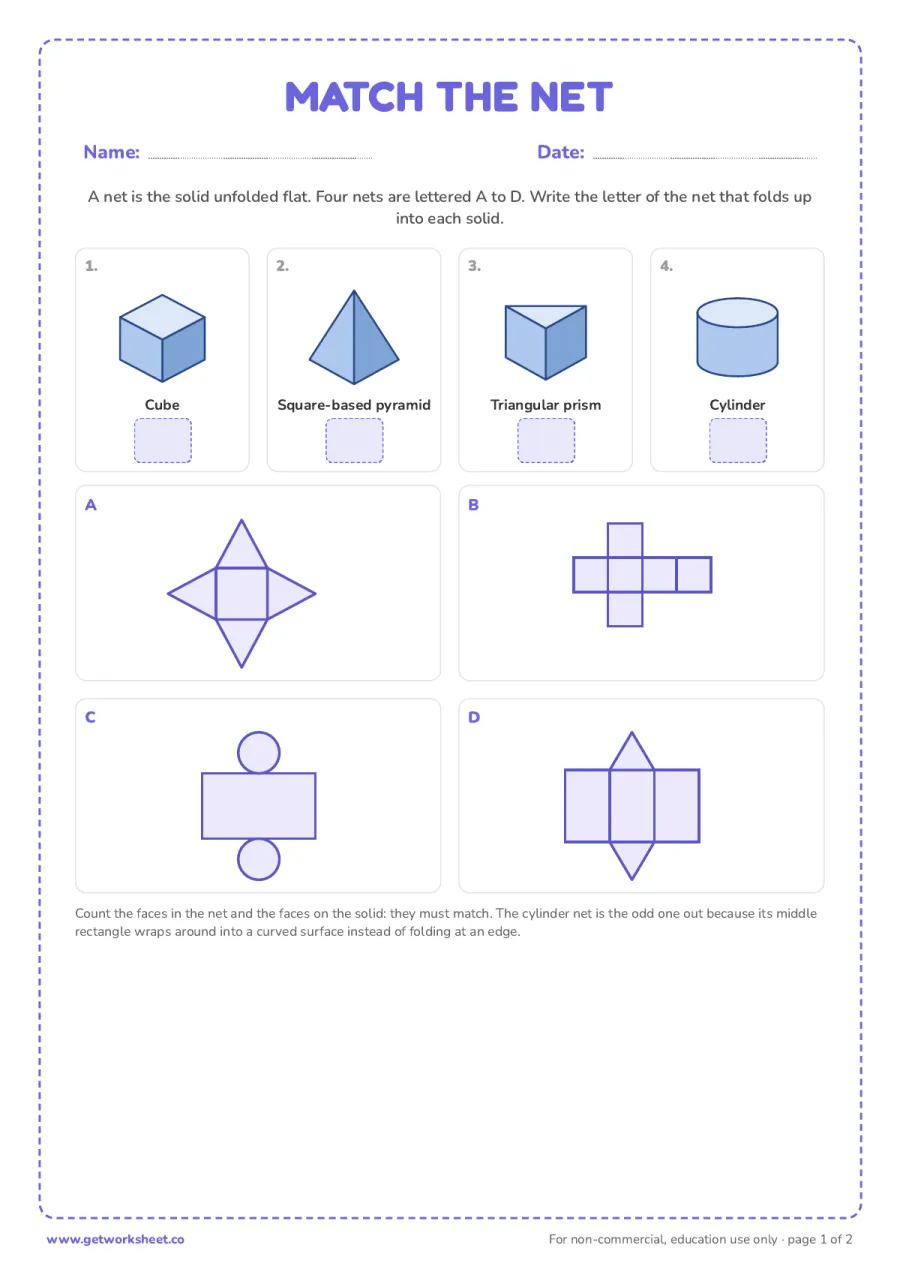
Match the solid to its net (answer key)
Four solids and four nets: the cube cross, the square pyramid, the triangular prism and the cylinder. Write the letter of the net that folds into each solid. Answer key on page 2. Free printable PDF.
AI worksheet generator
Make a worksheet like this for your class
The 7 sheets above are fixed. The generator writes a new montessori geometric solids worksheet for your grade, with the question types and count you choose, in about 20 seconds. Pick a grade to start:
What you get
- A fresh set of questions on montessori geometric solids, not a copy of the sheets above
- Multiple choice, fill in the blanks, true or false, open ended
- Answer key and print-ready PDF with Pro
Free account, 1 worksheets a week. No card.
The ten Montessori geometric solids are all painted the same blue so that nothing but the shape tells them apart. A child picks one up, feels it with both hands and with closed eyes, learns its name, and then finds out what it does on a table. These seven worksheets follow that order: the name first, then the parts, then the behavior, then the flat shapes hiding inside each solid.
What is on each sheet
- The ten solids. A reference page with all ten drawn and named, each with a one line note, plus boxes explaining flat face, edge and vertex.
- Name the solid. Ten drawings in mixed order with a word bank: cone, cube, cuboid, cylinder, ellipsoid, ovoid, sphere, square pyramid, triangular prism, triangular pyramid. Answer key on page 2.
- Faces, edges and vertices. A table for eight solids with four columns: flat faces, curved surfaces, edges and vertices. Curved surfaces get their own column so a child is never told that a sphere has one face. Answer key on page 2.
- Roll, slide or stack. A check mark table for all ten solids, with three columns. Some solids do only one of the three, the cylinder does all three, and nothing will balance on the point of a cone. Answer key on page 2.
- Match the flat faces. Six solids and six sets of flat shapes (six squares; two circles and a curved rectangle; one circle and a fan; two triangles and three rectangles; one square and four triangles; four triangles). Answer key on page 2.
- Solids all around us. Six solids, each with a large box to draw an everyday object of that shape and a line to name it, with a bank of ideas at the bottom.
- Match the net. Four solids and four nets, lettered A to D: the cube cross, the square-based pyramid, the triangular prism and the cylinder. Answer key on page 2.
The counts on the table sheet use the wording a teacher actually says out loud. A cylinder has two flat faces, one curved surface, two edges and no vertices; a cone has one flat face, one curved surface, one edge and one vertex; the sphere, ovoid and ellipsoid have a curved surface and nothing else.
Free printable makers
Make your own montessori geometric solids sheets
Type your own words or numbers and print in about 30 seconds. No account, no AI, answer key where it applies.
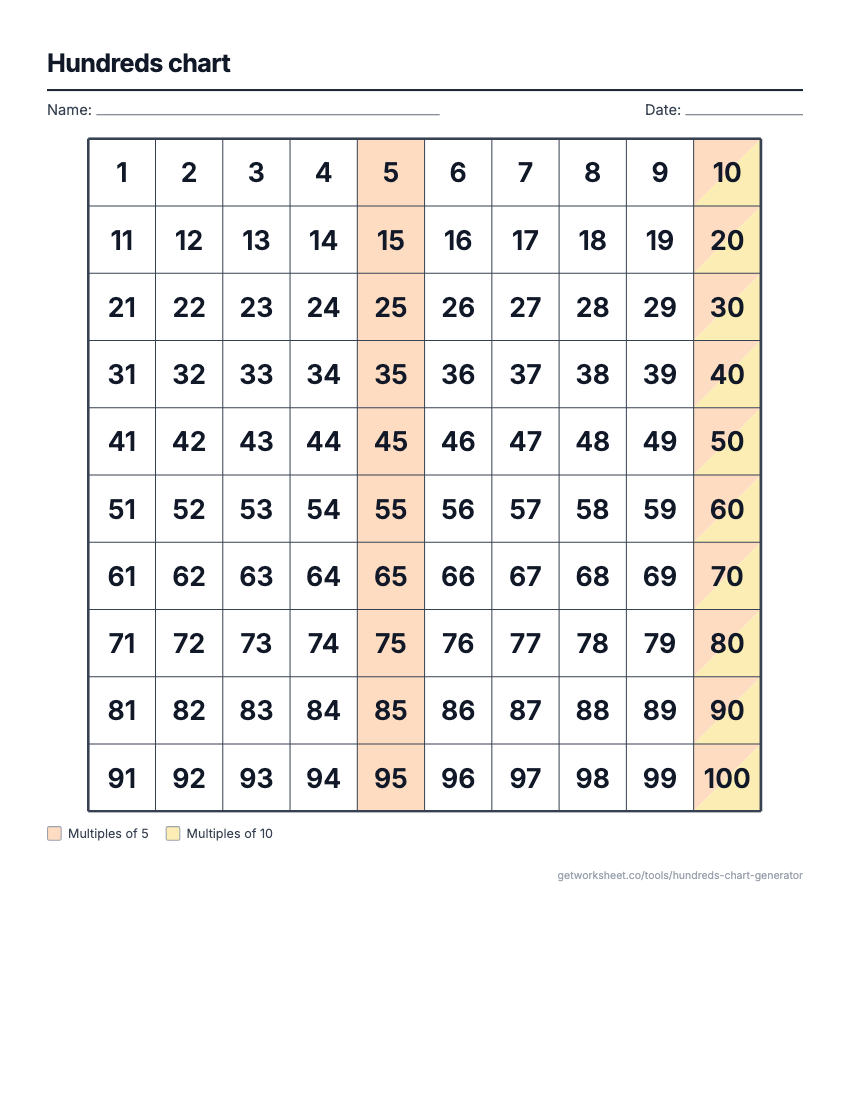 Hundreds chart generator1-100, 1-120 or 0-99, blank or missing numbers, skip-count colours, odd/even. Free to print.
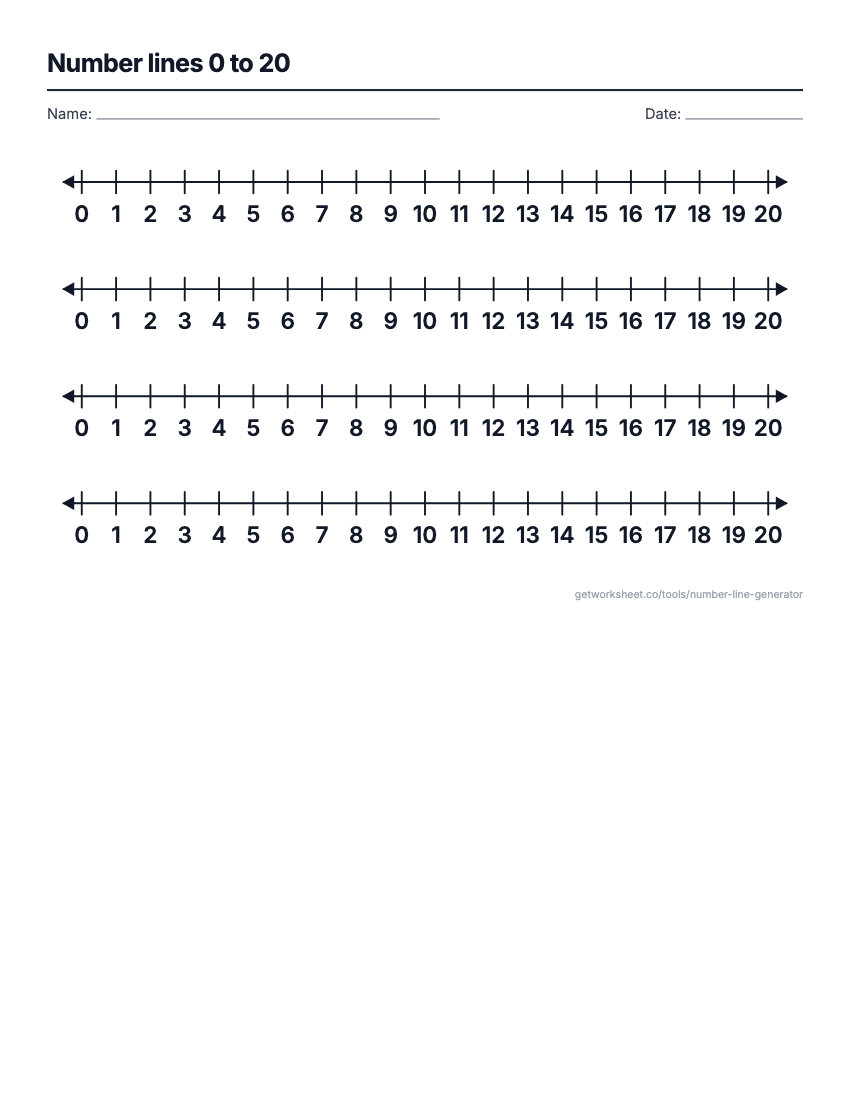 Number line generatorAny range and step, fractions and decimals, blank or missing numbers with a key. Free to print.
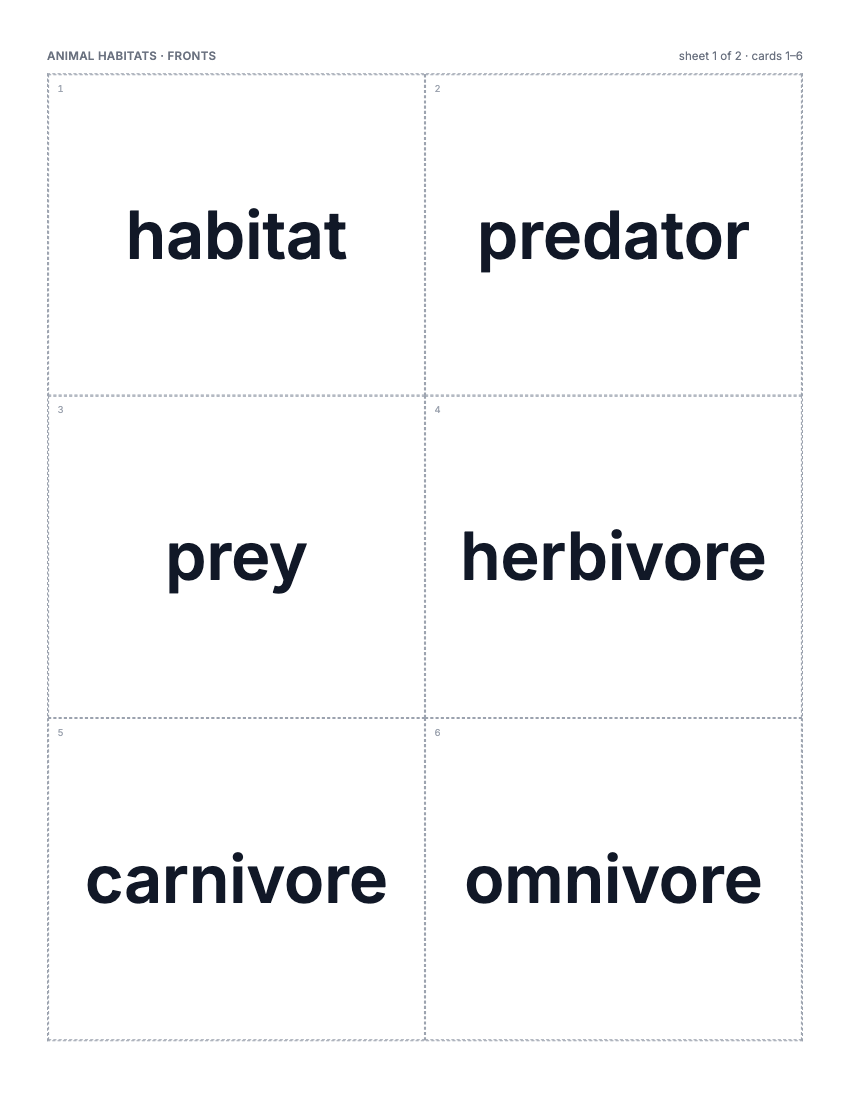 Flashcard makerVocabulary, math fact or sight word cards, 2-8 a page, two-sided or fold-over. Free to print.
AI worksheet generator
Need a different montessori geometric solids worksheet?
Generate a custom montessori geometric solids worksheet: pick the grade, question types and count, and print it in about 20 seconds. Free accounts get 1 generation a week.
Complete pack · $2.99
All 7 sheets above, plus 5 bonus sheets you will not find on this page
7 free sheets + 5 bonus sheets in one print-ready PDF with a contents page. Instant, no ads, no account; the link is emailed to you so it works on any device. The 7 sheets above stay free.
- BonusGeometric solids: three-part cards
- BonusNets to cut out and build
- BonusThe mystery bag record sheet
- BonusGeometric solids test, 18 marks
- BonusSolid words: write the definition
One-time payment of $2.99. Card, Apple Pay or Google Pay. For home and classroom use.
- Bonus
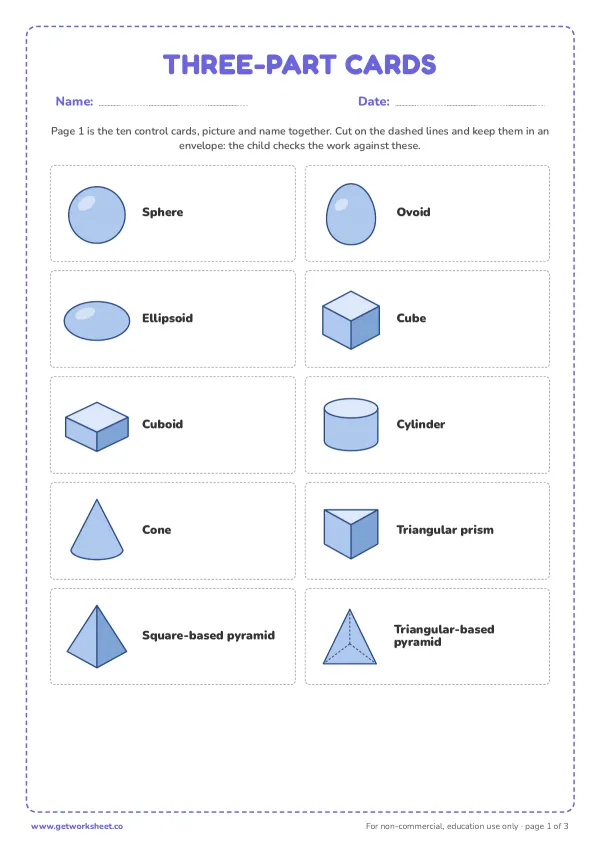 Geometric solids: three-part cards
- Bonus
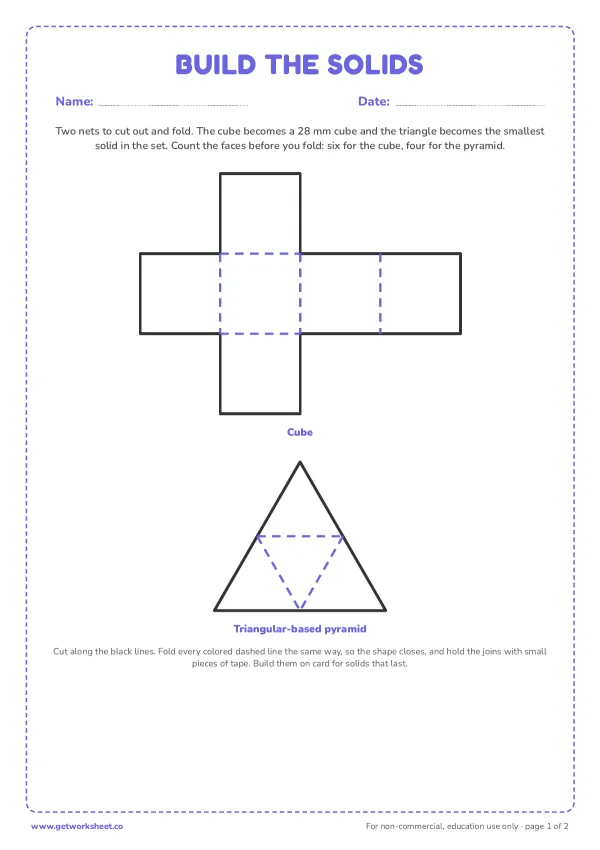 Nets to cut out and build
- Bonus
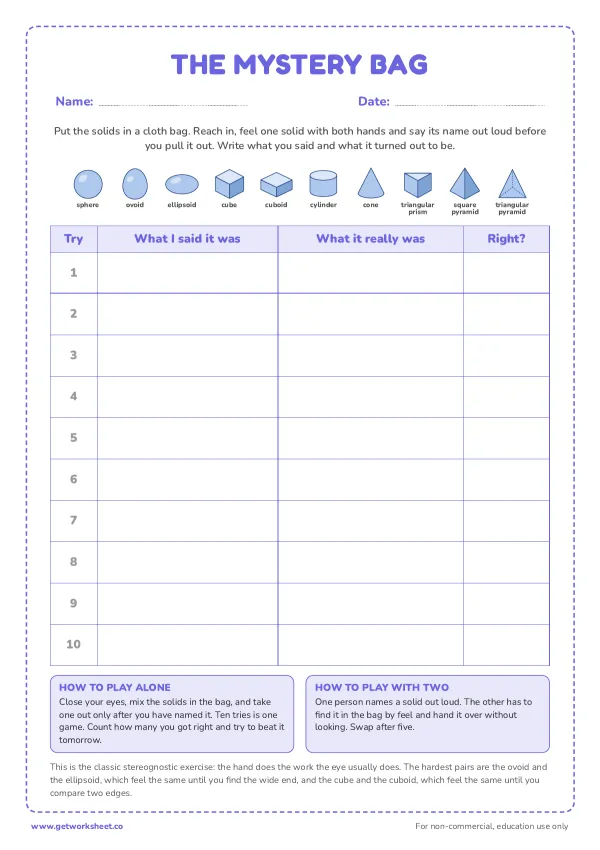 The mystery bag record sheet
- Bonus
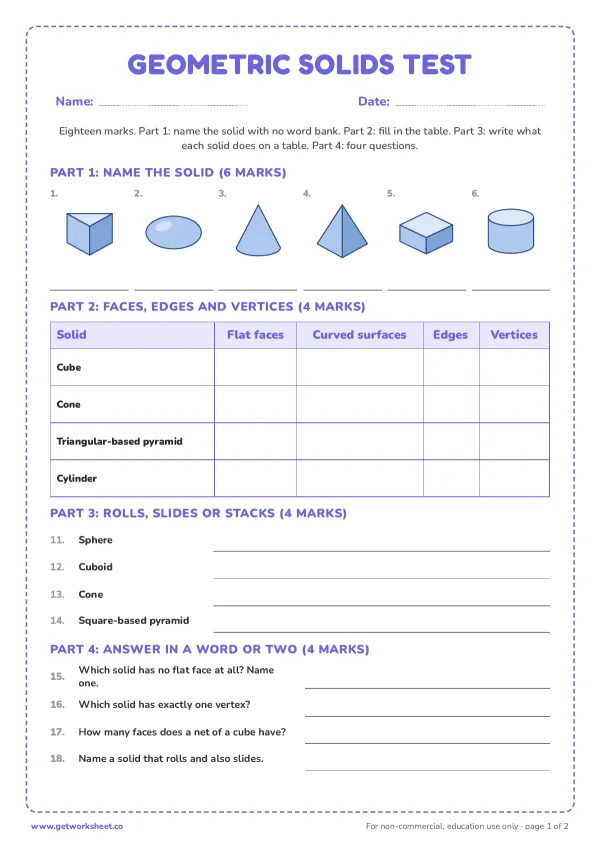 Geometric solids test, 18 marks
- Bonus
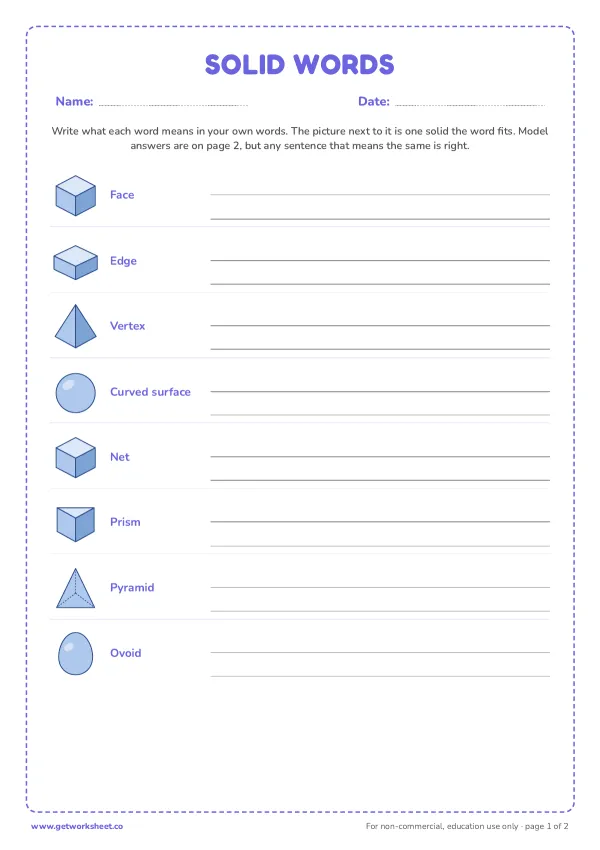 Solid words: write the definition
Teaching tips and common mistakes
How to use these worksheets
Print at 100% on A4 or US letter paper. A real set of solids is better than any sheet, but a ball, a tin can, a dice, a cereal box and a party hat cover five of the ten.
- Hands before pencils. Hold the solid while filling in the table. Counting the edges of a triangular prism from a picture is a guessing game; counting them with a finger on the wood is not.
- Three period lesson. Name three solids, then ask for them, then ask what each one is. Three at a time is enough, and the two pyramids should not be in the same three at the start.
- Try the table test. The roll, slide or stack sheet only works if the child actually pushes each solid across a table and tries to put another on top. Let it be noisy.
- Build a net. Fold the cube net from paper before doing the net matching sheet, so folding is a memory rather than an idea.
- Order of the sheets. Reference page, name the solid, roll slide or stack, faces edges and vertices, match the flat faces, solids all around us, then the nets.
Common mistakes to watch for
- Saying a sphere has one face. A face is flat. The sphere has one curved surface and no faces, no edges and no vertices, which is why the table has a separate column for curved surfaces.
- Ovoid and ellipsoid. Both are curved all over. An ovoid is egg shaped and wider at one end; an ellipsoid is the same at both ends. Rolling them shows it: the ovoid curves away, the ellipsoid runs straight.
- Cube and cuboid. A cube is a cuboid whose faces are all squares. Ask for two edges to compare rather than a look.
- Counting the vertices of a cone as none. The point is one vertex. The circle at the bottom is one edge, even though it is curved.
- Deciding a cylinder cannot roll because it stacks. Lying down it rolls, standing up it slides and stacks. More than one column can be ticked.
- Counting net faces in a hurry. If the net has five squares it cannot be a cube. Counting faces first rules out three of the four nets.
Frequently asked questions
What are the ten Montessori geometric solids?
Sphere, ovoid, ellipsoid, cube, cuboid (a rectangular prism), cylinder, cone, triangular prism, square-based pyramid and triangular-based pyramid. They are presented in blue wood, with stands and flat bases for tracing.
What age are the geometric solids for?
The names and the mystery bag start at about three, and the counting of faces, edges and vertices suits five to eight. These sheets are written for kindergarten through grade three.
What is the mystery bag?
The solids go in a cloth bag and the child names one by touch before pulling it out. It is the classic stereognostic exercise, and it is the fastest way to find out whether the names are really known.
Which solids roll?
The sphere, ovoid and ellipsoid roll and do nothing else. The cylinder rolls on its side and slides and stacks on its ends. The cone rolls on its side and slides on its base. The rest only slide, and the cube, cuboid and triangular prism also stack.
Is a cuboid the same as a rectangular prism?
Yes. Both names describe a solid with six rectangular faces, twelve edges and eight vertices. Montessori albums usually say rectangular prism.
More shape and Montessori printables
For the flat shapes behind the solids, start with the shape tracing worksheets. The full sequence of Montessori math materials, with typical ages, is on the Montessori math worksheets page, and the material children usually meet just before the solids work is on the Montessori bead stair worksheets page.
Free library
Related collections
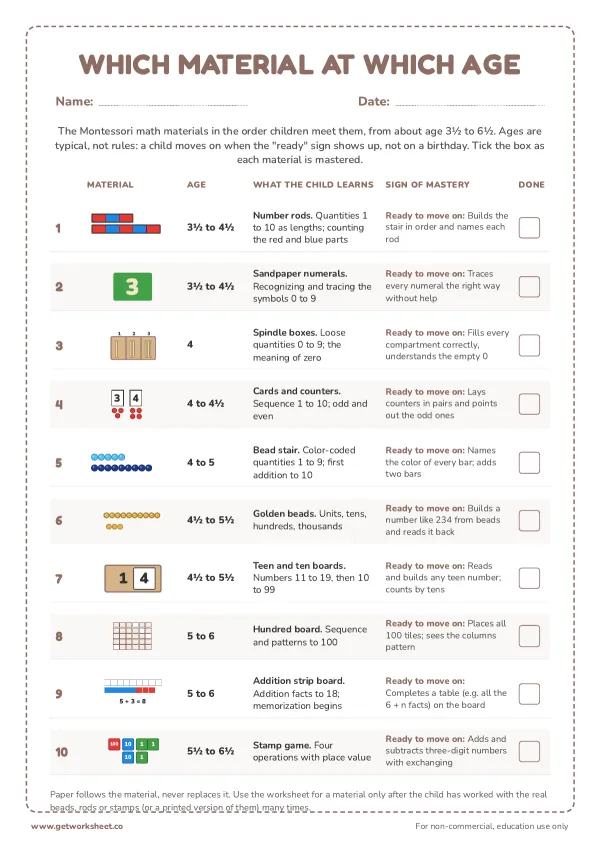
Free Montessori math worksheets: one from every material
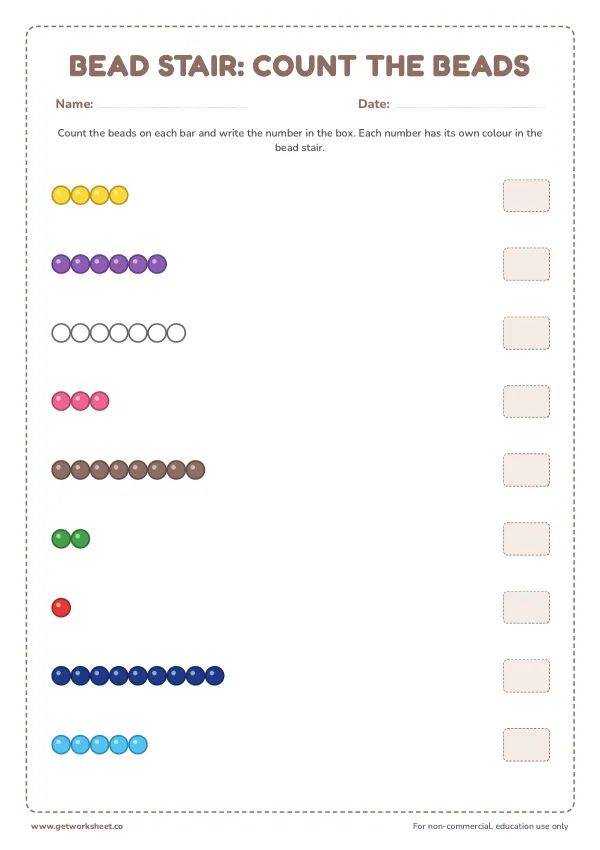
Free Montessori bead stair worksheets
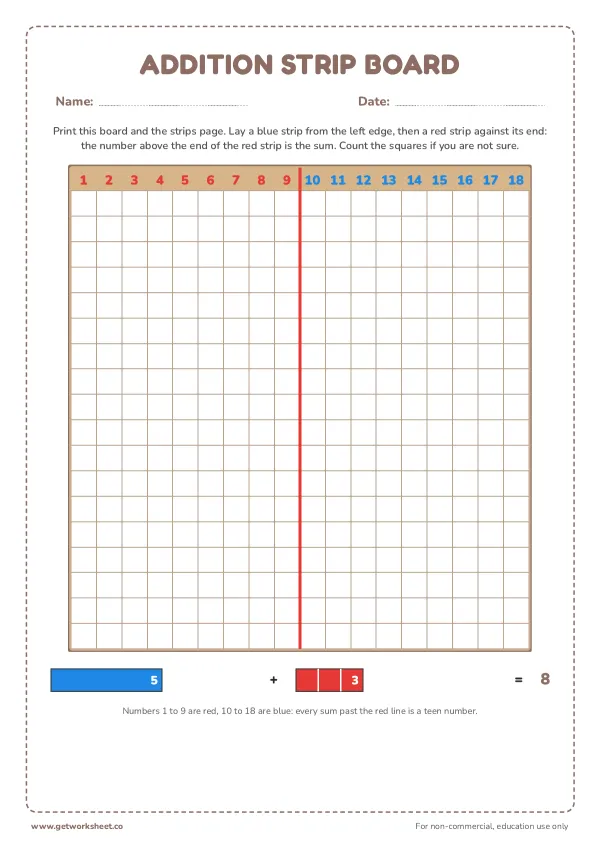
Free Montessori addition strip board worksheets
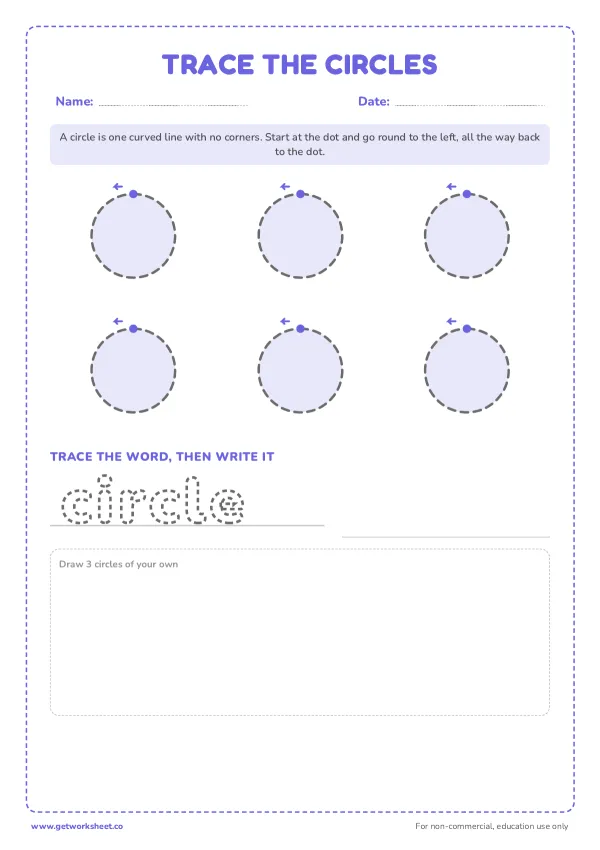
Free shape tracing worksheets
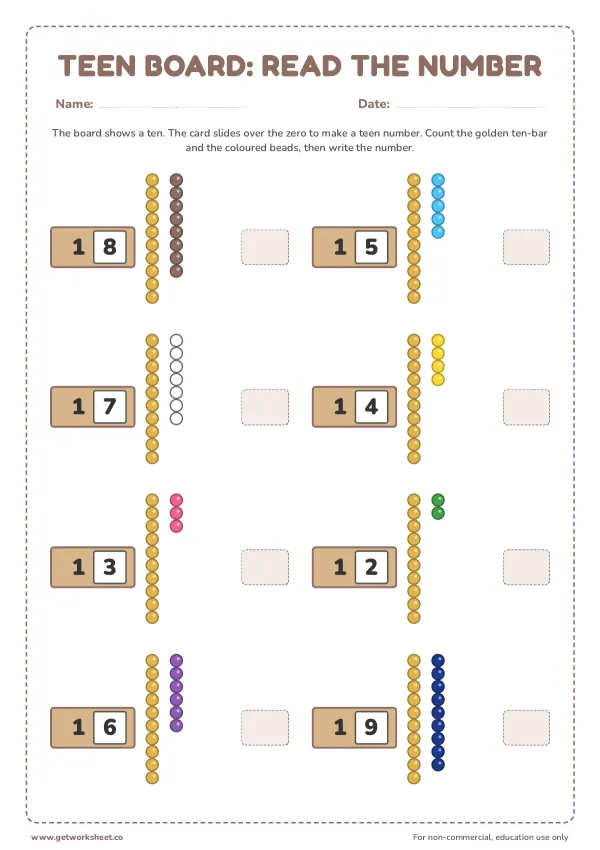
Free Montessori teen board and ten board worksheets
Free Montessori place value worksheets (golden beads)
Free Montessori hundred board worksheets
Free rekenrek worksheets
More worksheets
- Free 100th day of school worksheets
- Free winter break packet worksheets
- Free Thanksgiving math worksheets
- Free greater than less than worksheets
- Free number line printables
- Free Halloween math worksheets
- Free Christmas math worksheets
- Free hundreds chart worksheets
- Free ten frame worksheets
- Free repeating patterns worksheets
- Free before and after numbers worksheets
- Free subtraction worksheets (within 10 and 20)