Maths · Kindergarten–Grade 1
Free ten frame worksheets
Four printable ten frame worksheets for kindergarten and grade 1: count the dots and write the number for 1 to 10 and 11 to 20, then draw the dots to show a given number, ten frames per sheet.
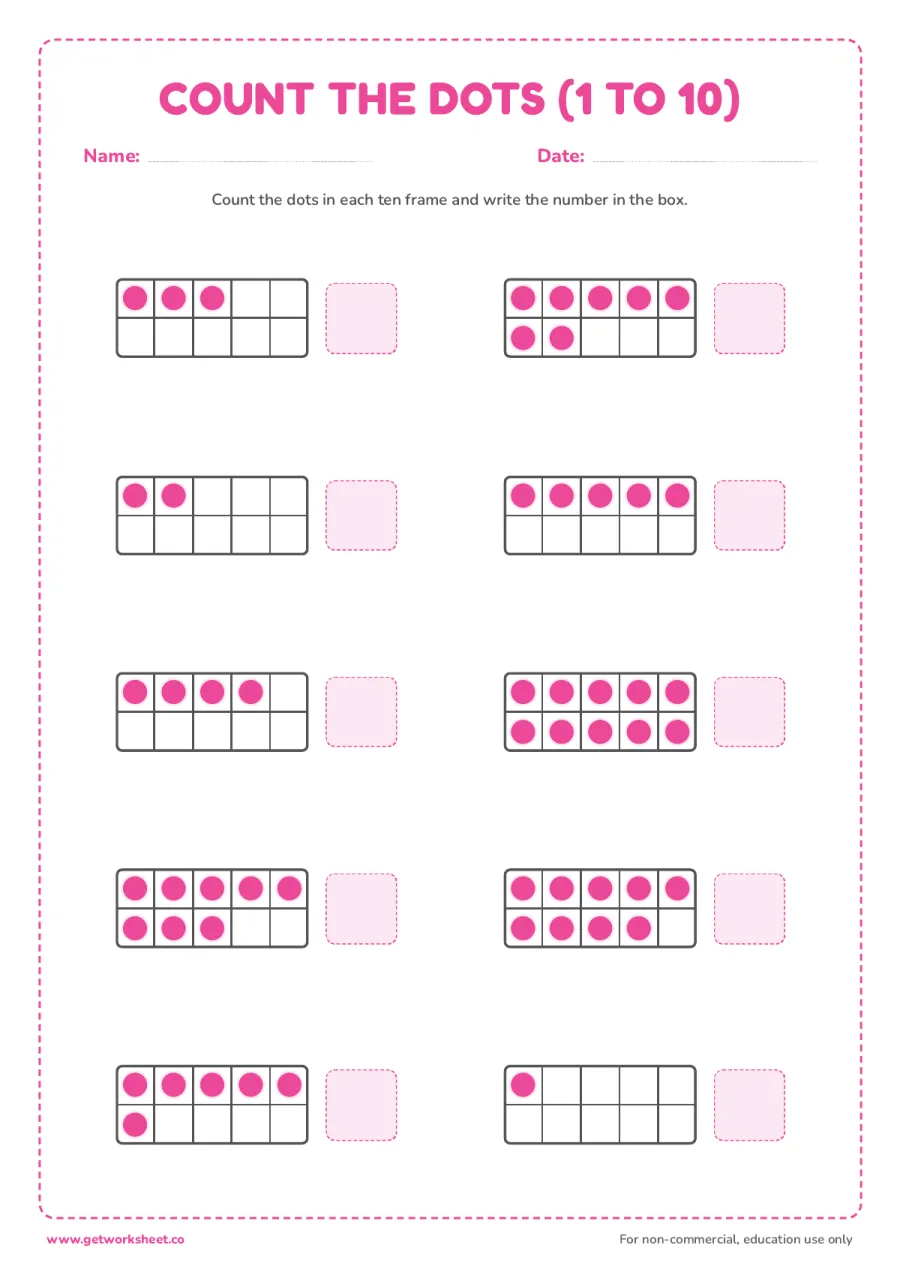
Count the dots in 10 ten frames: numbers 1 to 10
Count the pink dots in each of 10 ten frames and write the total (1 to 10) in the box beside it.
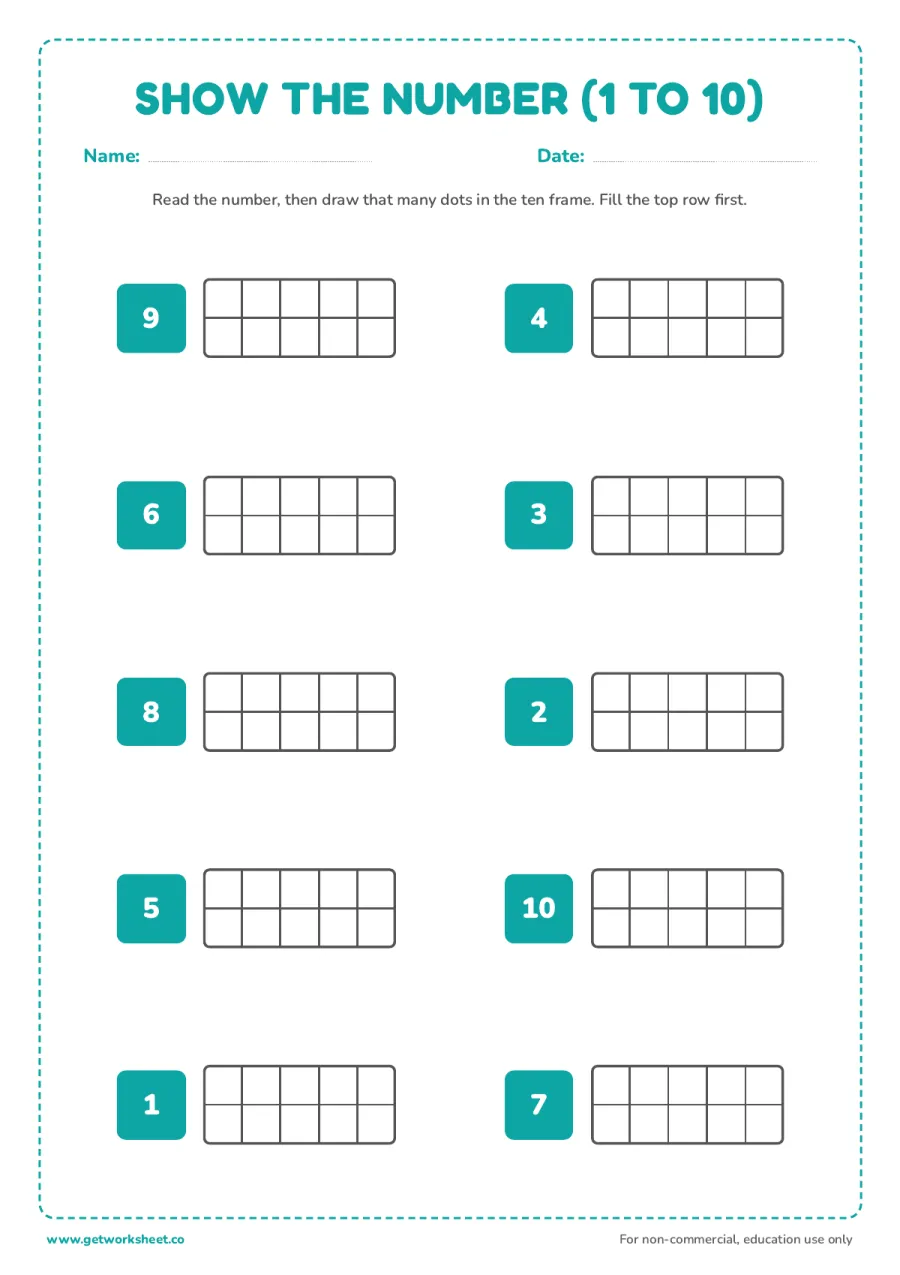
Draw the dots for 10 numbers from 1 to 10 in ten frames
Read each given number from 1 to 10 and draw that many dots in the empty ten frame, filling the top row first; 10 frames.
Whole set
All 4 sheets in one PDF
Instant and ad-free. No account needed.
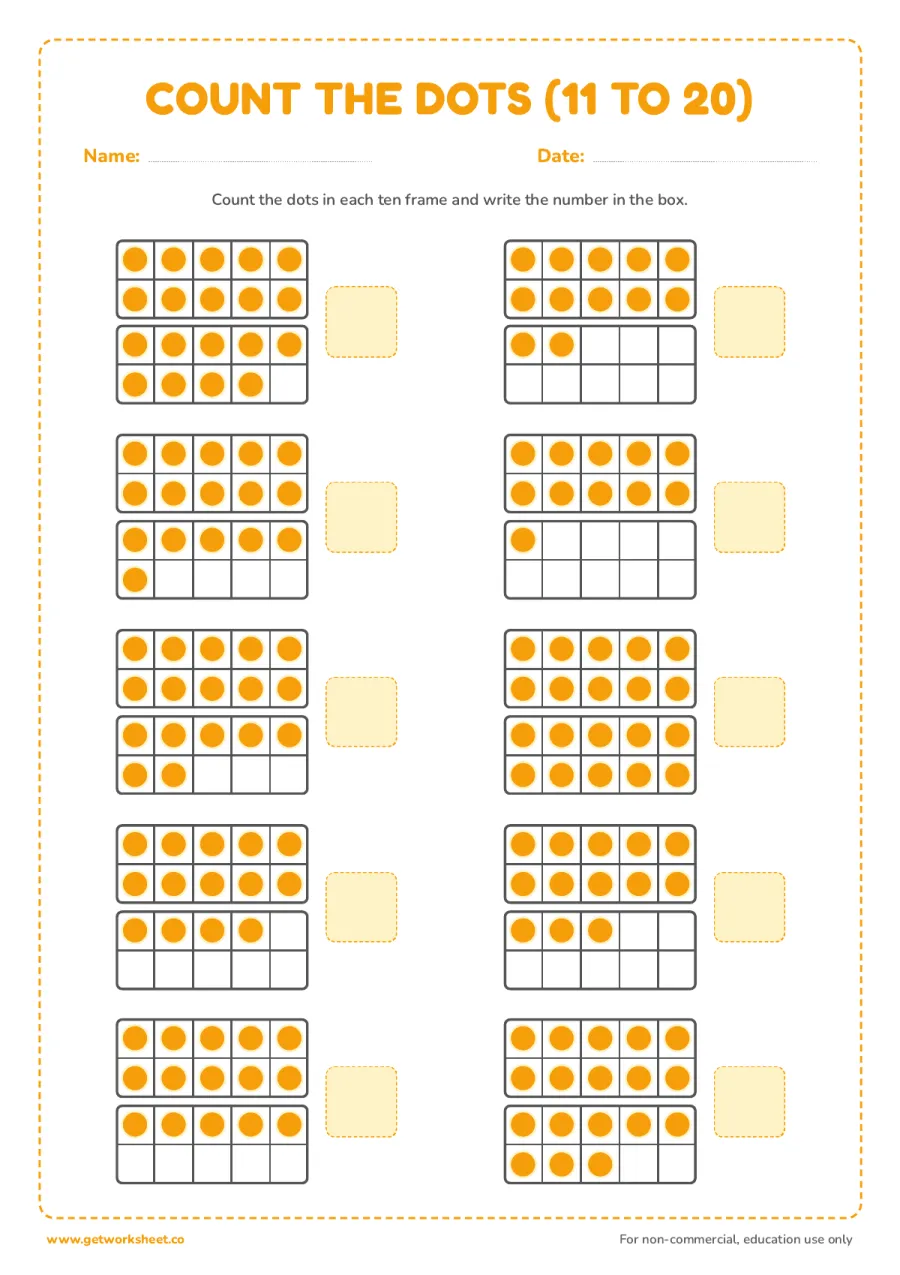
Count the dots in 10 double ten frames: numbers 11 to 20
Count the orange dots in each of 10 double ten frames (a full frame of ten plus extras) and write the total from 11 to 20 in the box.
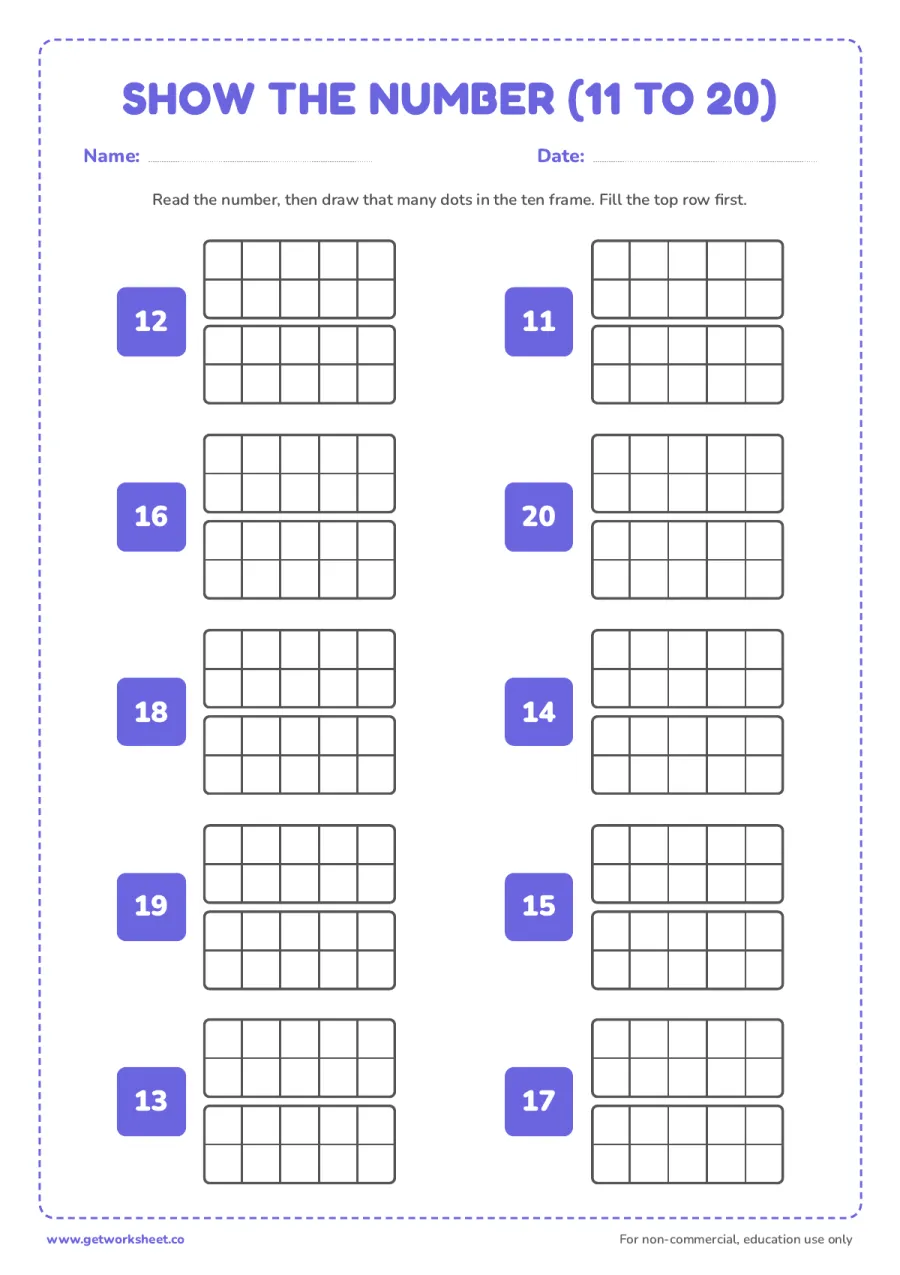
Draw the dots for 11 to 20 in double ten frames: 10 numbers
Read each given number from 11 to 20 and draw that many dots across a pair of ten frames, filling the top row first; 10 problems.
AI worksheet generator
Make a worksheet like this for your class
The 4 sheets above are fixed. The generator writes a new ten frame worksheet for your grade, with the question types and count you choose, in about 20 seconds. Pick a grade to start:
What you get
- A fresh set of questions on ten frame, not a copy of the sheets above
- Multiple choice, fill in the blanks, true or false, open ended
- Answer key and print-ready PDF with Pro
Free account, 1 worksheets a week. No card.
A ten frame is a two-by-five grid that holds up to ten counters. It is one of the most useful tools in early math because it lets children see numbers as five and some more, or ten and some more, instead of counting every dot. These four worksheets cover both directions of the skill, ten frames per sheet. Sheet one: count the pink dots in 10 ten frames and write the total, 1 to 10. Sheet two: read a number from 1 to 10 and draw that many dots in an empty frame, top row first. Sheet three: count the orange dots in 10 double ten frames (a full ten plus extras) and write the total, 11 to 20. Sheet four: read a number from 11 to 20 and draw the dots across a pair of frames.
What Students Will Practice
- Counting dots in a ten frame quickly by using the full top row of five as an anchor
- Writing the numeral that matches a set of dots, 1 to 10 and 11 to 20
- Drawing the right number of dots, filling the top row first, then the bottom row
- Seeing teen numbers as one full ten frame plus extra dots (14 is ten and four)
- Recognizing how many empty boxes are left, which is the foundation for making ten
Ten frames support Common Core K.CC.B.4 and K.CC.B.5 (counting to tell how many, up to 20 in a rectangular array), K.OA.A.4 (finding the number that makes 10) and K.NBT.A.1 (composing teen numbers as ten ones and some further ones).
Free printable makers
Make your own ten frame sheets
Type your own words or numbers and print in about 30 seconds. No account, no AI, answer key where it applies.
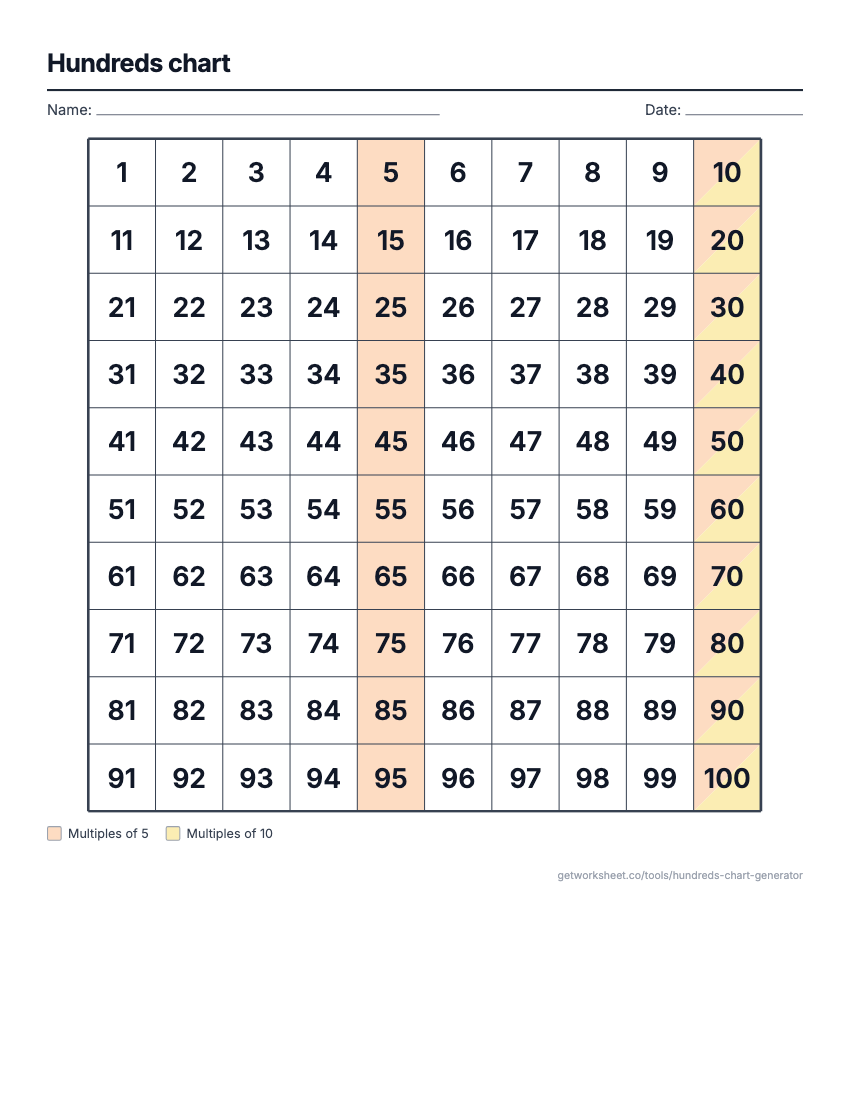 Hundreds chart generator1-100, 1-120 or 0-99, blank or missing numbers, skip-count colours, odd/even. Free to print.
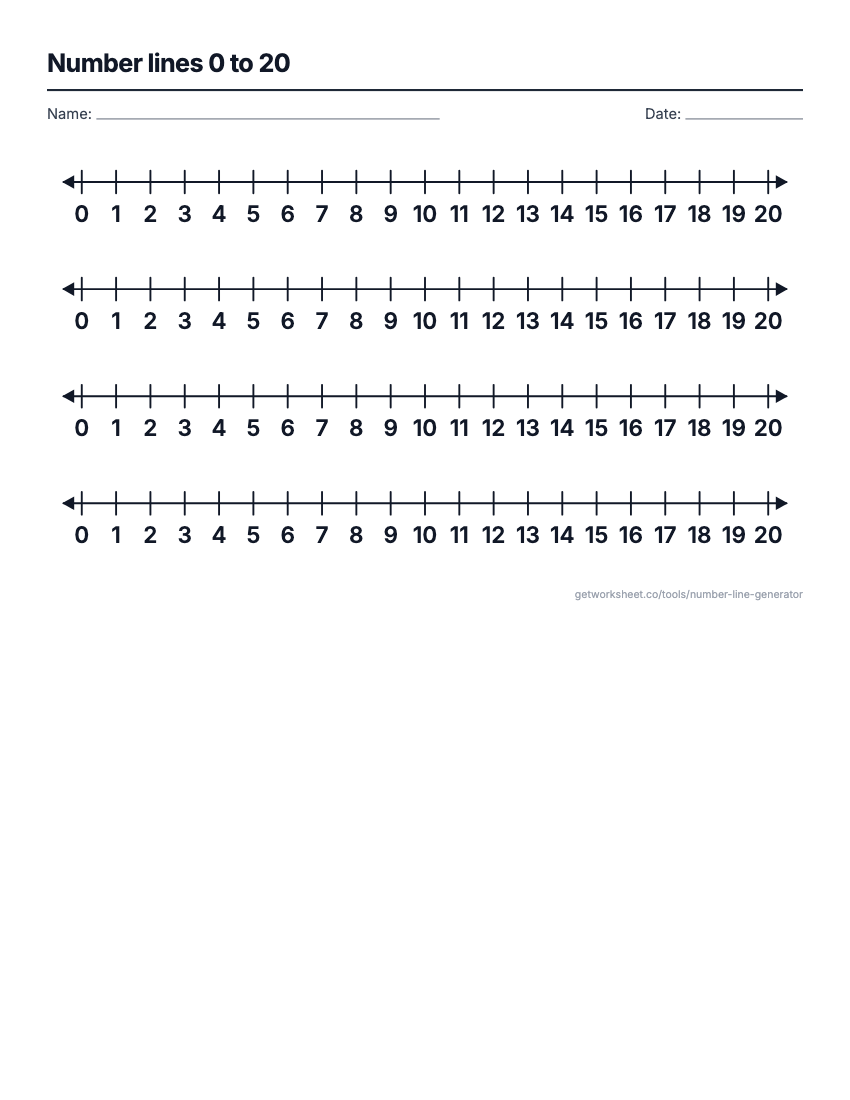 Number line generatorAny range and step, fractions and decimals, blank or missing numbers with a key. Free to print.
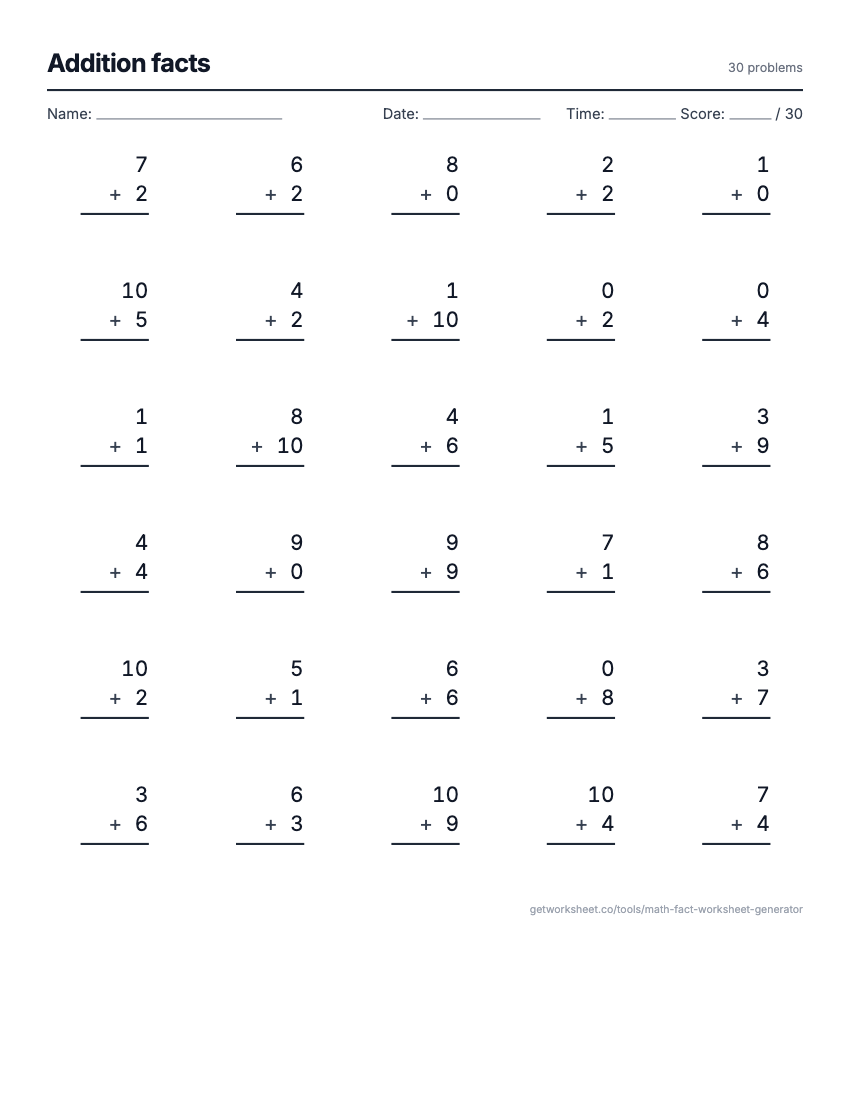 Math fact worksheet generatorAddition to division drills with an answer key. Free to print.
AI worksheet generator
Need a different ten frame worksheet?
Generate a custom ten frame worksheet: pick the grade, question types and count, and print it in about 20 seconds. Free accounts get 1 generation a week.
How to Use These Worksheets
Print at 100% on A4 or US Letter paper. If you have counters, buttons or coins, use them on the frame before writing anything.
- Sheet one: count the dots (1 to 10). Discourage counting one dot at a time. Ask “is the top row full?” If it is, that is five, so the child only needs to count the bottom row and add.
- Sheet two: show the number (1 to 10). Insist on filling the top row first, left to right, then the bottom row. This convention is what makes ten frames readable at a glance later on.
- Sheet three: count the dots (11 to 20). The first frame is always full. Say “ten” for the full frame, then count on: “ten, eleven, twelve, thirteen”.
- Sheet four: show the number (11 to 20). Ask your child to fill the whole first frame before touching the second. Then ask “how many more than ten is this?”
- Ask about the empty boxes. For every frame ask how many boxes are empty. A frame showing 7 has 3 empty boxes: 7 and 3 make 10. This is making ten, and it is the single most useful fact for later addition.
Common Mistakes to Watch For
- Counting every dot: Correct, but slow. Model “five and two more is seven” so the child hears the shortcut.
- Scattering dots randomly: A frame with dots in random boxes cannot be read quickly. Gently reset: top row first, no gaps.
- Writing 41 for fourteen: Reversing the digits of teen numbers is common because the ones digit is said first in English. Point at the full frame and say “one ten”, then the extra dots.
- Confusing 6 and 9 dot patterns: Both have a full top row. Count the bottom row slowly and check the total against the number of empty boxes.
Frequently Asked Questions
What is a ten frame and why is it used?
A ten frame is a rectangle divided into ten boxes, two rows of five. Placing counters in it shows a number in relation to five and ten, which helps children subitise (see how many without counting) and later add and subtract by making ten.
What age are ten frame worksheets for?
Sheets one and two (1 to 10) suit pre-K and kindergarten, ages 4 to 6. Sheets three and four (11 to 20) are aimed at kindergarten and early first grade, once the child understands that a full frame means ten.
Should dots be drawn in a particular order?
Yes. Fill the top row from left to right, then the bottom row from left to right. This is the convention used in classrooms so that any ten frame can be read at a glance.
Can I use real counters instead of drawing?
Absolutely, and it is better for very young children. Print the “show the number” sheets, laminate them or use a plastic sleeve, and place buttons, coins or cereal on the frames before drawing.
What comes after ten frames?
Making ten (7 + 3, 6 + 4), then adding two numbers on a double ten frame (8 + 5 becomes 10 + 3), then place value with tens and ones. Number bonds worksheets are the natural next step.
Related Early Number Practice
Ten frames pair naturally with number bonds worksheets and doubles addition worksheets. For counting practice with pictures, see the count and color worksheets, and for writing the numerals themselves the number tracing worksheets 1 to 20. Montessori families may also like the Montessori beads worksheets, which show quantities in a similar structured way.
Free library
Related collections
Free doubles addition worksheets
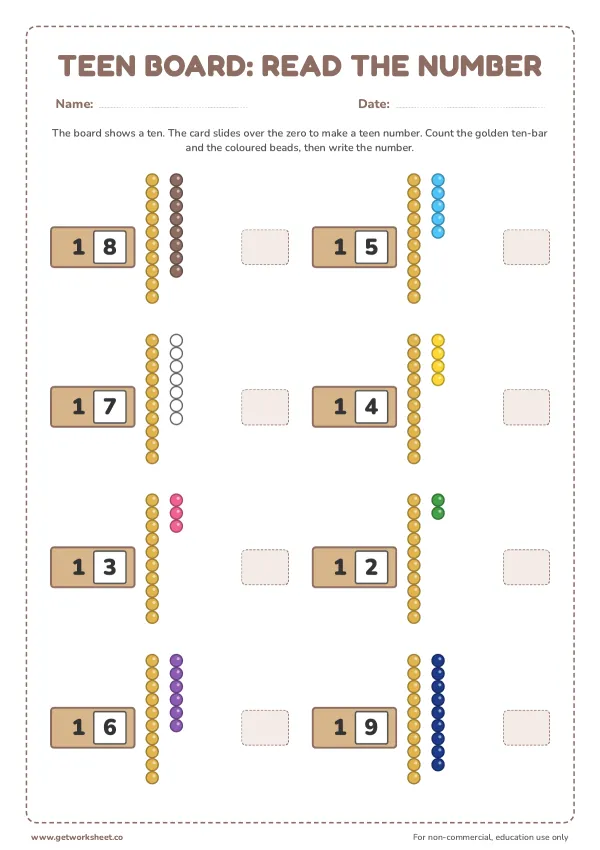
Free Montessori teen board and ten board worksheets
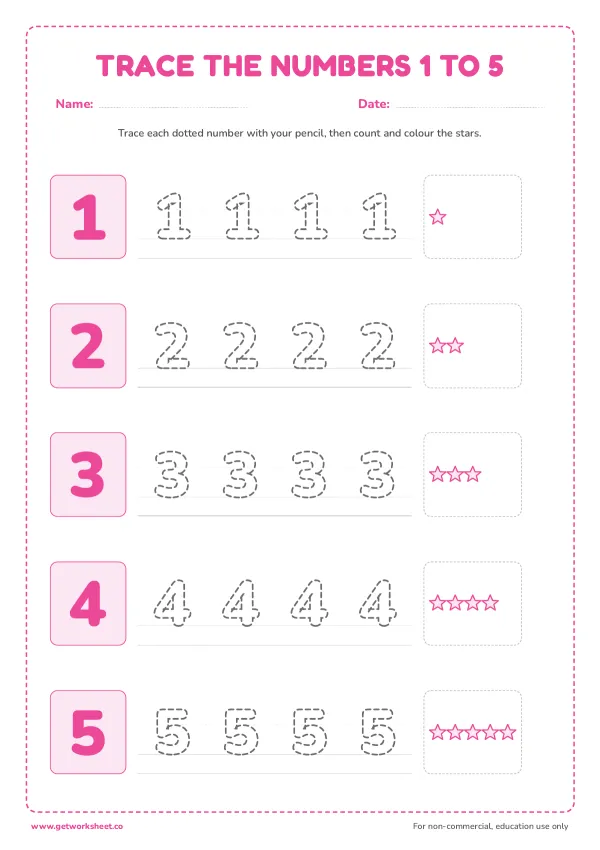
Free number tracing worksheets (1-20)
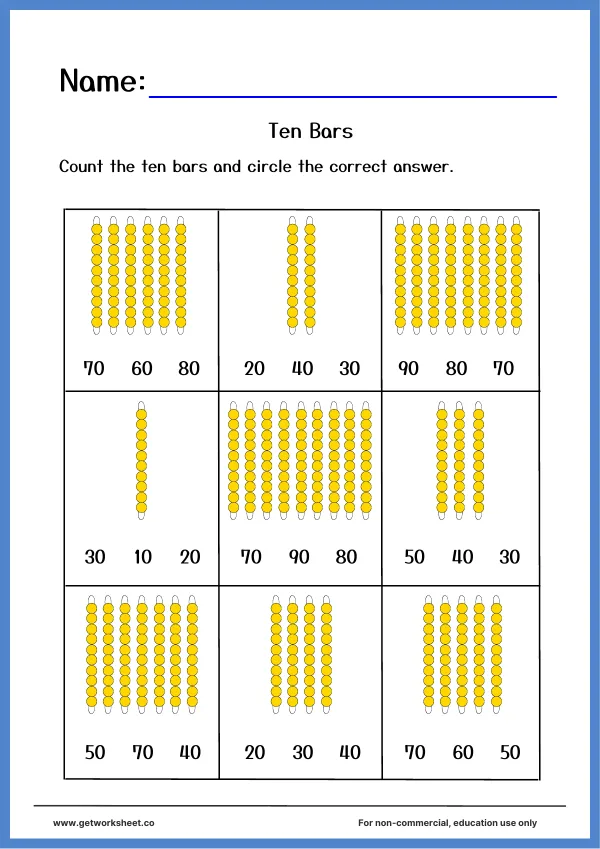
Free Montessori worksheets (PDF)
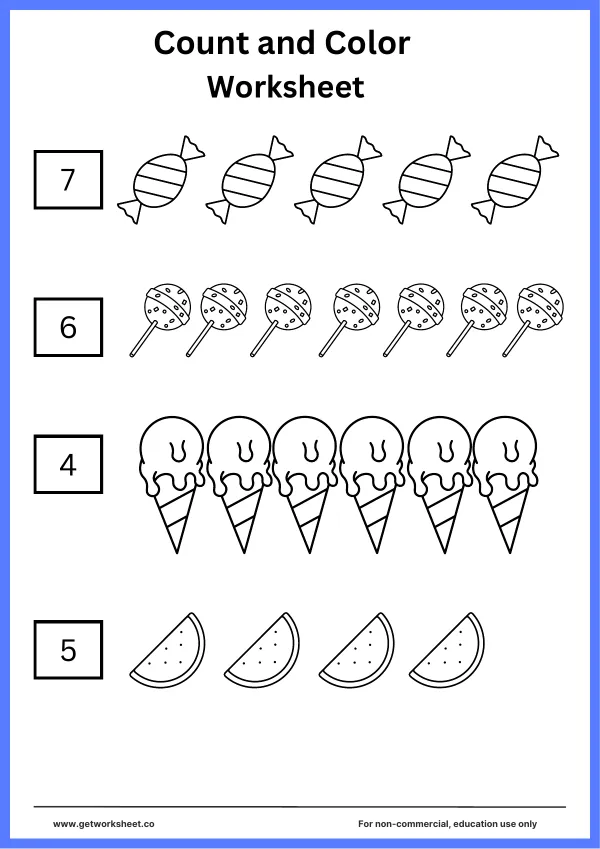
Free count and color worksheets
Free Halloween math worksheets
Free Christmas math worksheets
Free hundreds chart worksheets
More worksheets
- Free Montessori place value worksheets (golden beads)
- Free Montessori hundred board worksheets
- Free repeating patterns worksheets
- Free before and after numbers worksheets
- Free subtraction worksheets (within 10 and 20)
- Free addition worksheets
- Free 3D shapes worksheets
- Free word families worksheets
- Free sight words worksheets (Dolch and Fry)
- Free CVC words worksheets
- Free Christmas worksheets: word searches, letter to Santa and writing
- Free handwriting worksheets