Free printable maker
Number Line Generator
Any start, end and step, including negatives; halves, quarters, thirds, tenths and decimals; blank and open lines; missing-number worksheets with an answer key. One to eight lines a page, portrait or landscape, large print for K–2. Free, no account.
Number lines 0 to 20
getworksheet.co/tools/number-line-generator
Using the lines
Choosing the right number line for the lesson
A number line turns counting into distance: each step is the same size, so 7 is further from 0 than 5 and the gap between them can be seen and measured. For the youngest children print the 0–10 or 0–20 line in large print, two or three to a page, and have them hop along it with a finger or a counter while they count on. Add the arrowheads so the line is understood to continue in both directions, which matters later for negatives.
Missing numbers are the first real worksheet. Start with 2 hidden per line on 0–20, then 4, then move to 0–100 by tens and fives, where the child has to work out the step before filling the gaps. The answer key prints as page two, so a pair of pupils can mark each other. Blank lines with ticks are the next stage: give the start and end and ask the class to label every tick, or leave both off and dictate the range. The missing number worksheets and before and after numbers collections cover the same ground with ready-made pages.
Open number lines (no ticks) are for mental strategies in grades 2 to 4: children draw their own jumps for 56 + 37 or 83 − 29, and the empty line records the thinking rather than the answer. Six or eight per page in portrait gives a full lesson of problems.
Fractions make most sense on a line between whole numbers, where 2/4 and 1/2 land on the same tick and 5/4 clearly sits past 1. Print halves 0–5 first, then quarters 0–3 and thirds 0–3, then tenths 0–2 next to the decimals 0–2 line so 0.3 and 3/10 can be matched up. The labels are stacked mixed numbers, the way they appear in textbooks. For long tenths lines set “Label every” to 5 or 10 ticks so only the whole numbers and halves are written.
Negative numbers from −10 to 10 (or −20 to 20 by twos) belong in grade 5 and 6 for temperature, sea level and subtraction that crosses zero. The line keeps zero in the middle and uses a true minus sign so −3 does not read as a dash.
Number lines pair with a hundreds chart: the chart shows place value in rows, the line shows magnitude. Print both from the hundreds chart generator, or take ready-made pages from the number line printables, hundreds chart worksheets and skip counting worksheets. For a drill on the facts the line has taught, the math fact worksheet generator takes the same number range.
How it works
How to make a printable number line
Three steps from a range to a page of lines.
- 1
Set the numbers
Pick a preset or type a start, end and step. Negatives are fine. Switch to halves, quarters, thirds, tenths or decimals for fraction lines.
- 2
Choose the type
Numbered, blank (ticks only or start and end labelled), open, or a missing-numbers worksheet with an answer key. Set lines per page, large print and landscape.
- 3
Print
Letter or A4, portrait or landscape. Save as PDF from the print dialog to reuse the sheet.
Good to know
Questions, answered
Yes. Set the range, choose how many lines you want on the page and print or save as a PDF. No account, no watermark, no limit. The lines are drawn as vector graphics in your browser, so ticks and numbers print crisp at any size.
Any whole-number start and end, including negatives such as −10 to 10, with any step (1, 2, 5, 10, 100, or decimals like 0.5 and 0.25). A line is limited to 201 ticks, so 0 to 1000 needs a step of 5 or more. Presets cover 0–10, 0–20, 0–100 by tens and fives, 0–1000 by hundreds and −10 to 10.
Yes. Choose halves, quarters, thirds or tenths and the line runs between whole numbers with the fractions written as stacked mixed numbers (1½ is shown as 1 and a half) and whole numbers on the longer ticks. The decimals option labels tenths as 0.1, 0.2 and so on. Set "Label every" to thin out the labels on a long tenths line.
Choose "Missing numbers" and how many labels to hide on each line (2 to 8). The generator blanks a different set on every line, never the first or last number, and prints an answer key as page two with the hidden numbers in colour. The blanks come from a seed, so a reprint matches the copy you handed out; press Shuffle for a fresh set.
An open number line is just the line with arrowheads and no ticks or numbers. Children mark only the numbers they need while adding or subtracting in jumps (47 + 25: jump 20 to 67, then 3 to 70, then 2 to 72). Print 6 or 8 open lines per page for a practice sheet, or a single large-print line for the whiteboard.
More free printable makers
More sheets you can make right now
Each of these builds the printable in your browser: no account, no AI, no weekly limit, an answer key where one applies.
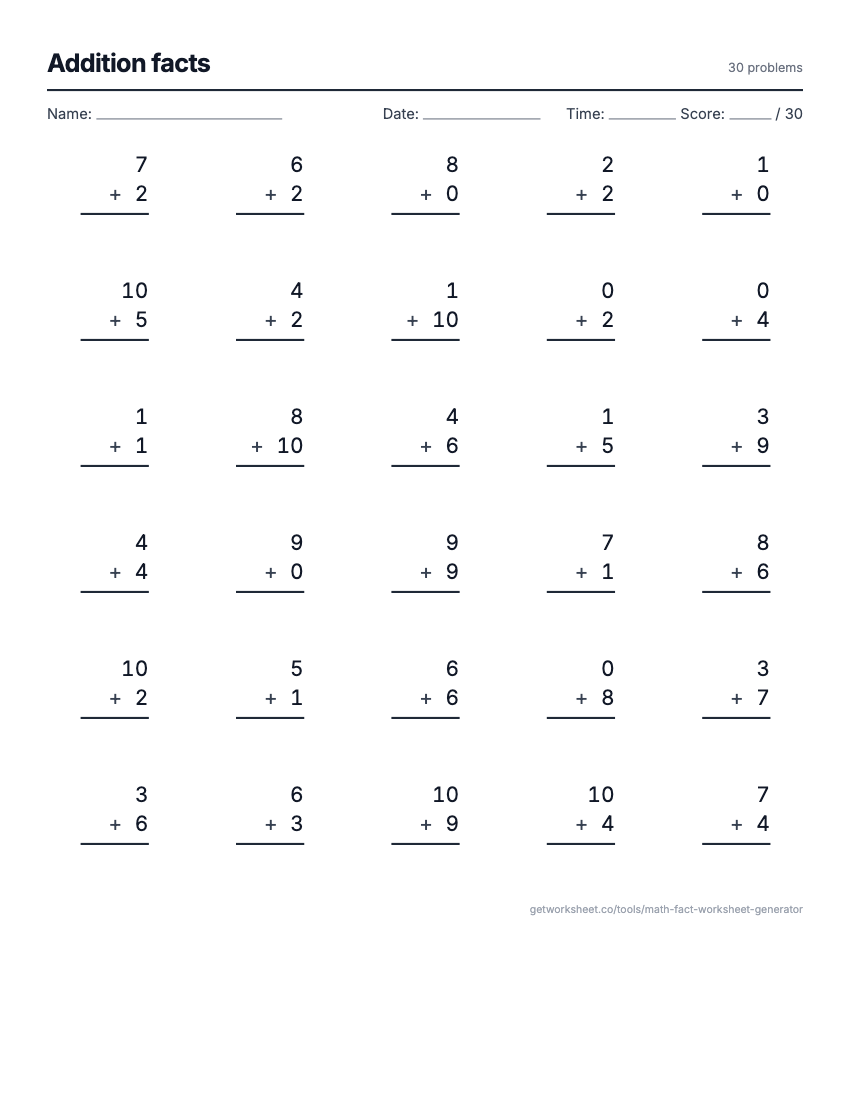 Math fact worksheet generatorAddition to division drills with an answer key. Free to print.
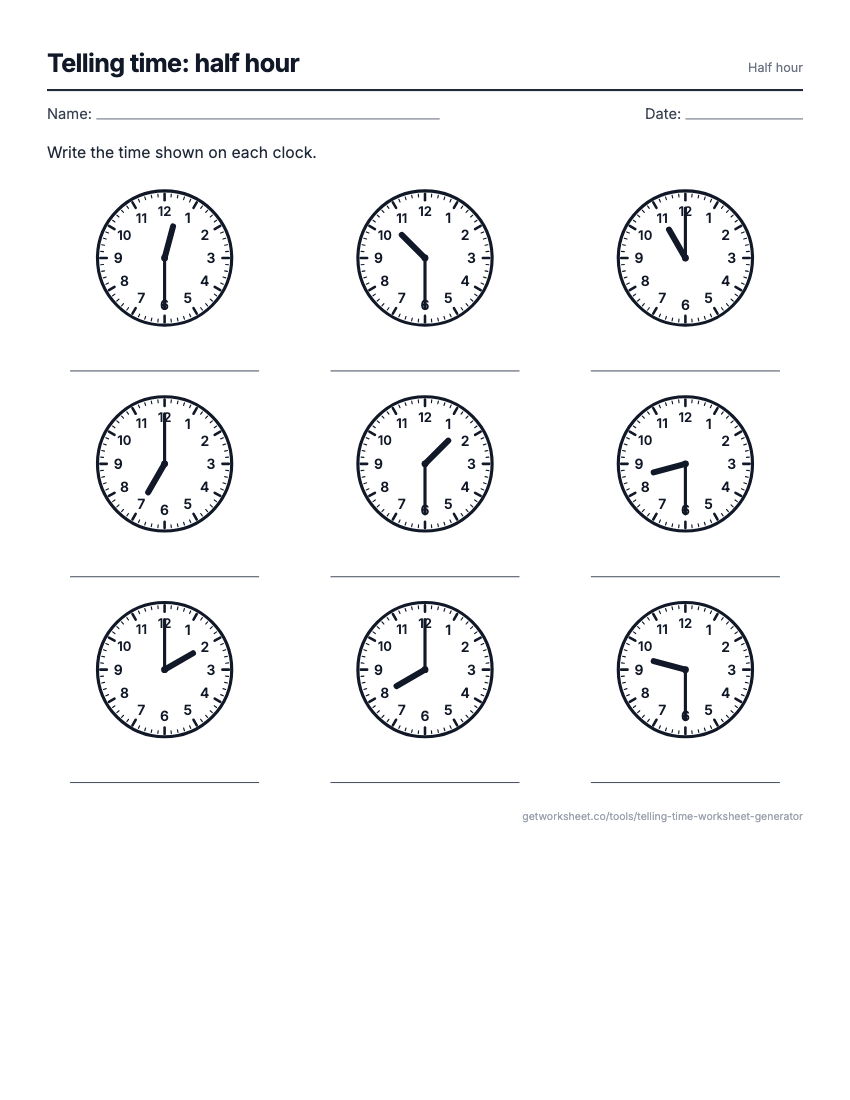 Telling time worksheet generatorAnalogue clocks to read, draw, match or add time to, with answer key. Free to print.
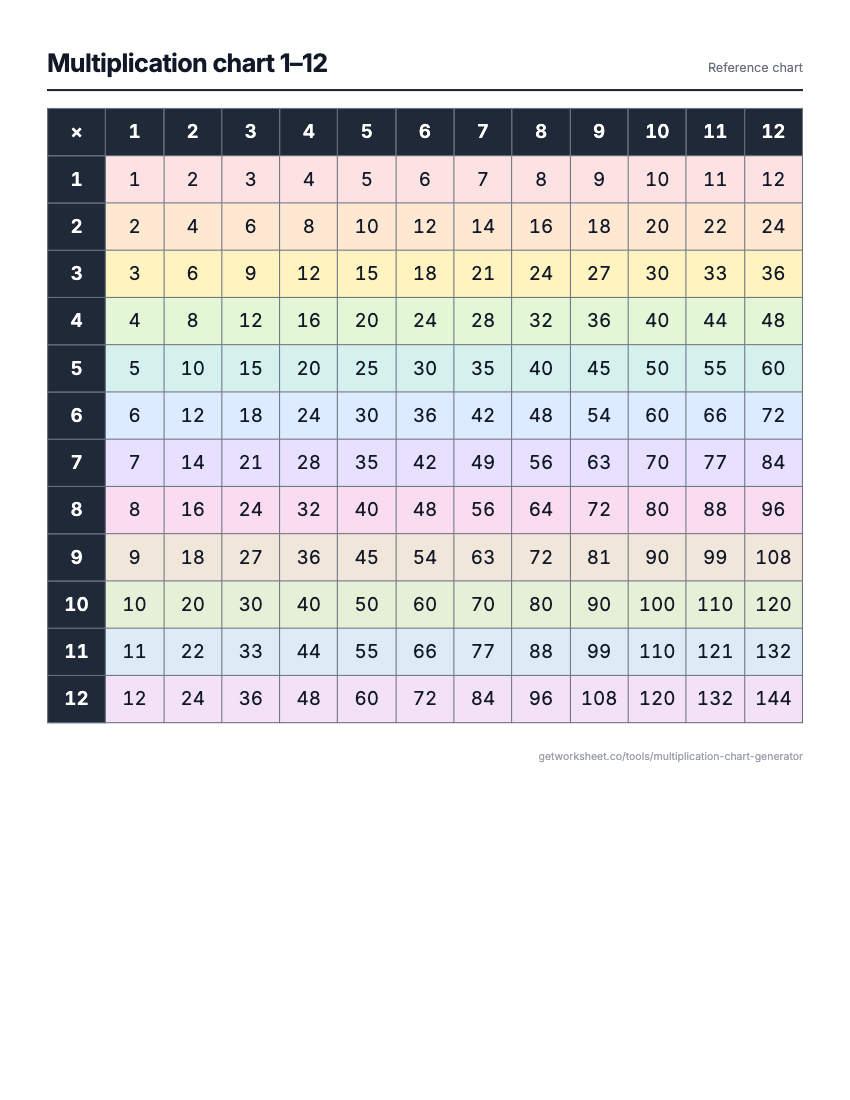 Multiplication chart generatorCharts to 15, full, blank or coloured, and times table tests with key. Free to print.
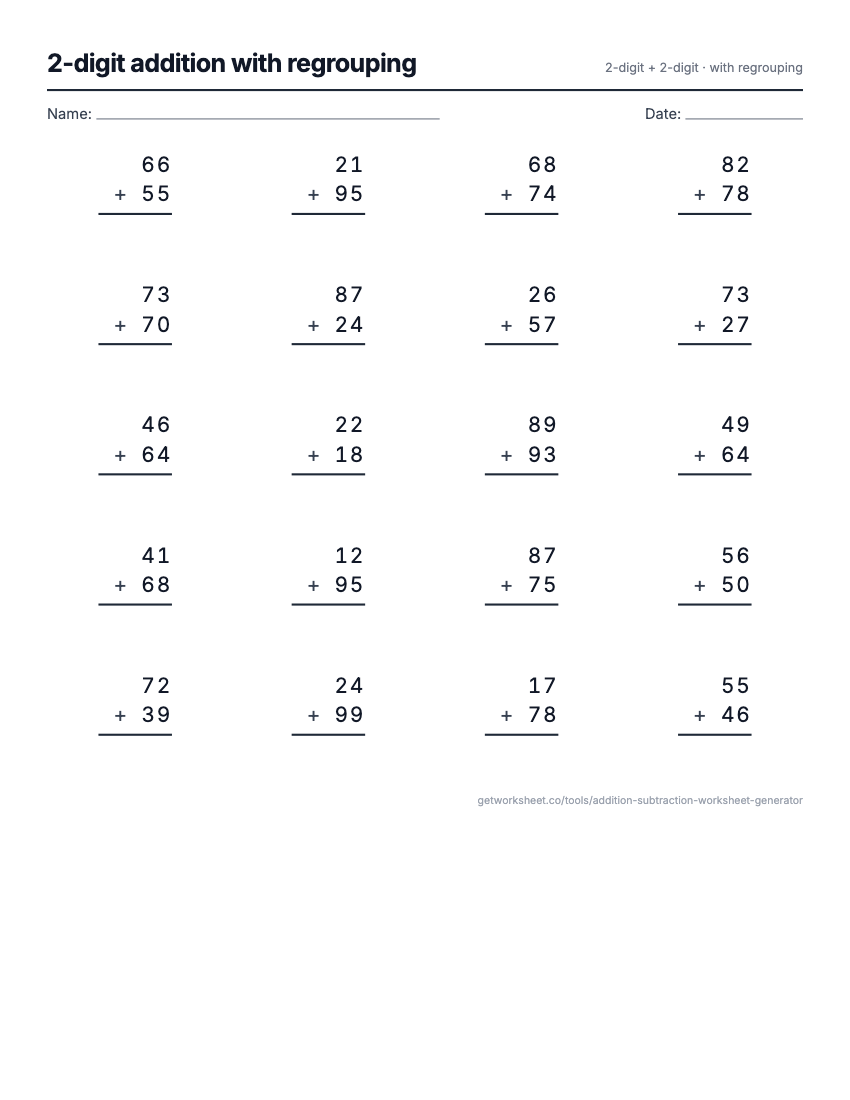 Addition and subtraction generatorColumn add and subtract, regrouping you control, boxes and key. Free to print.
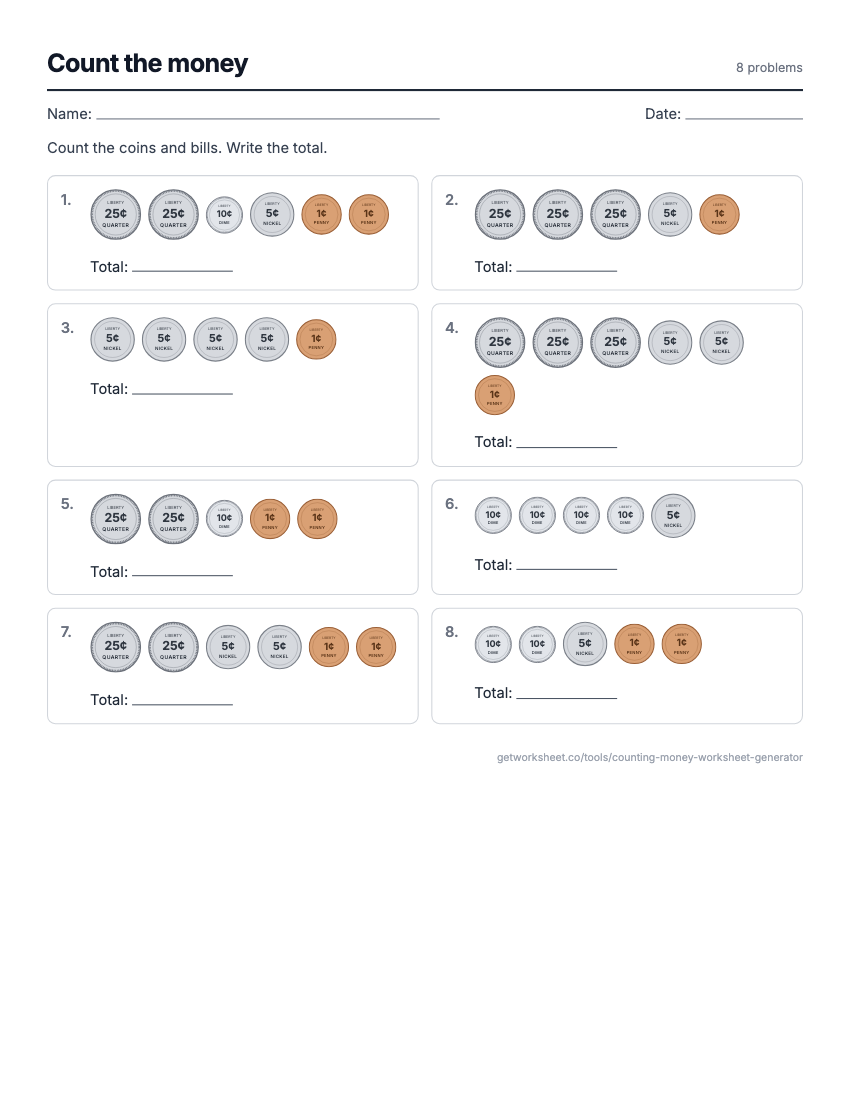 Counting money worksheet generatorCount US coins, make change, compare groups, write amounts. Answer key. Free to print.
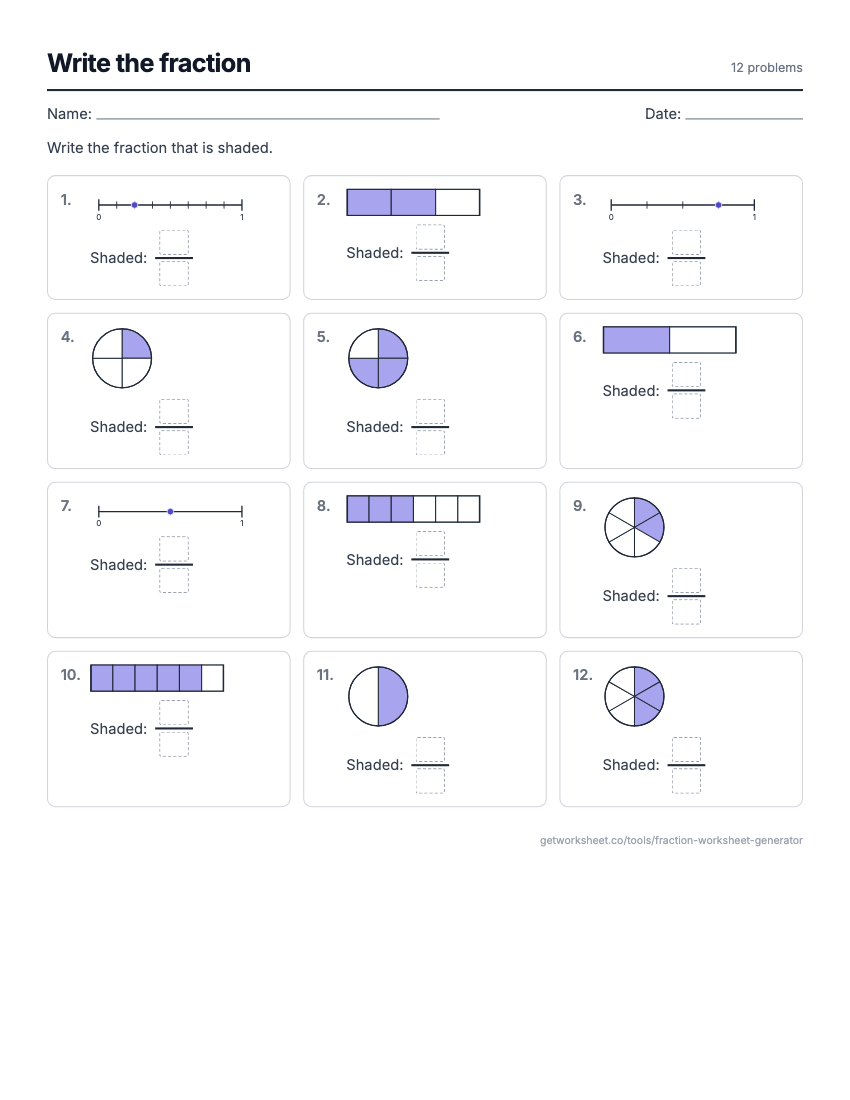 Fraction worksheet generatorVisual pie, bar and number-line models; equivalent, compare, add, subtract. Free to print.
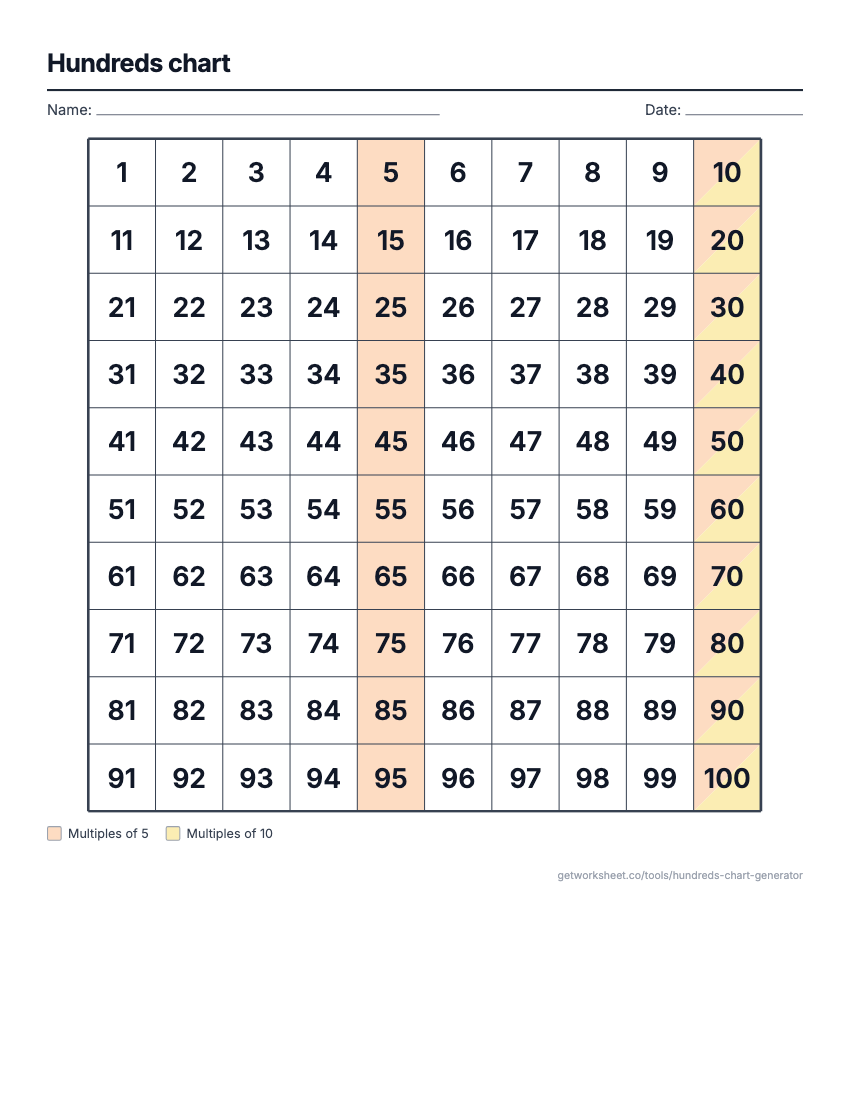 Hundreds chart generator1-100, 1-120 or 0-99, blank or missing numbers, skip-count colours, odd/even. Free to print.
- Worksheet generatorCustom worksheets for any topic, grade and question type.
- Lesson plan generatorStandards-aligned plans with objectives, activities and assessment.