Maths · Kindergarten–Grade 2
Free Montessori place value worksheets (golden beads)
Free printable Montessori place value worksheets using golden beads: count ten-bars and units to write two-digit numbers, add hundred-squares for three-digit numbers, and draw the beads for a given number. PDF download.
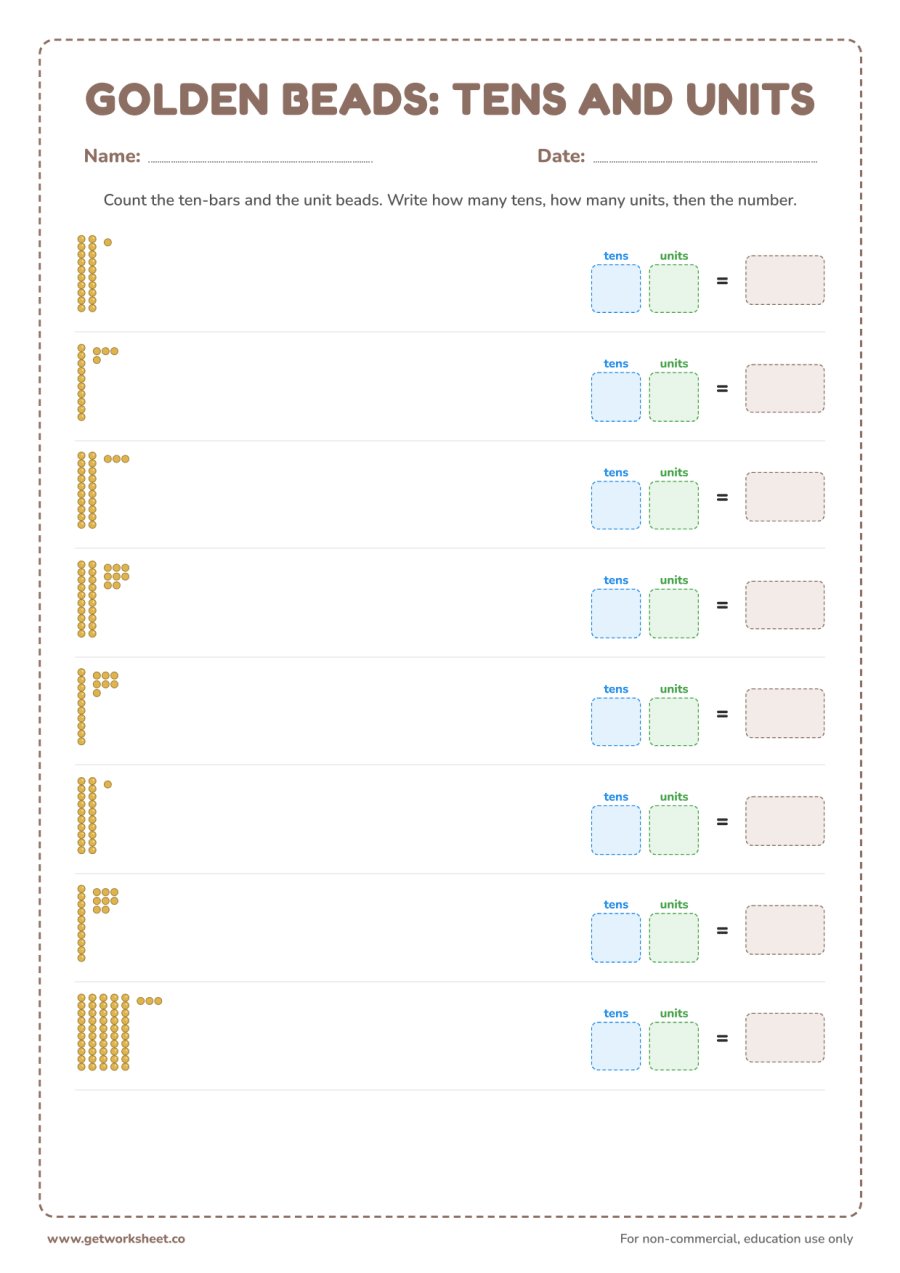
Golden beads: tens and units
Count golden ten-bars and unit beads; write the tens, units and the two-digit number. Free printable PDF.

Golden beads: hundreds, tens and units
Count hundred-squares, ten-bars and units; write each digit in its colour. Free printable PDF.
Whole set
All 3 sheets in one PDF
Free with an account, after a short wait.

Golden beads: draw the number
Draw ten-bars and unit beads to show two-digit numbers. Free printable PDF.
AI worksheet generator
Make a worksheet like this for your class
The 3 sheets above are fixed. The generator writes a new montessori place value (golden beads) worksheet for your grade, with the question types and count you choose, in about 20 seconds. Pick a grade to start:
What you get
- A fresh set of questions on montessori place value (golden beads), not a copy of the sheets above
- Multiple choice, fill in the blanks, true or false, open ended
- Answer key and print-ready PDF with Pro
Free account, 3 worksheets a week. No card.
The golden beads are the Montessori material for place value. One bead is a unit, ten beads on a wire are a ten-bar, ten bars fastened together are a hundred-square, and ten squares stacked are a thousand-cube. A child can hold 1,000 in their hands and see that it is exactly ten hundreds. These three worksheets picture the units, ten-bars and hundred-squares so children can count them and write the number, first with tens and units, then with hundreds, and finally in reverse: given a number, draw the beads.
What Students Will Practice
- Counting ten-bars by tens and unit beads by ones
- Writing the tens digit and the units digit separately, then the whole number
- Counting hundred-squares and reading three-digit numbers
- Using the hierarchy colors: green for units, blue for tens, red for hundreds
- Drawing the golden beads for a given two-digit number
Golden beads are introduced around age 4½ to 5½ and support K.NBT.A.1 (compose and decompose 11 to 19 as ten ones and some further ones) and 1.NBT.B.2 (understand that the two digits of a two-digit number represent tens and ones).
AI worksheet generator
Need a different montessori place value (golden beads) worksheet?
Generate a custom montessori place value (golden beads) worksheet: pick the grade, question types and count, and print it in about 20 seconds. Free accounts get 3 generations a week.
How to Use These Worksheets
Print at 100% on A4 or US Letter paper. Green, blue and red pencils match the hierarchy colors used on the sheets.
- Sheet one: tens and units. Count the ten-bars (“ten, twenty, thirty”), write that digit in the blue box, count the unit beads, write that digit in the green box, then write the whole number. Saying “three tens and four units, thirty-four” every time builds the language of place value.
- Sheet two: hundreds. Hundred-squares appear on the left. Count them by hundreds first. Children who have handled a real hundred-square know it is ten ten-bars; if yours has not, count one row of the square together to show it.
- Sheet three: draw the number. Reverse the process. For 47, draw four lines of ten beads and seven single beads. Dots in a line for a ten-bar are fine; the aim is the right number of bars and units, not artwork.
- Use the place value mat. The golden bead mat on our Montessori worksheets page has columns for thousands, hundreds, tens and units in the same colors. Real beads or drawn beads can be laid on it.
- Read the number out loud. Every row should end with the child reading the whole number. Reading “two hundred and thirty-five” while pointing at squares, bars and beads is the whole lesson.
Common Mistakes to Watch For
- Counting ten-bars as one each: The most common slip. Touch each bar and say “ten, twenty, thirty”.
- Writing the units first: A child who hears “thirty-four” may write the 4 first. Point to the blue box, then the green box, left to right.
- Forgetting zero tens: 105 has one hundred, no tens, five units. If a row has no ten-bars, the tens box needs a 0.
- Drawing the wrong number of beads on a bar: A ten-bar always has ten. Count the dots on the first drawn bar together, then let the child continue.
Frequently Asked Questions
What are Montessori golden beads?
Golden-colored beads used to show the decimal system: a single bead is a unit, a bar of ten beads is a ten, a square of ten bars is a hundred, and a cube of ten squares is a thousand. Children build and read numbers by combining them.
What age are golden beads for?
Usually 4½ to 5½ for the introduction, with the material used through age 6 or 7 for addition, subtraction, multiplication and division with exchanging.
Why are the answer boxes green, blue and red?
Those are the Montessori hierarchy colors: green for units, blue for tens, red for hundreds (and green again for thousands). The same colors appear on the stamp game and the large number cards, so children recognize place value by color across materials.
How is this different from your golden beads counting worksheets?
Our original Montessori beads worksheets focus on counting beads and bead bars. This set moves on to place value: tens and units, then hundreds, and drawing the beads for a given number.
More Montessori Maths
See the whole sequence on the free Montessori worksheets page. The golden beads follow the bead stair worksheets and lead to the teen board and ten board worksheets and later the stamp game worksheets. For the same idea in a standard format, see the ten frame worksheets.
Free library
Related collections

Free Montessori teen board and ten board worksheets
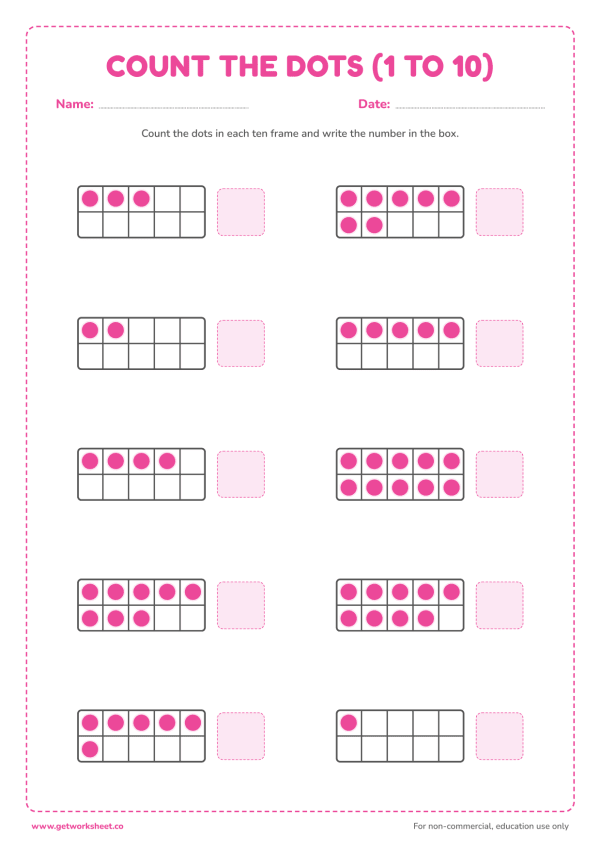
Free ten frame worksheets

Free Montessori stamp game worksheets

Free Montessori bead stair worksheets
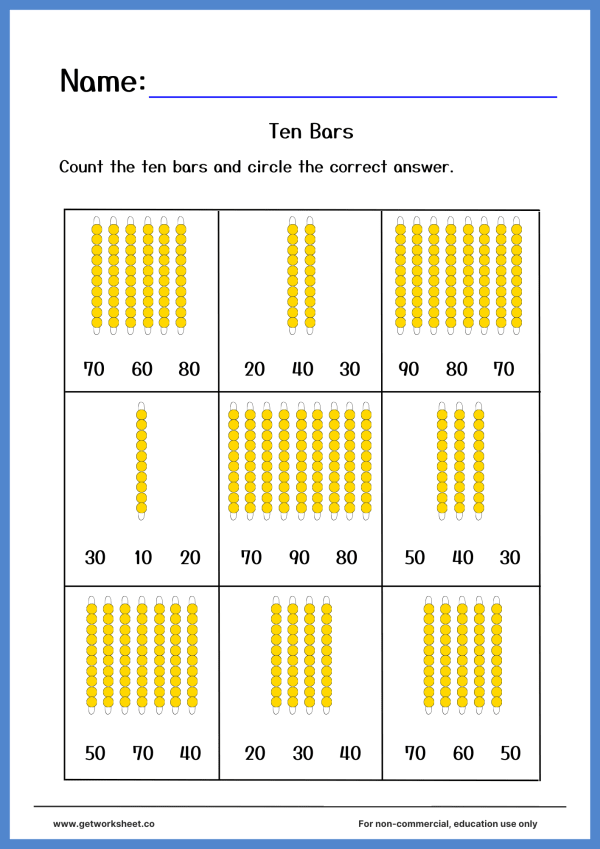
Free Montessori worksheets (PDF)

Free Montessori hundred board worksheets
Free Halloween math worksheets
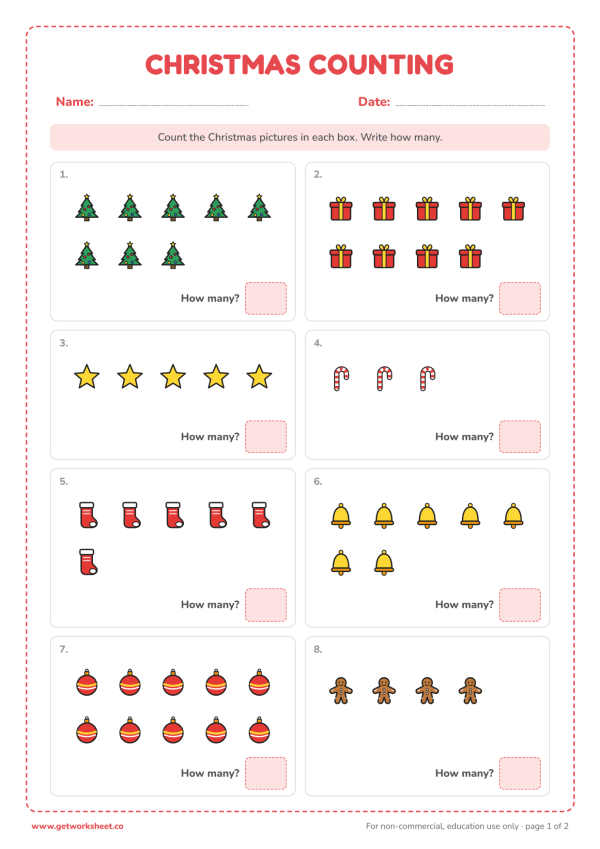
Free Christmas math worksheets
More worksheets
- Free hundreds chart worksheets
- Free repeating patterns worksheets
- Free before and after numbers worksheets
- Free subtraction worksheets (within 10 and 20)
- Free doubles addition worksheets
- Free addition worksheets
- Free 3D shapes worksheets
- Free Montessori math worksheets: one from every material
- Free Montessori sandpaper numerals and cards and counters worksheets
- Free Montessori number rods worksheets
- Free sight words worksheets (Dolch and Fry)
- Free CVC words worksheets