Maths · Grades 1–3
Free Montessori stamp game worksheets
Three stamp game sheets for ages 5 to 8: count green unit and blue ten stamps and write the number, add two groups with no exchanging, and write hundreds, tens and units in colored boxes.
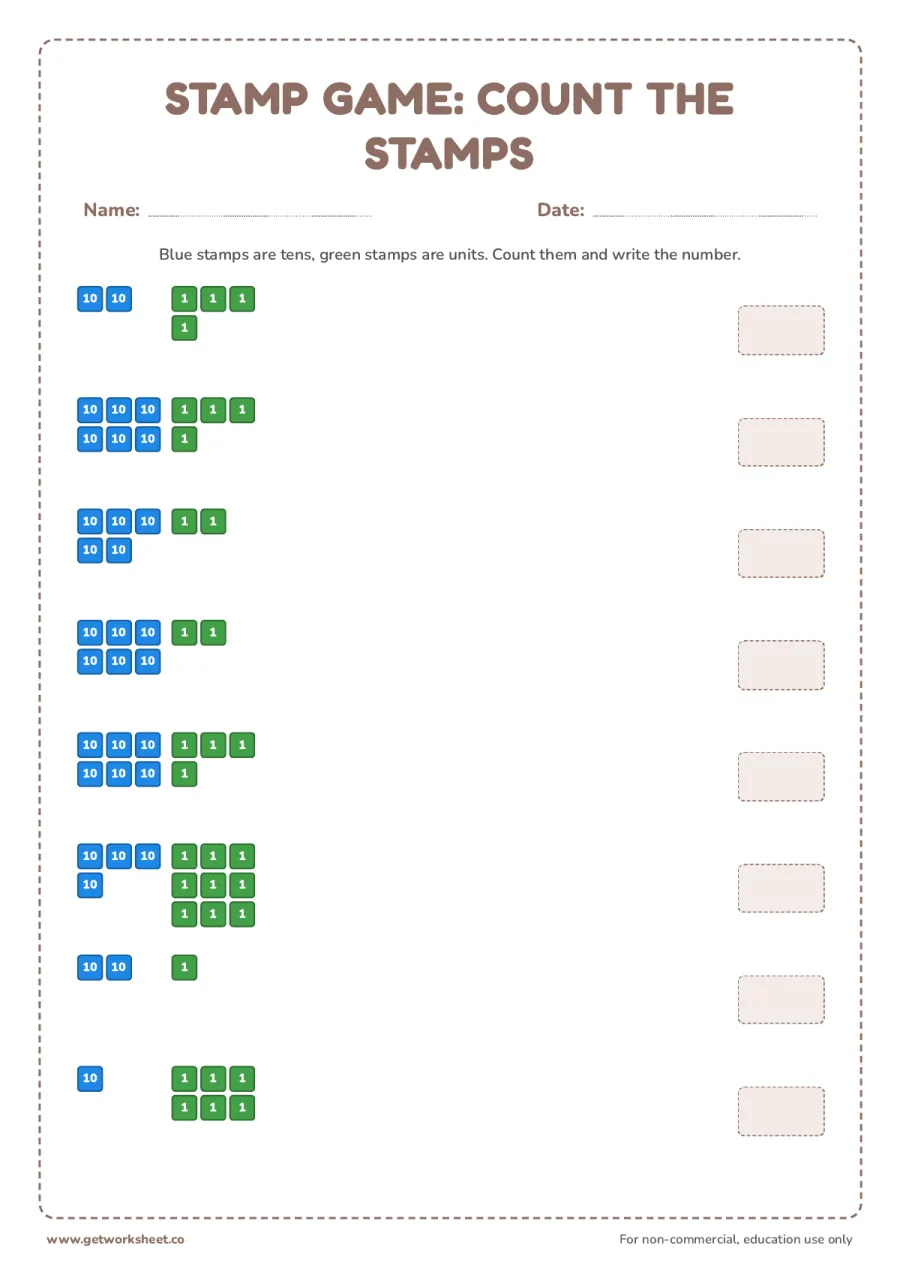
Stamp game: count the stamps
Blue ten-stamps and green unit-stamps; count and write the number. Free printable PDF.
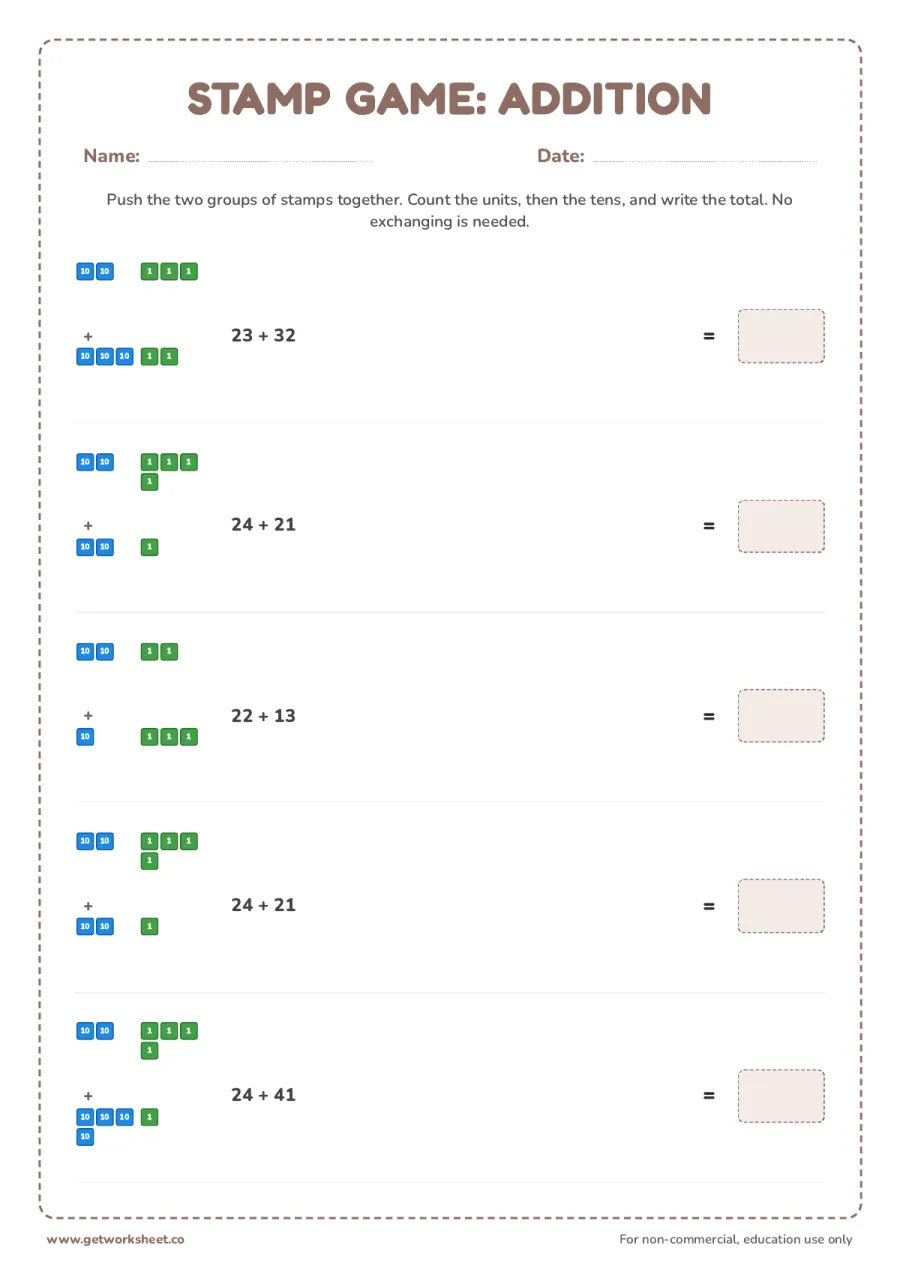
Stamp game: static addition
Add two groups of stamps with no exchanging. Free printable PDF.
Whole set
All 3 in one PDF
- Every sheet on this page, one file
- No ads, no countdowns, print as often as you like
- Instant download, ad-free, no account needed
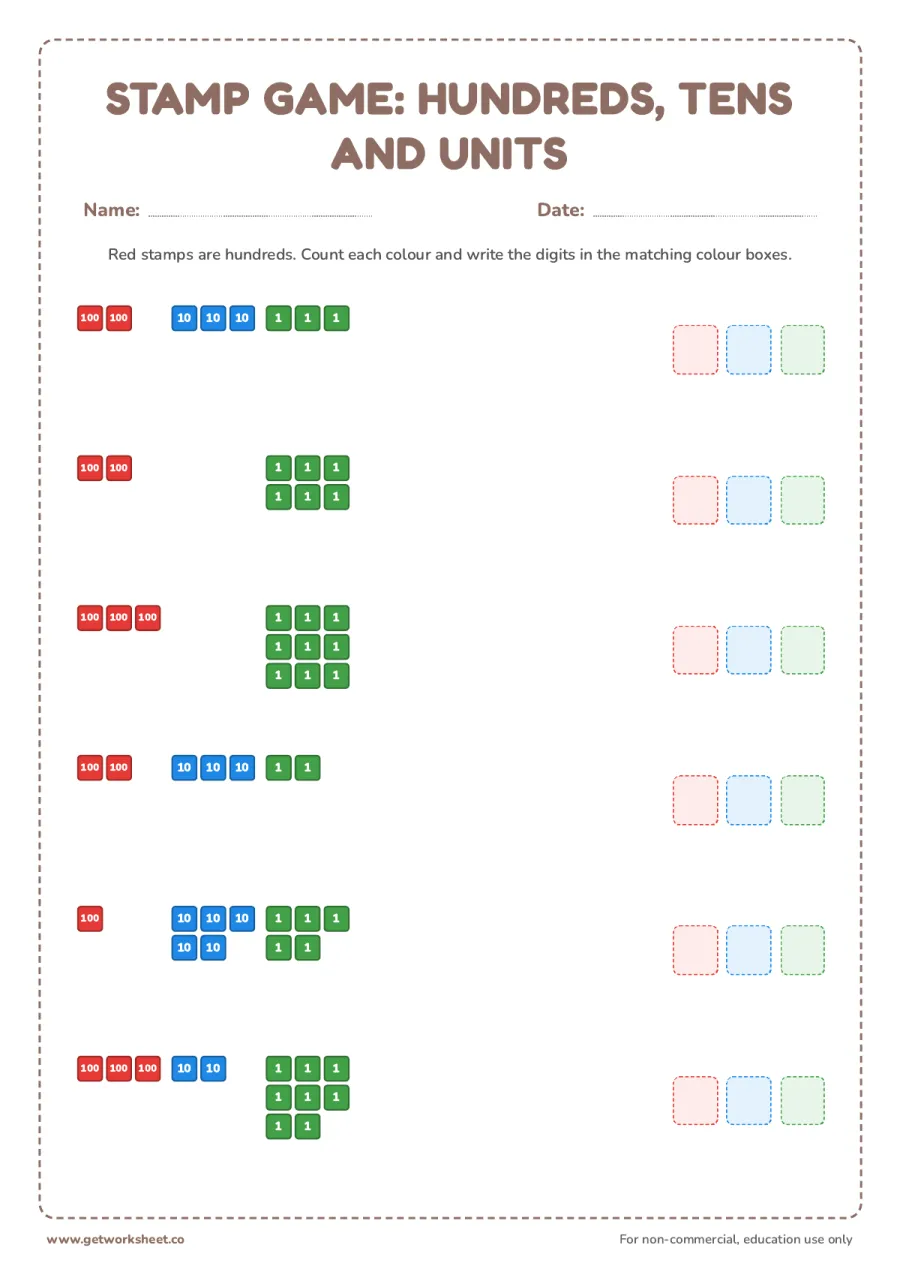
Stamp game: hundreds, tens and units
Red, blue and green stamps; write each digit in its colour box. Free printable PDF.
AI worksheet generator
Make a worksheet like this for your class
The 3 sheets above are fixed. The generator writes a new montessori stamp game worksheet for your grade, with the question types and count you choose, in about 20 seconds. Pick a grade to start:
What you get
- A fresh set of questions on montessori stamp game, not a copy of the sheets above
- Multiple choice, fill in the blanks, true or false, open ended
- Answer key and print-ready PDF with Pro
Free account, 1 worksheets a week. No card.
The stamp game is where Montessori children move from the golden beads to a more abstract material. Instead of a bar of ten beads, a ten is a single small blue tile printed with 10; a unit is a green tile printed with 1; a hundred is a red tile printed with 100. The quantity is no longer visible, only the color and the number, which is one step closer to written arithmetic. These three worksheets picture the stamps in the standard colors. The first asks children to count blue ten-stamps and green unit-stamps and write the number. The second is static addition: two groups of stamps to add with no exchanging. The third adds red hundred-stamps, and children write each digit in its colored box.
The sheets suit children around 5½ to 7 who have already worked with the golden beads and know the hierarchy colors. They can be used as paper follow-up after a lesson with the real stamps, or as a home introduction when the material is not available. They support 1.NBT.B.2 (place value of two-digit numbers), 1.NBT.C.4 (add within 100) and 2.NBT.A.1 (hundreds, tens and ones).
What Students Will Practice
- Recognizing the stamp colors: green 1, blue 10, red 100
- Counting stamps of each kind and writing the number they make (sheet one)
- Static addition: combining two groups of stamps, units first then tens, with no exchanging (sheet two)
- Reading hundreds, tens and units and writing each digit in its color box (sheet three)
- Moving from concrete quantity (beads) to symbolic quantity (stamps)
Free printable makers
Make your own montessori stamp game sheets
Type your own words or numbers and print in about 30 seconds. No account, no AI, answer key where it applies.
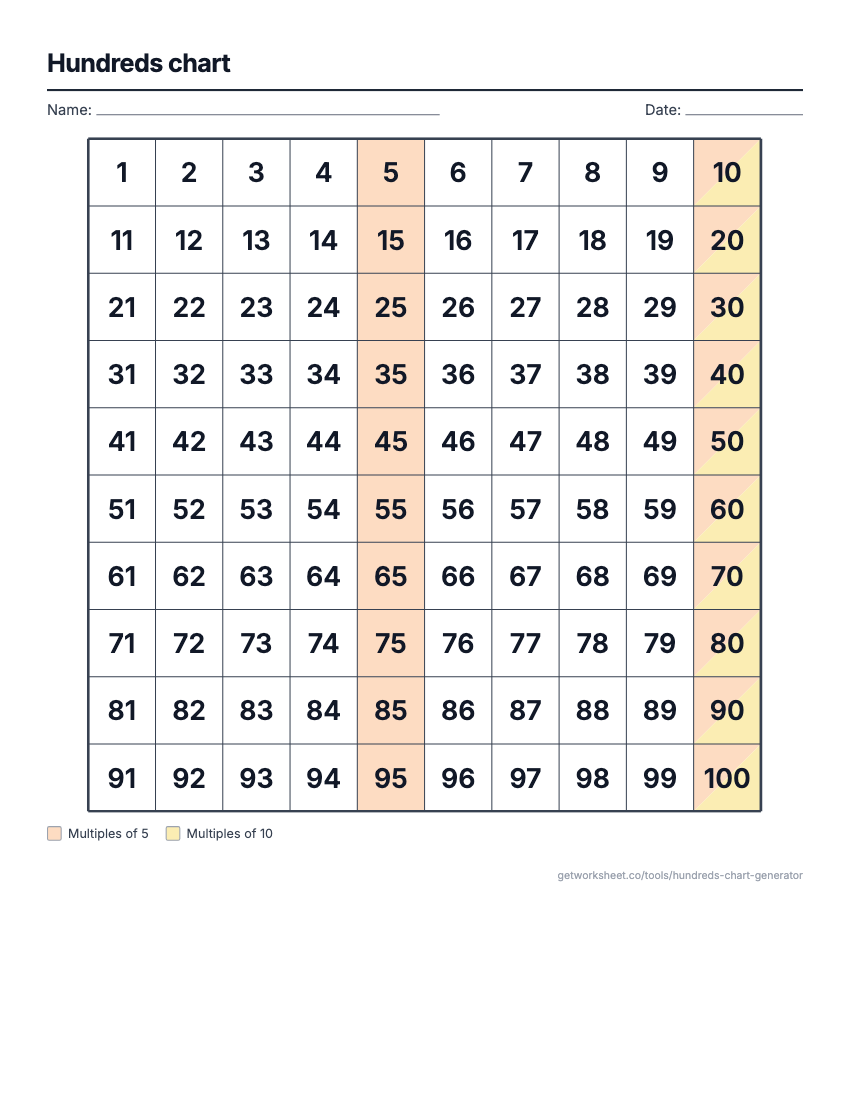 Hundreds chart generator1-100, 1-120 or 0-99, blank or missing numbers, skip-count colours, odd/even. Free to print.
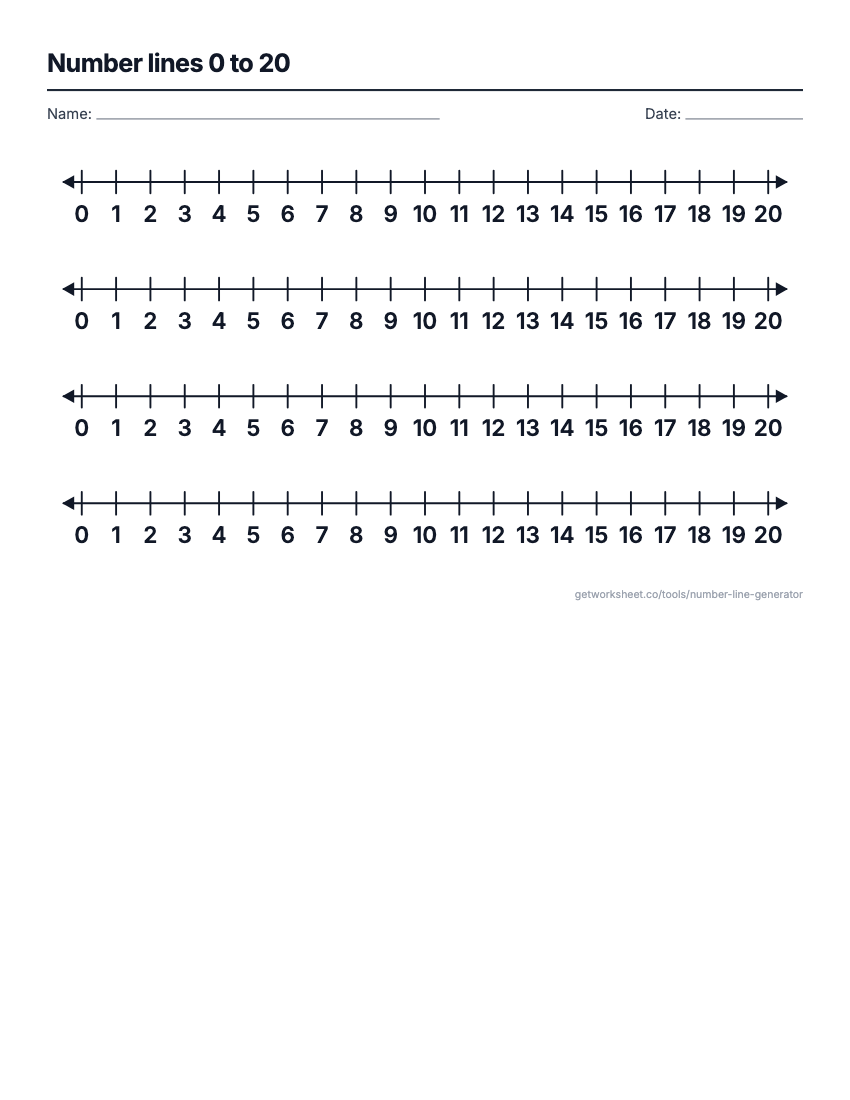 Number line generatorAny range and step, fractions and decimals, blank or missing numbers with a key. Free to print.
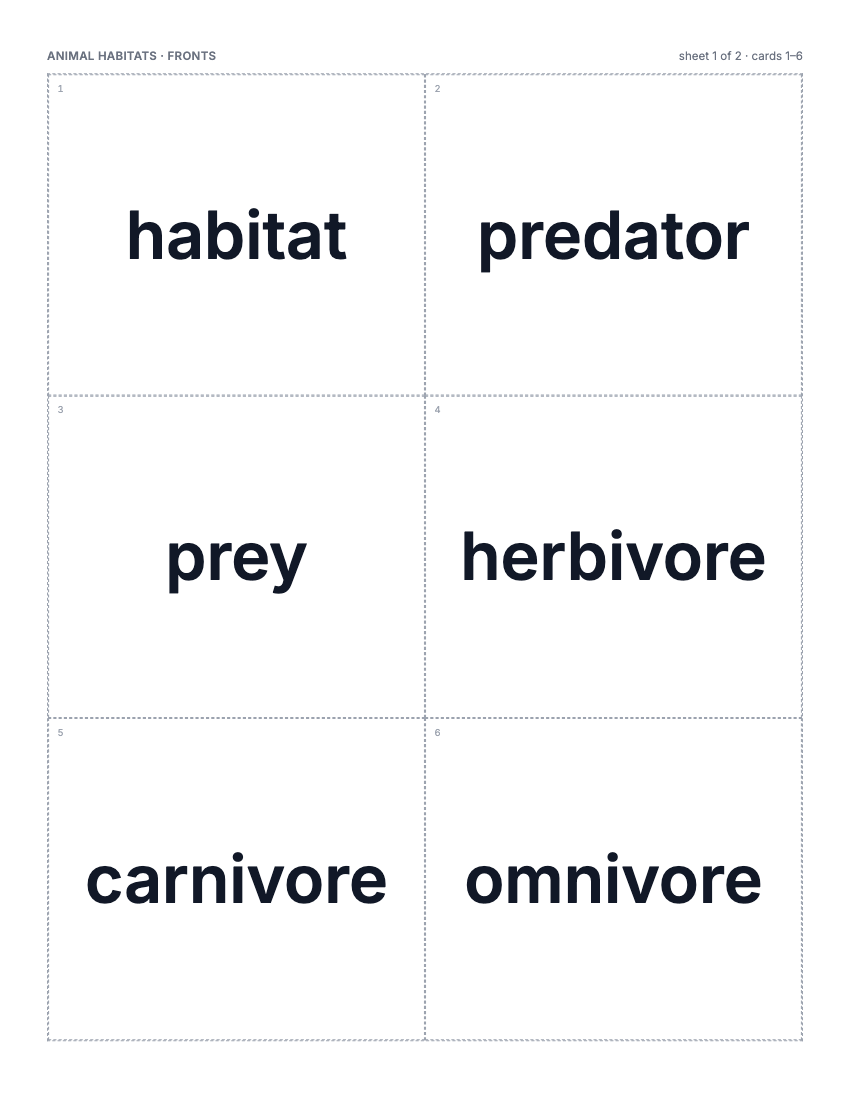 Flashcard makerVocabulary, math fact or sight word cards, 2-8 a page, two-sided or fold-over. Free to print.
AI worksheet generator
Need a different montessori stamp game worksheet?
Generate a custom montessori stamp game worksheet: pick the grade, question types and count, and print it in about 20 seconds. Free accounts get 1 generation a week.
Teaching tips and common mistakes
How to Use These Worksheets
Print at 100% on A4 or US Letter paper. Green, blue and red pencils match the stamps.
- Sheet one: count the stamps. Tens are on the left, units on the right, as they would be on a place value mat. Count the blue stamps by tens, the green stamps by ones, and write the number. Say “four tens and six units, forty-six”.
- Sheet two: static addition. Two groups of stamps, one above the other. Push them together in your mind: count all the units first, then all the tens, and write the total. The problems are chosen so no column reaches ten, so there is no exchanging yet.
- Sheet three: hundreds. Red stamps are hundreds. Write the count of each color in the matching colored box, left to right. Read the whole number out loud at the end.
- Make your own stamps. Small squares of green, blue and red card with 1, 10 and 100 written on them turn any of these sheets into a hands-on activity. Lay the stamps on the golden bead mat from our Montessori worksheets page.
- Connect to beads. If a child is unsure what a blue 10 stamp means, put a golden ten-bar beside it. The stamp is the bar, folded up.
Common Mistakes to Watch For
- Counting all stamps as one: Point to the color and the number on the stamp. Blue says 10; count it as ten.
- Adding tens before units: Not wrong here, since there is no exchanging, but the habit of units first matters later. Model it.
- Mixing up the colors: Green units, blue tens, red hundreds is the same on every Montessori material. Keep the bead color and place value charts nearby.
- Leaving a column blank when there are no stamps: No blue stamps means a 0 in the tens box, not an empty box.
Frequently Asked Questions
What is the Montessori stamp game?
A box of small square tiles, or stamps: green marked 1 for units, blue marked 10 for tens, red marked 100 for hundreds and green marked 1000 for thousands. Children lay out numbers with the stamps and perform addition, subtraction, multiplication and division by moving them.
What age is the stamp game for?
Around 5½ to 6½ for static work (no exchanging), and through age 7 or 8 for dynamic operations with exchanging. It follows the golden beads.
What does static addition mean?
Addition where no column adds up to ten or more, so nothing has to be exchanged. 23 + 45 is static; 27 + 45 is dynamic because 7 + 5 needs a ten exchanged. These worksheets are all static.
Why are the stamps colored?
Green, blue and red are the Montessori hierarchy colors for units, tens and hundreds. They are the same on the large number cards and the bead frame, so a child recognizes place value by color across every material.
More Montessori Maths
See the whole sequence on the free Montessori worksheets page. The stamp game follows the golden beads place value worksheets and the teen board worksheets, and pairs with the hundred board worksheets. Children ready for conventional arithmetic can move on to the addition worksheets.
Free library
Related collections
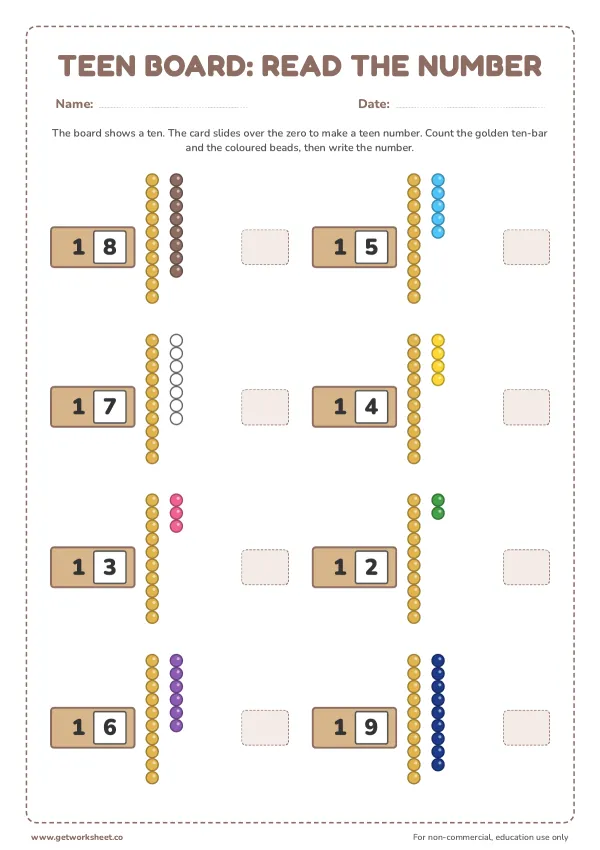
Free Montessori teen board and ten board worksheets
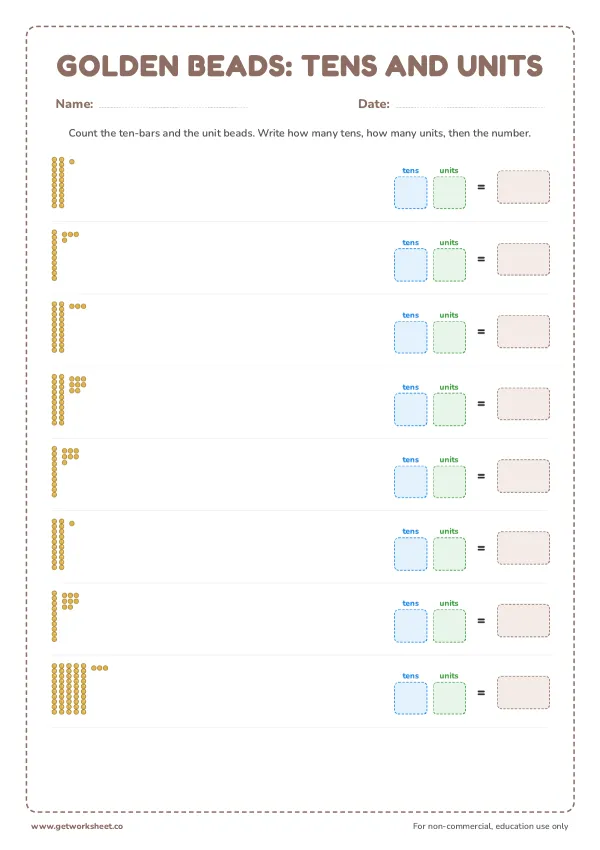
Free Montessori place value worksheets (golden beads)
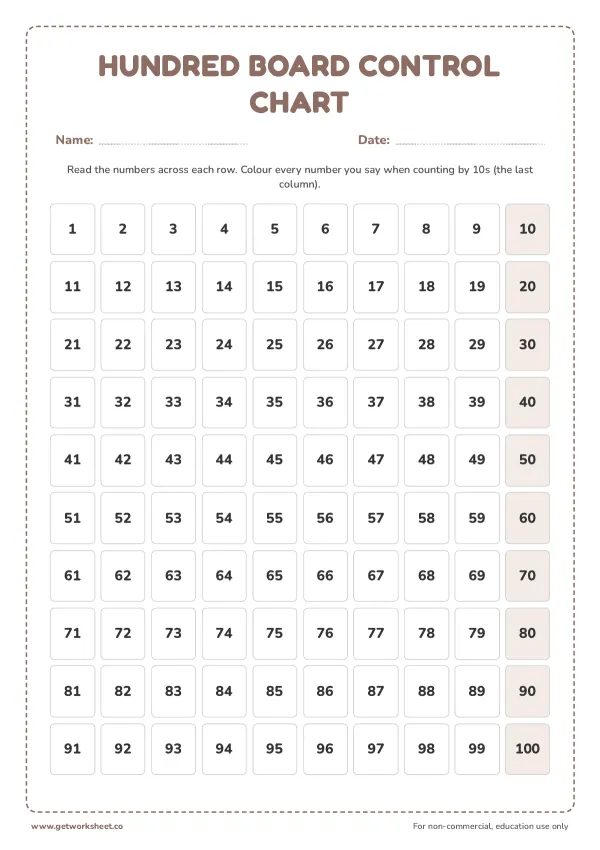
Free Montessori hundred board worksheets
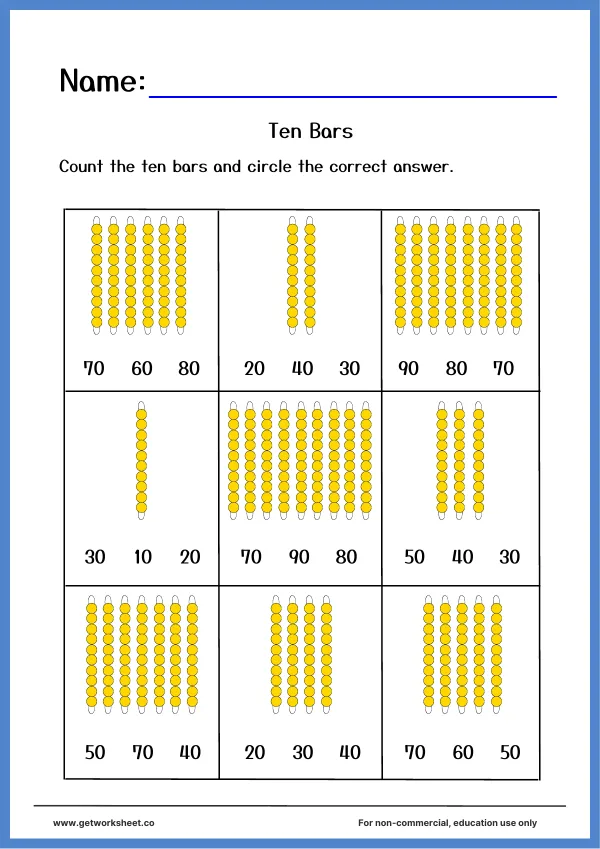
Free Montessori worksheets (PDF)
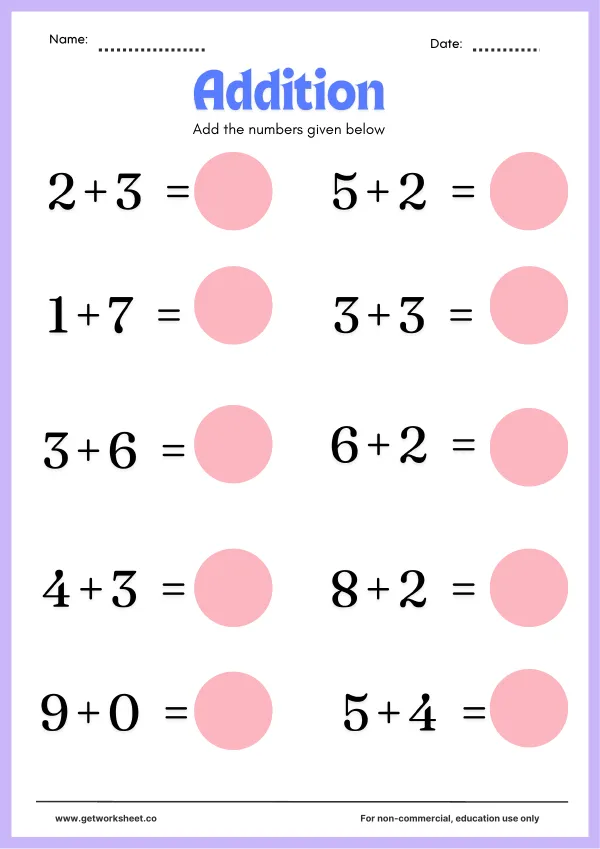
Free addition worksheets
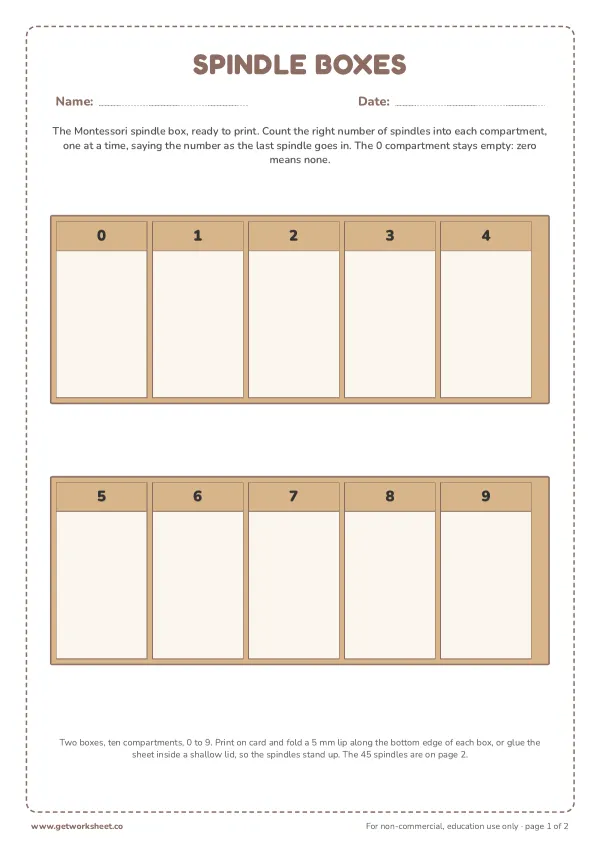
Free Montessori spindle box worksheets
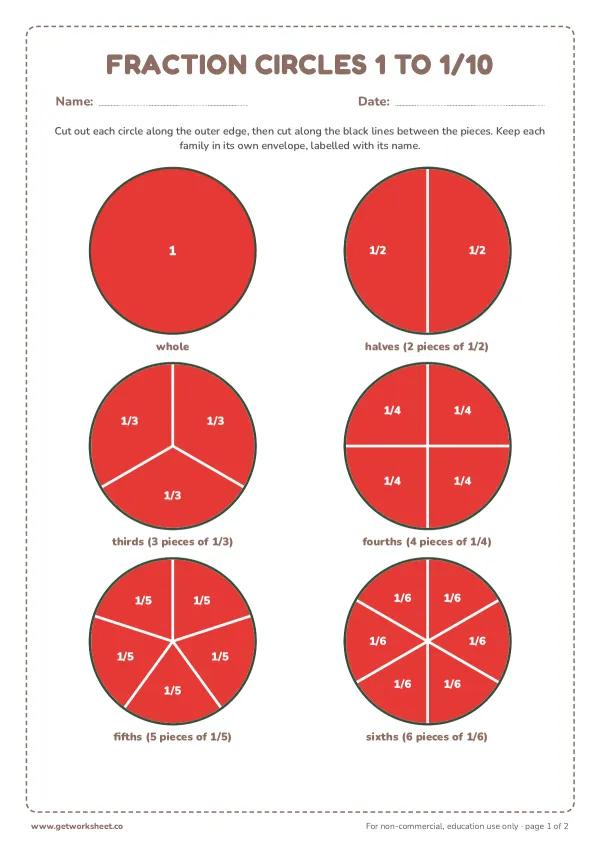
Free Montessori fraction circles worksheets
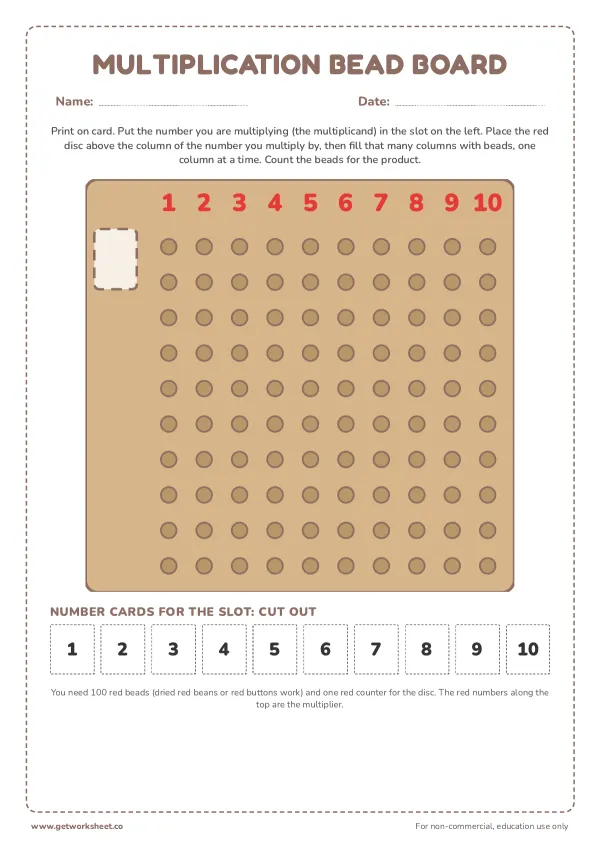
Free Montessori multiplication board worksheets
More worksheets
- Free Montessori addition strip board worksheets
- Free Montessori math worksheets: one from every material
- Free Montessori bead stair worksheets
- Free Montessori sandpaper numerals and cards and counters worksheets
- Free Montessori number rods worksheets
- Free 100th day of school worksheets
- Free penguin worksheets
- Free snowman worksheets
- Free winter worksheets for preschool and kindergarten
- Free winter tracing worksheets
- Free winter break packet worksheets
- Free long division worksheets