Rounding Numbers Worksheets
Free rounding numbers worksheets with answer keys. Practice rounding to tens, hundreds, thousands, and decimals — printable PDFs for grades 3-6.
Rounding is one of those math skills that shows up everywhere — estimating a grocery bill, reporting a distance, interpreting population figures, or checking if a calculated answer makes sense. These worksheets teach students the rules of rounding and, more importantly, when and why rounding is useful. The core idea is simple: look at the digit to the right of where you're rounding, and decide whether to round up or keep the same.
What Students Will Practice
- Rounding whole numbers to the nearest 10 (e.g., 47 rounds to 50, 83 rounds to 80)
- Rounding to the nearest 100 and 1,000 (e.g., 6,482 rounds to 6,500 or 6,000 depending on which place)
- Understanding the rounding rule: if the digit to the right is 5 or more, round up; if it's 4 or less, round down
- Rounding decimals to the nearest whole number, tenth, or hundredth (e.g., 3.847 rounded to the nearest tenth is 3.8)
- Using rounding to estimate sums, differences, and products before calculating (e.g., 493 + 217 ≈ 500 + 200 = 700)
- Identifying which place to round to based on context (rounding money to the nearest cent vs. dollar vs. hundred dollars)
Rounding aligns with 3rd-6th grade math standards for estimation, place value understanding, and number sense. It's also a prerequisite for working with significant figures in science.
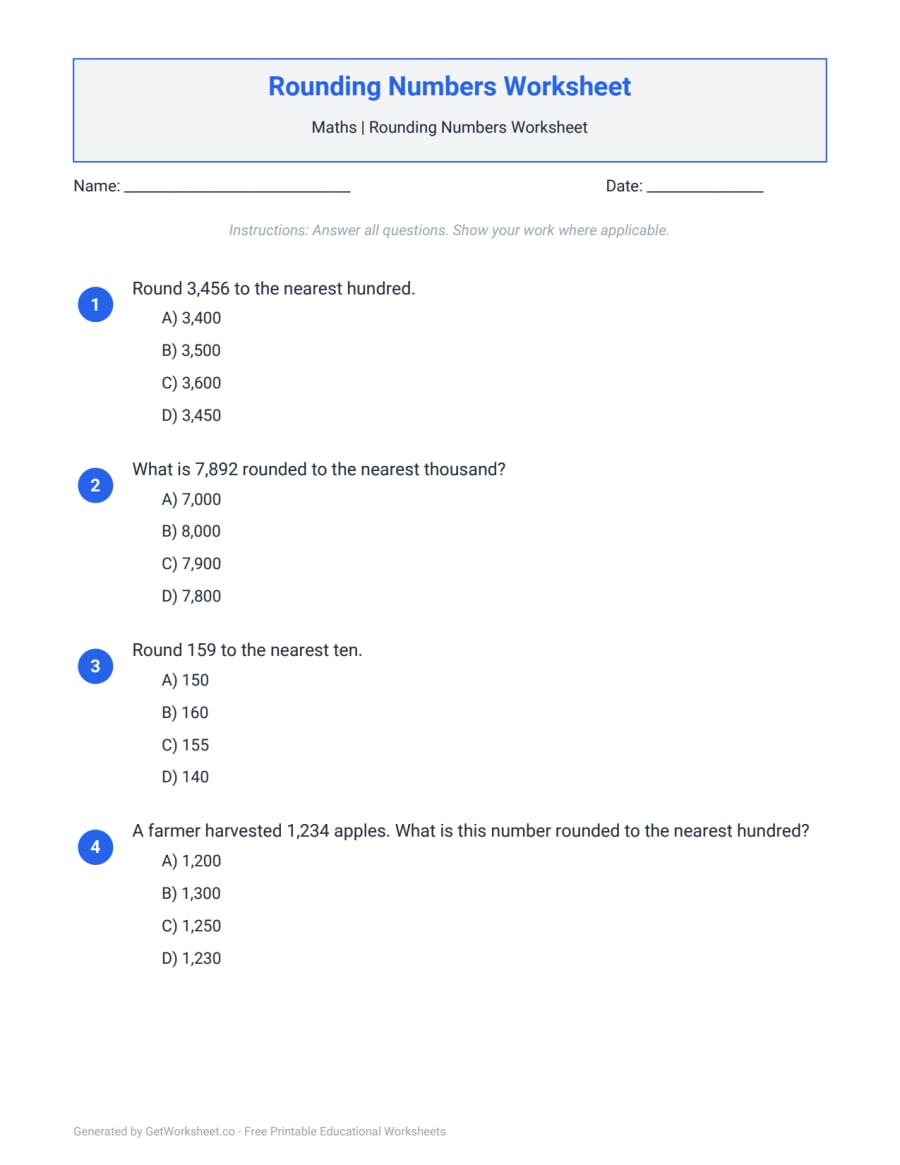
Rounding Numbers Worksheet
Free printable rounding numbers worksheet with answer keys. Ideal for homework, skill reinforcement, or extra practice in rounding skills.

Rounding Numbers Worksheet
Free printable rounding numbers worksheets with answer keys. Great for homework, extra practice, or enhancing math skills at home.
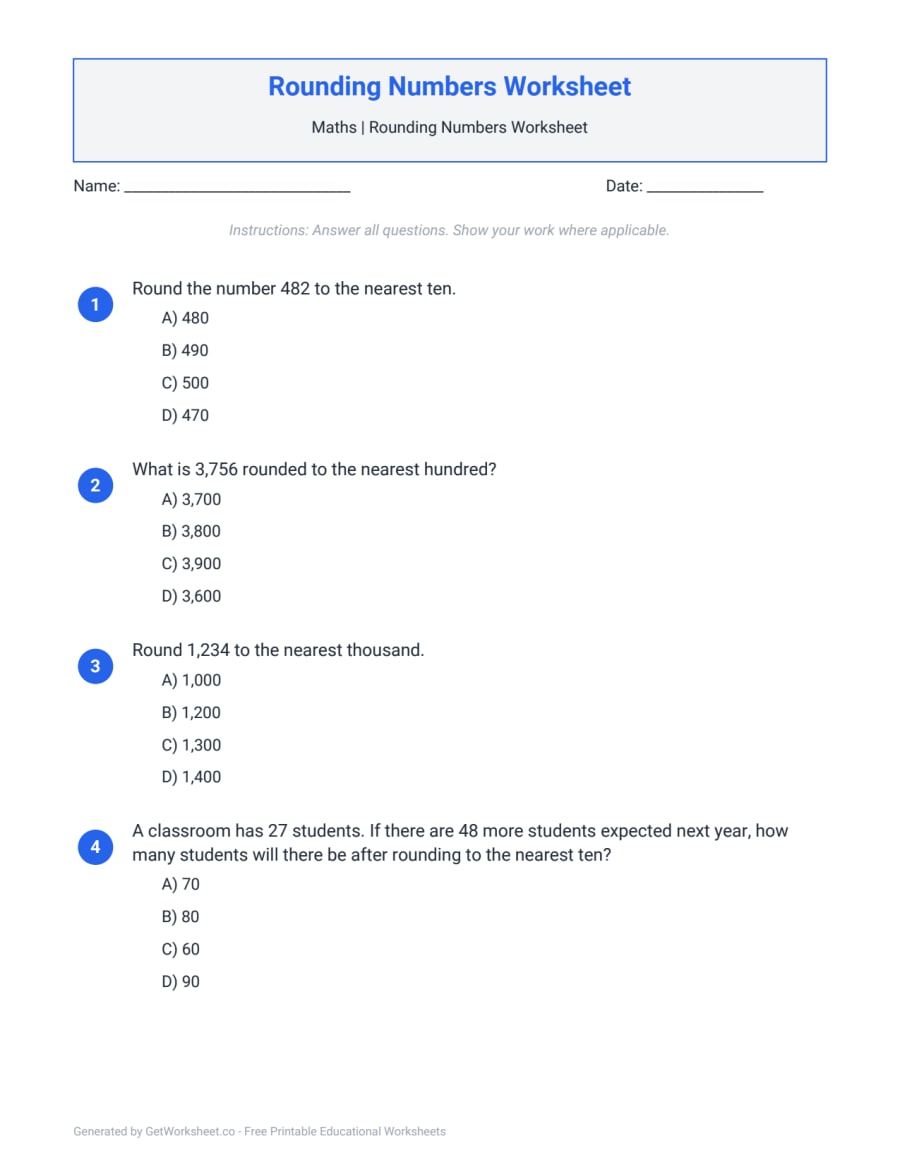
Rounding Numbers Worksheet
Free printable rounding numbers worksheets with answer keys. Perfect for homework, extra practice, or support in understanding rounding concepts.
How to Use These Worksheets
Rounding is mechanical once you know the steps — the challenge is remembering which digit to look at.
- Teach the "underline and circle" method: underline the digit in the place you're rounding to, then circle the digit immediately to its right. The circled digit is the decision-maker. If it's 5-9, the underlined digit goes up by one. If it's 0-4, the underlined digit stays the same. Everything to the right becomes zeros (or is dropped for decimals).
- Use number lines for visual learners. To round 67 to the nearest 10, draw a number line from 60 to 70. Where does 67 fall? It's closer to 70. Number lines make rounding intuitive instead of procedural, especially for students who struggle with the "5 or more" rule.
- Practice estimation as a real skill, not just a worksheet exercise. Before your child adds two numbers, have them round both and estimate the sum. Then calculate exactly. If the estimate and exact answer are far apart, something went wrong. This builds the habit of checking work automatically.
- Progress from rounding whole numbers (tens, hundreds) to rounding decimals (tenths, hundredths). The rule is identical — only the place changes. Students who are solid on rounding 482 to the nearest hundred will transfer easily to rounding 4.82 to the nearest tenth.
Common Mistakes to Watch For
- Looking at the wrong digit: When rounding 5,847 to the nearest hundred, students should look at the 4 (tens digit) to decide. Many students look at the 7 (ones digit) or the 5 (thousands digit) instead. The "underline and circle" method prevents this — the circled digit is always immediately to the right of the one being rounded.
- Rounding the wrong direction on 5: The rule says 5 rounds up — so 450 rounded to the nearest hundred is 500, not 400. Some students think 5 is "in the middle" and round down. Be firm on this: 5 and above always rounds up in standard rounding.
- Changing digits to the left of the rounding place: When rounding 3,982 to the nearest hundred, the answer is 4,000 — the 3 in the thousands place changes to 4 because rounding up 9 to 10 carries over. Students who don't expect this carry-over write 3,000 instead of 4,000.
- Replacing digits with zeros incorrectly in decimals: Rounding 6.847 to the nearest tenth gives 6.8 — you drop the remaining digits, not replace them with zeros. Students sometimes write 6.800 thinking they need to fill the original number of decimal places.
Frequently Asked Questions
When should kids start learning to round?
Rounding to the nearest 10 and 100 is introduced in 3rd grade. Rounding larger numbers (thousands, ten thousands) comes in 4th grade. Rounding decimals is typically a 5th grade skill. Estimation using rounding should be practiced alongside exact computation from 3rd grade onward.
Why does my child get exact answers right but estimation wrong?
Estimation requires a different mindset — students need to decide what level of precision is enough and work with approximate values. Kids trained to always find the exact answer may resist rounding because it feels "wrong" to change numbers. Emphasize that estimation is a separate, valuable skill used in real life far more often than exact calculation.
Should rounding always follow the "5 rounds up" rule?
In school math, yes — this is the standard convention. In statistics and science, there's an alternative called "banker's rounding" where 5 rounds to the nearest even number. But for elementary and middle school, always round 5 up. Your child doesn't need to worry about alternative rounding rules yet.
How does rounding connect to real life?
You round constantly without thinking about it: estimating if you have enough cash for groceries ("that's about $5, $3, $7... roughly $15"), reading news about population ("approximately 8 billion people"), or checking distances on a map ("about 200 miles"). Teaching rounding as a life skill — not just a math exercise — makes it meaningful.
After mastering rounding, students can apply estimation to more complex operations — estimating products and quotients, working with compatible numbers, and eventually understanding significant figures in scientific measurement.