English · Grades 1–4
Free punctuation worksheets
Five printable punctuation worksheets for grades 1 to 4: tick the right end mark for sixteen sentences, add commas to ten lists, choose the correct apostrophe in twelve items, rewrite eight lines of dialogue with quotation marks, and proofread a beach story with fifteen errors. Answer keys included.
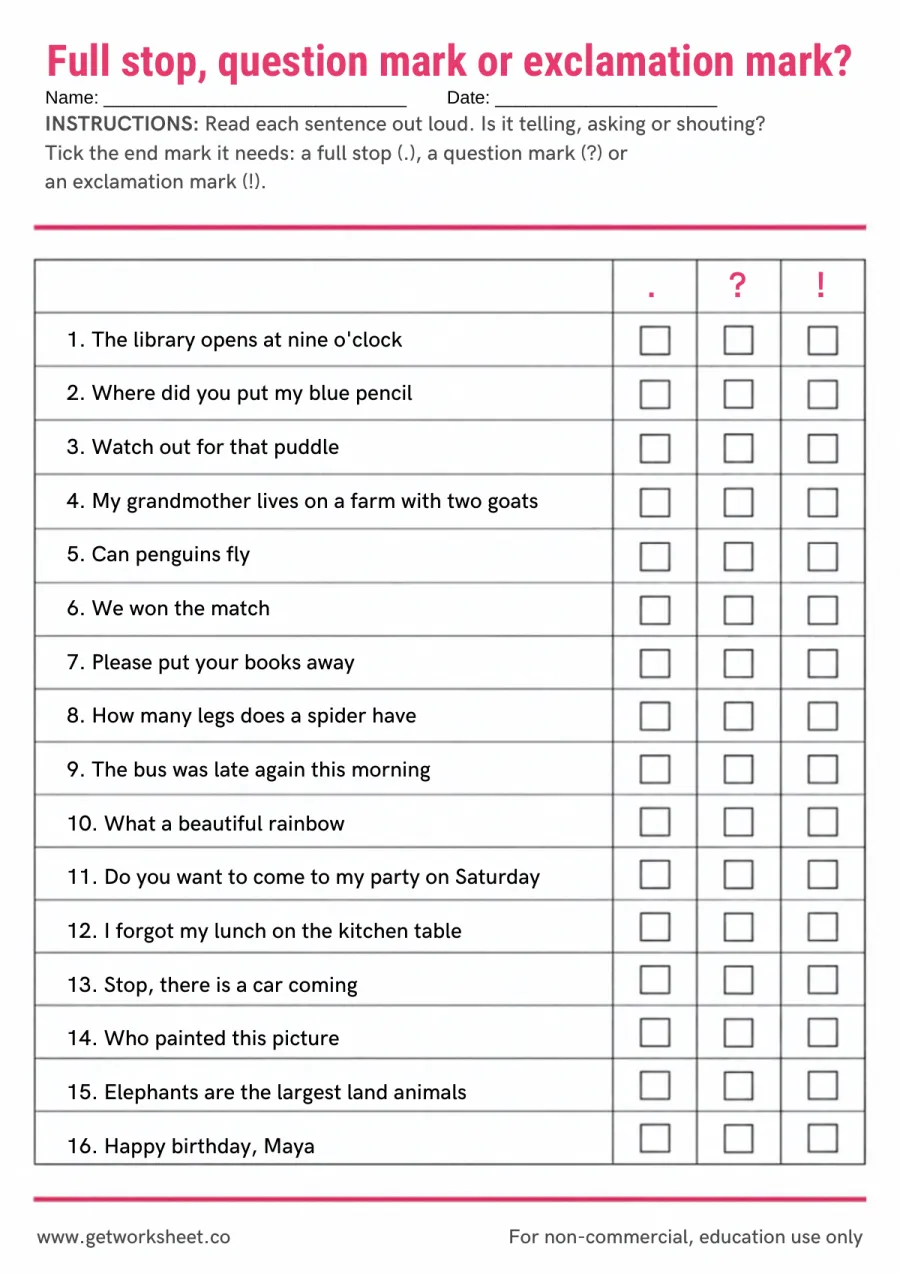
Full stop, question mark or exclamation mark? 16 sentences to finish
Sixteen sentences with the end mark missing. Students tick the full stop, question mark or exclamation mark that each one needs: statements, questions, commands and strong feelings. Answer key on page 2.
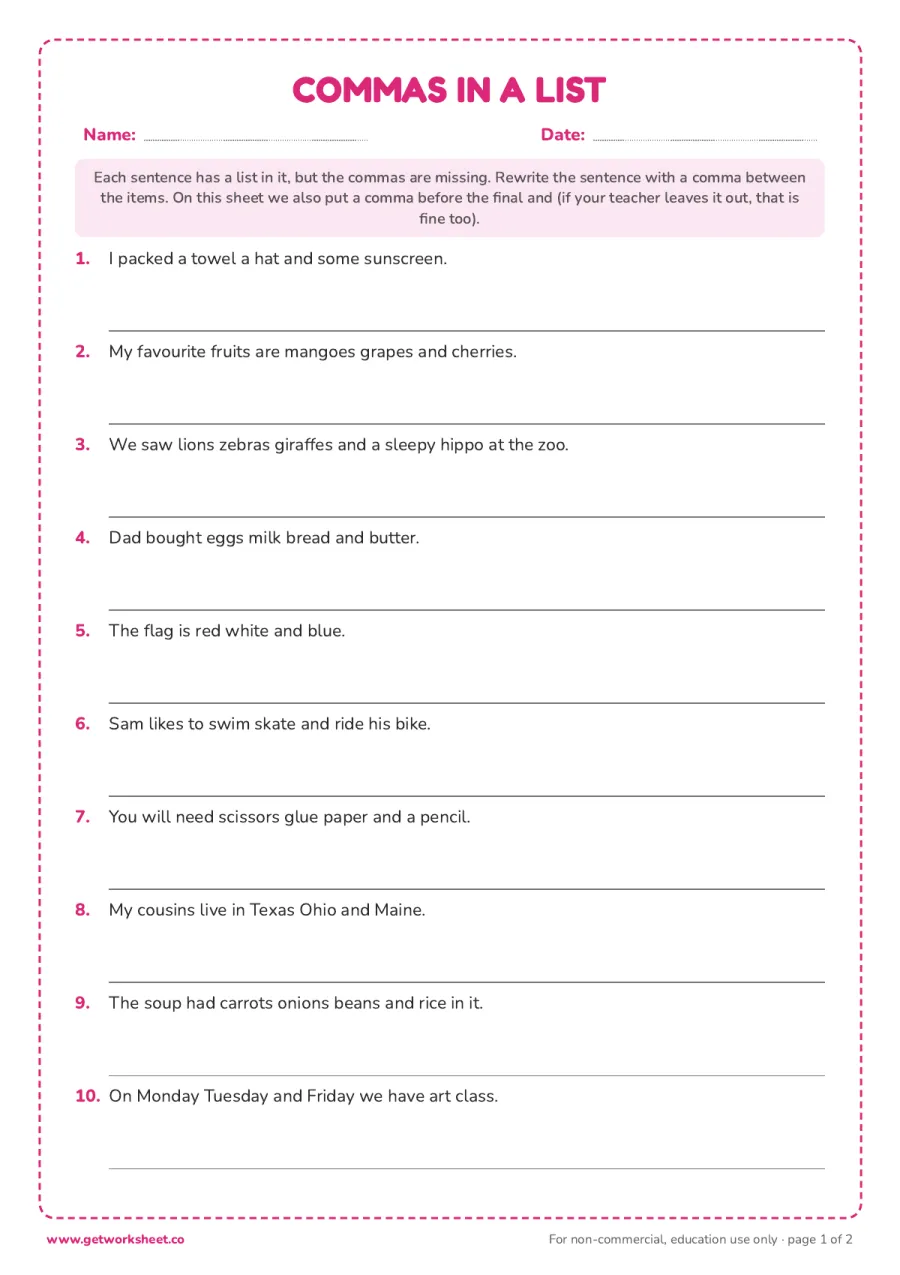
Commas in a list: rewrite 10 sentences with the missing commas
Ten sentences that list three or more things with every comma missing. Students rewrite each one, separating the items with commas (a comma before the final and is used on this sheet). Answer key on page 2.
Whole set
All 5 in one PDF
- Every sheet on this page, one file
- No ads, no countdowns, print as often as you like
- Instant download, ad-free, no account needed
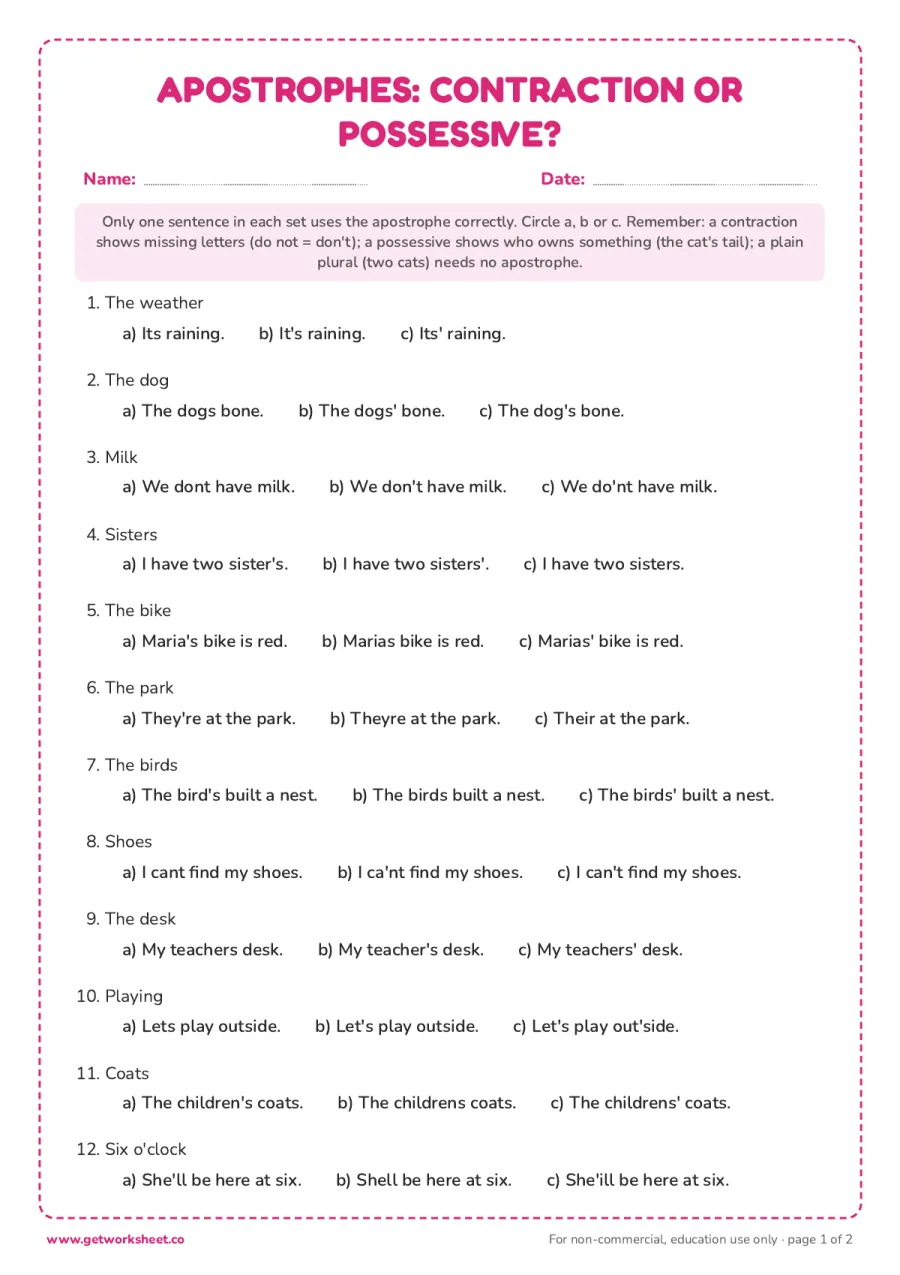
Apostrophes: pick the correct version of 12 sentences (contractions and possessives)
Twelve multiple-choice items: only one of the three versions uses the apostrophe correctly. Covers contractions (it's, don't, we're), singular possessives (the dog's bone) and plurals that need no apostrophe at all. Answer key on page 2.
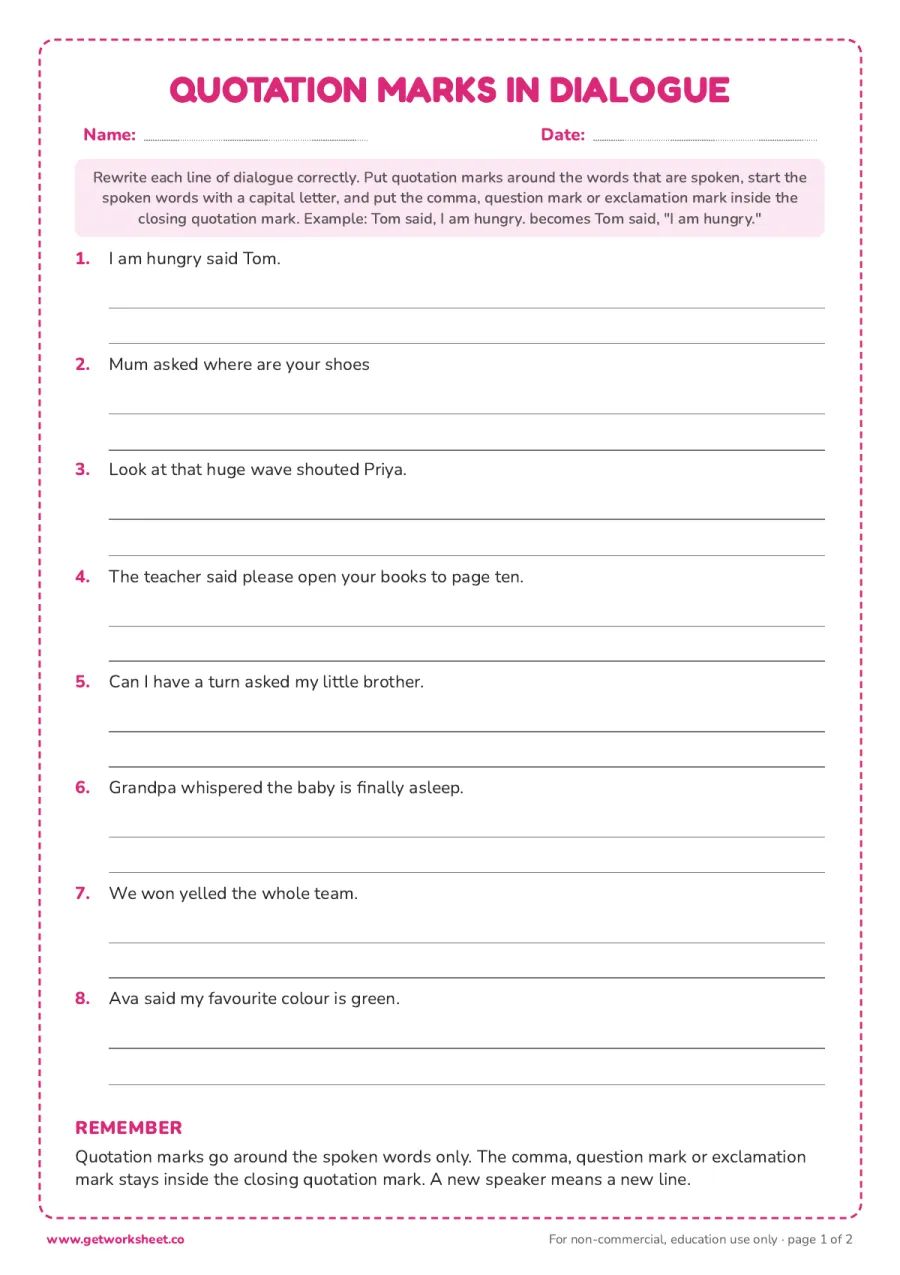
Quotation marks: rewrite 8 lines of dialogue with speech marks and commas
Eight lines of dialogue written without quotation marks or the comma that separates the speech from the speaker. Students rewrite each line correctly: quotation marks around the spoken words, the comma, question mark or exclamation mark inside the closing quotation mark. Answer key on page 2.
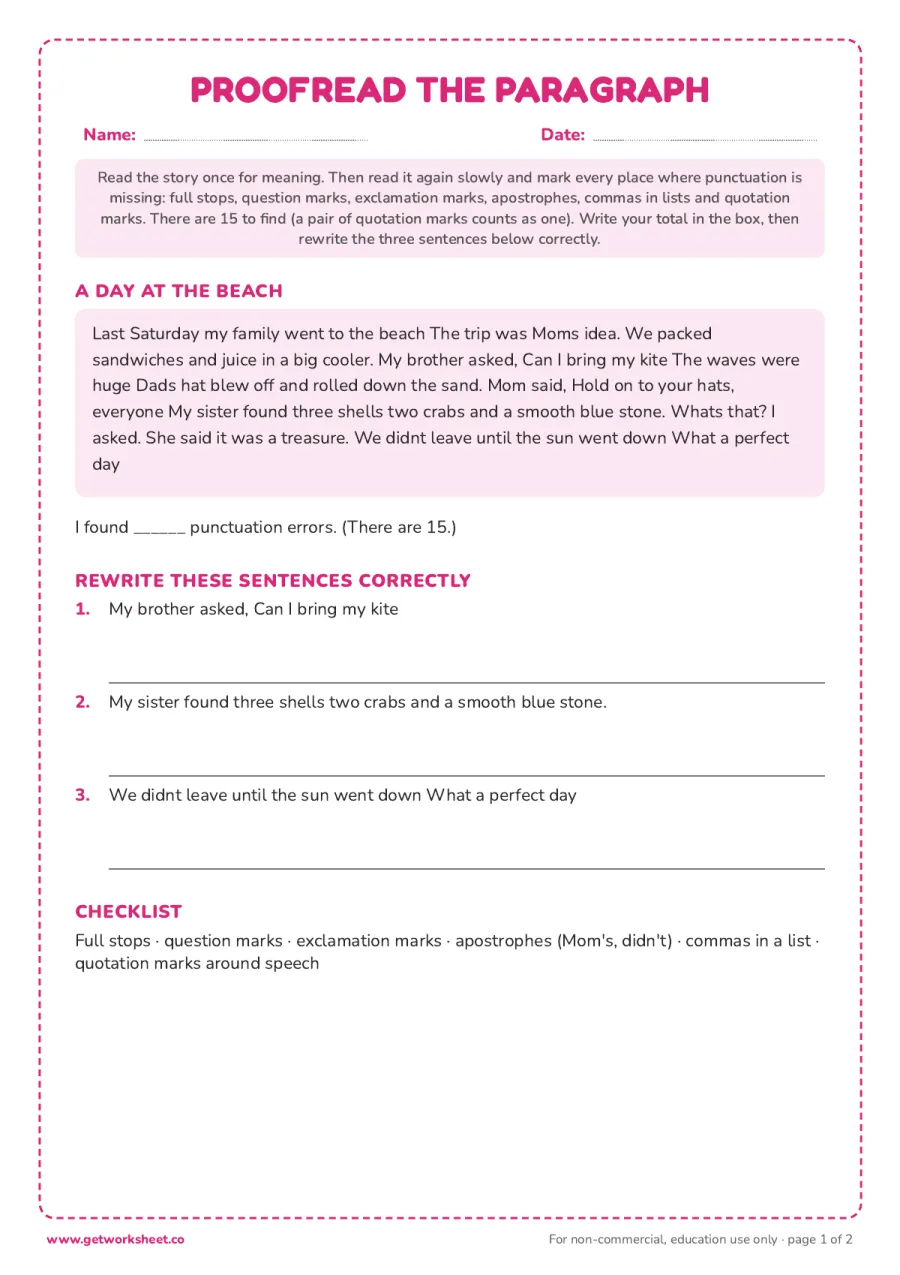
Proofread the paragraph: find 15 punctuation errors in a story about the beach
A short story about a day at the beach with 15 punctuation errors: missing full stops, question and exclamation marks, apostrophes, commas in lists and quotation marks. Students mark every error, count them and rewrite three sentences correctly. Answer key on page 2 lists every correction.
AI worksheet generator
Make a worksheet like this for your class
The 5 sheets above are fixed. The generator writes a new punctuation worksheet for your grade, with the question types and count you choose, in about 20 seconds. Pick a grade to start:
What you get
- A fresh set of questions on punctuation, not a copy of the sheets above
- Multiple choice, fill in the blanks, true or false, open ended
- Answer key and print-ready PDF with Pro
Free account, 1 worksheets a week. No card.
Punctuation is the part of writing that children can hear before they can see it. A sentence that asks goes up at the end; a list has little pauses in it; speech sounds like a different voice. These five worksheets connect what children already hear to the marks on the page, one mark at a time: end marks first, then commas in a list, then apostrophes, then quotation marks, and finally a proofreading passage where all of them are missing at once, which is how punctuation is actually used and checked.
What's in this set
- Full stop, question mark or exclamation mark? Sixteen sentences (statements, questions, commands and exclamations) to finish by ticking the right end mark.
- Commas in a list. Ten sentences with lists of three to five items, rewritten with commas between the items.
- Apostrophes: contraction or possessive? Twelve a/b/c items where one version uses the apostrophe correctly, mixing contractions, possessives and plain plurals.
- Quotation marks in dialogue. Eight lines of dialogue to rewrite with quotation marks, the comma or end mark inside the quotes and a capital letter for the first spoken word.
- Proofread the paragraph. A 95-word beach story with 15 missing punctuation marks to find and fix, a tally box and three sentences to rewrite.
What students will practice
- Choosing a full stop, question mark or exclamation mark by deciding whether a sentence tells, asks or exclaims (CCSS L.1.2b, L.K.2b)
- Separating the items of a list with commas (L.1.2c, L.2.2)
- Using apostrophes for contractions (don’t, it’s) and singular possessives (the dog’s bone), and leaving plain plurals alone (L.2.2c)
- Punctuating dialogue with quotation marks, a comma after the speaker and the end mark inside the quotes (L.3.2c)
- Proofreading a paragraph for every kind of punctuation error and counting what was found (L.3.2, L.4.2)
Free printable makers
Make your own punctuation sheets
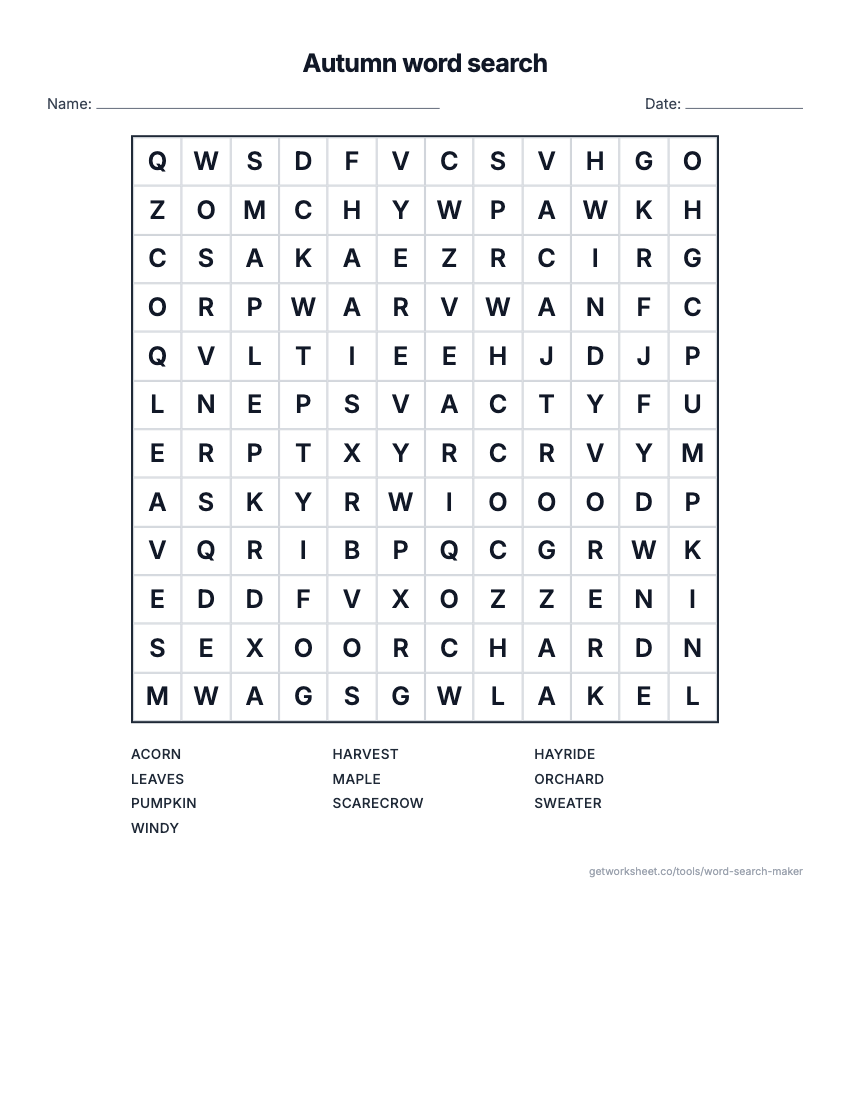
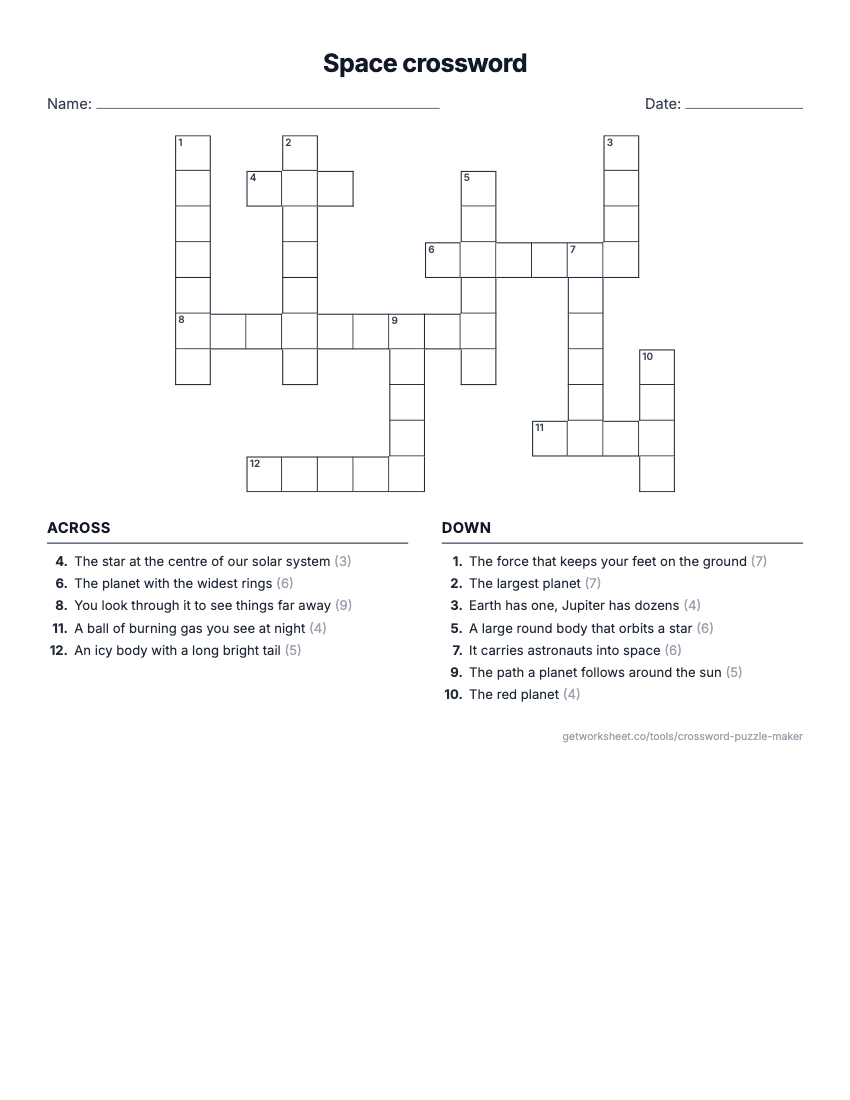
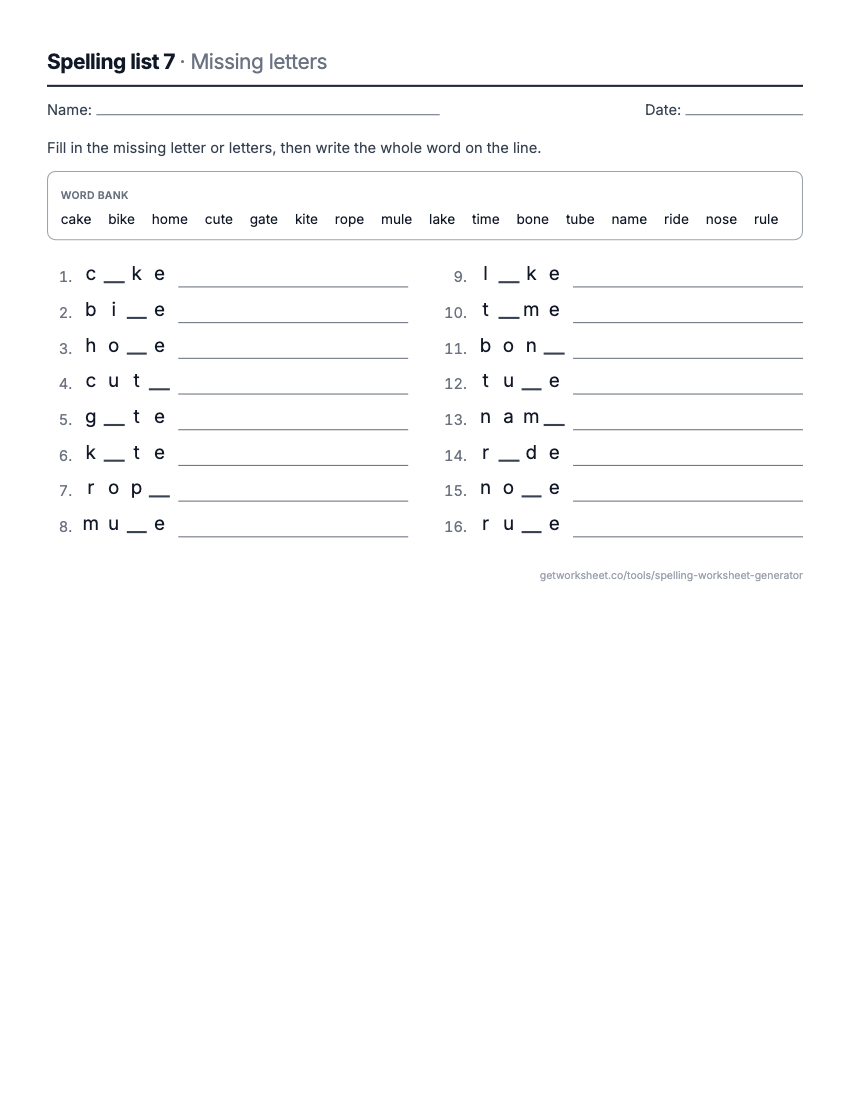
Type your own words or numbers and print in about 30 seconds. No account, no AI, answer key where it applies.
AI worksheet generator
Need a different punctuation worksheet?
Generate a custom punctuation worksheet: pick the grade, question types and count, and print it in about 20 seconds. Free accounts get 1 generation a week.
Teaching tips and common mistakes
How to use these worksheets
- Read aloud before marking. On Full stop, question mark or exclamation mark? the answer is in the voice: have students read each sentence aloud and listen for a rising question or a shout before they tick. Grade 1 can do this sheet on its own.
- Commas as pauses. Read a sentence from Commas in a list without pausing (“eggs milk bread and butter”) and then with pauses. The comma goes where the pause is. The sheet uses a comma before the final and; if your class does not, tell students to leave it out.
- Two jobs for one mark. On Apostrophes, ask “is something missing or does someone own something?” for every item. If neither, there is no apostrophe, which is the point of the plain plural items (two sisters, the birds).
- Act out the dialogue. Read each line of Quotation marks in dialogue with two voices: the narrator and the speaker. The quotation marks go around the speaker’s voice only. The rule box on the sheet covers the comma and end mark.
- Proofread with a target. The beach story has exactly 15 errors and a tally box. Students who find 12 go back for the rest; the checklist tells them which kinds to look for.
- Grades 1 to 4. Grade 1: end marks. Grade 2: end marks, commas, apostrophes. Grades 3 and 4: all five sheets, with the proofreading passage as the assessment.
Answer key
Every practice sheet carries its own answer key on page 2 of the PDF. The keys are repeated here for quick marking.
- Full stop, question mark or exclamation mark?: 1. . 2. ? 3. ! 4. . 5. ? 6. ! 7. . 8. ? 9. . 10. ! 11. ? 12. . 13. ! 14. ? 15. . 16. !
- Commas in a list: 1. I packed a towel, a hat, and some sunscreen. 2. My favourite fruits are mangoes, grapes, and cherries. 3. We saw lions, zebras, giraffes, and a sleepy hippo at the zoo. 4. Dad bought eggs, milk, bread, and butter. 5. The flag is red, white, and blue. 6. Sam likes to swim, skate, and ride his bike. 7. You will need scissors, glue, paper, and a pencil. 8. My cousins live in Texas, Ohio, and Maine. 9. The soup had carrots, onions, beans, and rice in it. 10. On Monday, Tuesday, and Friday we have art class.
- Apostrophes: contraction or possessive?: 1. b 2. c 3. b 4. c 5. a 6. a 7. b 8. c 9. b 10. b 11. a 12. a
- Quotation marks in dialogue: 1. "I am hungry," said Tom. 2. Mum asked, "Where are your shoes?" 3. "Look at that huge wave!" shouted Priya. 4. The teacher said, "Please open your books to page ten." 5. "Can I have a turn?" asked my little brother. 6. Grandpa whispered, "The baby is finally asleep." 7. "We won!" yelled the whole team. 8. Ava said, "My favourite colour is green."
- Proofread the paragraph: Rewrite these sentences correctly: 1. My brother asked, "Can I bring my kite?" 2. My sister found three shells, two crabs, and a smooth blue stone. 3. We didn't leave until the sun went down. What a perfect day! Checklist: The 15 corrections, in order: (1) full stop after "beach"; (2) Mom's; (3) quotation marks around "Can I bring my kite?"; (4) question mark after "kite"; (5) full stop after "huge"; (6) Dad's; (7) quotation marks around "Hold on to your hats, everyone!"; (8) exclamation mark after "everyone" (a full stop is also acceptable); (9) comma after "shells"; (10) comma after "crabs"; (11) What's; (12) quotation marks around "What's that?"; (13) didn't; (14) full stop after "down"; (15) exclamation mark after "day".
Common mistakes to watch for
- Exclamation marks everywhere. Children love them. The rule on the first sheet is simple: only when the sentence shows strong feeling or gives a warning. “The bus was late again” is a full stop, even if it feels dramatic.
- A comma after the last item. “Eggs, milk, bread, and butter,” is wrong. The list ends where the sentence continues.
- Apostrophe plurals. “Two sister’s” is the most common apostrophe error in every grade. A plural needs no apostrophe; test it with the question “who owns something here?”
- Punctuation outside the quotation marks. In US style the comma, question mark or exclamation mark goes inside the closing quotation mark: “Can I have a turn?” asked my brother.
- Its and it’s. It’s is always it is or it has. If the sentence still makes sense with it is, the apostrophe stays.
Frequently asked questions
What grade are these punctuation worksheets for?
Grades 1 to 4. End marks are kindergarten and grade 1 (CCSS L.K.2b, L.1.2b), commas in a list and apostrophes are grades 1 and 2 (L.1.2c, L.2.2c), and quotation marks in dialogue are grade 3 (L.3.2c). The proofreading passage works as a grade 3 or 4 review.
Do the worksheets have answer keys?
Yes. Every sheet has its answer key on page 2 of the PDF, and the keys are repeated on this page, including all fifteen corrections for the beach story in order.
Do you use the Oxford comma?
The commas sheet puts a comma before the final and in a list and says so in its instructions. Classes that leave it out can simply skip that comma; the other commas are the skill being tested.
Which punctuation rules are covered?
Full stops, question marks and exclamation marks at the end of a sentence; commas between items in a list; apostrophes in contractions and singular possessives (and no apostrophe in plurals); quotation marks around speech with the comma or end mark inside; and proofreading for all of these at once. Commas in dates and addresses, colons and semicolons are not covered.
More English practice
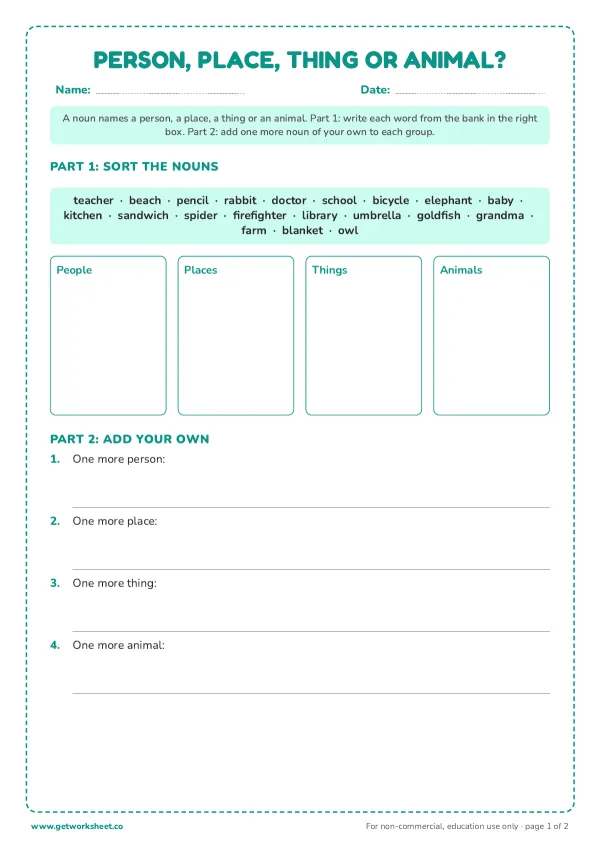
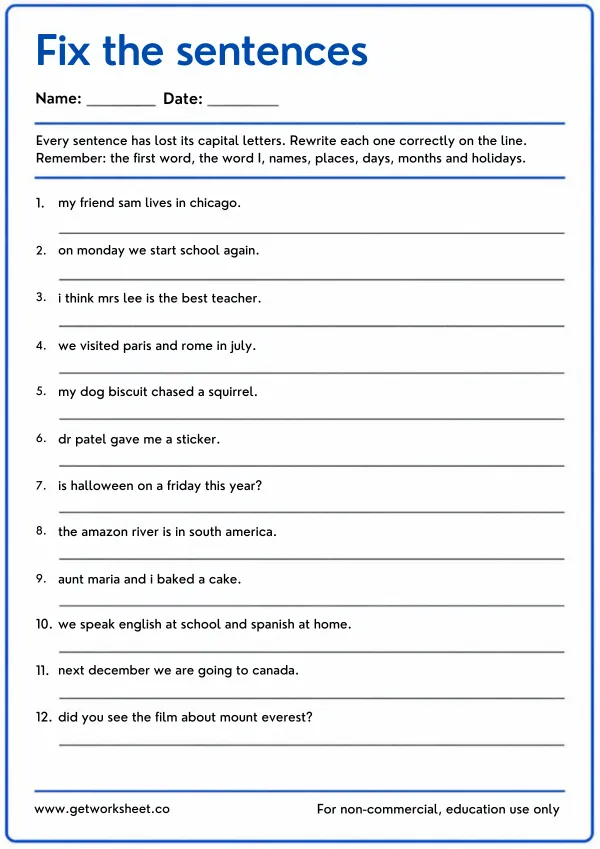
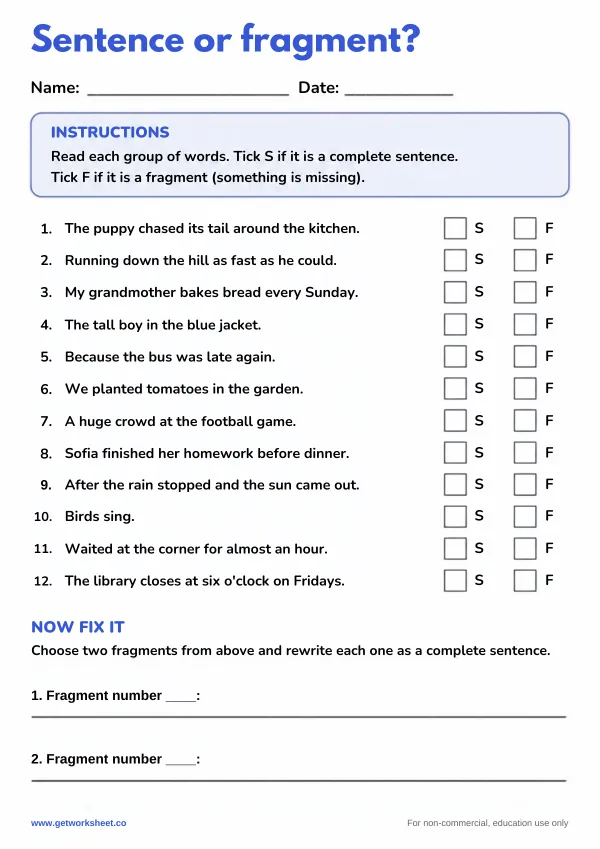
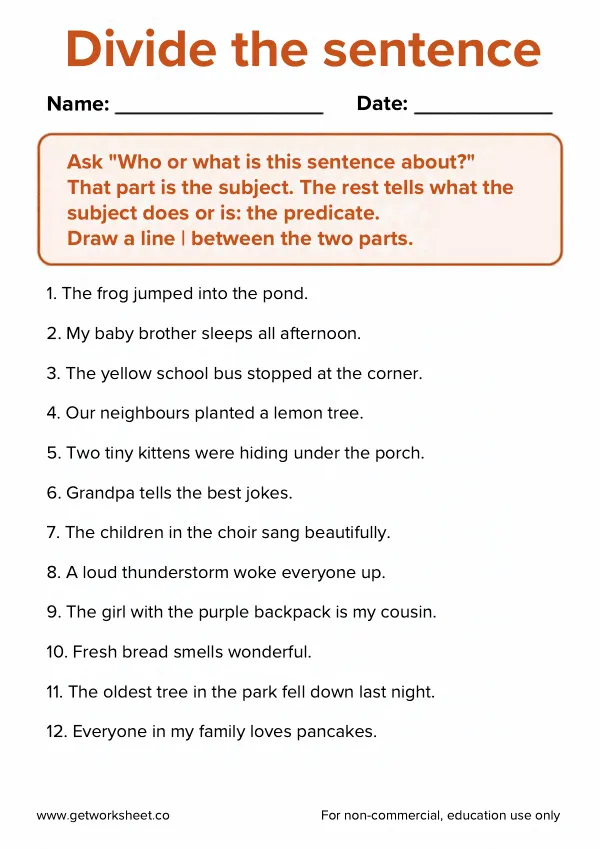
Capital letters are the other half of sentence mechanics: the capitalization worksheets follow the same fix-the-sentence format. To check that each line is a whole sentence before punctuating it, use the sentence fragments worksheets and the subject and predicate worksheets. The nouns worksheets cover plural and possessive nouns, where most apostrophe errors start.
Free library
Related collections
Free nouns worksheets
Free capitalization worksheets
Free sentence fragments worksheets
Free subject and predicate worksheets
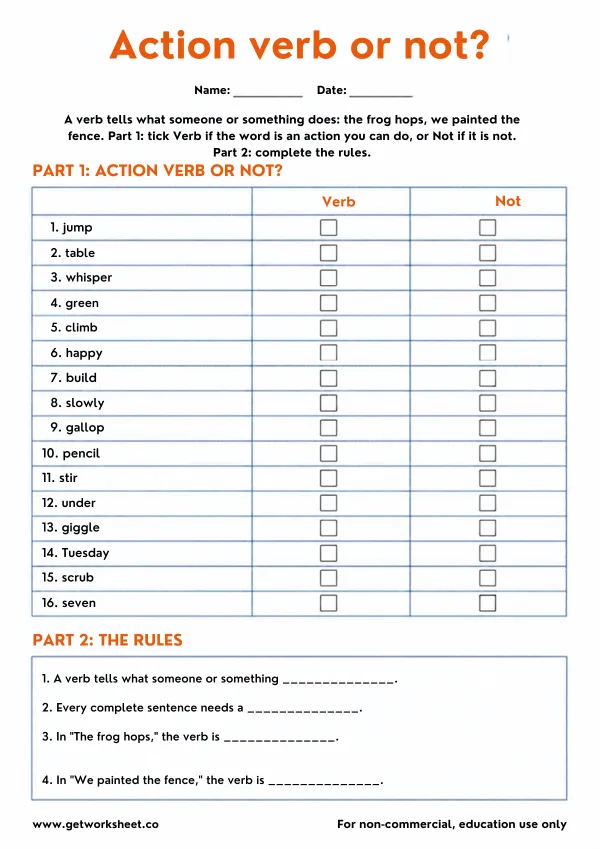
Free verbs worksheets
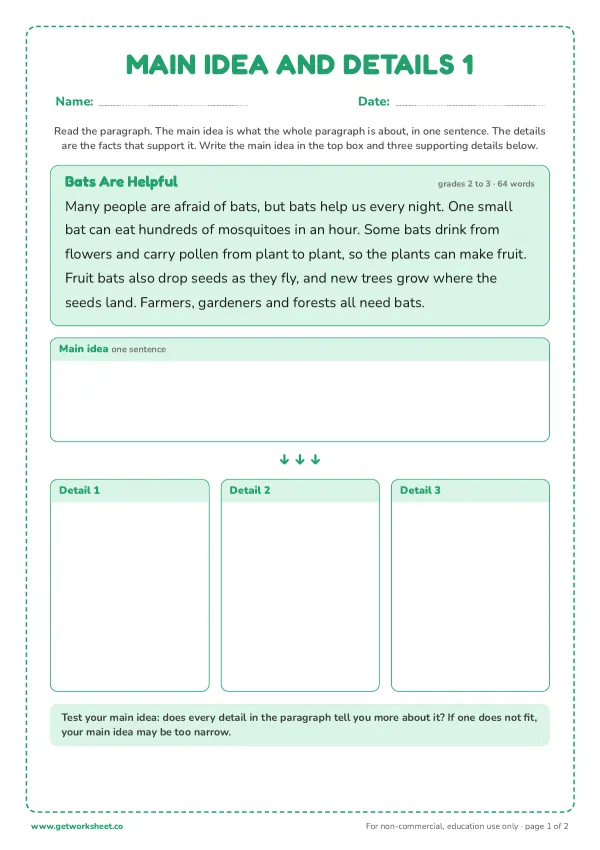
Free main idea worksheets
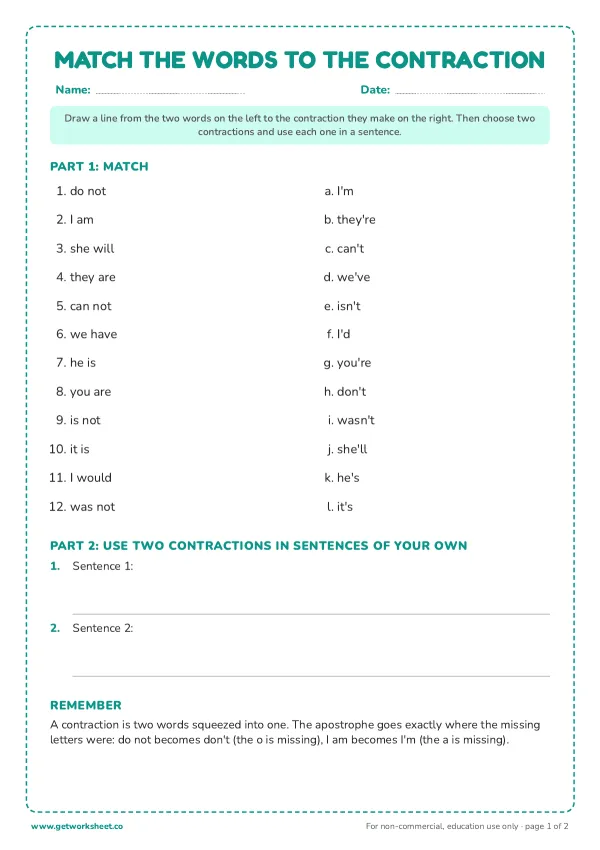
Free contractions worksheets
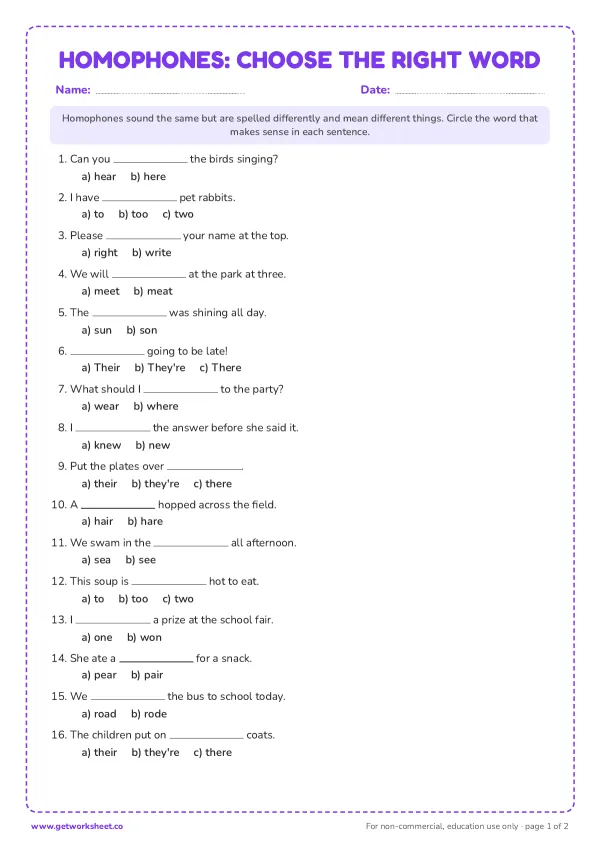
Free homophones worksheets
More worksheets
- Free prefixes and suffixes worksheets
- Free short and long vowel worksheets
- Free Groundhog Day worksheets
- Free Presidents' Day worksheets
- Free Montessori three part cards templates
- Free Montessori grammar symbols worksheets
- Free y as a vowel worksheets
- Free schwa sound worksheets
- Free glued sounds worksheets
- Free FLOSS rule worksheets
- Free Elkonin boxes worksheets
- Free heart words worksheets