English · Grades 2–5
Free subject and predicate worksheets
Five printable subject and predicate worksheets for grades 2 to 5: divide the sentence, match the subject to the predicate, complete and simple subjects and predicates and more. Answer keys on page 2 of each PDF.
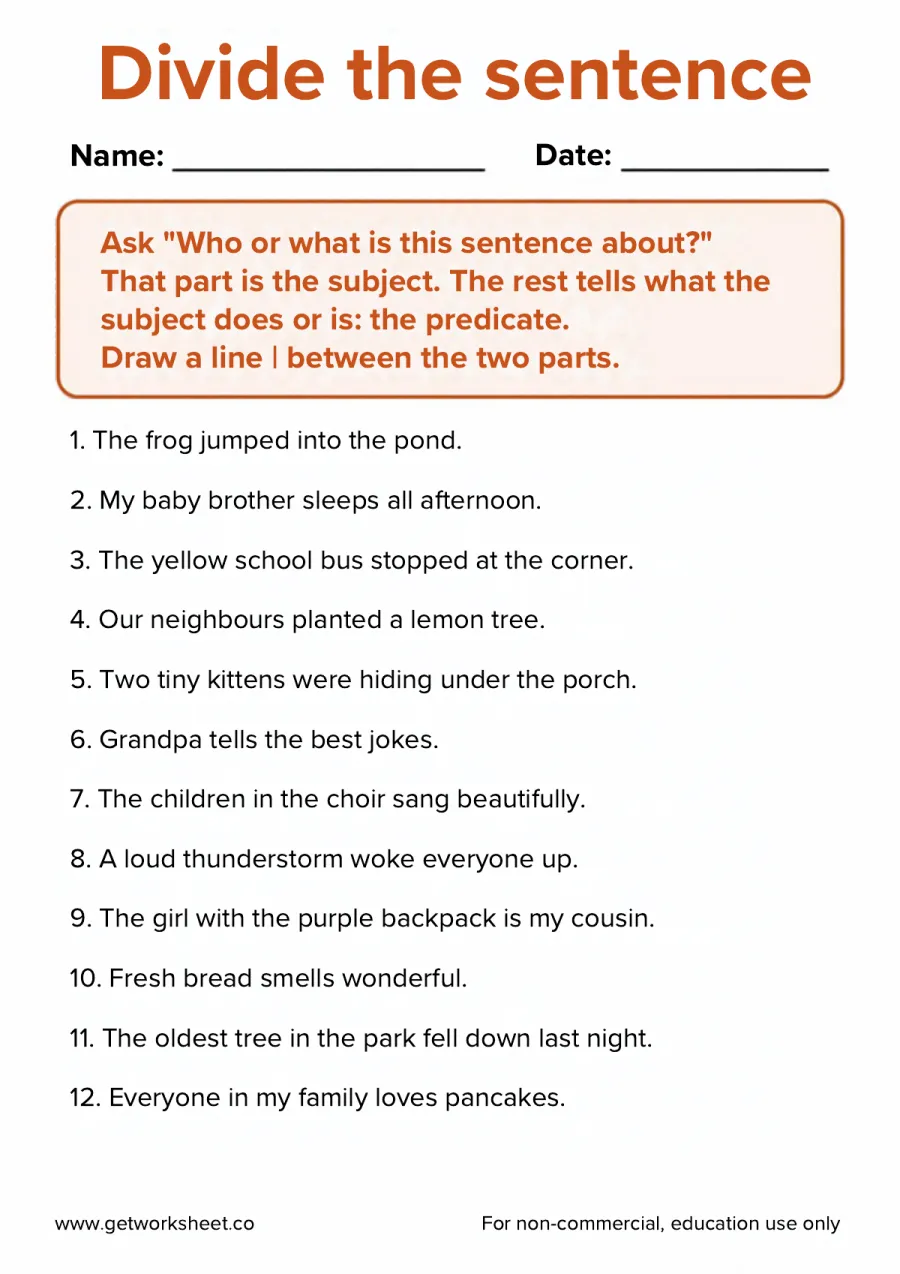
Divide the sentence: draw the line between subject and predicate
Twelve sentences; students draw a vertical line between the subject and the predicate. Answer key on page 2.
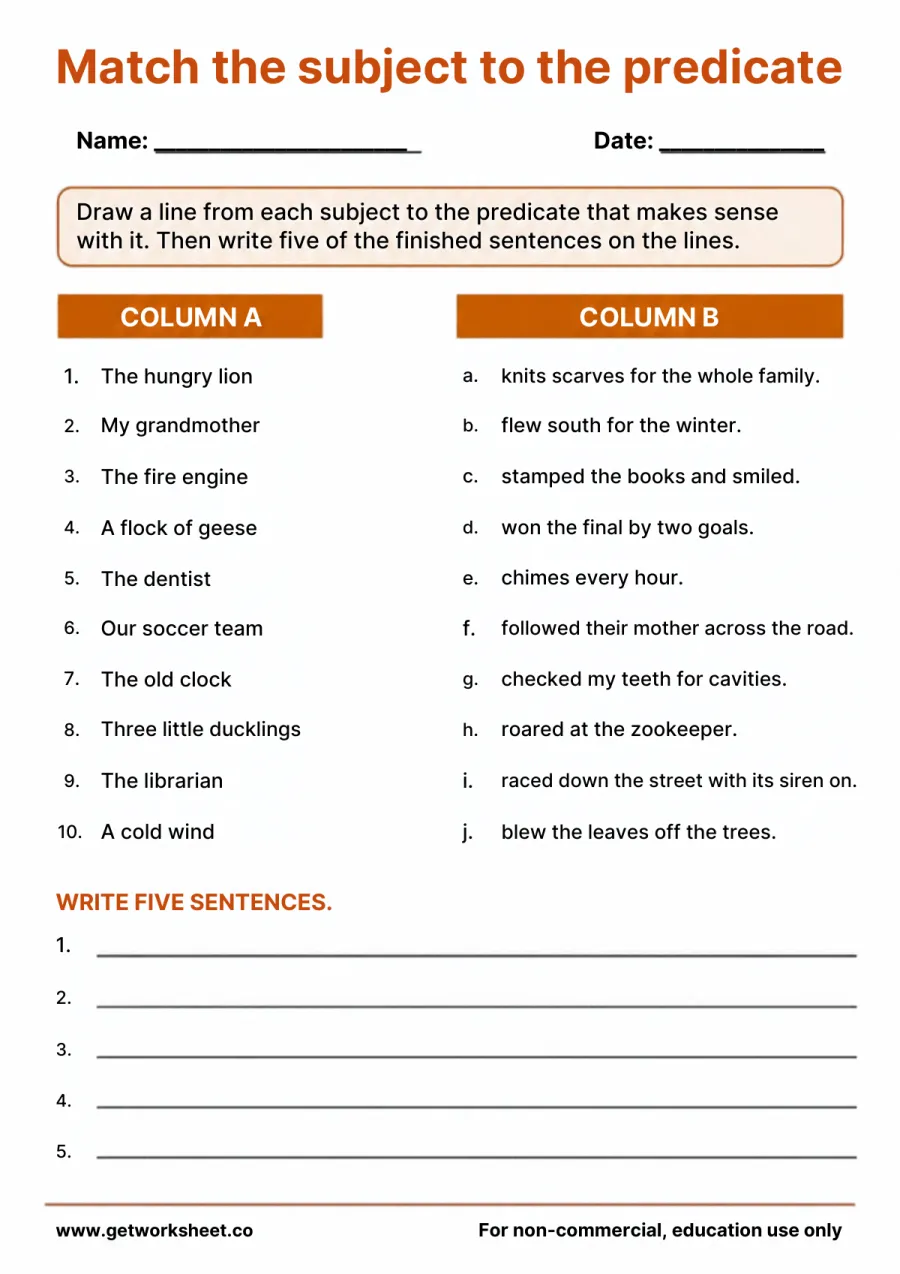
Match the subject to the predicate, then write the sentences
Ten subjects and ten predicates to match into sensible sentences, then five sentences to write out. Answer key on page 2.
Whole set
All 5 sheets in one PDF
Instant and ad-free. No account needed.
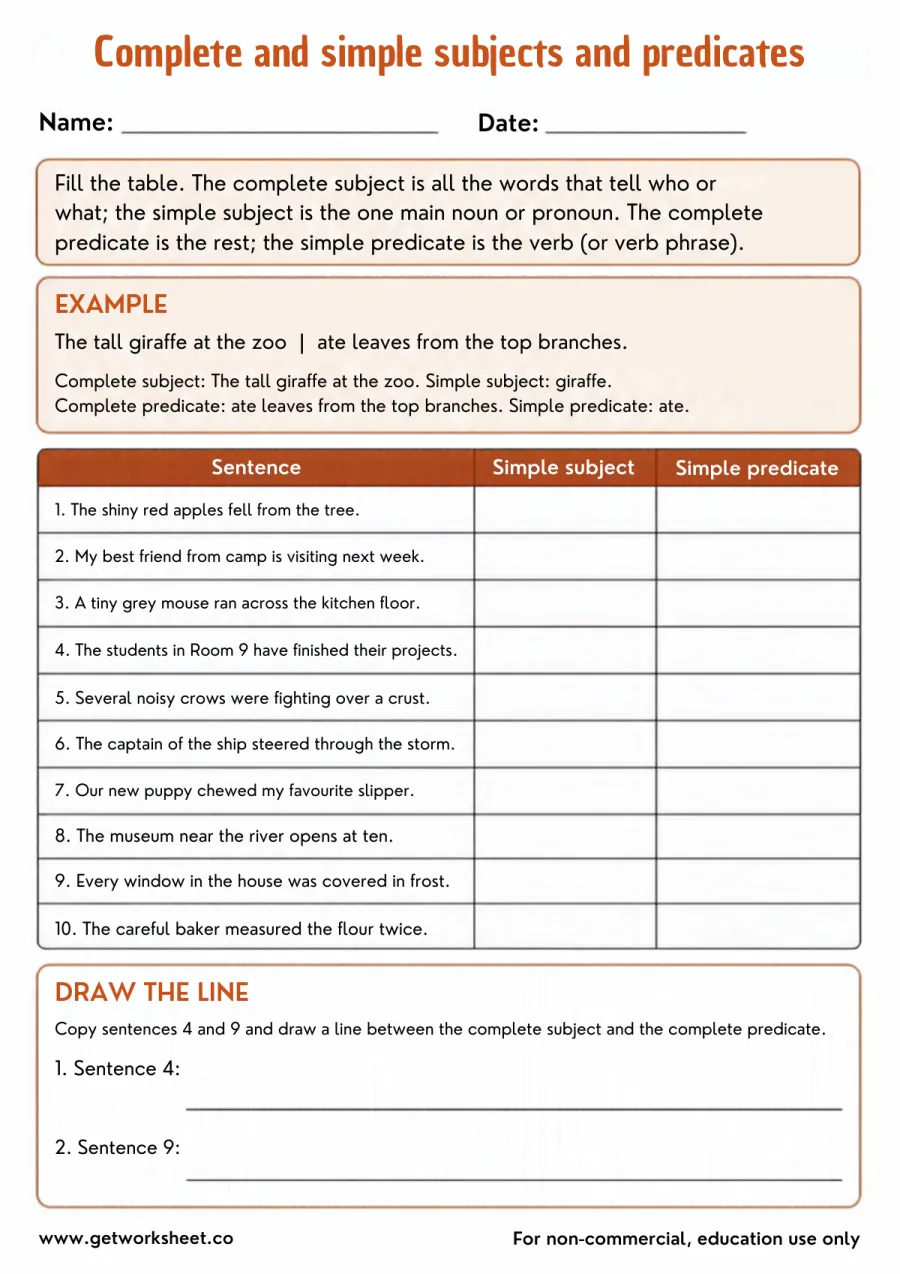
Complete and simple subjects and predicates (grades 4-5)
Ten sentences; students copy the complete subject and predicate, then circle the simple subject (the key noun) and simple predicate (the verb). Answer key on page 2.
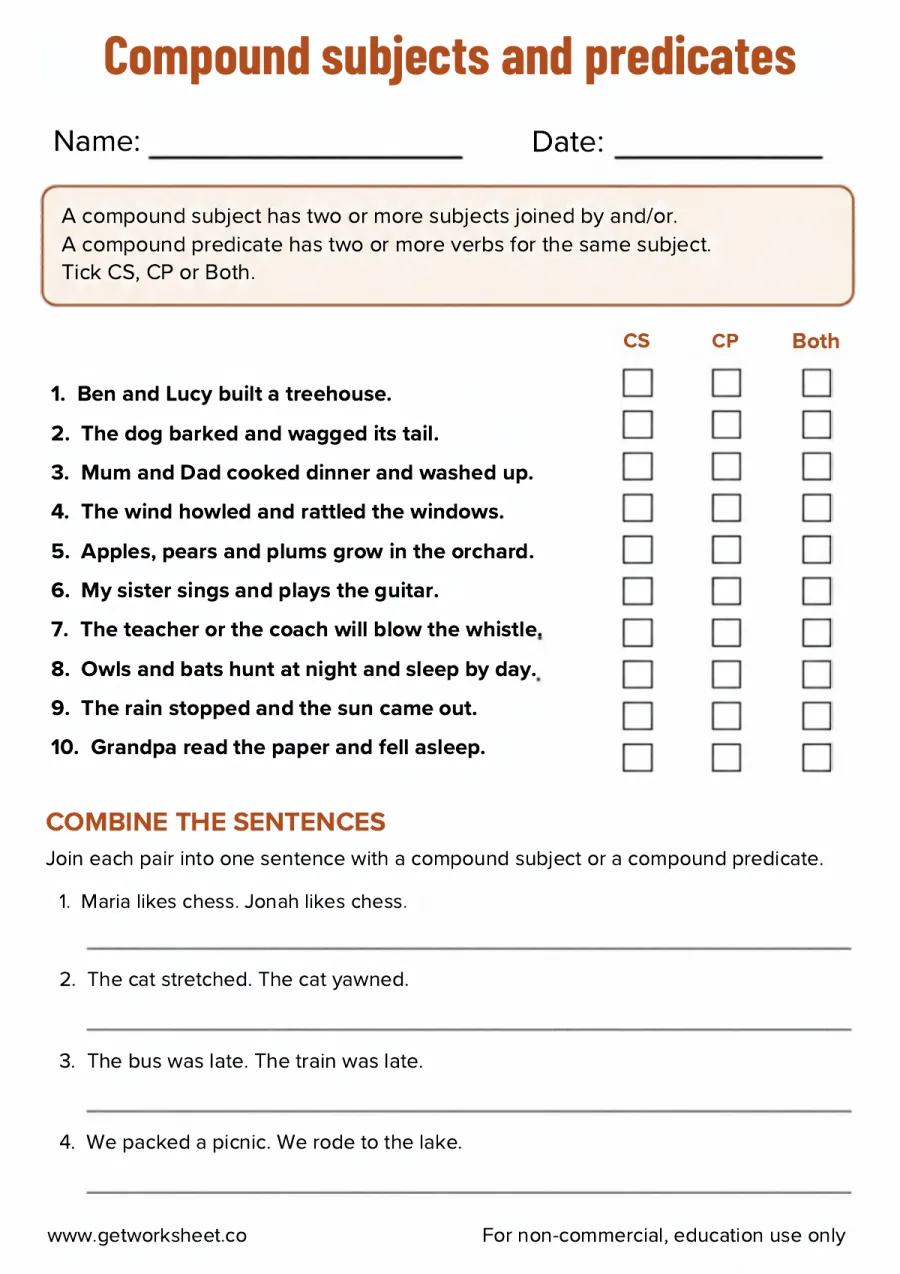
Compound subjects and predicates: identify and combine
Ten sentences to label CS (compound subject), CP (compound predicate) or both, then four pairs of sentences to combine. Answer key on page 2.
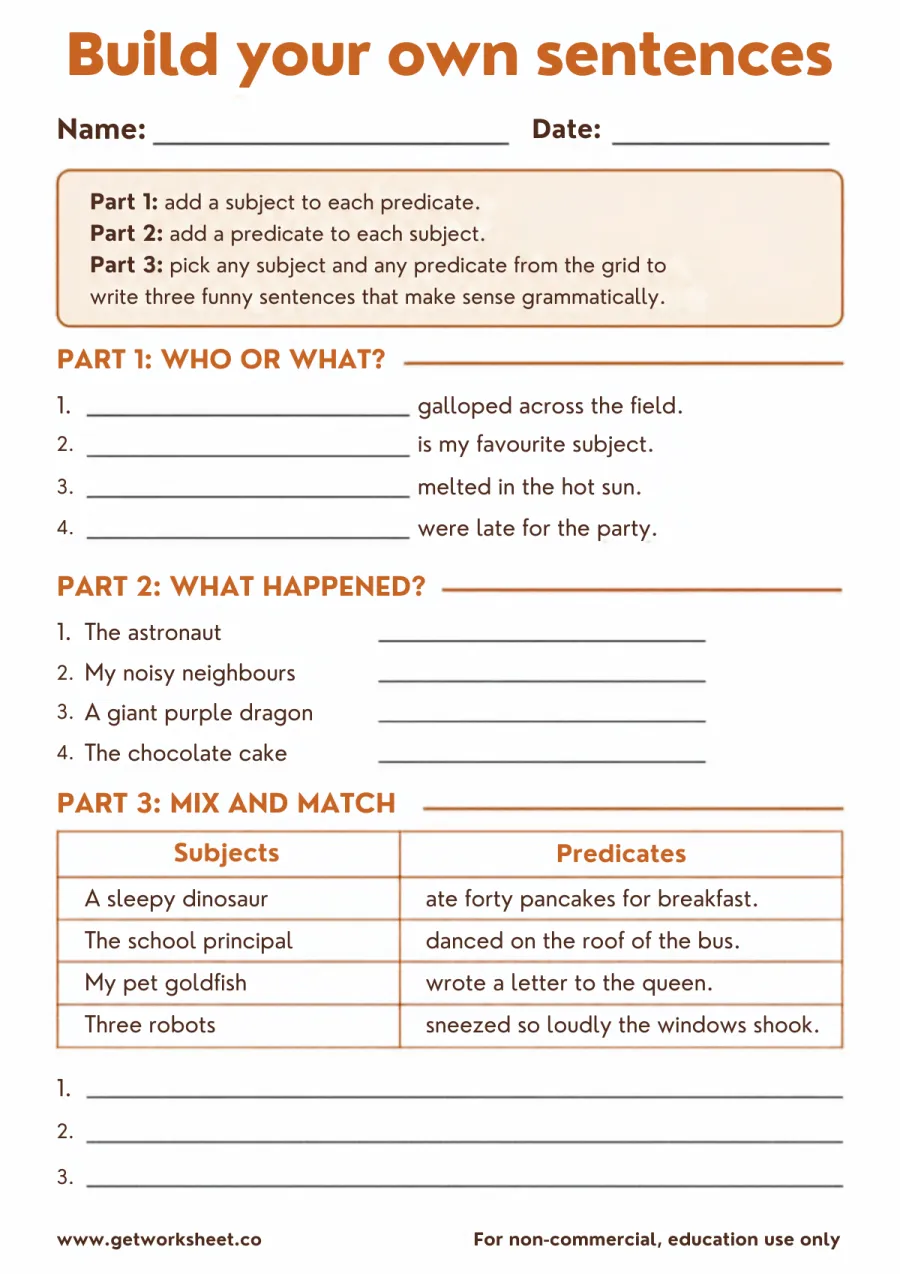
Build your own sentences: add a subject, add a predicate
Four predicates that need a subject, four subjects that need a predicate, and a mix-and-match grid for silly sentences. Sample answers on page 2.
AI worksheet generator
Make a worksheet like this for your class
The 5 sheets above are fixed. The generator writes a new subject and predicate worksheet for your grade, with the question types and count you choose, in about 20 seconds. Pick a grade to start:
What you get
- A fresh set of questions on subject and predicate, not a copy of the sheets above
- Multiple choice, fill in the blanks, true or false, open ended
- Answer key and print-ready PDF with Pro
Free account, 1 worksheets a week. No card.
Every complete sentence has two parts: the subject, who or what the sentence is about, and the predicate, what the subject does or is. Children who can split a sentence into these two parts can check their own writing for fragments, fix subject-verb agreement and, later, understand clauses. These five worksheets go from drawing a line through a simple sentence to combining sentences with compound subjects and predicates.
What's in this set
- Divide the sentence. Twelve sentences of growing length; draw a line where the subject (who or what) ends and the predicate (what happens) begins.
- Match the subject to the predicate. Ten subjects in column A and ten predicates in column B; match them into sentences that make sense, then copy five out with capitals and full stops.
- Complete and simple subjects and predicates. Ten sentences in a four-column table: complete subject, simple subject, complete predicate, simple predicate. Grades 4-5.
- Compound subjects and predicates. Ten sentences to label as having a compound subject, a compound predicate or both, then four sentence pairs to combine into one sentence with "and". Grades 4-5.
- Build your own sentences. Four predicates missing their subject, four subjects missing their predicate, and a mix-and-match grid for writing three silly but complete sentences. Grades 2-4.
What students will practice
- Asking the two questions, "who or what?" and "did what?", to find the two parts of any sentence (Common Core L.1.1.j, L.3.1.i)
- Separating the complete subject from the simple subject (the key noun) and the complete predicate from the simple predicate (the verb)
- Recognizing that a phrase such as "in the choir" belongs to the subject even though it is not the subject
- Identifying and writing compound subjects and compound predicates, and combining short sentences with them (L.3.1.h, L.4.1.f)
- Generating sentences by supplying a missing subject or predicate
Free printable makers
Make your own subject and predicate sheets
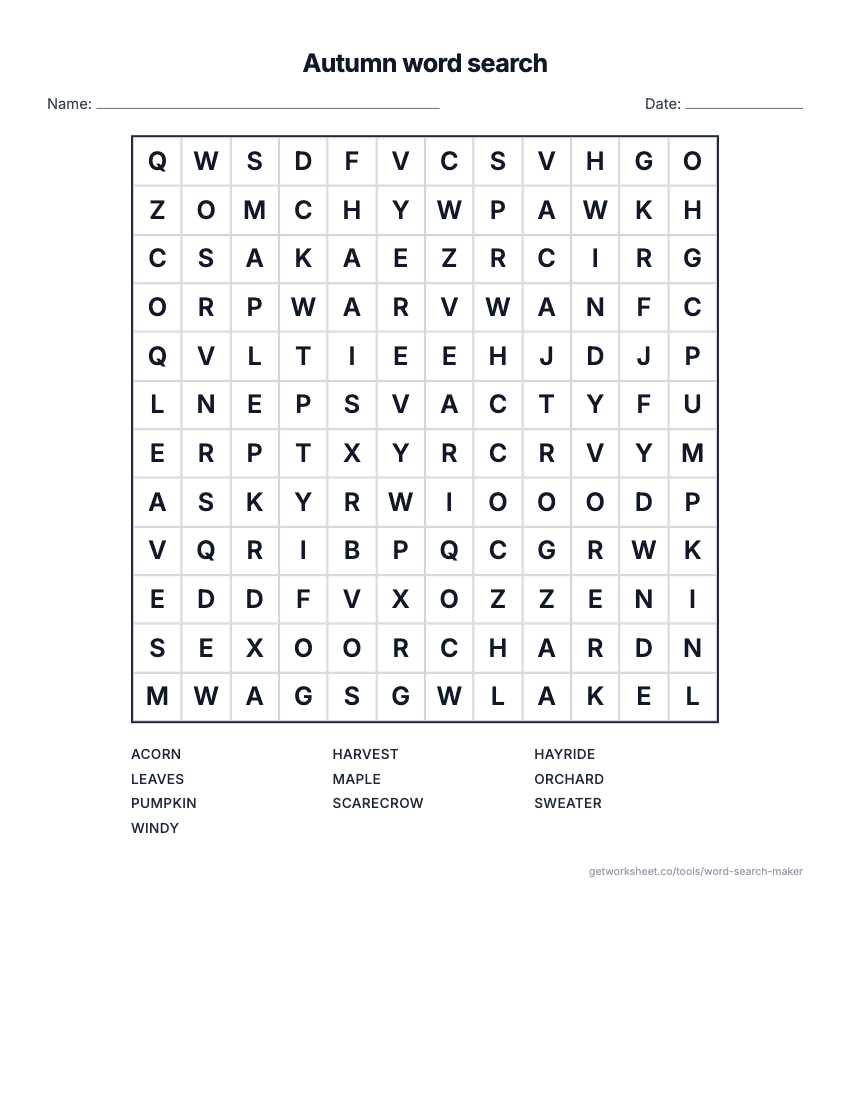
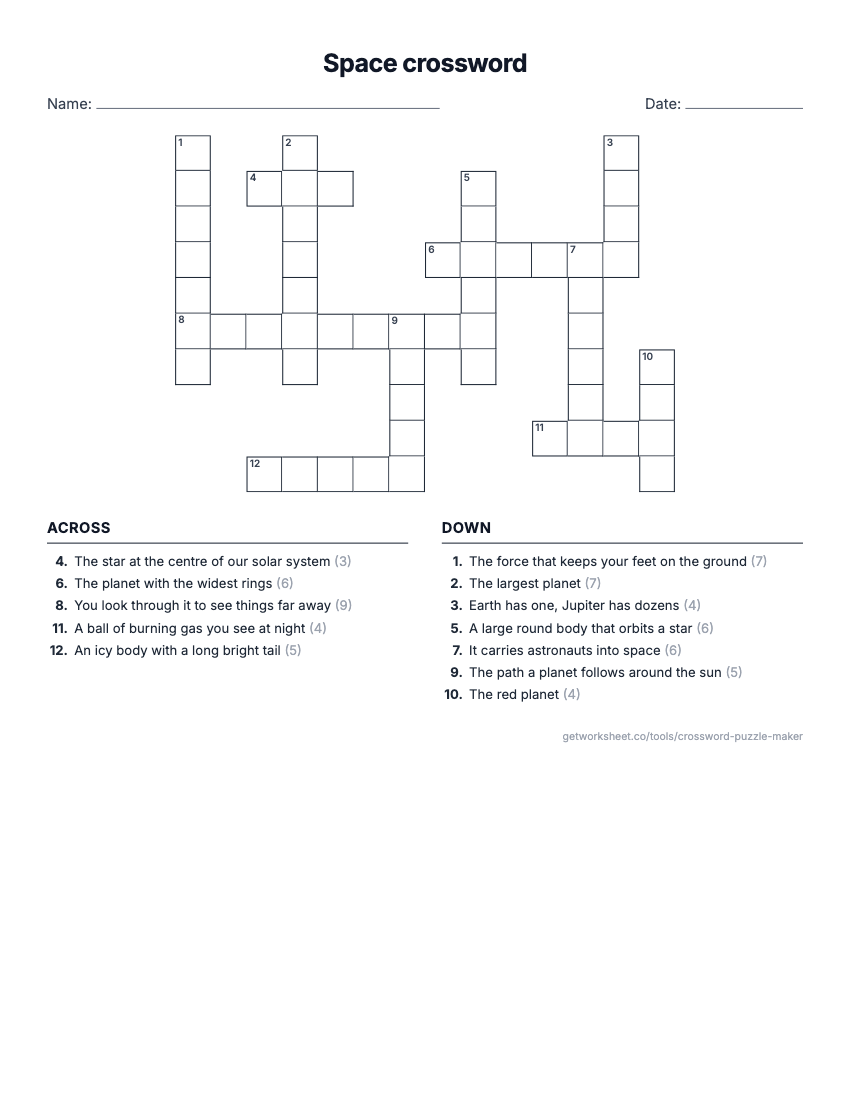
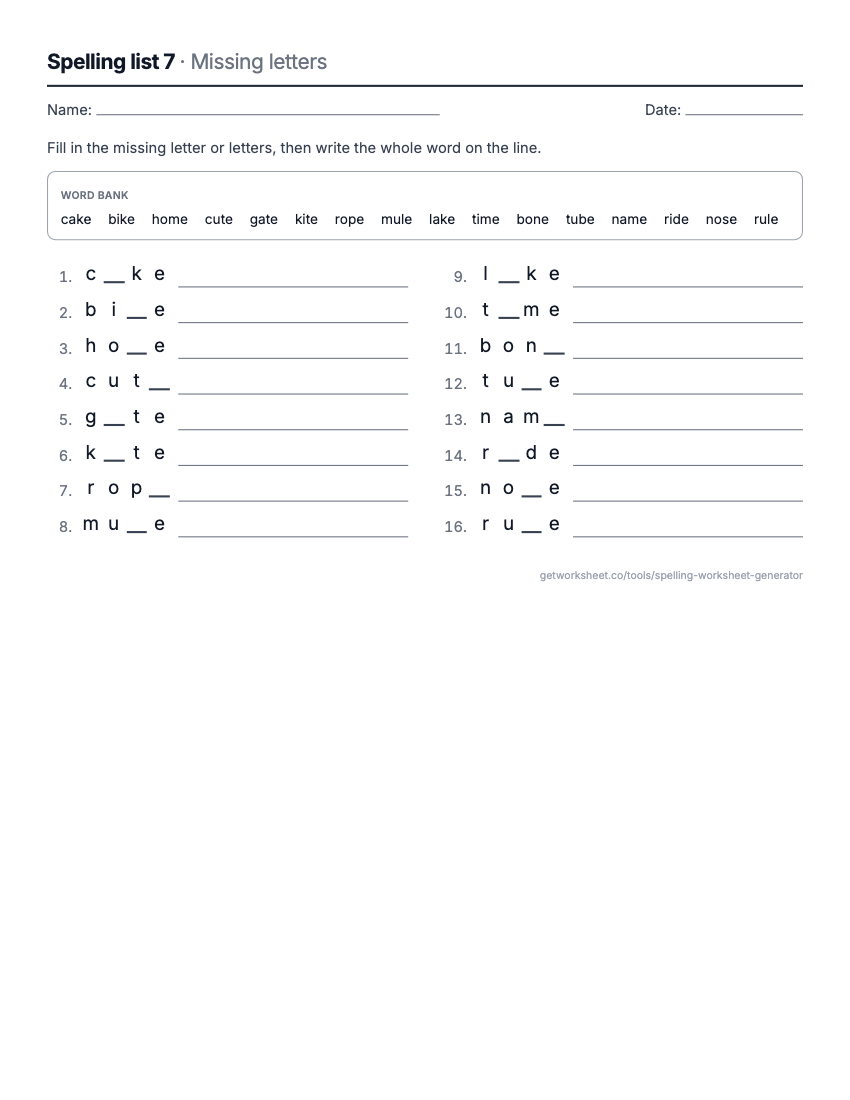
Type your own words or numbers and print in about 30 seconds. No account, no AI, answer key where it applies.
AI worksheet generator
Need a different subject and predicate worksheet?
Generate a custom subject and predicate worksheet: pick the grade, question types and count, and print it in about 20 seconds. Free accounts get 1 generation a week.
How to use these worksheets in class
- Grade 2: the dividing line. Divide the sentence is the whole lesson. Read a sentence, ask "Who or what?" and let children draw the line with a ruler. The last four items have a phrase inside the subject ("The girl with the purple backpack") and show that the line does not always come after the second word.
- Matching before writing. Match the subject to the predicate is a partner task: one reads a subject, the other finds the predicate that makes sense. Copying five sentences out afterwards is where capitals and full stops get practiced.
- Grades 4 to 5: simple versus complete. The table sheet asks for the one key noun and the one verb. Simple predicates that are verb phrases ("have finished", "were fighting") catch many students; connect this to the helping verbs worksheets.
- Compound parts. Item 9 on the compound sheet ("The rain stopped and the sun came out") is actually two clauses. Let students argue about it; the argument is the lesson.
- Writing. Build your own sentences ends with a mix-and-match grid. Silly sentences that are grammatically complete prove the point better than sensible ones: the grammar works even when the meaning is absurd.
Answer key
Every practice sheet carries its own answer key on page 2 of the PDF. The keys are repeated here for quick marking.
- Divide the sentence: 1. The frog | jumped into the pond. 2. My baby brother | sleeps all afternoon. 3. The yellow school bus | stopped at the corner. 4. Our neighbors | planted a lemon tree. 5. Two tiny kittens | were hiding under the porch. 6. Grandpa | tells the best jokes. 7. The children in the choir | sang beautifully. 8. A loud thunderstorm | woke everyone up. 9. The girl with the purple backpack | is my cousin. 10. Fresh bread | smells wonderful. 11. The oldest tree in the park | fell down last night. 12. Everyone in my family | loves pancakes.
- Match the subject to the predicate: The hungry lion = roared at the zookeeper.; My grandmother = knits scarves for the whole family.; The fire engine = raced down the street with its siren on.; A flock of geese = flew south for the winter.; The dentist = checked my teeth for cavities.; Our soccer team = won the final by two goals.; The old clock = chimes every hour.; Three little ducklings = followed their mother across the road.; The librarian = stamped the books and smiled.; A cold wind = blew the leaves off the trees. Write five sentences: Any five correctly matched sentences with a capital letter and a full stop.
- Complete and simple subjects and predicates: 1 | apples | fell 2 | friend | is visiting 3 | mouse | ran 4 | students | have finished 5 | crows | were fighting 6 | captain | steered 7 | puppy | chewed 8 | museum | opens 9 | window | was covered 10 | baker | measured Draw the line: 1. The students in Room 9 | have finished their projects. 2. Every window in the house | was covered in frost.
- Compound subjects and predicates: 1. CS 2. CP 3. Both 4. CP 5. CS 6. CP 7. CS 8. Both 9. CS (two subjects, two predicates: really two clauses; accept Both) 10. CP Combine the sentences: 1. Maria and Jonah like chess. 2. The cat stretched and yawned. 3. The bus and the train were late. 4. We packed a picnic and rode to the lake.
- Build your own sentences: Part 1: who or what?: 1. Sample: The wild horses galloped across the field. 2. Sample: Science is my favorite subject. 3. Sample: My ice cream melted in the hot sun. 4. Sample: The clowns were late for the party. Part 2: what happened?: 1. Sample: The astronaut floated out of the spaceship. 2. Sample: My noisy neighbors played drums until midnight. 3. Sample: A giant purple dragon landed on the school roof. 4. Sample: The chocolate cake disappeared in five minutes.
Common mistakes to watch for
- Drawing the line after the first noun. "The children | in the choir sang" is wrong; the whole noun phrase is the subject. Ask "Which children?" to pull the phrase back into the subject.
- Choosing the noun inside a phrase as the simple subject. In "The captain of the ship", the simple subject is captain, not ship.
- Leaving the helping verb out of the simple predicate. The simple predicate of "have finished their projects" is have finished.
- Calling a compound sentence a compound predicate. If each verb has its own subject, there are two clauses, not one compound predicate.
Frequently asked questions
What grade are these subject and predicate worksheets for?
Divide the sentence, Match the subject to the predicate and Build your own sentences suit grades 2 and 3. Complete and simple subjects and predicates and Compound subjects and predicates suit grades 4 and 5. The set covers Common Core L.1.1.j, L.3.1.h-i and L.4.1.f.
What is the difference between a simple subject and a complete subject?
The complete subject is every word that tells who or what: "The tall giraffe at the zoo". The simple subject is the one main noun or pronoun inside it: "giraffe".
Can a predicate come before the subject?
Yes, in questions ("Is the museum open?") and in sentences starting with here or there ("Here comes the bus"). These worksheets use the normal order so the idea is clear first; the subject-verb agreement worksheets include the inverted cases.
Do the worksheets have answer keys?
Yes, on page 2 of each PDF and in the "Answer key" section above. Writing tasks show sample answers.
Related grammar worksheets
Once students can find the two parts of a sentence, the sentence fragments worksheets show what a sentence looks like when one part is missing, the subject-verb agreement worksheets make the subject and verb match, and the helping verbs worksheets unpick two-word simple predicates.
Free library
Related collections
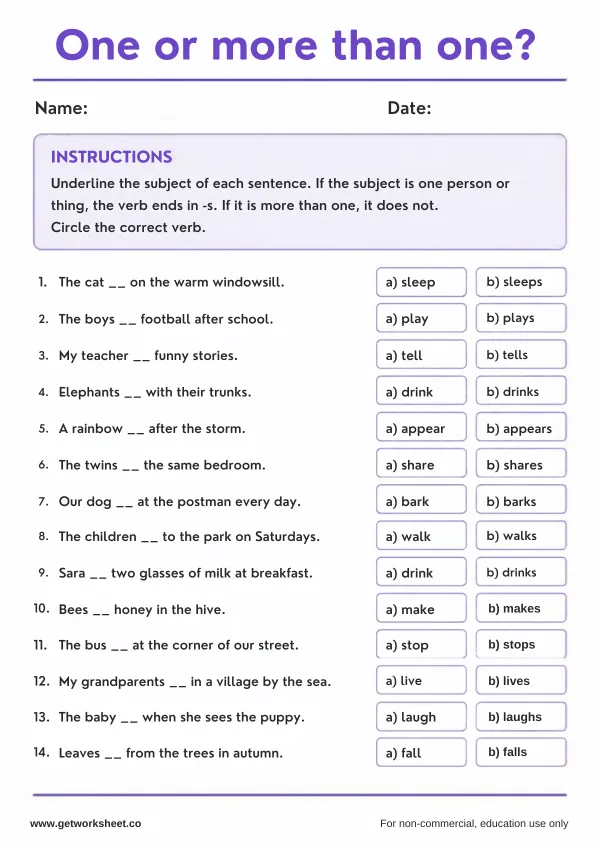
Free subject-verb agreement worksheets
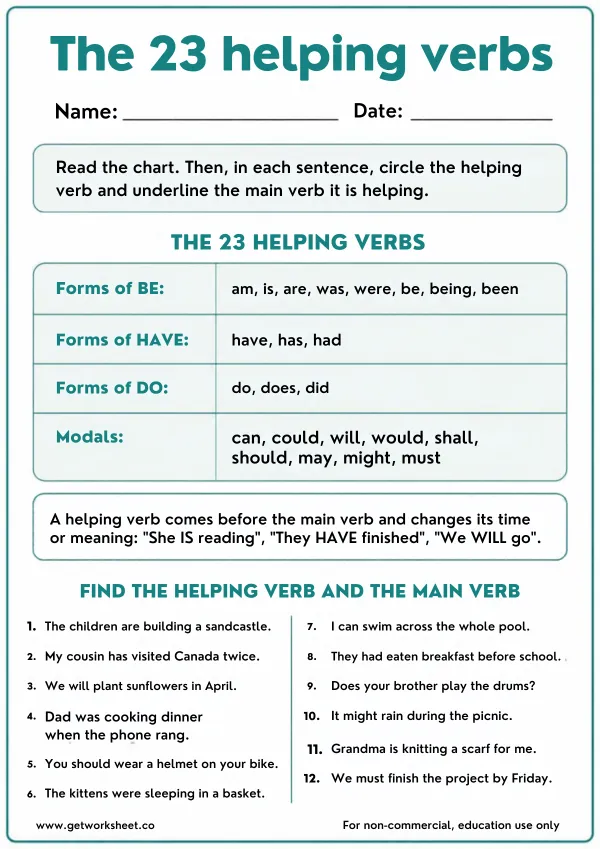
Free helping verbs worksheets
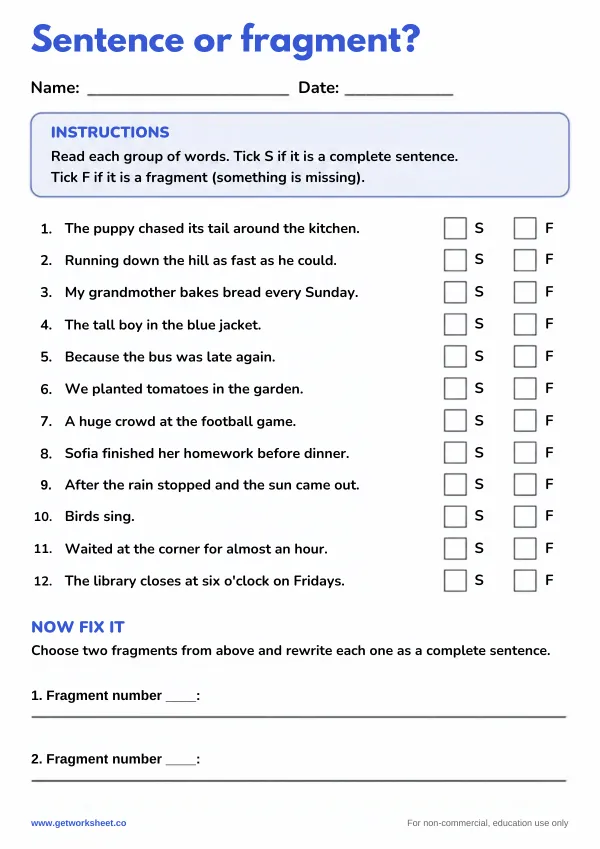
Free sentence fragments worksheets
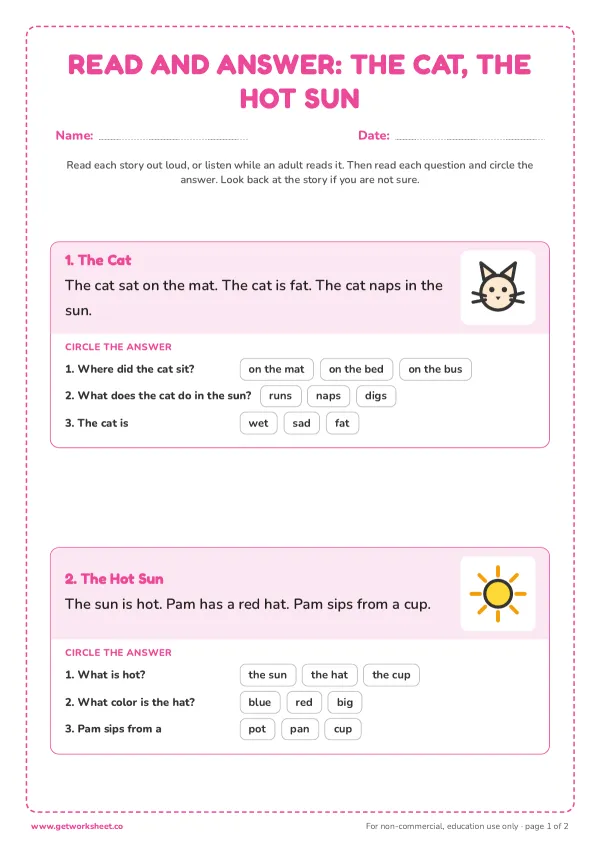
Free kindergarten reading comprehension worksheets
Free handwriting paper printables
Free word search printables
Free word families worksheets
Free Montessori language worksheets
More worksheets
- Free pre-writing worksheets
- Free sight words worksheets (Dolch and Fry)
- Free CVC words worksheets
- Free name tracing worksheets
- Free letter Z tracing worksheets
- Free letter Y tracing worksheets
- Free letter X tracing worksheets
- Free letter W tracing worksheets
- Free letter V tracing worksheets
- Free letter U tracing worksheets
- Free letter T tracing worksheets
- Free letter S tracing worksheets