Maths · Preschool–Grade 2
Free cuisenaire rods worksheets
Free printable Cuisenaire rods worksheets for preschool through grade 2: count the rod's length in centimetres, match each rod to its number, build the ten-rod colour staircase, and rod addition to 10. Answer keys included.
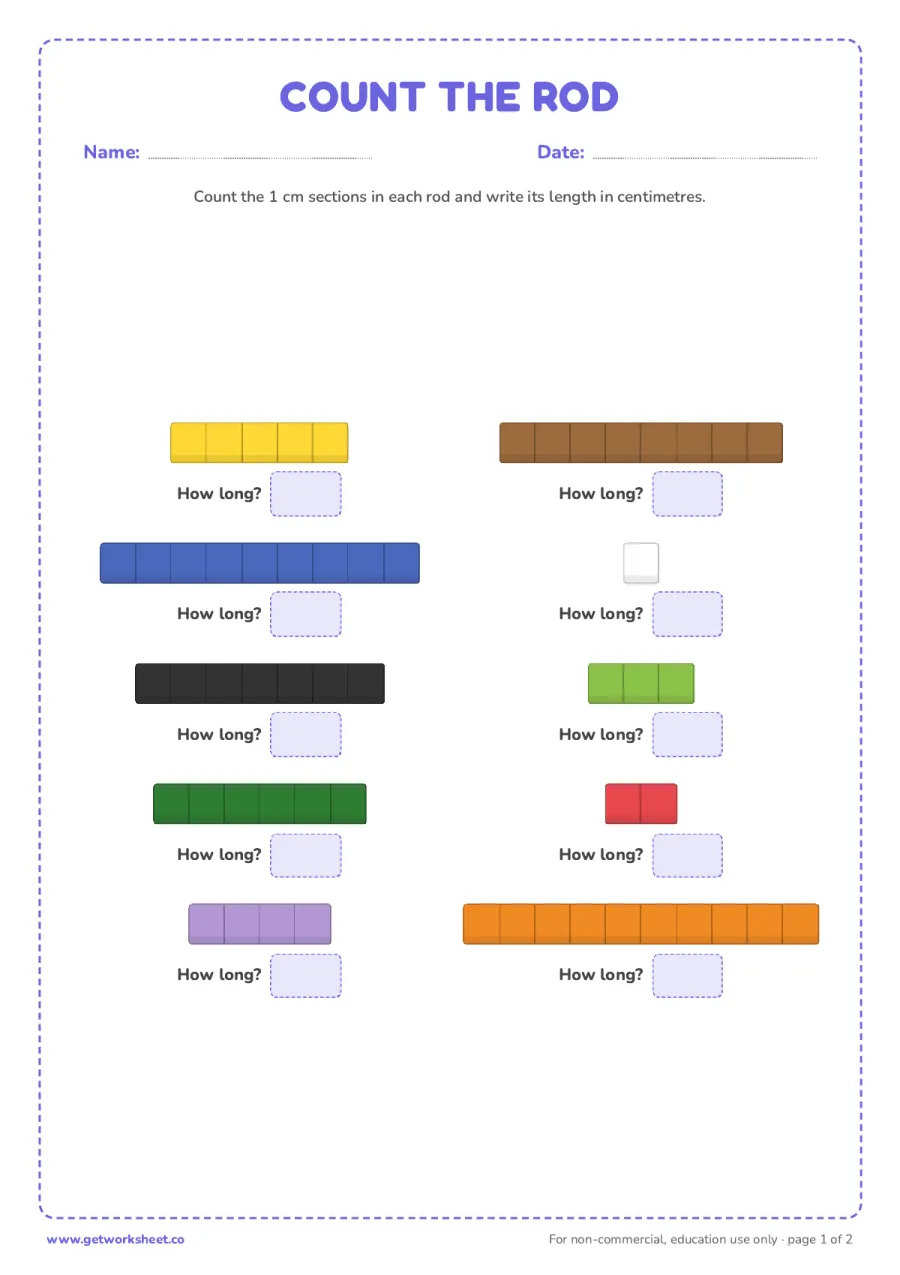
Count the rod (1 to 10 cm)
Ten Cuisenaire rods in mixed order, each a real manufacturer colour; count the 1 cm sections and write the length. Answer key on page 2. Free printable PDF.
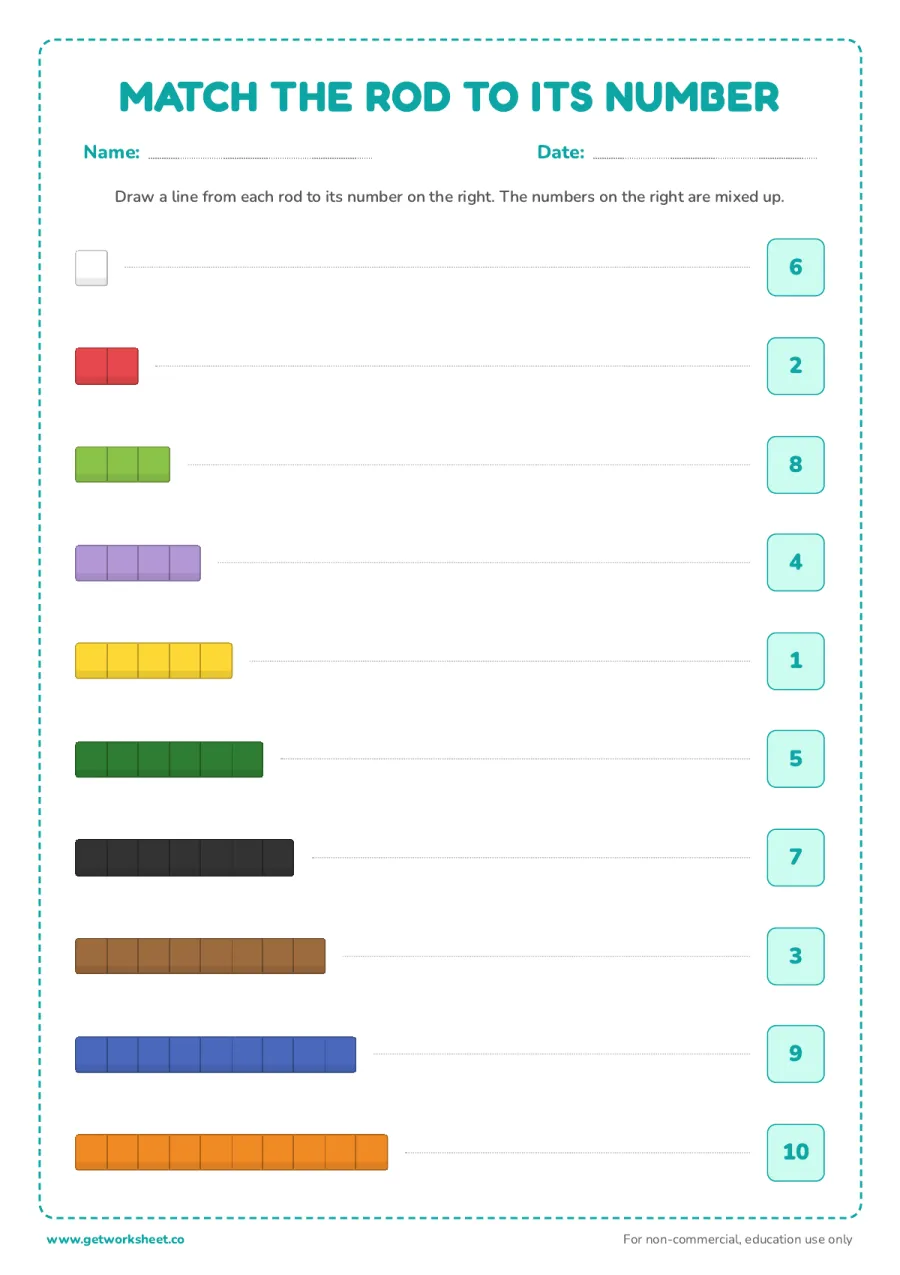
Match the rod to its number
All ten rods in order on the left, their numbers shuffled on the right: draw a line to match each rod to its length. Free printable PDF.
Whole set
All 4 in one PDF
- Every sheet on this page, one file
- No ads, no countdowns, print as often as you like
- Instant download, ad-free, no account needed
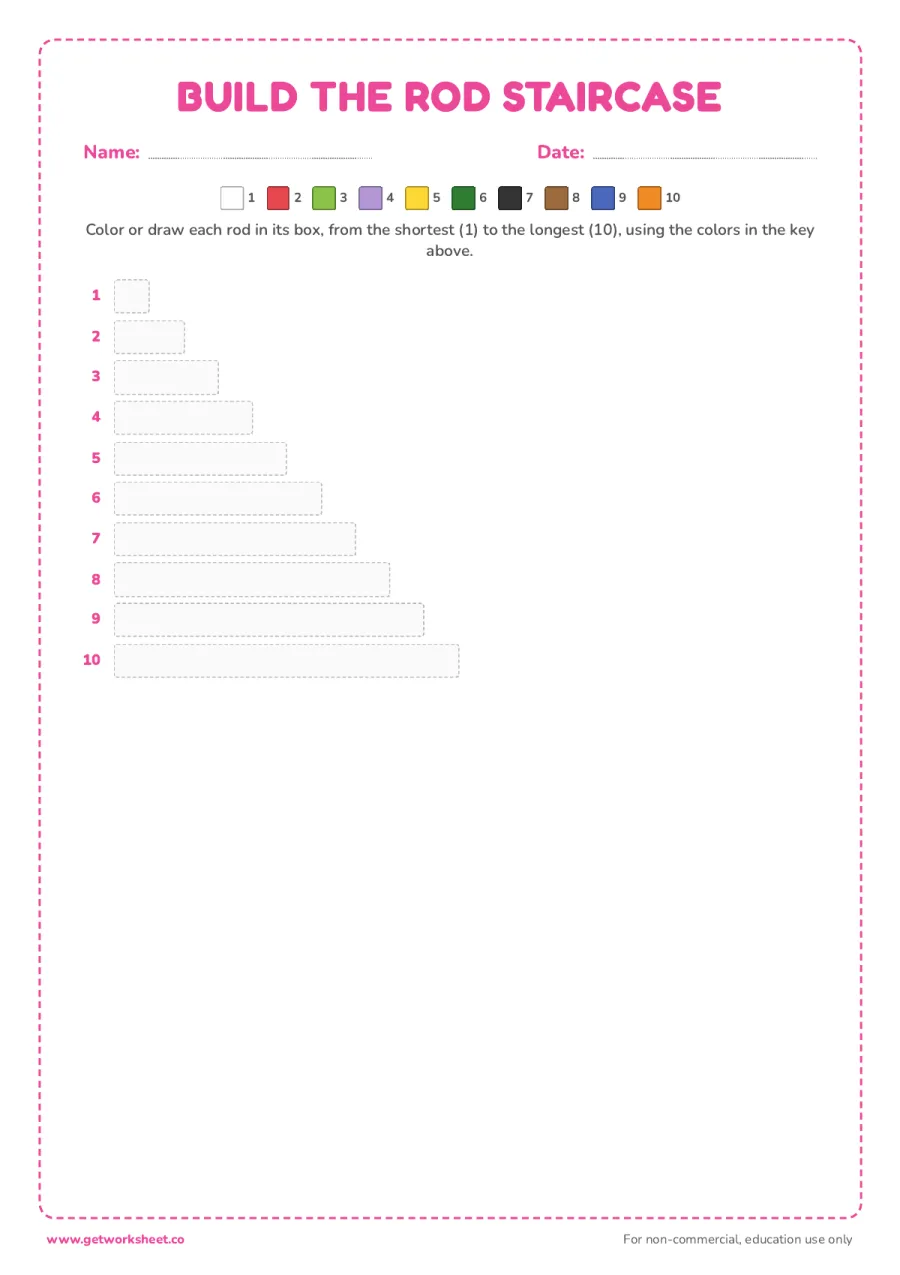
Build the rod staircase
A colour key for all ten rods, then ten boxes from shortest to longest to colour or draw each rod in its correct colour. Free printable PDF.
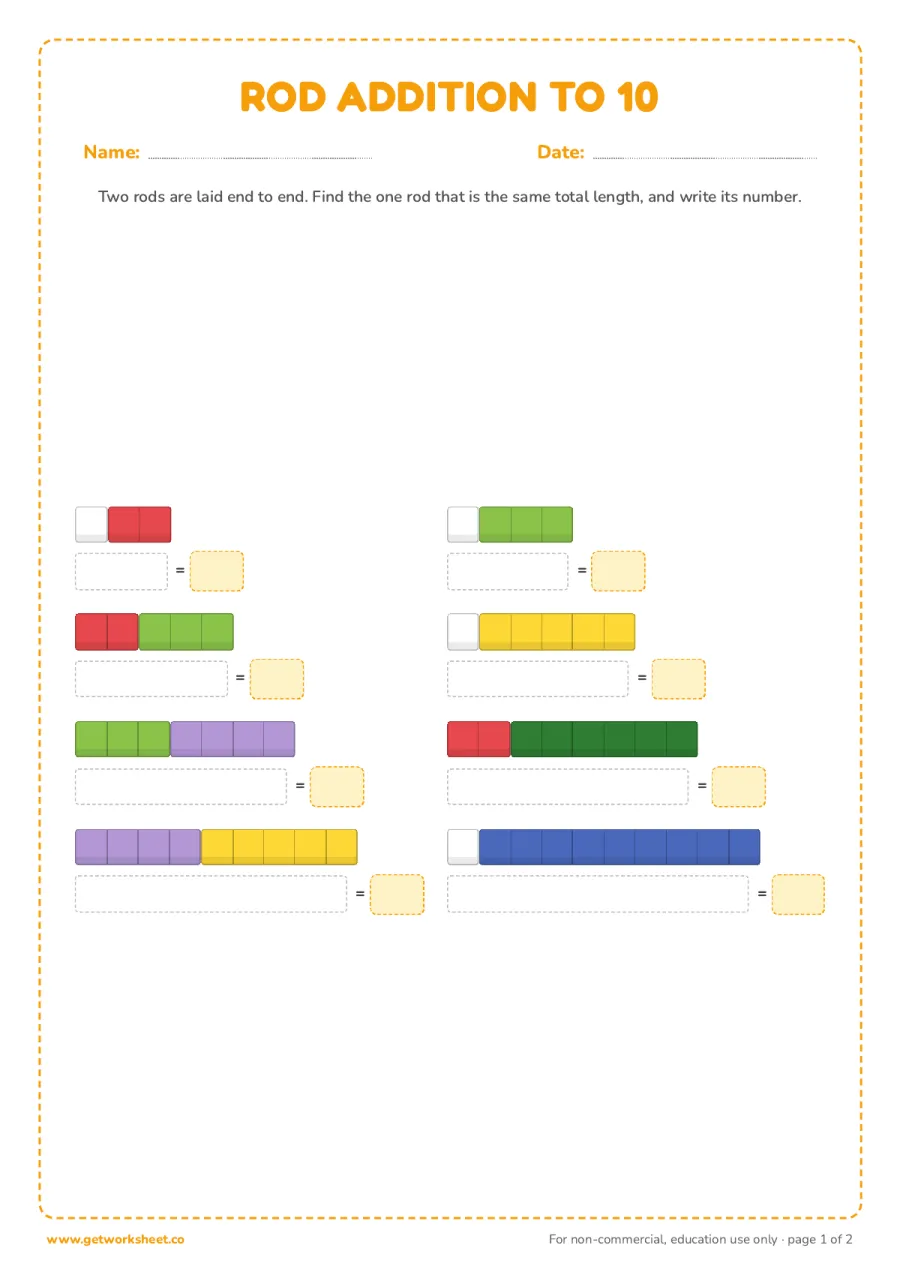
Rod addition to 10
Eight pairs of rods laid end to end; find the single rod that matches the total length and write the number. Answer key on page 2. Free printable PDF.
AI worksheet generator
Make a worksheet like this for your class
The 4 sheets above are fixed. The generator writes a new cuisenaire rods worksheet for your grade, with the question types and count you choose, in about 20 seconds. Pick a grade to start:
What you get
- A fresh set of questions on cuisenaire rods, not a copy of the sheets above
- Multiple choice, fill in the blanks, true or false, open ended
- Answer key and print-ready PDF with Pro
Free account, 1 worksheets a week. No card.
Cuisenaire rods are one colour per length, from a 1 cm white cube to a 10 cm orange bar, and every classroom set in the world uses the same ten colours. That fixed code is the whole point: a child who knows yellow means 5 can read a rod across the room, long before they can count the centimetres on it. These four worksheets take the rods off the shelf and onto paper: a counting sheet with every rod drawn in its real colour and marked off in 1 cm sections, a matching sheet, the ten-rod staircase to colour from memory, and simple rod addition where two rods end to end equal one longer rod.
What's in this set
- Count the rod. Ten rods in mixed order, each in its correct colour with faint 1 cm divider lines. Count the sections, write the length. Answer key on page 2.
- Match the rod to its number. All ten rods in order on the left, the numbers 1 to 10 shuffled on the right. Draw a line to match each rod to its length.
- Build the rod staircase. A colour key for every rod, then ten empty boxes from shortest to longest to colour or draw in the right colour from memory.
- Rod addition to 10. Eight pairs of rods laid end to end; find the one rod that is the same total length and write its number. Answer key on page 2.
Free printable makers
Make your own cuisenaire rods sheets
Type your own words or numbers and print in about 30 seconds. No account, no AI, answer key where it applies.
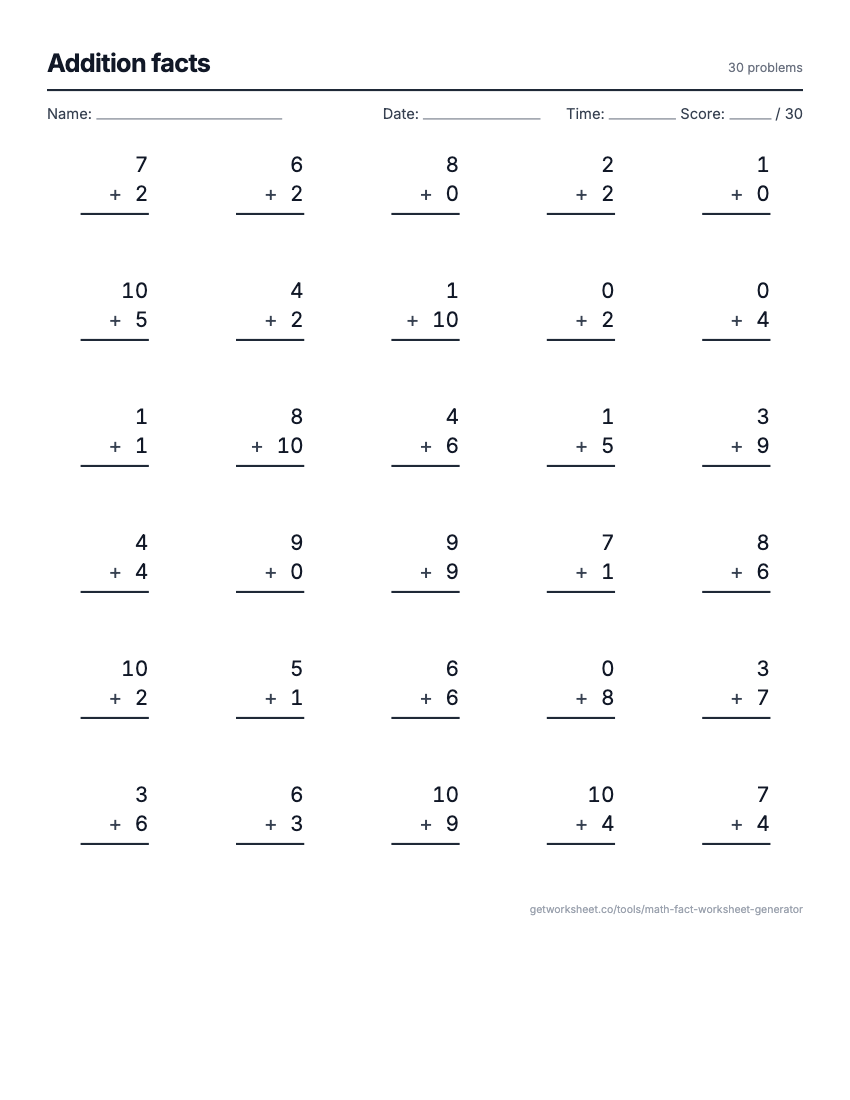 Math fact worksheet generatorAddition to division drills with an answer key. Free to print.
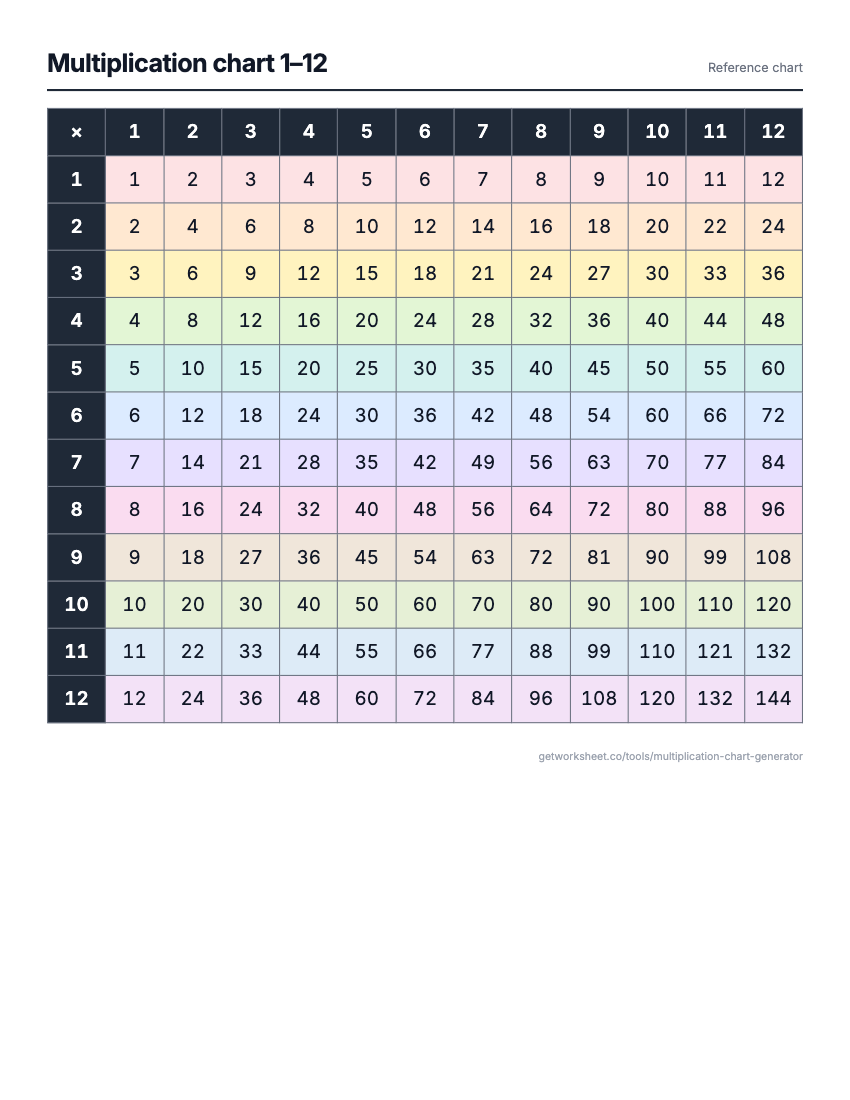 Multiplication chart generatorCharts to 15, full, blank or coloured, and times table tests with key. Free to print.
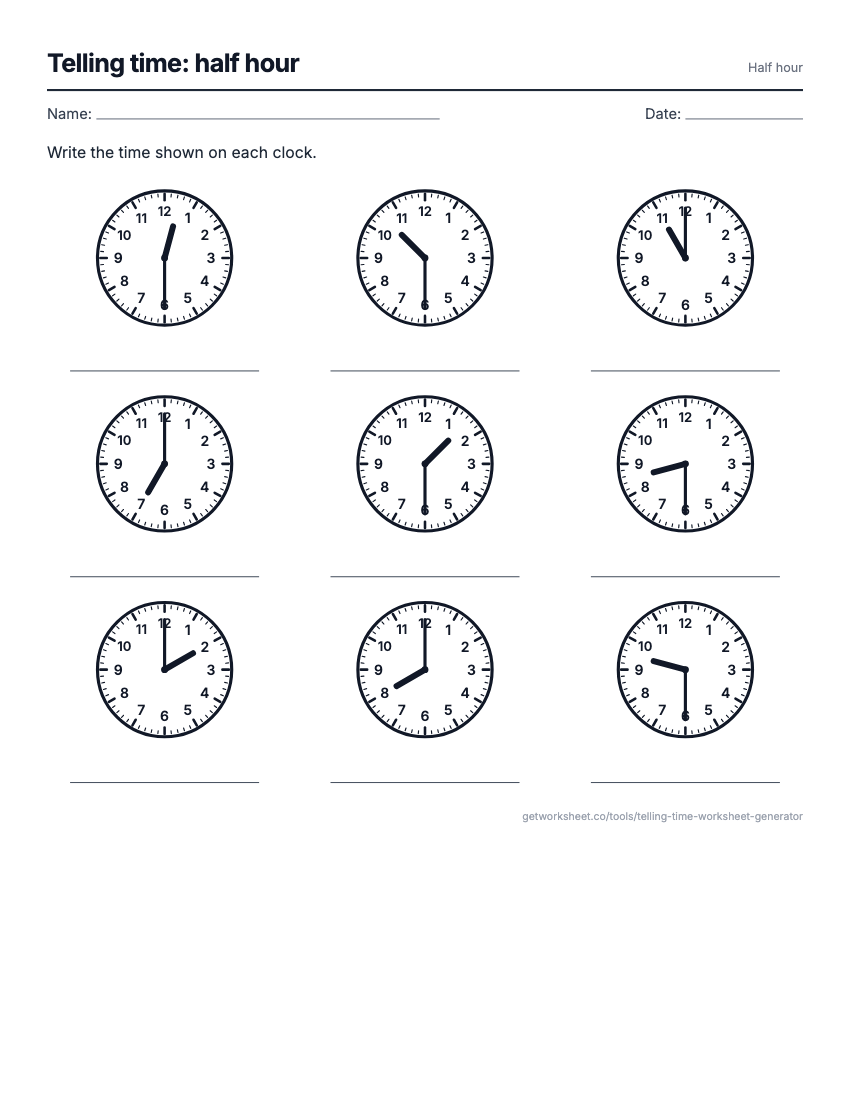 Telling time worksheet generatorAnalogue clocks to read, draw, match or add time to, with answer key. Free to print.
AI worksheet generator
Need a different cuisenaire rods worksheet?
Generate a custom cuisenaire rods worksheet: pick the grade, question types and count, and print it in about 20 seconds. Free accounts get 1 generation a week.
Teaching tips and common mistakes
How to use these worksheets
Print at 100% on A4 or US Letter. If you have the physical rods, put them next to the page for the first few sheets; the worksheets are meant to follow the material, not replace it.
- Count the rod. Point at each 1 cm section as the child counts out loud, the same way they would count notches on the real rod. The white 1-rod is a single square: count 'one' and stop.
- Match the rod to its number. Cover the left-hand numbers 1 to 10 if the child already knows them by sight; otherwise read each length together before matching.
- Build the staircase. This is a memory test, not a counting one. Let the child peek at the key as often as needed at first; the goal is to stop needing it.
- Rod addition. Lay the two printed rods end to end with a finger, then look along the staircase (or the real rods) for the single rod of the same length. All totals are 10 or less.
Common mistakes to watch for
- Counting the rod, not the sections. A child says "one" for the whole bar instead of counting each 1 cm segment. Point at each divider line as you count.
- Guessing the colour instead of reading the length. On the staircase sheet, some children colour rods in a favourite colour rather than the correct one. Check against the key after, not during.
- Losing track mid-rod on longer lengths. The 8, 9 and 10 rods have the most sections to count. Slow down and keep a finger on the last section counted.
Frequently asked questions
What are Cuisenaire rods?
A set of ten wooden or plastic rods, 1 cm to 10 cm long, where every length has always been made in the same colour: white (1), red (2), light green (3), purple (4), yellow (5), dark green (6), black (7), brown (8), blue (9) and orange (10). Belgian teacher Georges Cuisenaire introduced them in the 1950s for teaching number and length without counting one unit at a time.
What do the rod colours mean?
Nothing beyond the length: the colour is just a fixed label so a rod can be recognised instantly instead of measured every time. There is no pattern linking colour family to size (red and purple are not "the small ones"); it is simply one length, one colour, memorised the way children memorise which crayon is which name.
Are Cuisenaire rods the same as Montessori number rods?
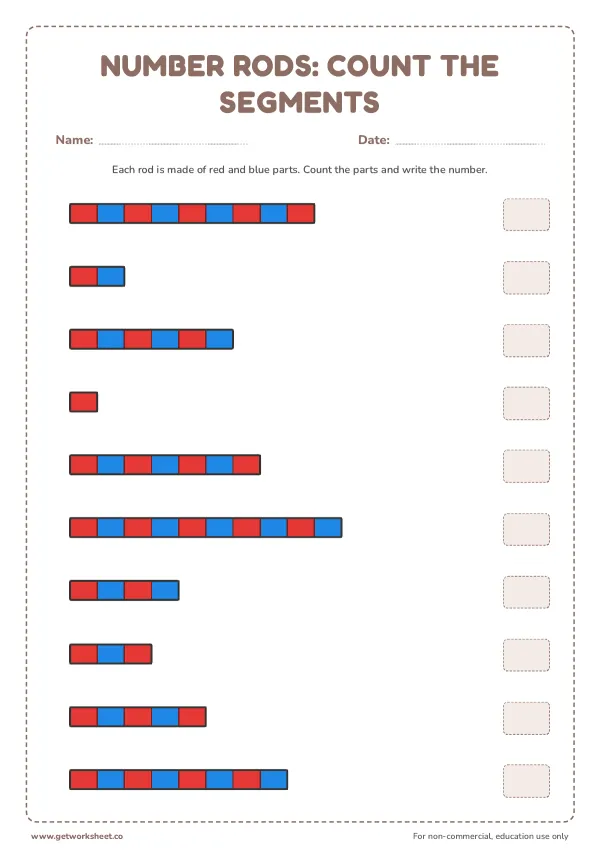
No, even though both teach length and number 1 to 10. Montessori number rods are each striped alternately red and blue in 10 cm segments, so every rod shows its own length again regardless of which other rod it is. Cuisenaire rods are solid, one colour per whole rod, and that colour is the same across every length-4 rod anyone owns. Different material, same underlying idea: see the Montessori number rods worksheets for the other version.
Do these worksheets need the real rods?
No, they work from the printed colours and the 1 cm divider lines alone. Having the physical set alongside makes the first sheet easier, since the child can check a printed rod against the real one, but none of the four sheets require it.
Do the worksheets have answer keys?
Count the rod and rod addition both have an answer key on page 2 of their PDF. Match the rod to its number and build the staircase are self-checking against the colour key printed on the page.
More math manipulative practice
The Montessori number rods worksheets teach the same 1-to-10 lengths with striped red-and-blue segments instead of fixed colours, and the Montessori bead stair worksheets use coloured bead bars for the same number range. For place value with a different material, see the Montessori golden beads worksheets.
Free library
Related collections
Free Montessori number rods worksheets
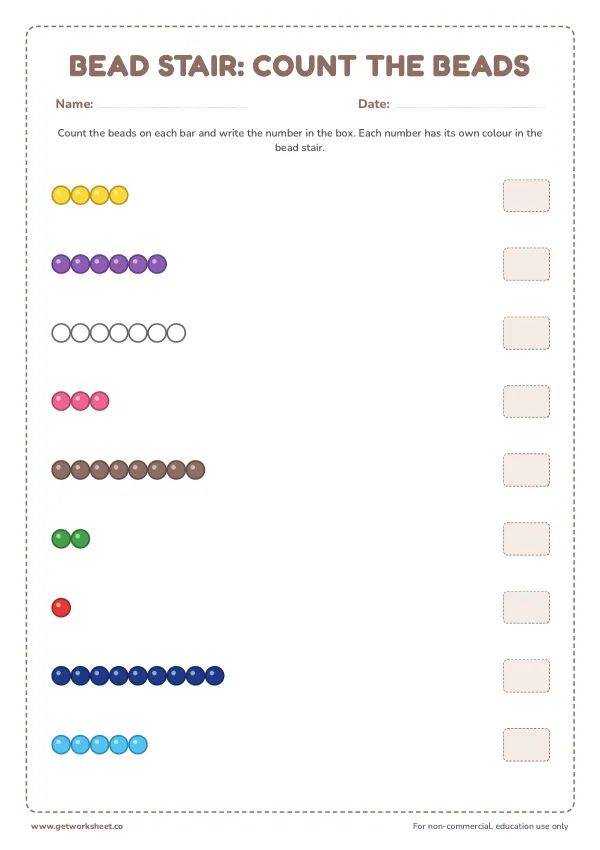
Free Montessori bead stair worksheets
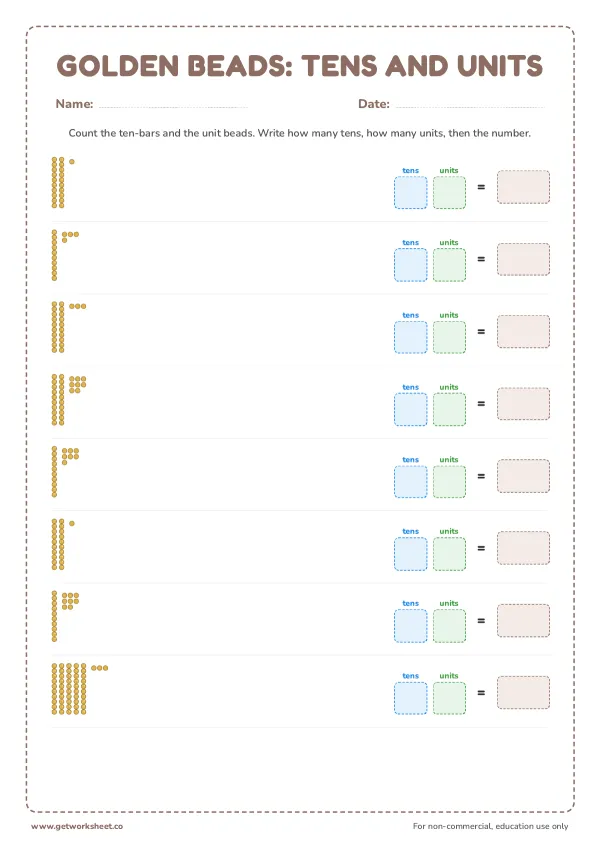
Free Montessori place value worksheets (golden beads)
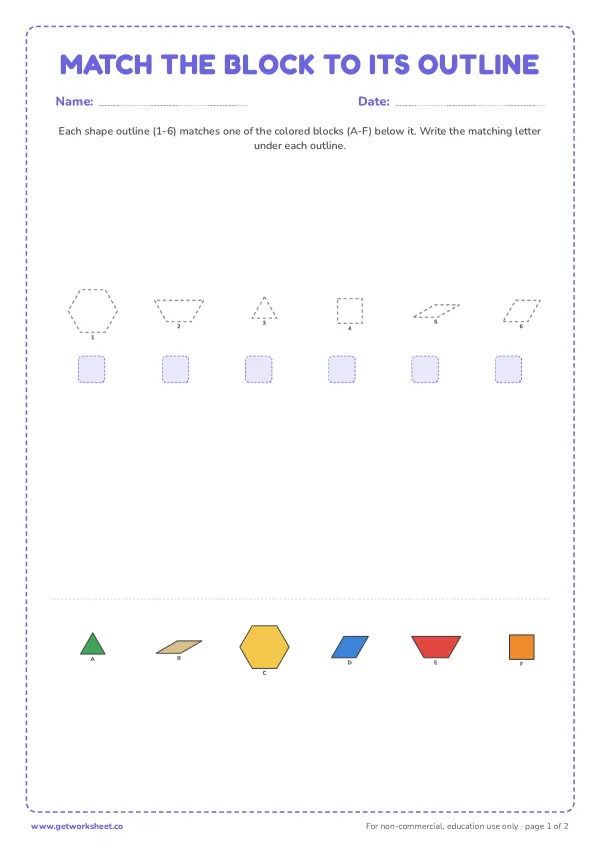
Free pattern blocks worksheets
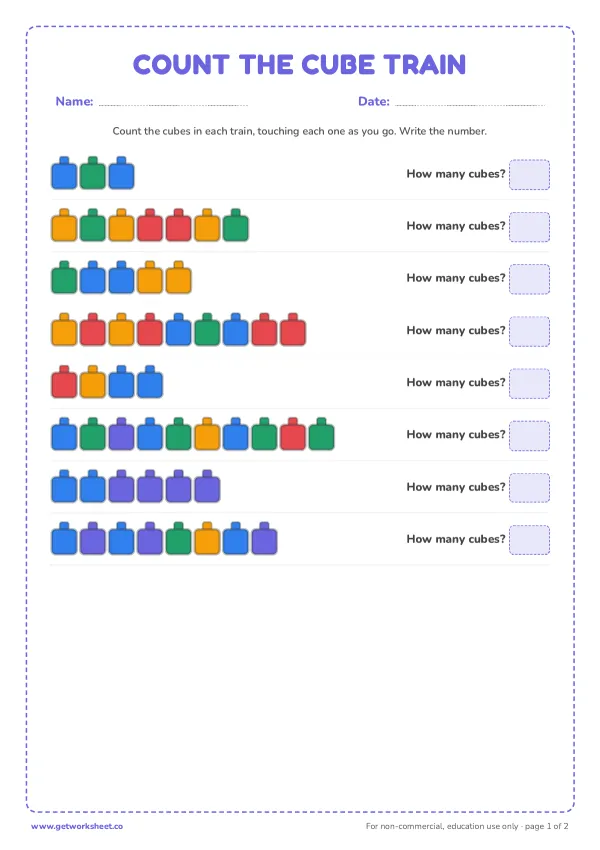
Free unifix cubes worksheets
Free diamond tracing worksheets
Free hexagon, pentagon and octagon tracing worksheets
Free star tracing worksheets
More worksheets
- Free Montessori spindle box worksheets
- Free penguin worksheets
- Free snowman worksheets
- Free winter worksheets for preschool and kindergarten
- Free winter tracing worksheets
- Free heart tracing worksheets
- Free Montessori math worksheets: one from every material
- Free shape tracing worksheets
- Free number 20 tracing worksheets
- Free number 19 tracing worksheets
- Free number 18 tracing worksheets
- Free number 17 tracing worksheets