Maths · Grades 4–7
Free angles worksheets
Free printable angles worksheets for grades 4 to 7, every one with an answer key: identify acute, right, obtuse, straight and reflex angles; estimate and measure with a protractor; draw angles of a given size; complementary and supplementary pairs; angles in a triangle; angles on a straight line and around a point; vertically opposite angles; and a mixed review. All angles are drawn to their true size.
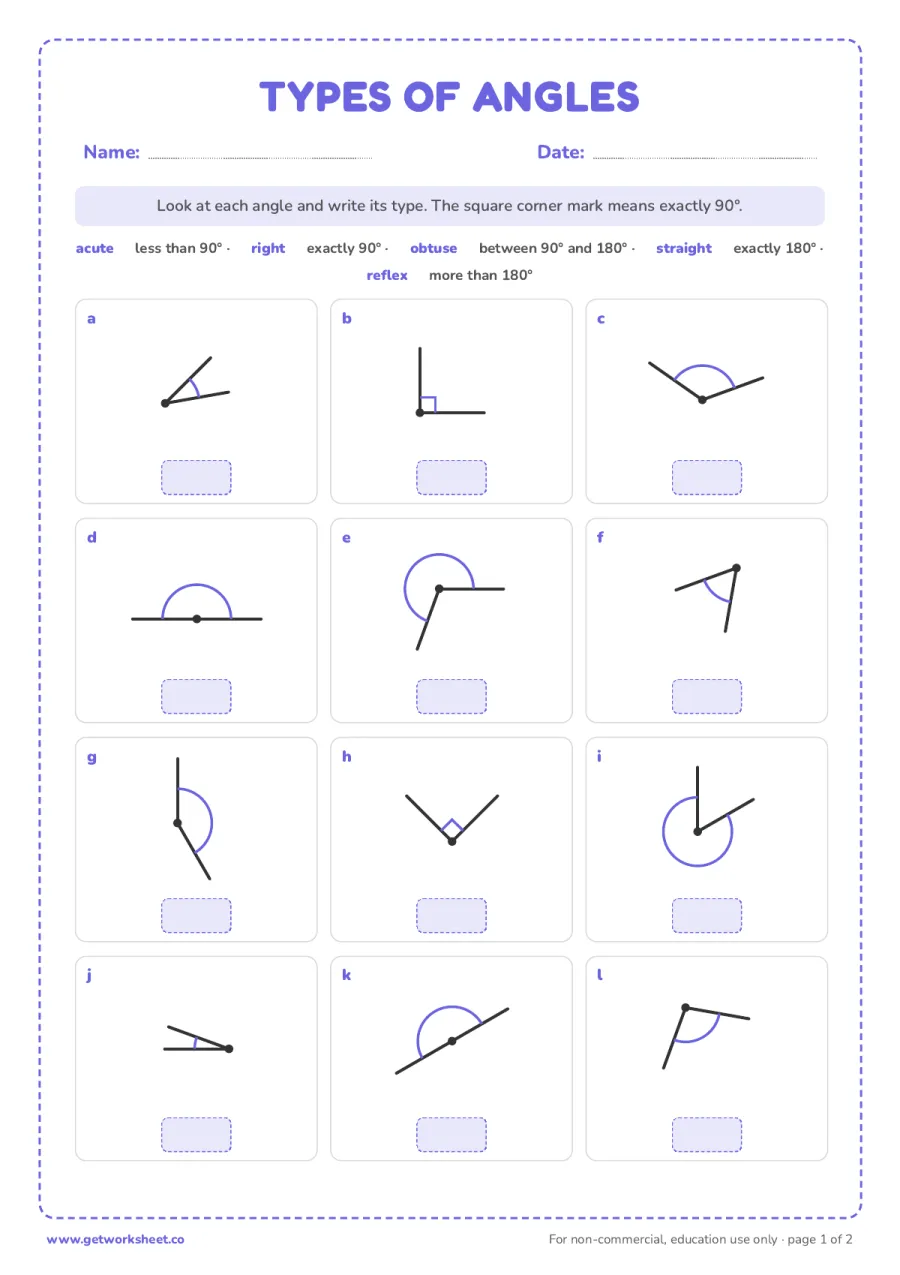
Identify angle types: acute, right, obtuse, straight, reflex
Twelve drawn angles to name as acute, right, obtuse, straight or reflex, with a definitions strip at the top. Answer key gives the type and the size. Free printable PDF.
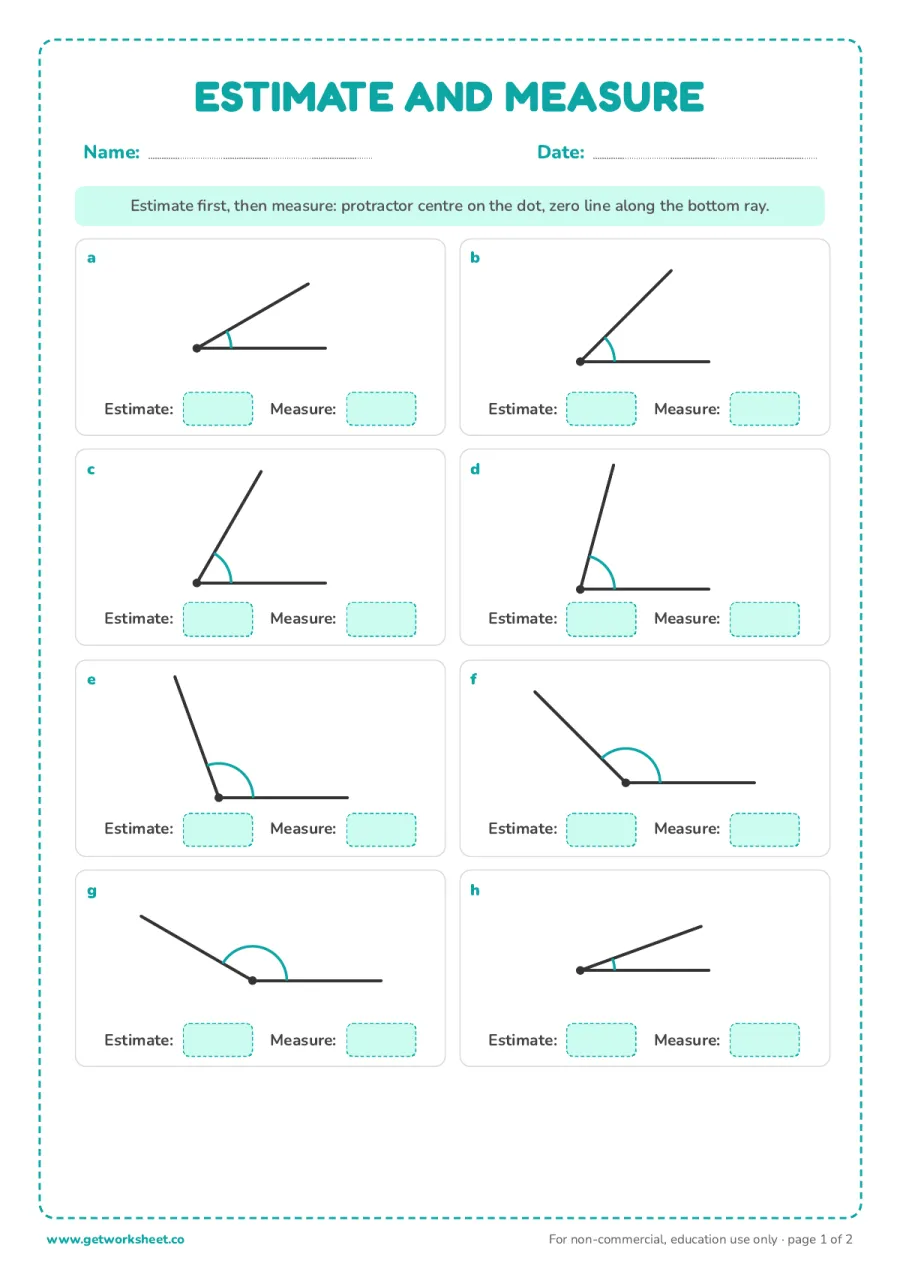
Estimate, then measure angles with a protractor
Eight angles drawn to exact degrees with a horizontal base ray: estimate first, then measure with a protractor. Answer key lists the true measures. Free printable PDF.
Whole set
All 8 sheets in one PDF
Instant and ad-free. No account needed.
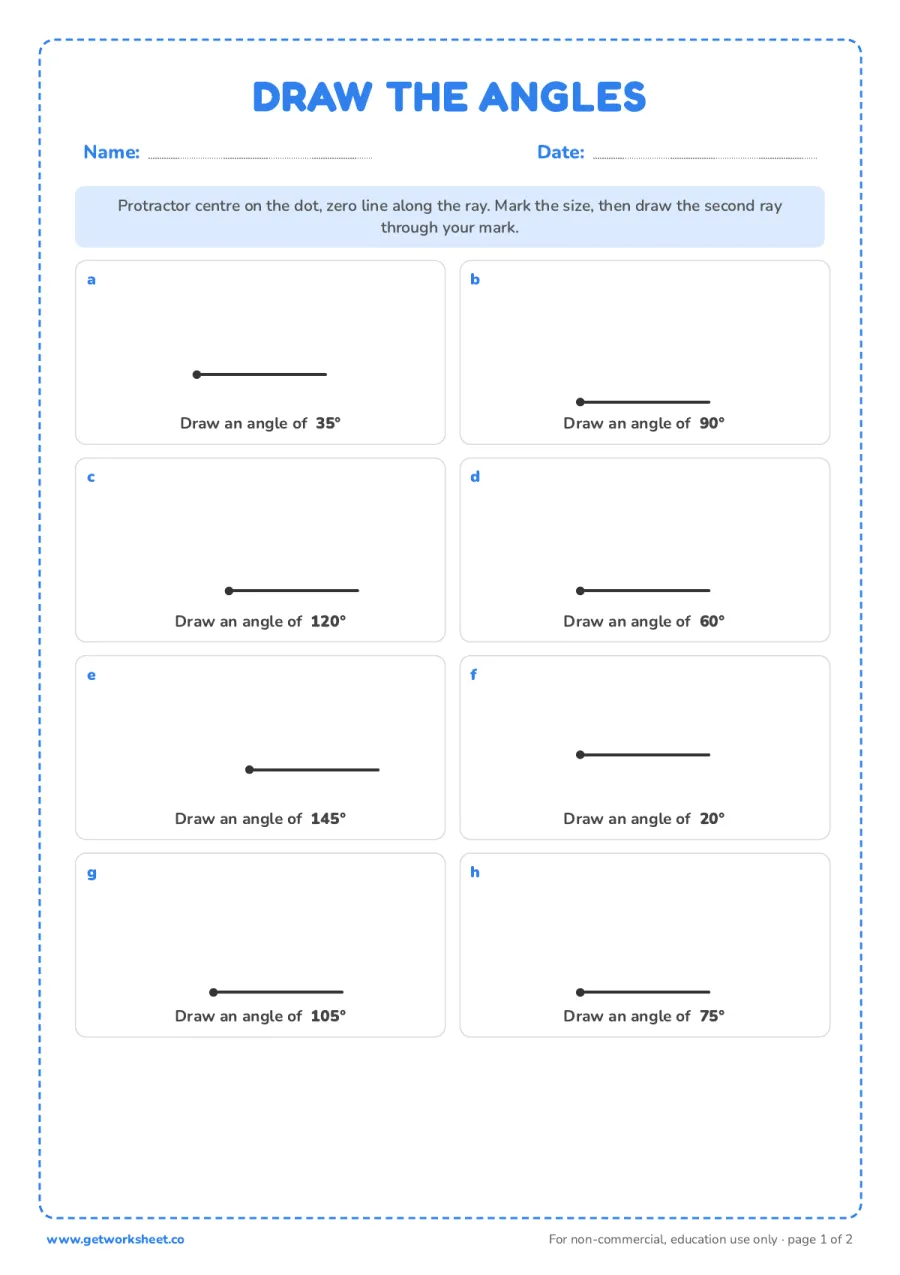
Draw angles of a given size
Eight blank rays with a vertex dot: use a protractor to draw an angle of the stated size (20 to 145 degrees). Answer key shows each finished angle. Free printable PDF.
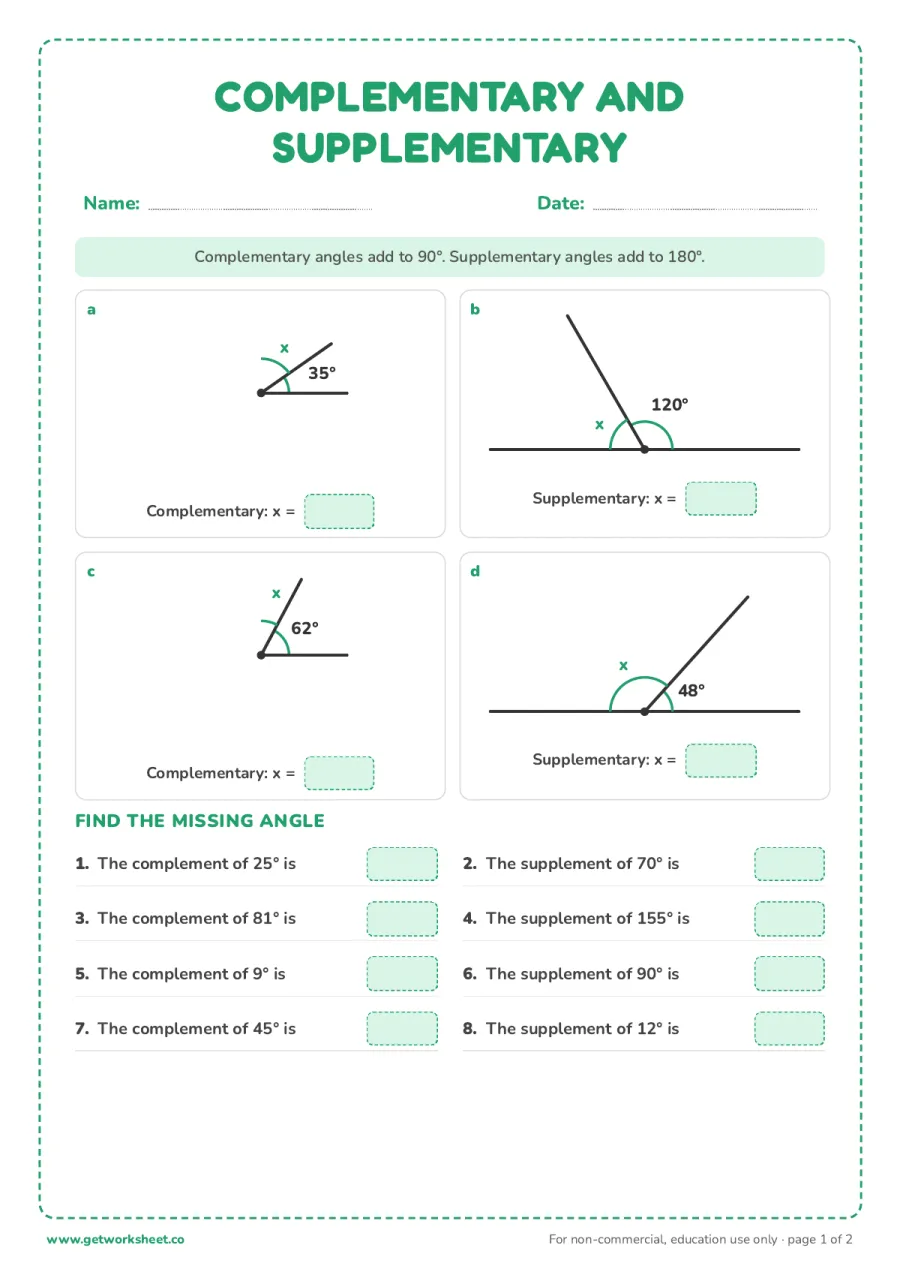
Complementary and supplementary angles
Four drawn angle pairs (two making a right angle, two on a straight line) and eight written complements and supplements to find. Answer key included. Free printable PDF.
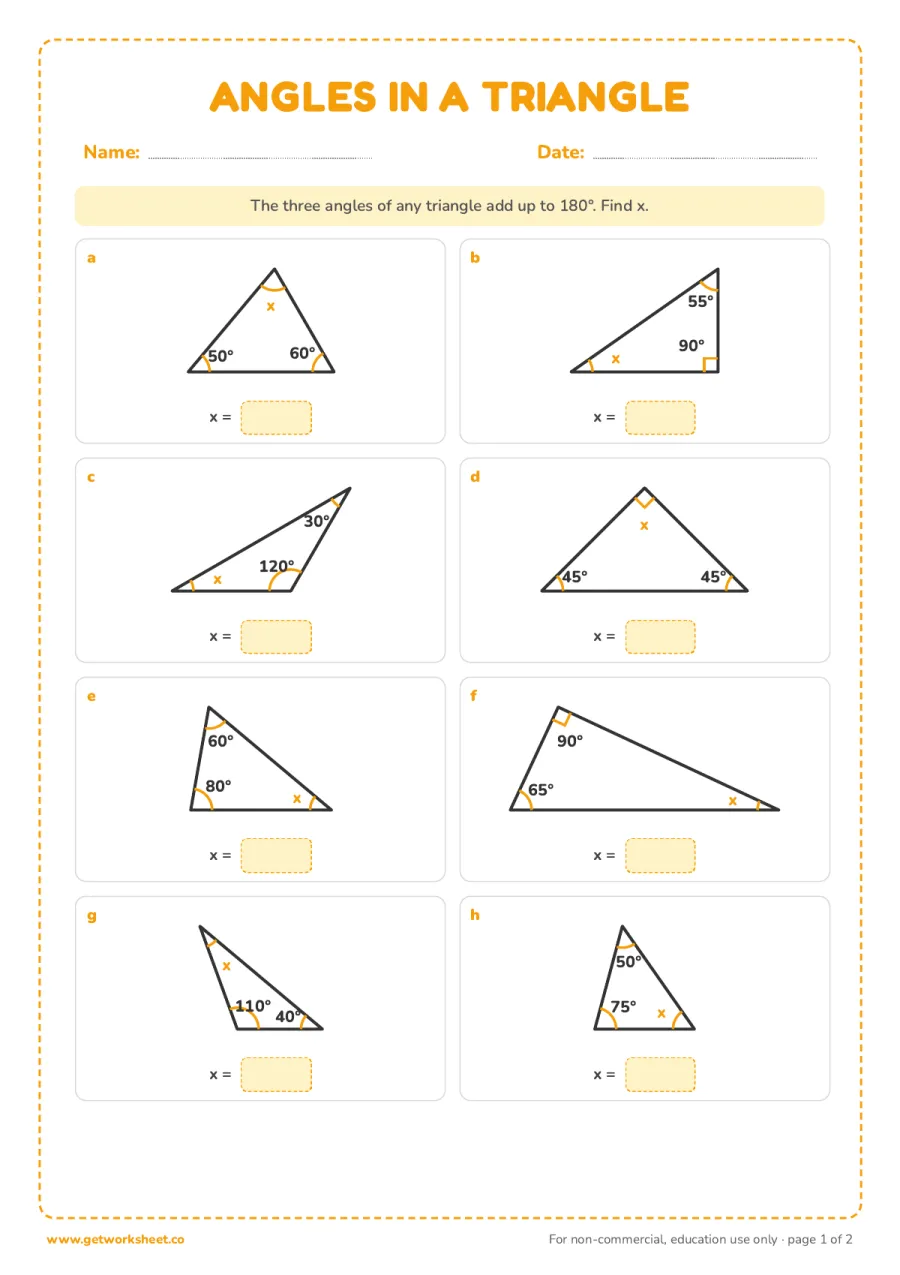
Angles in a triangle: find the missing angle
Eight triangles drawn to scale with two angles given; use the 180 degree rule to find the third. Includes right and isosceles triangles. Answer key included. Free printable PDF.
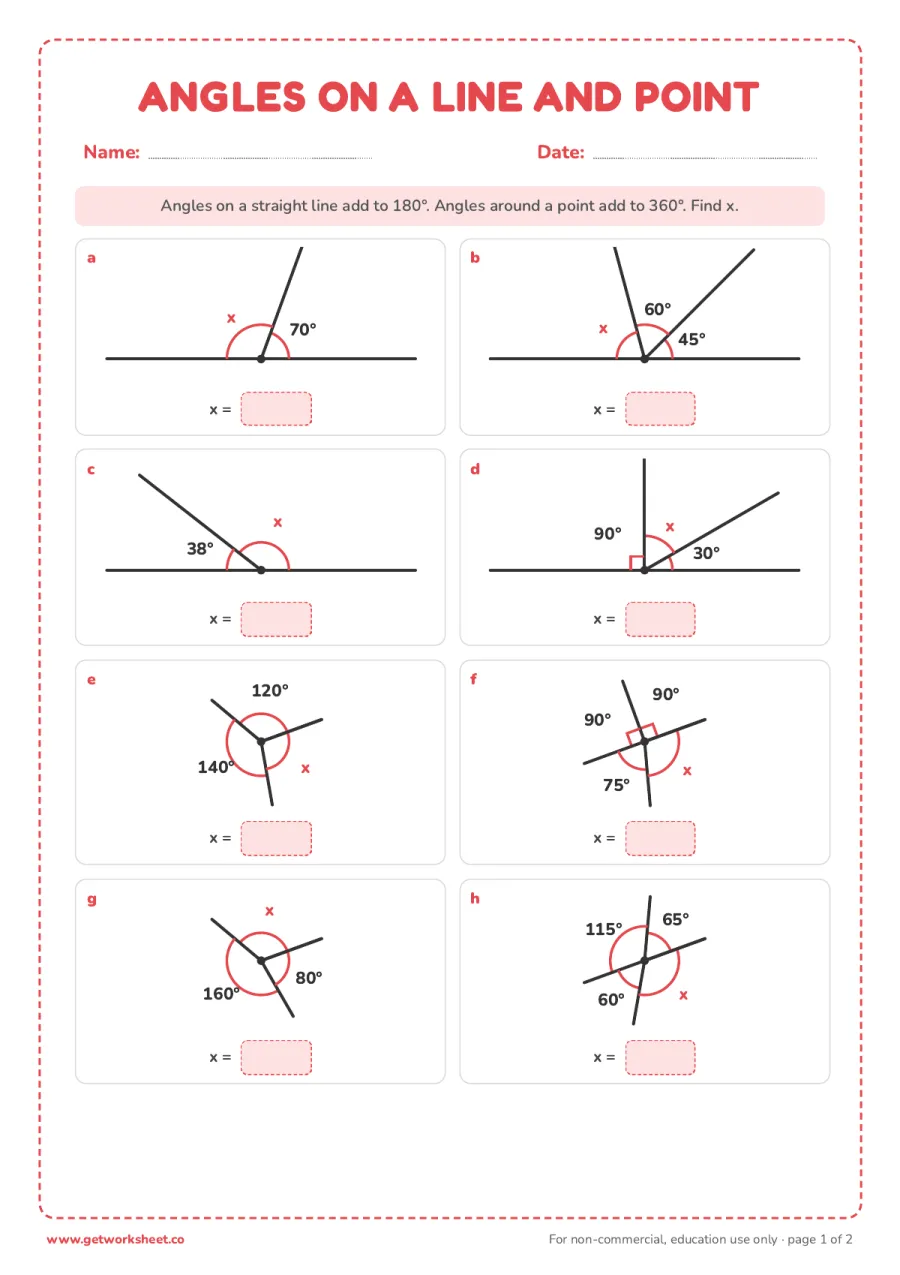
Angles on a straight line and around a point
Four angles-on-a-line problems (180 degrees) and four angles-around-a-point problems (360 degrees), all drawn to true size. Answer key included. Free printable PDF.
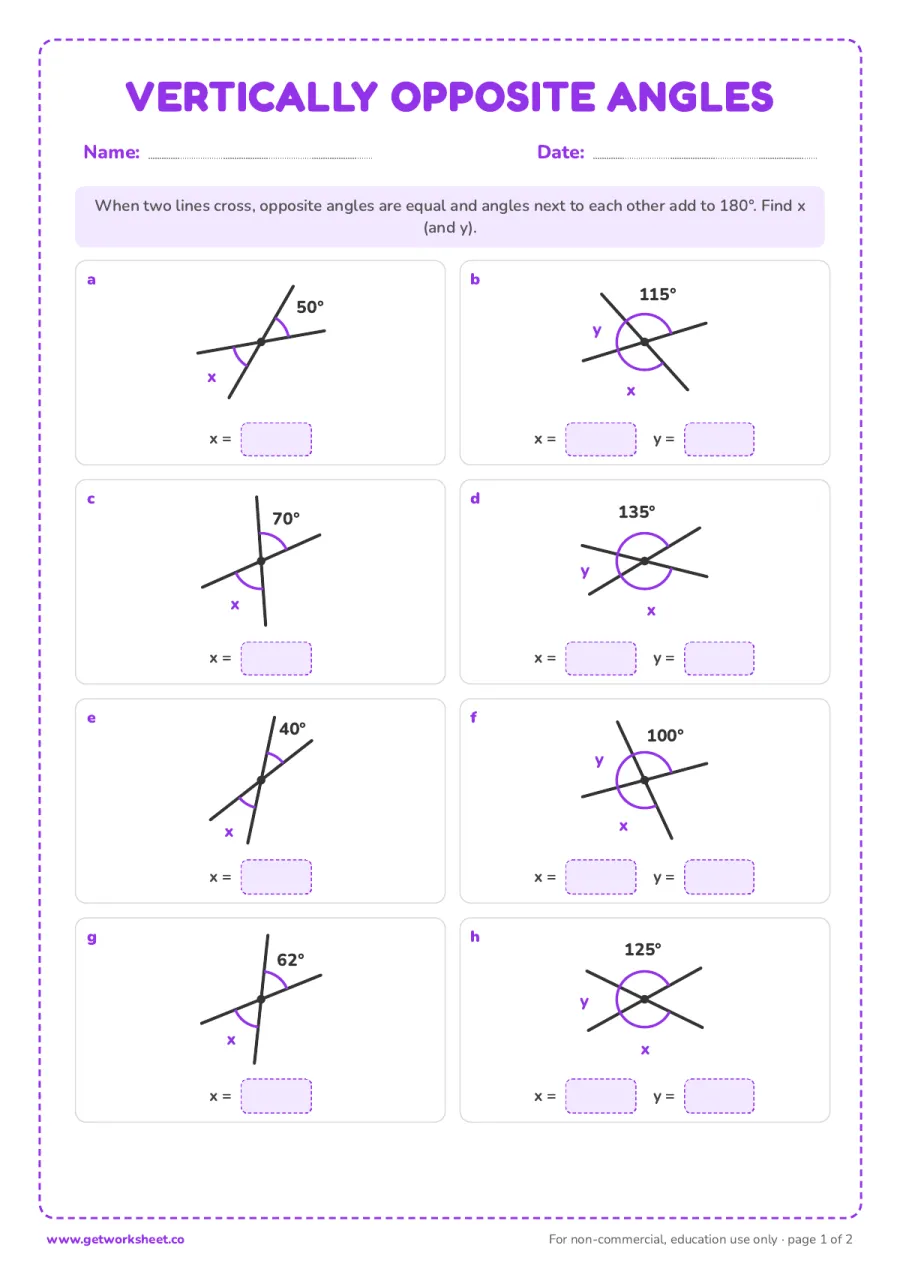
Vertically opposite angles
Eight pairs of crossing lines: find the vertically opposite angle x, and on four of them the adjacent angle y as well. Answer key included. Free printable PDF.
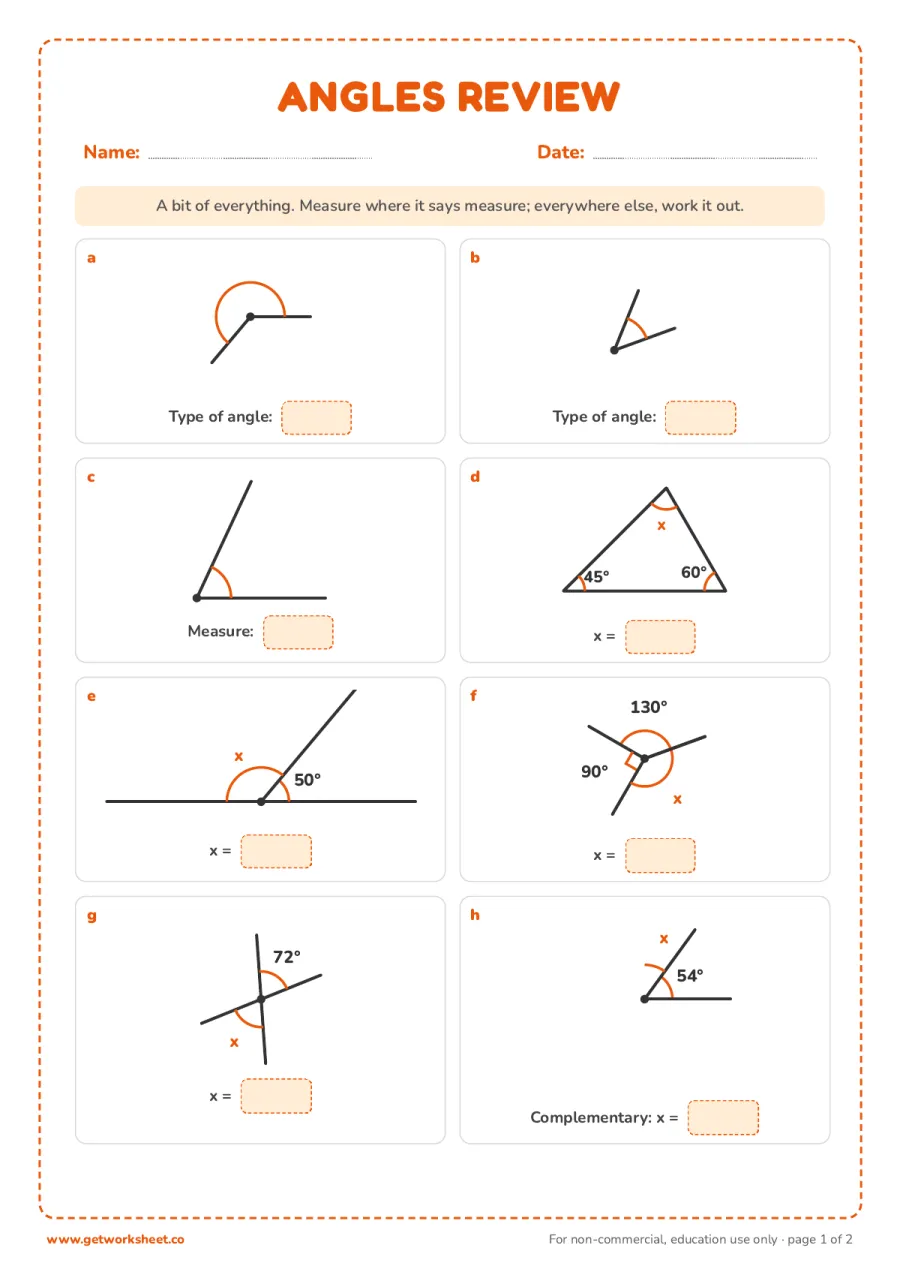
Angles mixed review
Eight mixed questions: name the type, measure, a triangle, angles on a line, around a point, vertically opposite and a complement, with an answer key. Free printable PDF.
AI worksheet generator
Make a worksheet like this for your class
The 8 sheets above are fixed. The generator writes a new angles worksheet for your grade, with the question types and count you choose, in about 20 seconds. Pick a grade to start:
What you get
- A fresh set of questions on angles, not a copy of the sheets above
- Multiple choice, fill in the blanks, true or false, open ended
- Answer key and print-ready PDF with Pro
Free account, 1 worksheets a week. No card.
Angles are where geometry stops being about naming shapes and starts being about measuring and reasoning. This set of eight worksheets follows the usual order from fourth grade to seventh: first naming angle types by eye, then using a protractor to measure and to draw, then the angle facts that let students work out a missing angle without measuring at all. Every angle on every page is drawn to its true size, so a protractor on the printout reads the right number, and every worksheet has an answer key on page 2.
What's in this set
- Types of angles. Twelve drawn angles to label acute, right, obtuse, straight or reflex, with a definitions strip at the top. The key gives the type and the size.
- Estimate and measure. Eight angles from 20 to 150 degrees with a horizontal base ray: estimate first, then measure. The key lists the exact values.
- Draw the angles. Eight blank rays with a vertex dot; draw an angle of the given size (20 to 145 degrees). The key shows each finished angle.
- Complementary and supplementary. Four drawn pairs (two making a right angle, two on a straight line) and eight written complements and supplements.
- Angles in a triangle. Eight triangles drawn to scale with two angles given, including right-angled and isosceles triangles.
- Angles on a line and around a point. Four problems that add to 180 degrees and four that add to 360, with up to four angles at a point.
- Vertically opposite angles. Eight pairs of crossing lines; find x, and on four of them the adjacent angle y as well.
- Angles review. Eight mixed questions covering everything above.
Printing
For the measuring and drawing pages, print at 100% ("actual size") rather than "fit to page". Scaling does not change an angle, but it does shrink the rays, and short rays are harder to line up with a protractor.
Free printable makers
Make your own angles sheets
Type your own words or numbers and print in about 30 seconds. No account, no AI, answer key where it applies.
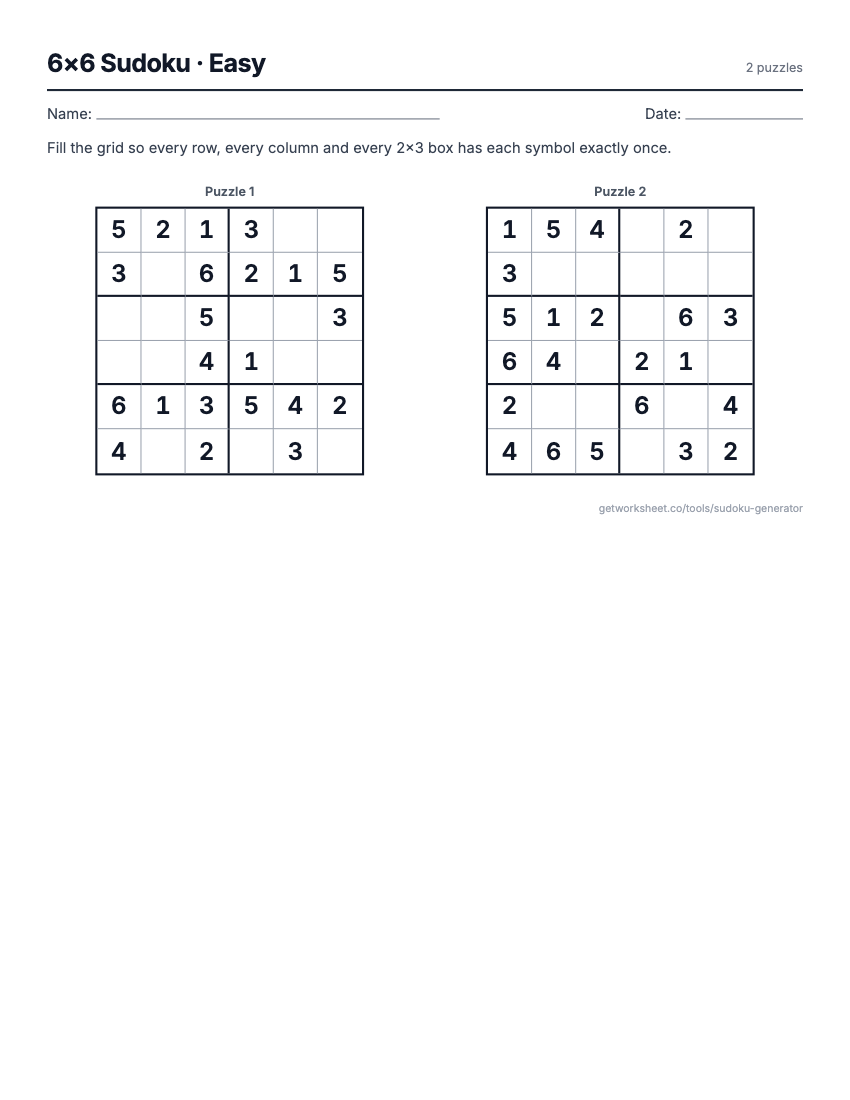 Sudoku generator4x4, 6x6 and 9x9 sudoku with numbers, letters or shapes, one solution each. Free to print.
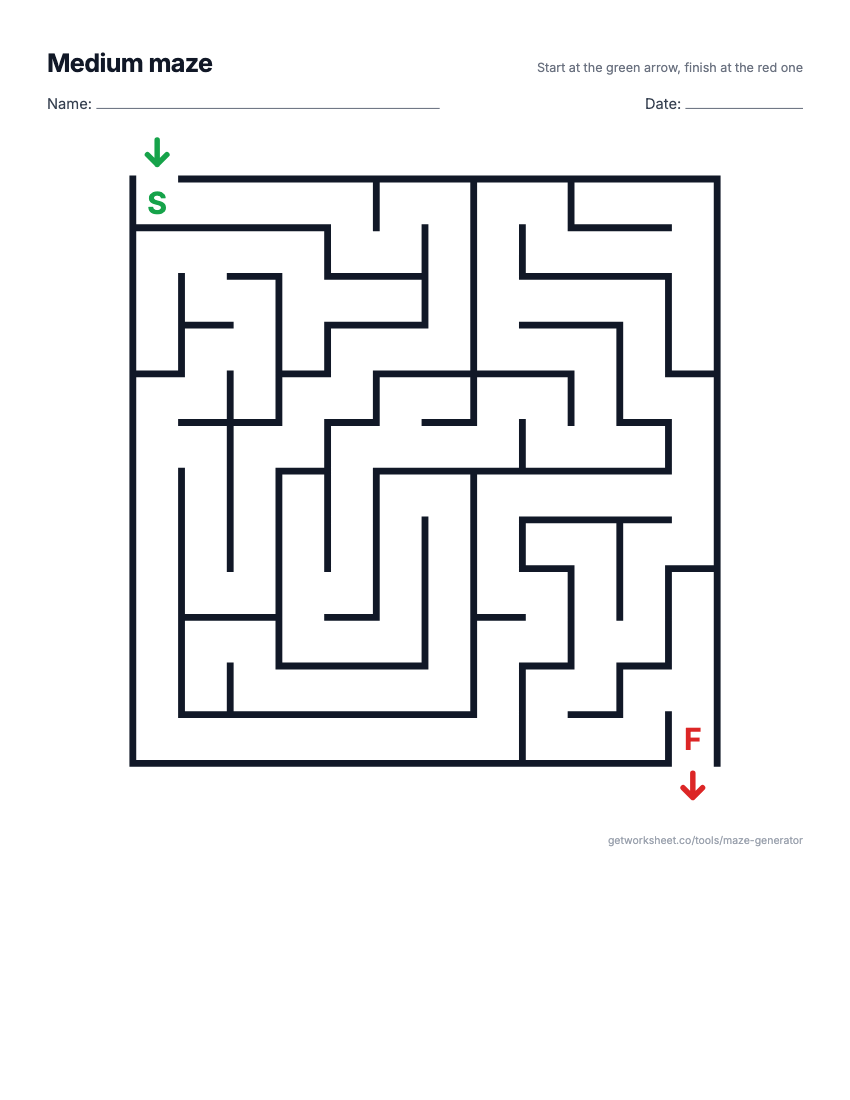 Maze generatorEasy to expert mazes, square or circle, with a solution page. Free to print.
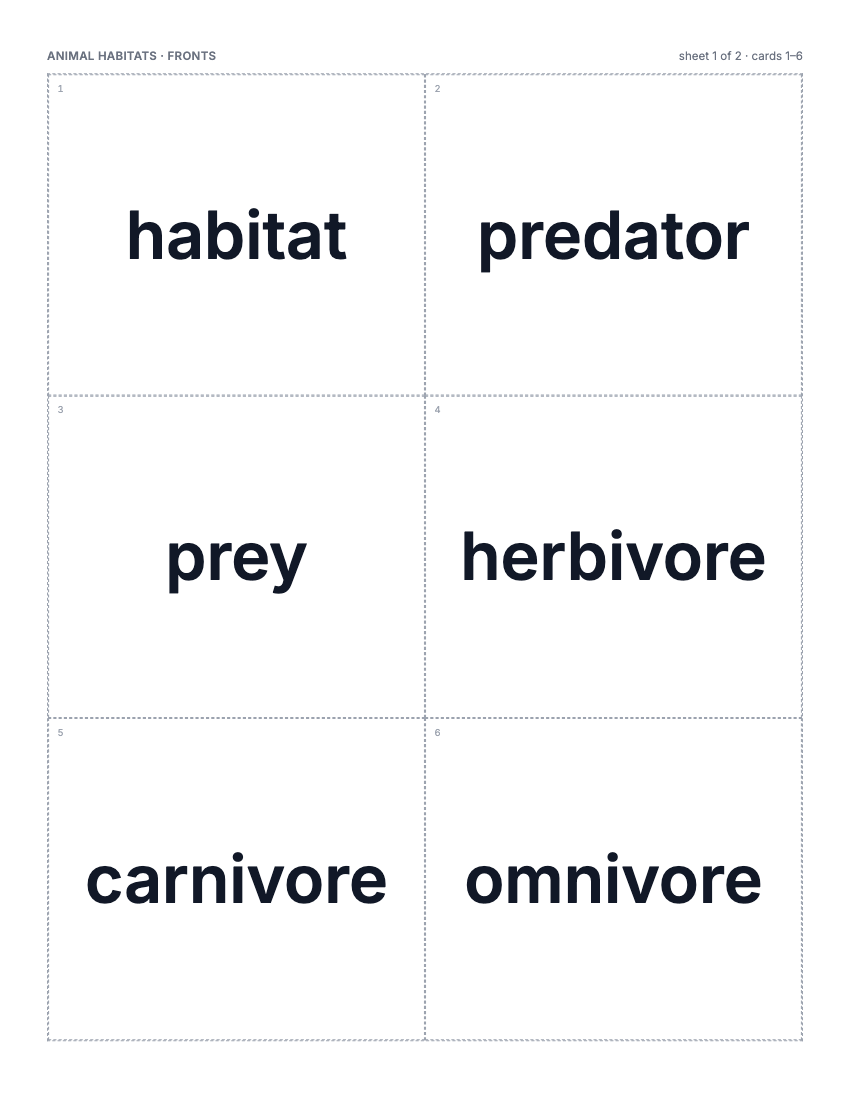 Flashcard makerVocabulary, math fact or sight word cards, 2-8 a page, two-sided or fold-over. Free to print.
AI worksheet generator
Need a different angles worksheet?
Generate a custom angles worksheet: pick the grade, question types and count, and print it in about 20 seconds. Free accounts get 1 generation a week.
Teaching sequence
- Grade 4: types and measuring. Start with the types page and the rule that a right angle is a square corner. Then the estimate-and-measure page: insisting on an estimate first catches the classic protractor mistake of reading the wrong scale (an angle that is obviously acute cannot be 130 degrees).
- Grade 4 to 5: drawing. Centre on the dot, zero line along the ray, mark the number, join the mark to the dot with a ruler. Check the drawn angles against the key by measuring, not by eye.
- Grade 5 to 6: angle facts. Complementary (90), supplementary and angles on a line (180), angles around a point (360) and the triangle sum (180). The drawn examples on each page are to scale, so students can measure to check their arithmetic.
- Grade 6 to 7: reasoning. Vertically opposite angles and the mixed review ask for a one-line reason as well as a number: "x = 50 because vertically opposite angles are equal". Marking the reason as well as the answer is what moves students from measuring to proving.
Common errors and what to say
- Reading the wrong protractor scale. Always estimate first; if the reading disagrees with the estimate, use the other scale.
- Protractor centre not on the vertex. The little hole or cross must sit exactly on the dot; a millimetre off changes the reading by several degrees on a short ray.
- Thinking a bigger drawing means a bigger angle. The types page has small acute angles with long rays and large reflex angles with short ones for this reason.
- Forgetting that x is an angle, not a length. Have students write the degree sign on every answer.
Frequently asked questions
Are the angles drawn accurately enough to measure?
Yes. Every angle is generated to the exact degree in the PDF itself, not traced by hand, and printing does not distort angles. Print at 100% so the rays stay long enough to line a protractor up on; on the measuring page they are 30 mm.
What grade are angles worksheets for?
Angle types and measuring with a protractor are fourth grade in most US curricula (Common Core 4.MD.5 to 4.MD.7); complementary, supplementary and the triangle sum are grades 5 to 7 (7.G.5); vertically opposite angles and reasoning with angle facts run through grades 6 to 8. The set is arranged in that order.
What is the difference between complementary and supplementary angles?
Complementary angles add to 90 degrees (they complete a right angle); supplementary angles add to 180 degrees (they make a straight line). A memory aid: C comes before S in the alphabet and 90 comes before 180.
Do the worksheets have answer keys?
Yes. Every PDF is two pages: the worksheet and a key with the answers in colour. For the drawing page the key shows the finished angle with its size written on the arc.
What is a reflex angle?
An angle greater than 180 degrees and less than 360. On the types page the reflex angles are drawn with the arc going the long way round so students see which side is being measured. To measure one with a 180 degree protractor, measure the small angle and subtract from 360.
More geometry printables
Before angles, students should know their shapes: the shape tracing and 3D shapes worksheets cover that. The Pythagorean theorem worksheet is the natural next step after right angles in triangles. For drawing and constructing angles on squared or isometric paper, print the graph paper printables, and for negative numbers as they appear in angle problems see the number line printables.
Free library
Related collections
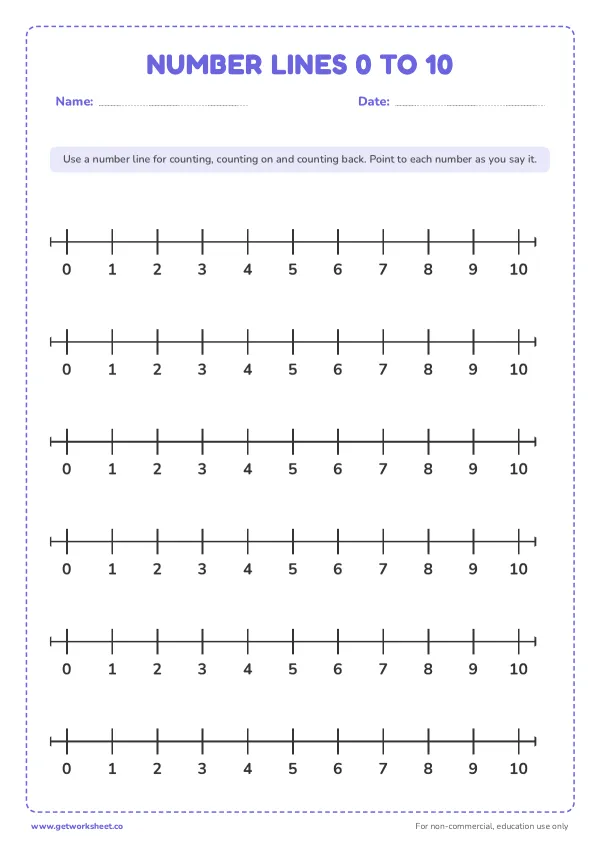
Free number line printables
Free graph paper printables
Free shape tracing worksheets
Free Pythagorean theorem worksheets
Free 3D shapes worksheets
Free printable multiplication charts
Free heart tracing worksheets
Free Montessori math worksheets: one from every material
More worksheets
- Free Halloween math worksheets
- Free number 20 tracing worksheets
- Free number 19 tracing worksheets
- Free number 18 tracing worksheets
- Free number 17 tracing worksheets
- Free number 16 tracing worksheets
- Free number 15 tracing worksheets
- Free number 14 tracing worksheets
- Free number 13 tracing worksheets
- Free number 12 tracing worksheets
- Free number 11 tracing worksheets
- Free number 10 tracing worksheets