10 Times Table Worksheets
Free 10 times table worksheets with answer keys. Practice multiplication by 10 with drills, patterns, and word problems — printable PDFs for kids.
The 10 times table is one of the easiest to learn — just add a zero to any number — but understanding why it works is what builds real math fluency. When students truly grasp that multiplying by 10 shifts every digit one place to the left, they're not just memorizing a trick. They're understanding place value, which is the foundation for multiplying by 100, 1000, and working with decimals later.
What Students Will Practice
- Recalling multiplication facts from 10 × 1 through 10 × 12 quickly and accurately
- Understanding the place value pattern — multiplying by 10 moves each digit one place to the left (e.g., 7 ones becomes 7 tens = 70)
- Skip counting by 10s (10, 20, 30, 40...) as both a counting skill and a multiplication foundation
- Solving word problems involving groups of 10 (e.g., "There are 10 crayons in each box. How many crayons in 8 boxes?")
- Connecting the 10 times table to division by 10 (if 10 × 6 = 60, then 60 ÷ 10 = 6)
- Extending the pattern to multiply larger numbers by 10 (e.g., 25 × 10 = 250, 134 × 10 = 1340)
The 10 times table is typically one of the first tables taught in 2nd grade because its clear pattern builds confidence. It's also foundational for understanding our base-10 number system and decimal operations.

10 Times Table Worksheet
Free printable 10 times table worksheets with answer keys. Perfect for homework, extra practice, or enhancing math skills at home.

10 Times Table Worksheet
Free printable 10 times table worksheets with answer keys. Ideal for homework, extra practice, or reinforcing multiplication skills.

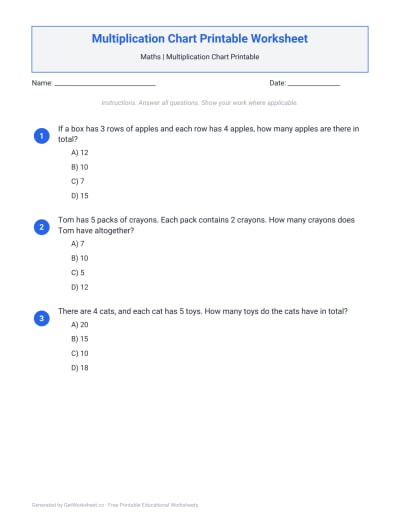
10 Times Table Worksheet
Free printable 10 times table worksheet with answer keys. Ideal for homework or practice to strengthen multiplication skills and build confidence.
How to Use These Worksheets
Since the 10s are pattern-based, the goal is understanding the pattern — not just memorizing answers.
- Start by having your child fill in the table in order (10 × 1, 10 × 2, etc.) and ask them what they notice. Most kids spot the "add a zero" pattern immediately. Then ask: does it work for 10 × 20? (Yes — 200.) Does it work for 10 × 0.5? (Yes — 5, but the zero pattern needs adjustment.) This pushes them from pattern recognition toward real understanding.
- Use the drill worksheets with mixed-order problems after the pattern is understood. The 10s table feels easy in order, but students still need to answer "10 × 7" instantly without counting up from 10 × 1. Randomized drills test true recall.
- Connect every 10s problem to place value. When your child says 10 × 4 = 40, ask: "What happened to the 4? It moved from the ones place to the tens place." This language — digit shifting, place value movement — is exactly what they'll need when multiplying by 100 or working with decimals.
- Mix in the word problems to give context. Ten-based problems are everywhere: packs of 10, decades, dimes (10 cents), metric system (10 millimeters = 1 centimeter). Real-world connections make the math stick.
Common Mistakes to Watch For
- Just memorizing "add a zero" without understanding: The rule works for whole numbers, but breaks down with decimals. 10 × 2.5 = 25, not 2.50. If students only know the zero trick, they'll struggle later. Teach the place-value shift: every digit moves one place left, and the vacated place gets a zero.
- Confusing × 10 with + 10: Young students sometimes write 10 × 3 = 13 (adding instead of multiplying). This usually clears up quickly with visual models — show three groups of ten objects, not ten plus three objects.
- Errors with 10 × 10 and 10 × 11: Students confidently handle 10 × 1 through 10 × 9 but sometimes stumble on 10 × 10 = 100 and 10 × 11 = 110, because the results are three digits and look unfamiliar. Extra practice on these two facts builds confidence with larger products.
- Forgetting 10 × 0 = 0: The "add a zero" rule makes students think 10 × 0 should be "00" or even 10. But anything times zero is zero. It's worth drilling this separately because it's the one fact where the pattern seems to break.
Frequently Asked Questions
When should my child learn the 10 times table?
Most students learn the 10s in 2nd grade, alongside the 2s and 5s. These three tables are pattern-based and form the foundation for all other multiplication facts. Many kids can skip count by 10s even before formally learning multiplication, which gives them a head start.
The 10 times table seems too easy. Should we just skip ahead?
Don't skip it — use it as a teaching moment for place value. The 10 times table is the perfect vehicle for understanding how our number system works. A student who truly understands why 10 × 7 = 70 (the 7 moves from ones to tens) will find multiplying by 100 and 1000 trivial. Skip the table, and you skip that deeper understanding.
How does the 10 times table help with other tables?
Knowing the 10s makes the 5s easier (half of 10s), and the 9s easier (10 times the number minus the number: 9 × 7 = 70 - 7 = 63). It's also the basis for multiplying any number by multiples of 10 (30 × 4 = 3 × 10 × 4 = 120), which is essential for multi-digit multiplication.
Should I use timed drills for the 10 times table?
Timed drills work well here because the 10s are straightforward enough that most students can achieve speed without stress. Start with a generous time limit and let your child beat their own record. The confidence they build from acing a timed test on the 10s carries over into harder tables.
After the 10 times table, students are ready to tackle the 5 times table (which is half of 10) and then move to the more challenging tables: 3s, 4s, 6s, 7s, 8s, and 9s.