Free printable maker
Sudoku Generator for Kids
4×4, 6×6 and 9×9 puzzles with numbers, letters or shapes, easy to hard, one solution each. Print 1 to 4 puzzles on a page with a solutions page. Free, no account.
Every puzzle has exactly one solution. Prints the puzzles, then the solutions on their own page. Free, no account.
6×6 Sudoku · Easy
2 puzzlesFill the grid so every row, every column and every 2×3 box has each symbol exactly once.
6×6 Sudoku · Easy · Solutions
getworksheet.co/tools/sudoku-generator
Using the puzzles
Why sudoku belongs in a math classroom
Sudoku has no arithmetic in it, which is exactly why it is useful. The numbers are only labels (letters or shapes work just as well, and this generator offers both), so the whole puzzle is logical reasoning: what must go here because of what is already there. Children practise scanning rows and columns, holding a constraint in mind, eliminating options and checking their work, the same habits that make them careful with multi-step problems later.
Start small. A 4×4 with shapes can be solved by a five-year-old who cannot yet read numerals: each row, column and 2×2 box needs one of each shape. Six givens on a 4×4 is already a real puzzle; ten is a gentle introduction. Move to 6×6 once the 4×4 is quick. The 2×3 boxes are the step children trip over, so point out that a box is two rows tall and three wide before the first attempt.
The 9×9 is the classic. Easy here means about 40 givens and a puzzle that can be solved by singles alone (a cell with only one candidate, or a symbol with only one place in a unit). Medium and hard need the next techniques: pencil-marking candidates, spotting a pair, working a box against a row.
Every puzzle has one solution. The generator builds a full solved grid first, then removes cells one at a time and keeps a removal only if the puzzle still has exactly one answer. That guarantee is what makes the printed solutions page trustworthy: a child who reaches a different grid has made a mistake, and can find it by comparing. It also means guessing is never required, which is the message worth repeating: if you are stuck, there is always a cell you can reason out.
Print four 4×4 or 6×6 puzzles on a page for an early-finisher tray or a warm-up, two for a lesson starter with room to pencil in candidates, or a single large grid for a shared whiteboard solve. The name line turns the sheet into something that can be collected and checked. New puzzles gives a different set with the same settings, so a class of thirty can each have their own.
More puzzles and pattern work: the word search maker for vocabulary, the missing number worksheets and repeating patterns worksheets for the same kind of look-and-reason thinking with numbers, the hundreds chart worksheets for grid fluency, and the math fact worksheet generator when it is time for arithmetic.
How it works
How to make a printable sudoku
Three steps from a grid size to a page of puzzles with its solutions.
- 1
Choose the grid
4x4 for the youngest, 6x6 for early primary, 9x9 for the classic puzzle. Pick easy, medium or hard and how many puzzles go on the page.
- 2
Pick the symbols
Numbers, letters, or six printable shapes for children who are not reading numerals yet. Add a title and keep the name line and solutions page if you want them.
- 3
Print
Letter or A4. The puzzles print first and the solutions follow on their own page. New puzzles gives a fresh set with the same settings; every puzzle has one solution.
Good to know
Questions, answered
Yes. Pick a grid size and difficulty, print the puzzles and the solutions page. No account, no watermark and no limit. The puzzles are generated in your browser, so nothing is uploaded and you can make as many as you like.
4x4 with 2x2 boxes for ages 4 to 6, 6x6 with 2x3 boxes for ages 6 to 9, and the classic 9x9 with 3x3 boxes for older children and adults. Smaller grids use the same rule as the big one (each symbol once per row, column and box) with far fewer cells to hold in mind.
Yes. Each grid starts as a complete solved sudoku; cells are then removed one at a time and a removal is only kept if the puzzle still has a single solution. The solution printed on the last page is therefore the only one, which matters when children check their own work.
Yes. For 4x4 and 6x6 choose numbers, letters (A to D or A to F) or six simple shapes (circle, square, triangle, star, heart, diamond) for children who do not read numerals yet. The shapes are drawn as vector graphics so they print cleanly. The 9x9 uses numbers or letters A to I.
Difficulty sets how many cells are given: a 4x4 shows 10, 8 or 6 of 16; a 6x6 shows 22, 18 or 14 of 36; a 9x9 shows about 40, 32 or 27 of 81. Fewer givens means more deduction. Print 1, 2 or 4 small puzzles per page (1 or 2 for 9x9) and press New puzzles for a fresh set with the same settings.
More free printable makers
More sheets you can make right now
Each of these builds the printable in your browser: no account, no AI, no weekly limit, an answer key where one applies.
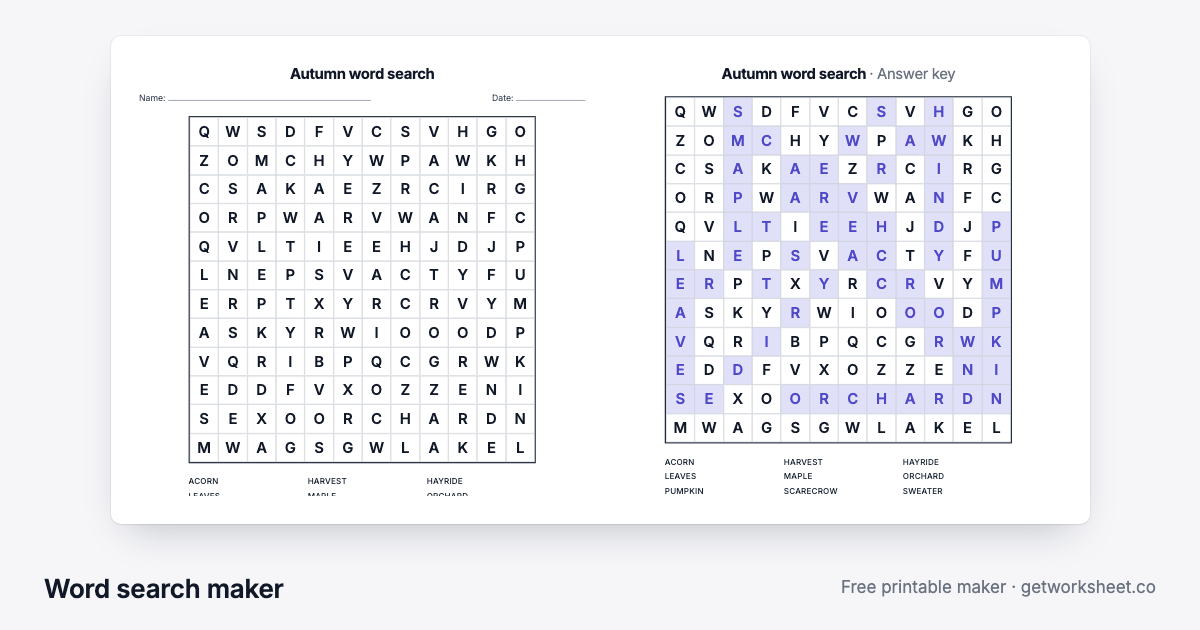 Word search makerYour words, a printable puzzle and an answer key. Free to print.
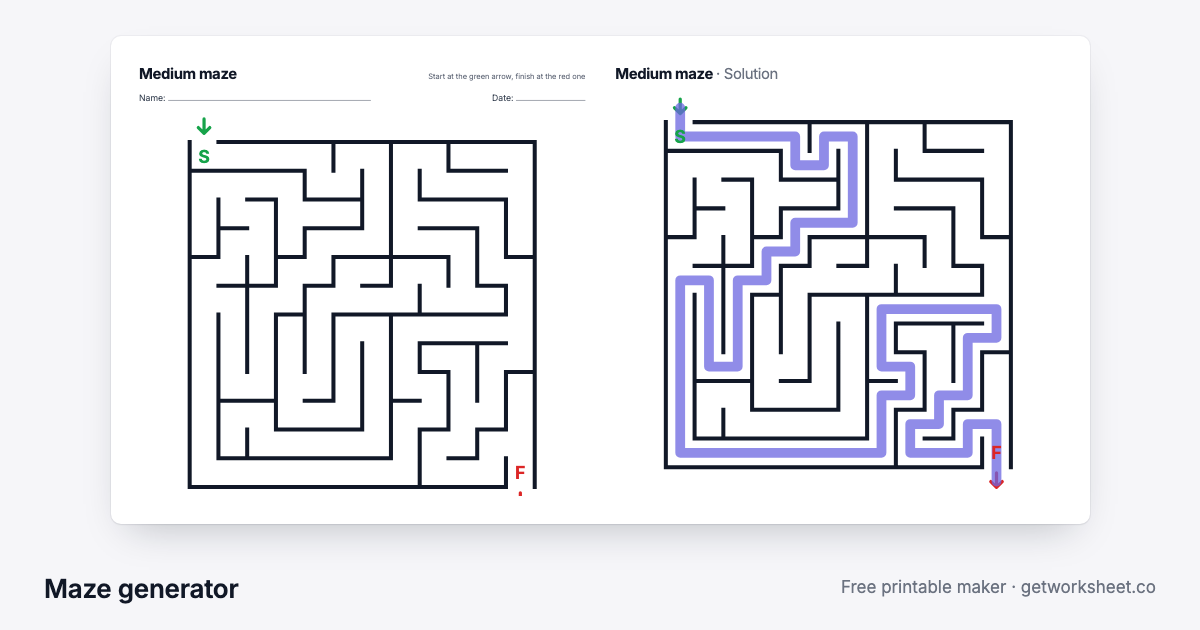 Maze generatorEasy to expert mazes, square or circle, with a solution page. Free to print.
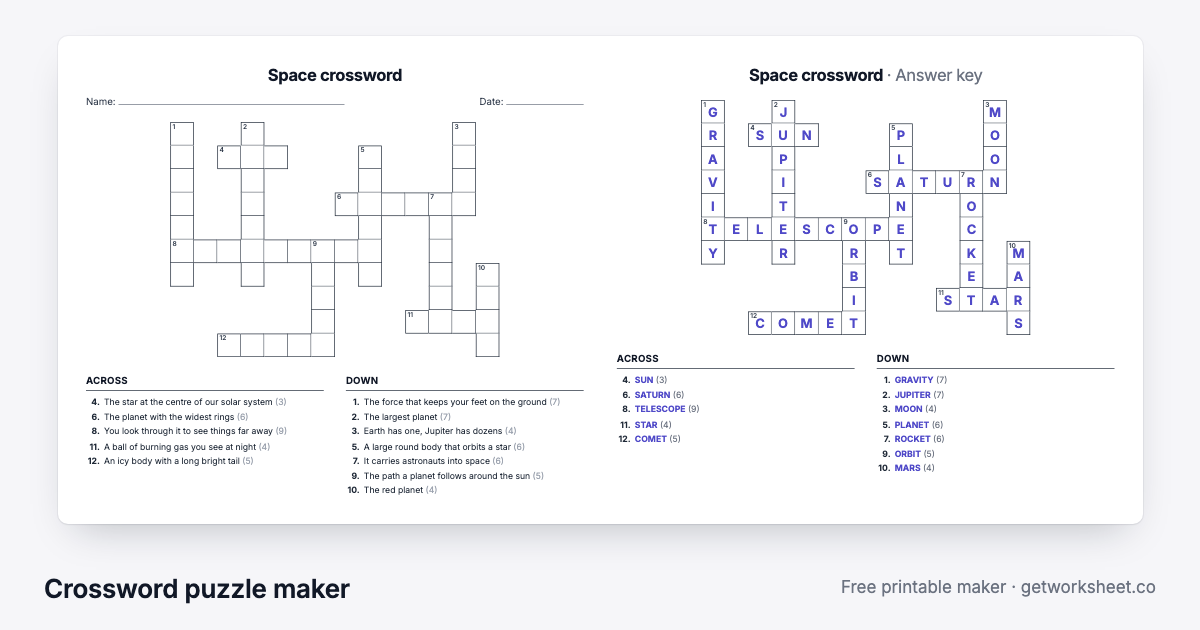 Crossword puzzle makerYour answers and clues, a numbered grid and an answer key. Free to print.
- Worksheet generatorCustom worksheets for any topic, grade and question type.
- Lesson plan generatorStandards-aligned plans with objectives, activities and assessment.
- Report card commentsPersonalised, professional comments for every student.
- Rubric makerClear criteria and scoring levels for any assignment.
- IEP goal generatorMeasurable goals in minutes, then probe worksheets for each one.
- IEP worksheet generatorPaste a goal, get practice probes and a progress record sheet.