Maths · Grades 3–4
Free equivalent fractions worksheets
Free printable equivalent fractions worksheets for grades 3 and 4: shade fraction bars, match bars and circles, find missing numerators and denominators, line up fractions on number lines, simplify to lowest terms and read a fraction wall. Answer keys included. PDF download.
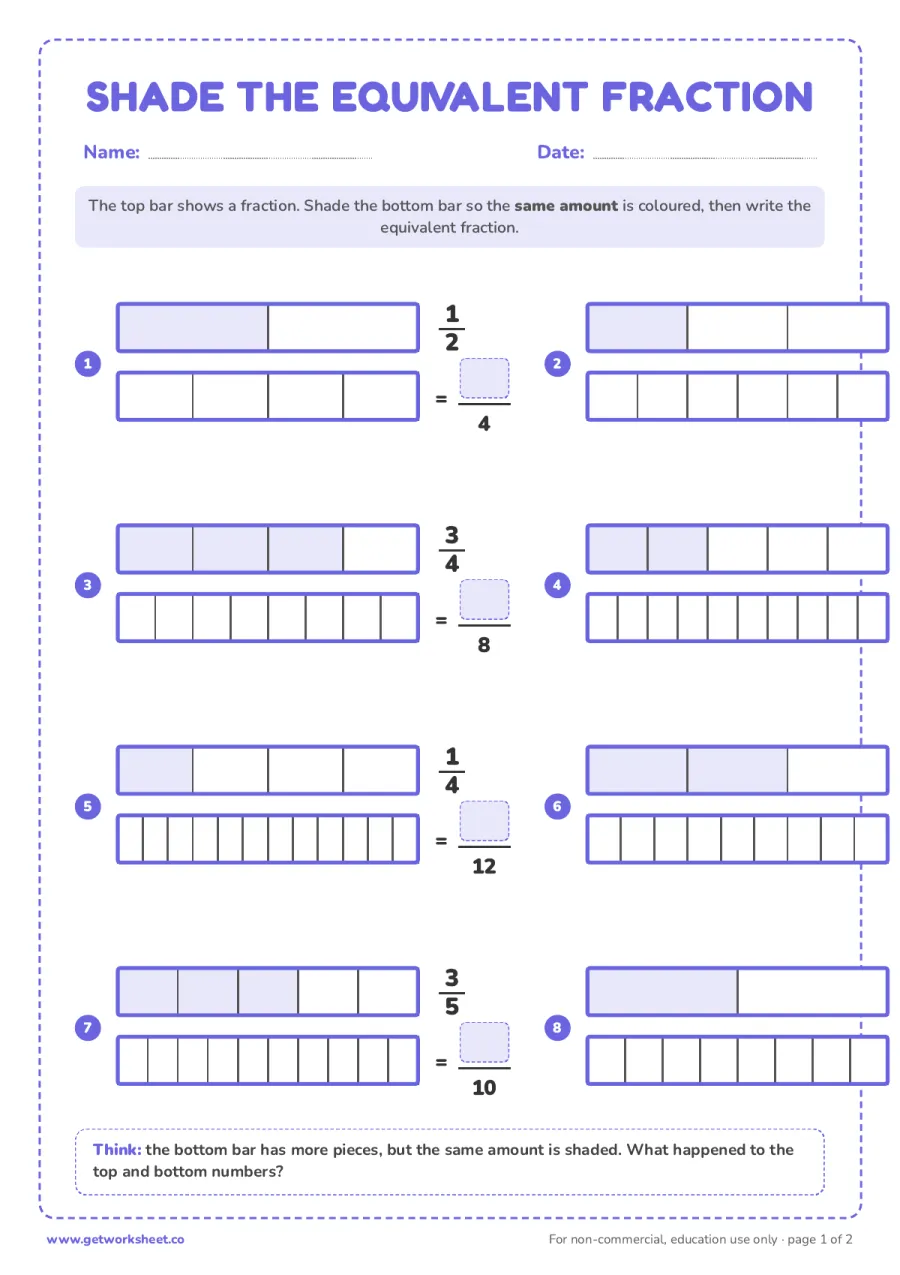
Shade the equivalent fraction: 8 pairs of fraction bars
Eight pairs of fraction bars: the top bar shows a fraction, students shade the bottom bar to match and write the equivalent fraction. Answer key on page 2.
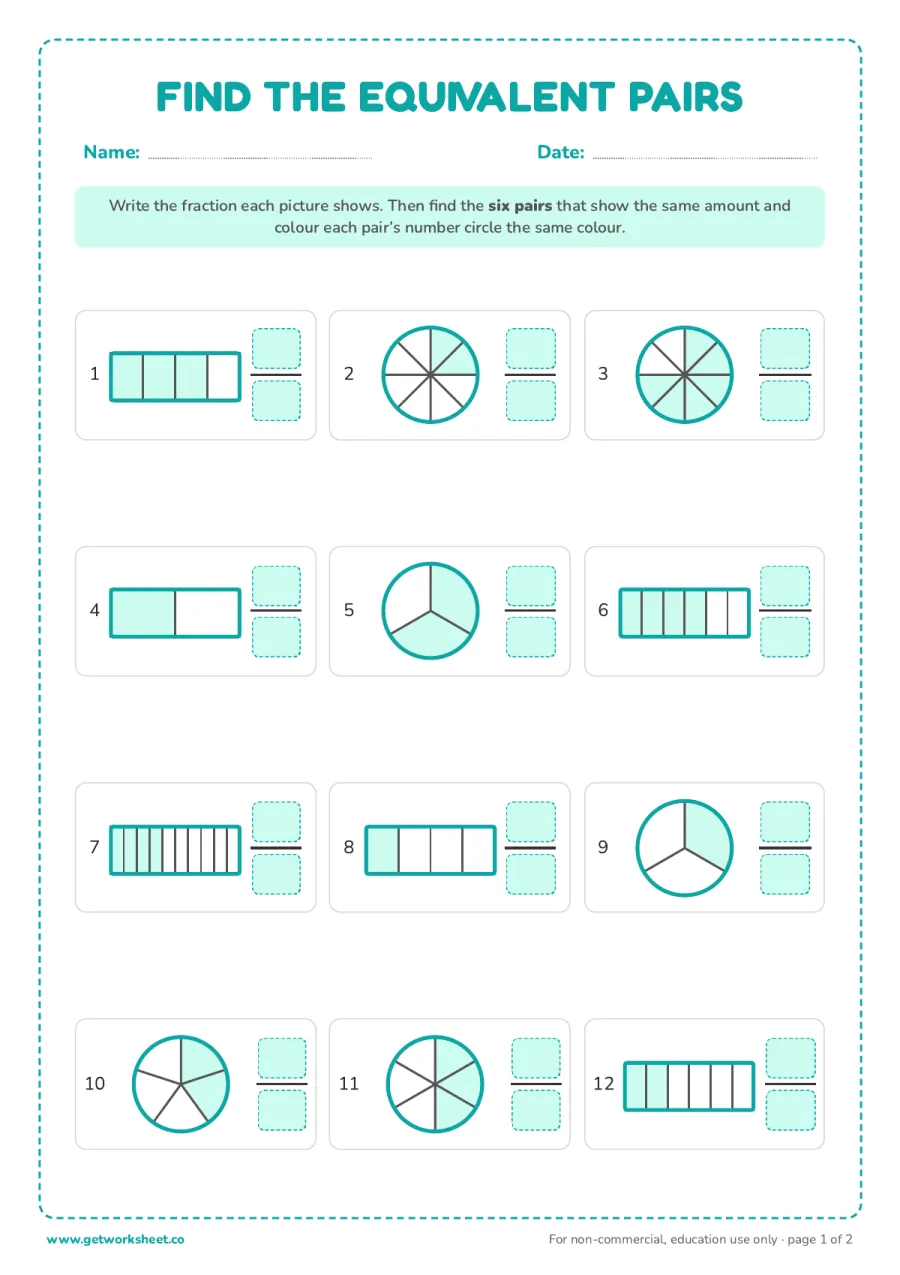
Name the fraction and find the 6 equivalent pairs (bars and circles)
Twelve shaded bars and circles to name as fractions, then match into six equivalent pairs by colouring. Answer key on page 2.
Whole set
All 6 in one PDF
- Every sheet on this page, one file
- No ads, no countdowns, print as often as you like
- Instant download, ad-free, no account needed
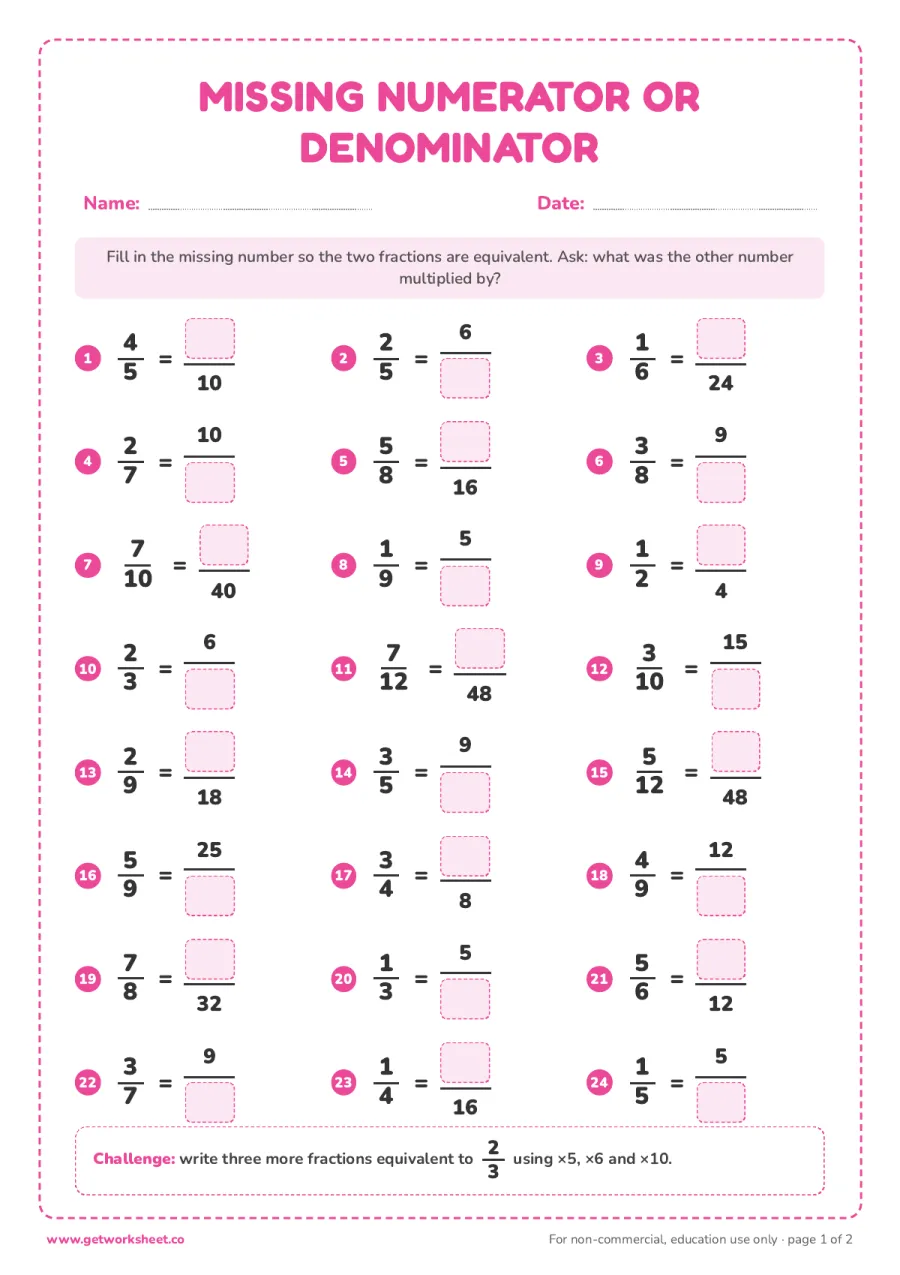
Missing numerator or denominator: 24 equivalent fraction pairs
Twenty-four equations such as 2/3 = ?/12 with one number missing, plus a challenge. Answer key on page 2.
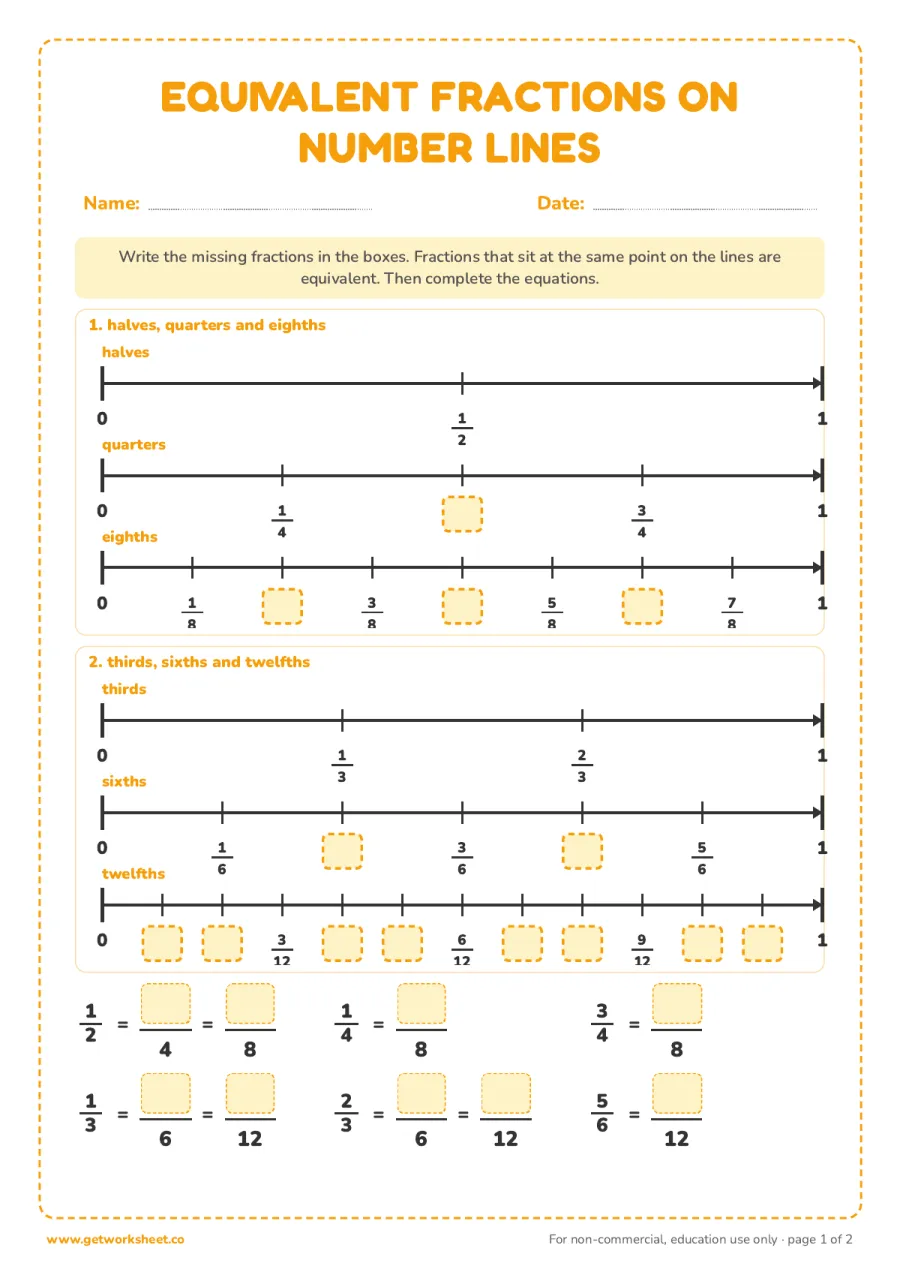
Equivalent fractions on number lines: halves to eighths, thirds to twelfths
Two stacks of aligned number lines to label, showing which fractions sit at the same point, then six equations to complete. Answer key on page 2.
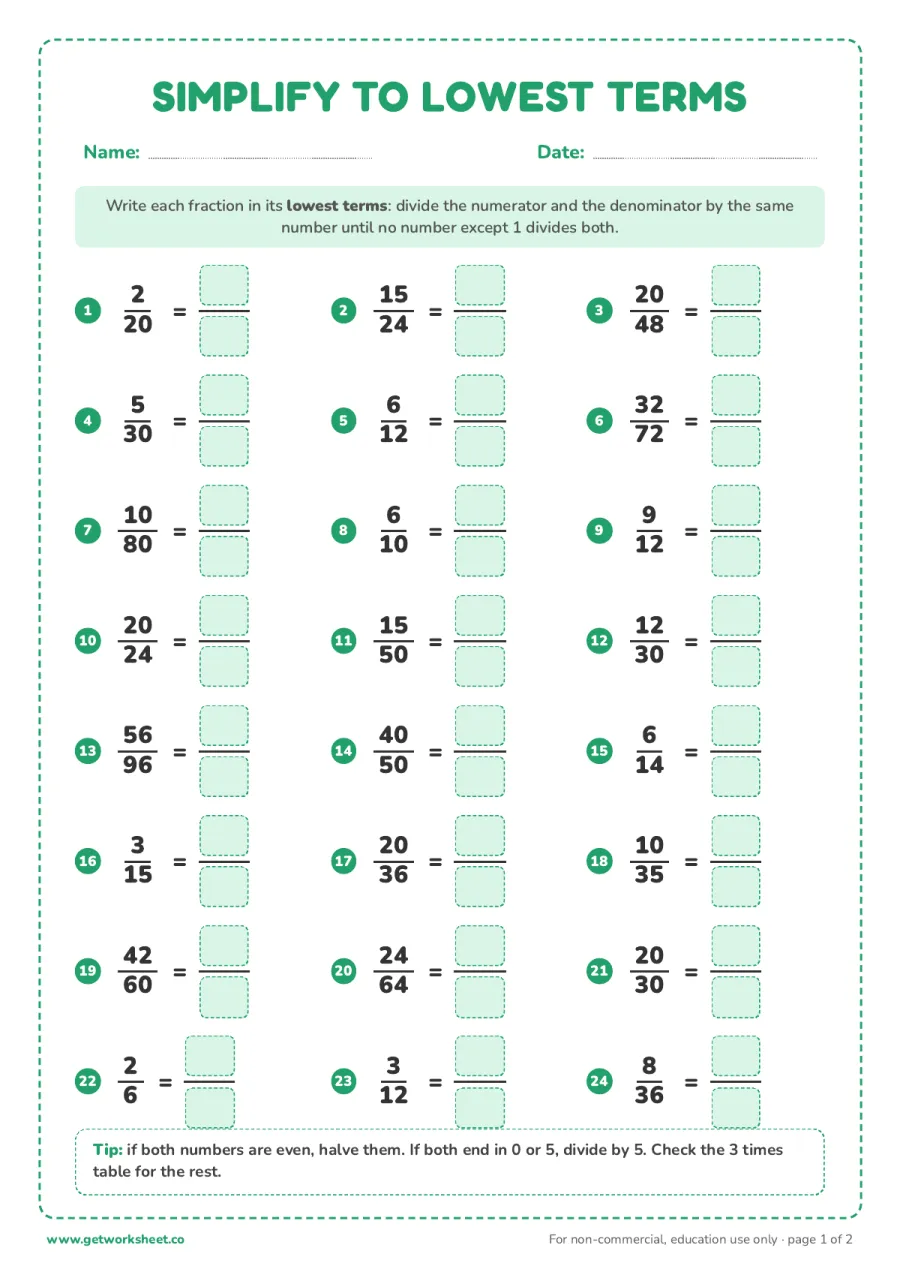
Simplify to lowest terms: 24 fractions
Twenty-four fractions such as 12/18 to reduce to lowest terms, with a tip box. Answer key on page 2 shows the divisor used.
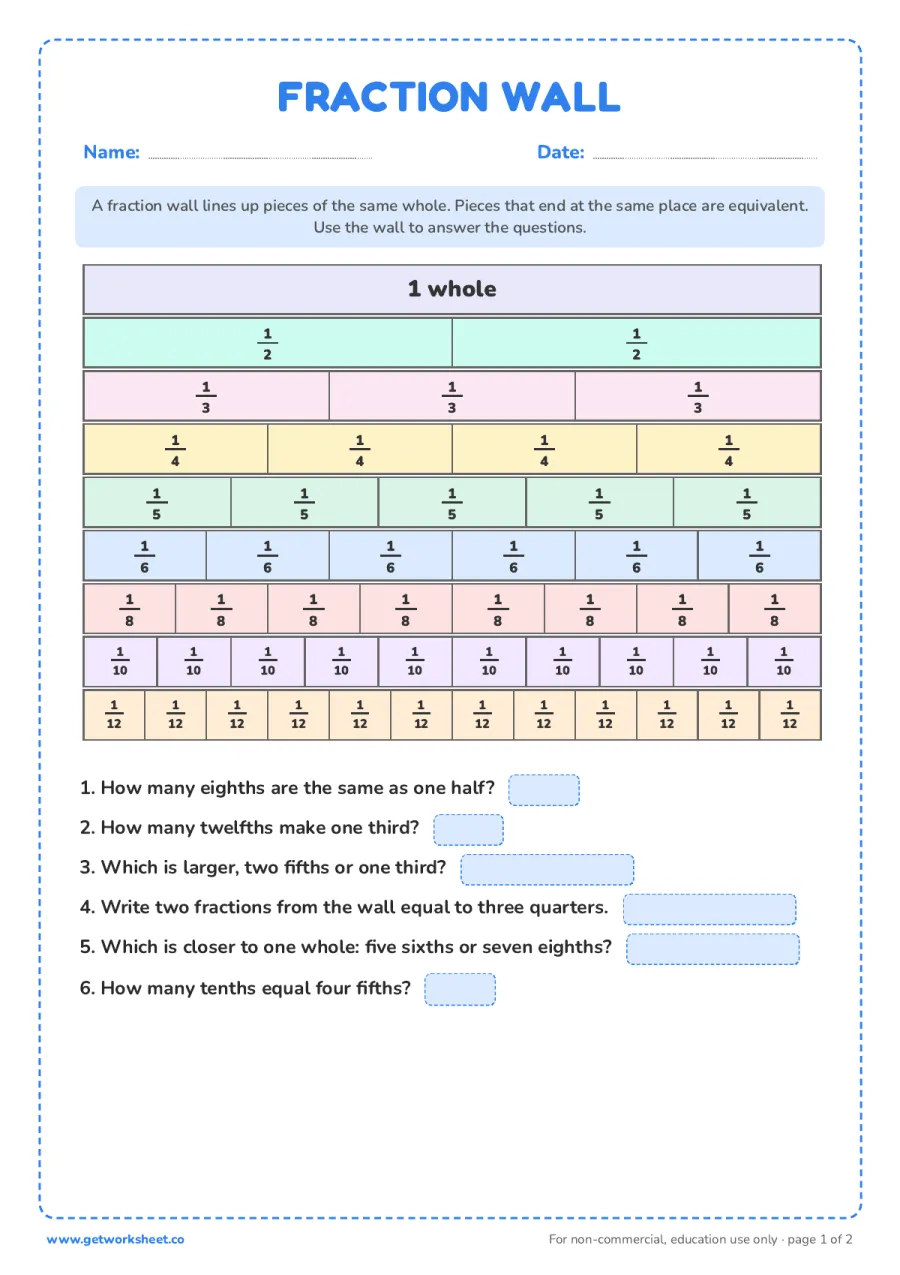
Fraction wall from 1 whole to twelfths, with 6 questions
A full-width colour fraction wall (1, halves, thirds, quarters, fifths, sixths, eighths, tenths, twelfths) and six questions answered by reading it. Answer key on page 2.
AI worksheet generator
Make a worksheet like this for your class
The 6 sheets above are fixed. The generator writes a new equivalent fractions worksheet for your grade, with the question types and count you choose, in about 20 seconds. Pick a grade to start:
What you get
- A fresh set of questions on equivalent fractions, not a copy of the sheets above
- Multiple choice, fill in the blanks, true or false, open ended
- Answer key and print-ready PDF with Pro
Free account, 1 worksheets a week. No card.
Two fractions are equivalent when they name the same amount of the same whole: half a pizza is the same pizza whether you call it 1/2, 2/4 or 4/8. Children who see this with pictures first find the rule (multiply or divide the top and bottom by the same number) obvious rather than mysterious, and everything that follows in fractions (comparing, adding with unlike denominators, simplifying answers) depends on it. These six worksheets move from shading bars to reading a fraction wall, and every practice sheet carries its answer key on page 2 of the PDF.
What’s in this set
- Shade the equivalent fraction: 8 pairs of fraction bars. The top bar shows a fraction such as 3/4; the bottom bar is cut into more pieces (eighths). Students shade the same amount and write the new fraction. Ends with a think-box about what happened to the numbers.
- Name the fraction and find the 6 equivalent pairs. Twelve shaded bars and circles to name, then six equivalent pairs hidden among them (1/2 and 3/6, 3/4 and 6/8, 2/5 and 4/10 ...) to find and colour-match.
- Missing numerator or denominator: 24 pairs. Equations such as 2/3 = ?/12 and 3/8 = 9/? with one number missing, in three columns, plus a challenge to write three fractions equal to 2/3.
- Equivalent fractions on number lines. Two stacks of aligned number lines (halves, quarters, eighths; thirds, sixths, twelfths). Students fill the missing labels and see that 1/2, 2/4 and 4/8 sit at exactly the same point, then complete six equations read straight off the lines.
- Simplify to lowest terms: 24 fractions. Fractions such as 15/24 and 56/96 to reduce, with a tip box (halve evens, divide by 5 when both end in 0 or 5, check the 3 times table). The key shows the divisor used for each one.
- Fraction wall from 1 whole to twelfths, with 6 questions. A full-width colour wall (1, halves, thirds, quarters, fifths, sixths, eighths, tenths, twelfths) and six questions answered by reading it, such as how many eighths make one half and which of 5/6 and 7/8 is closer to one whole.
What students will practice
- Recognising that two fractions are equivalent when they cover the same amount of the same whole (CCSS 3.NF.A.3a)
- Generating equivalent fractions with pictures and explaining why they are equal (3.NF.A.3b, 4.NF.A.1)
- Multiplying or dividing numerator and denominator by the same number to find a missing part
- Placing fractions on a number line and reading equivalences from aligned lines (3.NF.A.2)
- Writing a fraction in lowest terms, the skill later needed to finish every fraction answer
- Reasoning with a fraction wall to compare fractions with different denominators (3.NF.A.3d)
Free printable makers
Make your own equivalent fractions sheets
Type your own words or numbers and print in about 30 seconds. No account, no AI, answer key where it applies.
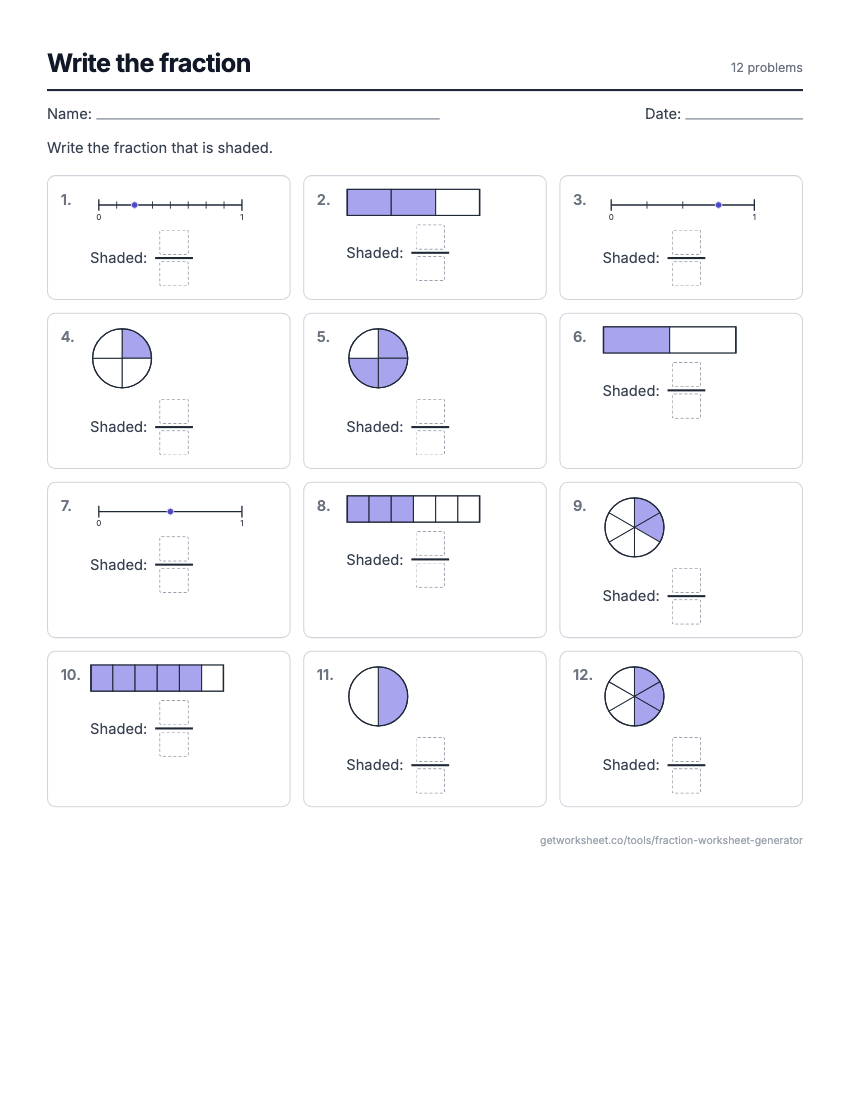 Fraction worksheet generatorVisual pie, bar and number-line models; equivalent, compare, add, subtract. Free to print.
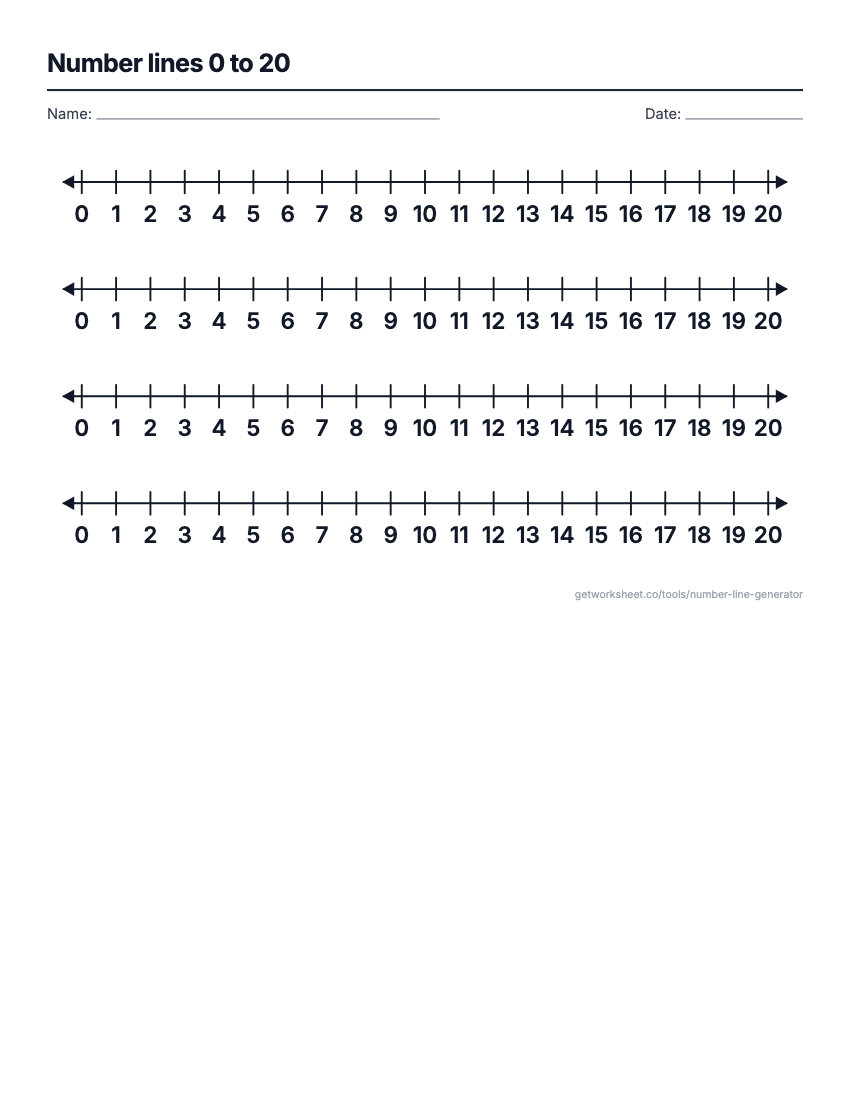 Number line generatorAny range and step, fractions and decimals, blank or missing numbers with a key. Free to print.
 Math fact worksheet generatorAddition to division drills with an answer key. Free to print.
AI worksheet generator
Need a different equivalent fractions worksheet?
Generate a custom equivalent fractions worksheet: pick the grade, question types and count, and print it in about 20 seconds. Free accounts get 1 generation a week.
Teaching tips and common mistakes
How to use these worksheets
Print at 100% on A4 or US Letter paper. The sheets are in teaching order; a class usually needs one or two lessons per sheet, and the fraction wall is worth keeping in the maths folder all year.
- Start with the bars. Before writing anything, ask children to look at the top bar and predict how many of the smaller bottom pieces will be shaded. Then shade and check. Say the equivalence out loud each time: “one half is the same as two quarters”.
- Name the pictures, then hunt for pairs. The circles and bars are deliberately mixed so that children compare amounts, not shapes. A pair is equivalent because the same part of each whole is coloured, even though one is round and one is a strip.
- Missing numbers. The question to ask every time is “what did the denominator get multiplied by?” and then do the same to the numerator. Odd-numbered items hide the numerator, even-numbered ones hide the denominator, so both directions get practised.
- Number lines. Have children use a ruler to draw a faint vertical line from 1/2 down through the quarters and eighths lines. Every label it passes through is equivalent to 1/2. This is the picture that makes equivalence feel real for children who are not convinced by bars.
- Simplifying. Two-step simplifying (dividing by 2 and then by 2 again) is fine at first; efficiency comes later. The key shows the single divisor so you can point out the shortcut.
- The fraction wall. Model answering question 1 with a ruler laid on the wall, then let children work the rest independently. Question 3 (2/5 or 1/3) and question 5 (5/6 or 7/8) need real reasoning, not just counting, and make a good class discussion.
Common mistakes to watch for
- Adding to the top and bottom instead of multiplying: 2/3 becomes 3/4. The bars show immediately that 3/4 is a bigger amount, so send children back to sheet one when this appears.
- Multiplying only the denominator: 1/2 = 1/4. Ask “is one quarter the same amount as one half?” with the fraction wall in view.
- Counting pieces without checking size: a child may say 2/4 and 2/8 are equivalent because both have two shaded. Line them up on the wall; the pieces are different sizes.
- Stopping before lowest terms: 8/12 becomes 4/6 and stays there. Ask “is there a number that still divides both?” until the answer is no.
- Thinking a fraction with bigger numbers is a bigger amount: 6/12 looks larger than 1/2. The number-line sheet settles it: same point, same value.
Answer key
Every practice sheet has its complete answer key on page 2 of the PDF, drawn rather than just listed where a picture helps: the shaded bottom bars on sheet one, every fraction and pair letter on sheet two, all the number-line labels on sheet four. Print page 1 only for the class and keep page 2 for marking.
Frequently asked questions
What grade are equivalent fractions worksheets for?
Equivalent fractions are introduced in third grade (age 8 to 9) using pictures and number lines, and extended in fourth grade with the multiply-or-divide rule and simplifying. Sheets one, two and four suit third grade; three, five and six suit fourth grade and revision in fifth.
Why start with pictures instead of the rule?
The rule (multiply top and bottom by the same number) is easy to memorise and easy to misapply. Children who have shaded bars and drawn lines down aligned number lines know why it works, so they can rebuild it when they forget, and they notice when an answer is obviously wrong.
Do the worksheets include answer keys?
Yes. Each PDF is two pages: the student sheet and an answer key. Keys show the shaded bars, the number-line labels and the divisor used to simplify, not just the final numbers.
What comes after equivalent fractions?
Comparing fractions with different denominators, then adding and subtracting them, and converting between improper fractions and mixed numbers. Knowing the times tables well makes all of this faster, because finding a common denominator is really finding a common multiple.
More practice
Finding equivalent fractions is multiplication and division in disguise, so a secure knowledge of the multiplication chart and the multiplication worksheets pays off here. Simplifying relies on spotting common factors; the prime number worksheets cover factor trees and prime factorisation. Browse every set in the maths worksheets library.
Free library
Related collections
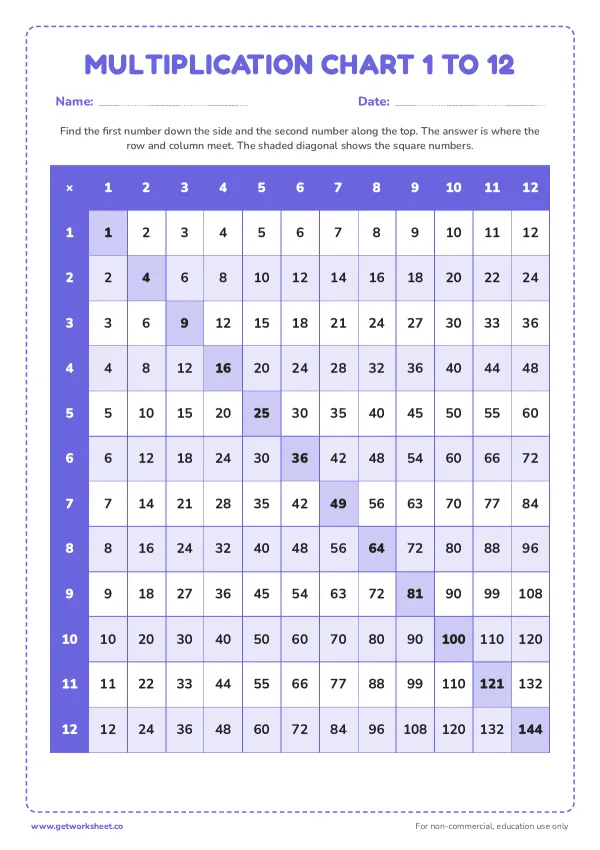
Free printable multiplication charts
Free prime number worksheets
Free multiplication worksheets
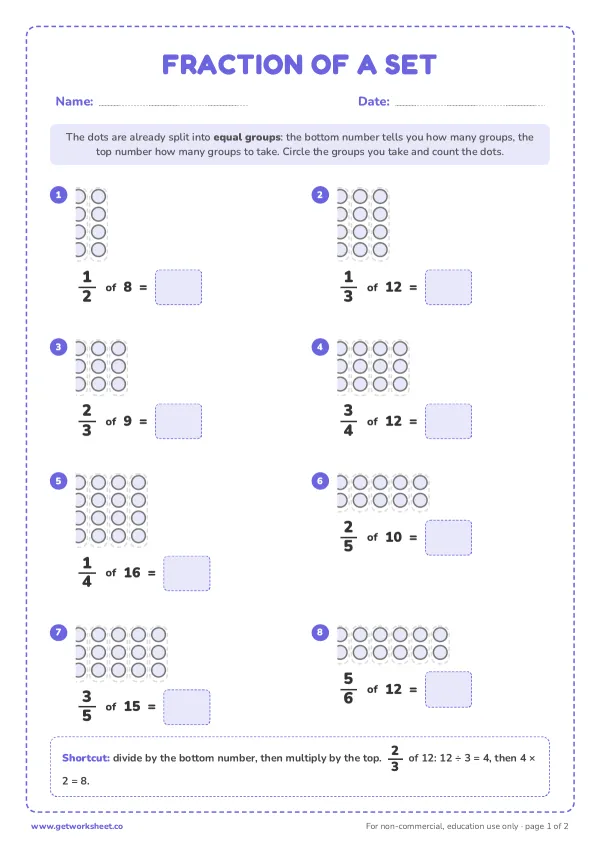
Free multiplying and dividing fractions worksheets
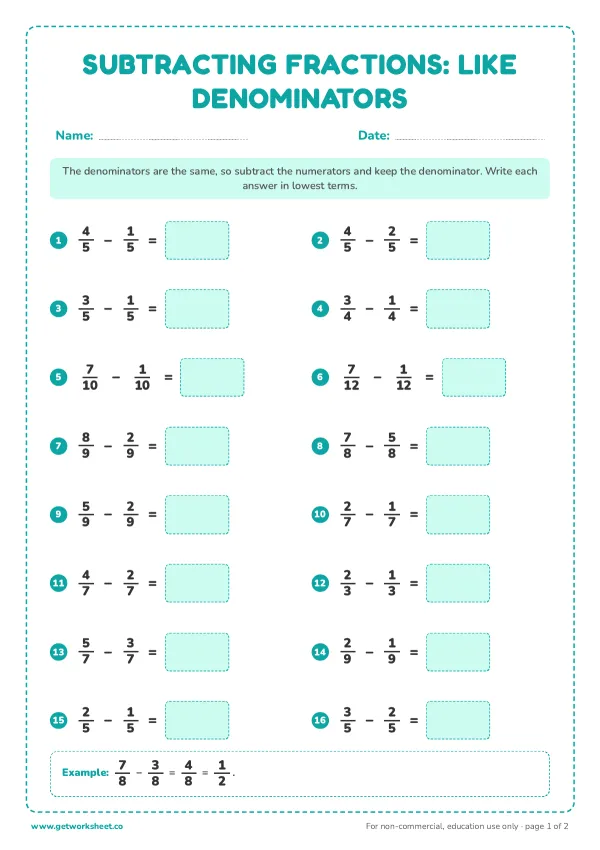
Free subtracting fractions worksheets
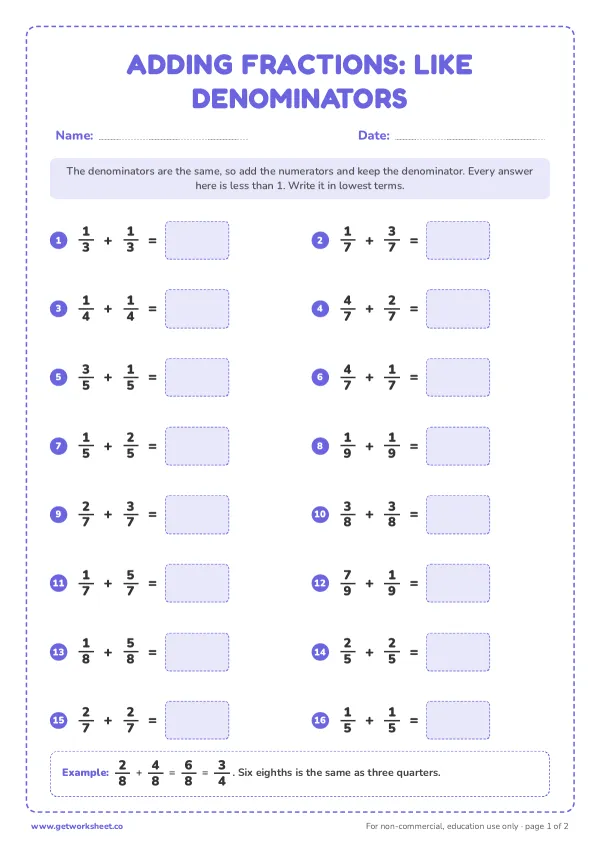
Free adding fractions worksheets
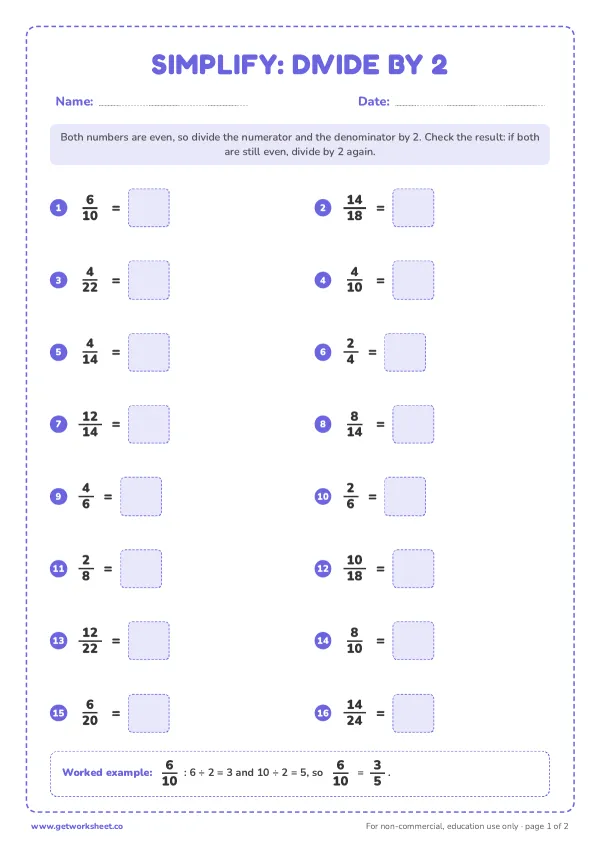
Free simplifying fractions worksheets
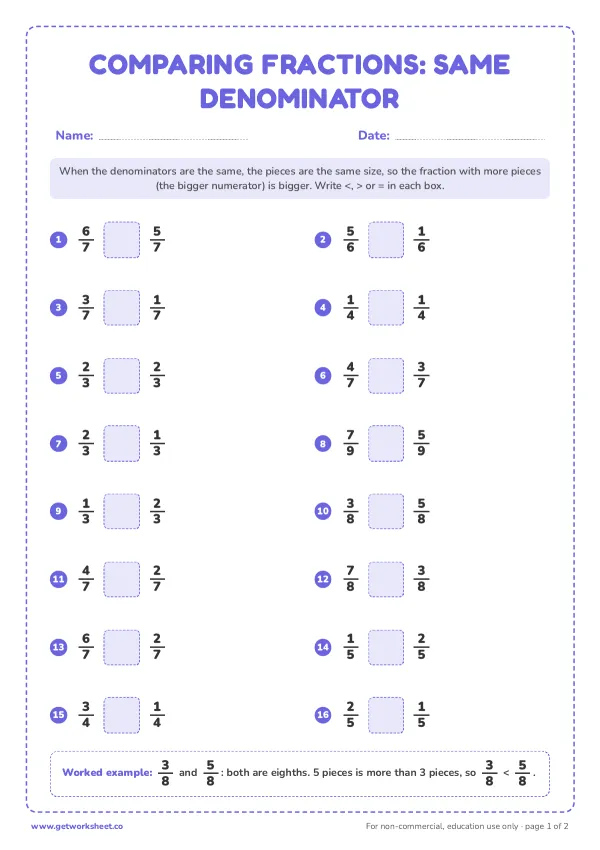
Free comparing fractions worksheets
More worksheets
- Free fractions worksheets
- Free integers worksheets
- Free percent worksheets
- Free elapsed time worksheets
- Free decimals worksheets
- Free 9 times table worksheets
- Free 12 times table worksheets
- Free 11 times table worksheets
- Free 8 times table worksheets
- Free 6 times table worksheets
- Free square numbers worksheets
- Free 10 times table worksheets