Life skills · Preschool–Grade 5
Free behavior chart printables
Free printable behavior charts for home and classroom: a daily green, yellow and red chart for eight parts of the day, a weekly smiley chart, a ten-token board, a home-school sheet, a positive goals tally chart and a five-level clip chart.
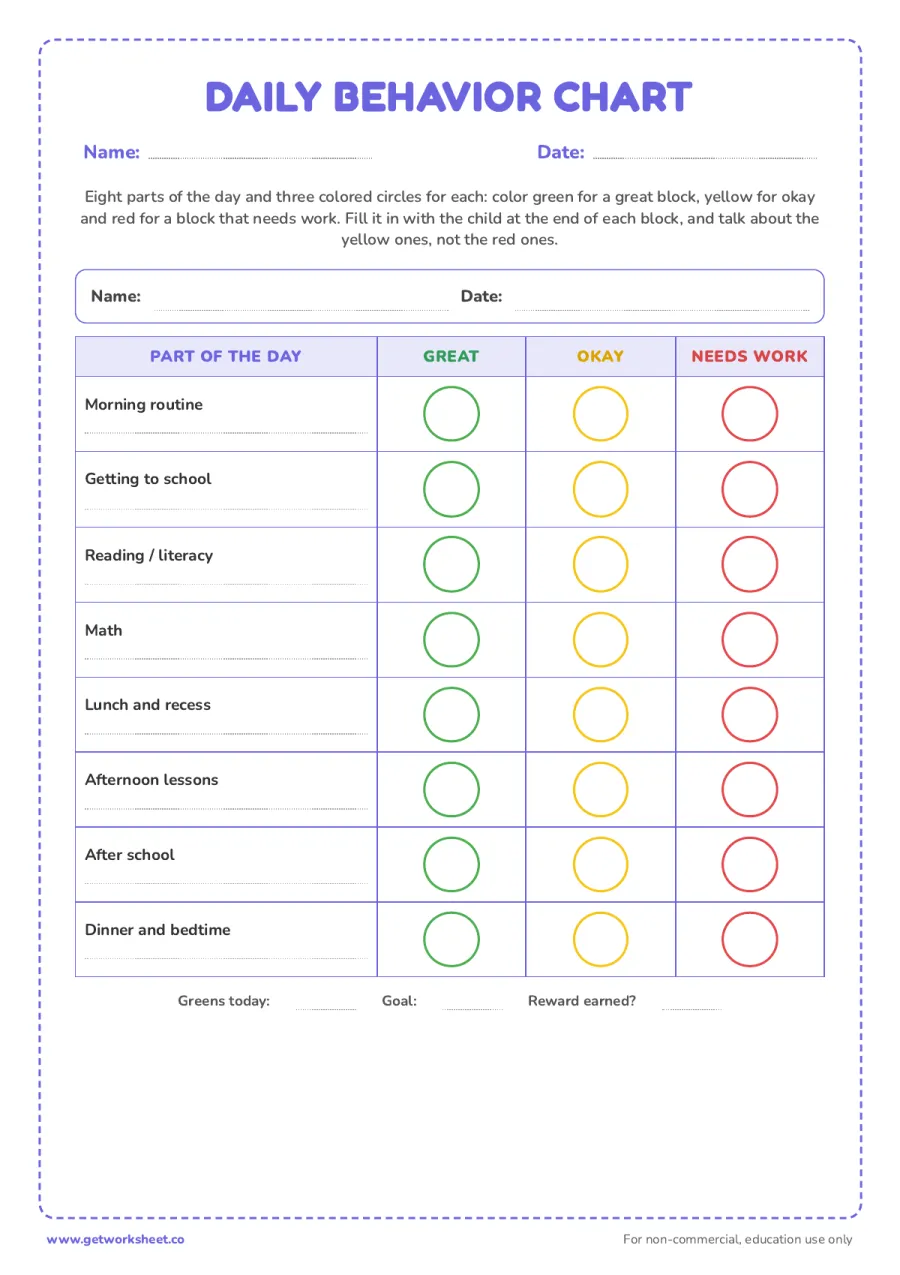
Daily behavior chart: 3 color zones for 8 parts of the day
Eight parts of the day with a green, yellow and red circle each to color at the end of every block, plus a greens count and reward line. Free printable PDF.
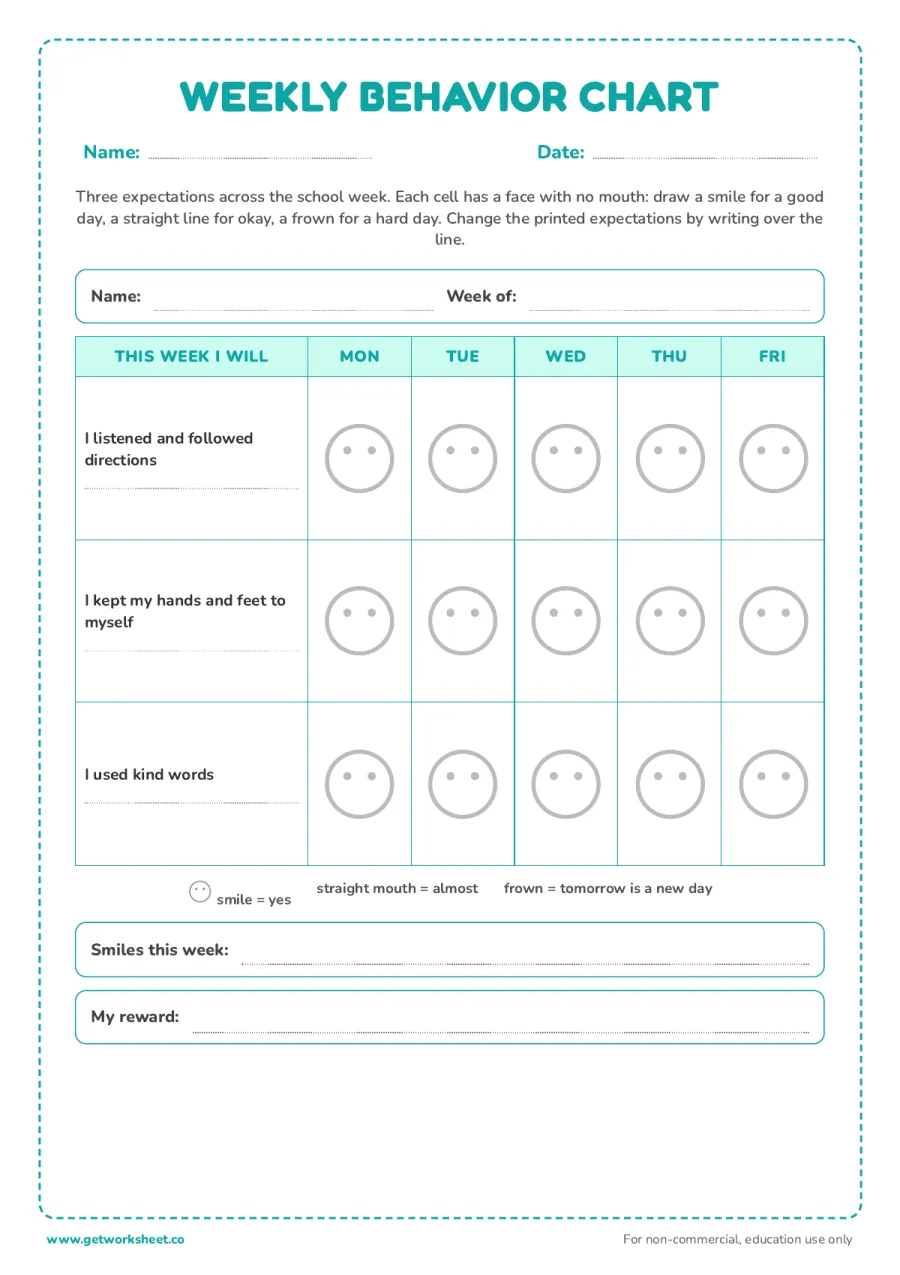
Weekly smiley face behavior chart
Three expectations across Monday to Friday; each cell has a face with no mouth to draw a smile, a straight line or a frown. Free printable PDF.
Whole set
All 6 in one PDF
- Every sheet on this page, one file
- No ads, no countdowns, print as often as you like
- Instant download, ad-free, no account needed
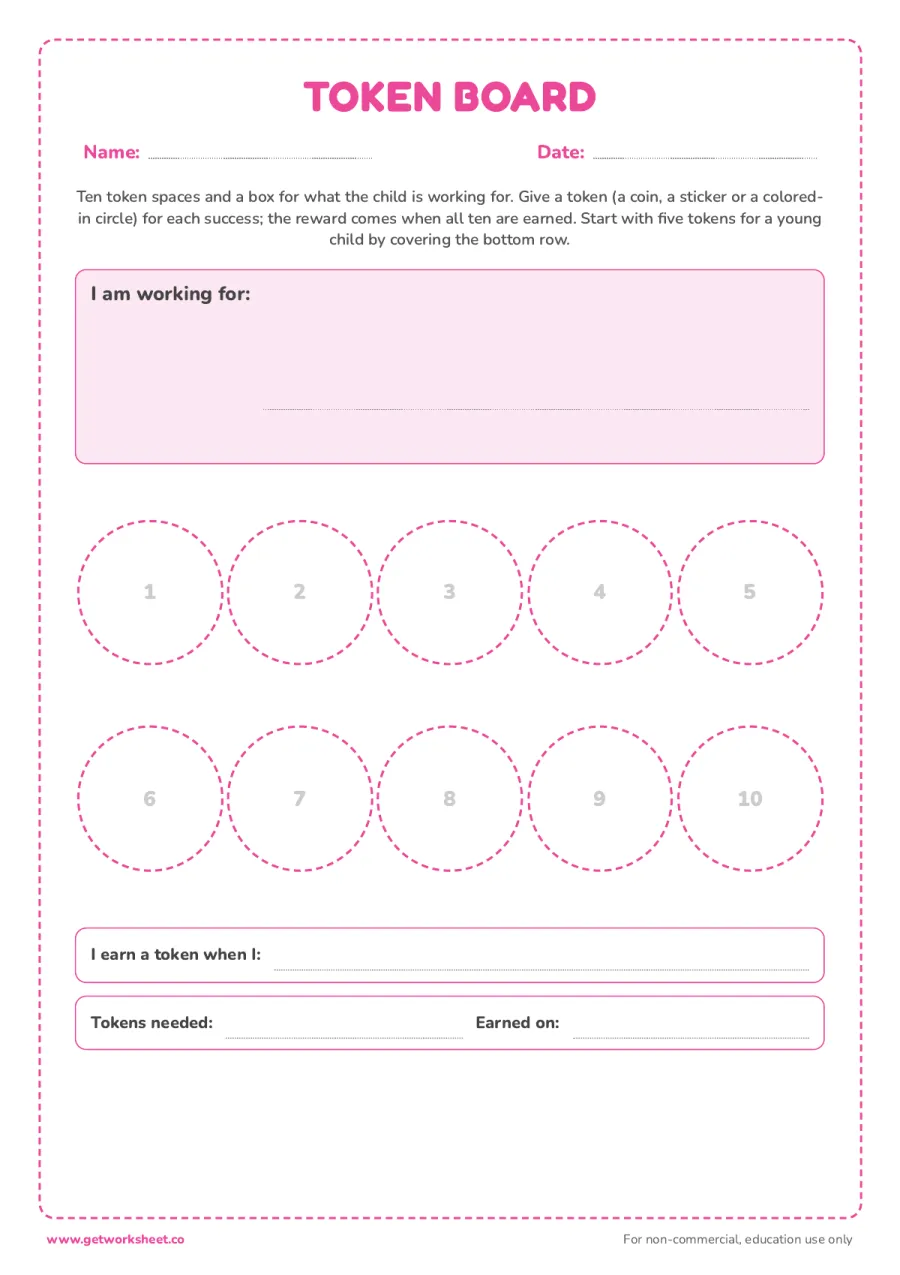
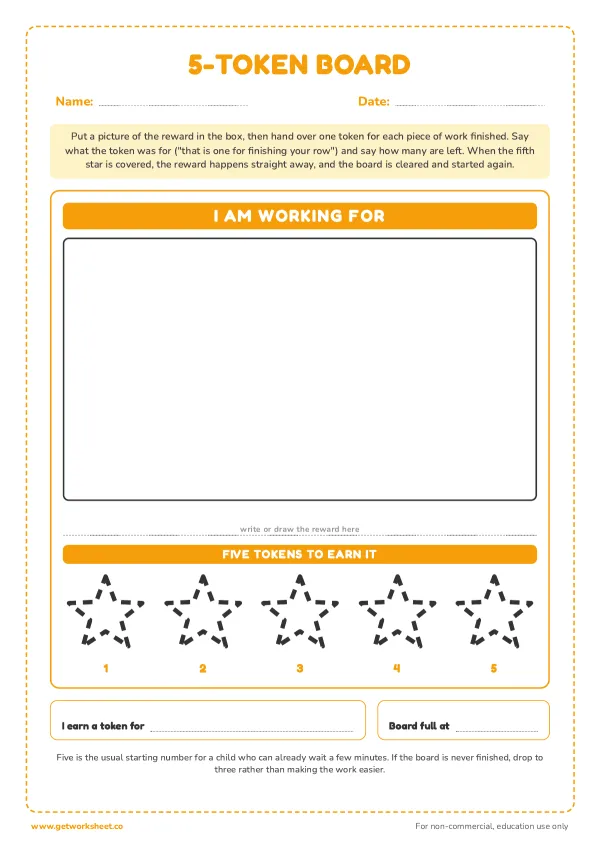
Token board: 10 tokens
Ten dashed token circles and an "I am working for" box, with lines for what earns a token and when the reward was earned. Free printable PDF.
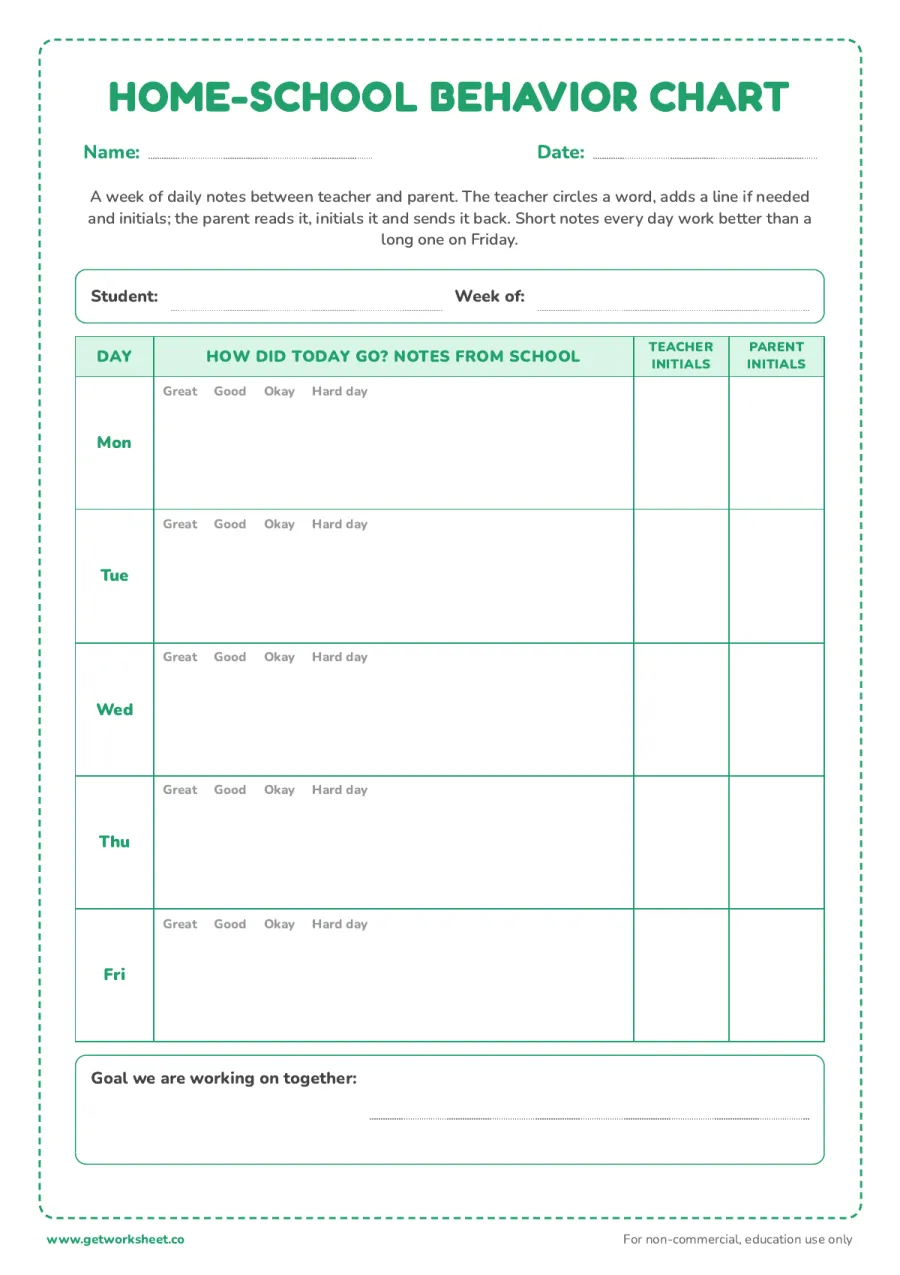
Home-school behavior communication chart
Monday to Friday rows for a short note from school (circle Great / Good / Okay / Hard day), teacher initials and parent initials, and a shared goal box. Free printable PDF.
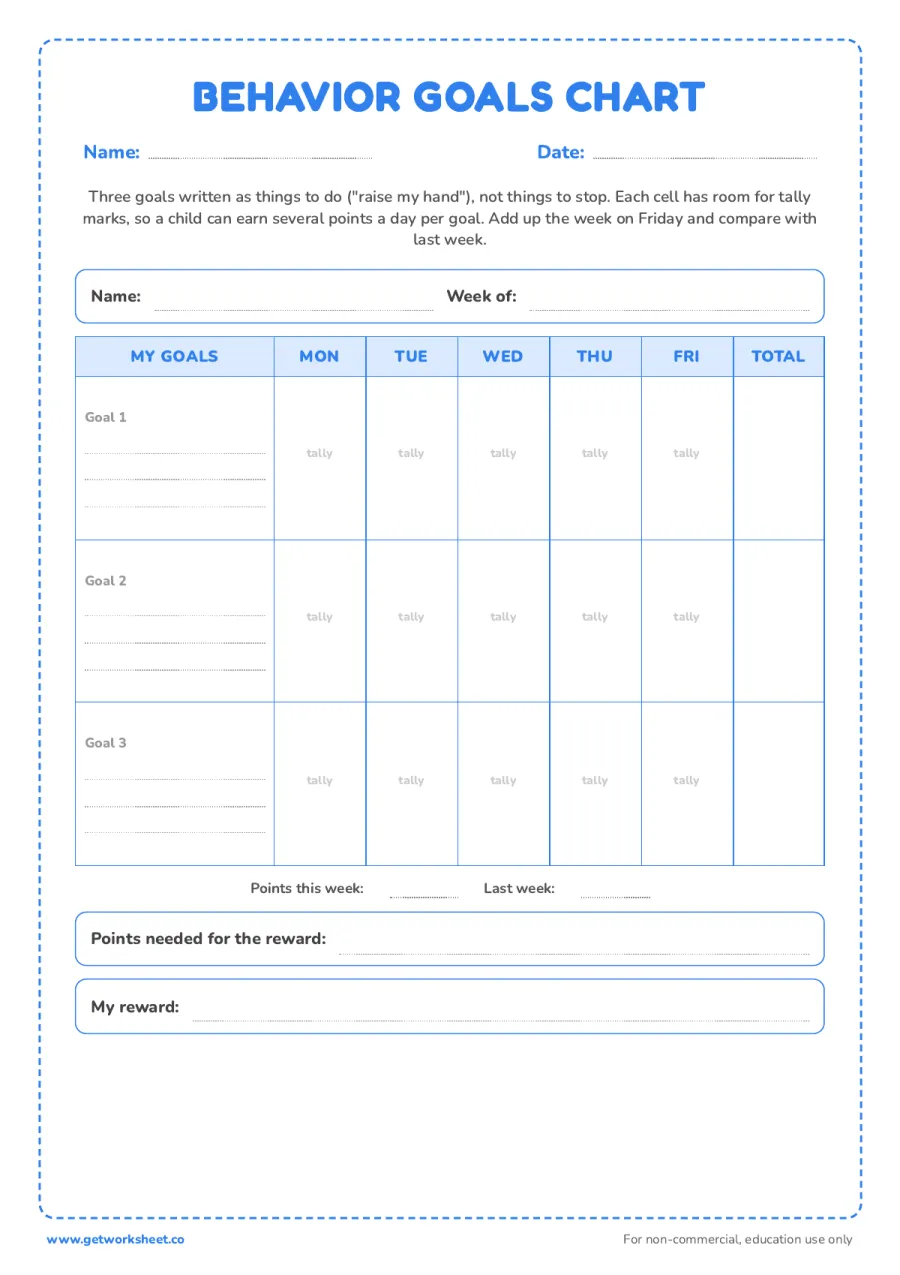
Behavior goals chart with tally boxes
Three positive goals, Monday to Friday tally cells and a total column, with points and reward lines to compare week to week. Free printable PDF.
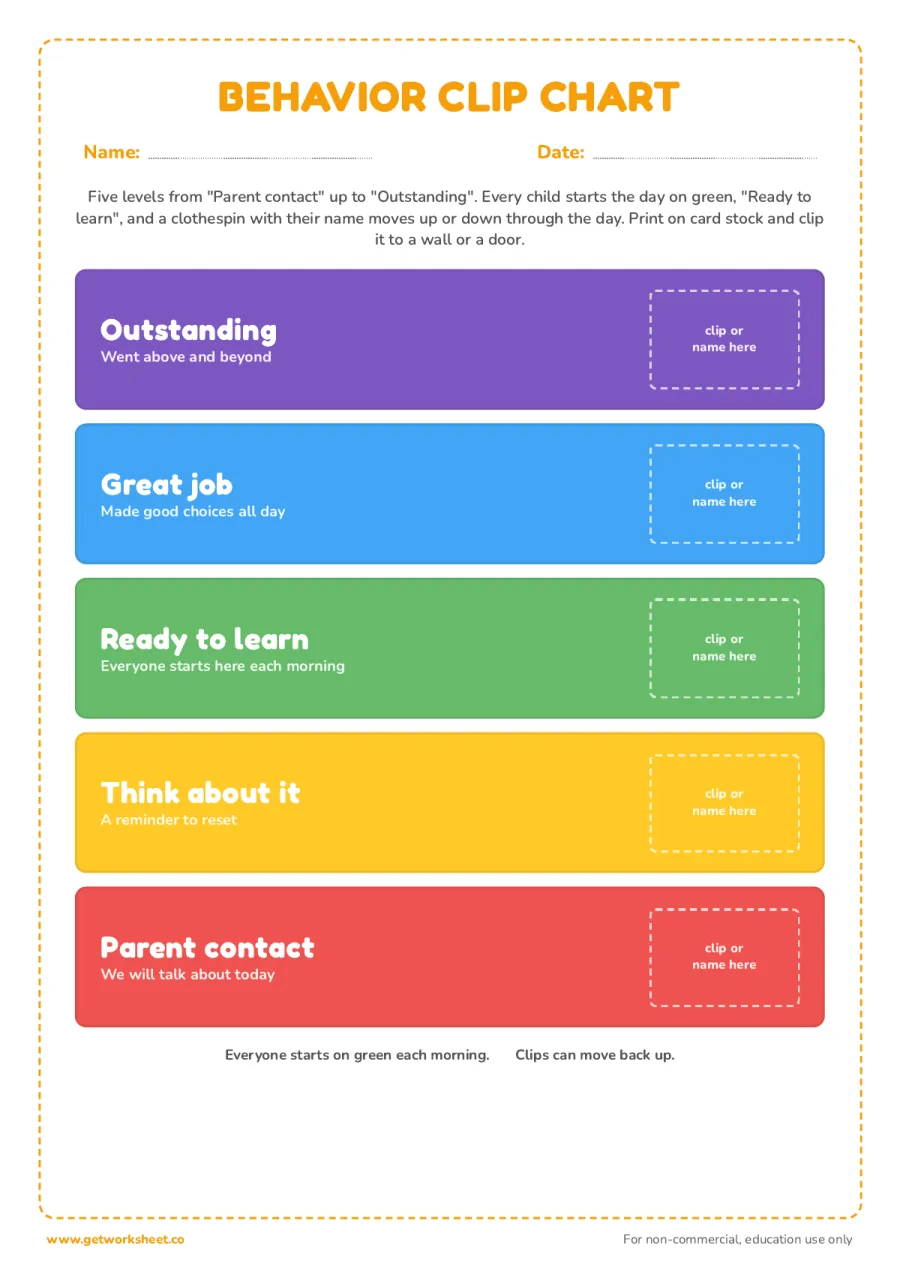
Behavior clip chart: 5 levels
Five colored levels from Parent contact to Outstanding with a clip space on each; everyone starts on green, Ready to learn. Free printable PDF.
AI worksheet generator
Make a worksheet like this for your class
The 6 sheets above are fixed. The generator writes a new behavior chart printables worksheet for your grade, with the question types and count you choose, in about 20 seconds. Pick a grade to start:
What you get
- A fresh set of questions on behavior chart printables, not a copy of the sheets above
- Multiple choice, fill in the blanks, true or false, open ended
- Answer key and print-ready PDF with Pro
Free account, 1 worksheets a week. No card.
A behavior chart is only as good as the conversation it starts. These six printable behavior charts are built to make that conversation short and specific: which part of the day went well, which expectation was met, how many tokens are left before the reward. Three are for home, two work in a classroom, and the home-school chart is for the folder that goes between them. Every chart has a name line and either a goal box or a reward box, and prints on A4 or US Letter.
What's in this set
- Daily behavior chart. Eight parts of the day (morning routine, getting to school, reading, math, lunch and recess, afternoon lessons, after school, dinner and bedtime) with a green, yellow and red circle each to color in.
- Weekly behavior chart. Three expectations (listened and followed directions, kept hands and feet to myself, used kind words) across Monday to Friday, with a mouthless face in every cell to draw a smile, a straight line or a frown.
- Token board. Ten dashed circles and an "I am working for" box, with lines for what earns a token.
- Home-school behavior chart. Monday to Friday rows where a teacher circles Great, Good, Okay or Hard day, adds a note and initials; a parent initials it back.
- Behavior goals chart. Three positive goals, Monday to Friday tally cells, a total column and lines to compare with last week.
- Behavior clip chart. Five colored levels from Parent contact up to Outstanding, with a space for a clothespin on each.
Free printable makers
Make your own behavior chart printables sheets
Type your own words or numbers and print in about 30 seconds. No account, no AI, answer key where it applies.
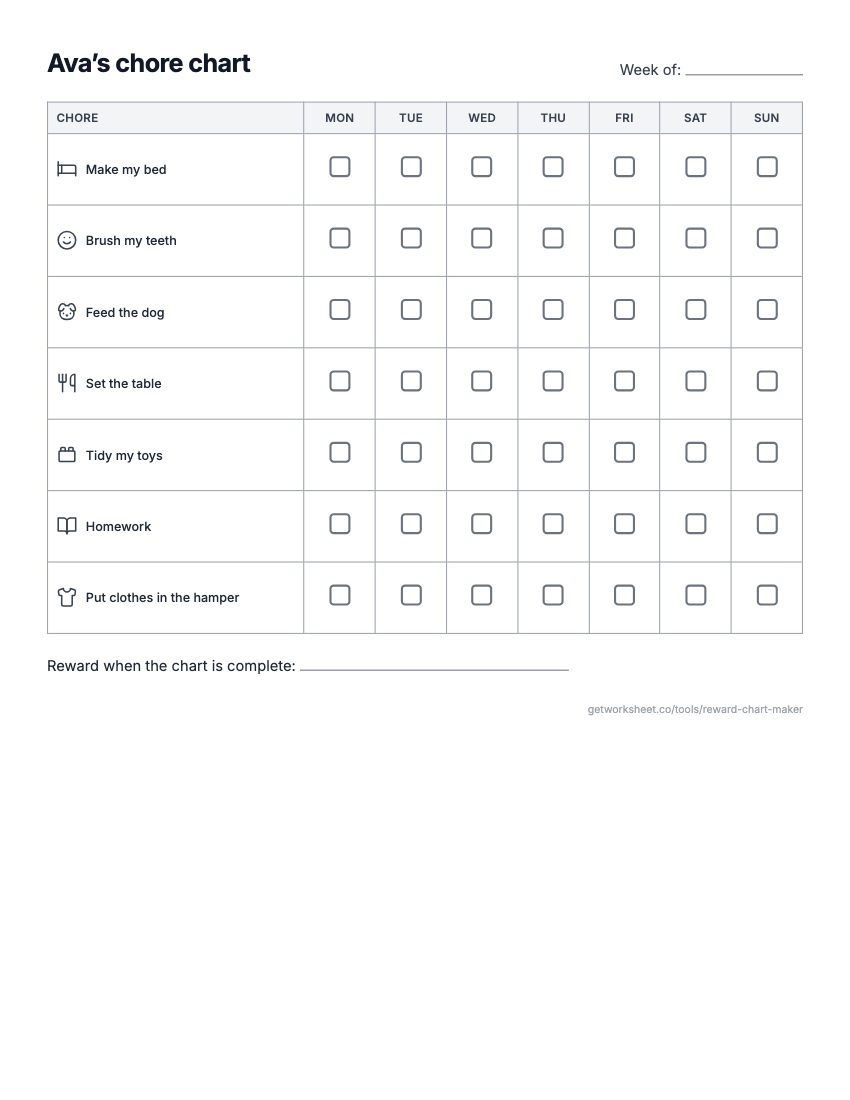 Reward chart and chore chart makerReward or sticker chart with a goal, Mon-Sun chore chart with pictures, behavior chart. Free to print.
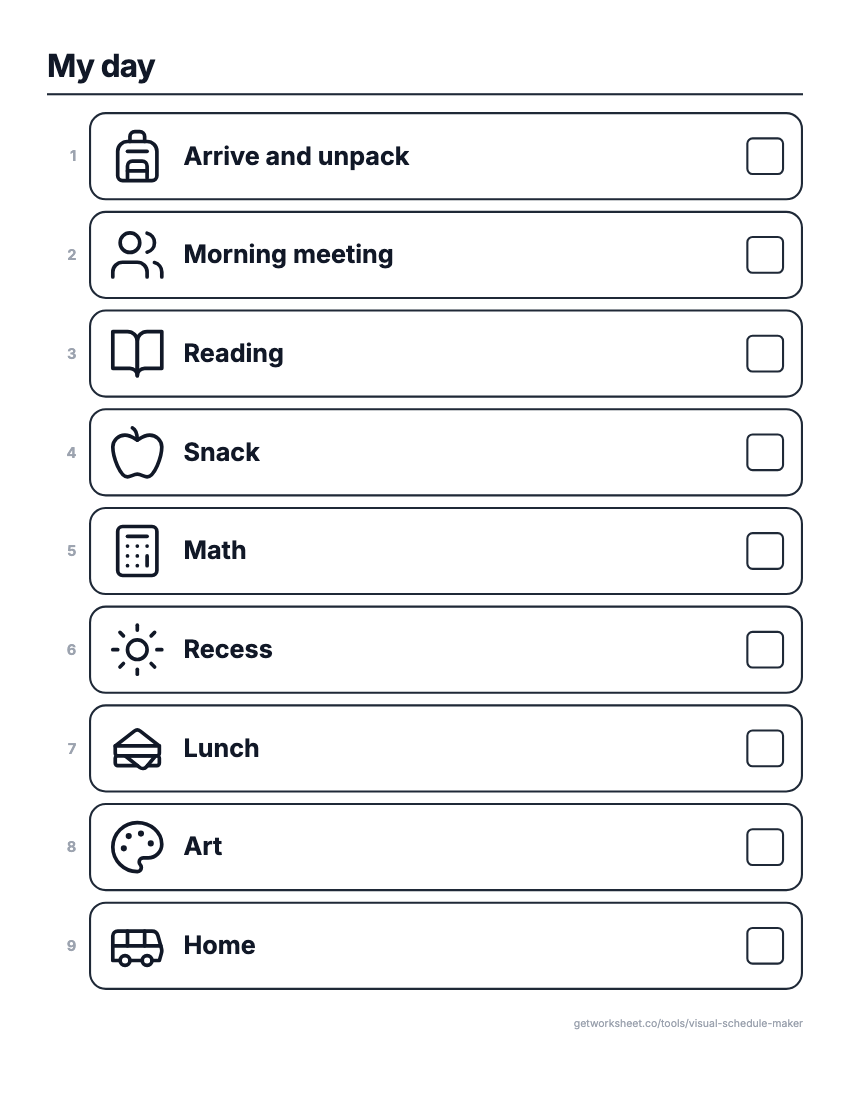 Visual schedule makerPicture schedules, First/Then and token boards. Free to print.
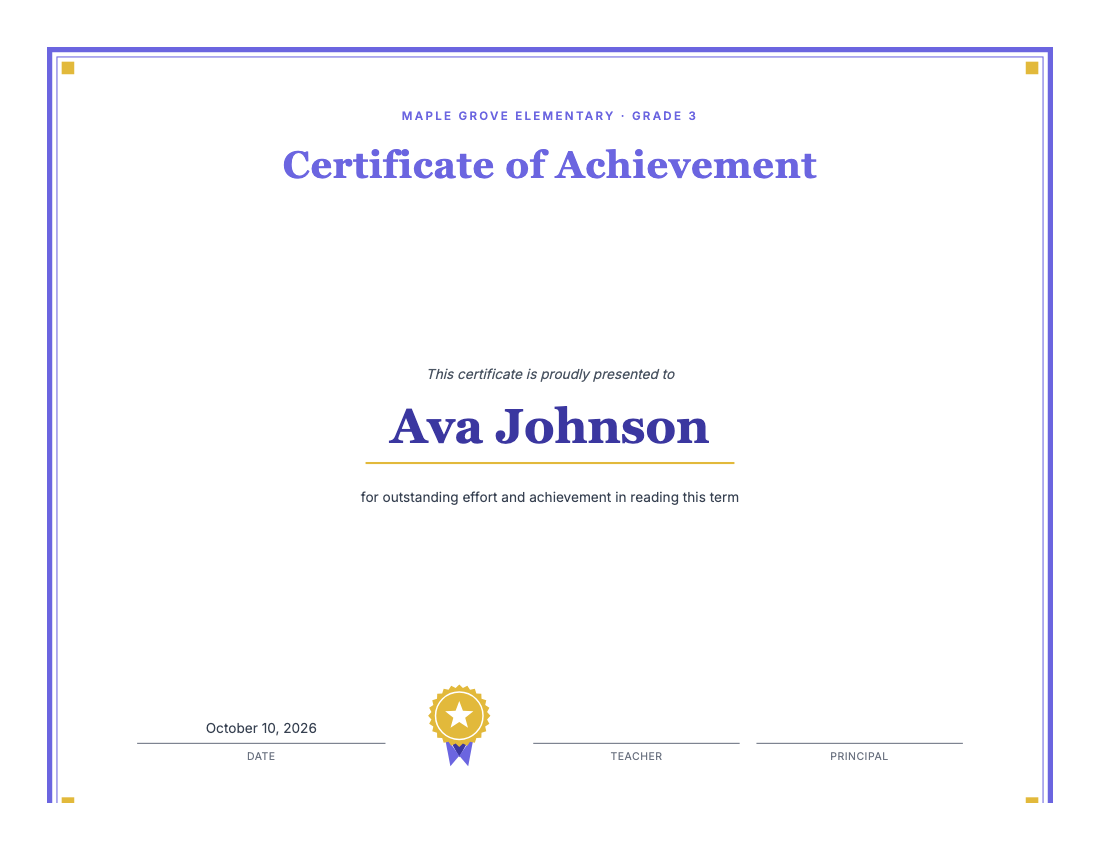 Certificate makerAward certificates for kids: preset titles, one name per page, borders, seal. Free to print.
AI worksheet generator
Need a different behavior chart printables worksheet?
Generate a custom behavior chart printables worksheet: pick the grade, question types and count, and print it in about 20 seconds. Free accounts get 1 generation a week.
Teaching tips and common mistakes
How to use these charts
- Write goals as things to do. "Raise my hand" and "use kind words" can be counted. "Stop shouting" cannot, and it keeps the child's attention on the shouting. The goals chart and the weekly chart are built for positive wording.
- Fill it in with the child, not about the child. At the end of each block of the day, ask "how did that go?" and let them color the circle. Disagreements about a yellow are the useful part.
- Daily chart (ages 4 to 8). Aim for mostly green and talk about the yellows. Red is not a punishment; it is a block to plan for tomorrow. Count the greens and write the total at the bottom.
- Token board (ages 3 to 7, and for children with additional needs). Ten tokens is the standard board; cover the bottom row to start with five. The reward is written first and is small enough to give the same day.
- Home-school chart. A word circled and initials from the teacher every day, initials from the parent every evening. Keep notes to one line; long notes stop being written by Wednesday.
- Clip chart (classroom). Every child starts on green each morning, and clips can move back up during the day. Print on card stock, add a clothespin per child, and use it as a public reminder rather than a public record.
Common mistakes
- Too many expectations. Three is the limit on the weekly and goals charts for a reason. Pick the ones that matter this month.
- Charts that only record bad days. If a child never reaches the reward, the chart is teaching failure. Lower the target until they succeed, then raise it.
- Running a chart for months. Four to six weeks is usual. When the behavior holds, retire the chart with a bit of ceremony.
- Using the chart as the consequence. Moving a clip down is a signal, not a punishment. Consequences are agreed separately and kept consistent.
Frequently asked questions
What is the difference between a behavior chart and a reward chart?
A reward chart records a single good behavior and builds toward a prize. A behavior chart records how the day or week went across several expectations, and is usually reviewed together rather than simply rewarded. The token board sits in between: it is a behavior tool that ends in a reward.
What age are behavior charts for?
About 3 to 10. The token board and the smiley chart suit ages 3 to 7; the daily and goals charts suit 5 to 10; the clip chart is used in kindergarten to grade 5 classrooms. Older children respond better to a written agreement than to a chart.
Are clip charts a good idea?
Many teachers use them and many have stopped, because a public clip can embarrass a child who is already struggling. If you use one, let clips move up as well as down, reset every morning, and keep the conversation about what to do next private.
How do I fill in the home-school chart?
The teacher circles one word, adds a short note if needed and initials the row before the child leaves; the parent reads it, initials it and sends the sheet back the next morning. The goal box at the bottom is agreed once, at the start of the week.
Can I edit the expectations?
The printed expectations and parts of the day each have a dotted line beneath them so you can write your own over them. The goals chart and the token board are blank by design.
More printables for home and school
When a behavior chart needs a prize at the end, the reward chart printables and the plain sticker charts do that job. Everyday responsibilities belong on a chore chart, and a child who is learning routines can practice with the time management worksheets. For a gentler start to the year, the all about me worksheet tells a new teacher what a child is proud of.
Free library
Related collections
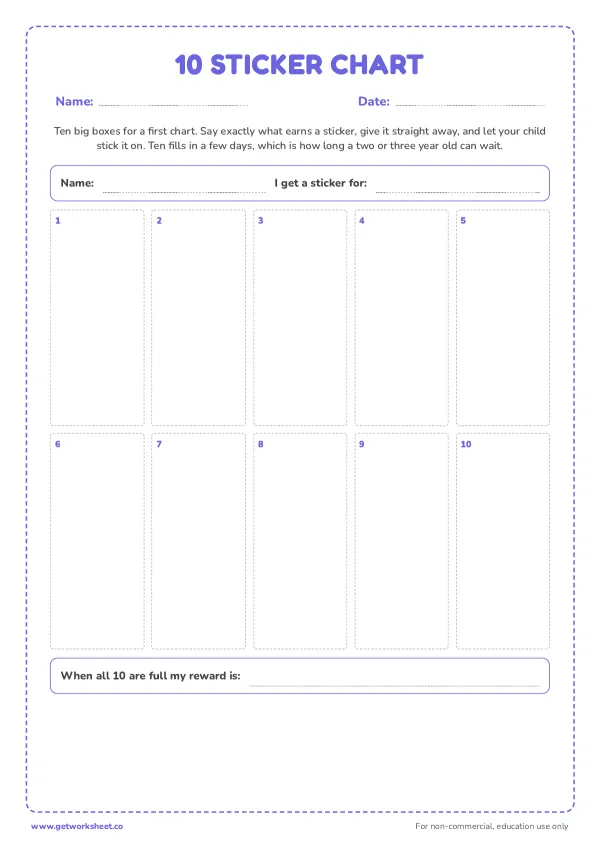
Free sticker chart printables
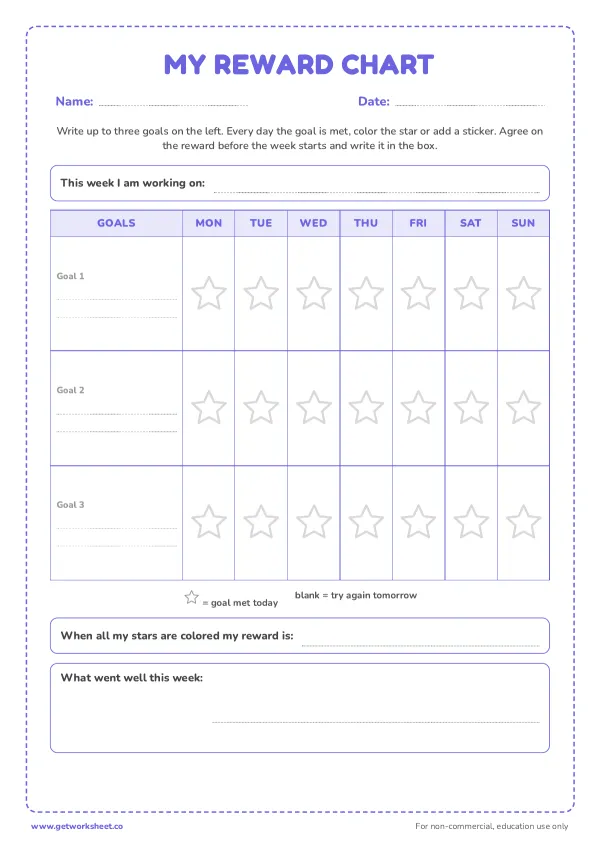
Free reward chart printables
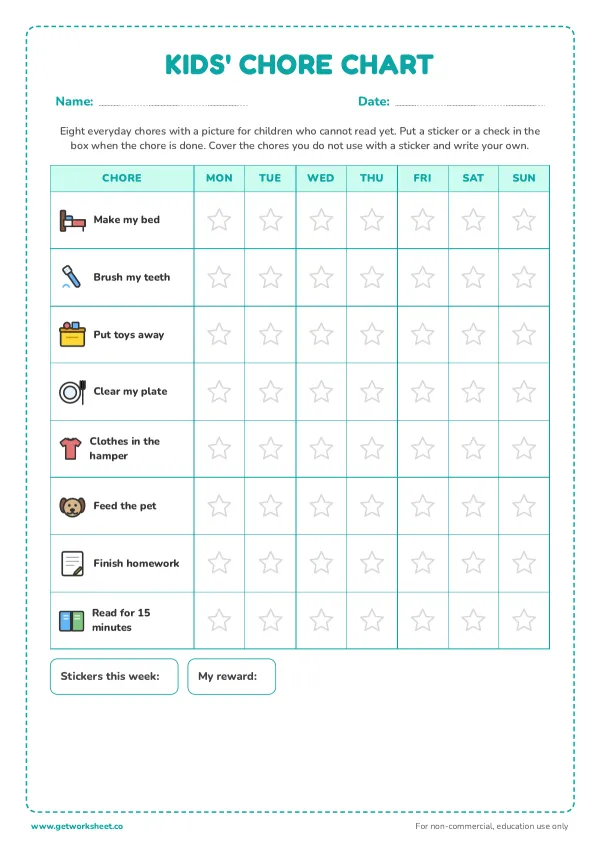
Free chore chart printables
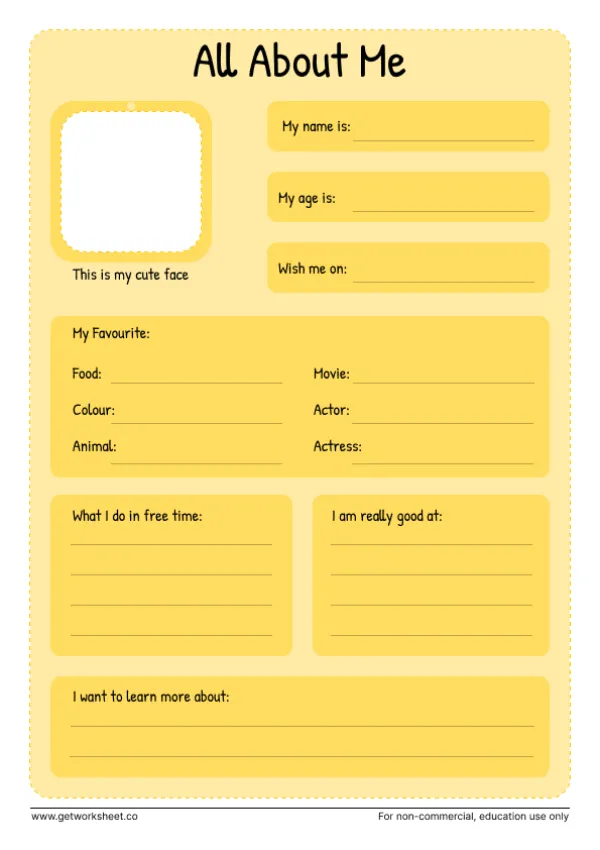
Free all about me worksheets
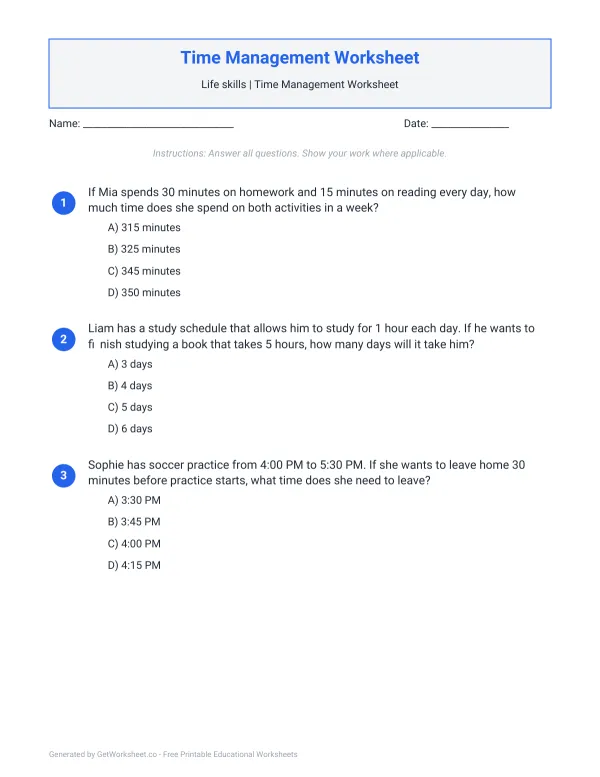
Time Management Worksheets
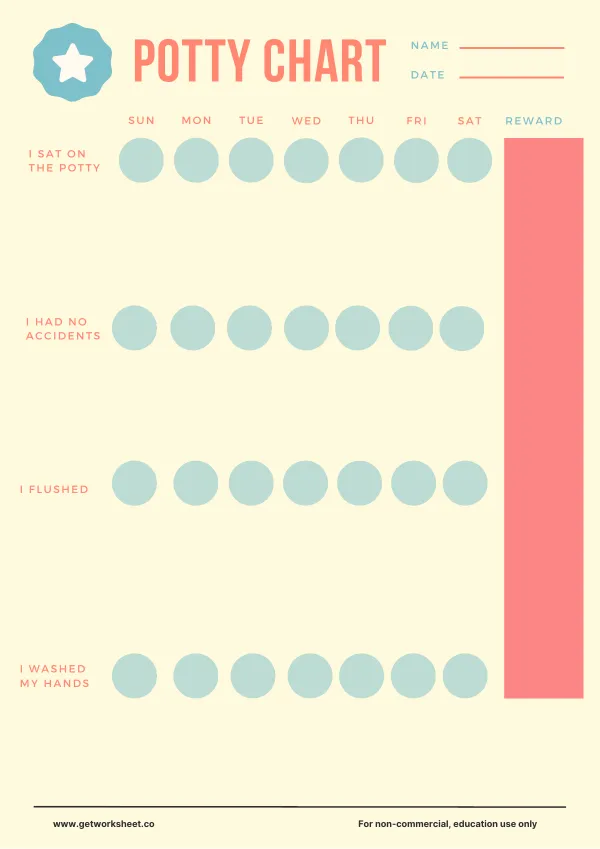
Free potty training chart printables
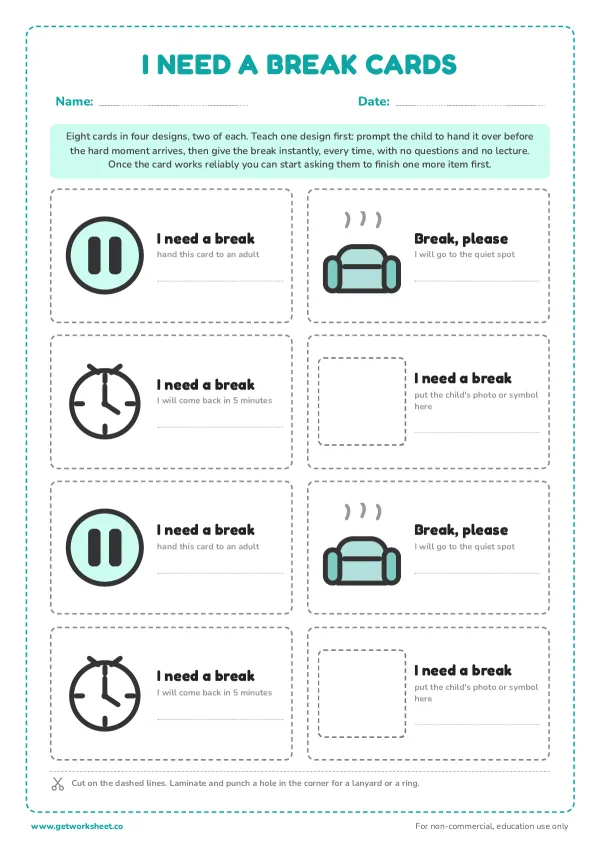
Free break card printables
Free token board printables
More worksheets
- Free First-Then board printables
- Free cutting practice worksheets
- Free i spy worksheets
- Free first day of school sign printables
- Free tooth brushing chart printables
- Free feelings chart printables
- Free bedtime routine chart printables
- Free Montessori land and water forms worksheets
- Free Montessori three part cards templates
- Free Elkonin boxes worksheets
- Free Montessori spindle box worksheets
- Free penguin worksheets