Life skills · Toddler–Preschool
Free potty training chart printables
Eight printable potty training charts for toddlers: a three-day chart with tried and went boxes, rocket and rainbow weekly star charts, a seven-step picture chart, two weekly dot trackers, a nine-box sticker chart and a four-week chart.
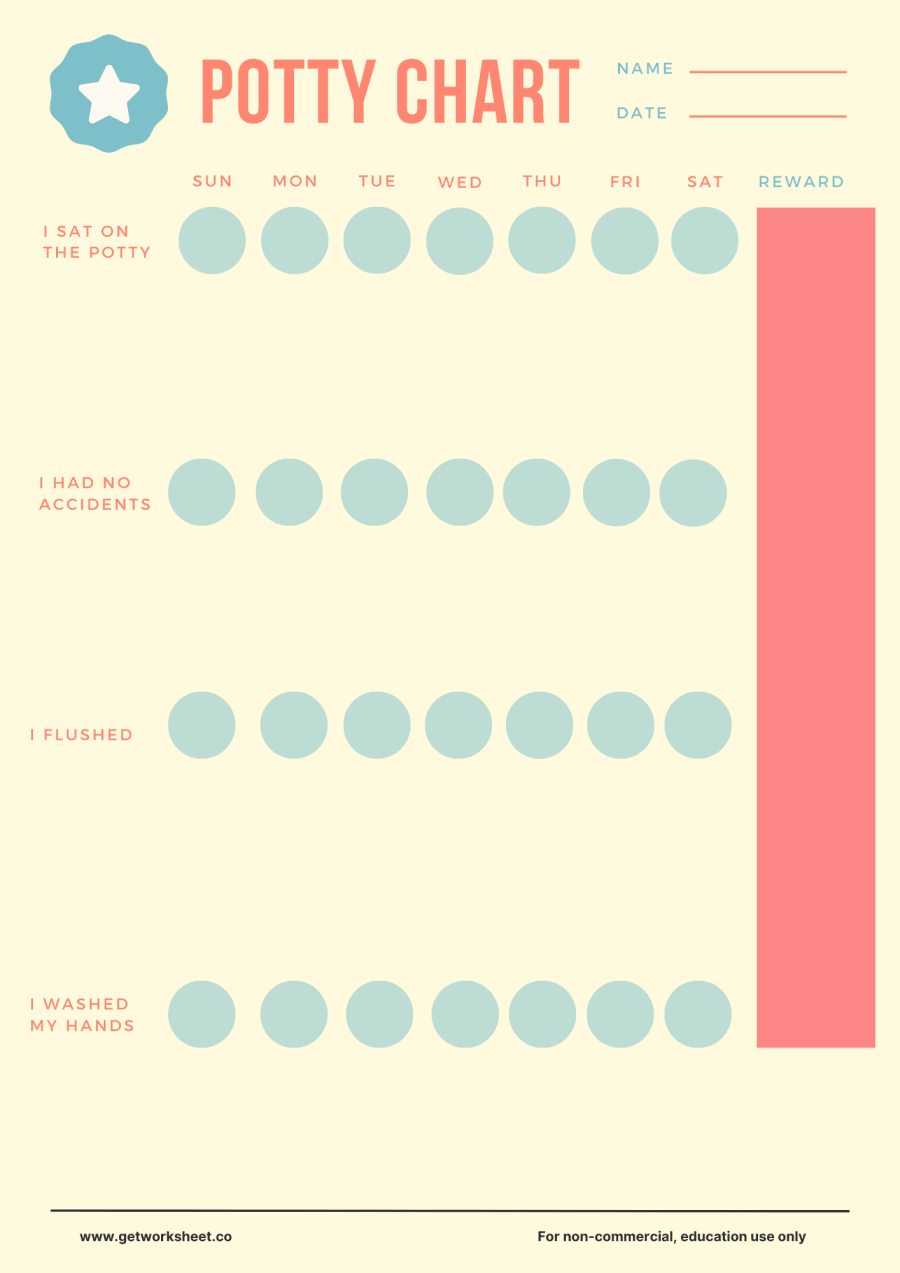
Potty chart: 4 daily goals, Sun to Sat dot tracker
Weekly grid with name and date lines; child marks a dot each day for sat on the potty, no accidents, flushed and washed hands, with a reward column.
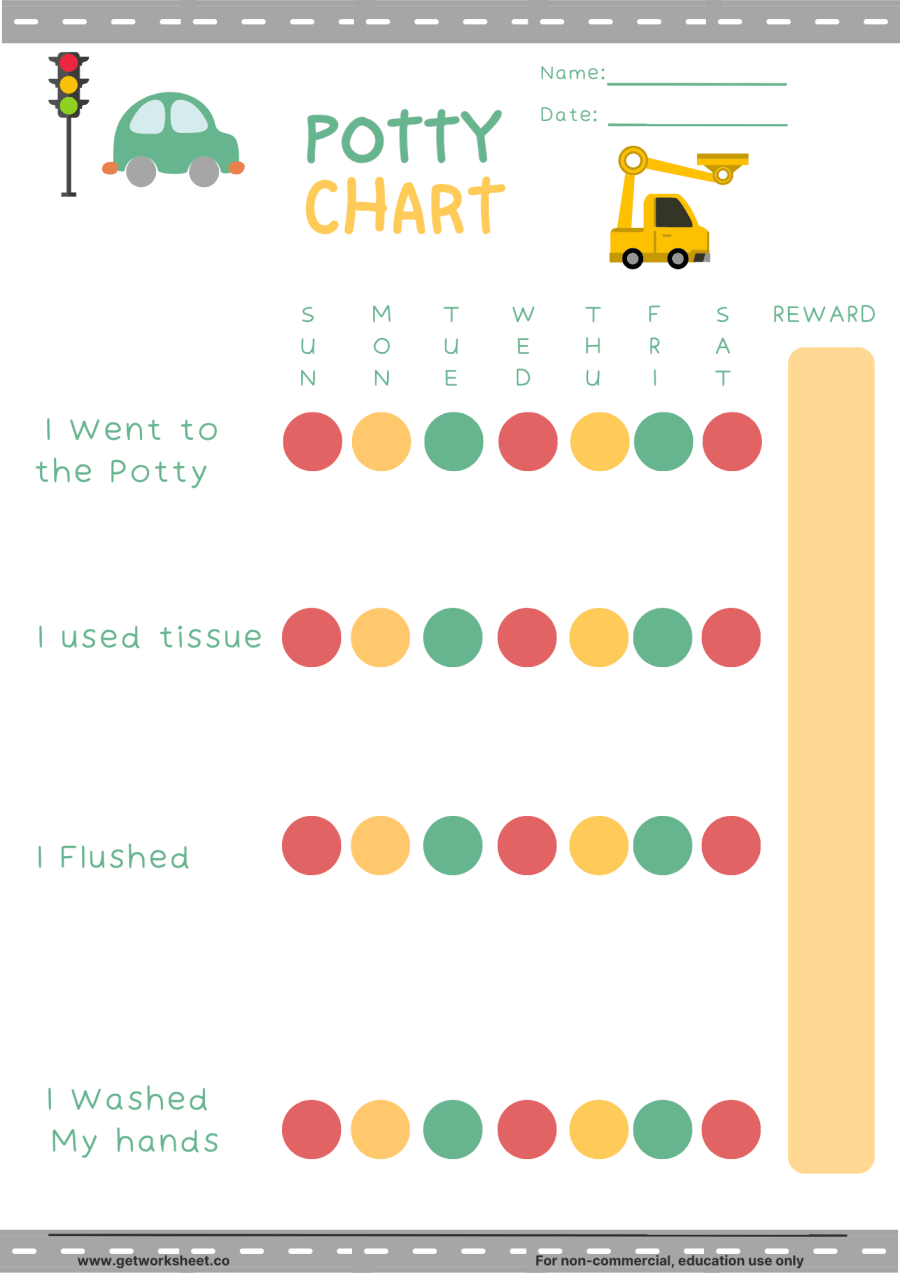
Potty chart: traffic-light dots for potty, tissue, flush
Car and traffic-light themed weekly chart; colour a dot Sun to Sat for went to the potty, used tissue, flushed and washed hands, plus a reward column.
Whole set
All 8 sheets in one PDF
Instant and ad-free. No account needed.
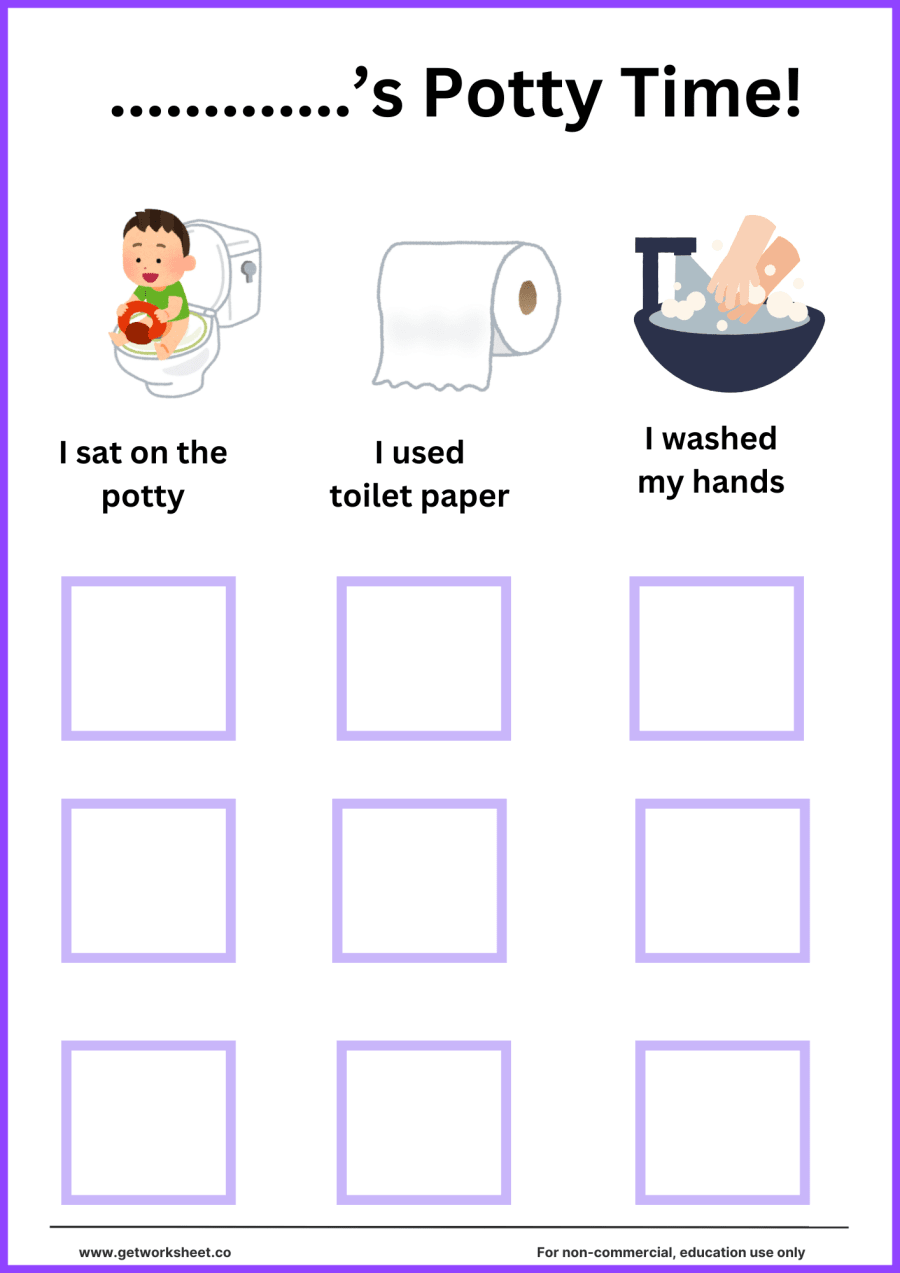
Potty time: 9 sticker boxes for sit, wipe, wash
Name-blank chart with three picture columns (I sat on the potty, I used toilet paper, I washed my hands) and three sticker squares under each.
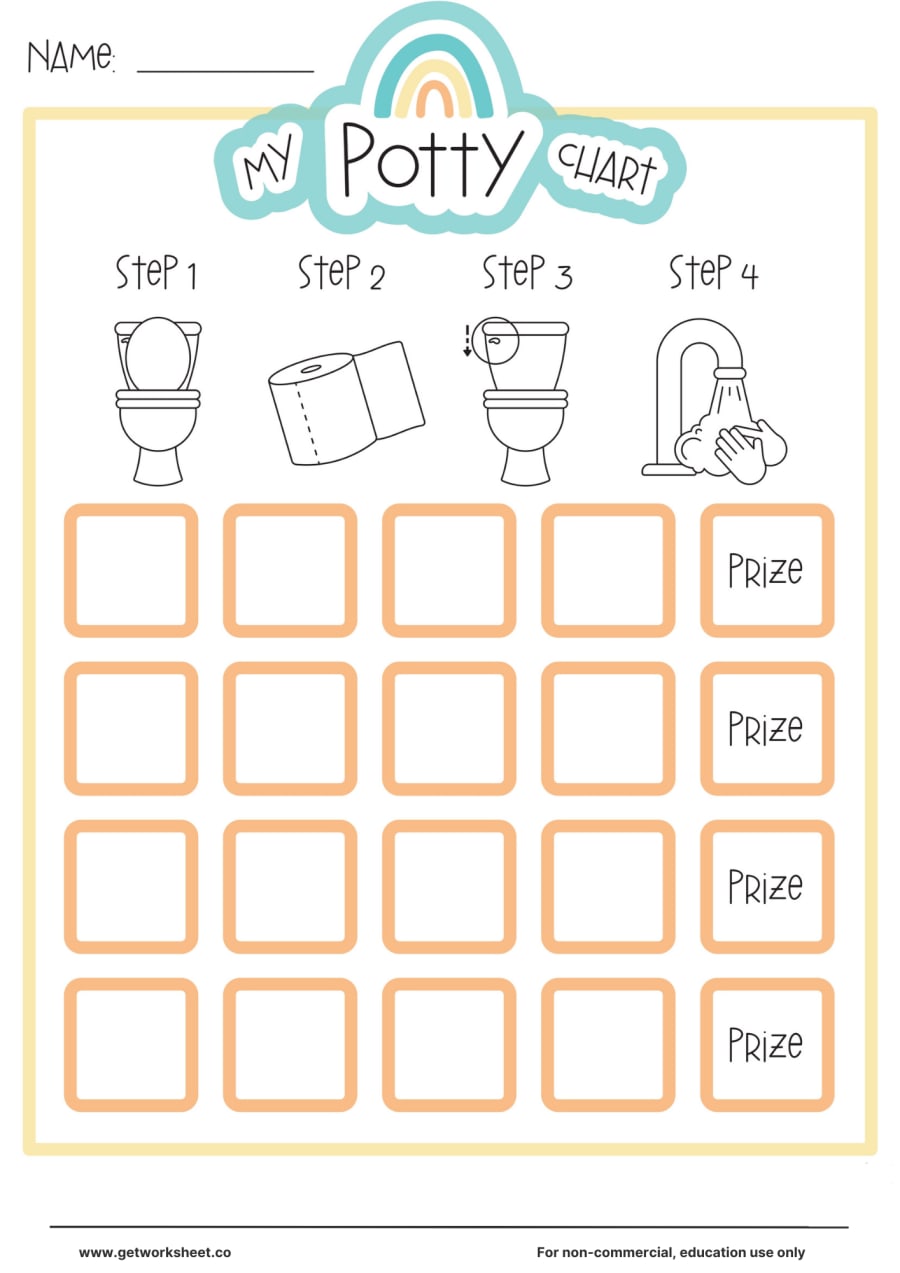
My potty chart: 4 steps with a prize box each row
Rainbow-topped chart with a name line, picture steps 1 to 4 (toilet, paper, flush, wash hands) and four rows of squares ending in a prize box.
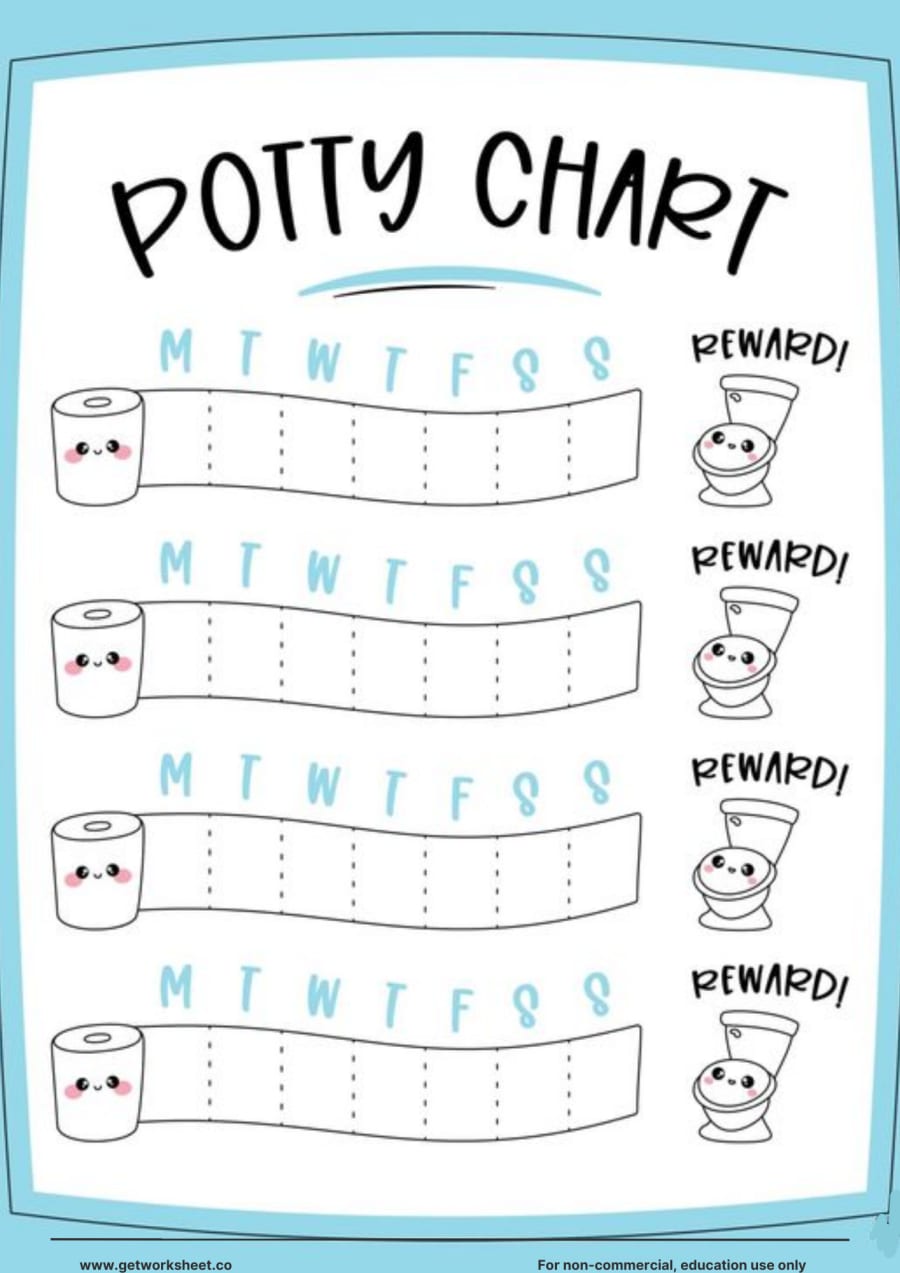
Potty chart: 4 weeks on toilet-paper rolls, Mon to Sun
Four toilet-paper-roll strips labelled M T W T F S S with a dashed box per day to tick or sticker, and a toilet 'Reward!' at the end of each week.

3-day potty training chart: 7 potty times a day
Seven set potty times a day for three days, with a "tried" box and a "went" box for each visit and a prize line. Free printable PDF.

Rocket and rainbow potty charts (boys and girls)
Two pages: a rocket-themed and a rainbow-themed week of stars for pee, poop and washing hands, Sunday to Saturday, with a reward line. Free printable PDF.

My potty steps: 7 pictured steps and a week of stickers
Seven picture steps from "I feel it" to "wash hands" across the top and a Monday to Sunday grid of sticker circles for days when all seven happened. Free printable PDF.
AI worksheet generator
Make a worksheet like this for your class
The 8 sheets above are fixed. The generator writes a new potty training chart printables worksheet for your grade, with the question types and count you choose, in about 20 seconds. Pick a grade to start:
What you get
- A fresh set of questions on potty training chart printables, not a copy of the sheets above
- Multiple choice, fill in the blanks, true or false, open ended
- Answer key and print-ready PDF with Pro
Free account, 1 worksheets a week. No card.
Every one of these eight potty training charts works the same way: the child marks a dot, a check or a sticker for each step done and works toward a reward space. The set now covers the three ways families train. For the three-day method there is a chart with seven set potty times a day and a "tried" box and a "went" box for each visit. For a week at a time there are two Sunday to Saturday dot trackers, a rocket chart and a rainbow chart with stars for pee, poop and washing hands, and a seven-step picture chart for children who need the sequence spelled out. For the long haul there is a nine-box sticker chart for quick wins, a four-step chart with a prize box on every row and a four-week toilet-roll chart. Every box is big enough for a standard star sticker.
What's in this set
- Sun to Sat chart with four daily goals. Sat on the potty, no accidents, flushed, washed hands, with a reward column.
- Traffic-light weekly chart. A car and traffic-light theme: color a dot for went to the potty, used tissue, flushed and washed hands.
- Nine-box sticker chart. Three picture columns (sat on the potty, used toilet paper, washed hands) with three sticker squares each.
- Four steps with a prize box. Picture steps 1 to 4 (toilet, paper, flush, wash hands) and four rows of squares that each end in a prize box.
- Four-week toilet-roll chart. Four toilet-paper-roll strips labelled M T W T F S S with a box per day and a reward each week.
- 3-day potty chart. Seven potty times a day (wake up, mid-morning, before lunch, after nap, late afternoon, after dinner, bedtime) for three days, with a tried box and a went box for every visit.
- Rocket and rainbow charts. Two pages, one with rockets and one with rainbows: a Sunday to Saturday week of stars for pee in the potty, poop in the potty and washed my hands.
- My potty steps. Seven pictured steps (I feel it, go to the potty, pull down, sit and try, wipe, flush, wash hands) across the top and a Monday to Sunday grid of sticker circles for days when all seven happened.
The charts suit children aged 2 to 4 who show signs of readiness: staying dry for longer stretches, telling you when they are wet, or showing interest in the toilet.
AI worksheet generator
Need a different potty training chart printables worksheet?
Generate a custom potty training chart printables worksheet: pick the grade, question types and count, and print it in about 20 seconds. Free accounts get 1 generation a week.
How to use these charts
Print at 100% on A4 or US Letter and tape the chart on the bathroom wall at your toddler's eye level, not on the fridge. Star stickers, dot markers or a crayon all work. Fill in the name line in front of your child, run one chart at a time rather than all eight, and reprint when the week ends.
- Nine-box sticker chart. Start here if you are training gradually. Three picture columns with three squares each, so a child can fill it in a day or two. Quick wins beat a long record at the start.
- 3-day potty chart. Start here if you are doing the three-day method: a long weekend at home, no diapers, a potty visit at each of the seven printed times. Sticker the "tried" box for every sit and the "went" box when something happened. Both boxes count; sitting is the habit.
- My potty steps. For a child who gets stuck halfway (sits, then forgets to wipe or flush). Point to each picture as they do it, and give the sticker only for a full run of seven. Talk through the steps at the start, not during.
- Rocket and rainbow charts. The same week of stars in two themes, so a child who loves rockets or rainbows has a reason to look at the chart. Pee, poop and hand-washing are separate rows because they come at different times.
- Four steps with a prize box. Picture steps 1 to 4 run toilet, paper, flush, wash hands, and each row ends in a prize box, so your child can count the squares left before the prize.
- Sun to Sat chart with four daily goals. Good once accidents are rare, because one of the four goals is a whole day with no accidents. Mark the dots together at bath time so the day gets a clear end.
- Traffic-light weekly chart. Swap to it when the plainer grid stops getting noticed.
- Four-week toilet-roll chart. Save this for last. It records a month of steady days without tracking every step.
Making the chart work
- Rewards that are too far away. A two year old cannot wait a week. Keep the first reward two or three stickers out, then stretch it once the habit holds.
- Marking the try, not just the result. Sitting on the potty is a goal on these charts for a reason, and the 3-day chart has a whole box for it. Give the sticker for the attempt, or your child learns that only perfect days count.
- Taking dots away after an accident. Never remove a mark. Leave the square blank, say nothing about it, and move on to the next visit.
- Leaving the chart up too long. Once your child is going without reminders, take it down. A chart that has outlived the habit turns into wallpaper.
Frequently asked questions
What age is a potty training chart for?
Most children use one between ages 2 and 4, once they show readiness: staying dry for longer stretches, telling you when they are wet, or showing interest in the toilet. These are toddler and preschool charts, so an adult reads the steps aloud.
Which of the eight charts should we start with?
For the three-day method, the 3-day chart. For gradual training, the nine-box sticker chart, because it has only nine squares and fills up fast. Move to the potty steps chart if your child forgets steps, then a weekly chart, then the four-week roll chart.
Do I need stickers?
No. Every chart works with a crayon dot, a check mark or an ink stamp. The weekly charts are designed for coloring a star or a dot, and every box is at least 14 mm, so a standard star sticker fits.
Is there a chart for boys and one for girls?
The rocket and rainbow sheet prints as two pages with the same layout and different pictures, so a child can choose the one they like. Nothing else on the charts is gendered; the potty steps chart shows a stick figure.
Will the charts print in black and white?
Yes. The rainbow, the rockets and the traffic-light dots lose their color, but the pictures and boxes stay clear, and some parents prefer it because the child colors the chart in instead.
What should the reward be?
Something small and immediate: a sticker, a story, a stamp on the hand, choosing dinner. The prize boxes on the four-step chart and the weekly reward on the roll chart mark the bigger moments.
More practice
For more printables at this age, try line tracing worksheets to build pencil control, i spy worksheets for looking and counting, and number coloring pages for quiet time. When preschool starts, print a first day of school sign.
Free library
Related collections
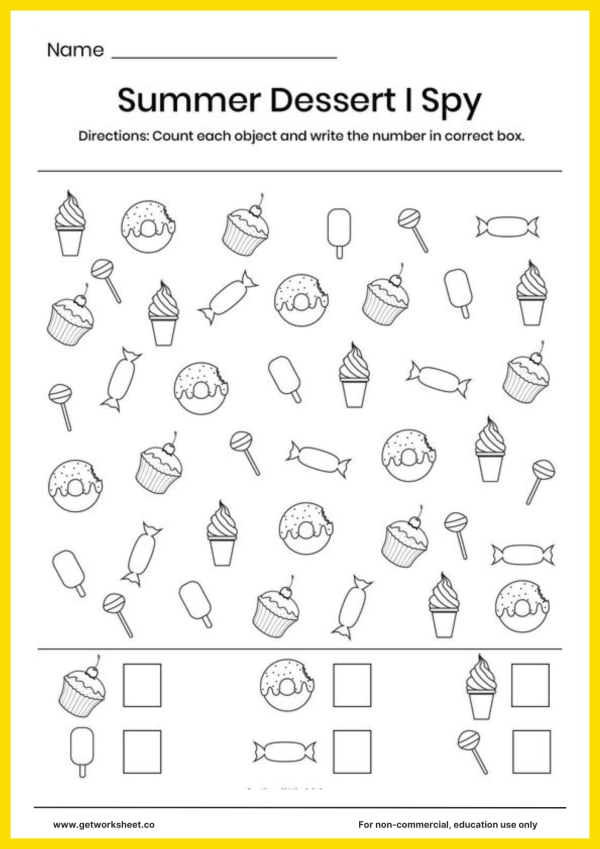
Free i spy worksheets
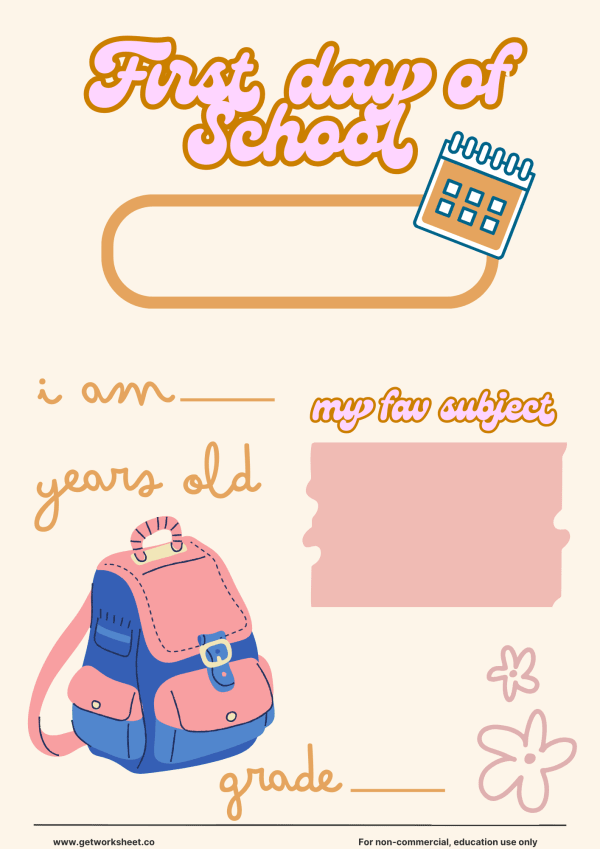
Free first day of school sign printables

Free line tracing worksheets
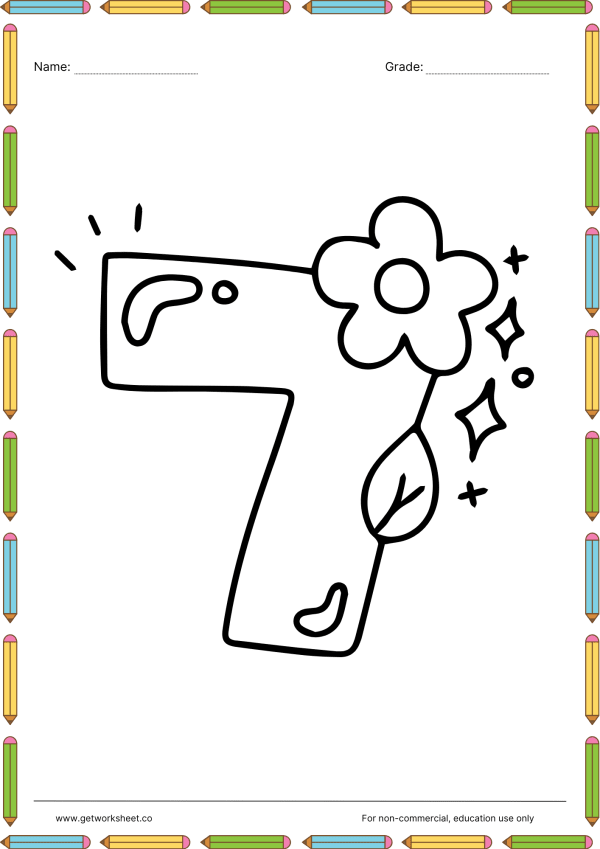
Free printable number coloring pages

Free cutting practice worksheets
Free all about me worksheets

Free heart tracing worksheets
Free Montessori language worksheets
More worksheets
- Free pre-writing worksheets
- Free Montessori math worksheets: one from every material
- Free name tracing worksheets
- Free shape tracing worksheets
- Free letter Z tracing worksheets
- Free letter Y tracing worksheets
- Free letter X tracing worksheets
- Free letter W tracing worksheets
- Free letter V tracing worksheets
- Free letter U tracing worksheets
- Free number 20 tracing worksheets
- Free letter T tracing worksheets