Life skills · Ages 6–14
Free allowance and savings tracker printables
Free printable allowance and savings trackers for ages 6 to 14: an allowance chart for jobs that earn money, a 20-step savings thermometer, spend / save / give jar tables, a weekly money ledger, an allowance agreement to sign and a coin-counting savings jar page with an answer key.
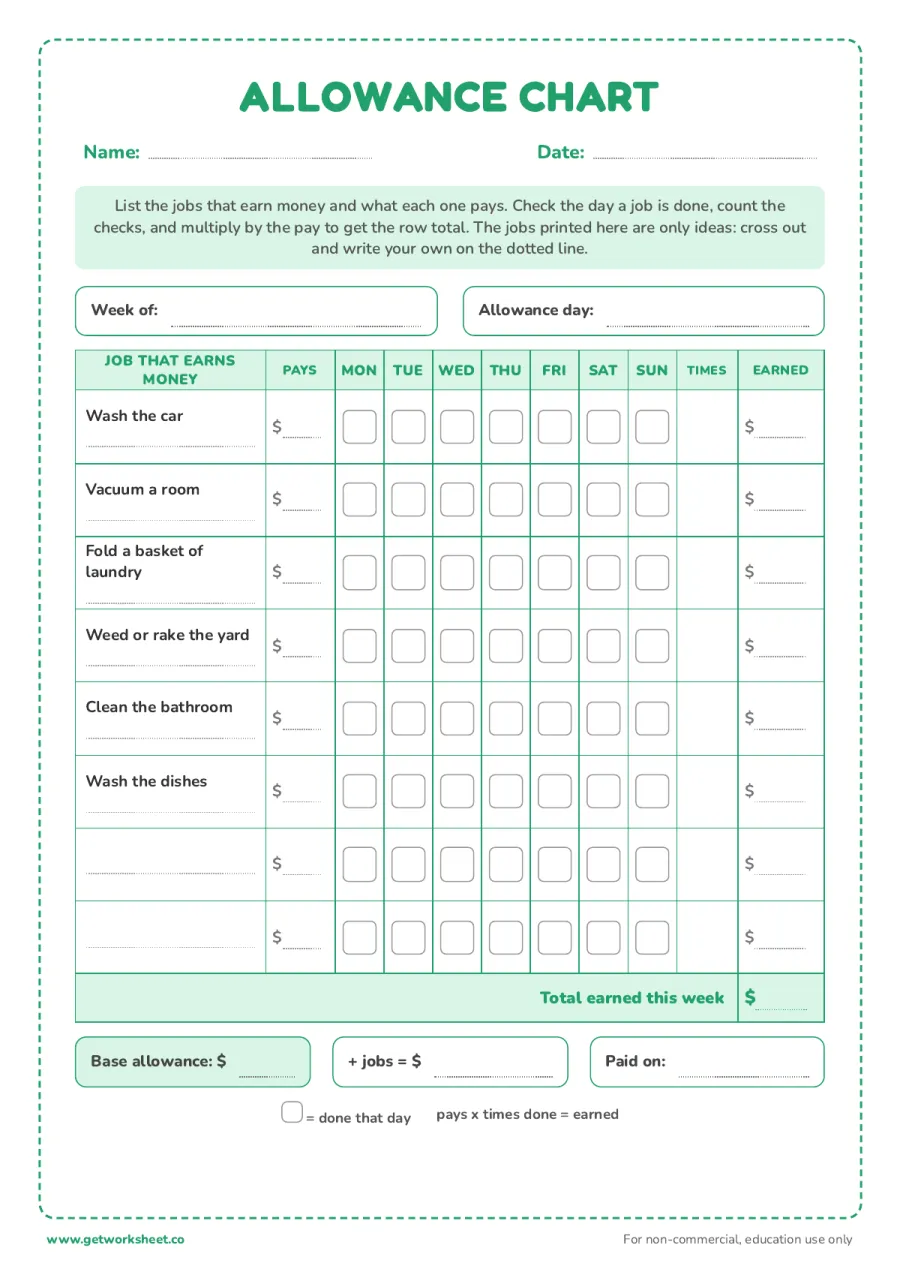
Allowance chart: jobs that earn money
Eight paid-job rows (six ideas printed, two blank) with a pays column, Monday to Sunday check boxes, times done and earned columns, a weekly total, base allowance and paid-on lines. Free printable PDF, A4 and US Letter.
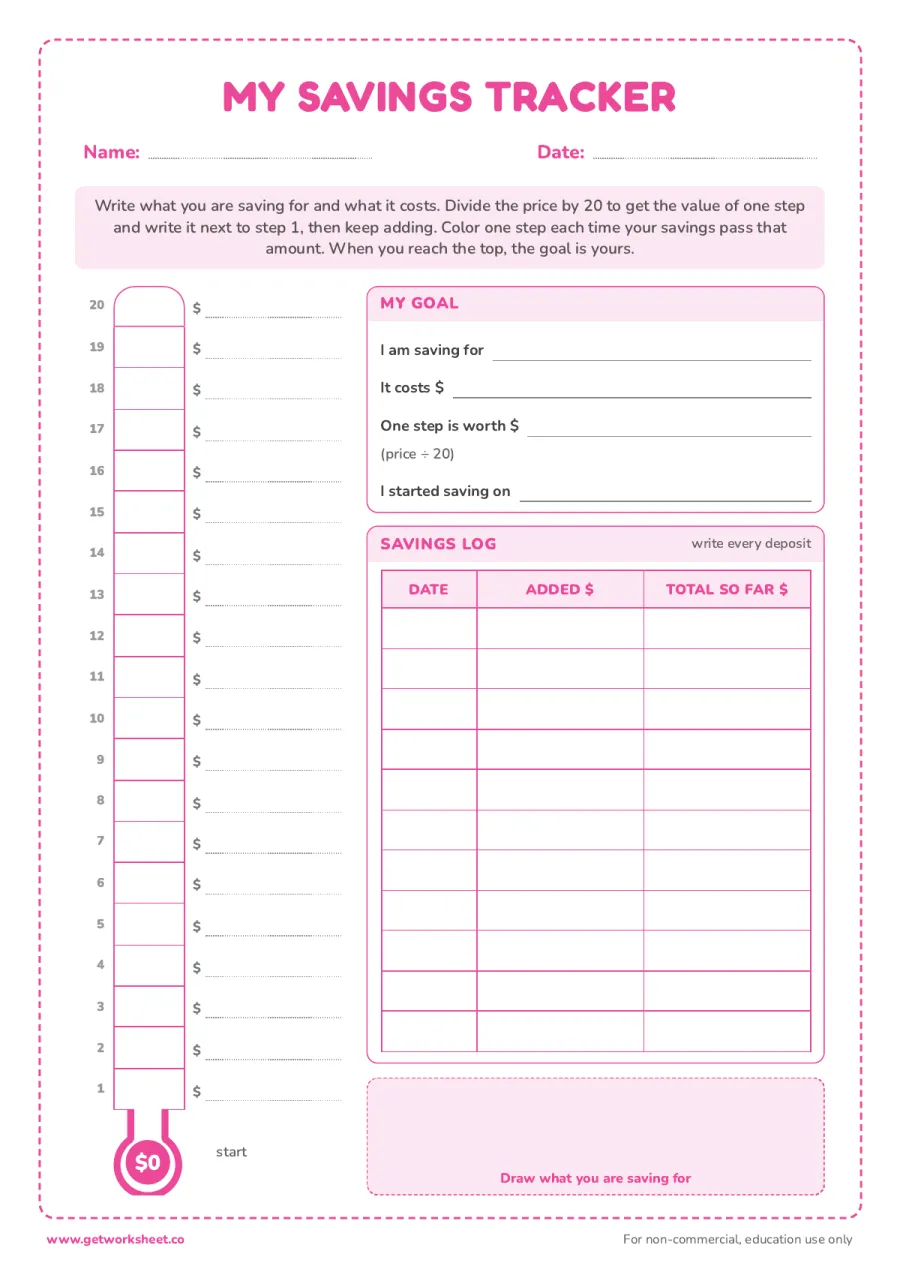
Savings tracker thermometer: 20 steps to my goal
A 20-step color-in savings thermometer with an amount line beside every step, a goal box (item, price, value of one step, start date), an eleven-row savings log and a drawing box. Free printable PDF, A4 and US Letter.
Whole set
All 6 in one PDF
- Every sheet on this page, one file
- No ads, no countdowns, print as often as you like
- Instant download, ad-free, no account needed
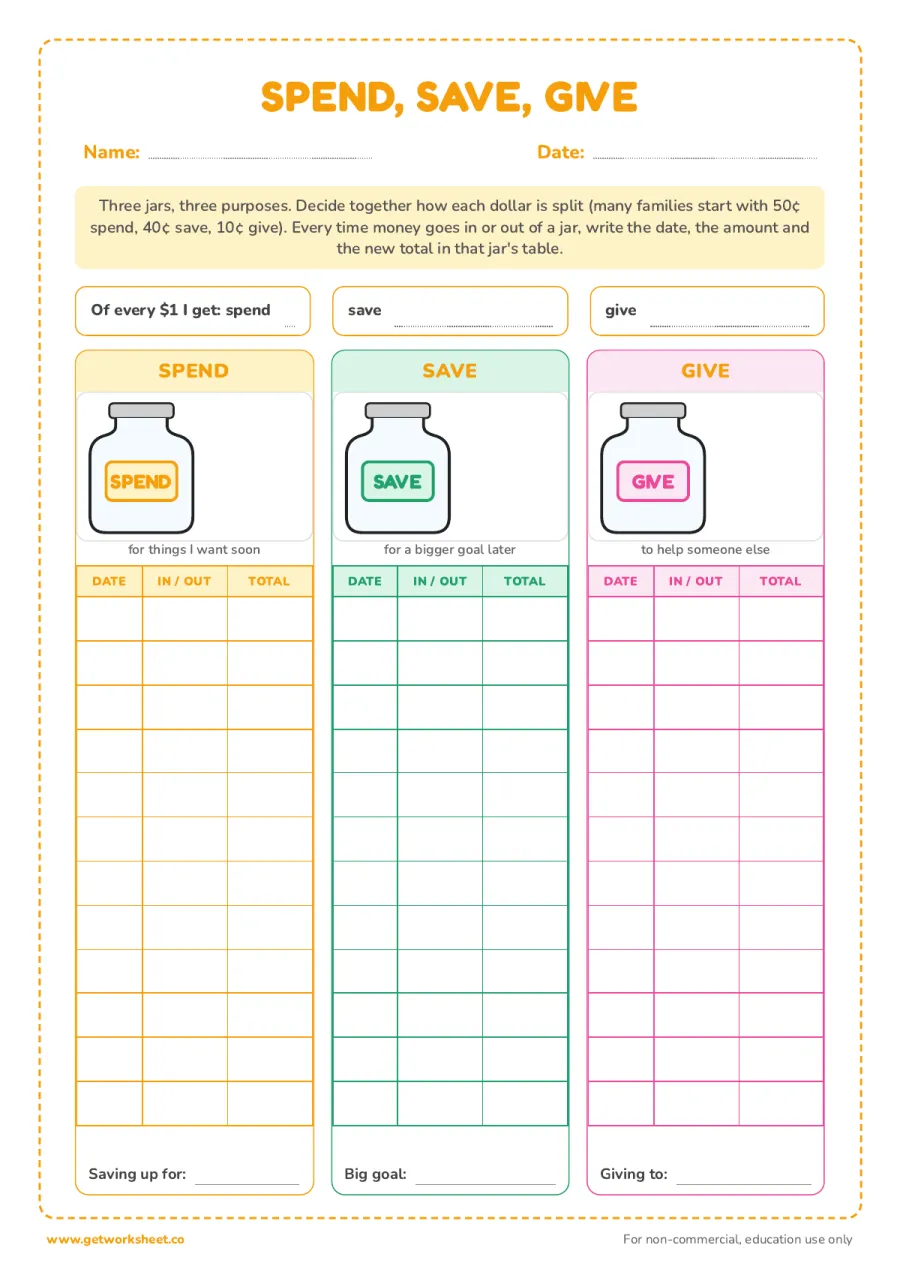
Spend, save, give jars with running totals
Three jar columns (spend, save, give), each with a nine-row date / in-out / total table and a goal line, plus a line for how every dollar is split. Free printable PDF, A4 and US Letter.
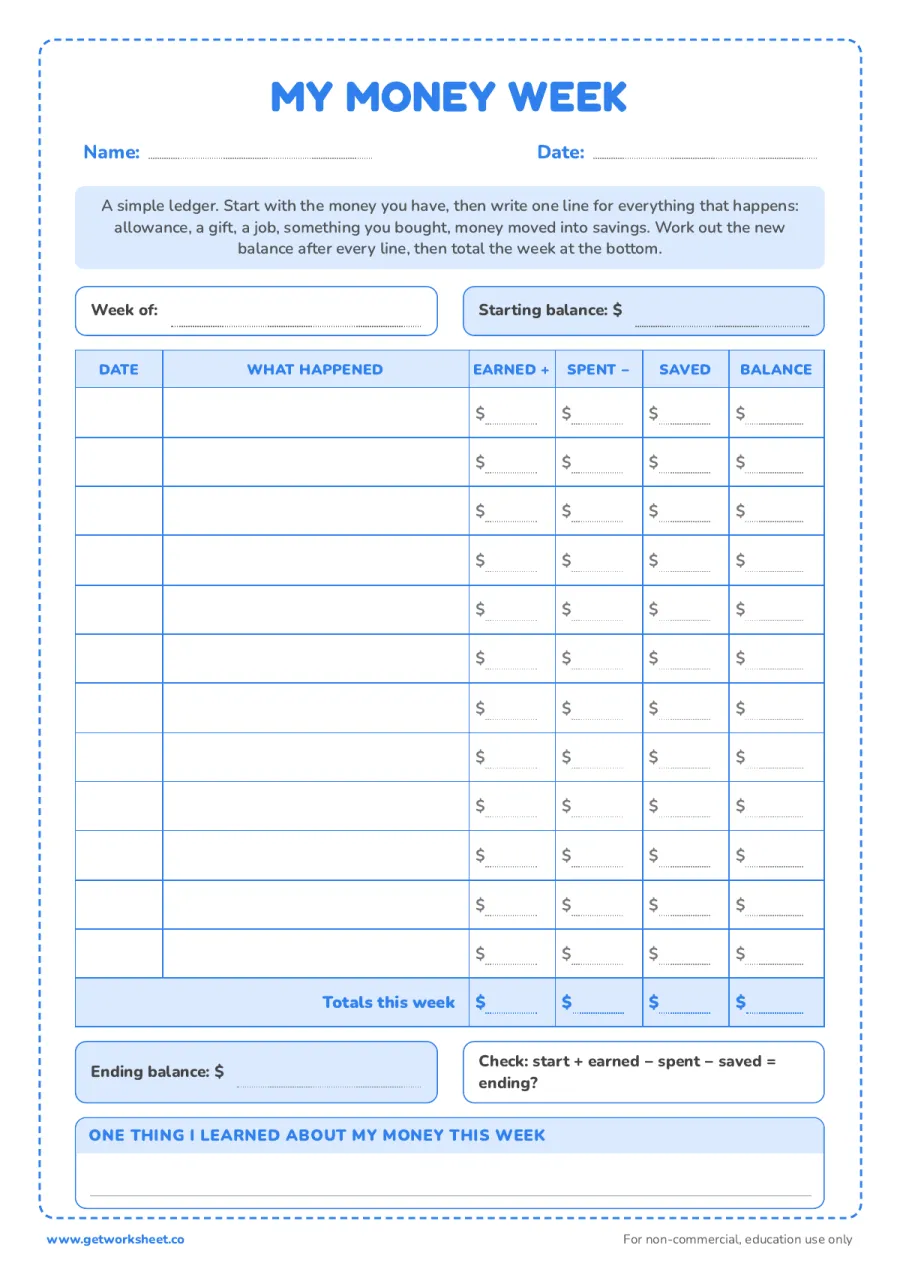
My money week: a ledger for kids
A twelve-row ledger with date, what happened, earned, spent, saved and balance columns, a totals row, starting and ending balance lines and a reflection line. Free printable PDF, A4 and US Letter.
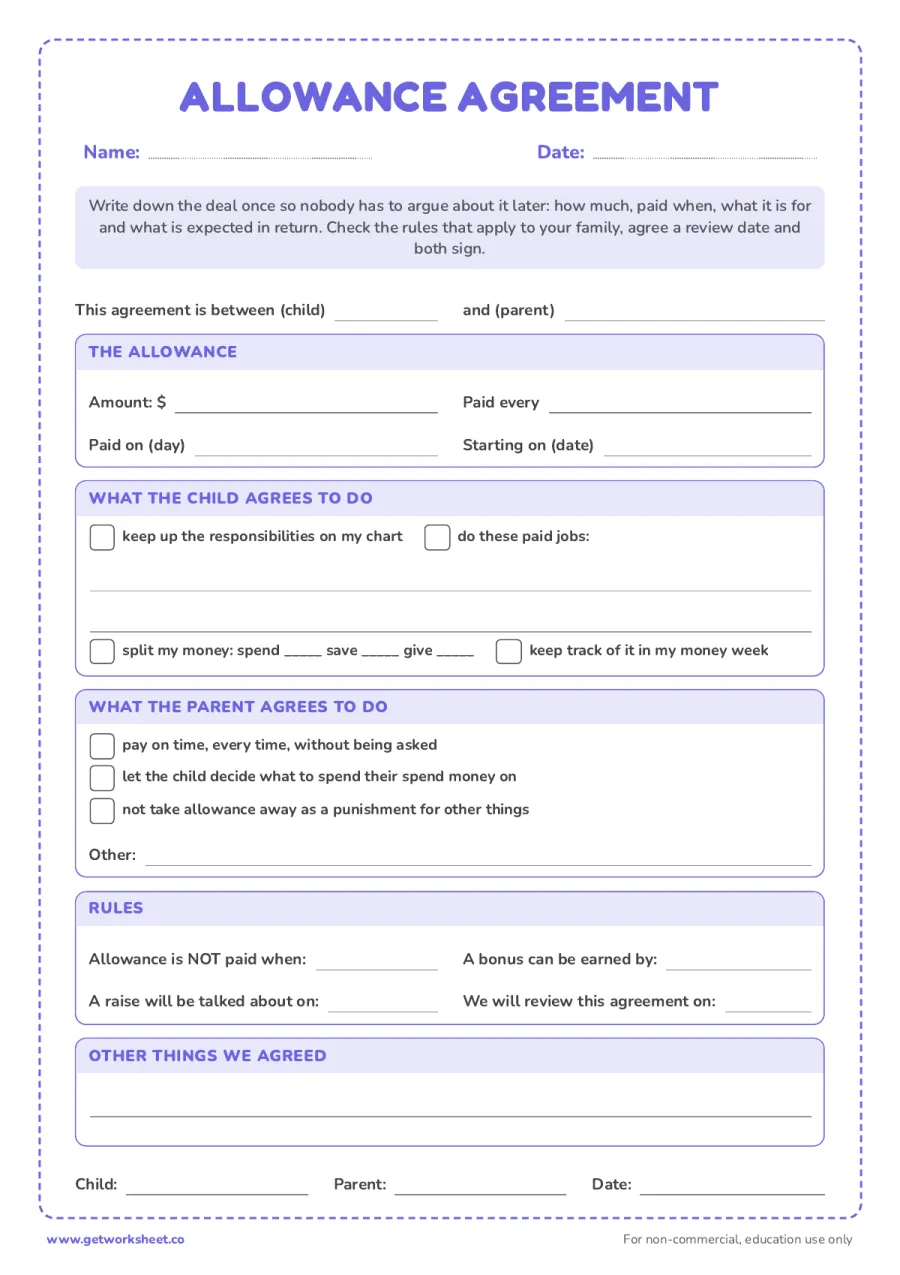
Allowance agreement between child and parent
A one-page contract: amount, how often and when it is paid, what the child agrees to do, what the parent agrees to do, rules (not paid when, bonus, raise, review date) and signatures. Free printable PDF, A4 and US Letter.
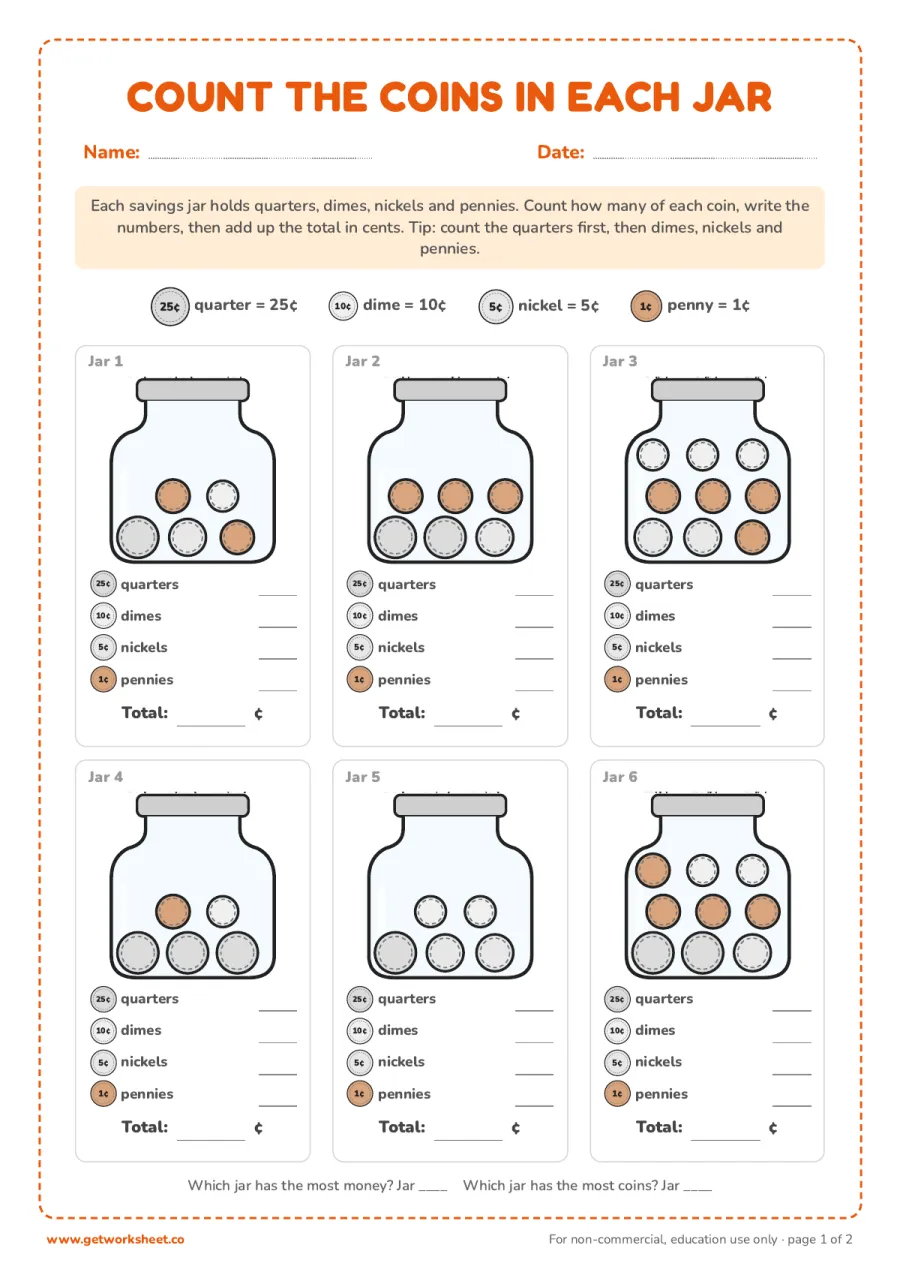
Count the coins in each savings jar
Six savings jars holding quarters, dimes, nickels and pennies: write how many of each coin and the total in cents (42¢ to 86¢), then say which jar holds the most money. Answer key on page 2. Free printable PDF, A4 and US Letter.
AI worksheet generator
Make a worksheet like this for your class
The 6 sheets above are fixed. The generator writes a new allowance and savings tracker printables worksheet for your grade, with the question types and count you choose, in about 20 seconds. Pick a grade to start:
What you get
- A fresh set of questions on allowance and savings tracker printables, not a copy of the sheets above
- Multiple choice, fill in the blanks, true or false, open ended
- Answer key and print-ready PDF with Pro
Free account, 1 worksheets a week. No card.
An allowance teaches more when it is written down. These six printables take a child from the first week of pocket money (which jobs pay, how much, when) through saving for something they want, splitting money between spend, save and give, and keeping a simple ledger. The agreement page settles the rules once so they do not get re-negotiated every Saturday, and the coin-counting page gives younger children a reason to handle real quarters, dimes, nickels and pennies. Everything prints in black and white and the amounts are left blank, so the pages work at 50 cents a job or 5 dollars a week.
What's in this set
- Allowance chart. Eight rows of jobs that earn money (six ideas printed, two blank, each with a dotted line to write your own), a "pays" column, Monday to Sunday check boxes, a times-done column, an earned column and a weekly total, plus base allowance, jobs and paid-on lines.
- Savings tracker thermometer. A 20-step thermometer to color in, with a dollar line beside every step, a goal box (what I am saving for, what it costs, the value of one step, the start date), an eleven-row savings log and a box to draw the goal.
- Spend, save, give jars. Three jar columns, each with a twelve-row date / in-out / total table and a goal line, under a strip for how every dollar is split.
- My money week ledger. Twelve rows with date, what happened, earned, spent, saved and balance, a totals row, starting and ending balance lines, a check line (start + earned − spent − saved = ending) and a one-line reflection.
- Allowance agreement. A one-page contract: the amount, how often and on what day, what the child agrees to do, what the parent agrees to do, the rules (when it is not paid, how to earn a bonus, when a raise is discussed, when the deal is reviewed) and signatures.
- Count the coins in each jar. Six savings jars drawn with quarters, dimes, nickels and pennies inside. Count each coin, write the totals (42¢ to 86¢) and say which jar holds the most money and the most coins. Answer key on page 2.
What children practice
- Connecting work to pay: checks x rate = earned, totaled over a week
- Setting a savings goal, dividing a price into equal steps and tracking progress toward it
- Splitting income into spend, save and give, and keeping a running total for each
- Keeping a ledger: adding income, subtracting spending, carrying a balance
- Identifying US coins and counting mixed coins to a dollar (1.MD.C, 2.MD.C.8)
- Reading and keeping a written agreement
Free printable makers
Make your own allowance and savings tracker printables sheets
Type your own words or numbers and print in about 30 seconds. No account, no AI, answer key where it applies.
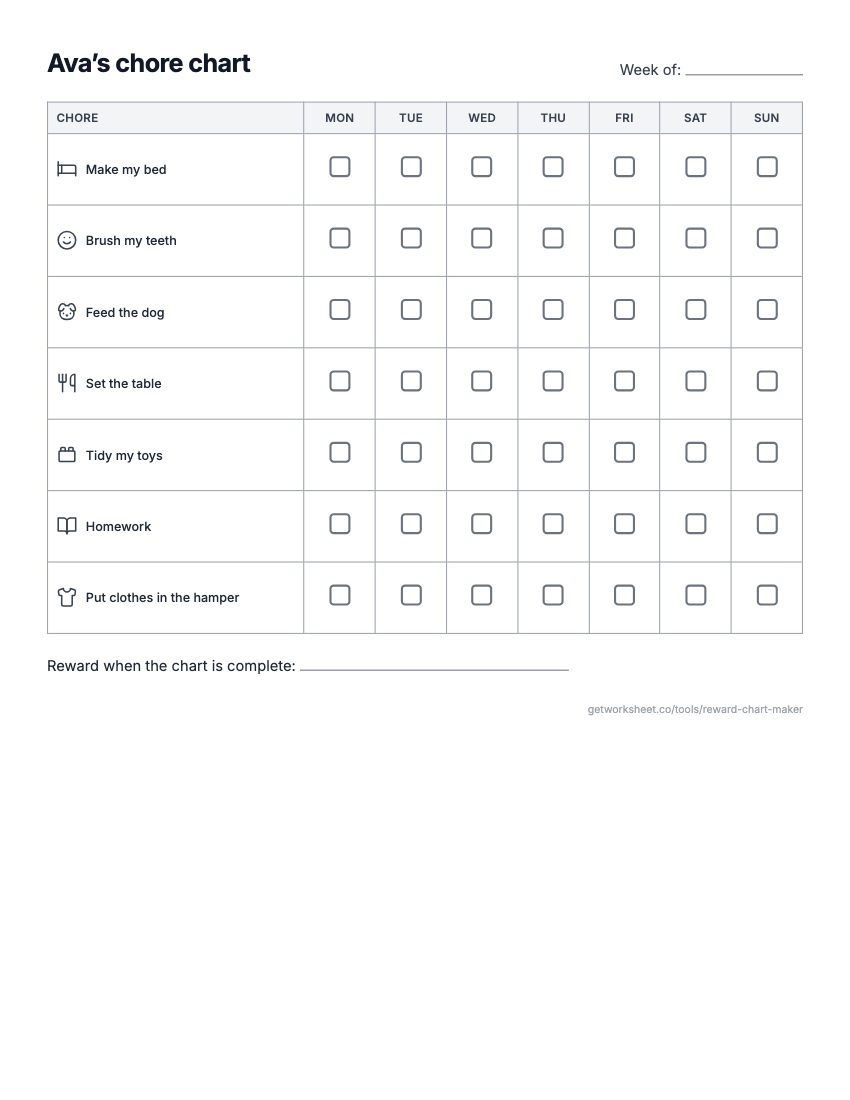 Reward chart and chore chart makerReward or sticker chart with a goal, Mon-Sun chore chart with pictures, behavior chart. Free to print.
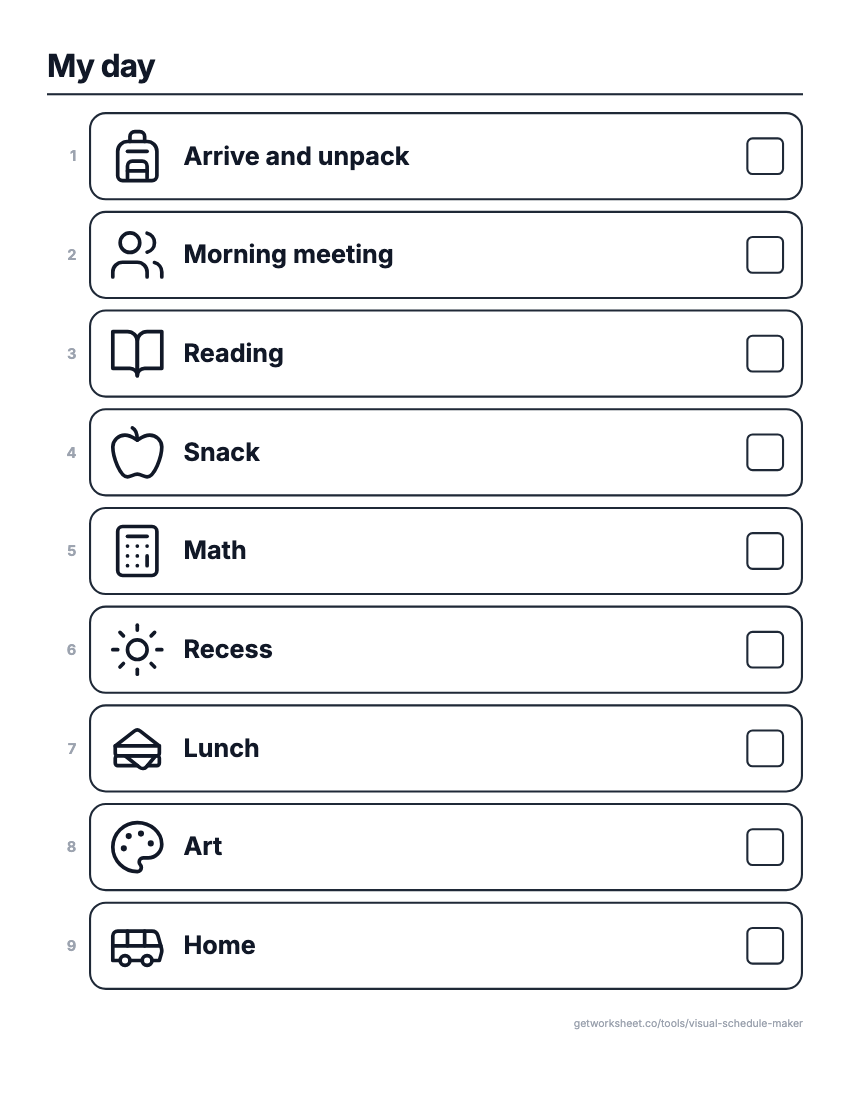 Visual schedule makerPicture schedules, First/Then and token boards. Free to print.
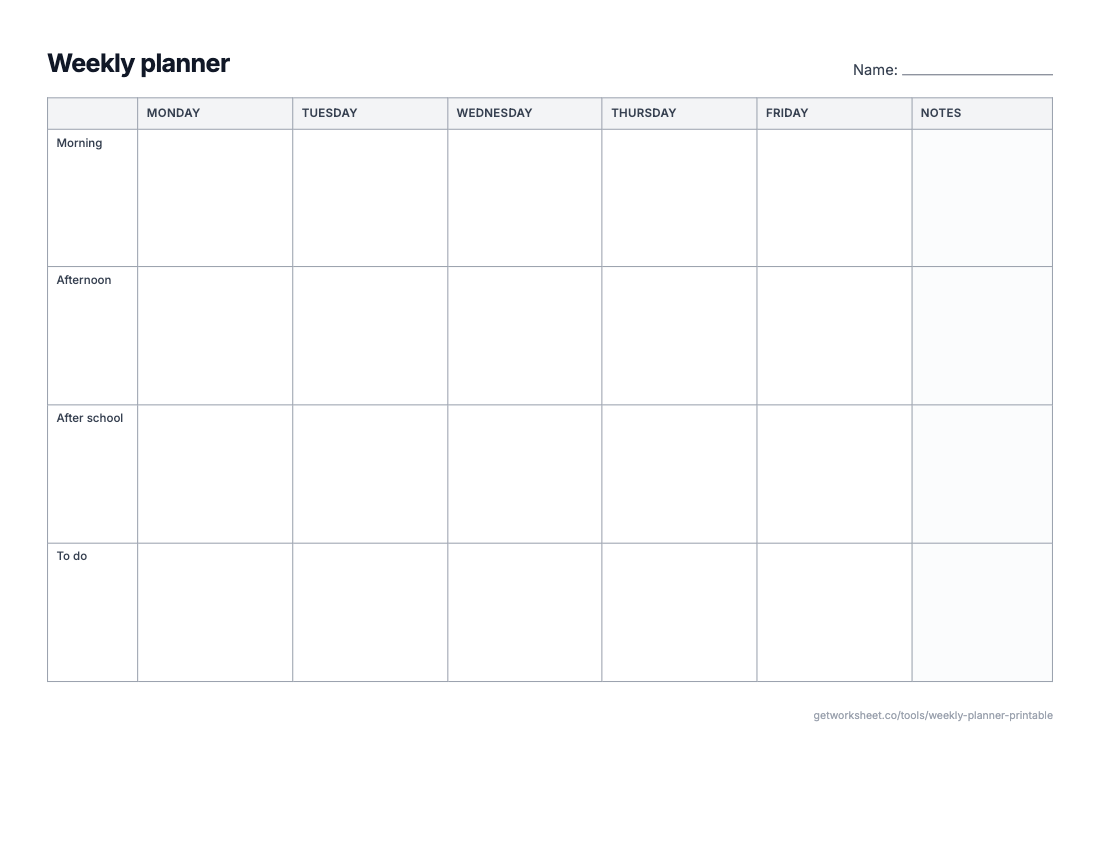 Weekly planner and calendar makerWeekly planner, monthly calendar, daily schedule or lesson-plan grid on one sheet. Free to print.
AI worksheet generator
Need a different allowance and savings tracker printables worksheet?
Generate a custom allowance and savings tracker printables worksheet: pick the grade, question types and count, and print it in about 20 seconds. Free accounts get 1 generation a week.
Teaching tips and common mistakes
How to use these printables
Print at 100% on A4 or US Letter. Most families use two or three of the six: the allowance chart and the thermometer for a child just starting out, the ledger and jars once they have money moving in and out, the agreement whenever the rules change. Teachers can use the ledger, jars and coin page as a financial literacy unit.
- Allowance chart. Decide first which jobs are paid and which are just part of living in the house (the chore charts handle the unpaid ones). Put prices on the paid jobs together, then let the child check the boxes and do the multiplication on allowance day. Pay exactly what the chart says, every time: the chart only teaches if it is honored.
- Savings thermometer. Help the child divide the price by 20 on a calculator and write that value next to step 1, then add it on for each step up (a $40 goal is $2 a step). Color a step when the total in the log passes that line. For a goal under $20, divide by 10 instead and color two steps at a time.
- Spend, save, give jars. Use three real jars or envelopes with the page beside them. Agree the split and write it at the top; 50 / 40 / 10 is a common start. Every time money moves, the child writes the line and the new total before closing the jar.
- Money week ledger. Fill in the starting balance on Monday, then one line per event through the week. On Sunday do the check line together: if start + earned − spent − saved does not equal the ending balance, hunt for the missing line. This is the whole habit of bookkeeping in one page.
- Allowance agreement. Sit down once, fill it in, both sign, and put it on the fridge next to the chart. The two most useful lines are "allowance is not paid when" and "we will review this on": a review date in three months means neither side has to re-open the deal before then.
- Coin counting. Younger children can lay real coins on the drawings as they count. Count quarters first, then dimes, nickels and pennies, writing each count before adding. The key on page 2 lets a child check their own work.
Allowance tied to chores, or not?
Families disagree, and both ways work when they are consistent. The pages are built so you can do either: the allowance chart has a "base allowance" line for money that is not earned by jobs plus rows for jobs that do pay extra, and the agreement has a line for each. Whichever you choose, write it down and stick to it for the length of the agreement.
Frequently asked questions
What age should a child start getting an allowance?
Around 6 or 7, when a child can count coins and understand that money runs out. The coin-counting page and the thermometer suit that age; the ledger and agreement are for 9 and up.
How much allowance is normal?
There is no right number. A common rule is half a dollar to a dollar per week per year of age, but the pages leave every amount blank so they work for any family budget or currency.
Do the pages use dollars?
The lines are marked with a $ sign and the coin page uses US coins (quarter, dime, nickel, penny). The other five pages work for any currency if you ignore or cross out the symbol.
Is there an answer key?
Only the coin-counting page has a key, on page 2 of its PDF, because it is the only page with set answers. The other five are trackers that the child fills in.
Can I print in black and white?
Yes. The coins are labeled with their value (25¢, 10¢, 5¢, 1¢) as well as drawn to size, so they are easy to tell apart in grayscale, and all tables use solid black lines.
More printables
Children who want more coin practice can use the counting money worksheets or make a fresh page with the counting money worksheet generator. The money management worksheets go further into budgets and wants versus needs. For the unpaid jobs that sit beside an allowance, see the chore charts and the reward charts.
Free library
Related collections
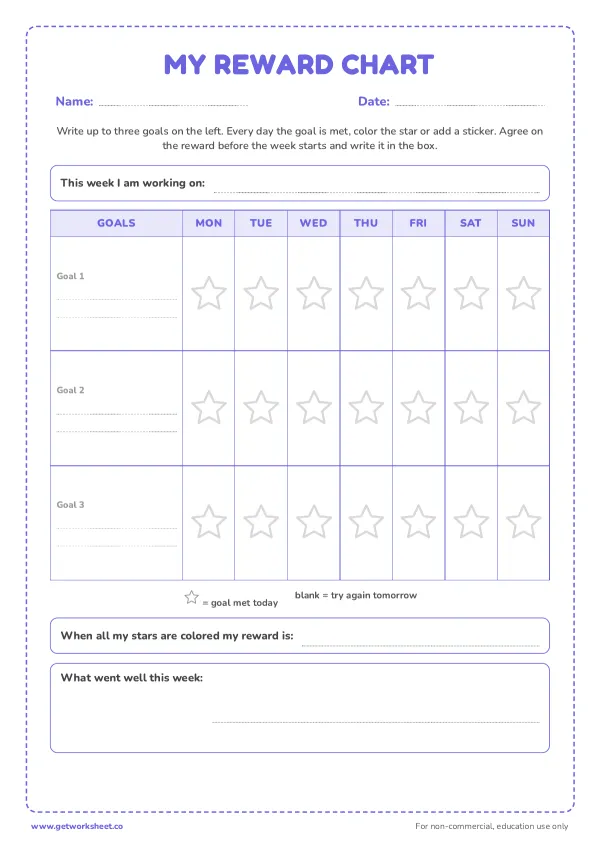
Free reward chart printables
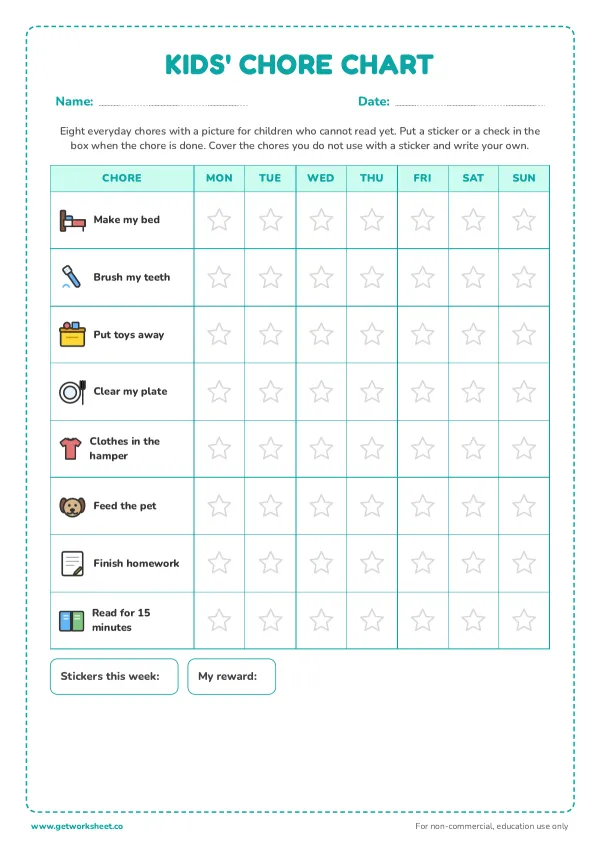
Free chore chart printables
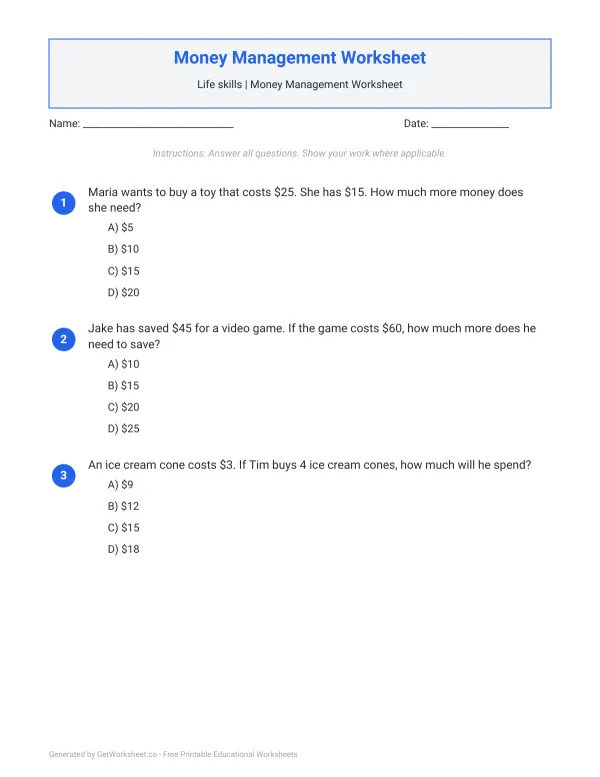
Money Management Worksheets
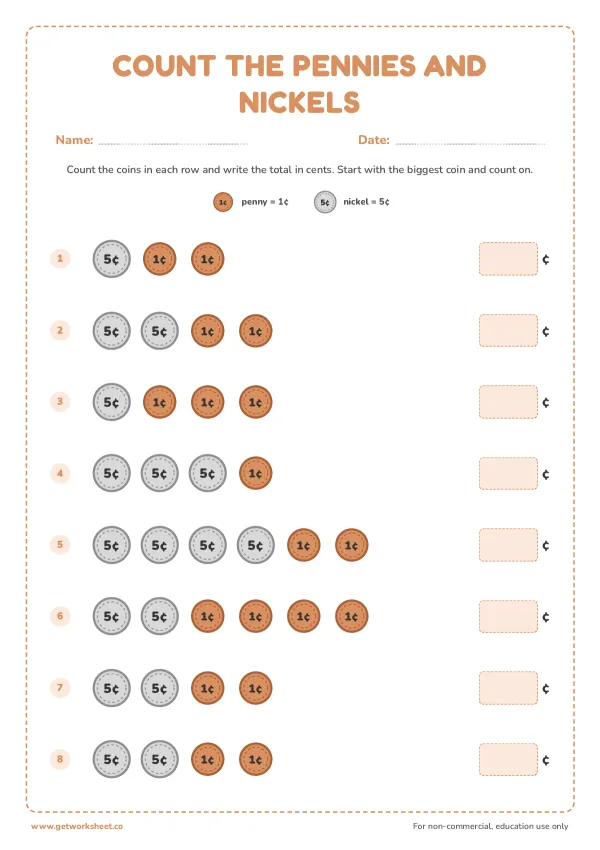
Free counting money worksheets (US coins)
Free boredom busters printables
Free calm-down strategies printables
Free gratitude journal for kids printables
Free lunch box notes printables
More worksheets
- Free daily routine charts for kids
- Free after-school routine chart printables
- Free homework planner printables
- Free screen time chart printables
- Free responsibility chart printables
- Free growth chart printables
- Free daily checklist printables for kids
- Free morning routine chart printables
- Free tooth brushing chart printables
- Free behavior chart printables
- Free feelings chart printables
- Free bedtime routine chart printables