Maths · Preschool–Kindergarten
Free triangle tracing worksheets
Eight triangle tracing worksheets for preschool and kindergarten: large dashed triangles with a start dot, sixteen small, big to small, dot-to-dot, everyday objects to finish and color, plus pizza slices and Christmas trees.
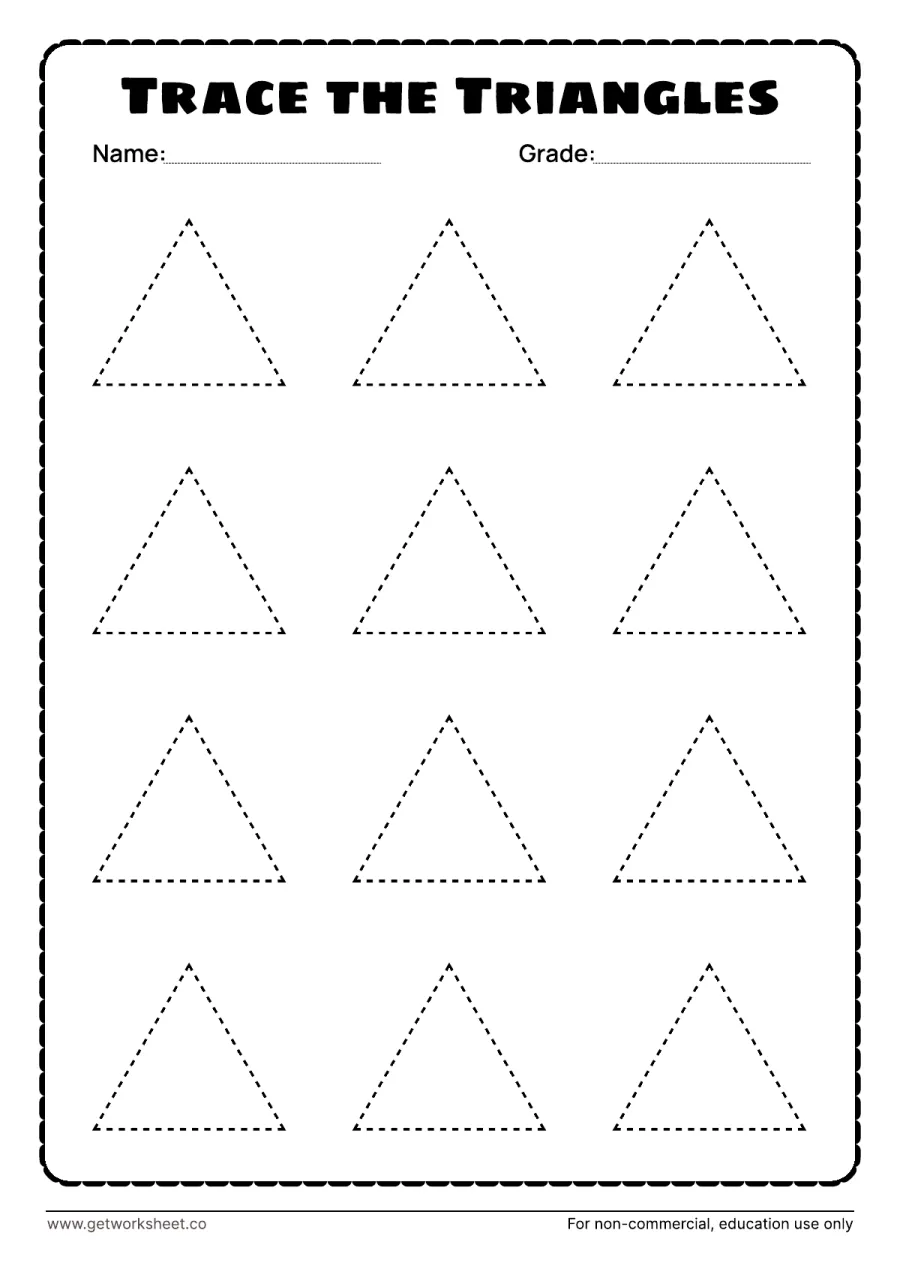
Trace the triangles: 12 plain dotted triangles
Twelve dotted outline triangles in four rows of three, with name and grade lines at the top; child traces each triangle with a pencil or crayon.
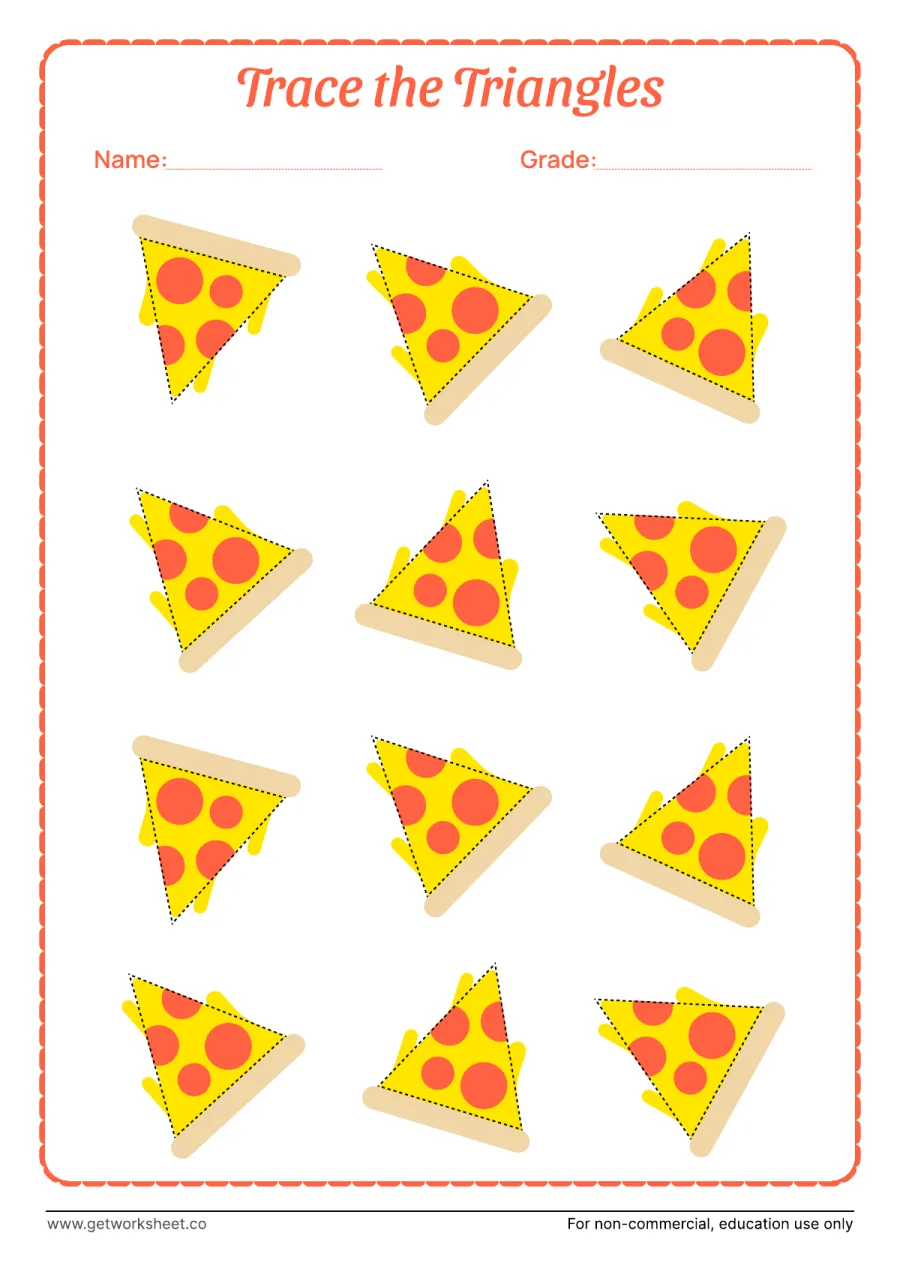
Trace the triangles: 12 pizza slices
Twelve pizza slices with pepperoni and cheese, turned at different angles, each with a dotted triangular outline for the child to trace.
Complete pack
All 8 sheets + 6 bonus sheets in one PDF
Instant and ad-free. No account needed.
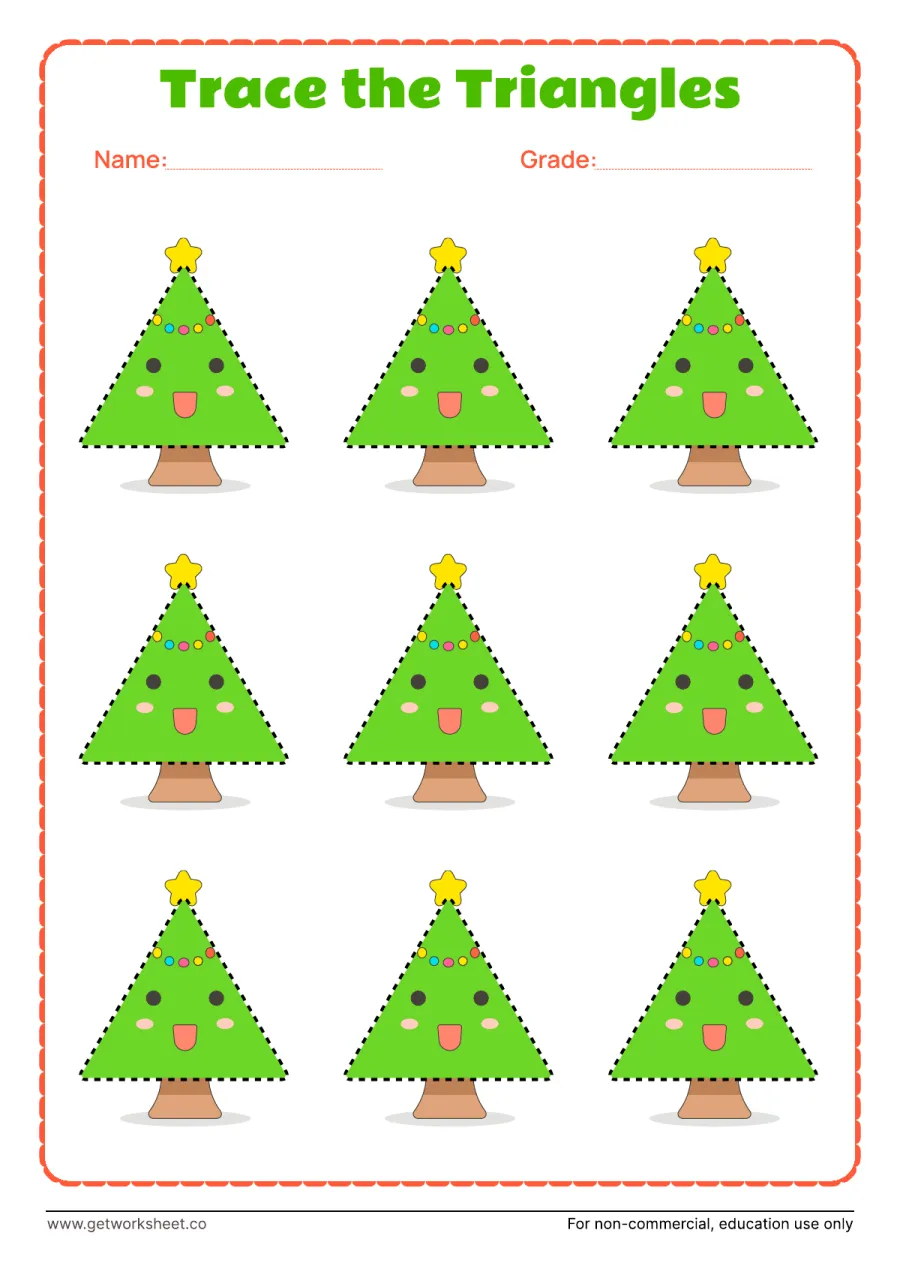
Trace the triangles: 12 Christmas trees
Twelve smiling Christmas trees with a star on top, arranged in four rows of three; child traces the dotted triangle outline around each tree.
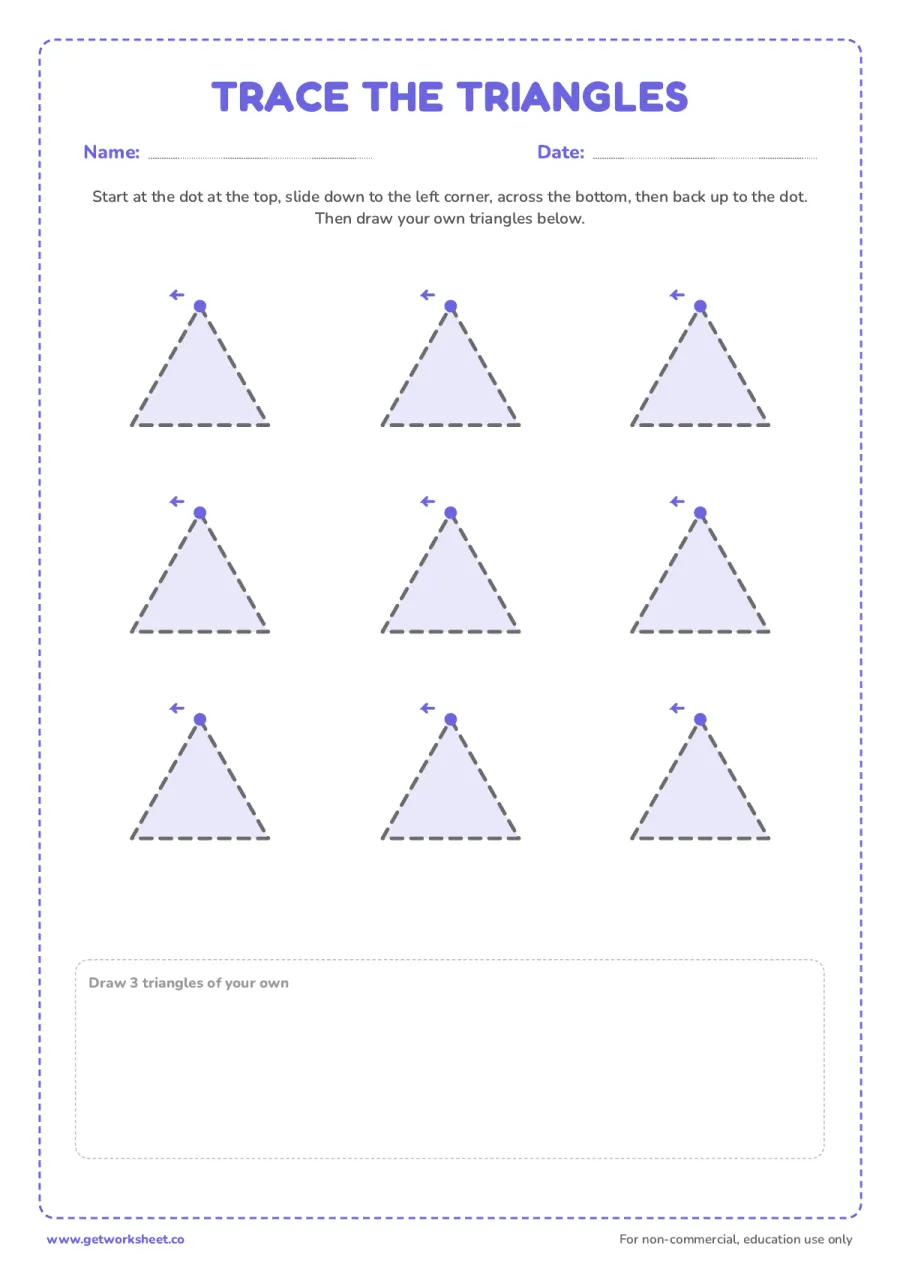
Trace 9 large triangles (start dot and arrow)
Nine big dashed triangles with a start dot and direction arrow, plus a box to draw your own. Best first sheet for age 3 to 4. Free printable PDF.
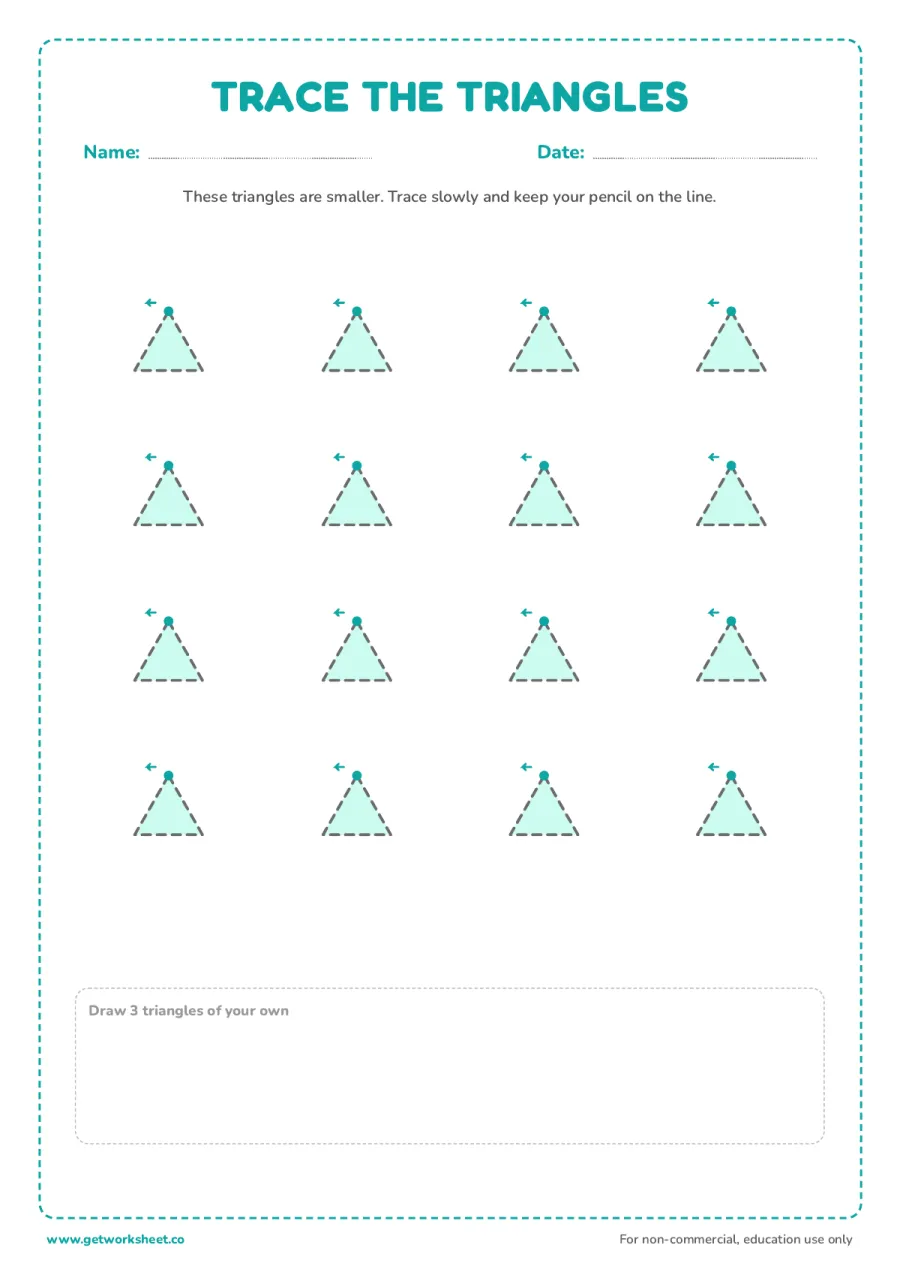
Trace 16 small triangles
Sixteen smaller triangles for more precise pencil control once the large ones are easy. Free printable PDF.
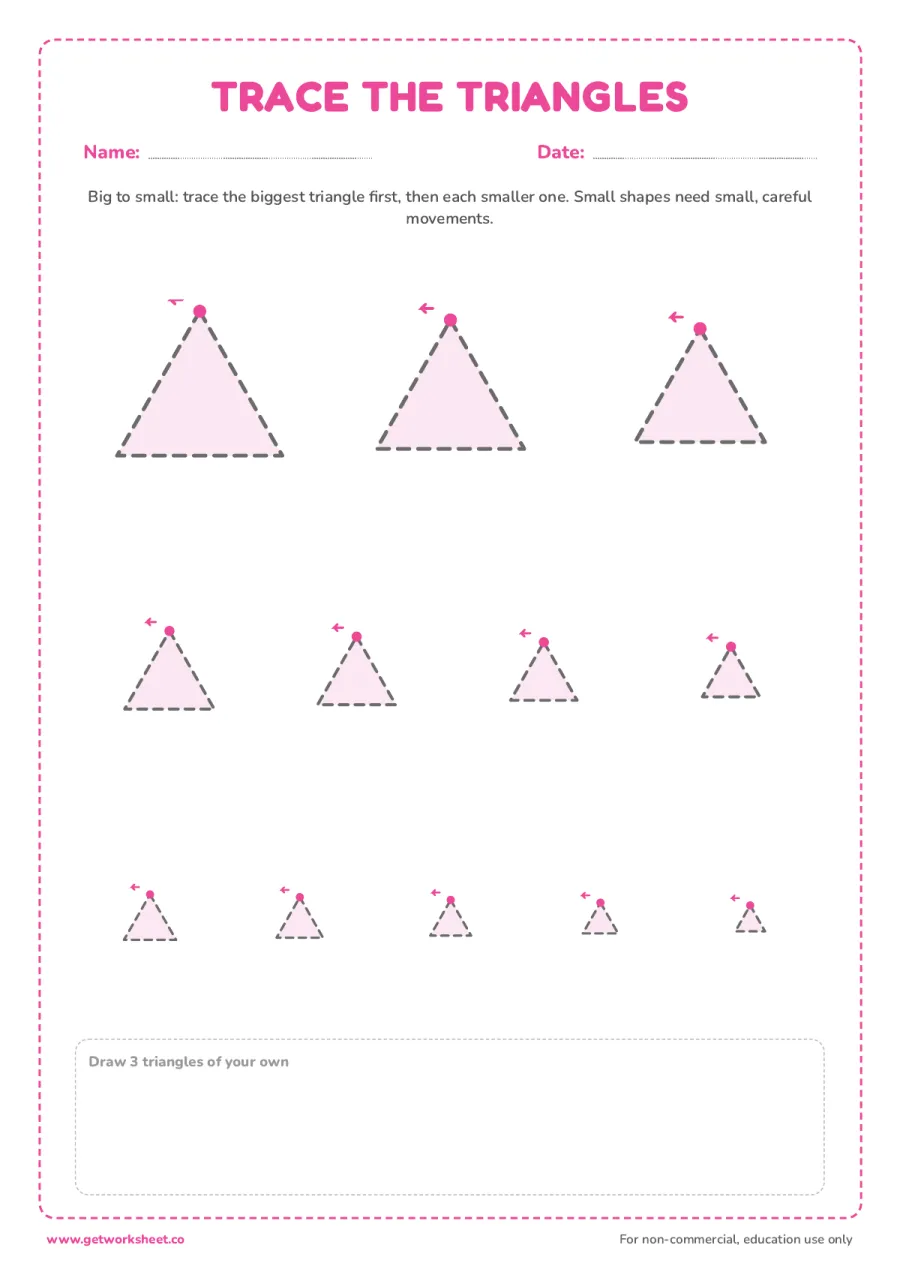
Triangles big to small
Twelve triangles that shrink row by row, from very large to tiny. Builds control of movement size. Free printable PDF.
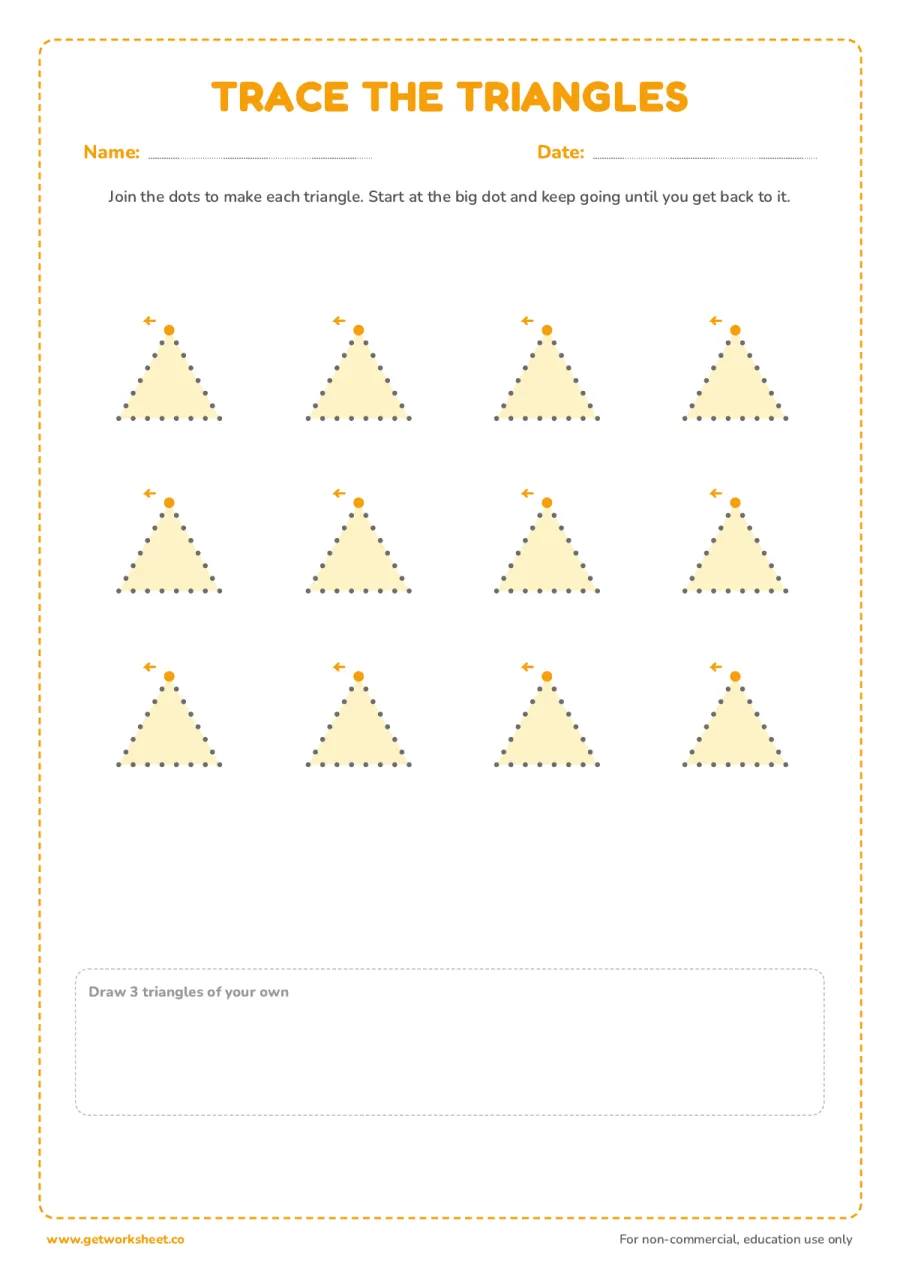
Dot-to-dot triangles
Twelve triangles drawn as dots instead of dashes: a lighter guide for children ready to draw the shape almost by themselves. Free printable PDF.
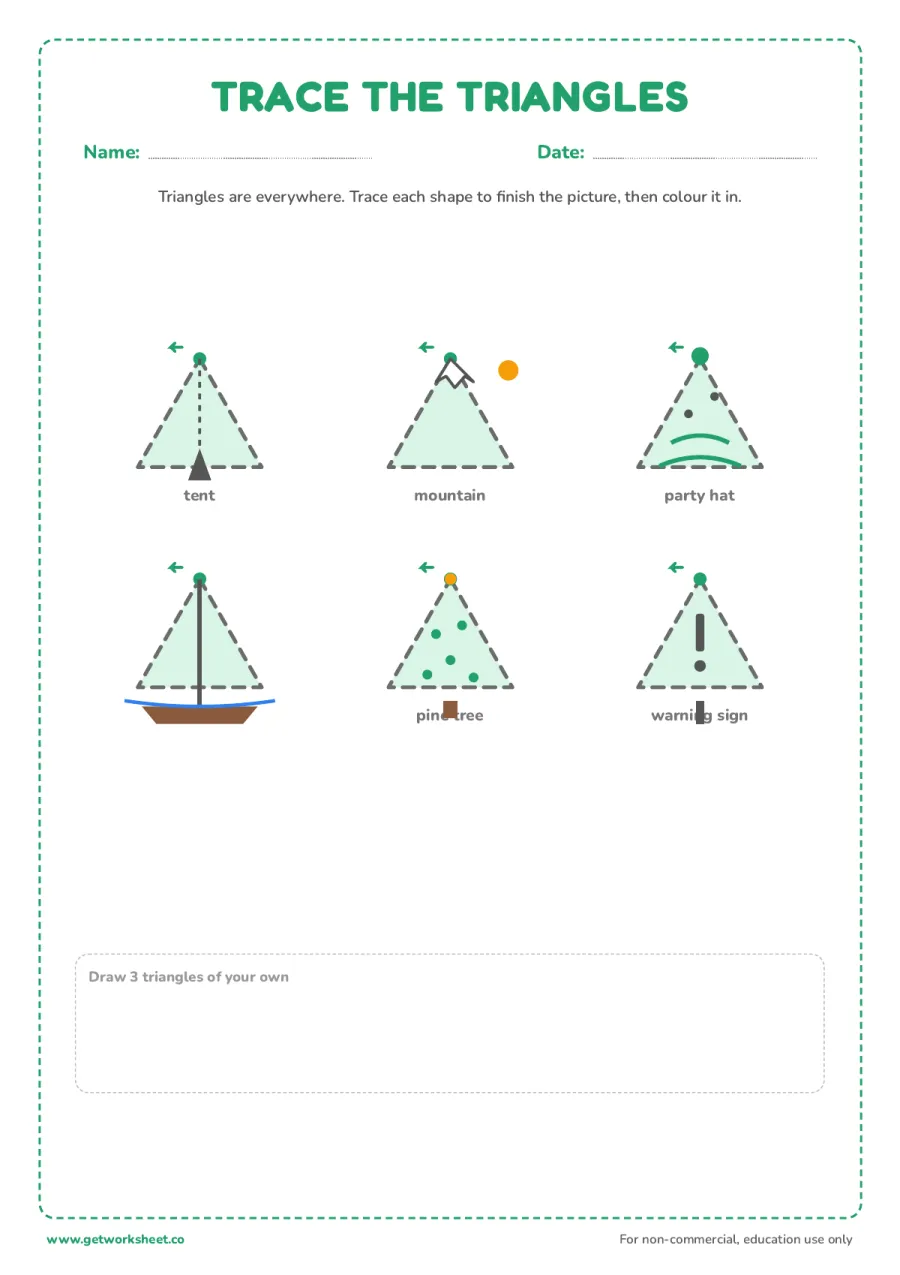
Triangles all around us: trace and colour
Trace the triangle to finish a tent, mountain, party hat, sail, pine tree and warning sign, then colour. Free printable PDF.
AI worksheet generator
Make a worksheet like this for your class
The 8 sheets above are fixed. The generator writes a new triangle tracing worksheet for your grade, with the question types and count you choose, in about 20 seconds. Pick a grade to start:
What you get
- A fresh set of questions on triangle tracing, not a copy of the sheets above
- Multiple choice, fill in the blanks, true or false, open ended
- Answer key and print-ready PDF with Pro
Free account, 1 worksheets a week. No card.
These eight triangle tracing worksheets run from big dashed triangles with a start dot to pictures to trace and color. The three picture sheets each give the child 12 triangles to trace. The first sheet has 12 plain dotted triangles in four rows of three, with name and grade lines at the top. The second turns each triangle into a pizza slice with pepperoni and cheese, with the slices turned at different angles so the child traces triangles pointing in different directions. The third has 12 smiling Christmas trees with a star on top, again in four rows of three, with a dotted triangle outline around each tree.
Triangles are harder to draw than circles or squares because they need three straight diagonal lines that meet at sharp corners. Tracing a dotted outline lets a preschooler feel that movement before drawing it freehand, and the same diagonal strokes turn up later in letters such as A, V and W. Start with the plain sheet, then use the pizza and tree sheets when the child wants a picture to color afterwards.
Five more sheets, in teaching order
- Trace 9 large triangles. Big dashed triangles with a start dot at the top and an arrow, plus a box to draw your own. Best first sheet for ages 3 to 4.
- Trace 16 small triangles. Smaller shapes for more precise pencil control once the large ones are easy.
- Triangles big to small. Twelve triangles that shrink row by row, building control of movement size.
- Dot-to-dot triangles. Triangles drawn as dots instead of dashes, a lighter guide for children nearly ready to draw the shape alone.
- Triangles all around us. Trace the triangle to finish a tent, mountain, party hat, sail, pine tree and warning sign, then color.
What Students Will Practice
- Tracing dotted triangle outlines with a pencil or crayon, 12 on each sheet
- Drawing straight diagonal lines that meet at three corners
- Tracing triangles turned at different angles on the pizza slice sheet
- Recognizing the triangle inside everyday pictures such as a pizza slice and a Christmas tree
- Working steadily through four rows of three, then coloring the finished pictures
Free printable makers
Make your own triangle tracing sheets
Type your own words or numbers and print in about 30 seconds. No account, no AI, answer key where it applies.
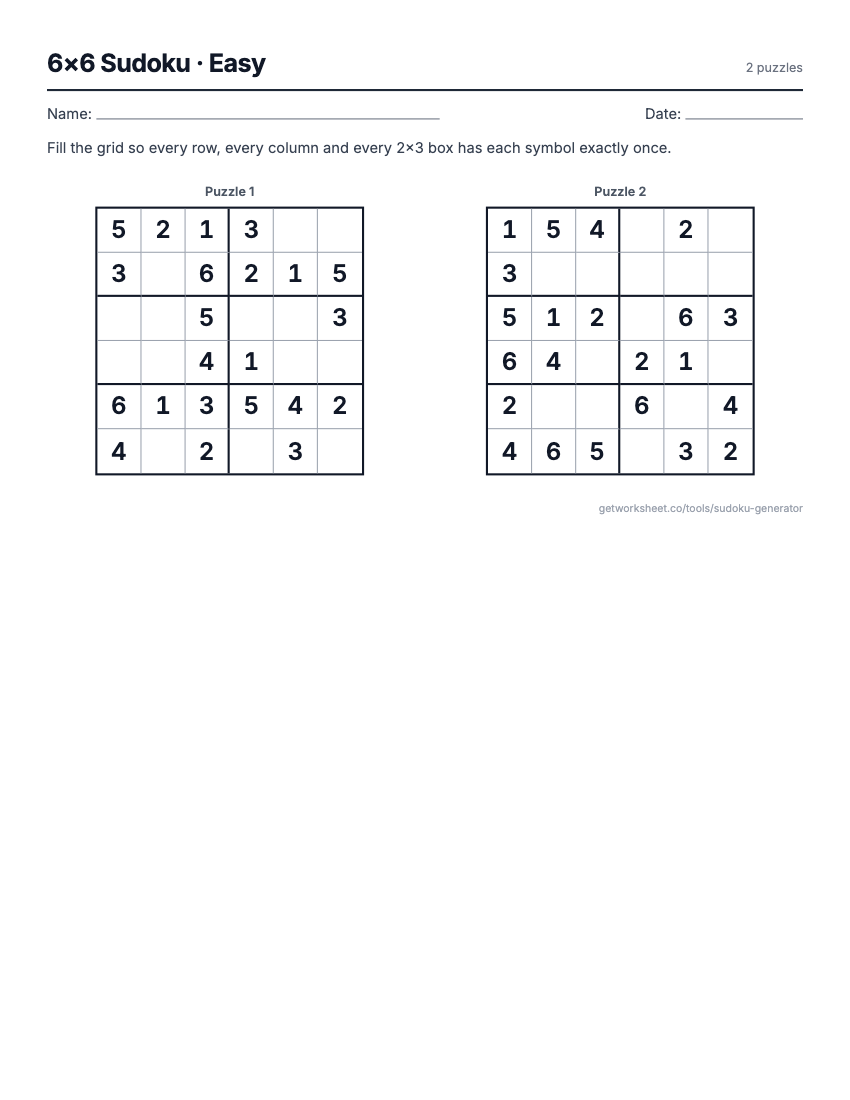 Sudoku generator4x4, 6x6 and 9x9 sudoku with numbers, letters or shapes, one solution each. Free to print.
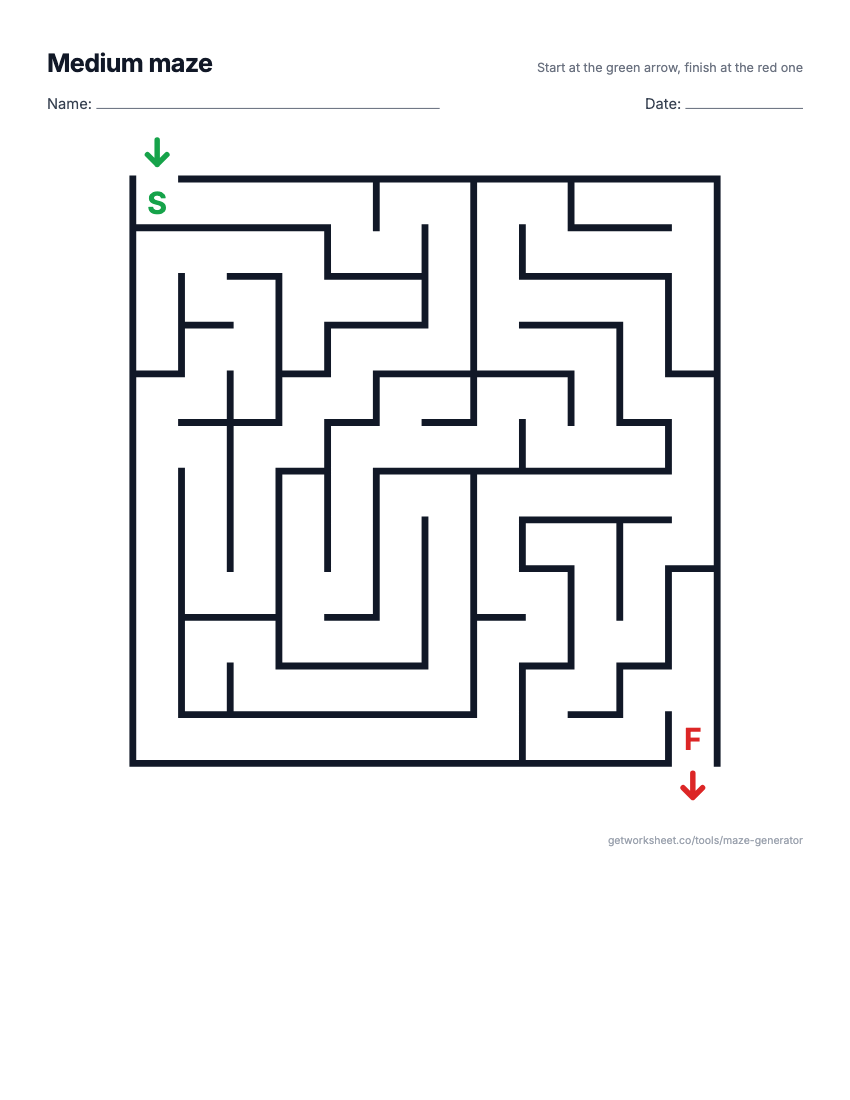 Maze generatorEasy to expert mazes, square or circle, with a solution page. Free to print.
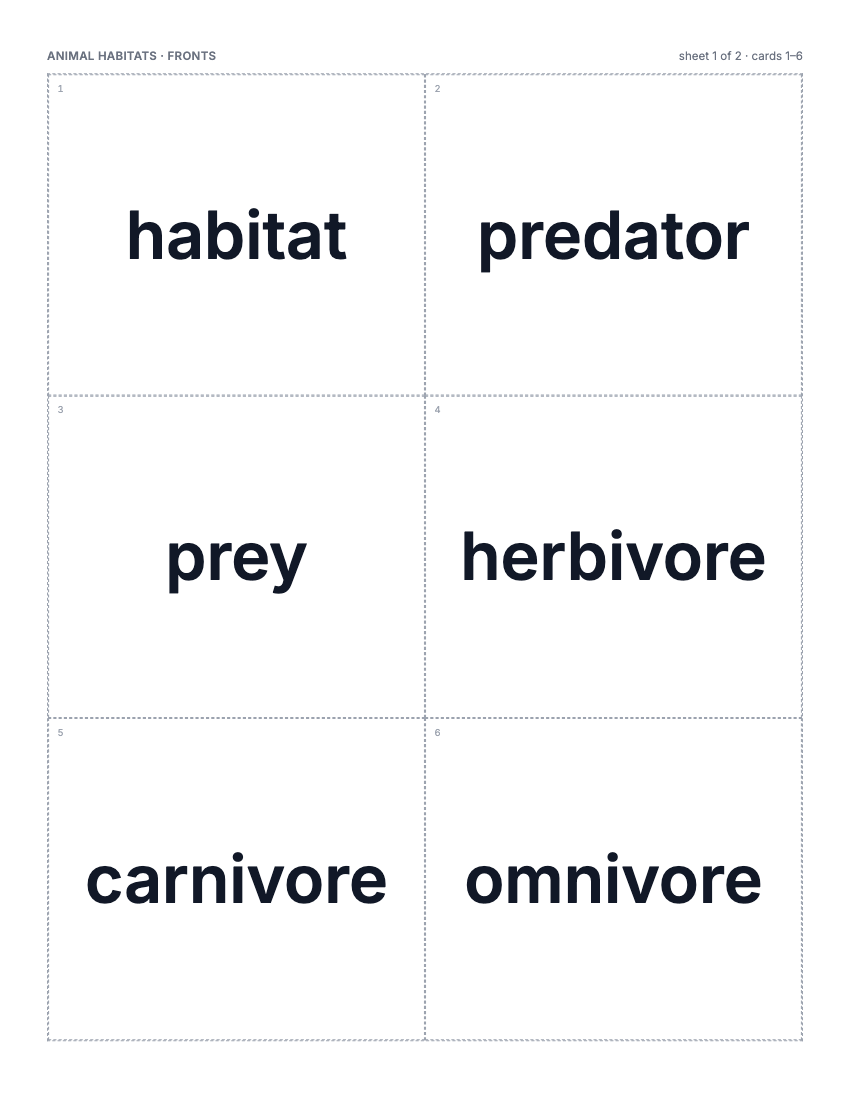 Flashcard makerVocabulary, math fact or sight word cards, 2-8 a page, two-sided or fold-over. Free to print.
AI worksheet generator
Need a different triangle tracing worksheet?
Generate a custom triangle tracing worksheet: pick the grade, question types and count, and print it in about 20 seconds. Free accounts get 1 generation a week.
Complete pack · $1.99
All 8 sheets above, plus 6 bonus sheets you will not find on this page
8 free sheets + 6 bonus sheets in one print-ready PDF with a contents page. Instant, no ads, no account; the link is emailed to you so it works on any device. The 8 sheets above stay free.
- BonusRows of triangles: 4 to 8 a row
- BonusTrace and count the triangles (2 to 7)
- BonusTriangles pattern strips
- BonusDraw your own triangles (fading guide)
- BonusTrace the triangles and write the word
- BonusTrace 9 diamonds: two triangles together
One-time payment of $1.99. Card, Apple Pay or Google Pay. For home and classroom use.
- Bonus
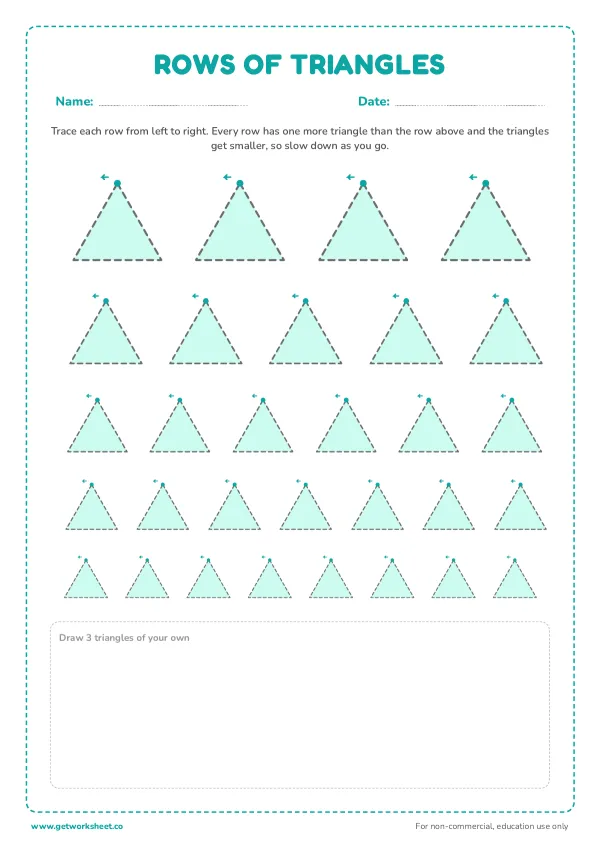 Rows of triangles: 4 to 8 a row
 - Bonus
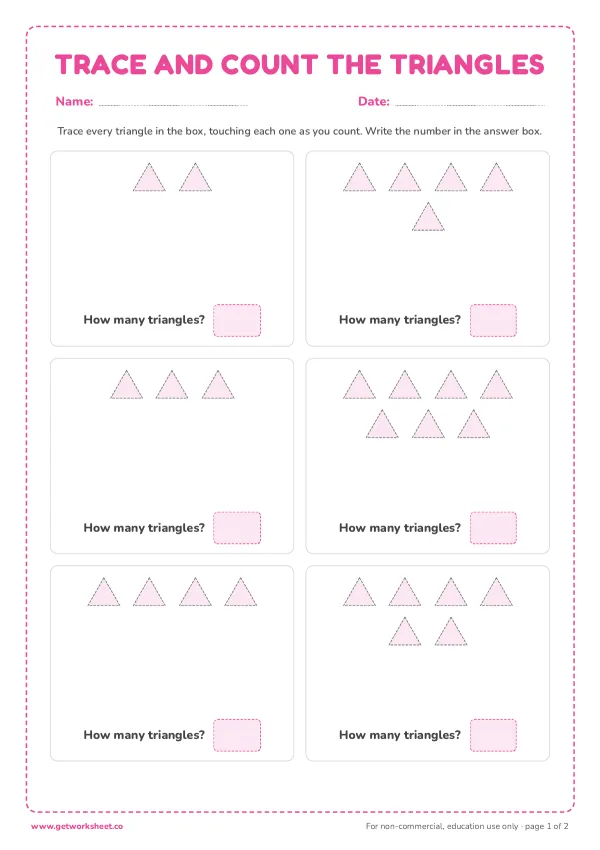 Trace and count the triangles (2 to 7)
 - Bonus
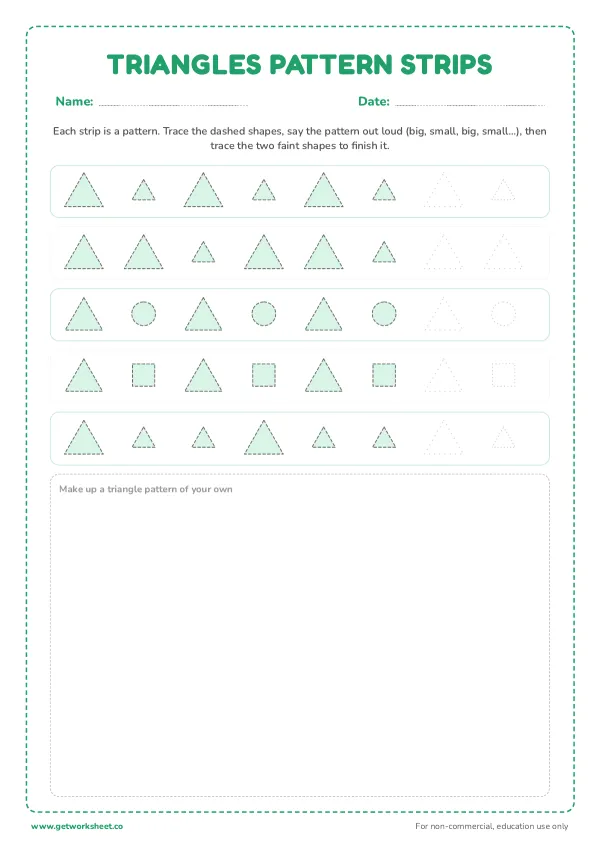 Triangles pattern strips
 - Bonus
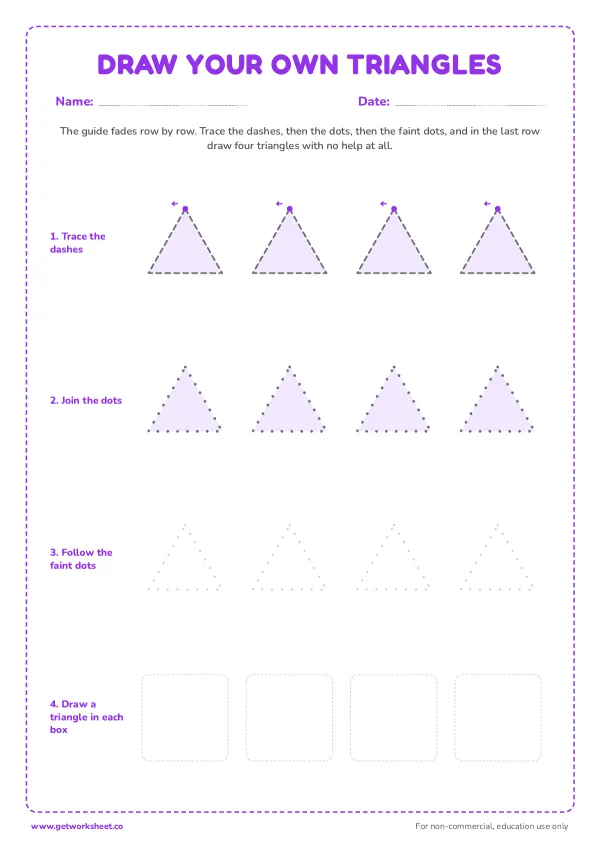 Draw your own triangles (fading guide)
 - Bonus
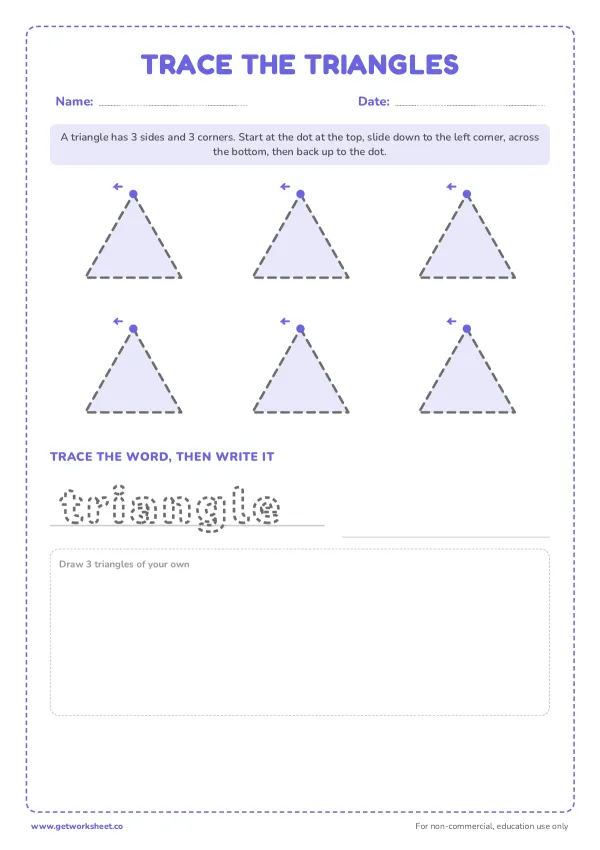 Trace the triangles and write the word
 - Bonus
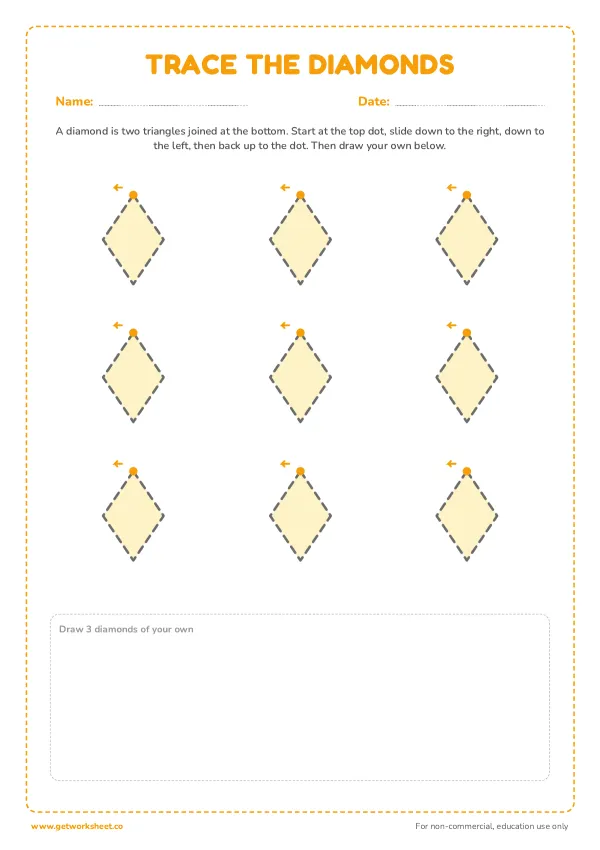 Trace 9 diamonds: two triangles together
How to use these worksheets
Print at 100% on A4 or US Letter so the dashed outlines stay the size a small hand can manage. One sheet per sitting is plenty: five to ten minutes with a chunky pencil or crayon. Print two copies of whichever sheet you are on, because the first attempt is rarely the neat one.
- Trace 9 large triangles. Start here at ages 3 to 4. Pencil on the start dot, follow the arrow, count the three strokes out loud. Leave the draw your own box until last.
- Trace 16 small triangles. Move on when the large shapes are easy. Ask for the pencil to stop dead at each corner instead of rounding it off.
- Triangles big to small. Work row by row from the top. The shrinking shapes make the child scale the same movement down, so do not skip to the tiny row.
- Dot-to-dot triangles. This is the step before freehand. If lines wander, have the child touch all three dots with a fingertip first.
- 12 plain dotted triangles. Four rows of three is a test of stamina. Fill in the name and grade lines, work left to right, and date the sheet to compare with a later copy.
- 12 pizza slices. The slices point different ways. Turn the paper for the first two, then ask the child to keep the page still and move the hand. Color the pepperoni after all twelve are traced.
- 12 Christmas trees. The star on top gives an obvious place to begin each outline. Trace first, color second, or the tracing never gets finished.
- Triangles all around us. Finish with this one. Name the tent, mountain, party hat, sail, pine tree and warning sign, then ask where else that shape turns up at home.
Common mistakes to watch for
- Curved sides. A side bows out when the hand swings from the elbow. Slow the stroke down and ask for three separate lines instead of one loop.
- Open corners. Children stop short and leave a gap. The last line has to come back and touch the start dot.
- Coloring first. On the picture sheets the coloring is the reward, not the task. Keep crayons out of reach until the outlines are done.
- Gripping too hard. A tight fist tires the hand in a minute. A broken crayon or a short pencil forces a lighter three finger hold.
Frequently asked questions
What age are these triangle sheets for?
Ages 3 to 6, so preschool through kindergarten. The large triangles with a start dot work from about three and a half. The dot-to-dot sheet suits a child who is close to drawing a triangle with no guide at all.
Are answer keys included?
No, and none are needed. These are tracing pages, so there is nothing to mark. Check the corners instead: three straight sides meeting cleanly means the child is ready for the next sheet.
Do the sheets print in black and white?
Yes. Every page is black line art on white, so a plain black cartridge is enough. Copier paper is fine for pencil work, and slightly heavier paper holds up better when a child colors the pizza slices or trees with markers.
What should we practice before triangles?
Straight lines, especially diagonals. If your child cannot pull a steady slanted line yet, spend a few days on line tracing and come back. Circles and squares are easier shapes and usually come first.
Can I print these for my class?
Yes. Print as many copies as you need for a classroom, homeschool or childcare group at no cost. Please link to this page rather than rehosting the PDF files.
More practice
Most children do the other basic shapes next: circle tracing worksheets and square tracing worksheets. Line tracing worksheets are the step back if diagonals are still shaky, and shapes flashcards build shape names away from the pencil.
Free library
Related collections
Free square tracing worksheets
Free circle tracing worksheets
Free shapes flashcards
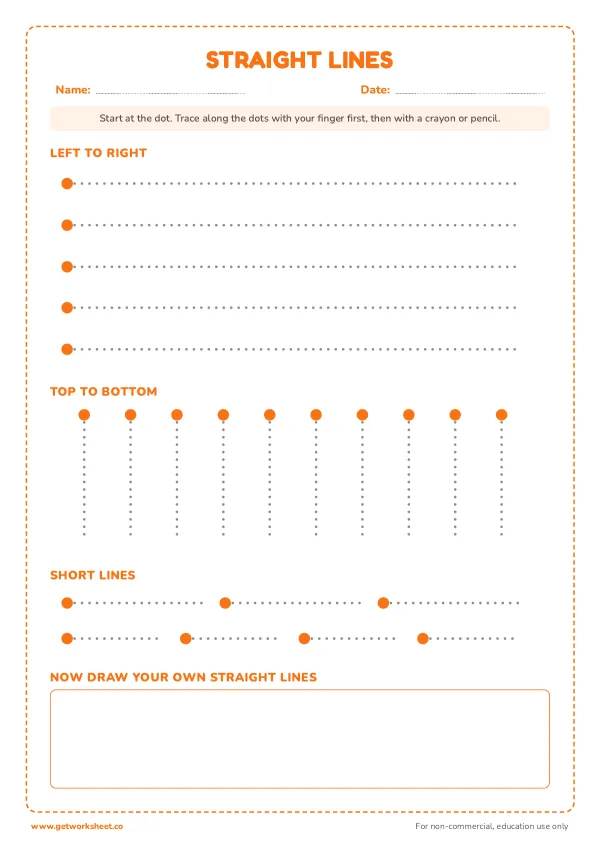
Free line tracing worksheets
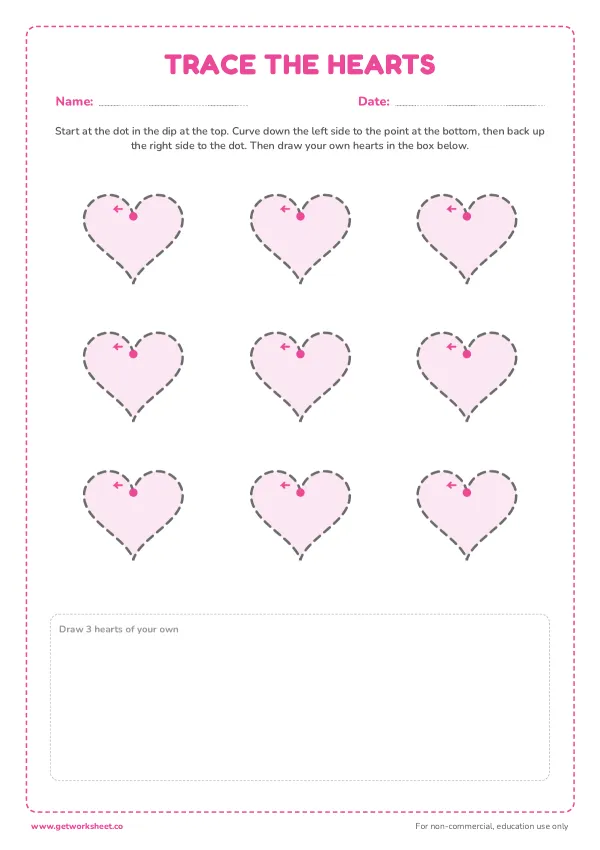
Free heart tracing worksheets
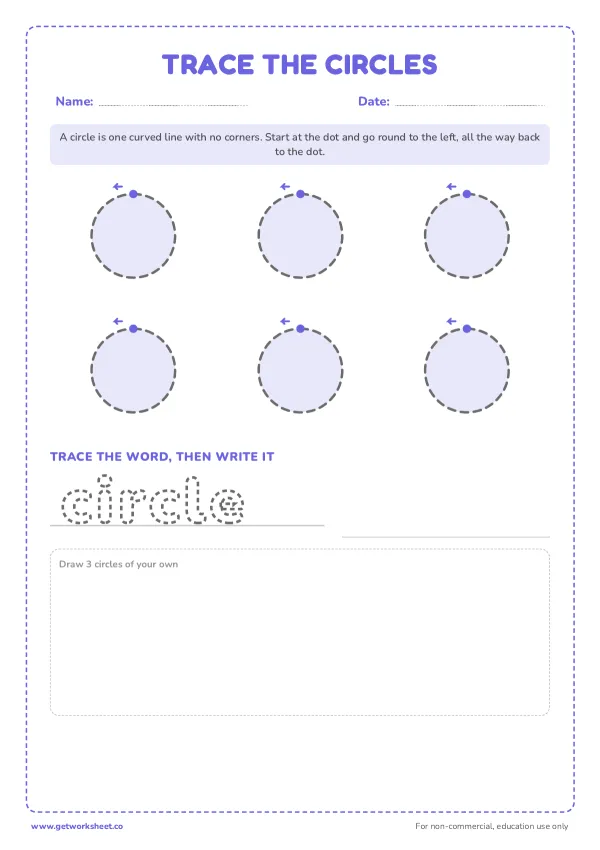
Free shape tracing worksheets
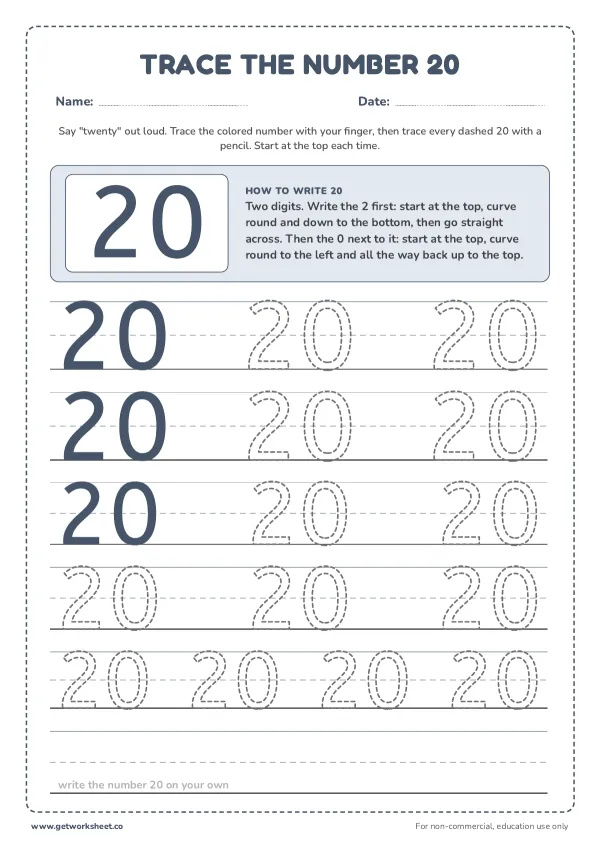
Free number 20 tracing worksheets
Free number 19 tracing worksheets
More worksheets
- Free number 18 tracing worksheets
- Free number 17 tracing worksheets
- Free number 16 tracing worksheets
- Free number 15 tracing worksheets
- Free number 14 tracing worksheets
- Free number 13 tracing worksheets
- Free number 12 tracing worksheets
- Free number 11 tracing worksheets
- Free number 10 tracing worksheets
- Free number 9 tracing worksheets
- Free number 8 tracing worksheets
- Free number 7 tracing worksheets