Life skills · All grades (staff use)
Free ABC data collection sheets
Seven free printable ABC (antecedent, behavior, consequence) data collection forms for teachers, paraprofessionals and behavior teams: the classic three-column sheet with six tall rows, a version with time, setting and who was present, a tick-box checklist for recording mid-lesson, a sheet with a function column to circle, narrative incident notes, a daily summary by time of day and a blank ruled form.
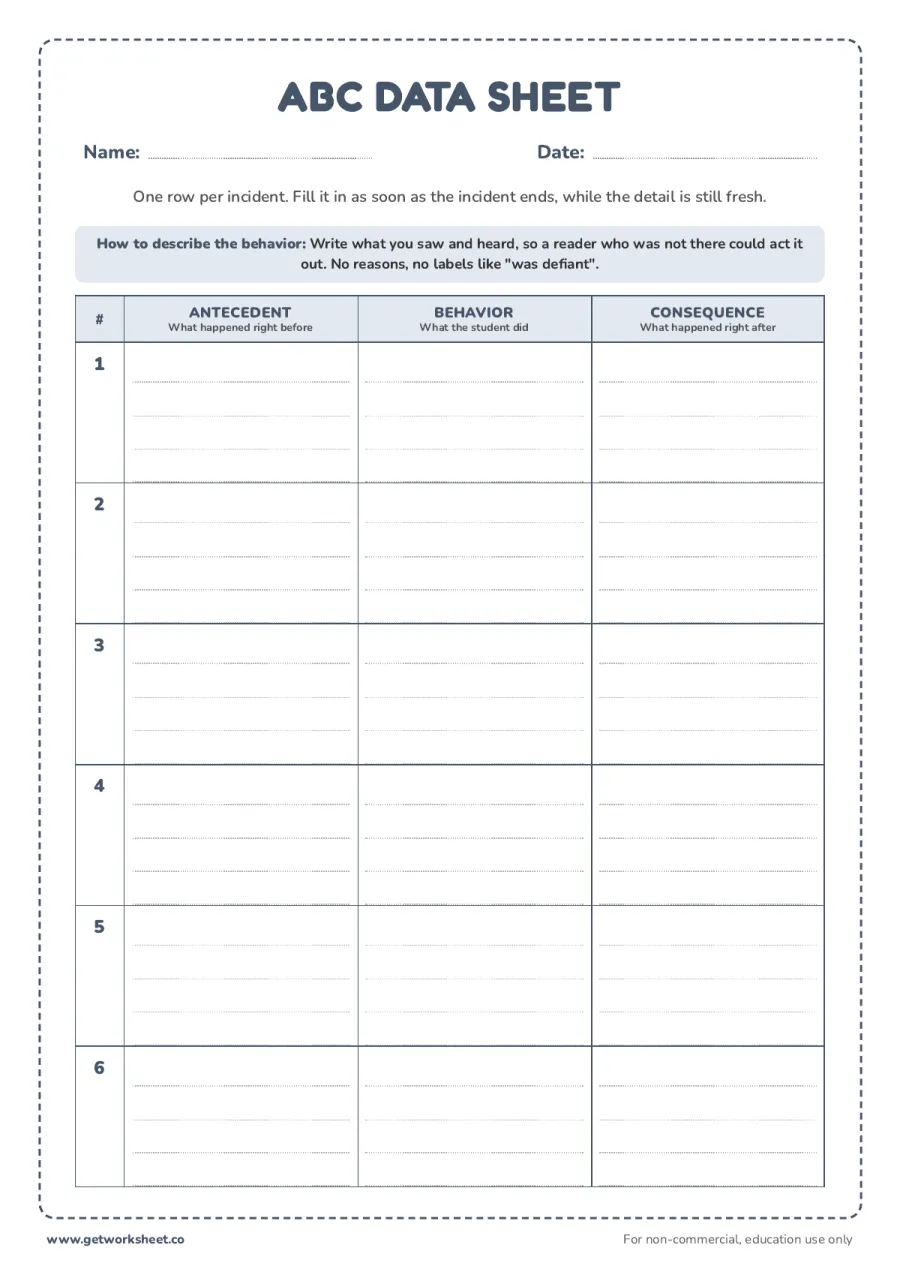
ABC data sheet (3 columns, 6 rows)
The classic antecedent, behavior, consequence form: six rows with four writing lines in each column, a student, observer and date line, and a reminder of how to describe behavior observably. Free printable PDF.
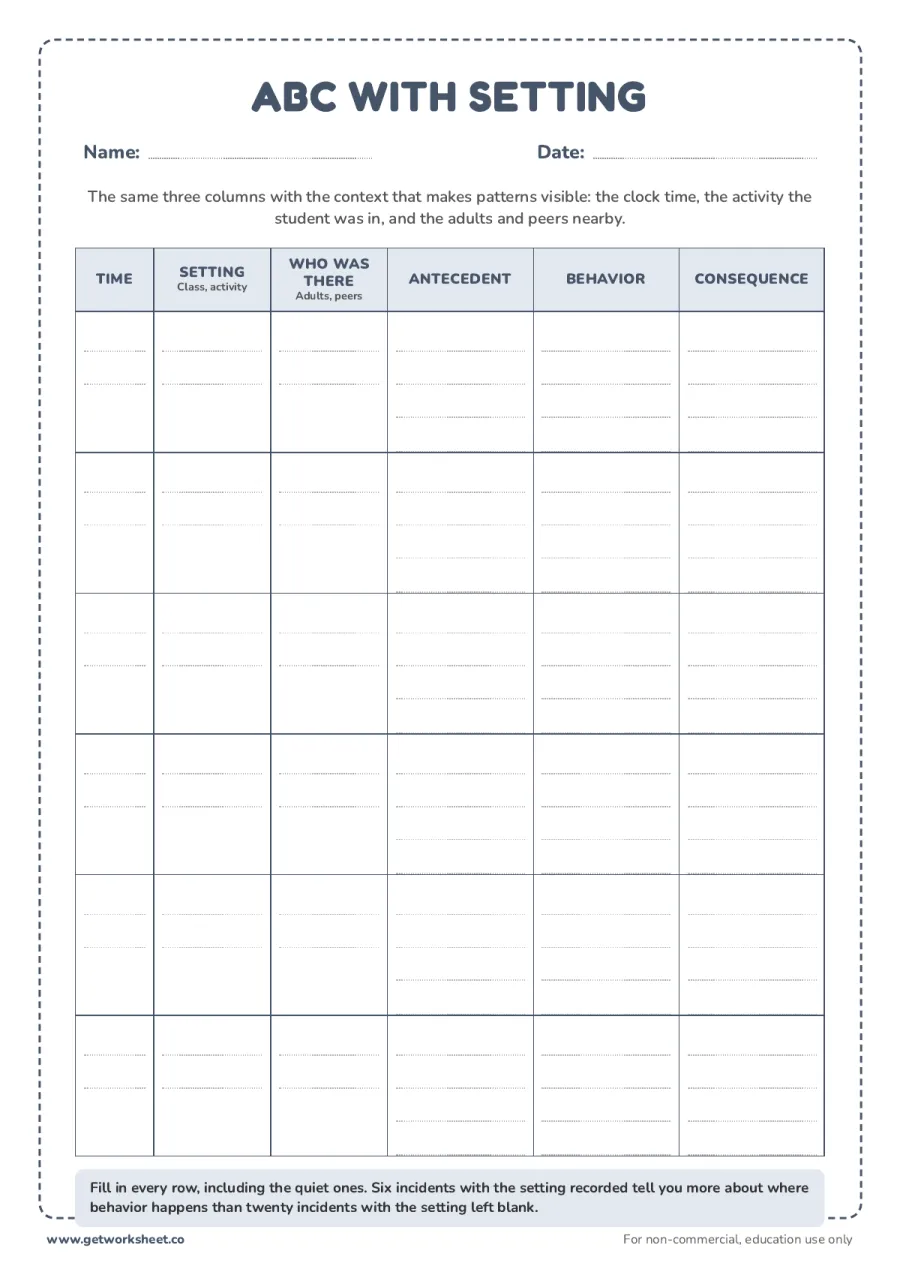
ABC data sheet with time, setting and who was present
Extended ABC recording form: six rows with columns for the clock time, the setting or activity, the adults and peers present, and the three ABC columns. Free printable PDF.
Complete pack
All 7 + 5 bonus, one PDF
- The 7 free sheets on this page
- 5 bonus sheets you will not find anywhere else
- Instant download, ad-free, no account needed
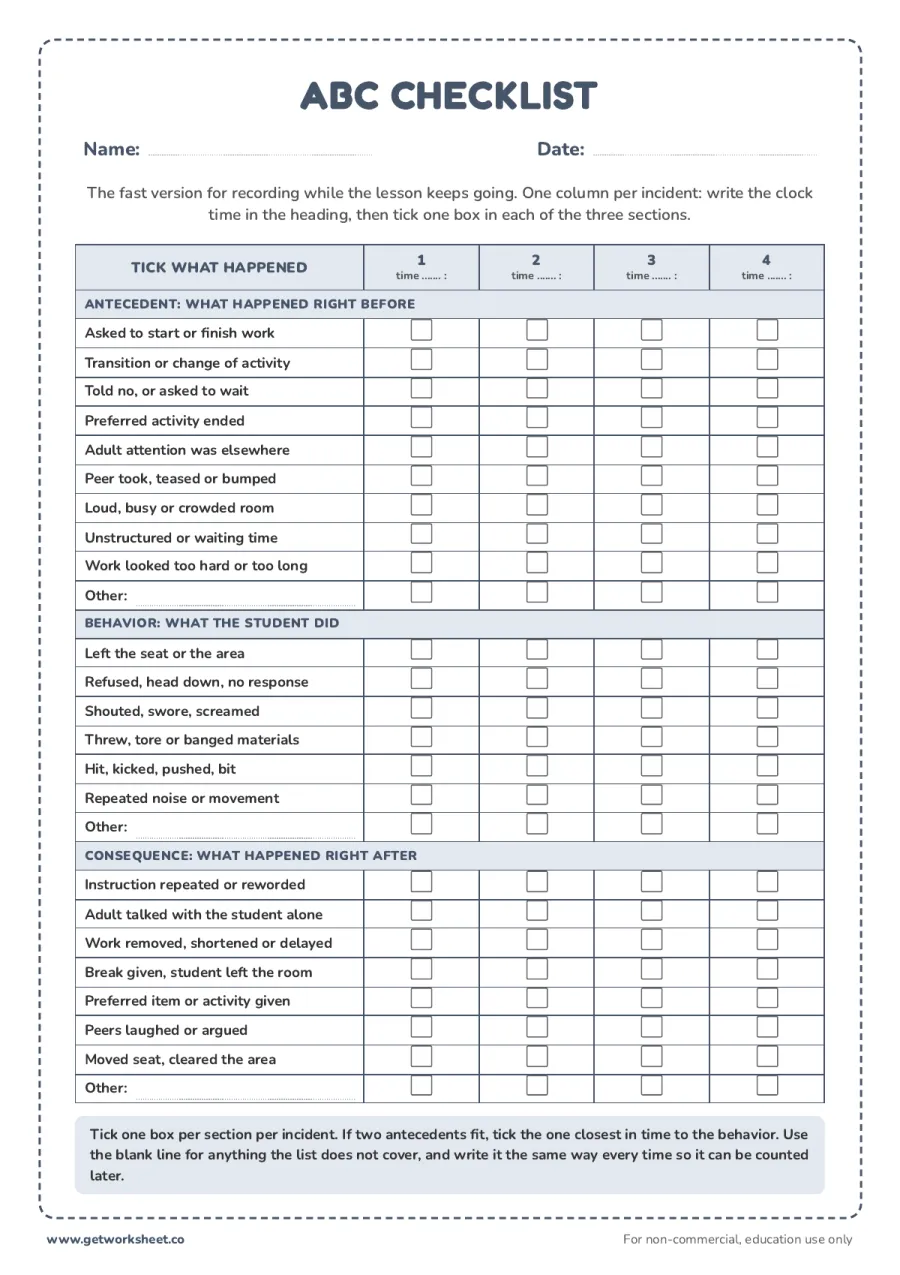
ABC checklist with tick boxes
Fast ABC form for recording during a lesson: nine common antecedents, six behaviors and seven consequences pre-listed with tick boxes, four incident columns and a blank line in each section. Free printable PDF.
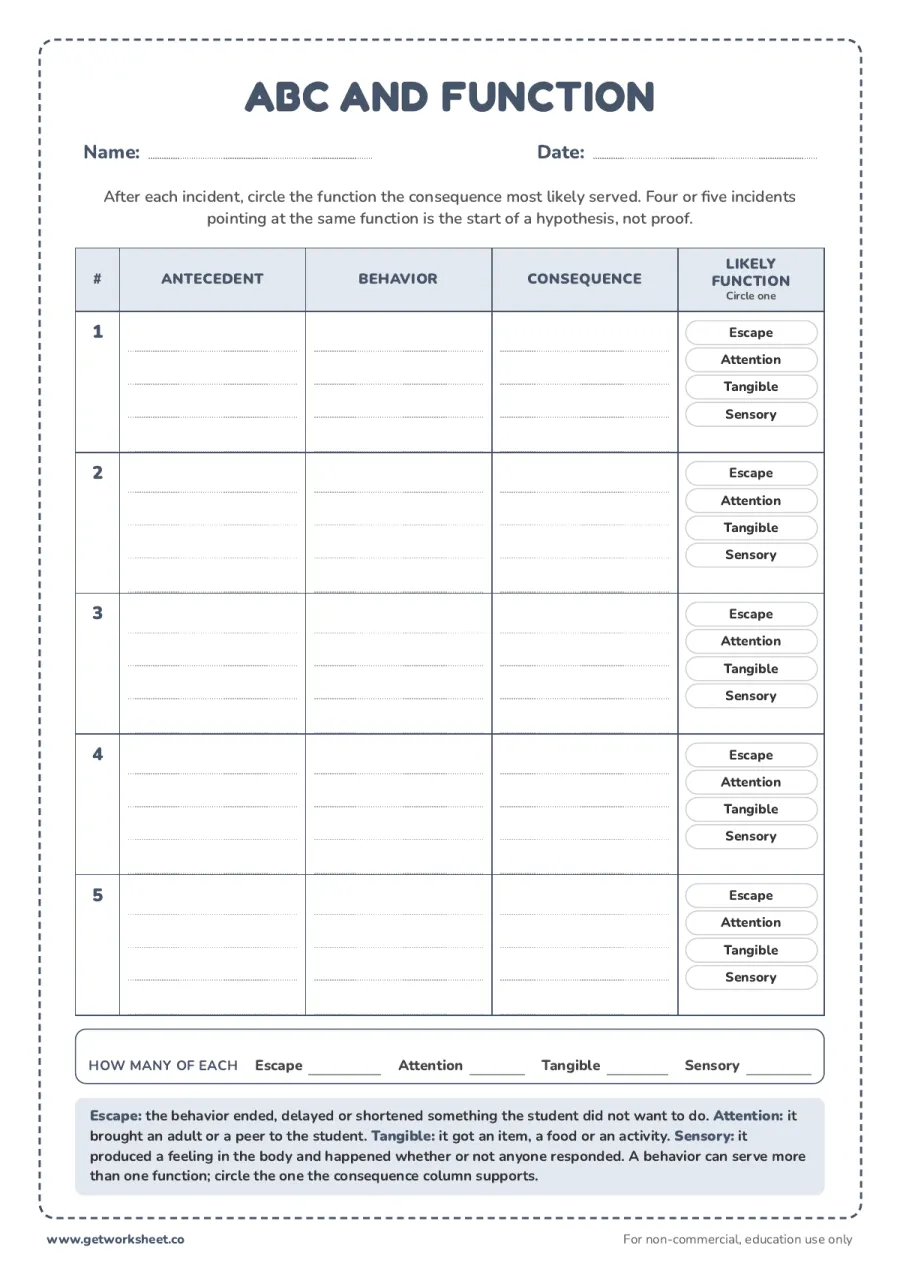
ABC data sheet with a function column
Five incident rows with the three ABC columns plus a function column to circle: escape, attention, tangible or sensory, with a one-line definition of each at the foot of the page. Free printable PDF.
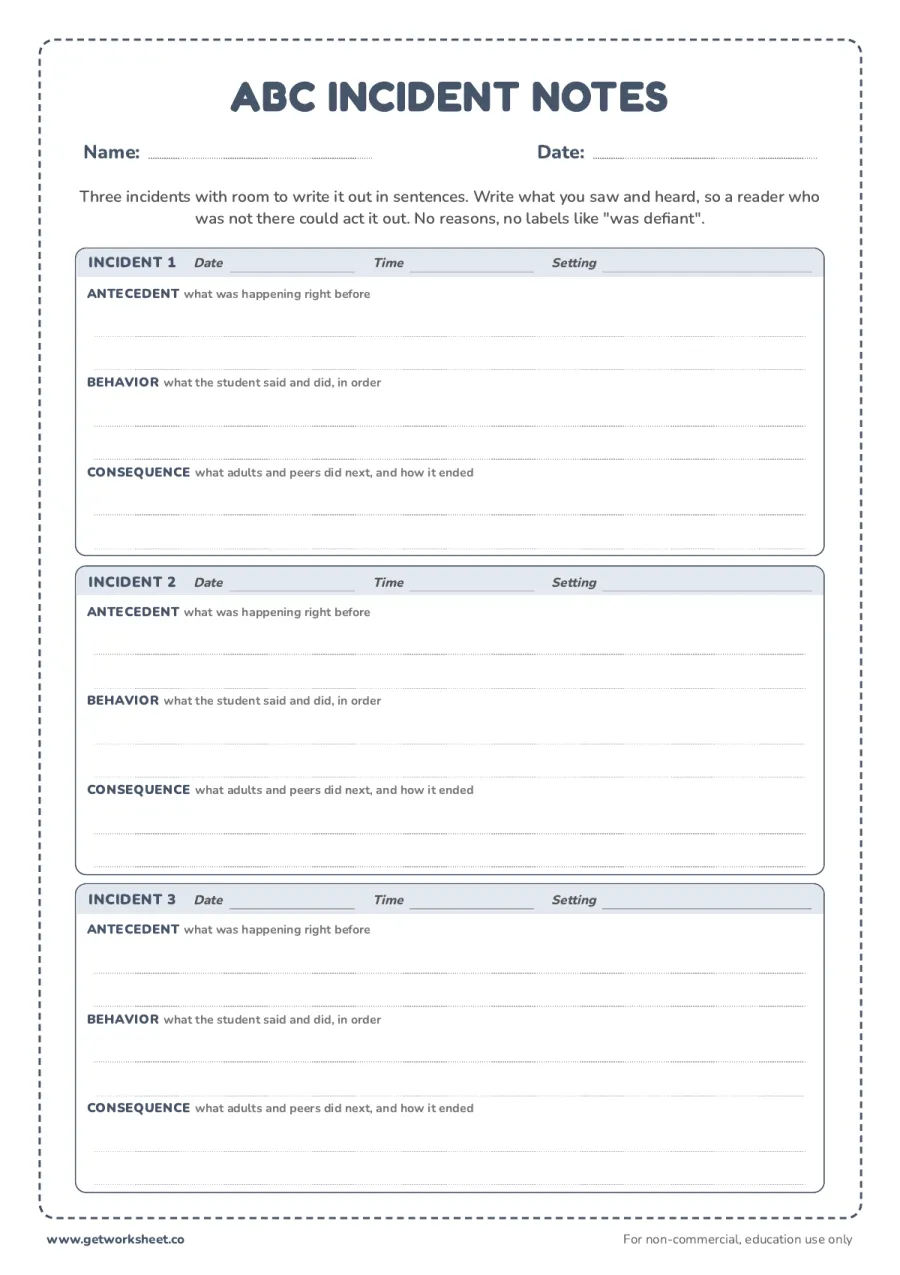
Narrative ABC incident notes (3 incidents)
Three incident blocks with a date, time and setting line and separate prompts for the antecedent, the behavior in order, and the consequence, with two ruled lines each. Free printable PDF.
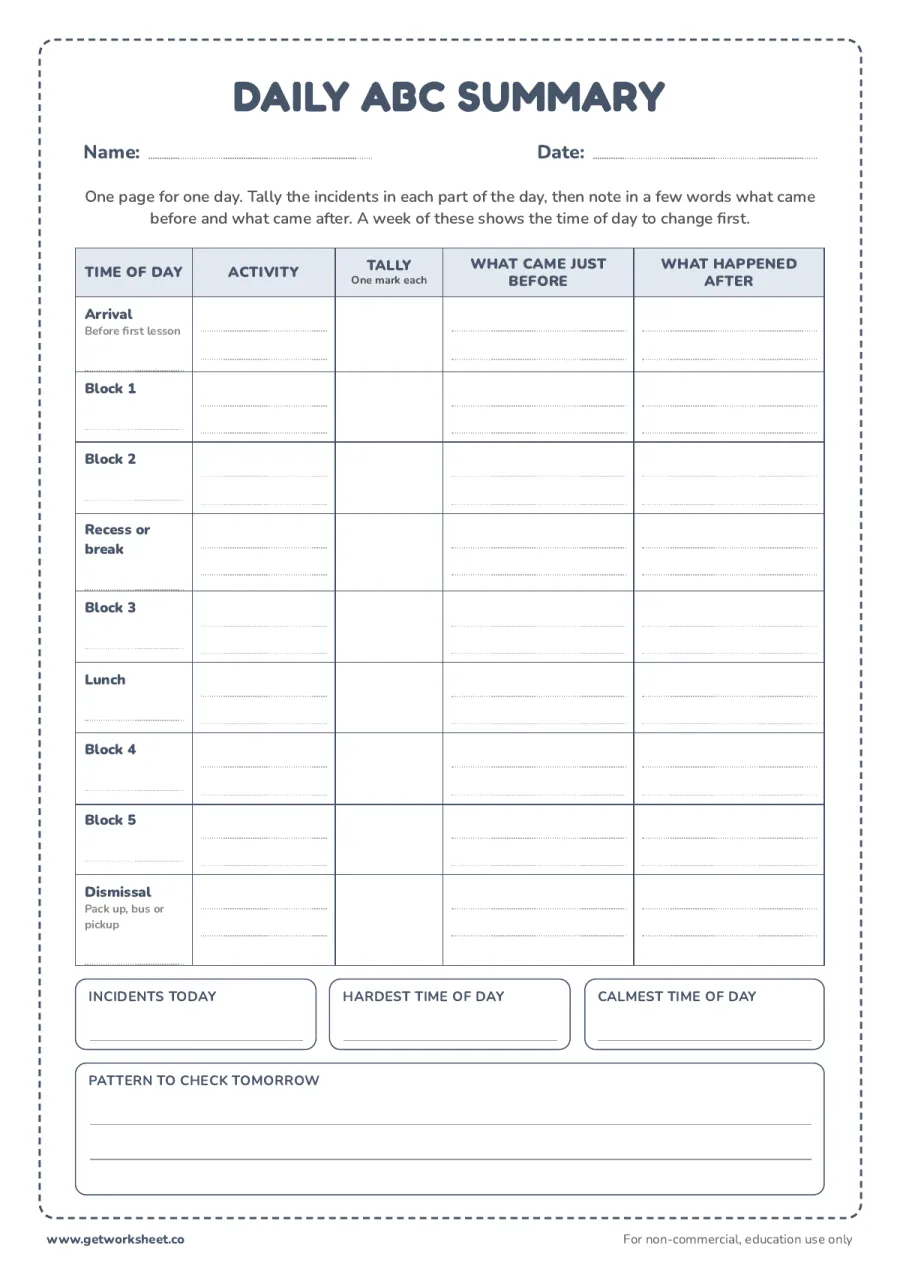
Daily ABC summary by time of day
One-page daily summary: nine parts of the school day from arrival to dismissal, with an activity line, a tally box and short lines for what came before and after, plus hardest and calmest time boxes. Free printable PDF.
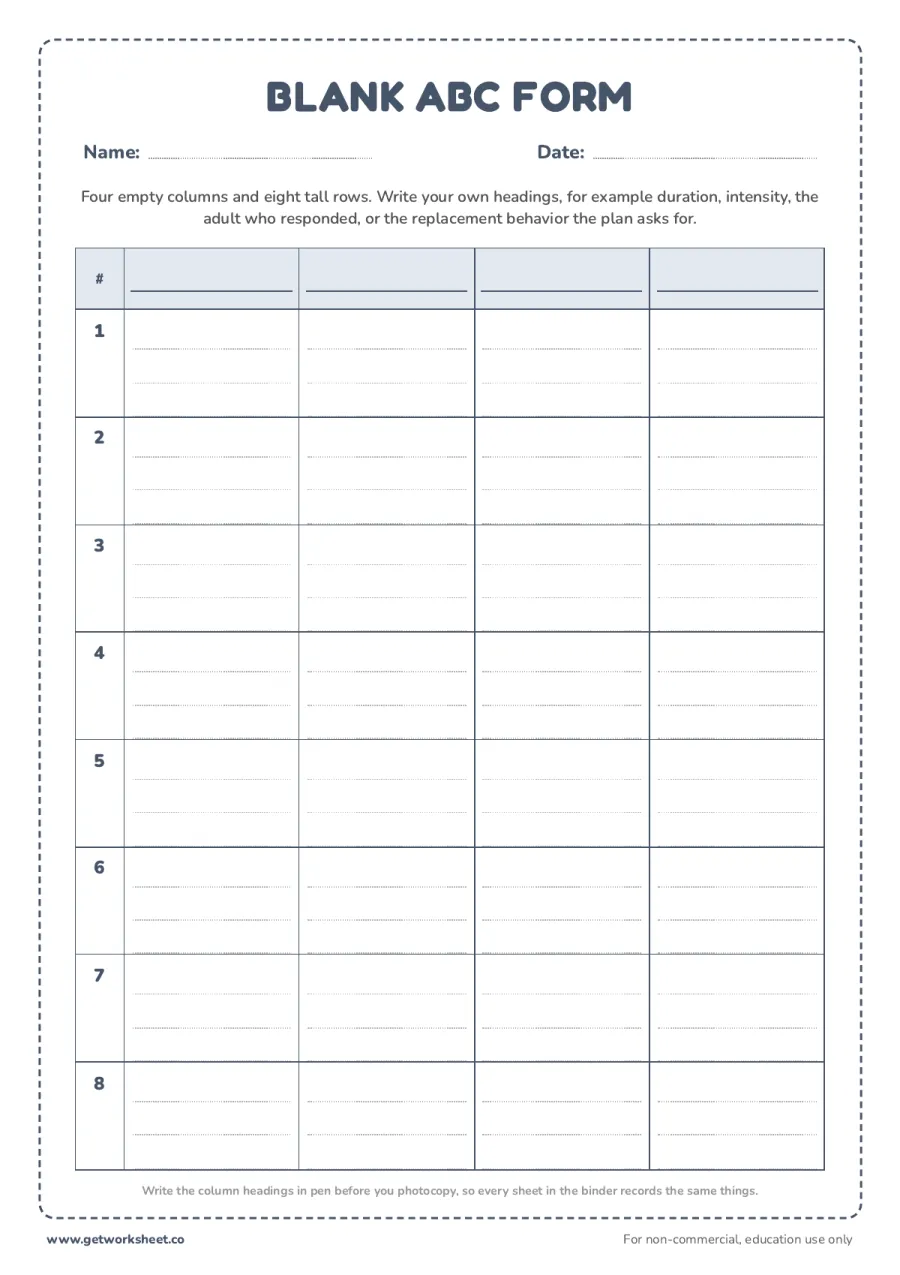
Blank ABC form with ruled columns
A blank recording form: four empty column headings for the adult to label and eight numbered rows of three dotted writing lines. Free printable PDF.
AI worksheet generator
Make a worksheet like this for your class
The 7 sheets above are fixed. The generator writes a new abc data collection sheets worksheet for your grade, with the question types and count you choose, in about 20 seconds. Pick a grade to start:
What you get
- A fresh set of questions on abc data collection sheets, not a copy of the sheets above
- Multiple choice, fill in the blanks, true or false, open ended
- Answer key and print-ready PDF with Pro
Free account, 1 worksheets a week. No card.
ABC data is the record a functional behavior assessment is built on. The antecedent is what happened in the moments before the behavior, the behavior is what the student did described so that someone who was not there could act it out, and the consequence is what happened immediately after. Collected across a week or two, those three columns show what sets a behavior off and what keeps it going. These seven forms are made to be used while a lesson carries on: every writing row is tall enough for an adult with a pen and a clipboard, and every page prints clearly in black and white.
What's in this set
- ABC data sheet (3 columns, 6 rows). The classic form. Six numbered rows with four dotted writing lines in each of the antecedent, behavior and consequence columns, plus a reminder across the top of how to describe behavior observably.
- ABC data sheet with time, setting and who was present. The same three columns plus the context that makes patterns visible: clock time, setting or activity, and the adults and peers nearby. Six rows.
- ABC checklist with tick boxes. The fast version for recording mid-lesson. Nine common antecedents, six behaviors and seven consequences are listed with a tick box, there are four incident columns with room for the time, and each section ends with a blank "other" line.
- ABC data sheet with a function column. Five incident rows with a fourth column holding the four functions to circle: escape, attention, tangible and sensory. A one-line definition of each sits at the foot of the page, with a strip to count how many incidents fell under each function.
- Narrative ABC incident notes. Three incident blocks, each with a date, time and setting line and separate prompts for the antecedent, the behavior in order and the consequence, two ruled lines each.
- Daily ABC summary by time of day. One page for one day: nine parts of the school day from arrival to dismissal, each with an activity line, a tally box and short lines for what came before and after, then boxes for the hardest and calmest time of day.
- Blank ABC form with ruled columns. Four empty column headings for the adult to label, for example duration, intensity or the adult who responded, with eight numbered rows of three dotted lines.
Free printable makers
Make your own abc data collection sheets sheets
Type your own words or numbers and print in about 30 seconds. No account, no AI, answer key where it applies.
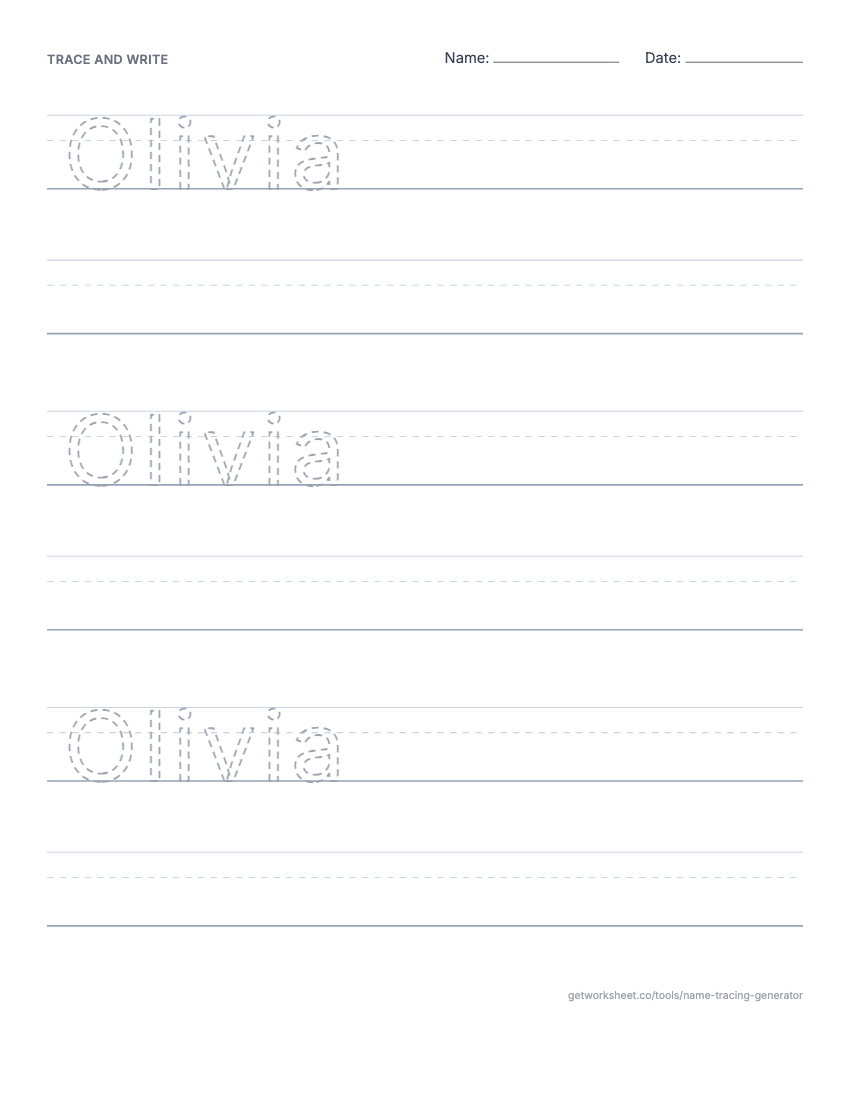 Name tracing generatorDashed, dotted or grey letters on handwriting lines. Free to print.
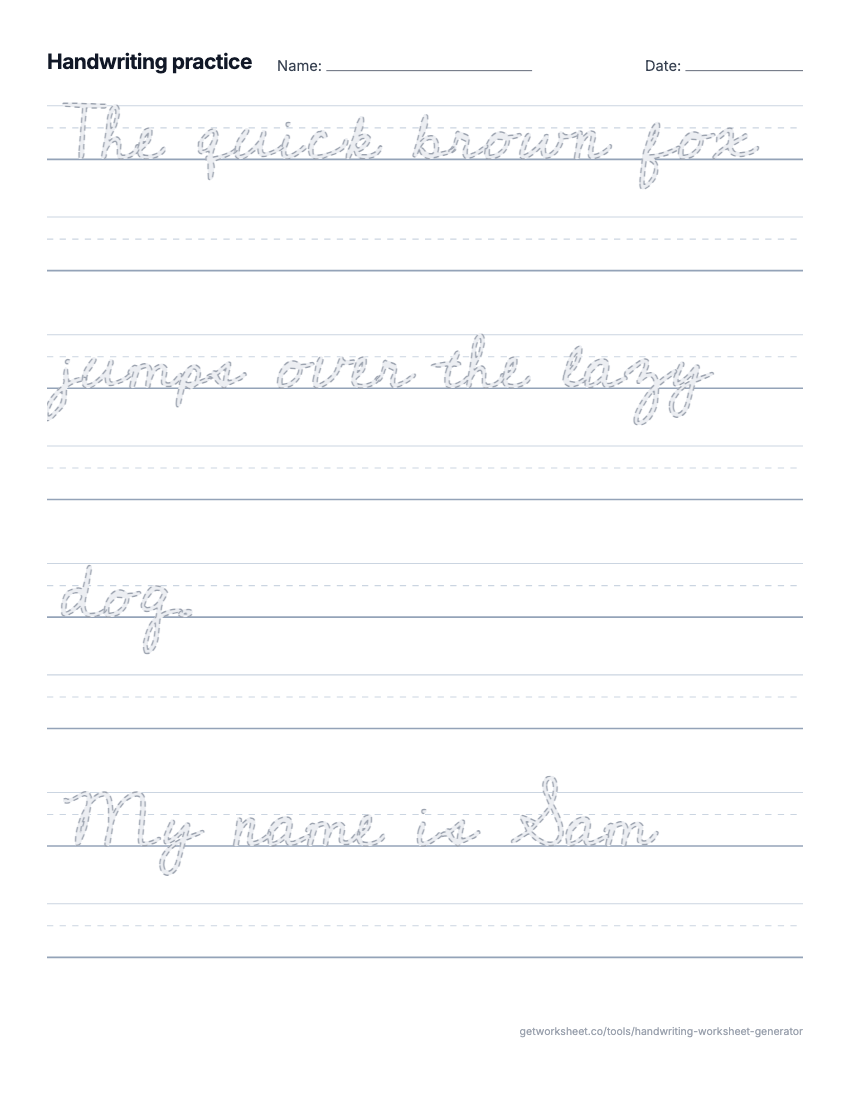 Handwriting worksheet generatorYour sentences as print or cursive tracing rows on guide lines. Free to print.
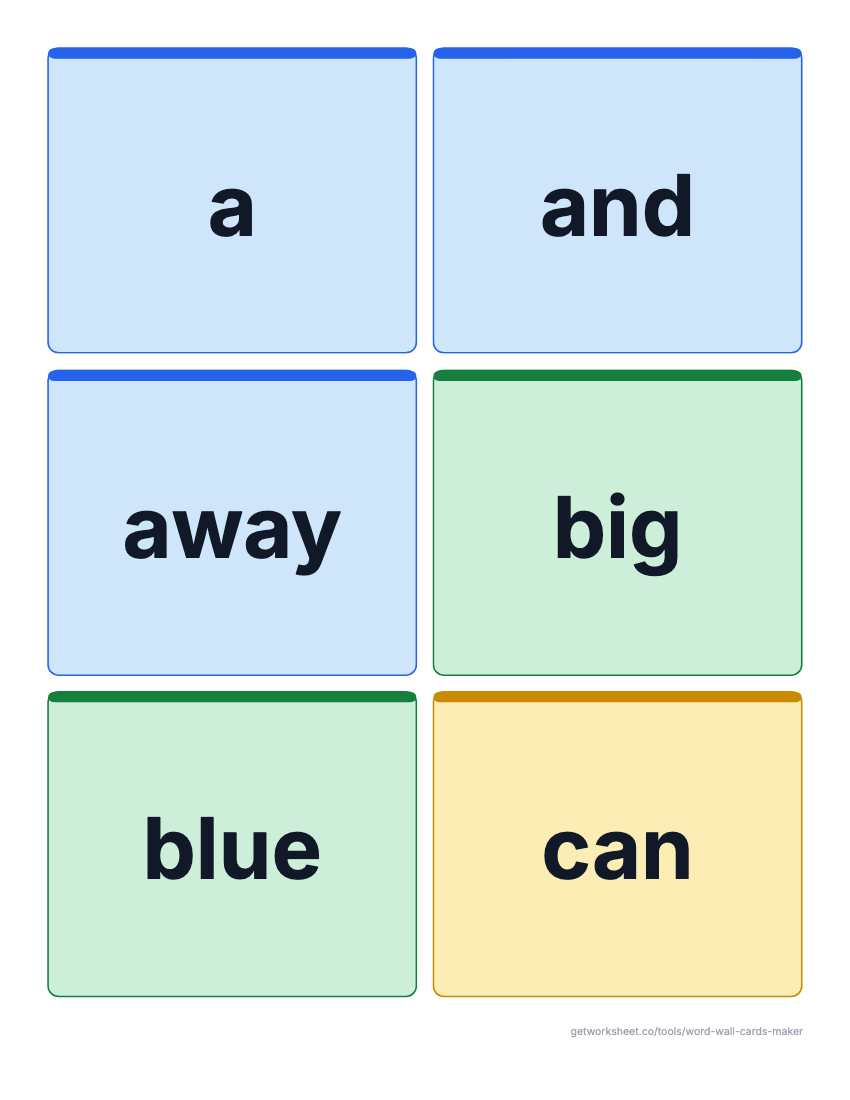 Word wall cards makerDolch, Fry or your own words as big-print cards, colour-coded, with A-Z headers. Free to print.
AI worksheet generator
Need a different abc data collection sheets worksheet?
Generate a custom abc data collection sheets worksheet: pick the grade, question types and count, and print it in about 20 seconds. Free accounts get 1 generation a week.
Complete pack · $2.99
All 7 sheets above, plus 5 bonus sheets you will not find on this page
7 free sheets + 5 bonus sheets in one print-ready PDF with a contents page. Instant, no ads, no account; the link is emailed to you so it works on any device. The 7 sheets above stay free.
- BonusABC log for home (parent version)
- BonusWeek at a glance: incidents by hour and day
- BonusHow often, how long: frequency, duration and intensity log
- BonusFunction summary and hypothesis statement
- BonusInterval recording sheet (12 intervals, 9 sessions)
One-time payment of $2.99. Card, Apple Pay or Google Pay. For home and classroom use.
- Bonus
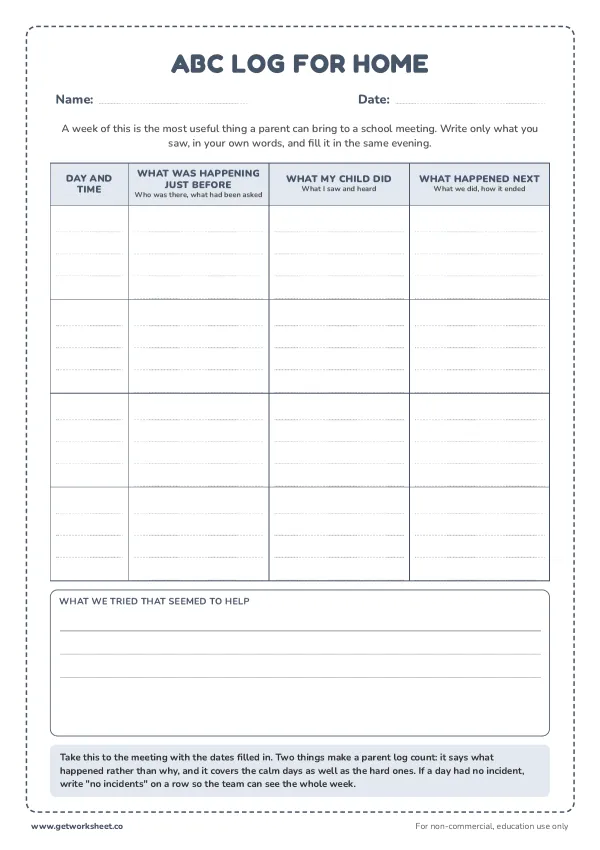 ABC log for home (parent version)
- Bonus
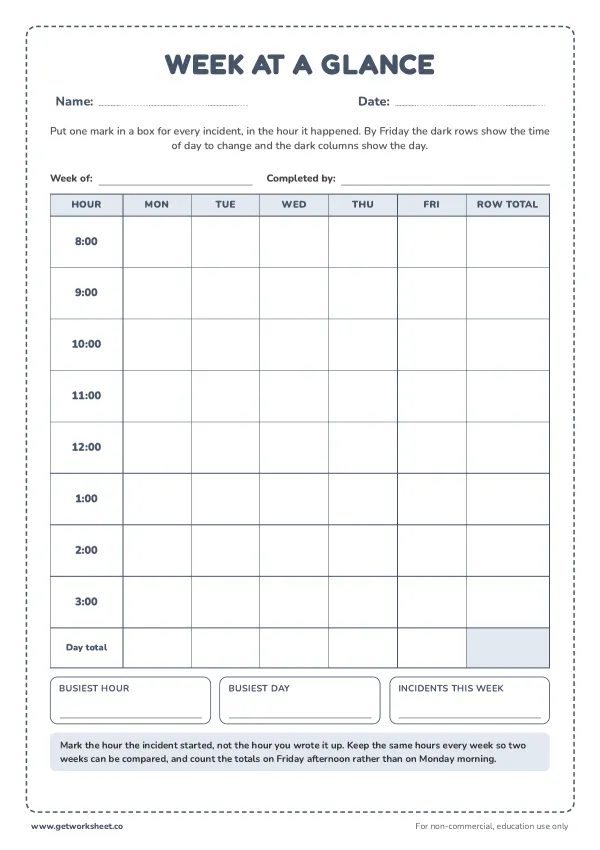 Week at a glance: incidents by hour and day
- Bonus
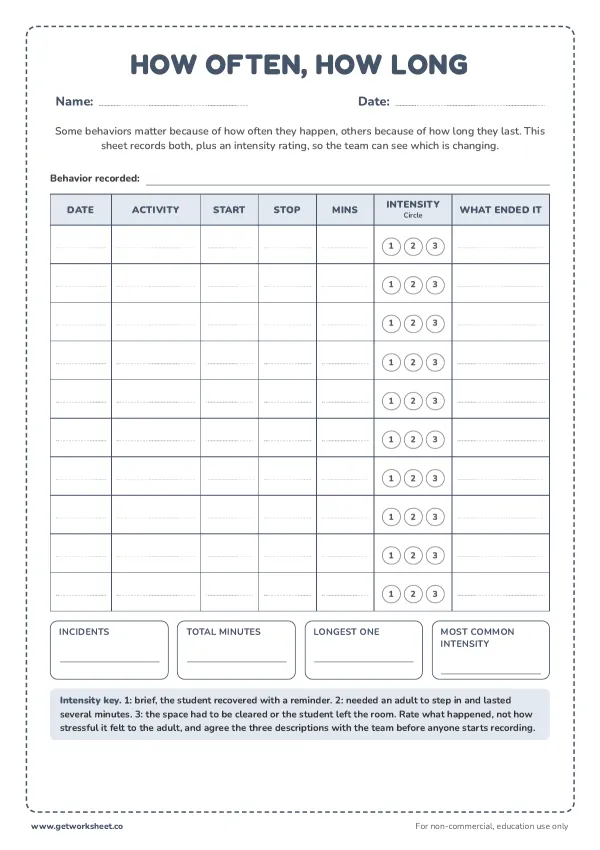 How often, how long: frequency, duration and intensity log
- Bonus
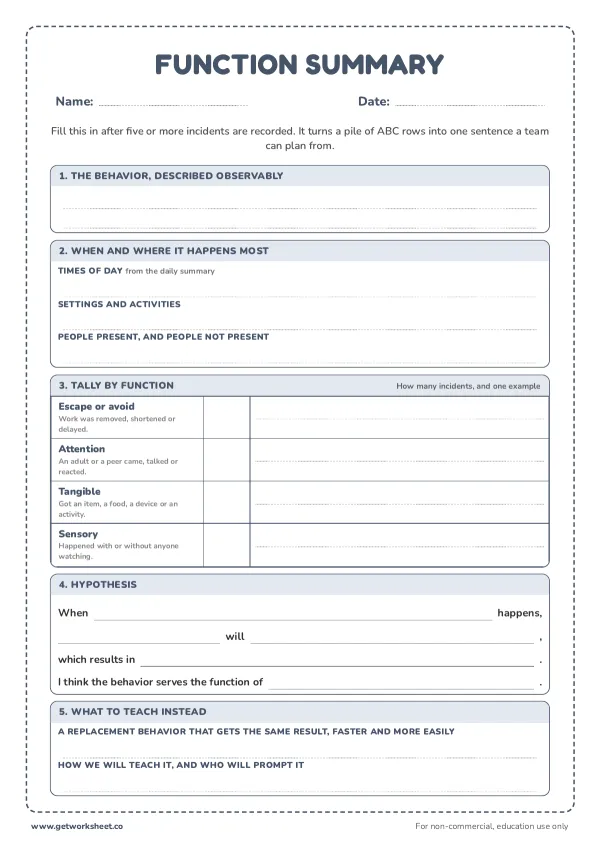 Function summary and hypothesis statement
- Bonus
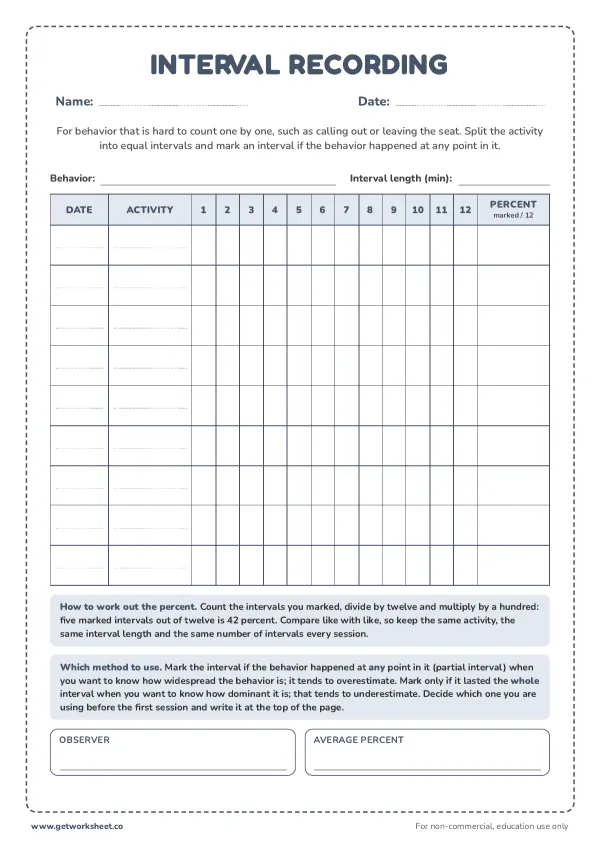 Interval recording sheet (12 intervals, 9 sessions)
Teaching tips and common mistakes
How to use these forms
Print at 100 percent on A4 or US Letter. Decide before you start which sheet the team will use for the next two weeks, photocopy a stack, and keep them in the same place so every adult records the same things in the same way. Data collected by three people in three formats cannot be counted.
- Start with sheet 1 or sheet 2. If you already know when and where the behavior happens, the three-column form is enough. If you do not, use the version with time, setting and who was present; the context columns are usually what reveal the pattern.
- Give the checklist to the people who are teaching. A paraprofessional running a small group cannot write four lines of prose, but can tick three boxes and note a time. Fill the "other" lines in the same wording every time so they can be counted later.
- Add the function column once you have five or six incidents. Circling a function after every incident is a hypothesis in progress, not a conclusion. Several incidents pointing at the same function is what you take to the meeting.
- Use the daily summary for a week. Five of those pages side by side show the hour of the day to change first, which is often a timetable or a transition problem rather than a behavior problem.
Mistakes to watch for
- Writing interpretations in the behavior column. "Was defiant", "had an attitude" and "was seeking attention" are conclusions. Write what you saw and heard: "put head down, said no twice, pushed the worksheet off the desk".
- Recording only the bad days. A pile of incident forms with no record of the calm lessons makes a behavior look constant. Note the quiet rows too, even if that means writing "no incidents".
- Logging an antecedent that is too far back. The antecedent is the last thing that happened before the behavior started, not something from that morning. Setting events from earlier in the day are worth noting, but in the setting column.
- Filling the form in at the end of the day. Detail disappears within minutes. Write the row as soon as the incident ends, even in shorthand, and tidy it later.
- Changing the form halfway through. Keep the same sheet, the same columns and the same wording for the whole baseline period.
Frequently asked questions
What does ABC stand for?
Antecedent, behavior, consequence. The antecedent is what happened immediately before the behavior, the behavior is what the student did described observably, and the consequence is what happened immediately after, including how adults and peers responded.
What are the four functions of behavior?
Escape or avoidance, attention, access to a tangible item or activity, and sensory or automatic reinforcement. Sheet 4 has a column to circle one of the four after each incident, with a short definition of each at the foot of the page. A behavior can serve more than one function, and the consequence column is the evidence for which one.
How many incidents do I need before the data is useful?
There is no fixed number, but most teams want at least five to ten incidents across different days, activities and adults before they draw a conclusion. Two weeks of consistent recording is a common baseline.
Who can collect ABC data?
Any adult who is with the student can, as long as everyone has been shown what to write in each column. The tick-box form exists for exactly that reason: it keeps the recording consistent when several people are collecting it.
Do these forms include an answer key?
No. They are recording forms, not question sheets, so every page is a single sheet with no key. The blank form is there for teams that need columns the other six do not have.
More printables for behavior and routines
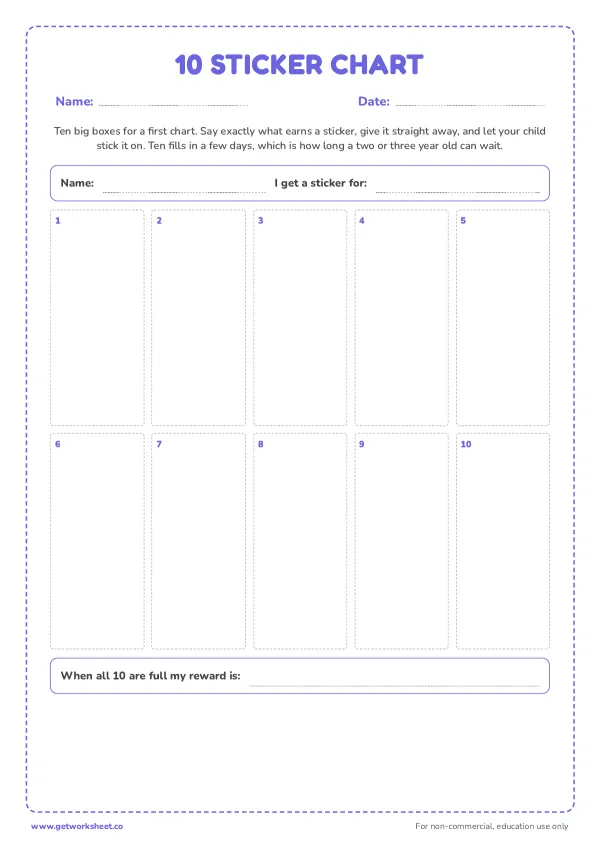
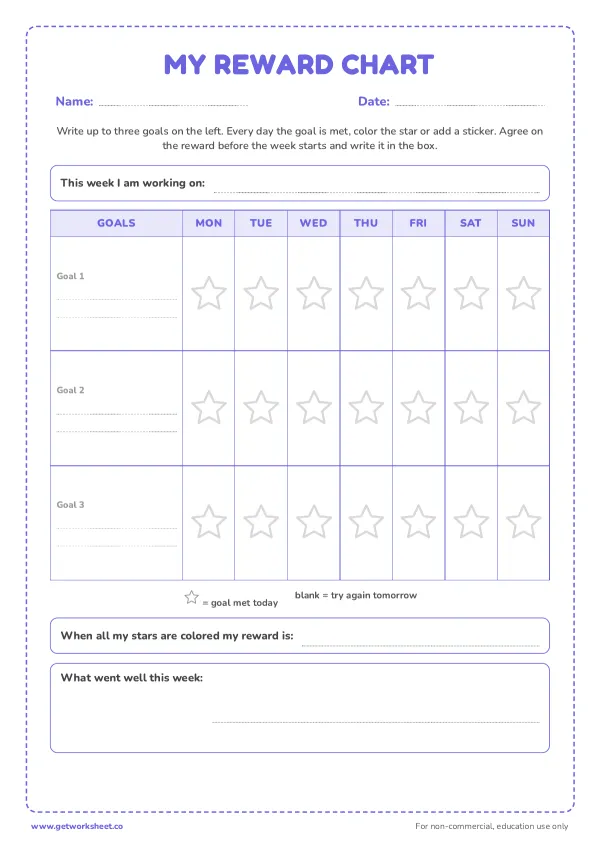
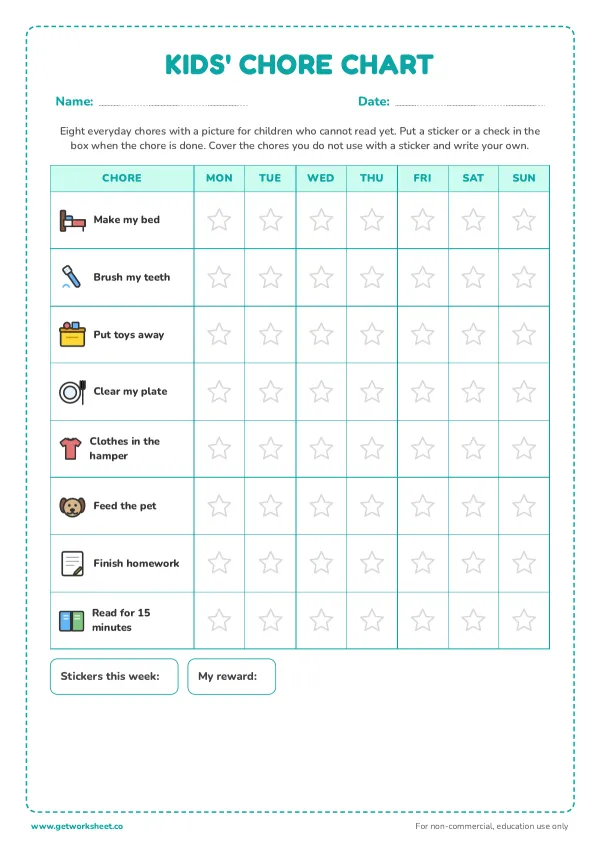
Once the data points at a pattern, the next step is usually a visible routine and something to work toward. The reward chart printables and sticker charts cover the motivation side, the chore chart printables work well for home routines that keep setting the morning off, and the goal-setting worksheets for students give an older student a way to own one target rather than having it set for them.
Free library
Related collections
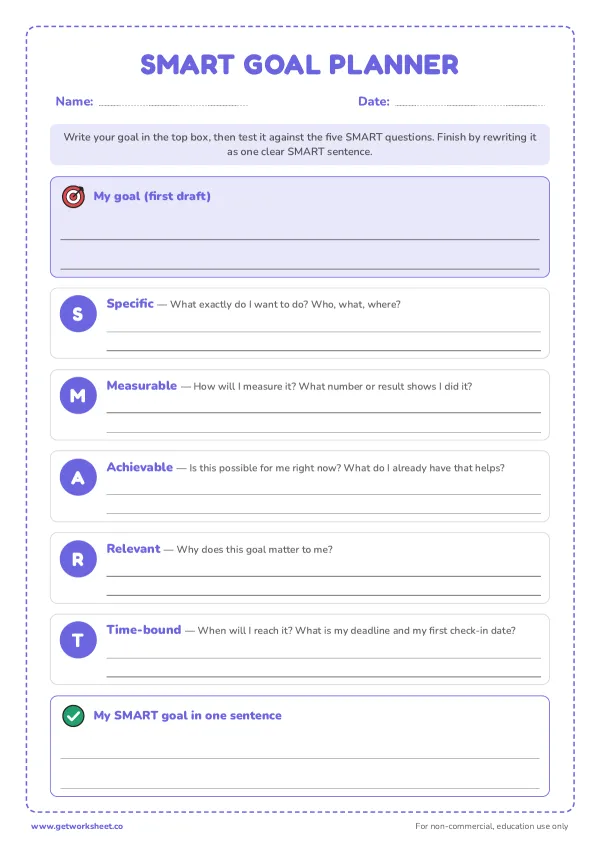
Free goal-setting worksheets for students
Free sticker chart printables
Free reward chart printables
Free chore chart printables
Free emotion thermometer printables
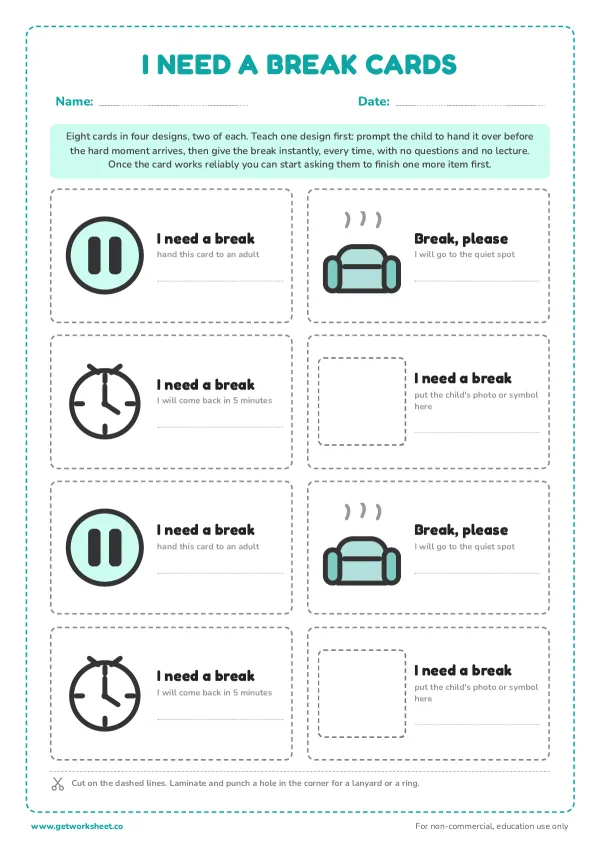
Free break card printables
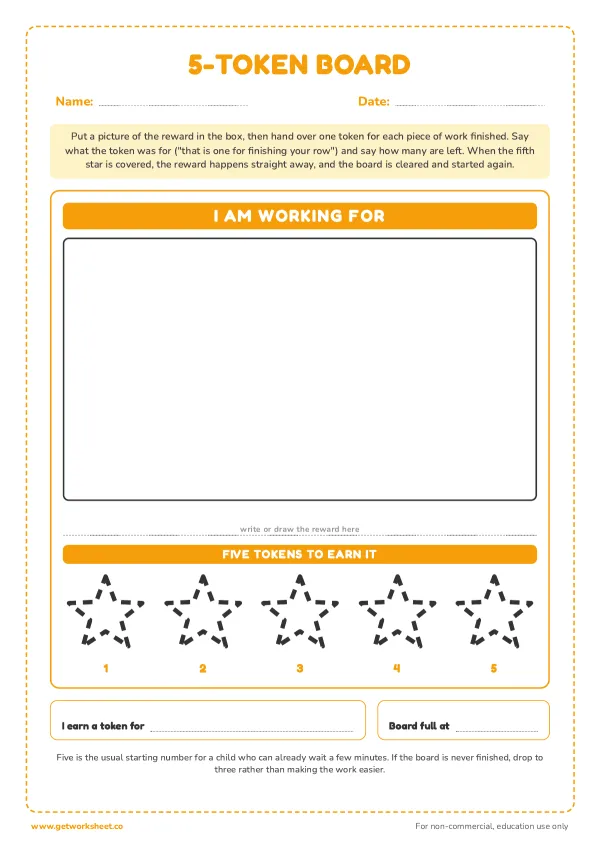
Free token board printables
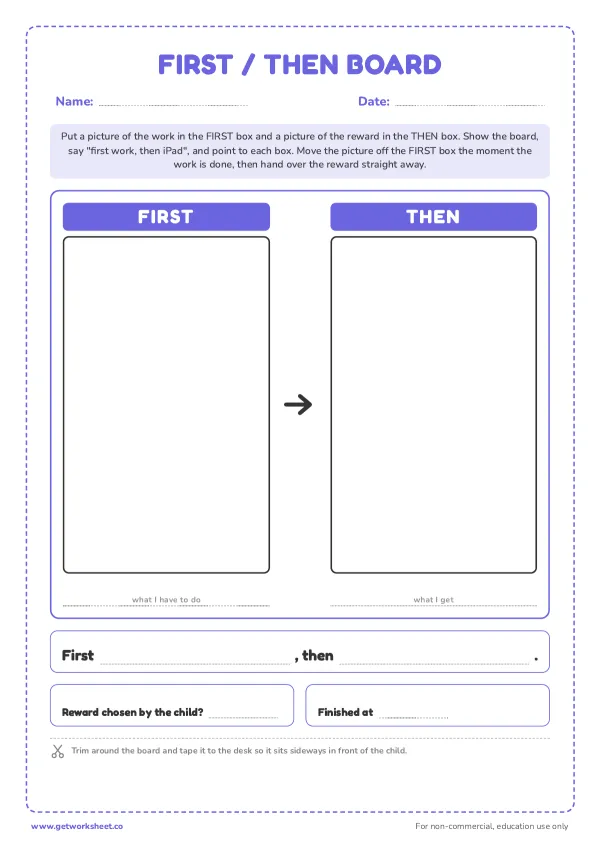
Free First-Then board printables
More worksheets
- Free emergency sub plans templates
- Free New Year's resolution worksheets
- Free reading log printables
- Free cutting practice worksheets
- Cooking Basics Worksheets
- Time Management Worksheets
- Free safety signs worksheets
- Money Management Worksheets
- Free i spy worksheets
- Free first day of school sign printables
- Free potty training chart printables
- Free all about me worksheets