English · Preschool–Kindergarten
Free name tracing worksheets
Free printable name tracing worksheets for preschool and kindergarten: the 20 most common first names in dotted letters to trace and write, blank three-line strips in three rule heights for any name, rainbow writing and trace-then-write.
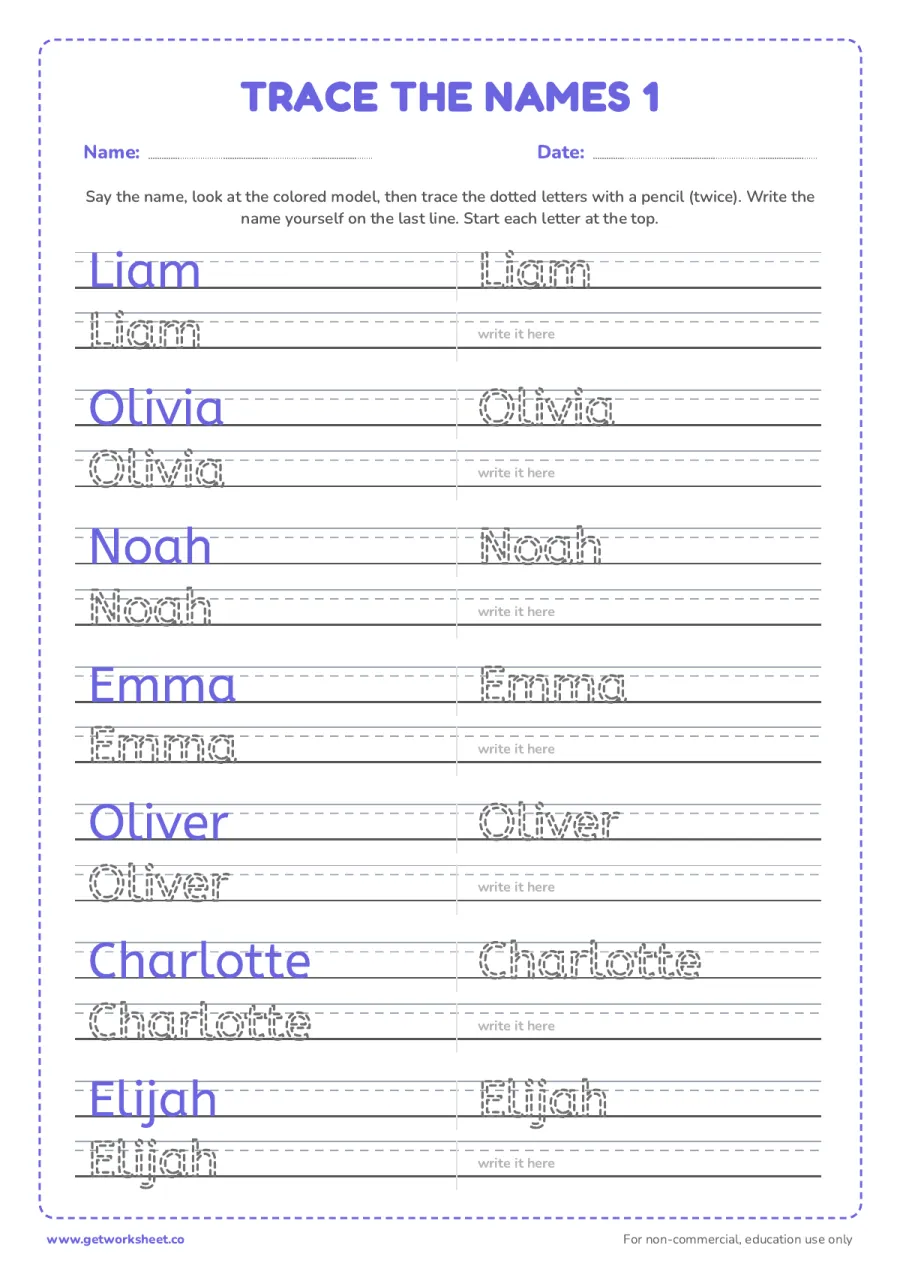
Trace the names 1: Liam, Olivia, Noah, Emma, Oliver, Charlotte, Elijah
Seven of the most common US first names, each with a colored model, the dotted name to trace twice and a ruled line to write it. Free printable PDF.
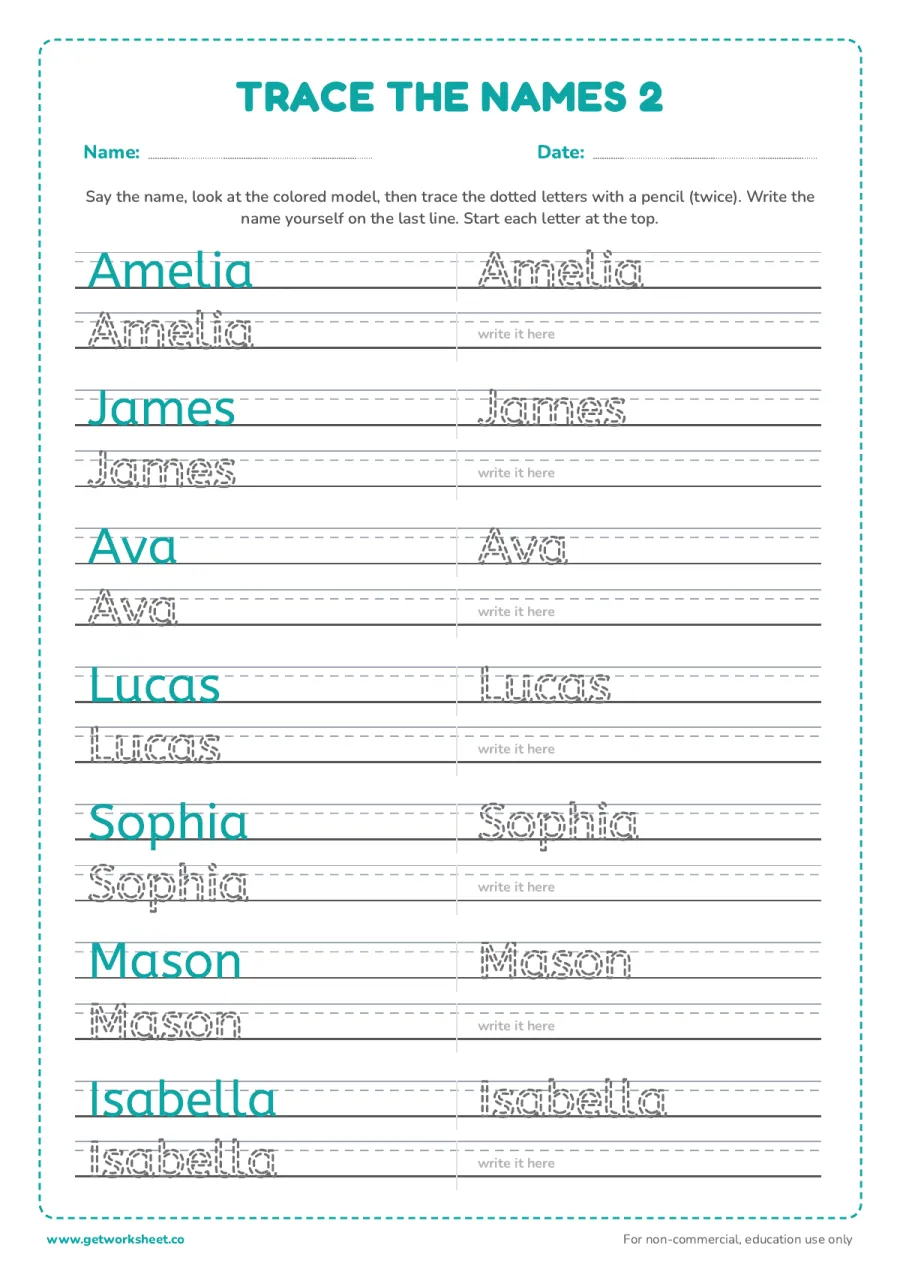
Trace the names 2: Amelia, James, Ava, Lucas, Sophia, Mason, Isabella
Seven more common first names on three-line handwriting rules: model, trace twice, write once. Free printable PDF.
Whole set
All 8 sheets in one PDF
Instant and ad-free. No account needed.
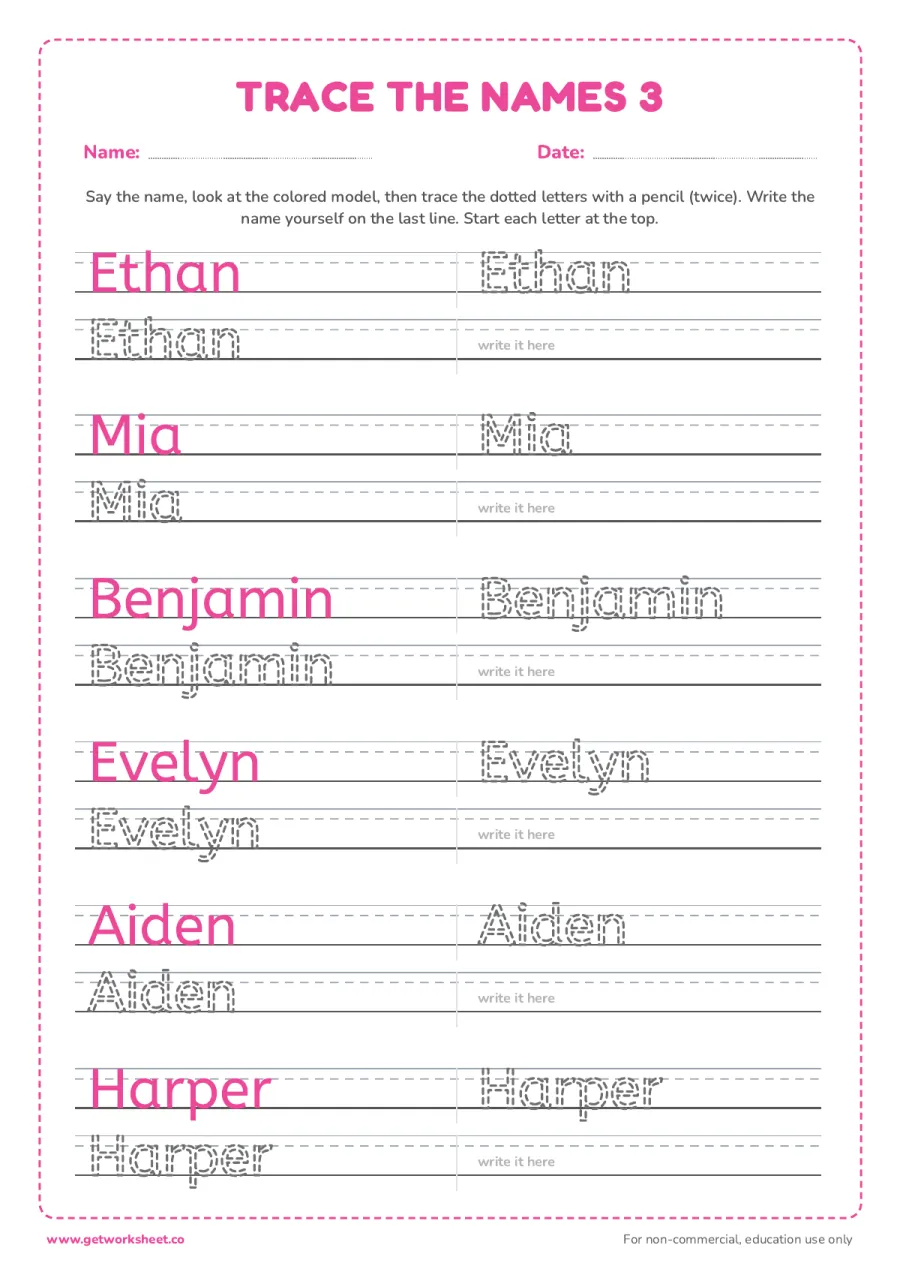
Trace the names 3: Ethan, Mia, Benjamin, Evelyn, Aiden, Harper
Six common first names on three-line handwriting rules: model, trace twice, write once. Free printable PDF.
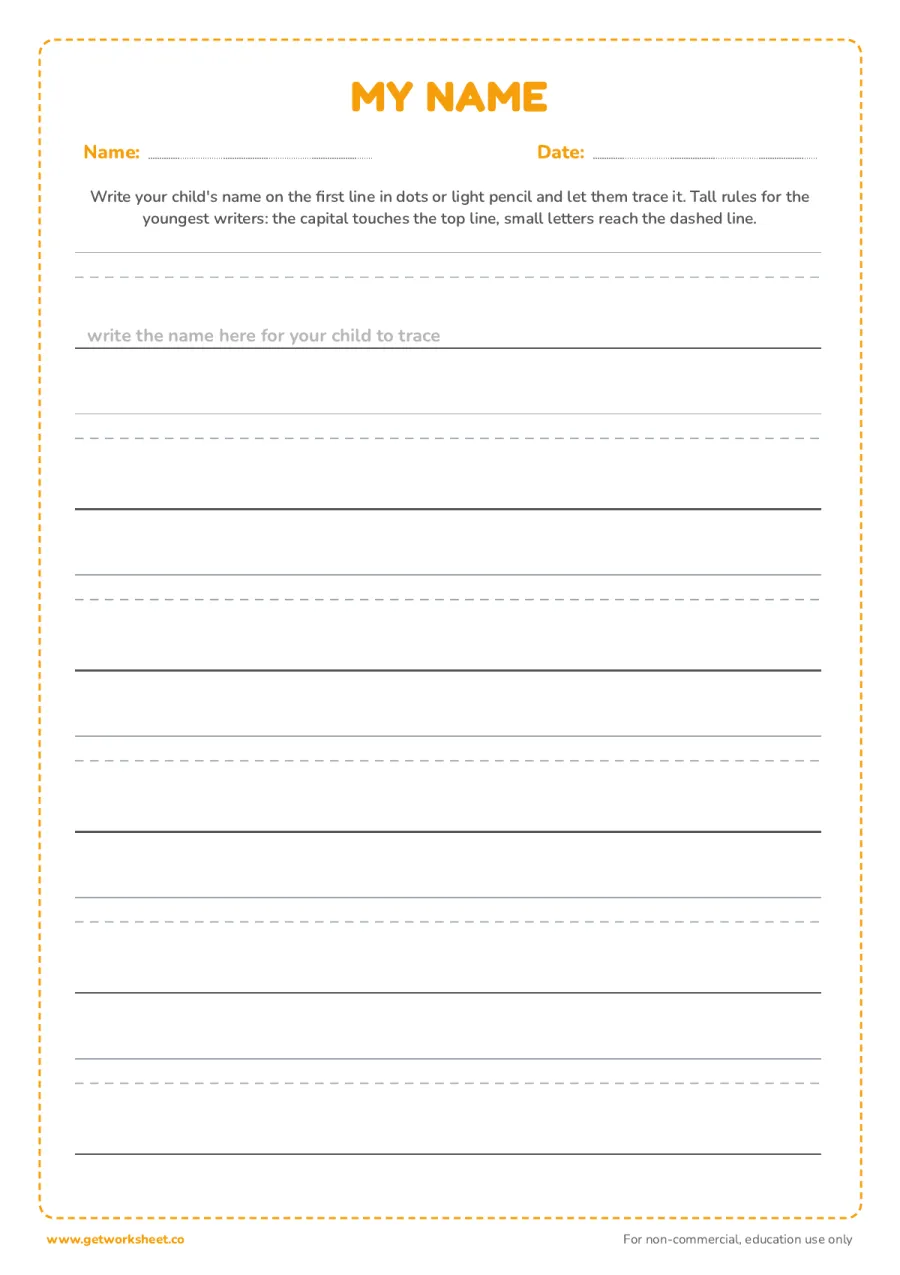
Blank name strips: tall rules (ages 3 to 4)
Six wide three-line rules for an adult to write any name for a child to trace. The tallest rules in the set, for a first go at a name. Free printable PDF.
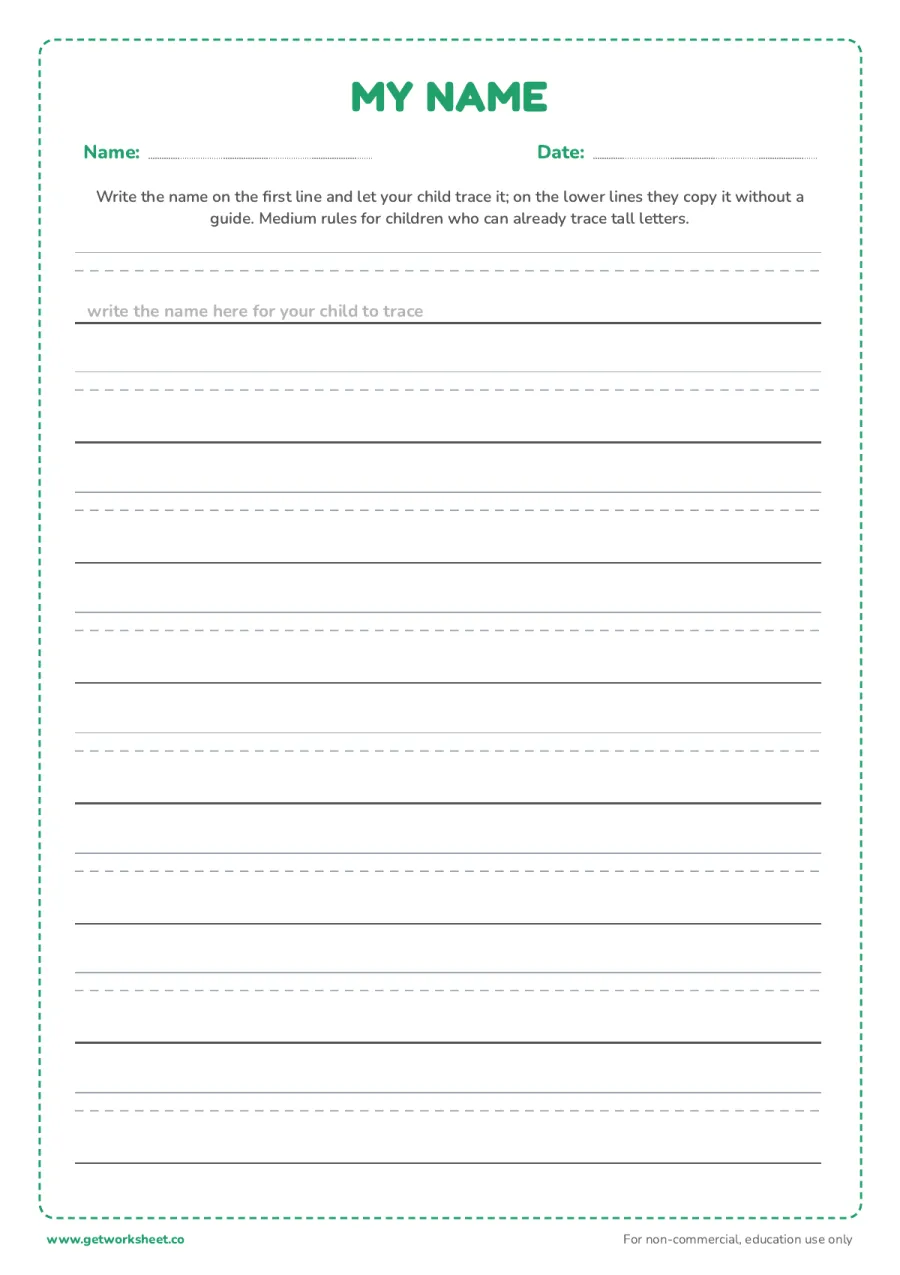
Blank name strips: medium rules (ages 4 to 5)
Eight three-line rules at a medium height for any name. Trace on some rows, write alone on the rest. Free printable PDF.
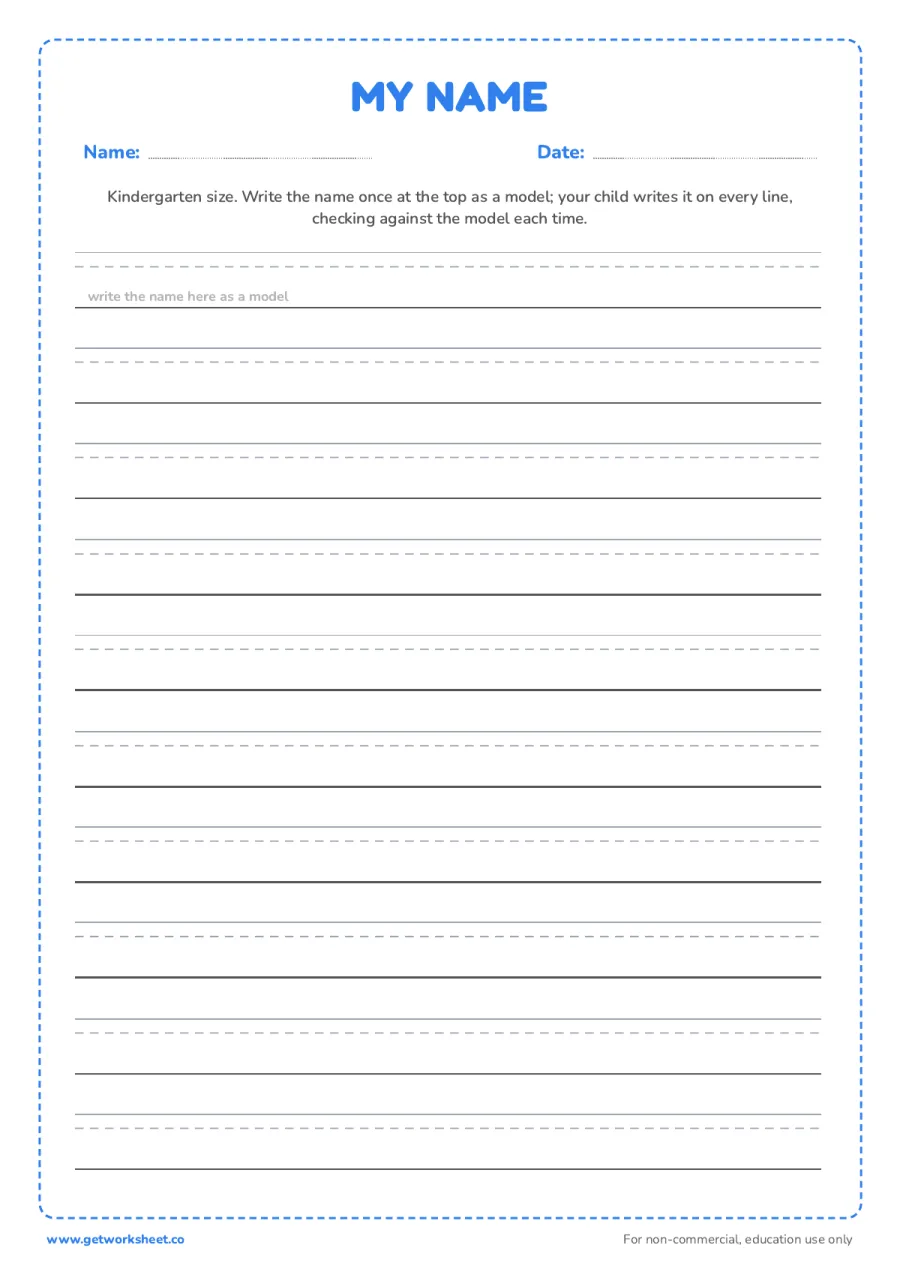
Blank name strips: small rules (kindergarten)
Ten three-line rules close to normal handwriting size, for a child who is nearly writing their name independently. Free printable PDF.
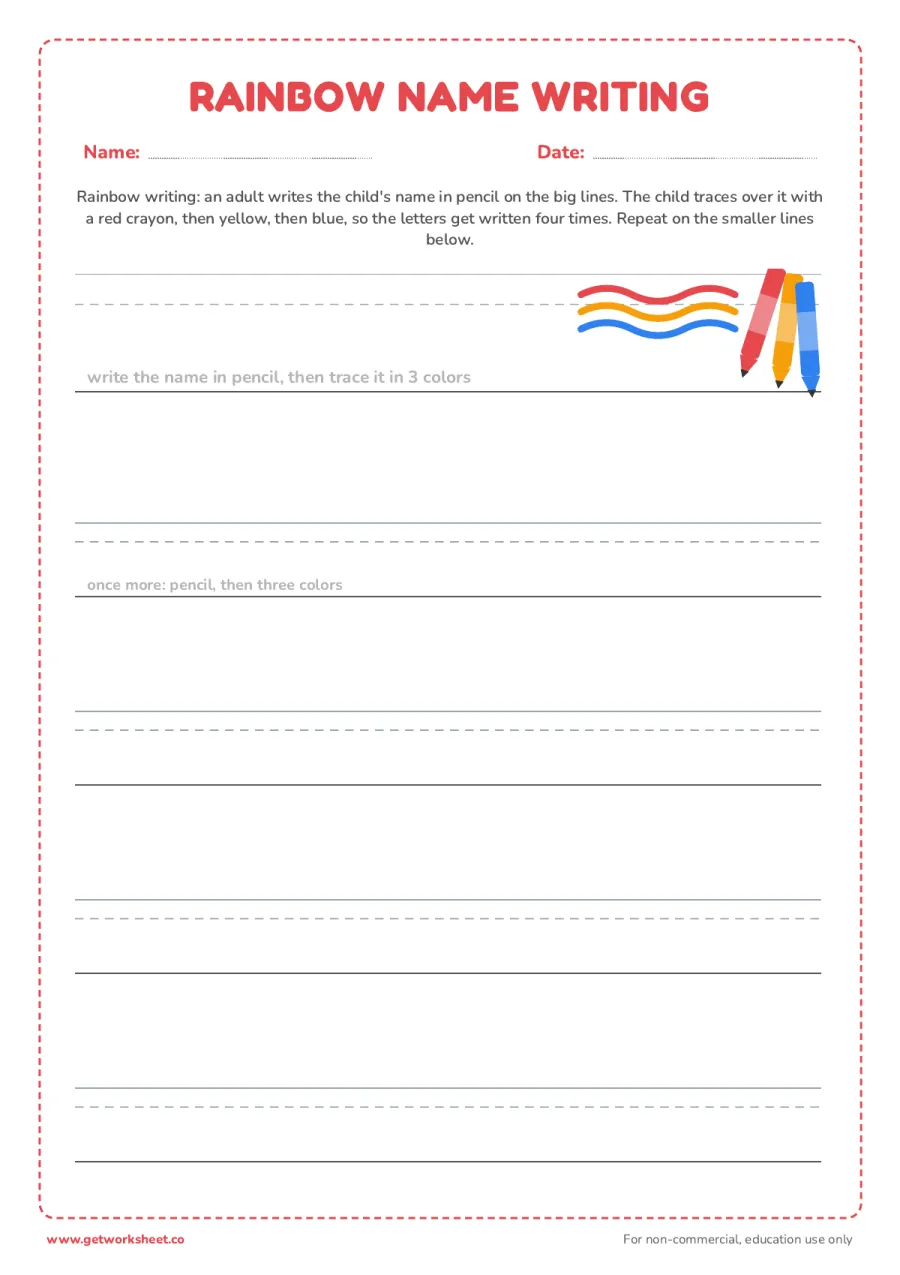
Rainbow name writing
One big set of rules to write the name in pencil and trace over in three colors, plus four smaller rows to repeat it. Free printable PDF.
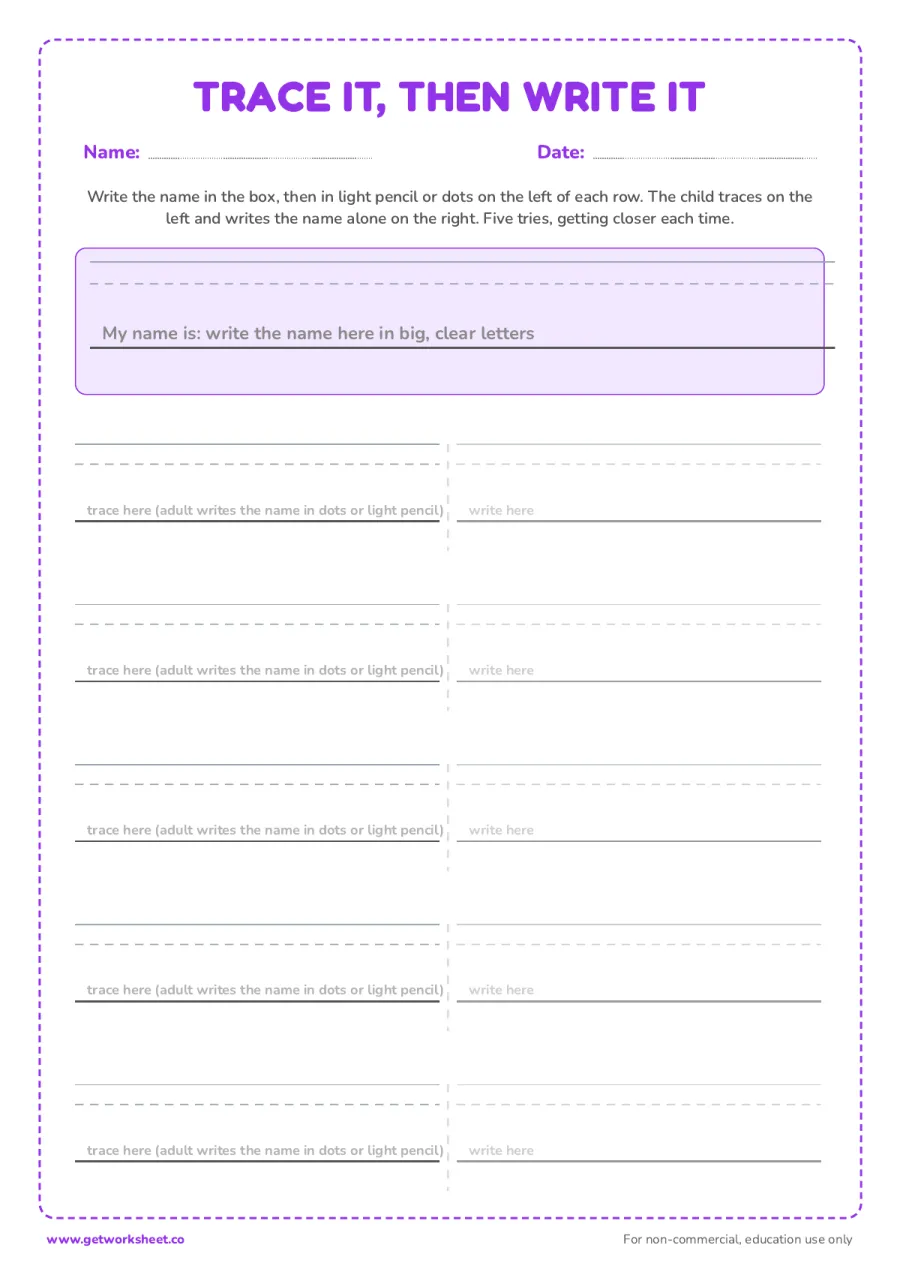
Trace it, then write it
A model box at the top and five rows split in half: trace the name on the left, write it alone on the right. Free printable PDF.
AI worksheet generator
Make a worksheet like this for your class
The 8 sheets above are fixed. The generator writes a new name tracing worksheet for your grade, with the question types and count you choose, in about 20 seconds. Pick a grade to start:
What you get
- A fresh set of questions on name tracing, not a copy of the sheets above
- Multiple choice, fill in the blanks, true or false, open ended
- Answer key and print-ready PDF with Pro
Free account, 1 worksheets a week. No card.
A child's own name is the first word they want to write, and the one they will write most often for the rest of school. These eight name tracing worksheets cover both ways of practicing it. Three sheets come pre-filled with the twenty most common first names in the United States (Liam, Olivia, Noah, Emma, Oliver, Charlotte and so on), each shown as a colored model, then in dotted letters to trace twice, then a blank line to write it. The other five sheets are blank three-line handwriting strips in three rule heights, a rainbow writing page and a trace-then-write page: print one, write your child's name on the first line in pencil or dots, and they trace it. The letters are a plain school print font with a top line, a dashed midline and a baseline, so what children practice here matches the letters they meet in kindergarten.
What's in this set
- Trace the names 1, 2 and 3. Twenty common first names, six or seven per sheet: model, trace twice, write once. Useful for a classroom where several children share these names, or as a model for how to set out any name.
- Blank name strips, tall rules. Six wide strips for ages 3 to 4. Write the name on the first strip; your child traces it and copies it on the rest.
- Blank name strips, medium rules. Eight strips for ages 4 to 5, when the letters are getting steadier.
- Blank name strips, small rules. Ten strips close to normal kindergarten handwriting size.
- Rainbow name writing. One large set of rules to write the name in pencil and trace over in three colors, then four smaller rows to repeat it. The letters get written four times without the child noticing the repetition.
- Trace it, then write it. A model box at the top and five rows split in half: trace on the left, write alone on the right.
Free printable makers
Make your own name tracing sheets
Type your own words or numbers and print in about 30 seconds. No account, no AI, answer key where it applies.
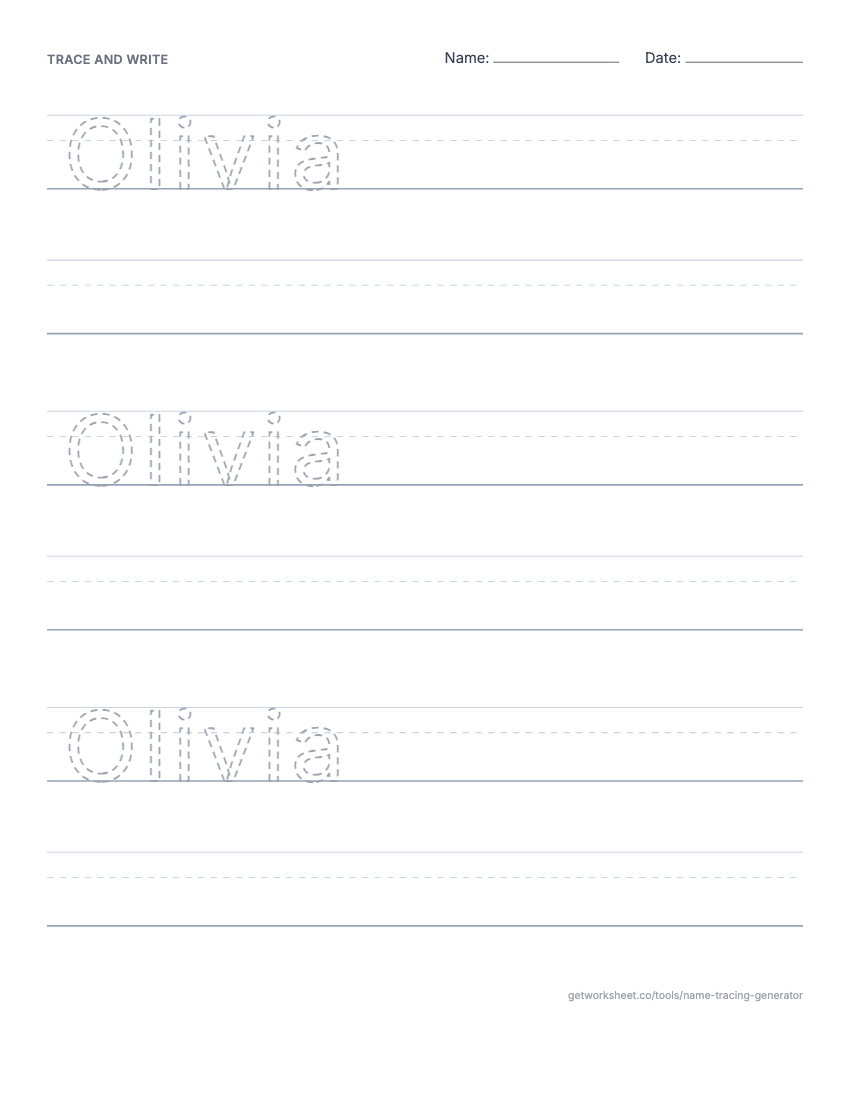 Name tracing generatorDashed, dotted or grey letters on handwriting lines. Free to print.
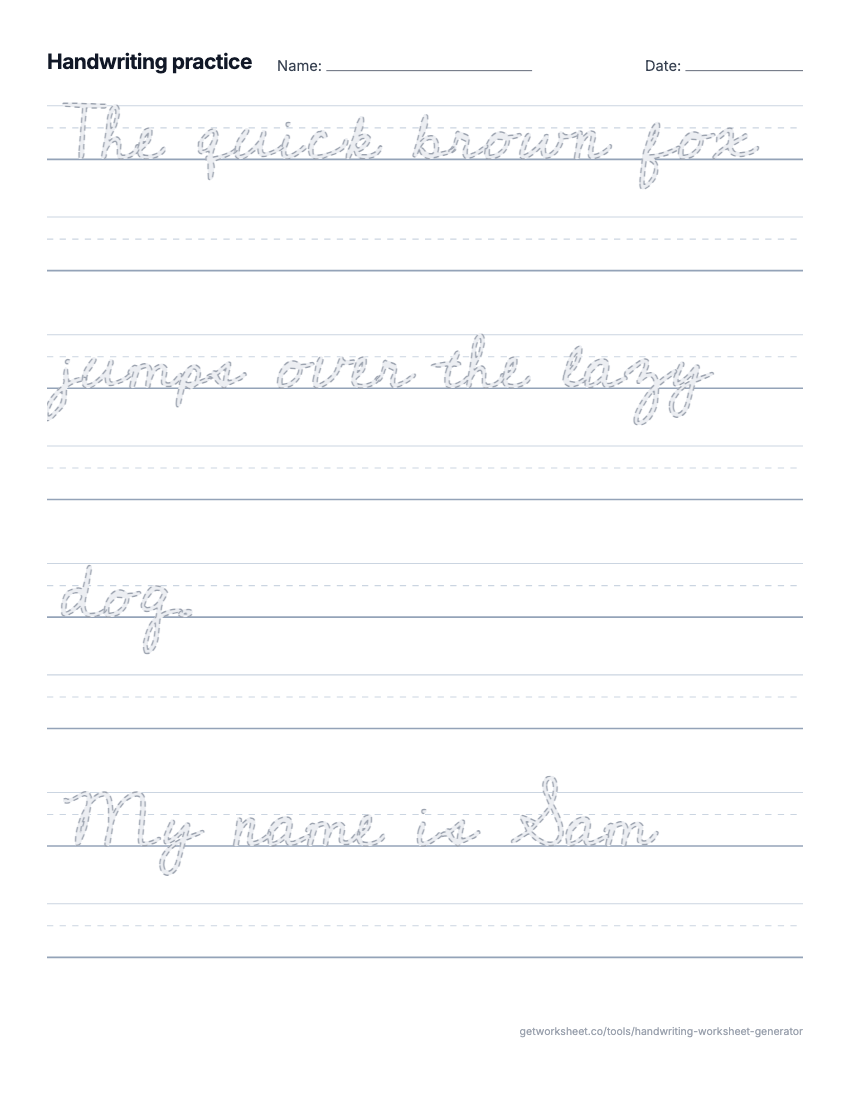 Handwriting worksheet generatorYour sentences as print or cursive tracing rows on guide lines. Free to print.
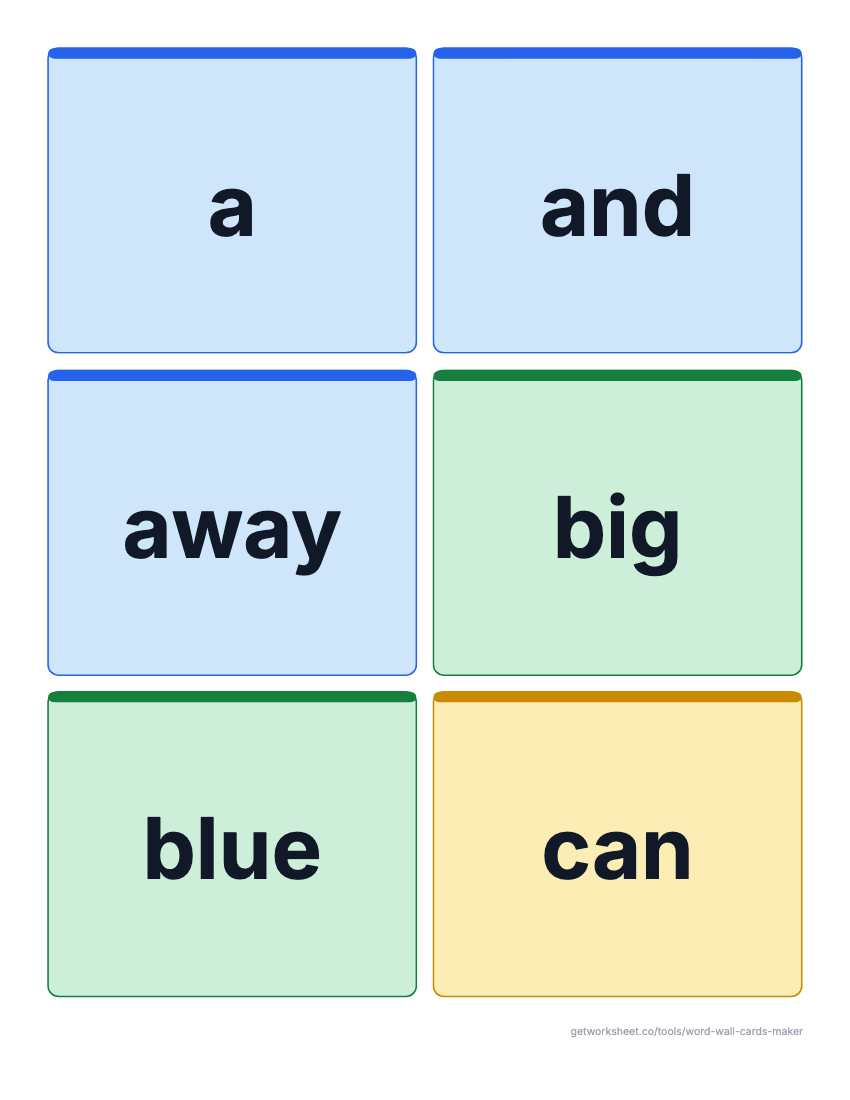 Word wall cards makerDolch, Fry or your own words as big-print cards, colour-coded, with A-Z headers. Free to print.
AI worksheet generator
Need a different name tracing worksheet?
Generate a custom name tracing worksheet: pick the grade, question types and count, and print it in about 20 seconds. Free accounts get 1 generation a week.
How to use these worksheets
Print at 100% on A4 or US Letter. For the blank sheets, write the name with a capital first letter and lowercase after it, the way it will be written at school. Dots or a light pencil line are easier to trace than a solid marker line.
- Pick the rule height by age, not by grade. Tall rules for ages 3 to 4, when the whole arm is still doing the writing. Medium rules at 4 to 5. Small rules once the child can already trace neatly and is ready to write at the size kindergarten expects.
- Trace the names 1 to 3. Say the name and spell it aloud first. Then finger-trace the colored model, trace the two dotted copies with a pencil, and write it on the empty line. Children who find their own name here get a lift; for everyone else these sheets show how a name is laid out before you write their own on a blank strip.
- Start every letter at the top. Capitals touch the top line, small letters reach the dashed midline, and g, j, p, q and y hang below the baseline. Watch the first letter: children often start a capital from the bottom because it feels natural, and the habit is hard to undo later.
- Pencil grip. A short pencil or a crayon stub forces a three-finger grip better than any instruction. For three-year-olds, tracing with a finger first and then a chunky crayon is enough.
- Rainbow writing. Pencil first, then red, yellow and blue crayons over the same letters. Say each letter name on every pass. This is the sheet to use when a child is bored of plain tracing.
- Trace it, then write it. Write the name in the box at the top and in light pencil on the left of each row. Expect the right-hand copies to get closer to the model as the rows go down; point out what improved.
Common mistakes to watch for
- All capitals. Many children first learn their name in capitals from labels and toys. Kindergarten teachers ask for a capital first letter and lowercase after it, so model that from the start.
- Letters floating above the line. Point at the baseline and say "every letter sits on the floor".
- Reversed letters. b and d, p and q, s and z are often flipped at this age. It is normal until about six; trace the dotted version together rather than correcting the free writing.
- Tracing too fast. The dots are a guide for slow, careful movement. If the lines wander off the dots, go back up a rule height.
Frequently asked questions
What age are name tracing worksheets for?
Ages 3 to 6. Most children can trace their name with a chunky crayon at 3 to 4 (tall rules), trace with a pencil and copy it at 4 to 5 (medium rules), and write it without a guide around 5 to 6 (small rules). Writing their first and last name is a common kindergarten goal.
Can I type my child's name to make a custom sheet?
Not yet. The five blank sheets are the way to do it: print one and write the name on the first line in pencil or dots for your child to trace. A name field in the worksheet generator is on our list. If your child's name is one of the twenty on the pre-filled sheets, those are ready to print.
Should I write the name in capitals?
No. Use a capital first letter and lowercase for the rest, because that is how the name is written at school. If your child already writes it in capitals, keep tracing the lowercase version alongside; it usually switches over within a few weeks.
Which font are the letters in?
A plain print school font with a simple a and g, no serifs and no cursive joins, the style most US kindergarten programs teach first. The rules are the standard three lines: top, dashed midline, baseline.
Can I reuse the sheets?
Yes. Laminate a blank sheet or put it in a plastic sleeve, write the name with a dry-erase marker in one color and let your child trace in another. The PDFs are free for home and classroom use.
More tracing and handwriting practice
If the letters in the name are new, start with the letter worksheets, which trace each letter of the alphabet on its own, and the line tracing worksheets for the strokes underneath. The handwriting worksheets continue with words and sentences on the same three-line rules. Numbers come next with the number tracing worksheets 1 to 20, and the shape tracing worksheets use the same start-dot tracing for shapes.
Free library
Related collections
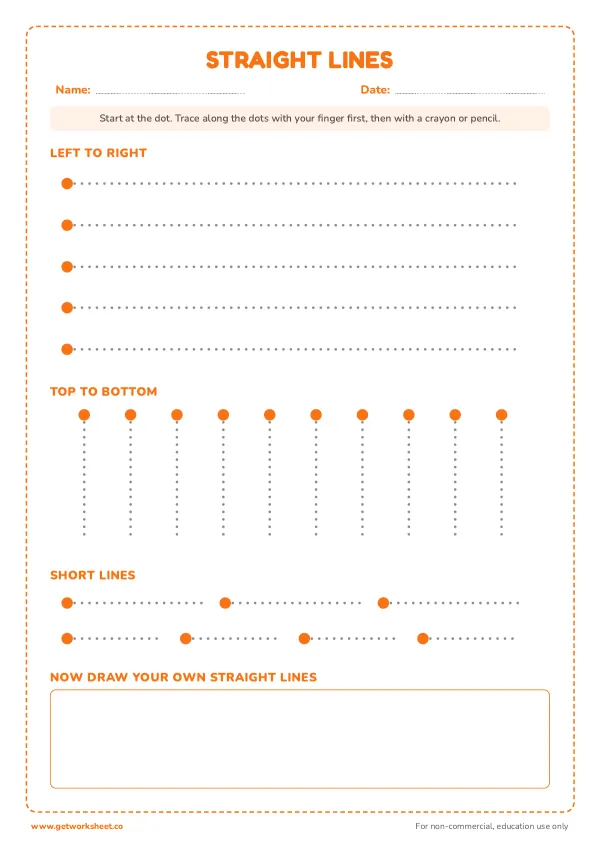
Free line tracing worksheets
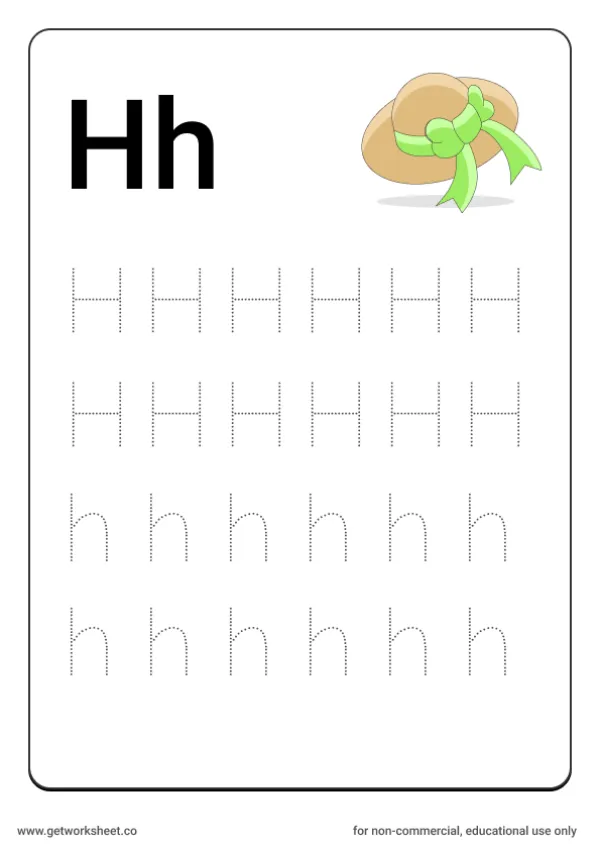
Free letter worksheets
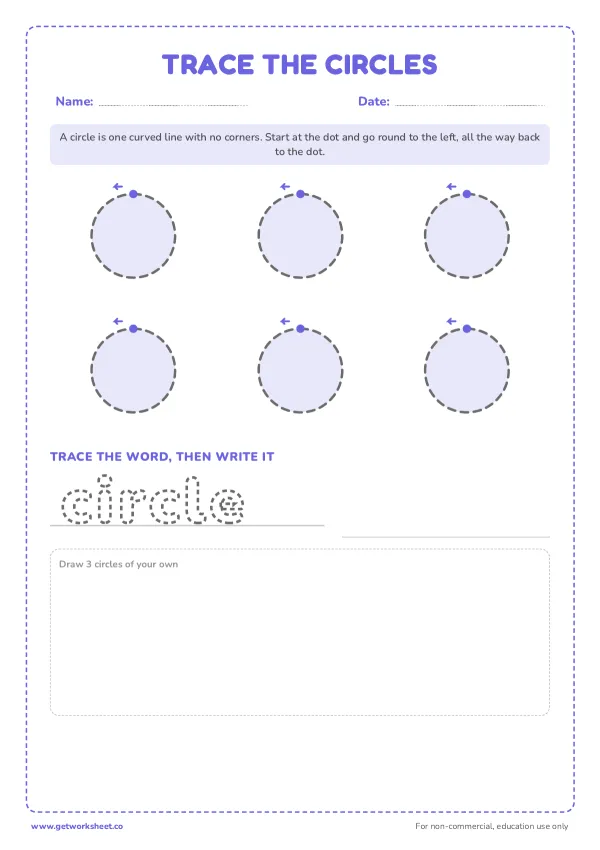
Free shape tracing worksheets
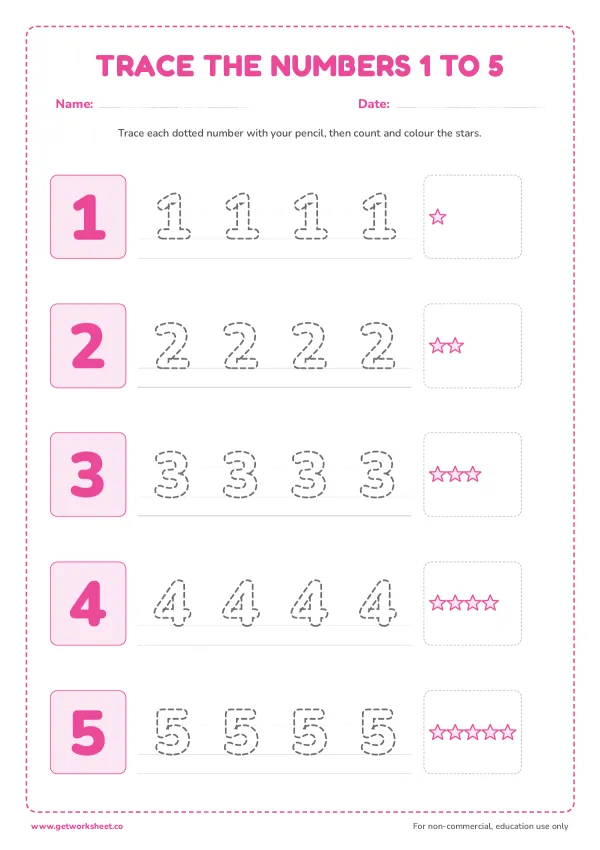
Free number tracing worksheets (1-20)
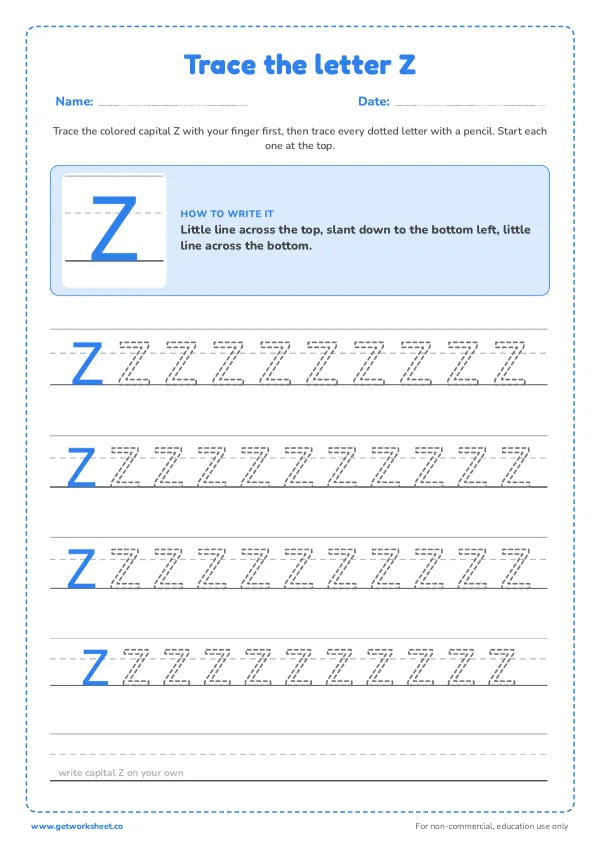
Free letter Z tracing worksheets
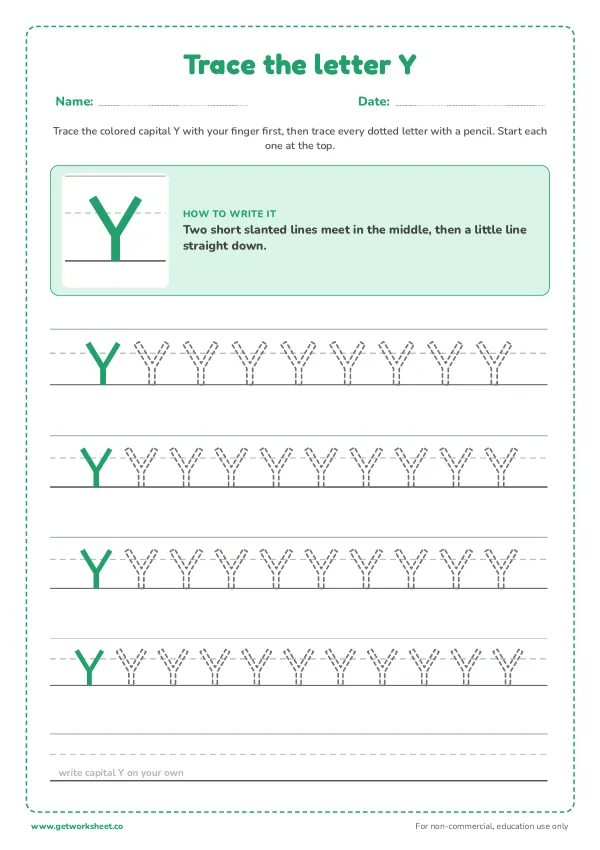
Free letter Y tracing worksheets
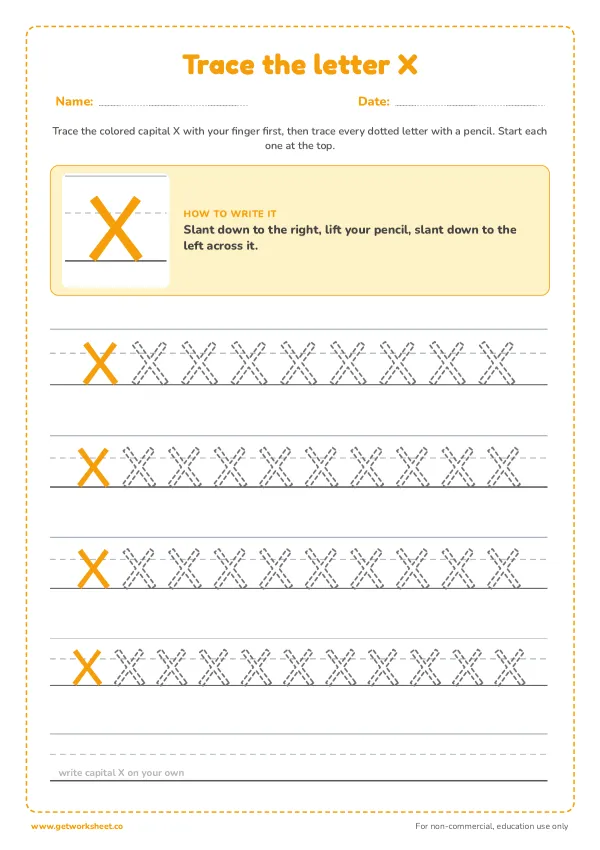
Free letter X tracing worksheets
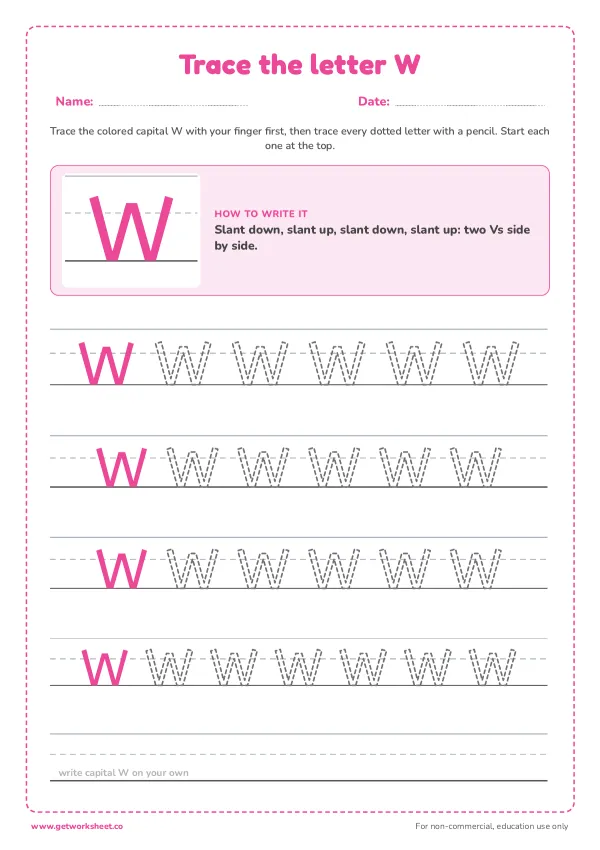
Free letter W tracing worksheets
More worksheets
- Free letter V tracing worksheets
- Free letter U tracing worksheets
- Free letter T tracing worksheets
- Free letter S tracing worksheets
- Free letter R tracing worksheets
- Free letter Q tracing worksheets
- Free letter P tracing worksheets
- Free letter O tracing worksheets
- Free letter N tracing worksheets
- Free letter M tracing worksheets
- Free letter L tracing worksheets
- Free letter K tracing worksheets