Maths · Grades 4–6
Free composite number worksheets
Five printable composite numbers worksheets for grades 4 to 6. Each sheet is a 16-number grid: circle the composite numbers, then list their factors in the box below. Answer keys included on this page.
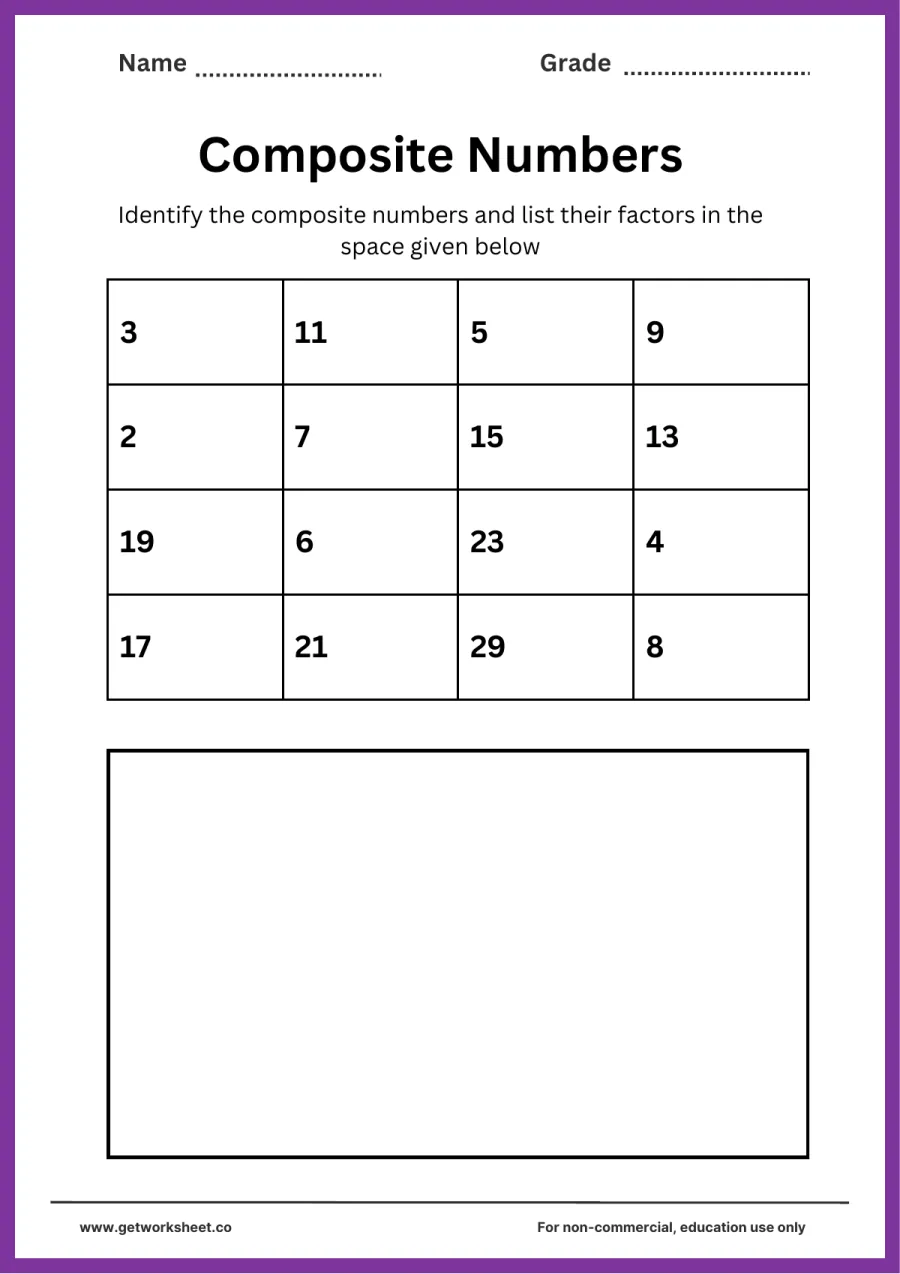
Composite numbers grid 1 (six composites)
Sixteen numbers from 2 to 29; circle the composites (4, 6, 8, 9, 15, 21) and list their factors in the box. Grade 4.
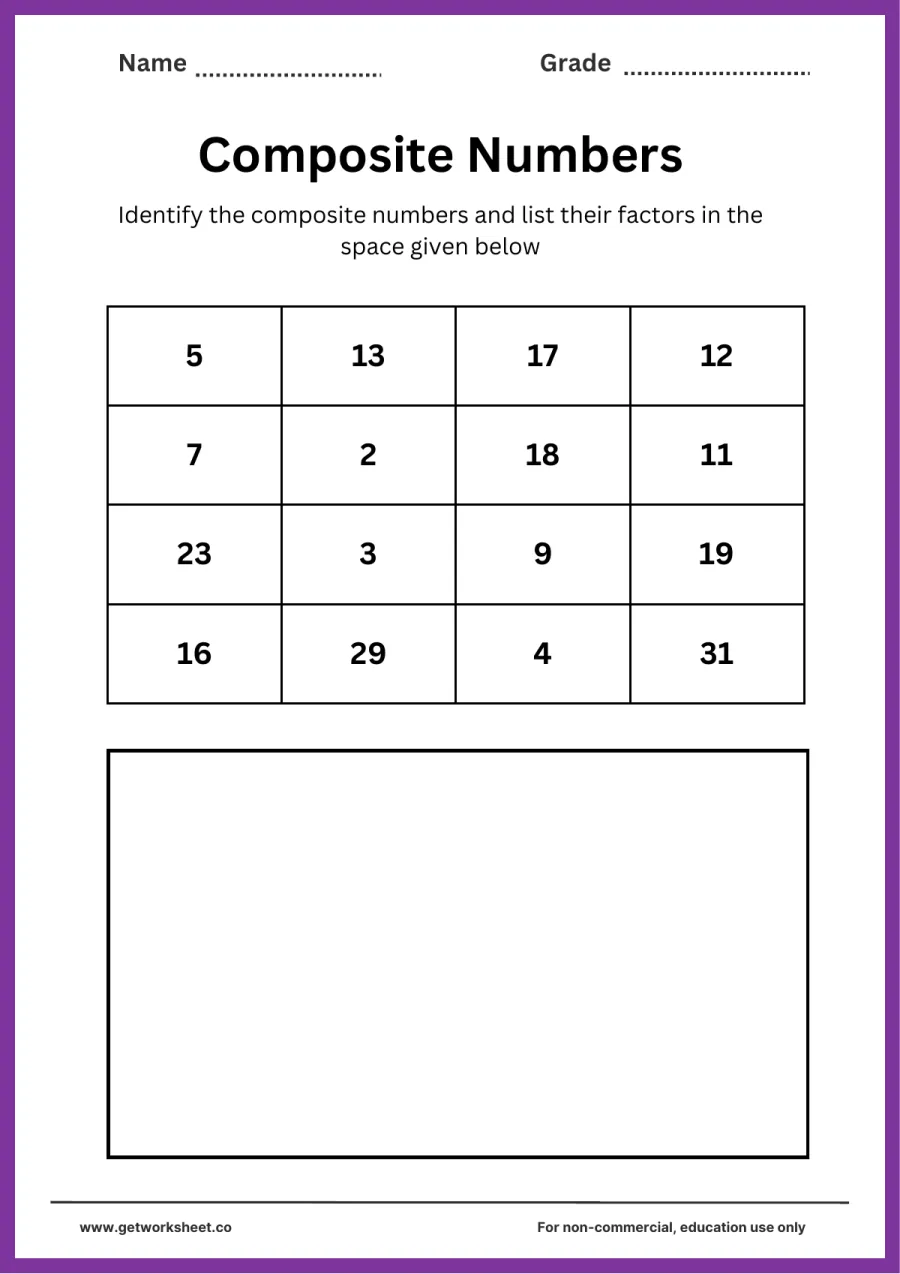
Composite numbers grid 2 (12, 16, 18)
Sixteen numbers to 31 including 12, 16 and 18, the longest factor lists in the set. Circle composites, list factors.
Whole set
All 5 in one PDF
- Every sheet on this page, one file
- No ads, no countdowns, print as often as you like
- Instant download, ad-free, no account needed
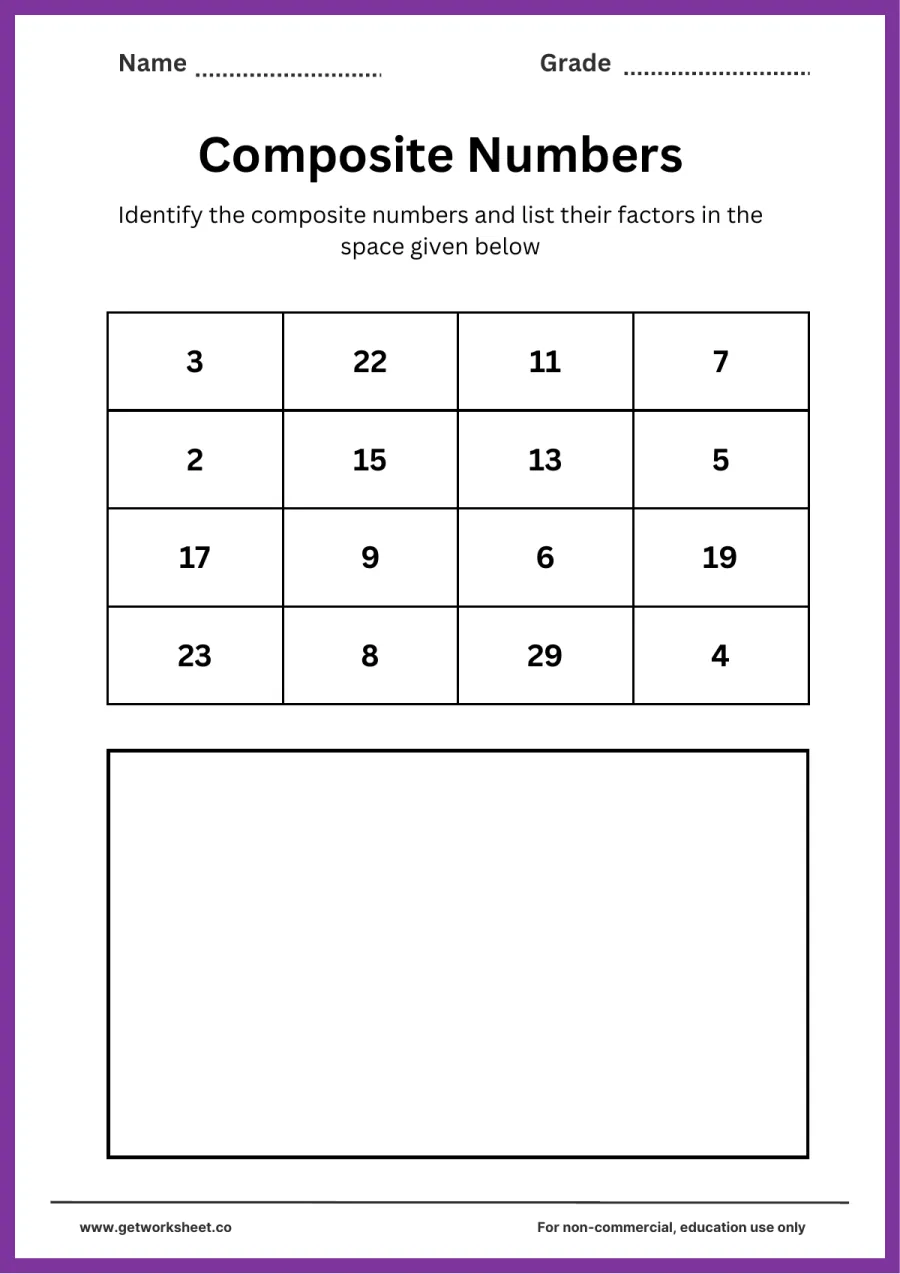
Composite numbers grid 3 (includes 22)
Sixteen numbers to 29; 22 is the one students most often call prime. Circle the six composites and list factors.
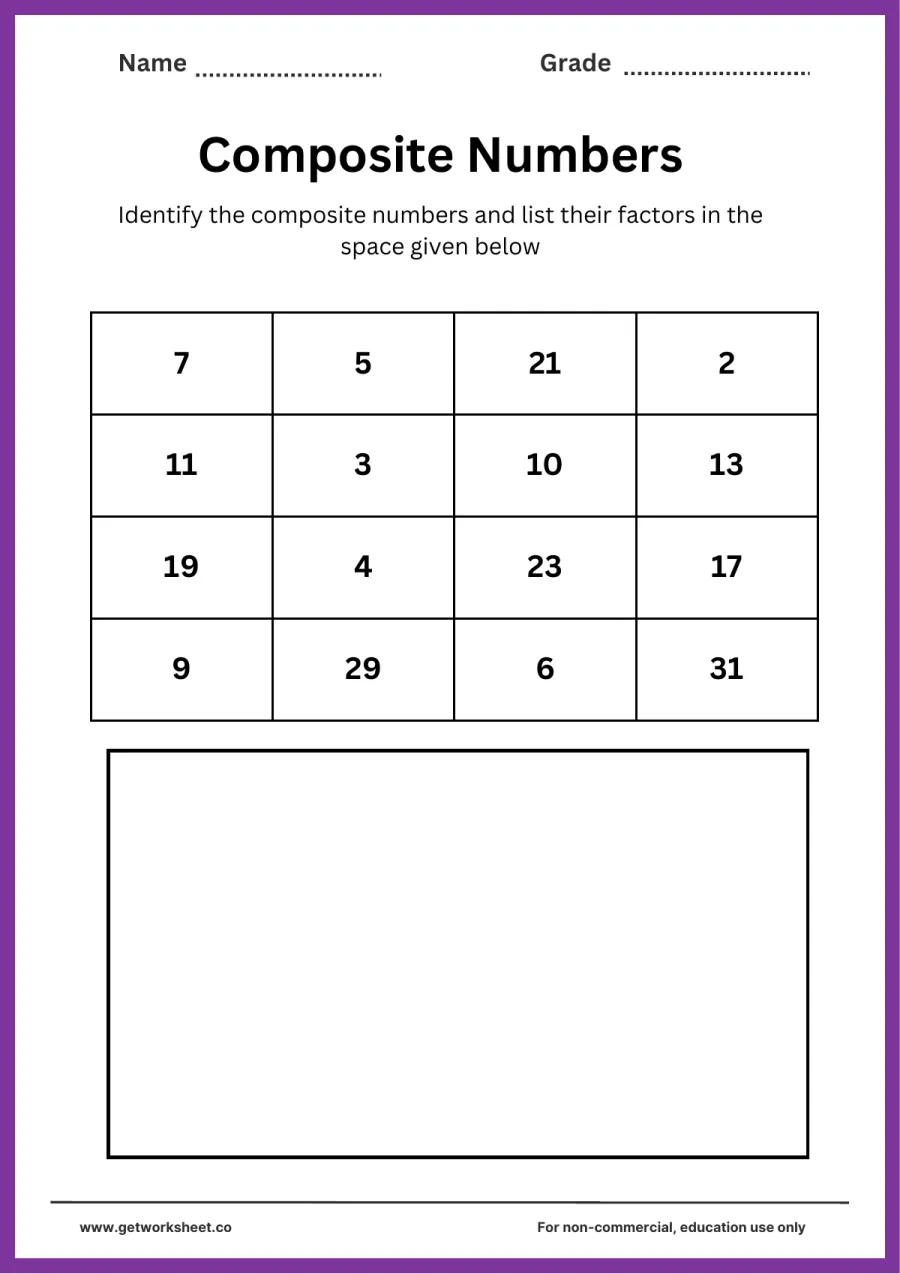
Composite numbers grid 4 (five composites)
Sixteen numbers to 31 with five composites (4, 6, 9, 10, 21). Circle and list factors. Grade 4 to 6.
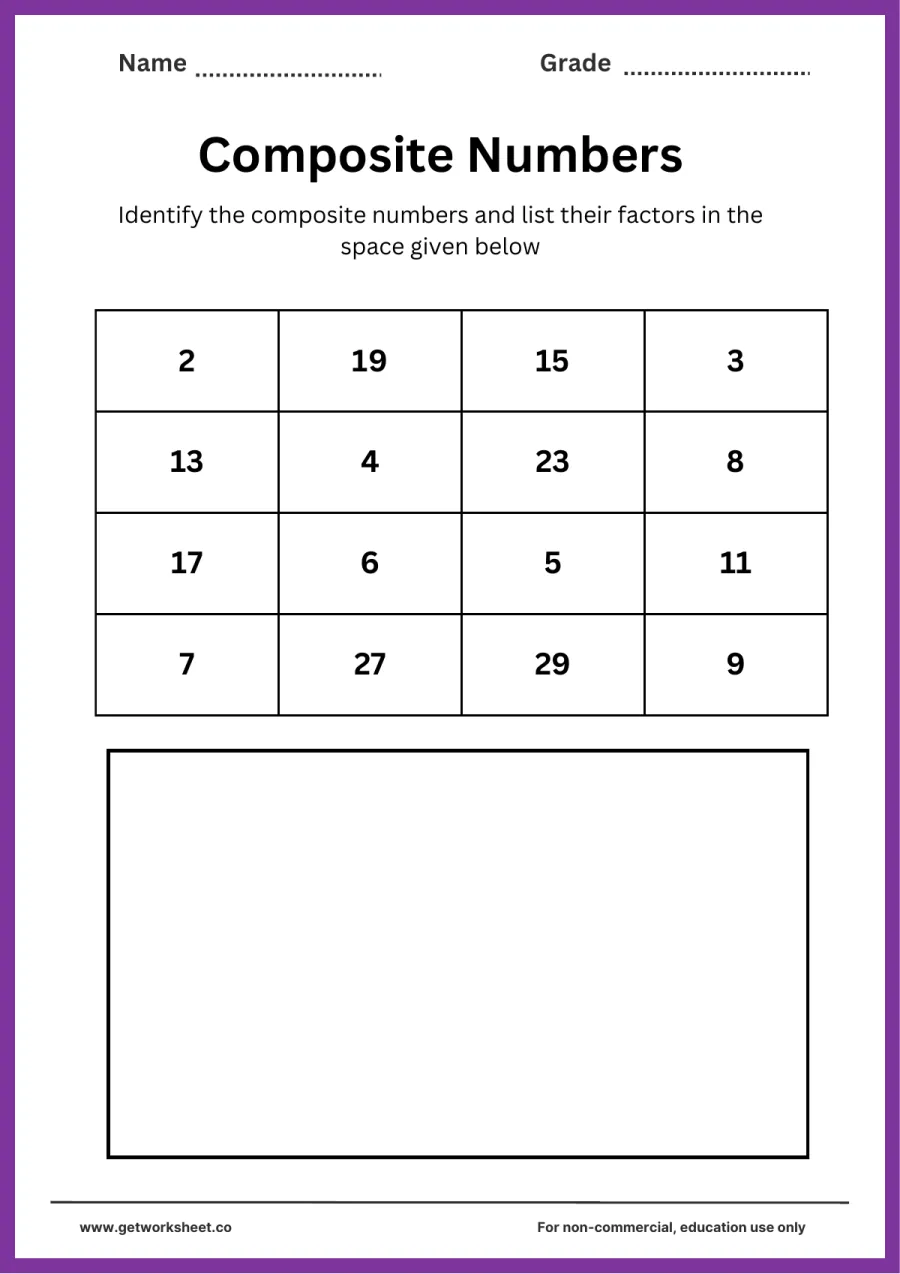
Composite numbers grid 5 (includes 27)
Sixteen numbers to 29 with 27 to test the divisibility-by-3 check. Six composites; list all factors.
AI worksheet generator
Make a worksheet like this for your class
The 5 sheets above are fixed. The generator writes a new composite number worksheet for your grade, with the question types and count you choose, in about 20 seconds. Pick a grade to start:
What you get
- A fresh set of questions on composite number, not a copy of the sheets above
- Multiple choice, fill in the blanks, true or false, open ended
- Answer key and print-ready PDF with Pro
Free account, 1 worksheets a week. No card.
A composite number is a whole number greater than 1 with more than two factors. These five worksheets give students 80 numbers between 2 and 31 to sort into prime and composite, and, more importantly, a large box to prove each decision by writing the factor list. The proving step is what separates children who understand composites from children who have memorized a list of primes.
What's in this set
- Grid 1: 3, 11, 5, 9, 2, 7, 15, 13, 19, 6, 23, 4, 17, 21, 29, 8. Six composites, ten primes.
- Grid 2: 5, 13, 17, 12, 7, 2, 18, 11, 23, 3, 9, 19, 16, 29, 4, 31. Five composites; includes 12, 16 and 18, which have the longest factor lists in the set.
- Grid 3: 3, 22, 11, 7, 2, 15, 13, 5, 17, 9, 6, 19, 23, 8, 29, 4. Six composites; 22 is the one children most often call prime.
- Grid 4: 7, 5, 21, 2, 11, 3, 10, 13, 19, 4, 23, 17, 9, 29, 6, 31. Five composites.
- Grid 5: 2, 19, 15, 3, 13, 4, 23, 8, 17, 6, 5, 11, 7, 27, 29, 9. Six composites; 27 tests whether students check for 3 as a factor.
Every sheet has the same instruction ("Identify the composite numbers and list their factors in the space given below"), a name and grade line, and a blank answer box roughly half the page, so the five sheets can be used as one lesson, five warm-ups, or a pre-test and post-test pair.
What students will practice
- Deciding whether a number up to 31 is prime or composite (Common Core 4.OA.B.4)
- Listing every factor of a composite number, not just one factor pair
- Using divisibility checks for 2, 3 and 5 instead of guessing
- Explaining reasoning in writing: "9 is composite because 3 x 3 = 9"
- Recognizing that 2 is prime and that every other even number is composite
Free printable makers
Make your own composite number sheets
Type your own words or numbers and print in about 30 seconds. No account, no AI, answer key where it applies.
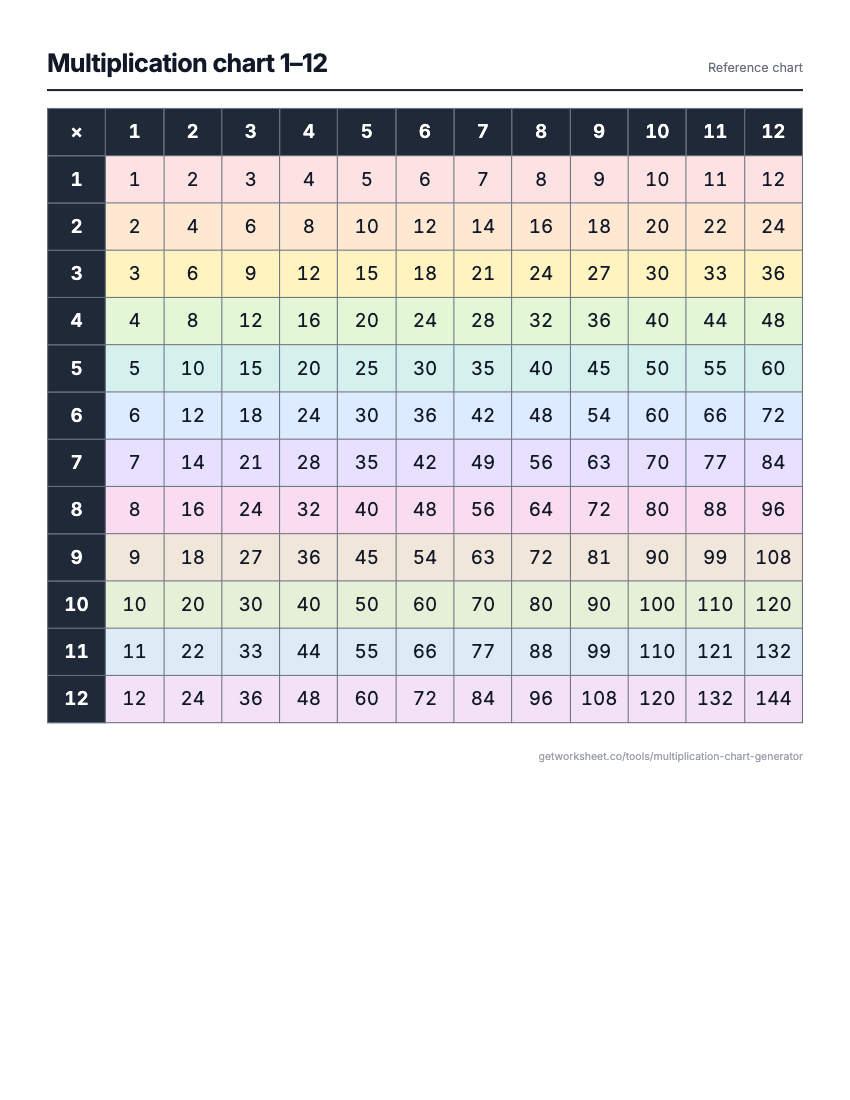 Multiplication chart generatorCharts to 15, full, blank or coloured, and times table tests with key. Free to print.
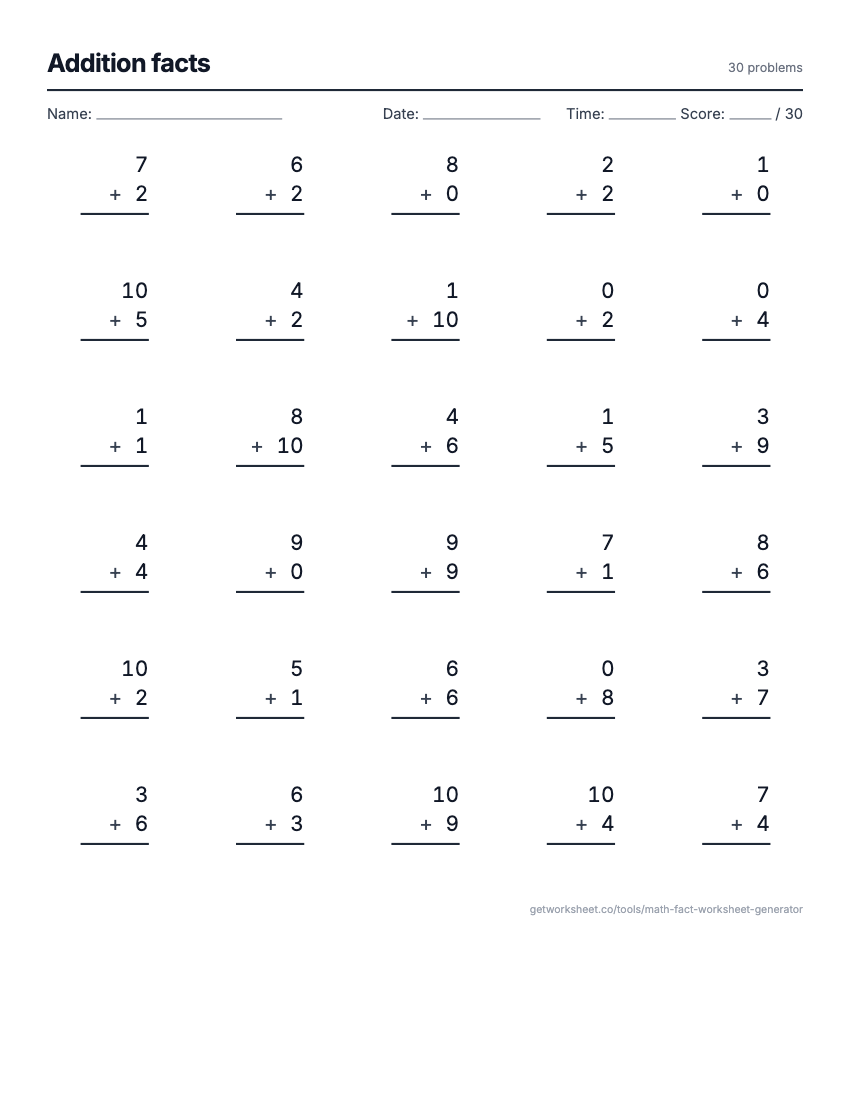 Math fact worksheet generatorAddition to division drills with an answer key. Free to print.
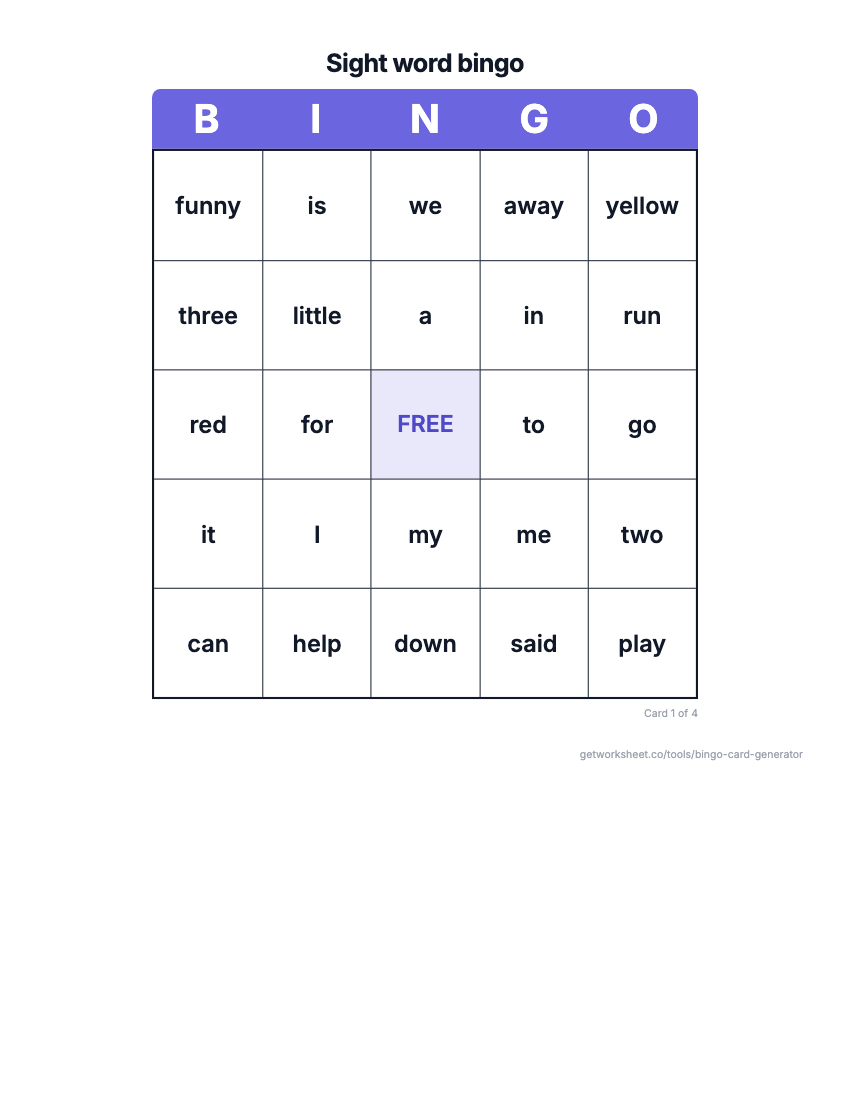 Bingo card generatorSight word, number, math fact or custom bingo cards with a call sheet. Free to print.
AI worksheet generator
Need a different composite number worksheet?
Generate a custom composite number worksheet: pick the grade, question types and count, and print it in about 20 seconds. Free accounts get 1 generation a week.
Teaching tips and common mistakes
How to use these worksheets in class
- Start with rectangles, not rules. Give pairs of students 12 counters and ask for every rectangle they can make (1 x 12, 2 x 6, 3 x 4). Repeat with 7 counters (only 1 x 7). Composite numbers make more than one rectangle. Then hand out grid 1.
- Insist on the factor list. The box under each grid is the point of the sheet. Ask for factors written in pairs from the outside in (1 and 12, 2 and 6, 3 and 4) so students know when they have finished: when the pairs meet in the middle.
- Use grids 1 and 5 as pre- and post-test. They have the same number of composites (six) and a similar mix, so a score of "4 out of 6 with correct factors" before the unit and "6 out of 6" after shows growth on a like-for-like task.
- Turn grid 3 into a discussion. Before anyone writes, ask the class to vote on 22 and 9. Both look prime to many children (22 because it "looks odd", 9 because it is odd). The vote surfaces the misconception; the factor list settles it.
- Extension for fast finishers: write each composite number as a product of primes (12 = 2 x 2 x 3). That connects directly to the prime factorisation sheets on the prime number worksheets page.
Answer key
- Grid 1 composites: 4 (1, 2, 4); 6 (1, 2, 3, 6); 8 (1, 2, 4, 8); 9 (1, 3, 9); 15 (1, 3, 5, 15); 21 (1, 3, 7, 21).
- Grid 2 composites: 4 (1, 2, 4); 9 (1, 3, 9); 12 (1, 2, 3, 4, 6, 12); 16 (1, 2, 4, 8, 16); 18 (1, 2, 3, 6, 9, 18).
- Grid 3 composites: 4 (1, 2, 4); 6 (1, 2, 3, 6); 8 (1, 2, 4, 8); 9 (1, 3, 9); 15 (1, 3, 5, 15); 22 (1, 2, 11, 22).
- Grid 4 composites: 4 (1, 2, 4); 6 (1, 2, 3, 6); 9 (1, 3, 9); 10 (1, 2, 5, 10); 21 (1, 3, 7, 21).
- Grid 5 composites: 4 (1, 2, 4); 6 (1, 2, 3, 6); 8 (1, 2, 4, 8); 9 (1, 3, 9); 15 (1, 3, 5, 15); 27 (1, 3, 9, 27).
Every other number on the grids is prime: 2, 3, 5, 7, 11, 13, 17, 19, 23, 29, 31.
Common mistakes to watch for
- "Odd means prime." 9, 15, 21 and 27 are on the grids for this reason. Ask students to test 3 as a factor of every odd number before deciding.
- Forgetting 1 and the number itself. A factor list of "2, 3" for 6 is incomplete. Teach the outside-in pairing so 1 and 6 are always the first pair written.
- Treating 1 as prime or composite. It is neither; it has only one factor. The grids deliberately do not include 1, but the question will come up.
- Missing the middle factor of square numbers. For 9 and 4, one pair repeats (3 x 3, 2 x 2), so the list has an odd number of factors. Students often write 3 twice or leave it out.
Frequently asked questions
What grade are composite number worksheets for?
Grade 4 is where prime and composite numbers are introduced (Common Core 4.OA.B.4, and Year 5 in England). Grades 5 and 6 use the same sheets as revision before prime factorisation, highest common factor and lowest common multiple.
Is 1 a composite number?
No. 1 has exactly one factor, so it is neither prime nor composite. 2 is the only even prime; every other even number is composite because 2 is a factor.
Do these worksheets have answer keys?
The PDFs are single pages. The full answer key, including every factor list, is in the "Answer key" section above.
How are composite numbers different from prime numbers?
A prime has exactly two factors (1 and itself). A composite has three or more. The quickest classroom test: can you arrange that many counters into a rectangle that is not a single row? If yes, the number is composite.
What should students do after these sheets?
Move to factor trees and prime factorisation, then to the Sieve of Eratosthenes on a hundreds chart to find all primes to 100. Both are covered in the linked prime number set below.
Related number worksheets
The prime number worksheets are the natural partner: a prime chart to 100, the Sieve of Eratosthenes and factor trees. Factor fluency comes from the multiplication worksheets and multi-digit multiplication worksheets, and a blank hundreds chart makes a good grid for coloring composites and primes in two colors.
Free library
Related collections
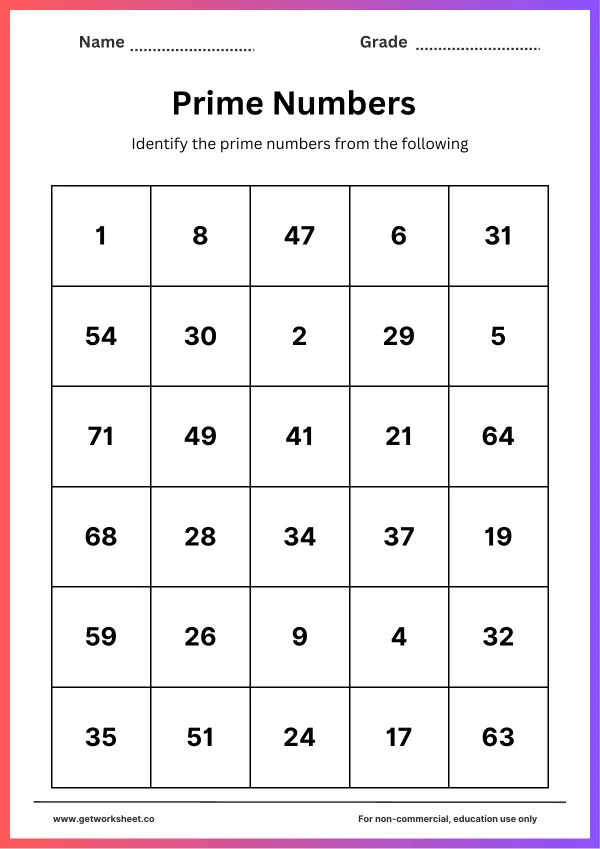
Free prime number worksheets
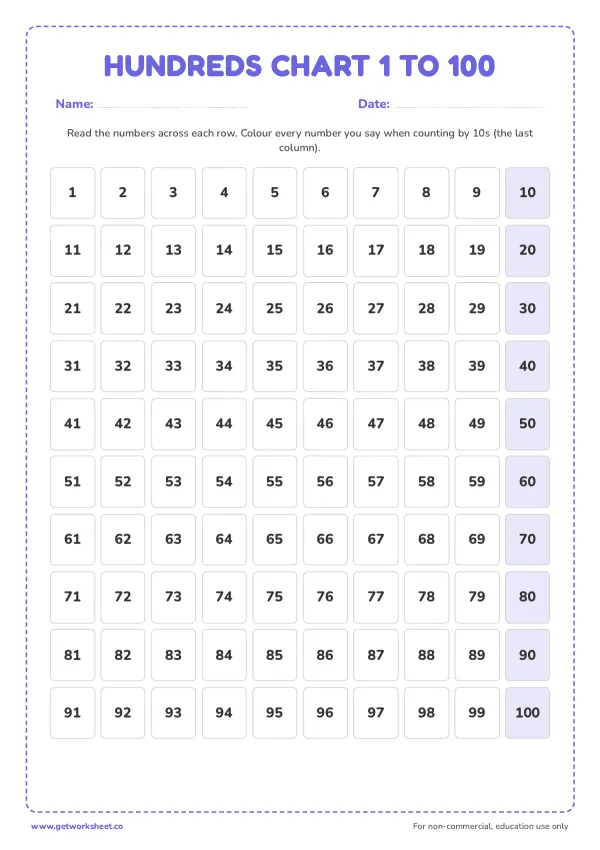
Free hundreds chart worksheets
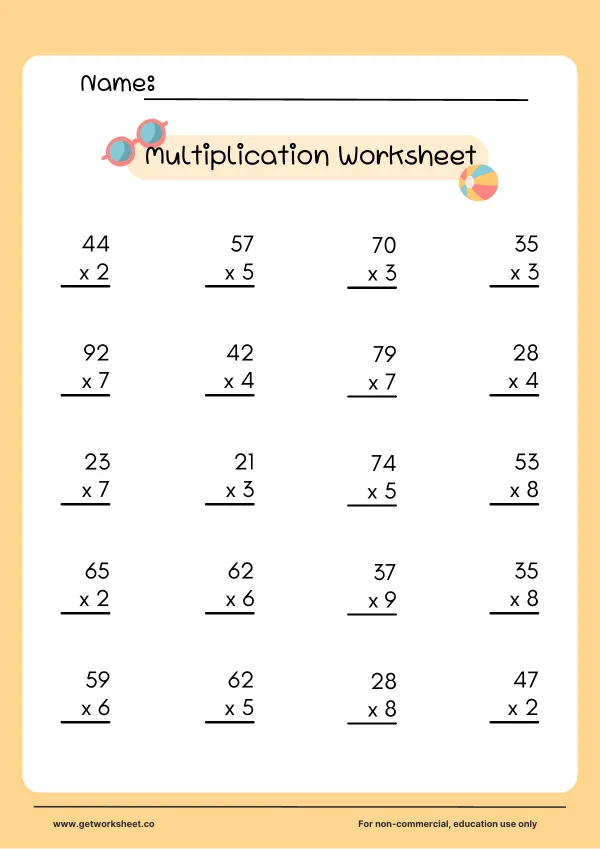
Free multiplication worksheets
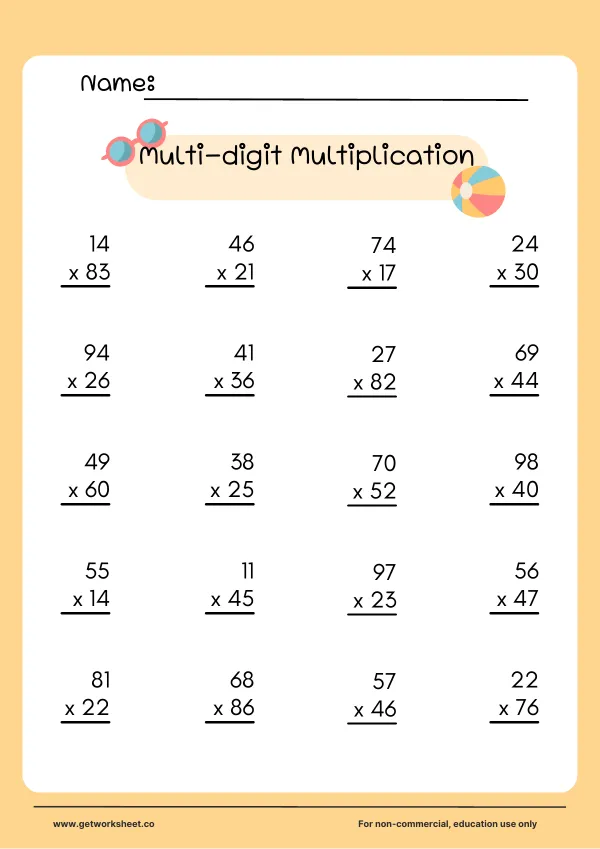
Free multi-digit multiplication worksheets
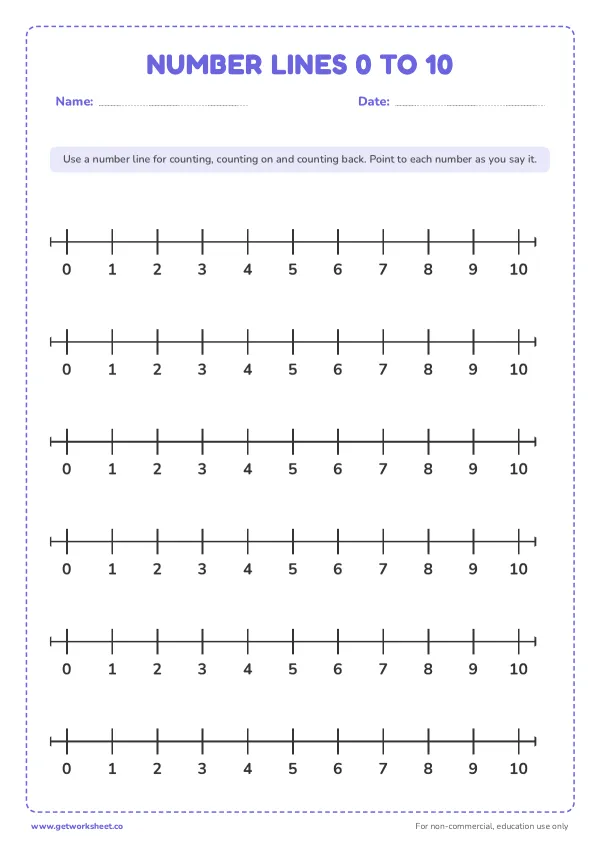
Free number line printables
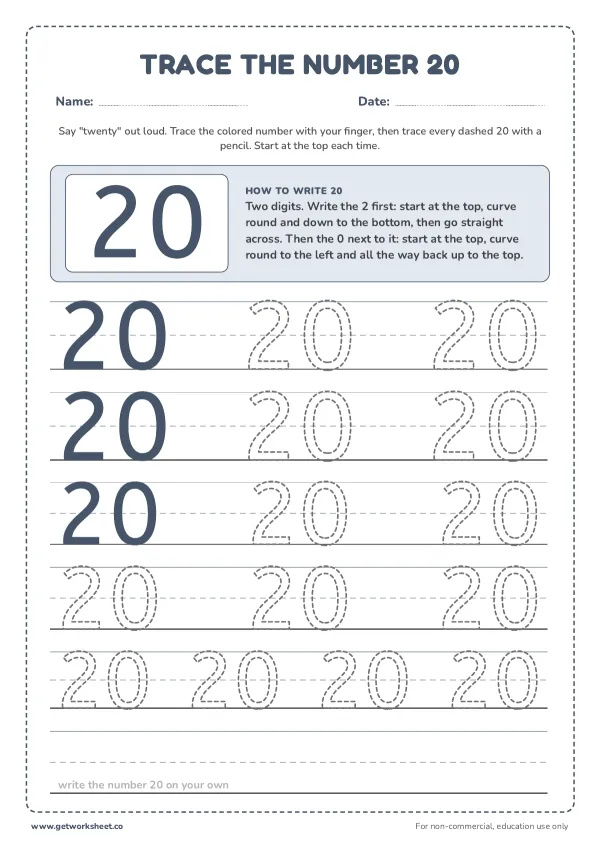
Free number 20 tracing worksheets
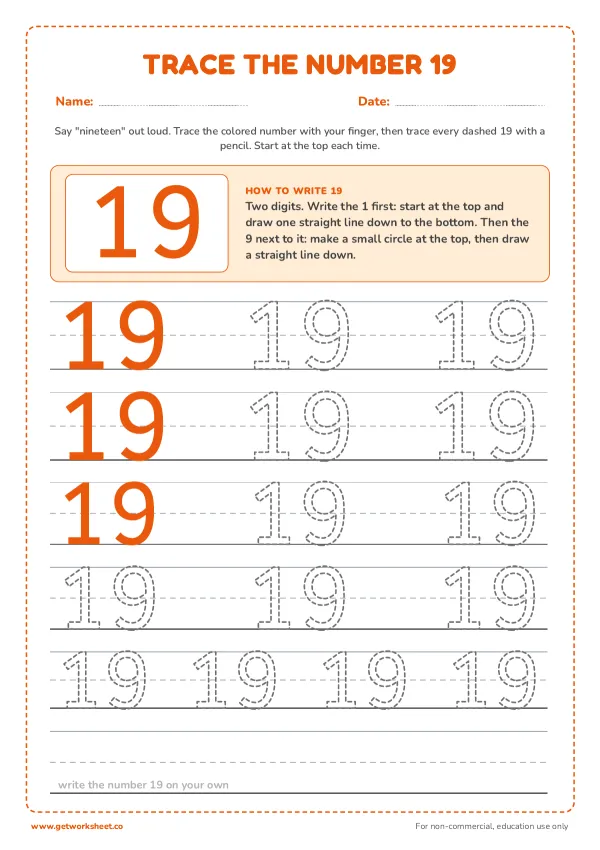
Free number 19 tracing worksheets
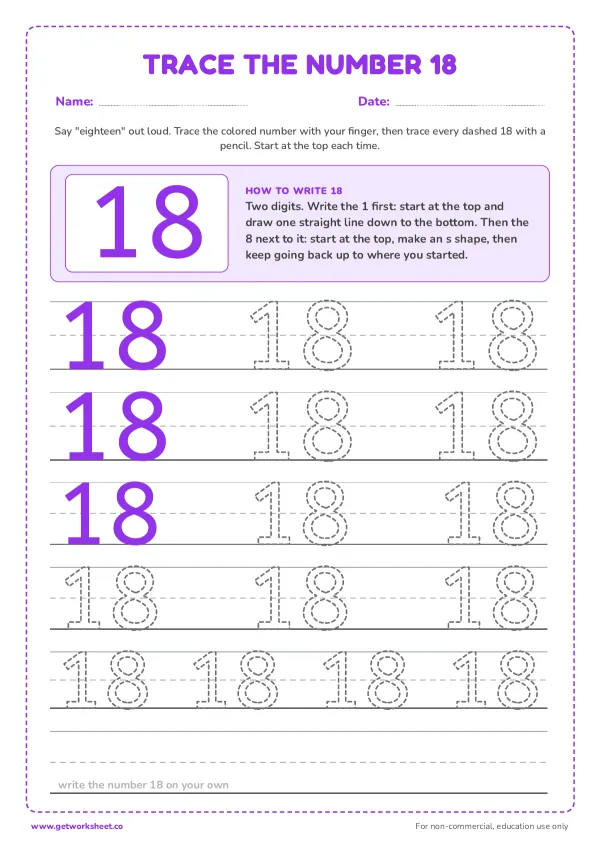
Free number 18 tracing worksheets
More worksheets
- Free number 17 tracing worksheets
- Free number 16 tracing worksheets
- Free number 15 tracing worksheets
- Free number 14 tracing worksheets
- Free number 13 tracing worksheets
- Free number 12 tracing worksheets
- Free number 11 tracing worksheets
- Free number 10 tracing worksheets
- Free number 9 tracing worksheets
- Free number 8 tracing worksheets
- Free number 7 tracing worksheets
- Free number 6 tracing worksheets