Chemistry · Grades 4–8
Free states of matter worksheets
Five printable states of matter worksheets for grades 4 to 8: sort eighteen materials and complete the properties table, identify and draw particle diagrams, label the six changes of state and more. Answer keys included.
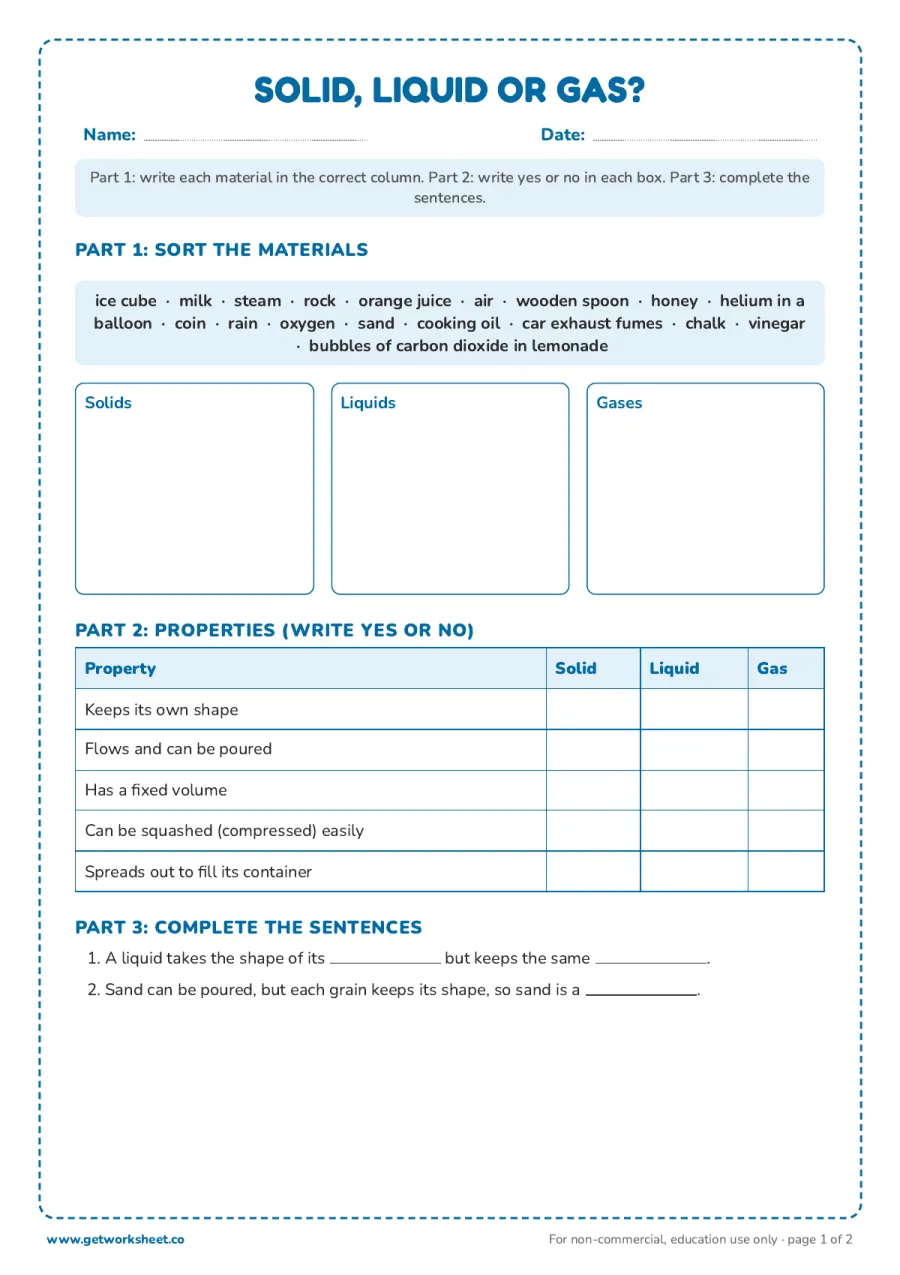
Solid, liquid or gas? Sort 18 materials, then the properties table
Eighteen everyday materials to sort into solids, liquids and gases, a properties table (keeps its shape, flows, fixed volume, can be squashed, fills its container) to complete with yes or no, and two sentences. Answer key on page 2.
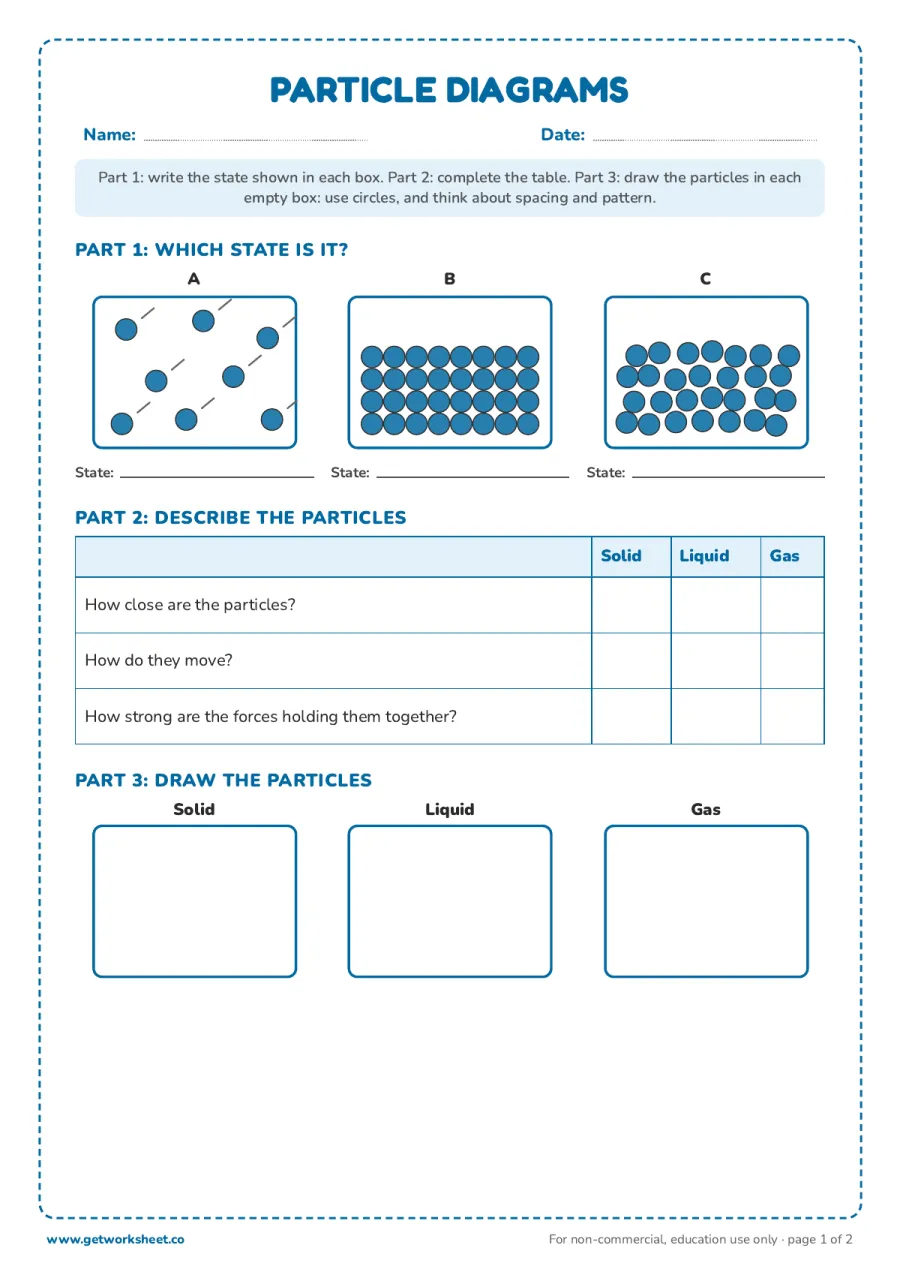
Particle diagrams: identify 3 states, describe the particles, draw your own
Three particle diagrams to identify as solid, liquid or gas, a table describing how close the particles are, how they move and how strong the forces between them are, and three empty boxes to draw the particles of each state. Answer key on page 2.
Whole set
All 5 in one PDF
- Every sheet on this page, one file
- No ads, no countdowns, print as often as you like
- Instant download, ad-free, no account needed
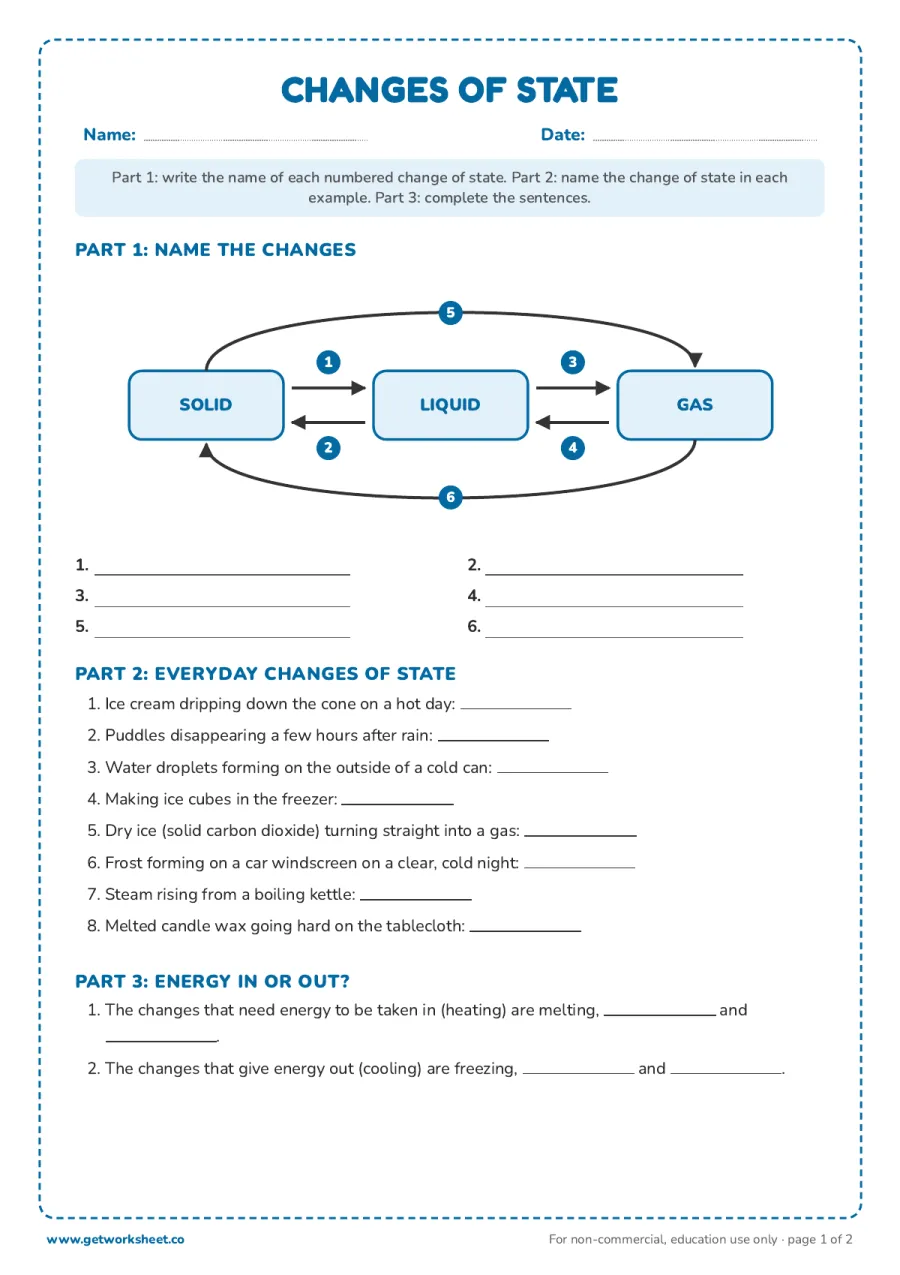
Changes of state: label the 6 arrows, then name 8 everyday changes
A solid-liquid-gas diagram with six numbered arrows to label (melting, freezing, evaporation, condensation, sublimation, deposition), eight everyday examples to name, and a question on which changes take energy in. Answer key on page 2.
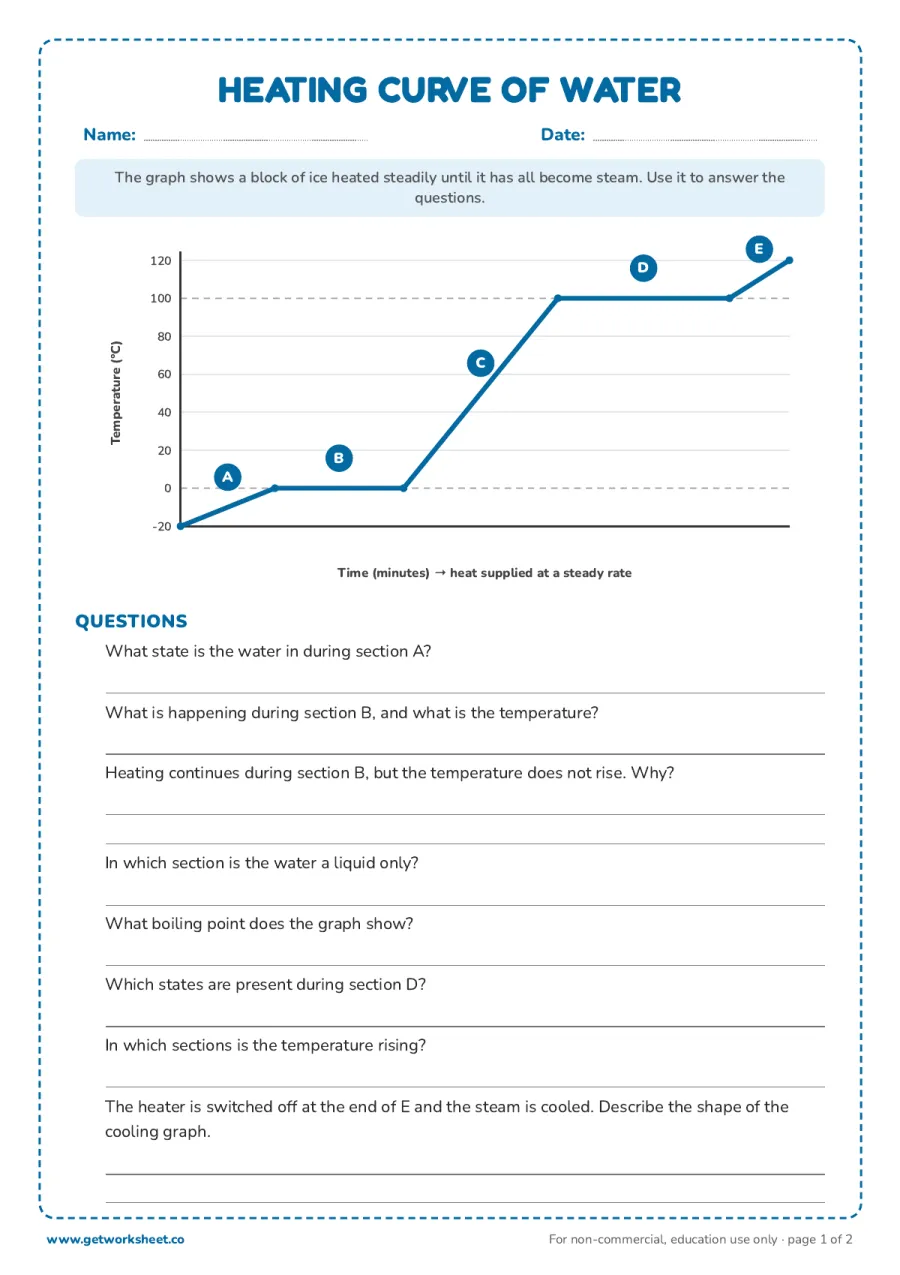
Heating curve of water: read the graph, 8 questions on the 5 sections
A heating curve for water from −20 °C to 120 °C with five lettered sections and eight questions: the state in each section, what happens on the flat parts, why the temperature stops rising while heating continues, and what the cooling curve would look like. Answer key on page 2.
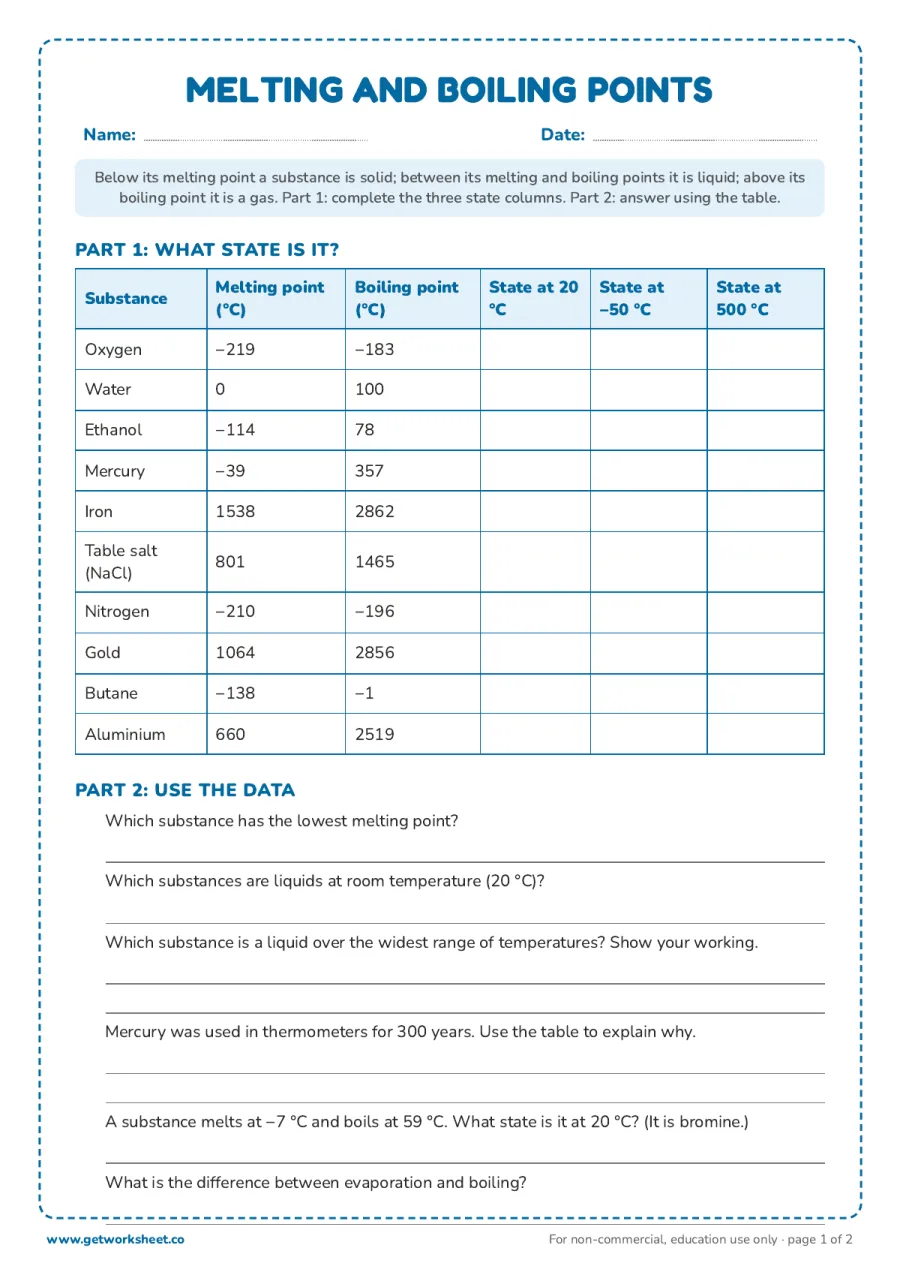
Melting and boiling points: state of 10 substances at 3 temperatures, 6 questions
A data table of ten substances (oxygen to gold) with melting and boiling points; students work out the state of each at 20 °C, −50 °C and 500 °C, then answer six questions including why mercury suits a thermometer and which substance is liquid over the widest range. Answer key on page 2.
AI worksheet generator
Make a worksheet like this for your class
The 5 sheets above are fixed. The generator writes a new states of matter worksheet for your grade, with the question types and count you choose, in about 20 seconds. Pick a grade to start:
What you get
- A fresh set of questions on states of matter, not a copy of the sheets above
- Multiple choice, fill in the blanks, true or false, open ended
- Answer key and print-ready PDF with Pro
Free account, 1 worksheets a week. No card.
States of matter is taught twice: once in elementary school as sorting solids, liquids and gases, and again in middle school as the particle model that explains why ice melts at exactly 0 °C and why the temperature stops rising while water boils. These five worksheets span both. The first two build the vocabulary and the particle pictures; the last three use them to explain changes of state, read a heating curve and predict the state of a substance from its melting and boiling points.
What's in this set
- Solid, liquid or gas? Eighteen materials from an ice cube to car exhaust fumes to sort into three columns, a five-row properties table to fill with yes or no for each state, and two fill-in sentences about liquids taking the shape of their container.
- Particle diagrams. Three drawn particle boxes (A, B, C, not in order) to name, a three-row table on particle spacing, movement and forces for each state, and three empty boxes for the student's own particle drawings.
- Changes of state. Six numbered arrows on a solid, liquid, gas diagram to name, eight everyday changes (ice cream dripping, dry ice smoking, frost forming) to identify, and a sort of the six changes into heating (energy in) and cooling (energy out).
- Heating curve of water. A temperature-time graph with sections A to E (ice warming, melting, water warming, boiling, steam warming) and eight questions that move from reading the graph to explaining the plateaus in terms of particles.
- Melting and boiling points. Ten substances with real melting and boiling points; three blank state columns at room temperature, −50 °C and 500 °C; six questions that use the data (lowest melting point, liquids at room temperature, widest liquid range, mercury thermometers, an unknown substance, evaporation versus boiling).
What students will practice
- Classifying materials as solid, liquid or gas and stating the properties of each state (shape, flow, volume, compressibility)
- Describing and drawing the arrangement, movement and forces of particles in each state (NGSS MS-PS1-4)
- Naming the six changes of state, including sublimation and deposition, and recognizing them in everyday life
- Knowing which changes take energy in and which give energy out
- Reading a heating curve and explaining the plateaus at the melting and boiling points in terms of particles
- Using melting and boiling point data to work out the state of a substance at a given temperature
Free printable makers
Make your own states of matter sheets
Type your own words or numbers and print in about 30 seconds. No account, no AI, answer key where it applies.
AI worksheet generator
Need a different states of matter worksheet?
Generate a custom states of matter worksheet: pick the grade, question types and count, and print it in about 20 seconds. Free accounts get 1 generation a week.
Teaching tips and common mistakes
How to use these worksheets in class
- Grades 4 and 5. Solid, liquid or gas? and Changes of state cover the elementary curriculum. Sand, honey and steam are on the sort deliberately: sand pours but is a solid, honey flows slowly but is a liquid, steam is a gas even though the cloud you see is tiny water droplets.
- Act out the particles. Before Particle diagrams, have students stand as particles: shoulder to shoulder and vibrating (solid), moving past each other in a huddle (liquid), spread around the room (gas). Then the drawings in part 3 are a record of what they did.
- Melt ice with a thermometer. Heating curve of water is far easier after students have watched a beaker of crushed ice sit at 0 °C for several minutes while being heated. Plot the class readings first, then read the printed graph.
- Data before definitions. Melting and boiling points asks students to reason from a table rather than memorize. The −50 °C column produces the surprises: butane becomes a liquid and ethanol stays liquid while water and mercury have frozen.
- Middle school in one lesson. Grades 6 to 8 can complete Particle diagrams, Heating curve of water and Melting and boiling points as a single revision lesson before a test.
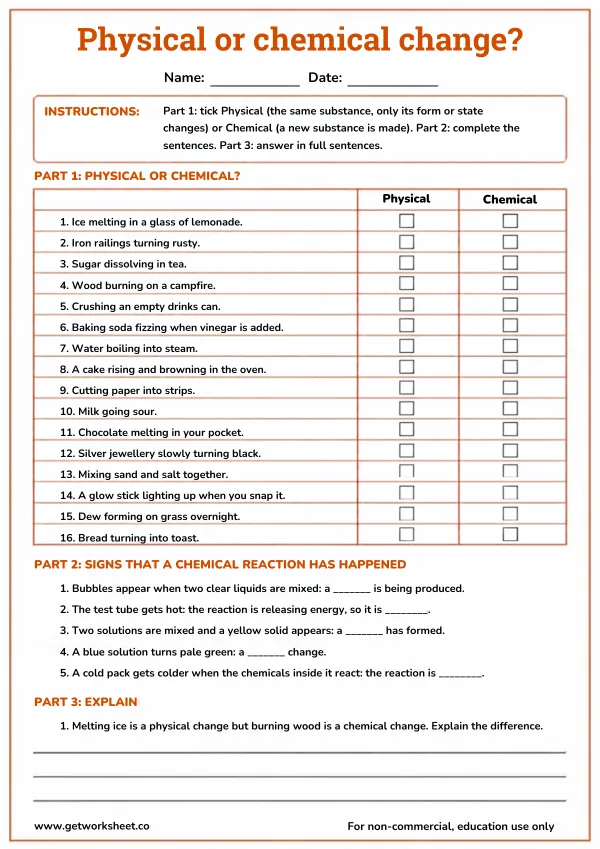
- Link to chemical change. Every change on these sheets is physical. The chemical reactions worksheets open with a physical-or-chemical sort that follows on directly.
Answer key
Every practice sheet carries its own answer key on page 2 of the PDF. The keys are repeated here for quick marking.
- Solid, liquid or gas?: Part 1: sort the materials: Solids: ice cube, rock, wooden spoon, coin, sand, chalk Liquids: milk, orange juice, honey, rain, cooking oil, vinegar Gases: steam, air, helium in a balloon, oxygen, car exhaust fumes, bubbles of carbon dioxide in lemonade Part 2: properties (write yes or no): Keeps its own shape | yes | no | no Flows and can be poured | no | yes | yes Has a fixed volume | yes | yes | no Can be squashed (compressed) easily | no | no | yes Spreads out to fill its container | no | no | yes Part 3: complete the sentences: 1. container; volume 2. solid
- Particle diagrams: Part 1: which state is it?: A = gas; B = solid; C = liquid Part 2: describe the particles: How close? | touching, packed tightly in a regular pattern | close together, no regular pattern | far apart How do they move? | vibrate in a fixed position | slide past each other | move fast in all directions Forces? | strong | weaker | very weak (almost none) Part 3: draw the particles: Drawings: solid = rows of touching circles in a regular pattern; liquid = touching circles with no pattern, filling the bottom of the box; gas = a few circles spread through the whole box.
- Changes of state: Part 1: name the changes: 1 = melting; 2 = freezing; 3 = evaporation (boiling); 4 = condensation; 5 = sublimation; 6 = deposition Part 2: everyday changes of state: 1. melting 2. evaporation 3. condensation 4. freezing 5. sublimation 6. deposition (water vapour straight to ice) 7. boiling (evaporation) 8. freezing (solidifying) Part 3: energy in or out?: 1. evaporation (boiling), sublimation 2. condensation, deposition
- Heating curve of water: Questions: 1. Solid (ice), warming from −20 °C towards 0 °C. 2. The ice is melting; the temperature stays at 0 °C. 3. The energy is being used to break the forces holding the particles in fixed positions (solid to liquid), not to make the particles move faster. 4. C 5. 100 °C 6. Liquid and gas: the water is boiling. 7. A, C and E 8. The reverse: temperature falls, flat at 100 °C while the steam condenses, falls again, flat at 0 °C while the water freezes, then falls below 0 °C.
- Melting and boiling points: Part 1: what state is it?: Oxygen | | | gas | gas | gas Water | | | liquid | solid | gas Ethanol | | | liquid | liquid | gas Mercury | | | liquid | solid | gas Iron | | | solid | solid | solid Table salt | | | solid | solid | solid Nitrogen | | | gas | gas | gas Gold | | | solid | solid | solid Butane | | | gas | liquid | gas Aluminium | | | solid | solid | solid Part 2: use the data: 1. Oxygen (−219 °C) 2. Water, ethanol and mercury 3. Aluminium: 2519 − 660 = 1859 degrees (gold 1792, iron 1324, salt 664). 4. It is a liquid across the whole everyday range, from −39 °C to 357 °C, so it can expand up the tube without freezing or boiling. 5. Liquid: 20 °C is between the melting and boiling points. 6. Evaporation happens only at the surface and at any temperature below the boiling point; boiling happens throughout the liquid, with bubbles, at the boiling point.
Common mistakes to watch for
- Drawing liquid particles far apart. Particles in a liquid still touch; only the regular pattern is lost. Gas particles are the ones with space between them.
- Particles that melt or expand. The particles themselves do not change size or state; the spacing and movement change.
- "Steam is a liquid because you can see it." Water vapour is invisible. The white cloud above a kettle is vapour that has condensed into droplets, which is why the sheet asks about a boiling kettle and a cold can separately.
- Reading a plateau as "nothing is happening". Energy is going in the whole time; during melting and boiling it breaks the forces between particles instead of raising the temperature.
- Confusing evaporation and boiling. Puddles evaporate at 15 °C; water boils at 100 °C. Question 6 on the data sheet asks for the difference.
Frequently asked questions
What grade are these states of matter worksheets for?
Grades 4 to 8. The sorting and changes-of-state sheets suit grades 4 and 5; the particle diagrams, heating curve and melting point data sheets suit grades 6 to 8 (NGSS MS-PS1-4).
Do the worksheets include answer keys?
Yes. Each PDF has the key on its last page and the keys are repeated on this page.
Are sublimation and deposition included?
Yes. The changes-of-state diagram has all six arrows, and the everyday examples include dry ice (sublimation) and frost forming on a windscreen (deposition). Younger students can label the four common changes and leave arrows 5 and 6.
Is plasma covered?
No. The sheets cover the three states students are assessed on. Plasma is mentioned in some curricula as a fourth state (stars, lightning, neon signs) but is not needed for any question here.
Where do the melting and boiling points come from?
Standard reference values at normal atmospheric pressure, rounded to the nearest degree. Butane's boiling point is about −1 °C, which is why it is a gas at room temperature but a liquid in a pressurised lighter.
Related chemistry worksheets
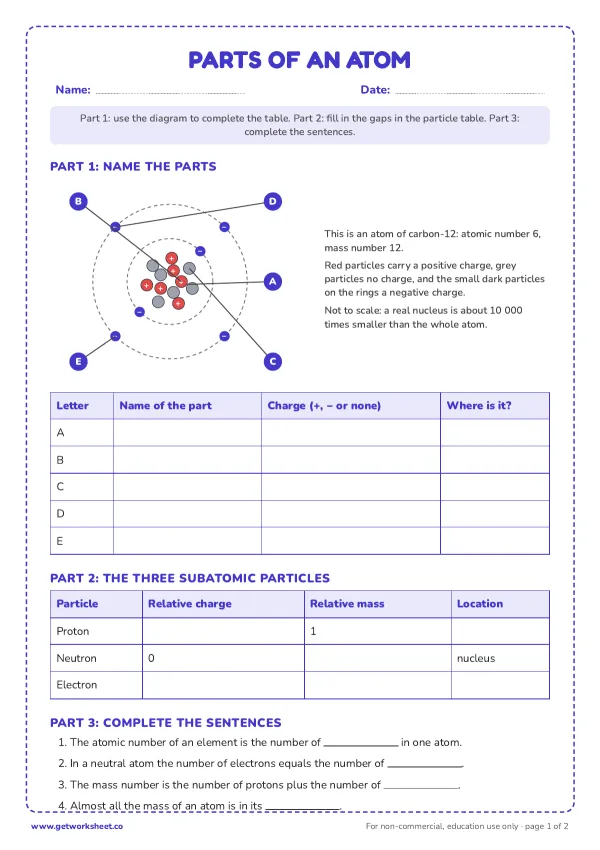
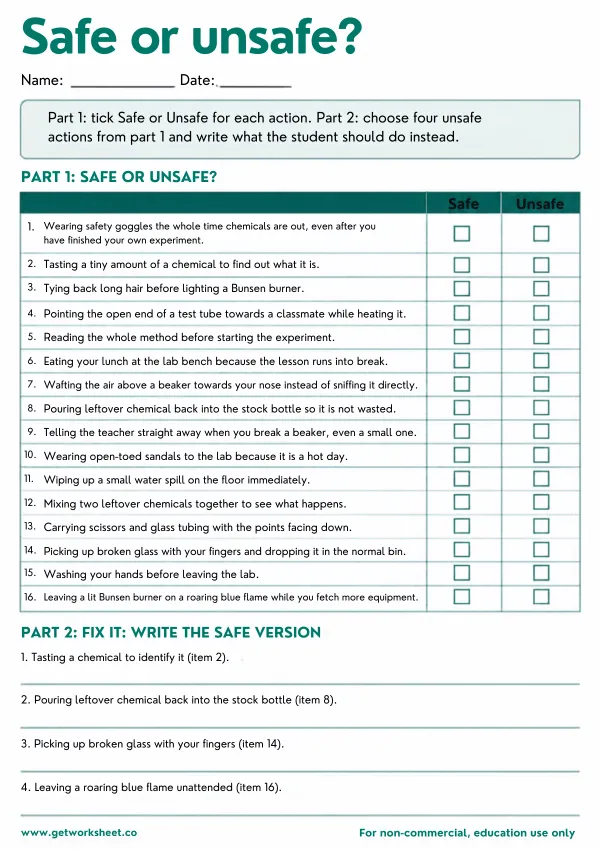
The atoms and molecules worksheets explain what the particles in these diagrams are. Changes of state are physical; the chemical reactions worksheets teach students to tell them apart from chemical changes. For safe heating and cooling in the lab, start with the lab safety worksheets.