Chemistry · Grades 8–10
Free balancing equations worksheets
Five worksheets with 66 chemical equations to balance, from KOH + H3PO4 and Al + O2 to the decomposition of KClO3 and the combustion of CH4, C3H8 and C8H18. For grades 8 to 10.
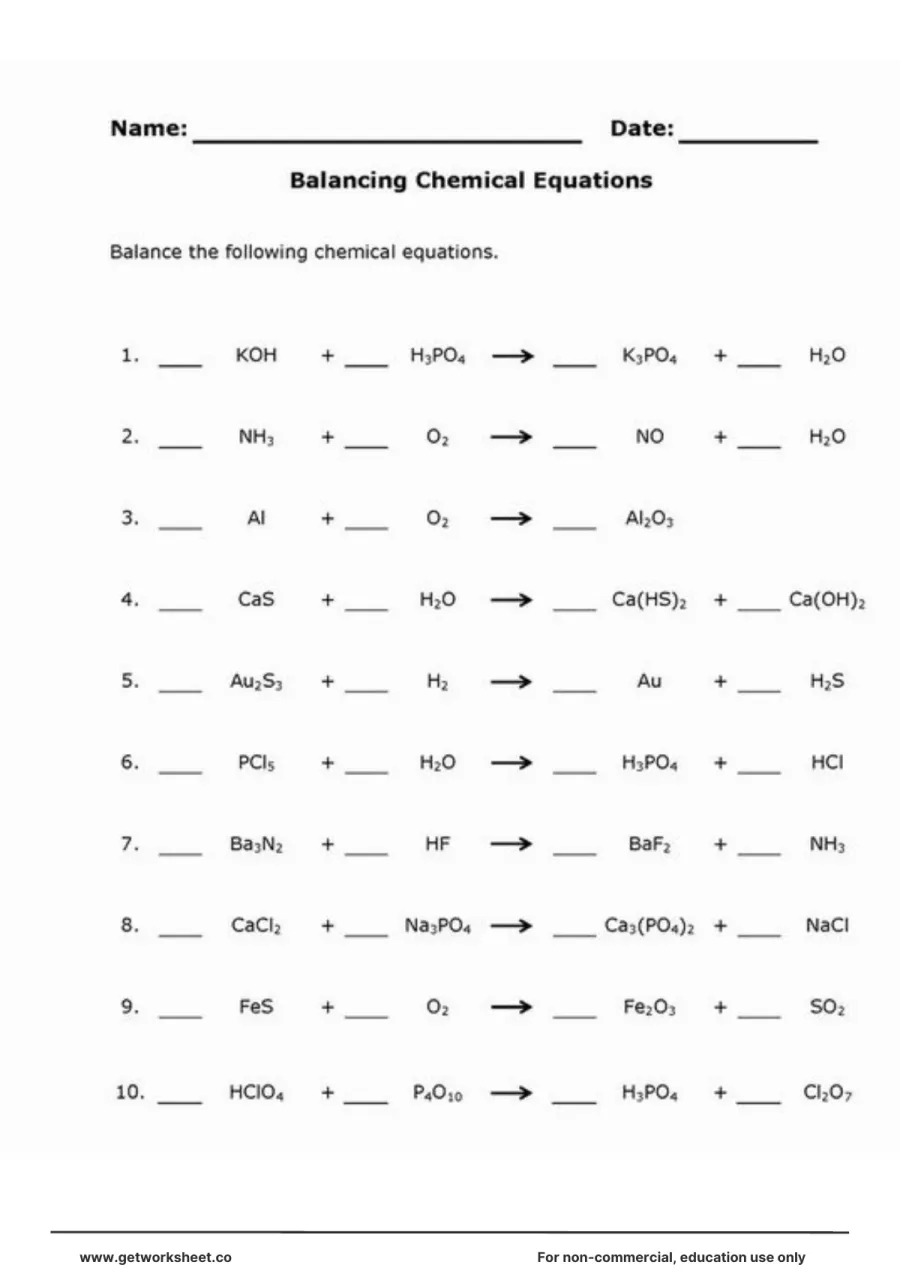
Balance chemical equations: KOH + H3PO4, NH3 + O2, Al + O2
Fill in coefficients for 10 unbalanced equations, starting with KOH + H3PO4 → K3PO4 + H2O, NH3 + O2 → NO + H2O and Al + O2 → Al2O3.
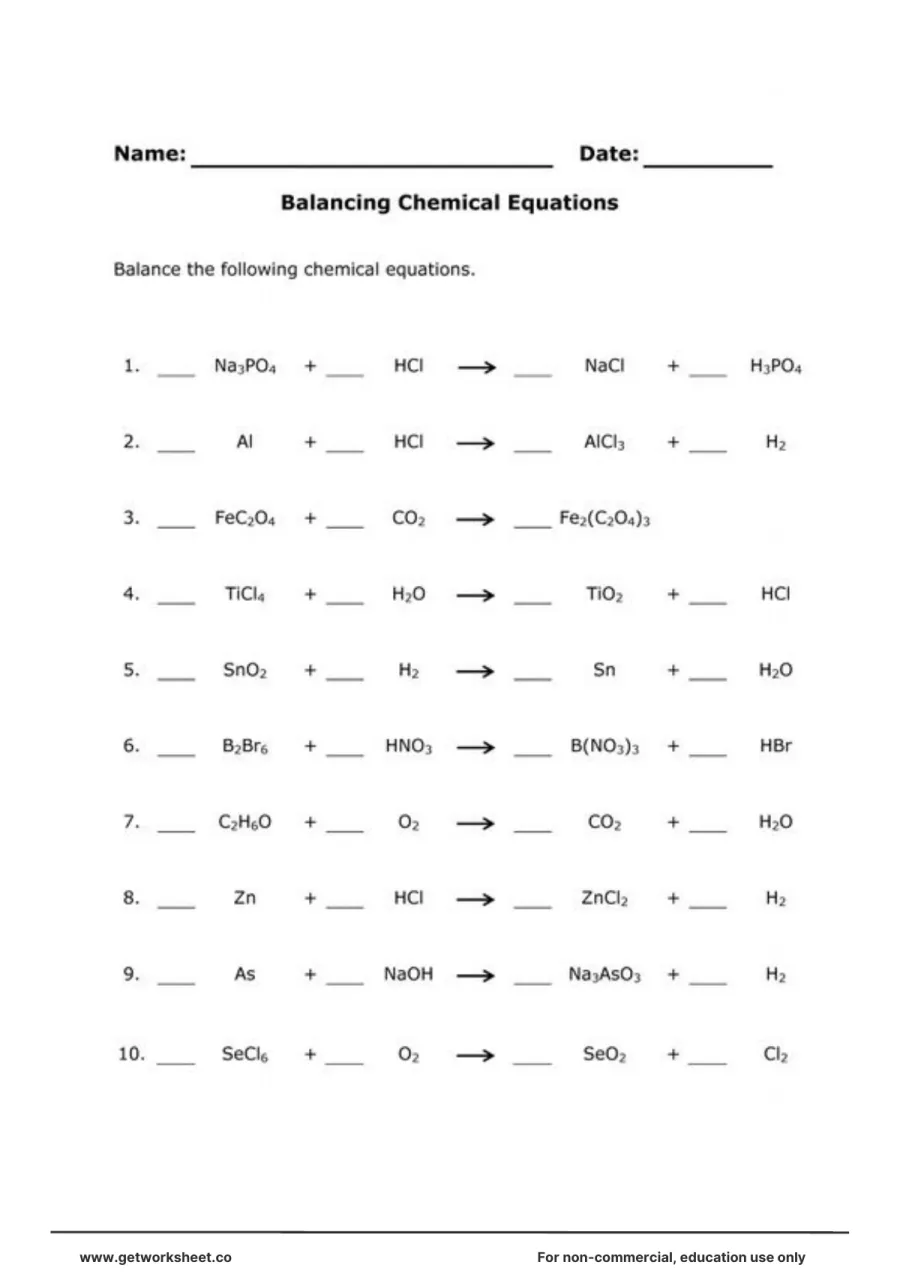
Balance chemical equations: Na3PO4 + HCl, Al + HCl, Zn + HCl
Fill in coefficients for 10 equations including Na3PO4 + HCl → NaCl + H3PO4, Al + HCl → AlCl3 + H2 and C2H6O + O2 → CO2 + H2O.
Whole set
All 5 in one PDF
- Every sheet on this page, one file
- No ads, no countdowns, print as often as you like
- Instant download, ad-free, no account needed
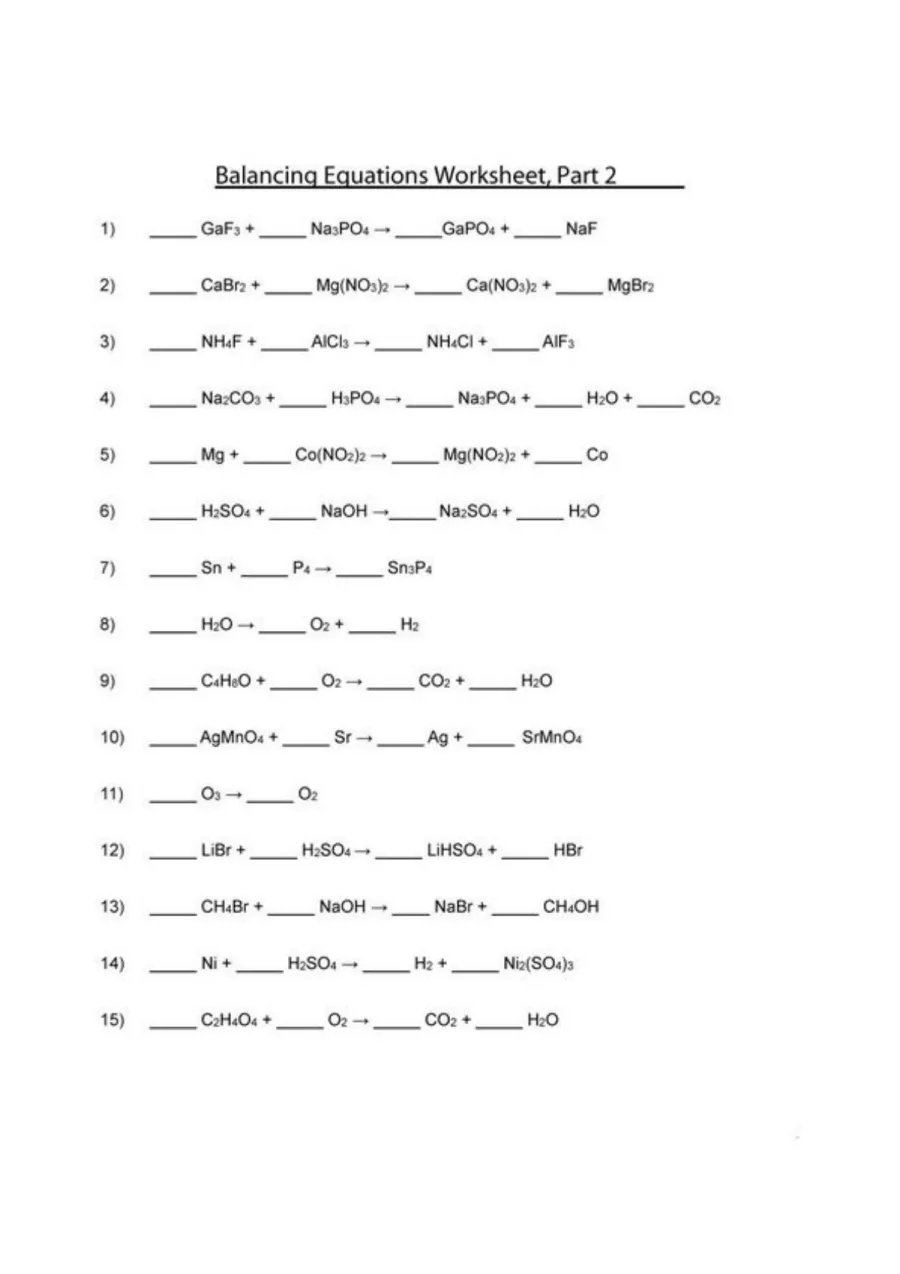
Balance 15 equations: GaF3 + Na3PO4, Mg + Co(NO2)2, H2O → H2
Part 2 sheet with 15 equations to balance, including GaF3 + Na3PO4 → GaPO4 + NaF, CaBr2 + Mg(NO3)2 and the decomposition of H2O and O3.
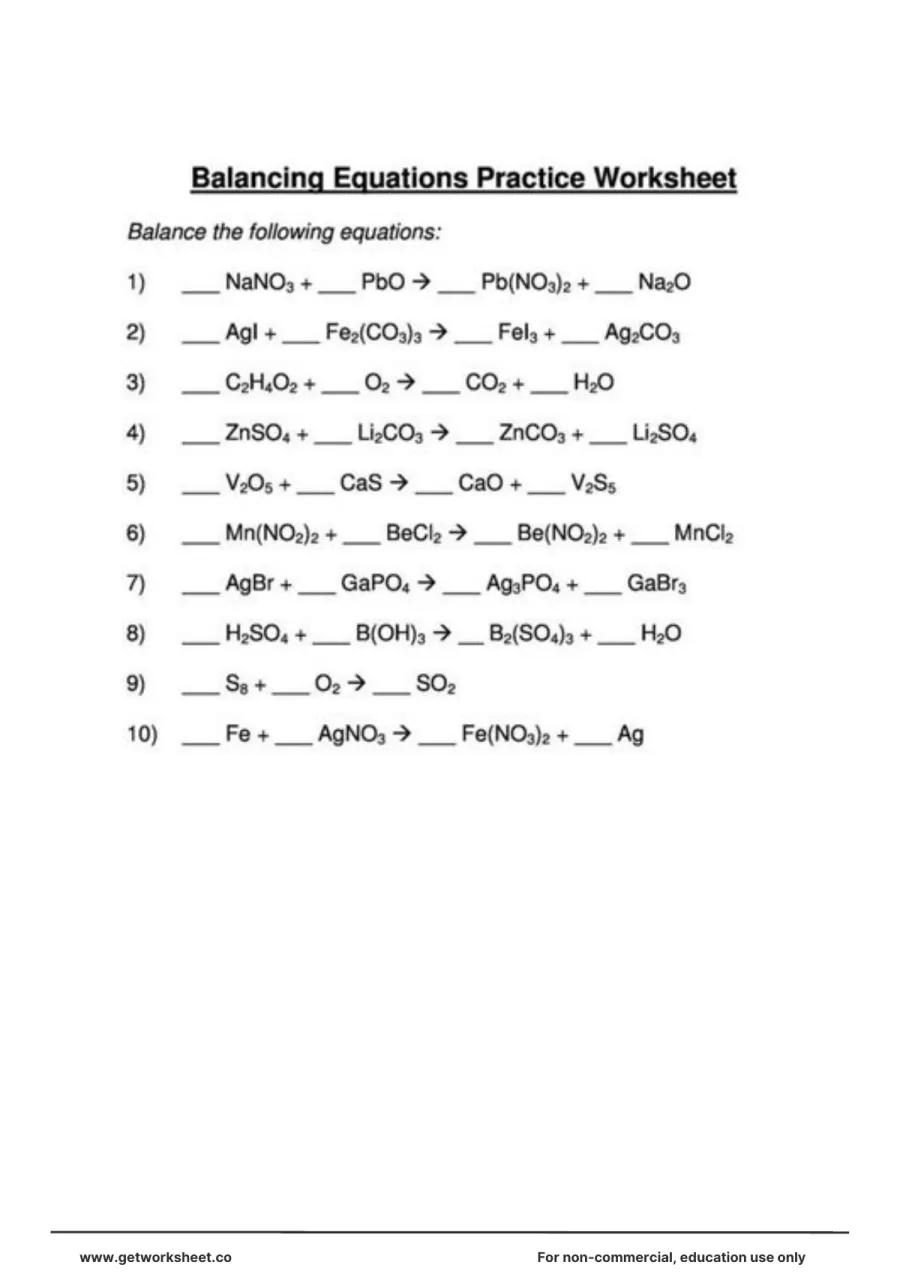
Balance chemical equations: NaNO3 + PbO, AgI + Fe2(CO3)3
Practice sheet with 10 equations to balance, including NaNO3 + PbO → Pb(NO3)2 + Na2O, ZnSO4 + Li2CO3 and Fe + AgNO3 → Fe(NO3)2 + Ag.
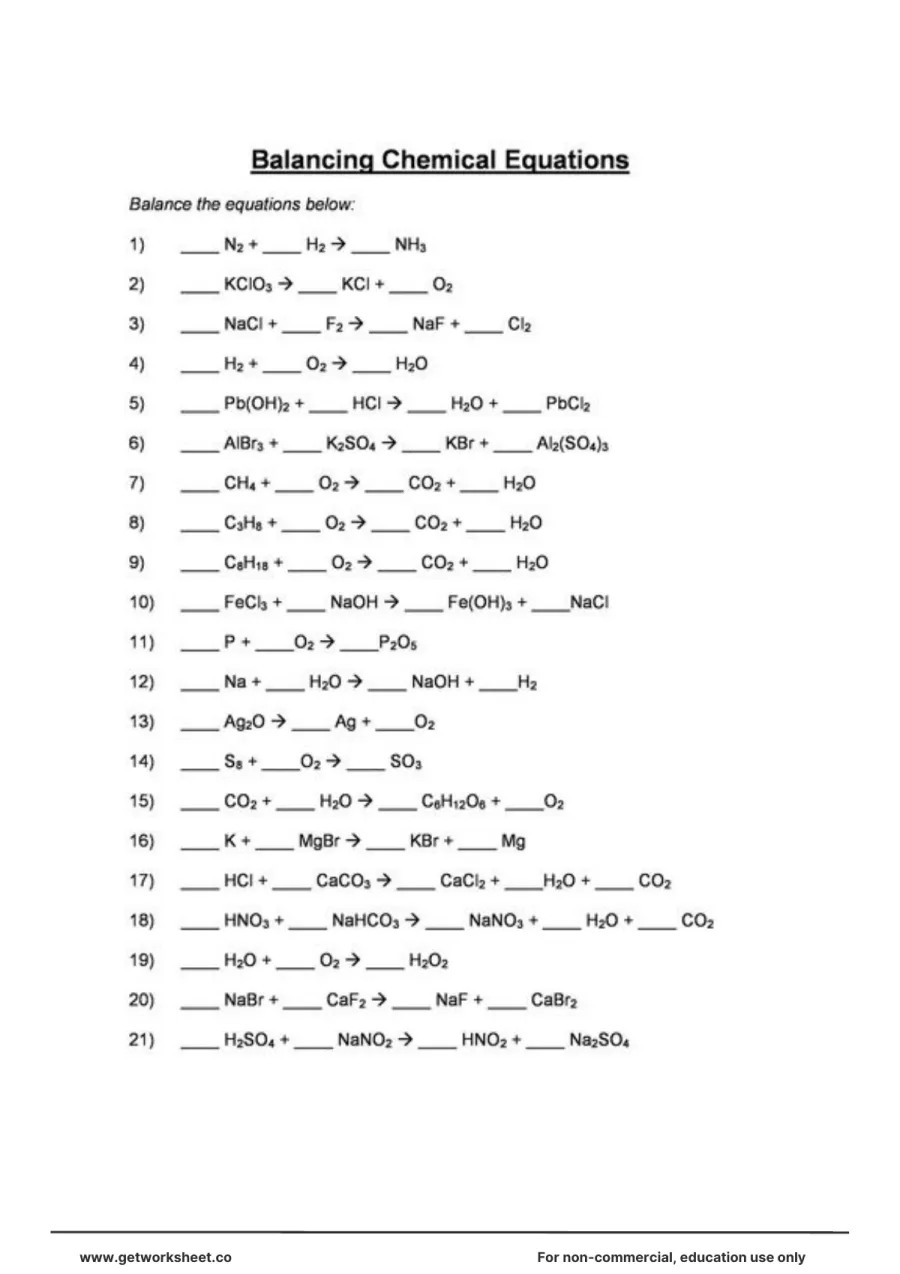
Balance 21 equations: N2 + H2 → NH3, KClO3, fuel combustion
Balance 21 equations covering synthesis, decomposition and combustion, from N2 + H2 → NH3 and KClO3 → KCl + O2 to CH4, C3H8 and C8H18 + O2.
AI worksheet generator
Make a worksheet like this for your class
The 5 sheets above are fixed. The generator writes a new balancing equations worksheet for your grade, with the question types and count you choose, in about 20 seconds. Pick a grade to start:
What you get
- A fresh set of questions on balancing equations, not a copy of the sheets above
- Multiple choice, fill in the blanks, true or false, open ended
- Answer key and print-ready PDF with Pro
Free account, 1 worksheets a week. No card.
These five worksheets give students 66 unbalanced chemical equations to complete by filling in coefficients. The first two sheets have 10 equations each and start with familiar reactions: KOH + H3PO4 → K3PO4 + H2O, NH3 + O2 → NO + H2O and Al + O2 → Al2O3 on sheet one, then Na3PO4 + HCl → NaCl + H3PO4, Al + HCl → AlCl3 + H2 and C2H6O + O2 → CO2 + H2O on sheet two. Sheet three is a Part 2 set of 15, including GaF3 + Na3PO4 → GaPO4 + NaF, Mg + Co(NO2)2, CaBr2 + Mg(NO3)2 and the decomposition of water and ozone. Sheet four has 10 more, such as NaNO3 + PbO → Pb(NO3)2 + Na2O, ZnSO4 + Li2CO3, AgI + Fe2(CO3)3 and Fe + AgNO3 → Fe(NO3)2 + Ag. Sheet five has 21 equations by reaction type: synthesis such as N2 + H2 → NH3, decomposition such as KClO3 → KCl + O2, and the combustion of CH4, C3H8 and C8H18.
What Students Will Practice
- Counting atoms of each element on both sides before choosing a coefficient, such as the three potassium atoms in K3PO4
- Balancing polyatomic ions as a unit when they appear unchanged, such as PO4 in Na3PO4 + HCl and NO3 in Fe + AgNO3
- Counting atoms inside brackets in compounds like Co(NO2)2, Mg(NO3)2, Pb(NO3)2 and Fe2(CO3)3
- Balancing combustion of hydrocarbons and ethanol, taking carbon, then hydrogen, then oxygen
- Recognizing synthesis and decomposition reactions such as N2 + H2 → NH3 and H2O → H2 + O2
Free printable makers
Make your own balancing equations sheets
Type your own words or numbers and print in about 30 seconds. No account, no AI, answer key where it applies.
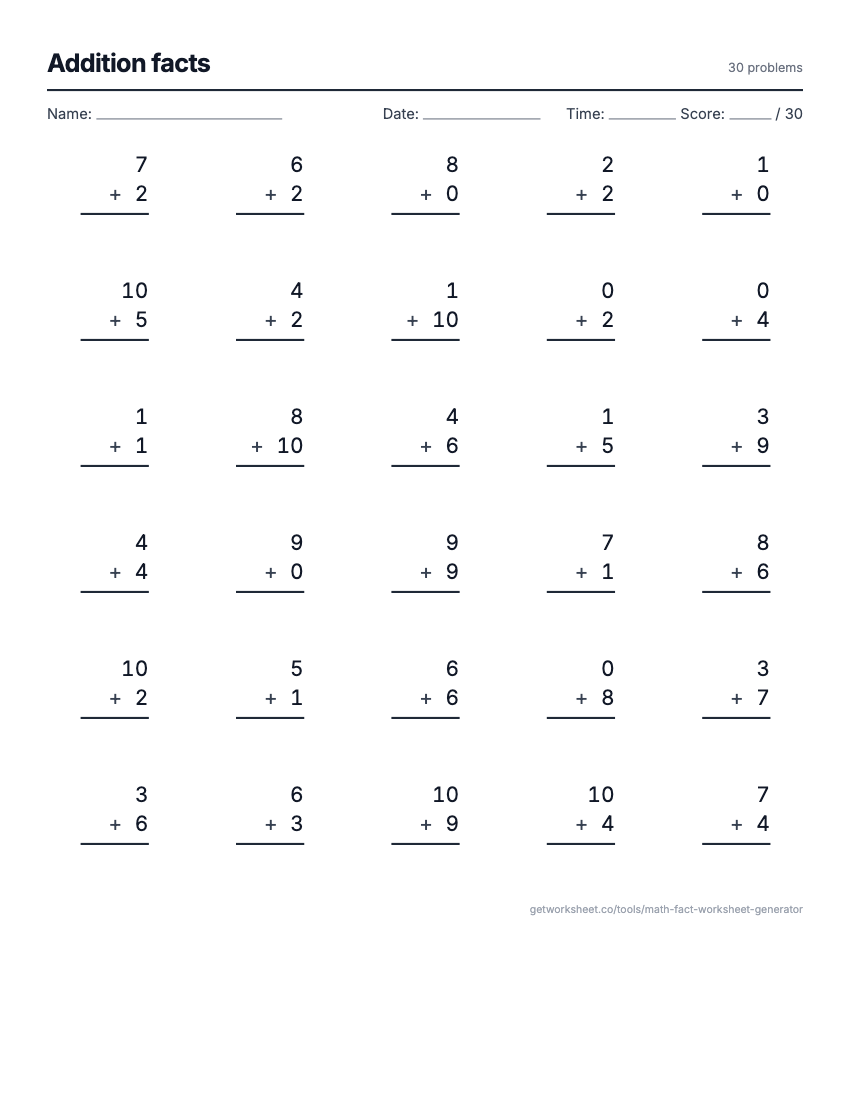 Math fact worksheet generatorAddition to division drills with an answer key. Free to print.
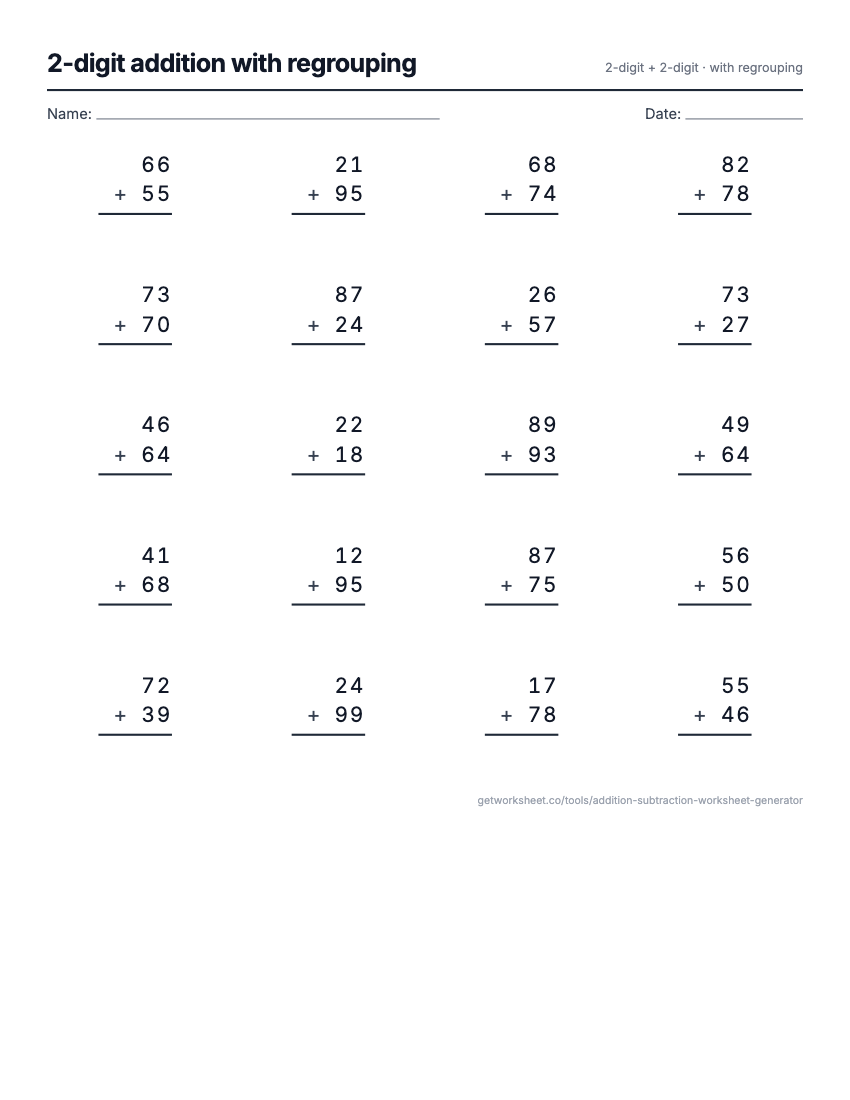 Addition and subtraction generatorColumn add and subtract, regrouping you control, boxes and key. Free to print.
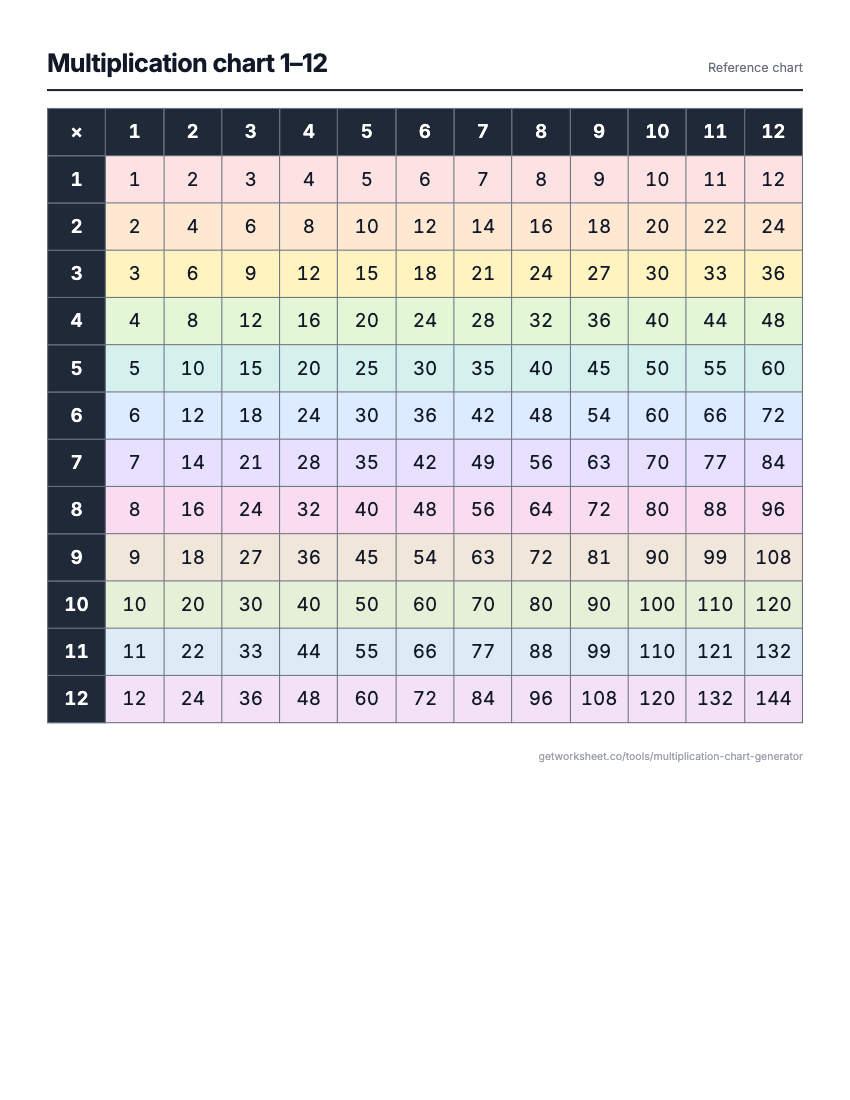 Multiplication chart generatorCharts to 15, full, blank or coloured, and times table tests with key. Free to print.
AI worksheet generator
Need a different balancing equations worksheet?
Generate a custom balancing equations worksheet: pick the grade, question types and count, and print it in about 20 seconds. Free accounts get 1 generation a week.
Teaching tips and common mistakes
How to use these worksheets
Print at 100% on A4 or US Letter so the subscripts and the brackets in formulas such as Fe2(CO3)3 stay readable. None of the five sheets has an answer key, so balance them yourself first or have students check each other by recounting atoms on both sides. A periodic table is not needed here: every formula is given, and the work is counting and coefficients.
- Sheets one and two, 10 equations each. Use these for the first two lessons. Ask students to write an atom count under both sides before touching a coefficient. KOH + H3PO4 and Na3PO4 + HCl both leave the phosphate group intact, which is the moment to introduce balancing a polyatomic ion as one unit.
- Sheet three, 15 equations. This is the bracket set: Mg + Co(NO2)2, CaBr2 + Mg(NO3)2 and GaF3 + Na3PO4. Have students expand each bracket in the margin, so Co(NO2)2 becomes one cobalt, two nitrogen, four oxygen, before they balance.
- Sheet four, 10 equations. Good homework after brackets. NaNO3 + PbO, ZnSO4 + Li2CO3 and Fe + AgNO3 are double and single replacement reactions, so students can predict which groups move across unchanged and balance those last.
- Sheet five, 21 equations. Use it as the review or the test. It is sorted by reaction type, so run it in three passes: synthesis such as N2 + H2, decomposition such as KClO3, then the combustion of CH4, C3H8 and C8H18. Teach carbon, then hydrogen, then oxygen last for every fuel.
Common mistakes to watch for
- Changing a subscript instead of a coefficient. Turning Al2O3 into Al2O2 balances the count and destroys the compound. Coefficients go in front only.
- Not recounting after a change. Adding a 3 in front of H2O fixes oxygen and quietly changes hydrogen. Recount the whole equation after every coefficient.
- Miscounting inside brackets. In Pb(NO3)2 there are two nitrogen and six oxygen, not one and three. The outside number multiplies everything inside.
- Leaving fractions or common factors. Combustion of C8H18 tempts a half in front of O2. Double the whole equation instead, and reduce sets such as 2, 4, 2 to 1, 2, 1 before calling it done.
Frequently asked questions
What grade are these for?
Grades 8 to 10. They fit a first chemistry course, from middle school physical science through high school chemistry one, and work as review for older students heading into stoichiometry.
Are answer keys included?
No. The sheets give the unbalanced equations and space for coefficients, with no key attached. Balanced answers are easy to verify in class by counting atoms on both sides of each arrow.
How many equations are there in total?
66 across the five sheets: 10, 10, 15, 10 and 21. That is enough for a unit, with sheet five held back as a review.
Do students need a periodic table or a calculator?
Neither. Every formula is printed on the sheet and the coefficients are small whole numbers. A pencil with an eraser matters more, since balancing is trial and adjustment.
Can I print these for my chemistry class?
Yes. Print a class set at no cost for your own students.
More practice
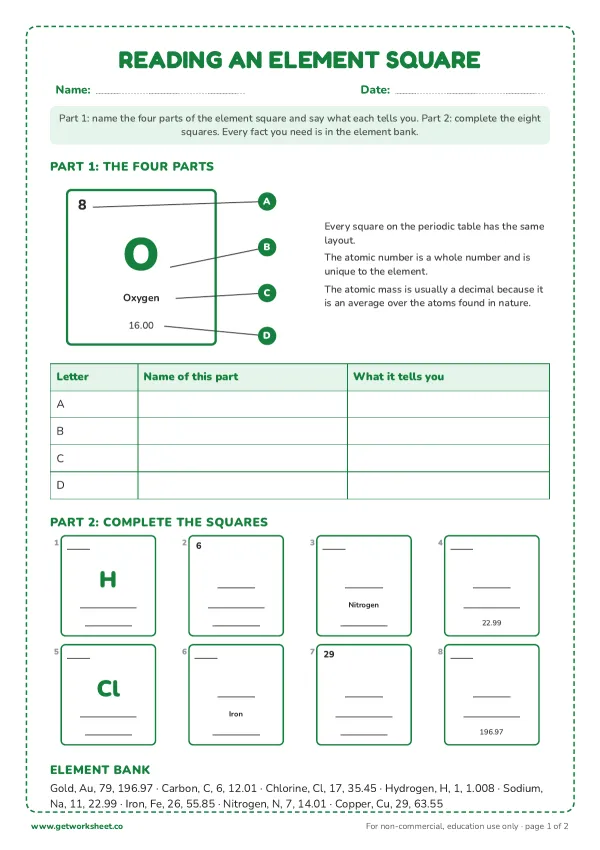
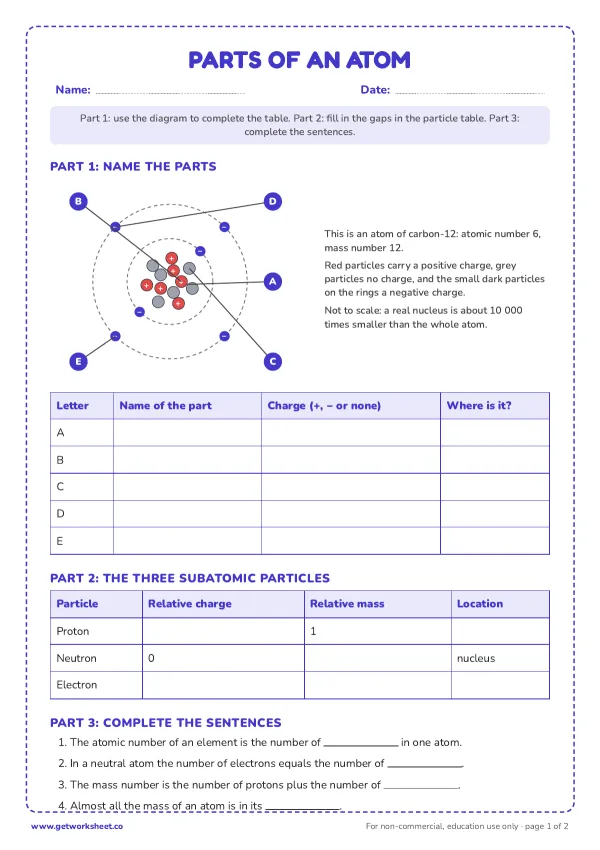
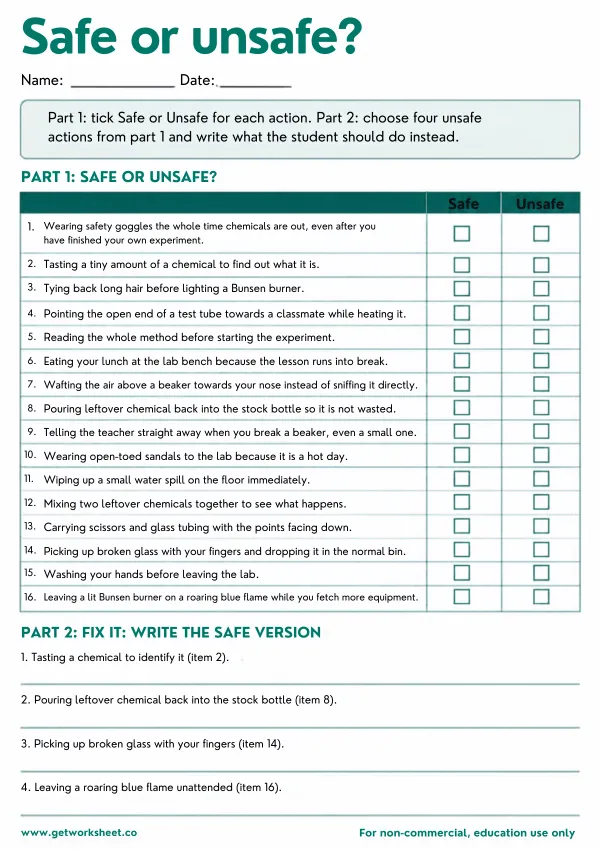
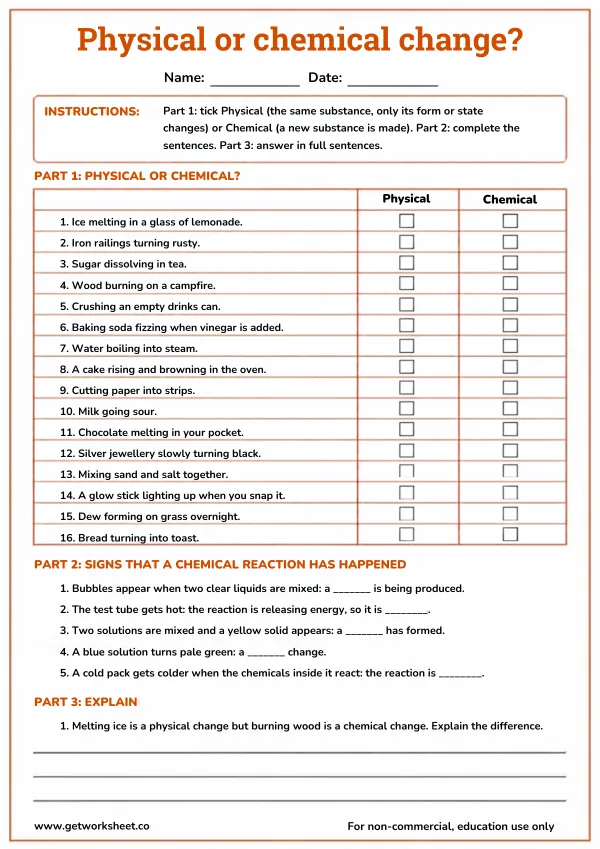
Balancing sits between formula writing and reaction types, so go either direction. Review formulas and atom counting with atoms and molecules worksheets or the periodic table worksheets, then classify what these equations are doing with chemical reactions worksheets. Before the first lab, run the lab safety worksheets.