Chemistry · Grades 6–9
Free periodic table worksheets
Five printable periodic table worksheets for grades 6 to 9: read an element square, complete the first 20 elements, fill in a blank table and color metals and non-metals, compare their properties, and solve ten element riddles.
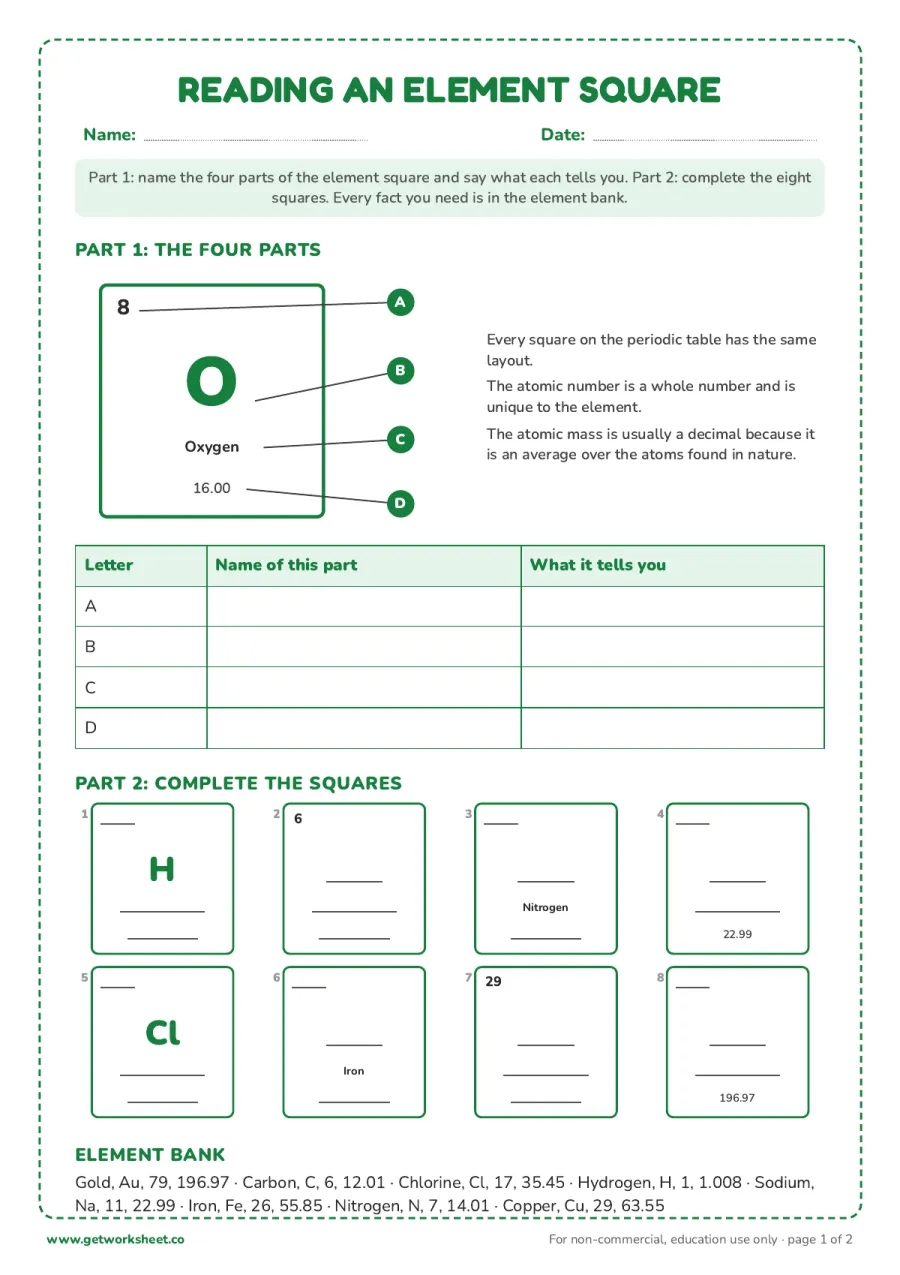
Reading an element square: the 4 parts, then complete 8 squares
A large oxygen square with its four parts lettered (atomic number, symbol, name, atomic mass) to name and explain, then eight element squares with only one fact filled in to complete from an element bank. Answer key on page 2.
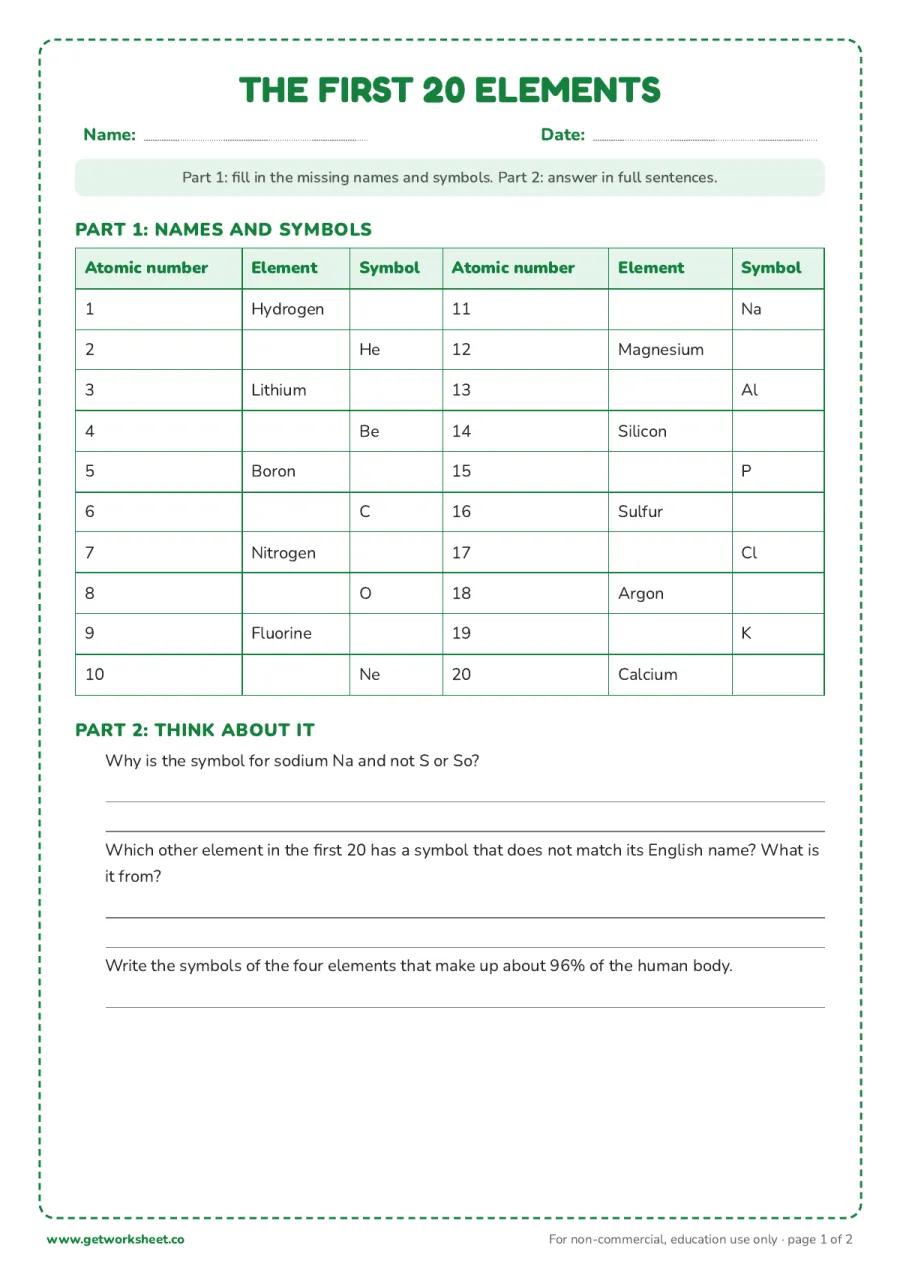
The first 20 elements: complete the names and symbols, then 3 questions
The first twenty elements in a table with alternating gaps in the name and symbol columns, then three questions on the symbols that do not match their English names and the four elements that make up most of the human body. Answer key on page 2.
Whole set
All 5 in one PDF
- Every sheet on this page, one file
- No ads, no countdowns, print as often as you like
- Instant download, ad-free, no account needed
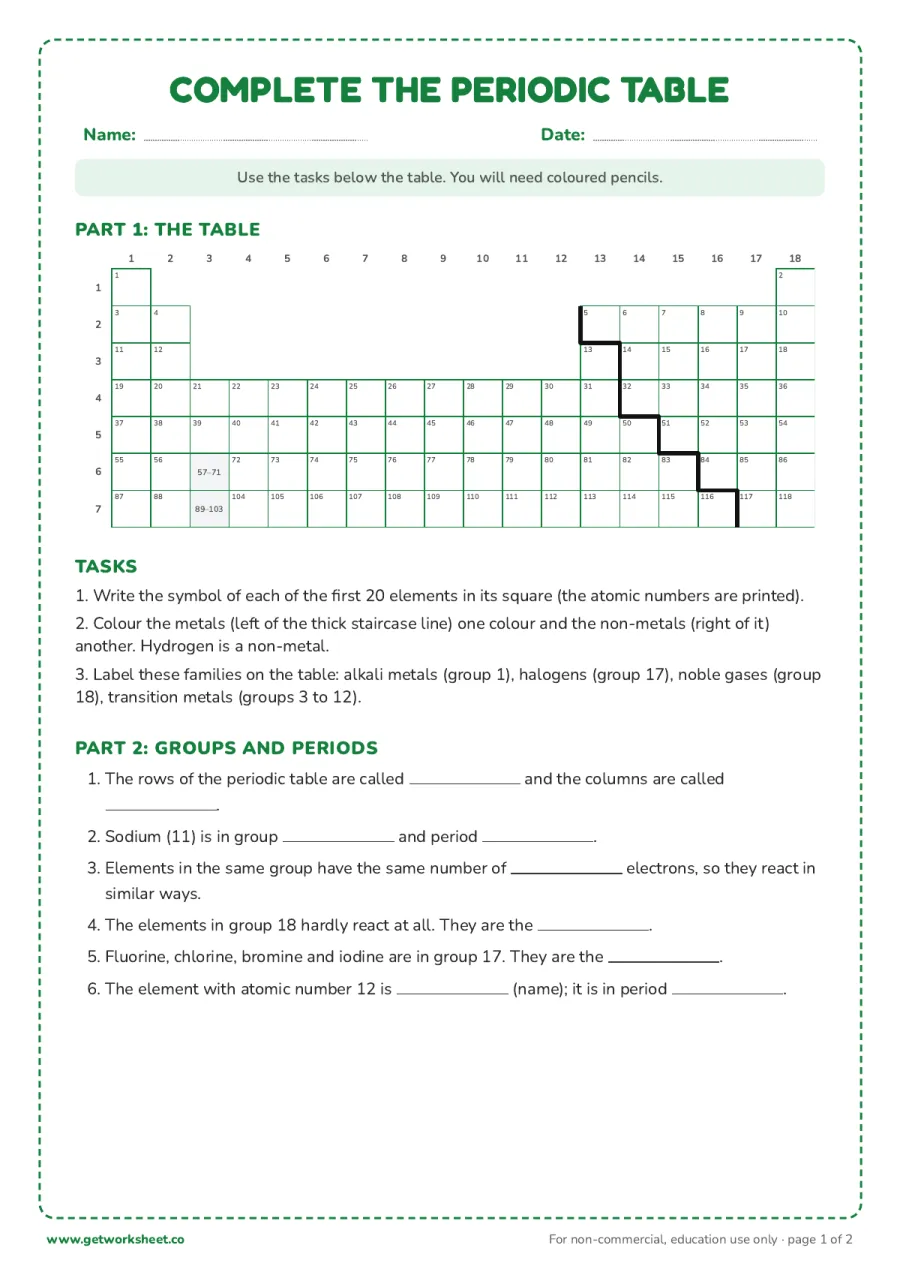
Complete the periodic table: symbols of the first 20, colour metals and non-metals, label the groups
A blank periodic table grid with atomic numbers: write the symbols of the first 20 elements in place, colour metals and non-metals either side of the staircase line, label four element families, then six questions on groups and periods. Full completed table on page 2.
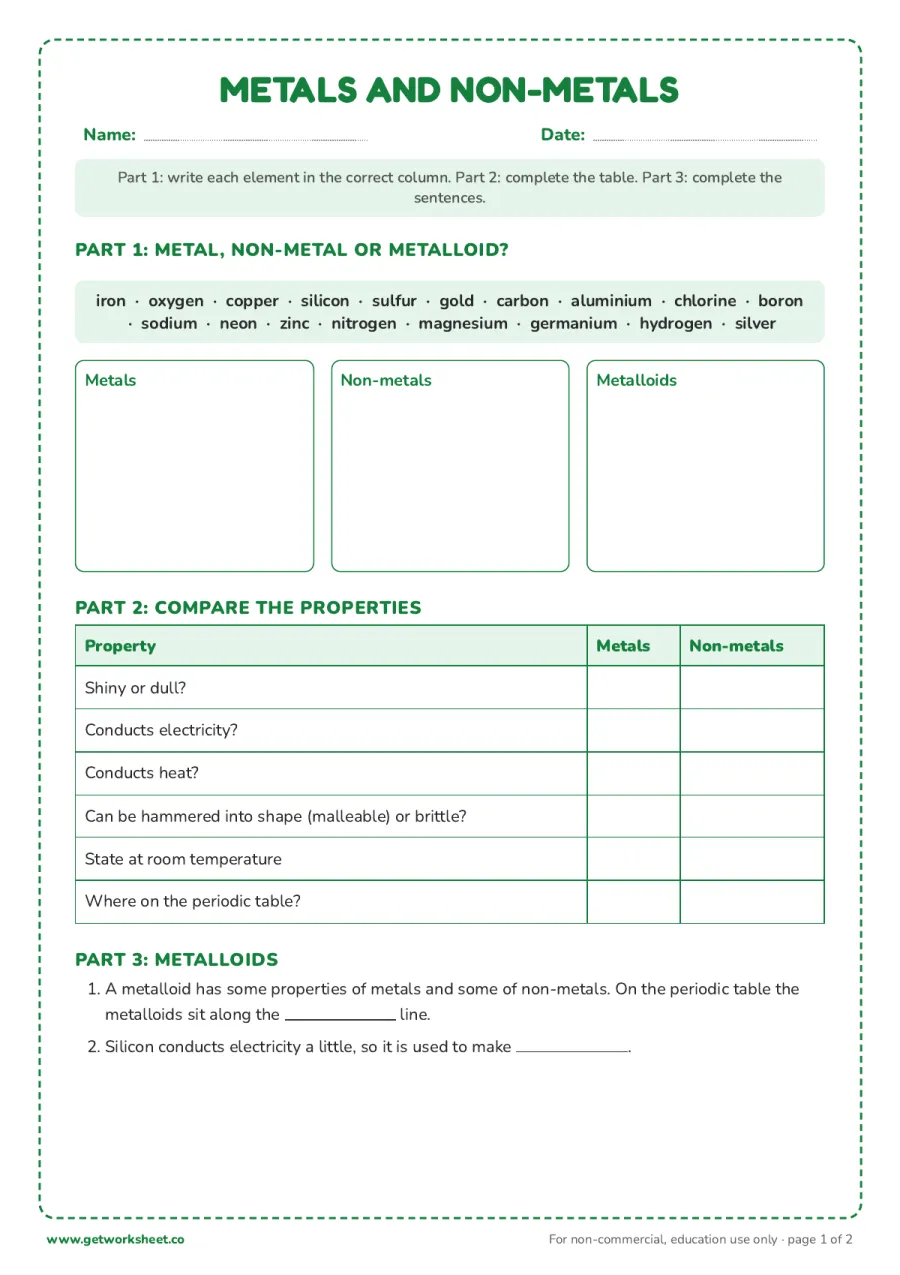
Metals and non-metals: sort 18 elements, compare properties, metalloids
Eighteen elements to sort into metals, non-metals and metalloids, a six-row properties table comparing metals and non-metals (shine, conduction, malleability, state, position on the table), and a question on why silicon is used in computer chips. Answer key on page 2.
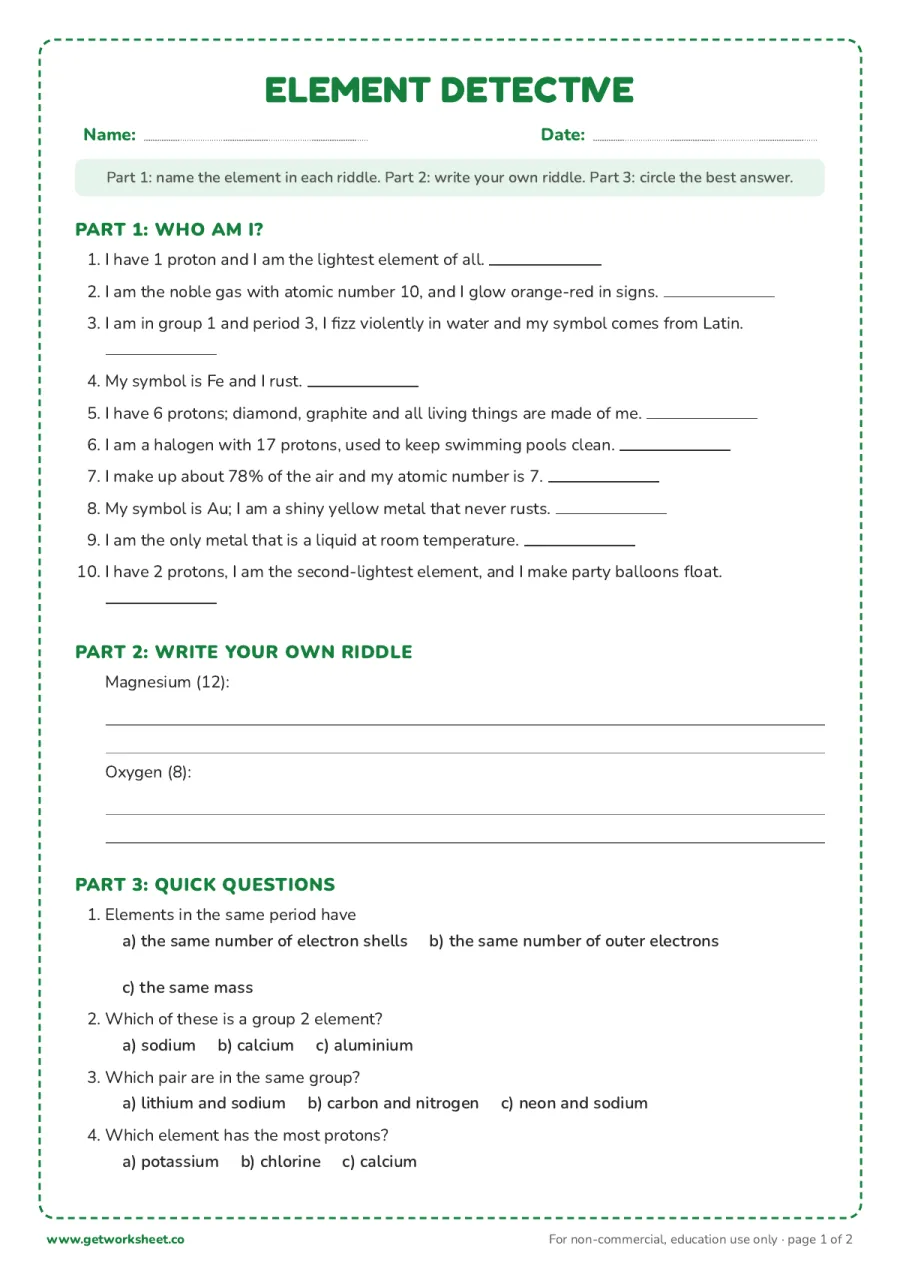
Element detective: 10 "Who am I?" riddles, write your own, 4 quick questions
Ten "Who am I?" element riddles using atomic numbers, groups, symbols and properties, two riddles for students to write themselves, and four multiple-choice questions on groups and periods. Answer key on page 2.
AI worksheet generator
Make a worksheet like this for your class
The 5 sheets above are fixed. The generator writes a new periodic table worksheet for your grade, with the question types and count you choose, in about 20 seconds. Pick a grade to start:
What you get
- A fresh set of questions on periodic table, not a copy of the sheets above
- Multiple choice, fill in the blanks, true or false, open ended
- Answer key and print-ready PDF with Pro
Free account, 1 worksheets a week. No card.
The periodic table is the one reference students are allowed to use in every chemistry exam, so the skill that matters is reading it: finding an element from its atomic number, knowing what the decimal underneath means, seeing that a column is a family of similar elements. These five worksheets teach that reading. They start with a single element square, build to the first 20 elements, then have students complete a blank table themselves, which is the fastest way to learn its shape.
What's in this set
- Reading an element square. A labelled oxygen square and a table asking what each of the four parts tells you, then eight squares (hydrogen, carbon, nitrogen, sodium, chlorine, iron, copper, gold) each showing a single fact, to complete using the element bank at the bottom.
- The first 20 elements. Hydrogen to calcium in a twenty-row table with either the name or the symbol missing, then three written questions: why sodium is Na, which other first-20 symbols come from Latin, and the four elements that make up most of a human body.
- Complete the periodic table. A blank 18-group, 7-period table with the atomic numbers printed and the metal/non-metal staircase drawn; tasks to write the first 20 symbols, color the two regions and label alkali metals, halogens, noble gases and transition metals; then six fill-in questions on groups, periods and outer electrons.
- Metals and non-metals. Eighteen elements to sort three ways (with boron, silicon and germanium as the metalloids), a properties table to complete for metals versus non-metals, and two sentences on metalloids and their use in electronics.
- Element detective. Ten riddles (from "I have 1 proton and I am the lightest element" to "I am the only metal that is liquid at room temperature"), two riddles to write for magnesium and oxygen, and four multiple-choice questions on what elements in the same period or group share.
What students will practice
- Reading an element square: atomic number, symbol, name and atomic mass, and what each one tells you
- Knowing the names and symbols of the first 20 elements, including the Latin-derived Na and K
- Placing elements on the table by atomic number and identifying groups (columns) and periods (rows) (NGSS MS-PS1-1)
- Locating the metal/non-metal staircase and the families: alkali metals, halogens, noble gases, transition metals
- Comparing the properties of metals and non-metals and recognizing metalloids
- Using clues about protons, groups and properties to identify an element
Free printable makers
Make your own periodic table sheets
Type your own words or numbers and print in about 30 seconds. No account, no AI, answer key where it applies.
AI worksheet generator
Need a different periodic table worksheet?
Generate a custom periodic table worksheet: pick the grade, question types and count, and print it in about 20 seconds. Free accounts get 1 generation a week.
Teaching tips and common mistakes
How to use these worksheets in class
- One square first. Reading an element square uses oxygen because every student knows it. Part 2 supplies an element bank so the sheet can be done without a wall chart; remove the bank (fold the bottom) once students have a periodic table of their own to search.
- Learn the first 20 as two columns of ten. The first 20 elements is laid out that way. Ten minutes a lesson for a week is enough for most classes to know them; the two Latin symbols (Na, K) are the ones to test.
- Complete the blank table before teaching trends. Complete the periodic table asks students to write in the first 20 symbols and color the regions. Once they have drawn the staircase and labelled the families themselves, statements like "group 1 metals react with water" have somewhere to land. Page 2 of the PDF is a full colored table for checking or display.
- Properties with samples. Pass round samples of copper, iron, aluminium, sulfur, carbon (graphite) and silicon while students complete Metals and non-metals. Graphite conducting electricity is the exception worth demonstrating with a bulb and battery.
- Riddles as a plenary. Read Element detective clues aloud and let students race to the table. Then collect their own riddles from part 2 and use the best ones as starters in the next lesson.
- Grades 6 to 9. Grades 6 and 7 can complete the first, second and fifth sheets; grades 8 and 9 should complete all five, including the groups and periods questions.
Answer key
Every practice sheet carries its own answer key on page 2 of the PDF. The keys are repeated here for quick marking.
- Reading an element square: Part 1: the four parts: A = Atomic number: the number of protons (and of electrons in a neutral atom); B = Chemical symbol: one or two letters, the first always a capital; C = Element name; D = Atomic mass: the average mass of one atom; roughly protons + neutrons A | Atomic number | the number of protons in one atom (and of electrons in a neutral atom) B | Chemical symbol | the one- or two-letter abbreviation used in formulas C | Element name | the name of the element D | Atomic mass | the average mass of one atom, roughly protons + neutrons Part 2: complete the squares: 1. Hydrogen (H), atomic number 1, atomic mass 1.008; 2. Carbon (C), atomic number 6, atomic mass 12.01; 3. Nitrogen (N), atomic number 7, atomic mass 14.01; 4. Sodium (Na), atomic number 11, atomic mass 22.99; 5. Chlorine (Cl), atomic number 17, atomic mass 35.45; 6. Iron (Fe), atomic number 26, atomic mass 55.85; 7. Copper (Cu), atomic number 29, atomic mass 63.55; 8. Gold (Au), atomic number 79, atomic mass 196.97
- The first 20 elements: Part 1: names and symbols: 1 Hydrogen H | 11 Sodium Na 2 Helium He | 12 Magnesium Mg 3 Lithium Li | 13 Aluminium Al 4 Beryllium Be | 14 Silicon Si 5 Boron B | 15 Phosphorus P 6 Carbon C | 16 Sulfur S 7 Nitrogen N | 17 Chlorine Cl 8 Oxygen O | 18 Argon Ar 9 Fluorine F | 19 Potassium K 10 Neon Ne | 20 Calcium Ca Part 2: think about it: 1. It comes from the Latin name natrium. S was already taken by sulfur, and symbols are one or two letters from the element's Latin or historical name. 2. Potassium, K, from the Latin kalium. 3. O, C, H, N (oxygen, carbon, hydrogen, nitrogen).
- Complete the periodic table: Part 1: the table: Symbols of the first 20 elements in order: H, He, Li, Be, B, C, N, O, F, Ne, Na, Mg, Al, Si, P, S, Cl, Ar, K, Ca. Metals are left of the staircase (plus the transition metals in the middle), non-metals to the right of it, and the metalloids boron, silicon, germanium, arsenic, antimony and tellurium sit along the line. Hydrogen (group 1) is a non-metal. Part 2: groups and periods: 1. periods; groups 2. 1; 3 3. outer (valence) 4. noble gases 5. halogens 6. magnesium; 3
- Metals and non-metals: Part 1: metal, non-metal or metalloid?: Metals: iron, copper, gold, aluminium, sodium, zinc, magnesium, silver Non-metals: oxygen, sulfur, carbon, chlorine, neon, nitrogen, hydrogen Metalloids: silicon, boron, germanium Part 2: compare the properties: Shiny or dull? | shiny (lustrous) | dull Conducts electricity? | yes | no (graphite, a form of carbon, is the exception) Conducts heat? | yes, well | poorly Malleable or brittle? | malleable | brittle (solids snap) State at room temperature | solid (except mercury, a liquid) | solid, liquid or gas; many are gases Where on the table? | left and center | right (and hydrogen at top left) Part 3: metalloids: 1. staircase 2. computer chips (semiconductors)
- Element detective: Part 1: who am I?: 1. hydrogen 2. neon 3. sodium 4. iron 5. carbon 6. chlorine 7. nitrogen 8. gold 9. mercury 10. helium Part 2: write your own riddle: 1. Sample: I have 12 protons, I am in group 2, and I burn with a bright white flame. 2. Sample: I have 8 protons, I am in group 16, and you breathe me in every few seconds. Part 3: quick questions: 1. a) the same number of electron shells 2. b) calcium 3. a) lithium and sodium 4. c) calcium
Common mistakes to watch for
- Two capital letters. "NA" or "CL" is wrong; the second letter of a symbol is always lower case. CO (carbon monoxide) and Co (cobalt) are different things.
- Confusing atomic number and atomic mass. The whole number is the atomic number (protons); the decimal is the atomic mass. Students often copy the wrong one into the wrong slot on the element squares.
- Hydrogen as a metal. It sits above the alkali metals but is a non-metal gas. The blank-table sheet says so in the tasks.
- Counting the placeholder columns. The lanthanides and actinides are shown as "57 to 71" and "89 to 103" cells so the grid stays 18 wide; students should not try to fit those elements into period 6 and 7.
- Period versus group. Periods go across, groups go down. "Group 3 for sodium" usually means the student read the period.
Frequently asked questions
What grade are these periodic table worksheets for?
Grades 6 to 9. Reading an element square and the first 20 elements are introduced in grades 6 and 7; groups, periods and the metal/non-metal division are grade 8 (NGSS MS-PS1-1) and revisited in grade 9 chemistry.
Do the worksheets include answer keys?
Yes. Each PDF has its key on the last page; the blank-table sheet's key is a complete colored periodic table with all 118 symbols, which also works as a classroom reference. The keys are repeated on this page.
Do students need to memorize the periodic table?
No. Knowing the first 20 elements by name and symbol, and being able to find any element from its atomic number, is what these sheets aim for. The table itself is always available in exams.
Which version of the periodic table is used?
The standard 18-group IUPAC layout with groups numbered 1 to 18 and the lanthanides and actinides shown as placeholder cells. Group 17 is used for the halogens and group 18 for the noble gases; some older textbooks call these groups 7 and 0.
Is aluminium spelled with an i?
The sheets use the IUPAC spelling aluminium and the IUPAC spelling sulfur. Both spellings of aluminium are accepted in most exams; if your curriculum uses "aluminum", tell students to write that.
Related chemistry worksheets
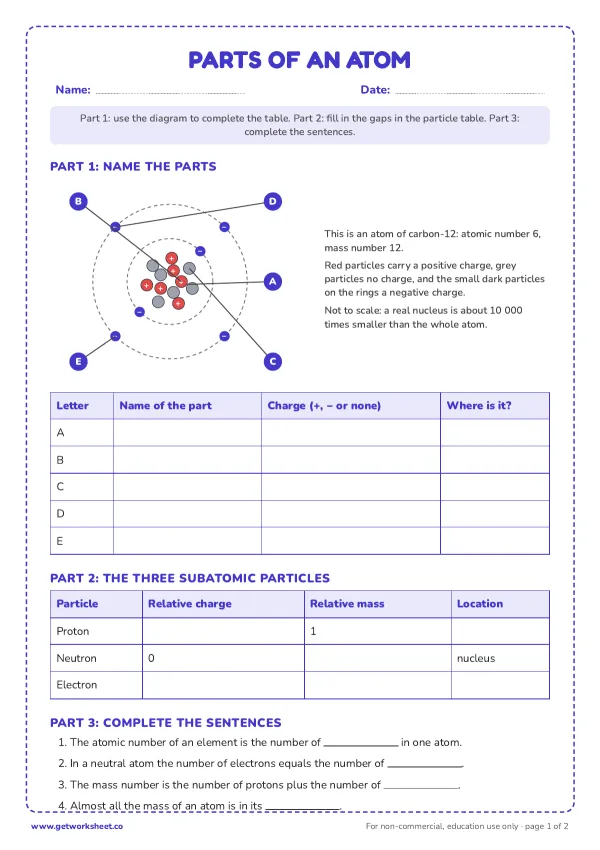
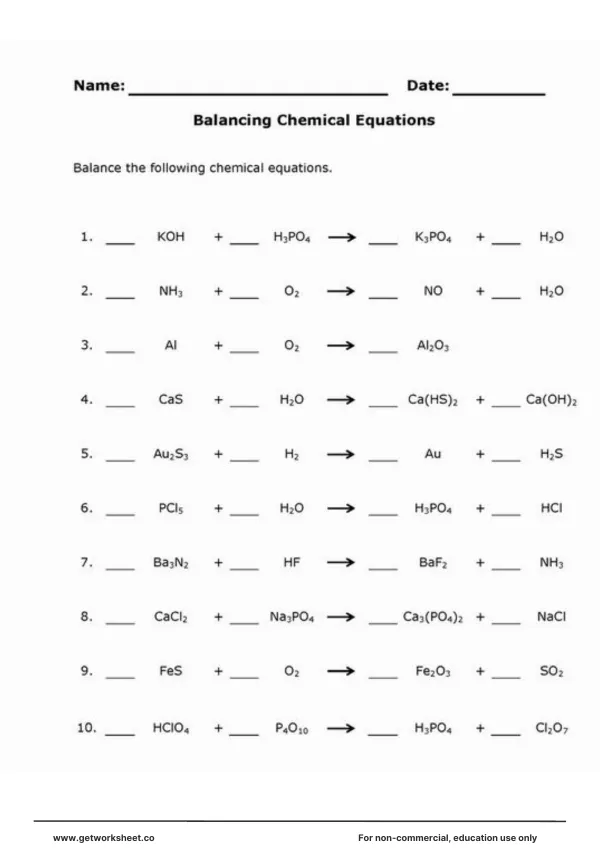
The atoms and molecules worksheets explain where atomic number and mass number come from, with Bohr models of the same first 20 elements. Once students can read the table, the chemical reactions worksheets and balancing equations worksheets put the symbols to work.