Chemistry · Grades 6–9
Free atoms and molecules worksheets
Five printable atoms and molecules worksheets for grades 6 to 9: label the parts of a carbon atom, complete a protons, neutrons and electrons table for twelve elements, draw six Bohr models and more. Answer keys included.
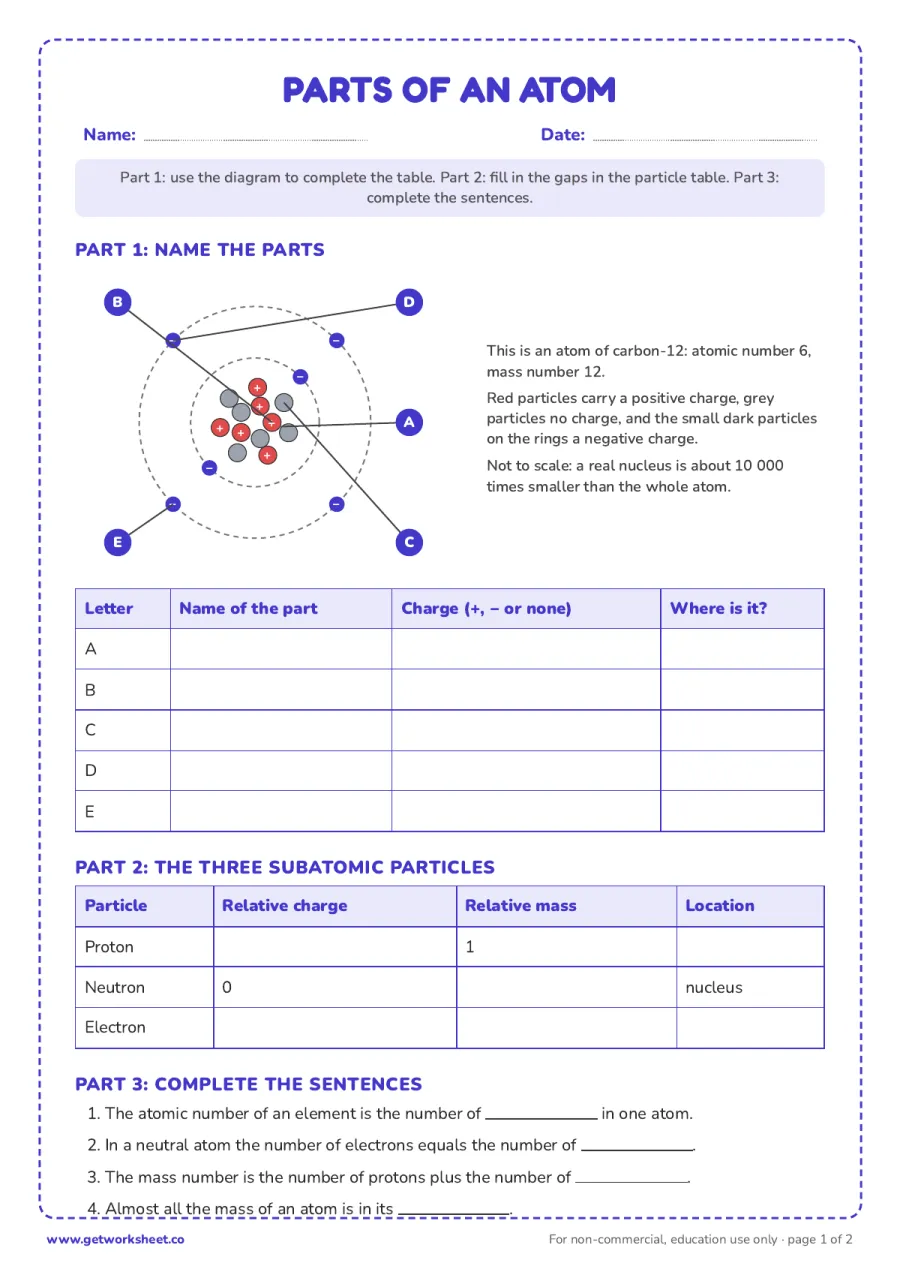
Parts of an atom: label a carbon atom, then the three particles
A Bohr diagram of a carbon-12 atom with five lettered parts to name, a table of the three subatomic particles (charge, mass, location) to complete, and four sentences about atomic number and mass number. Answer key on page 2.
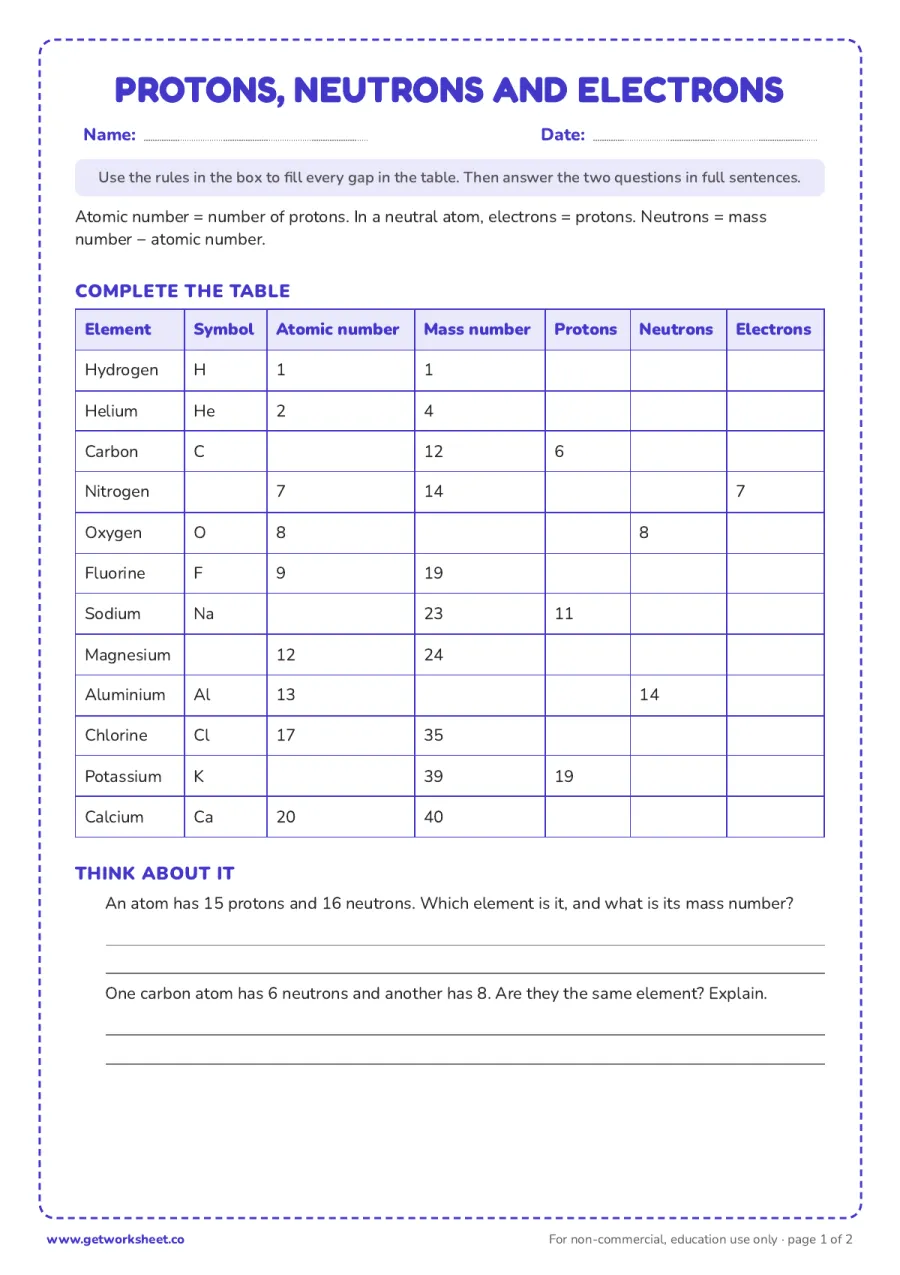
Protons, neutrons and electrons: complete the table for 12 elements
A table of twelve elements from hydrogen to calcium with gaps in the symbol, atomic number, mass number, protons, neutrons and electrons columns, plus two reasoning questions on identifying an element and on isotopes. Answer key on page 2.
Whole set
All 5 sheets in one PDF
Instant and ad-free. No account needed.
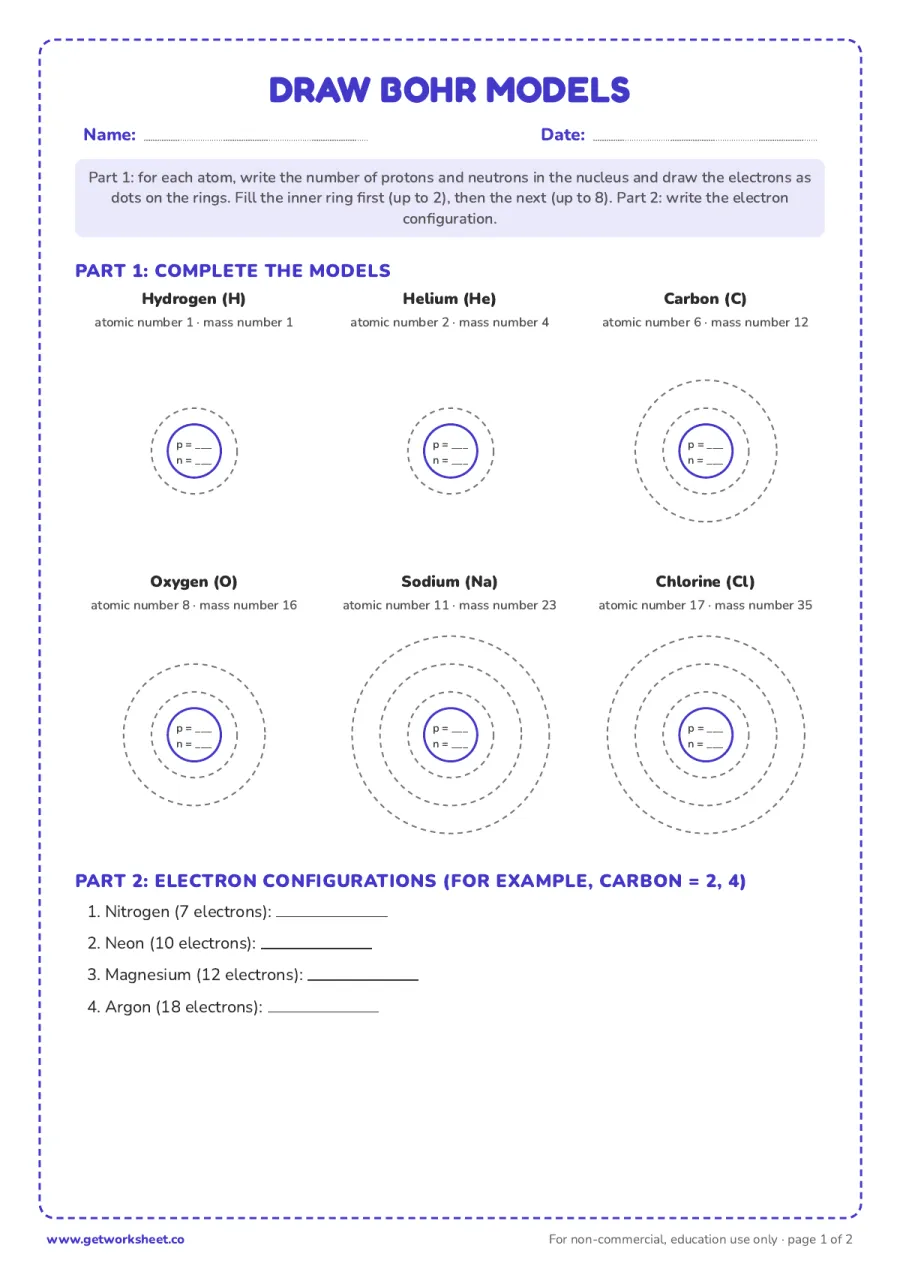
Draw Bohr models: 6 atoms from hydrogen to chlorine
Six Bohr model templates (hydrogen, helium, carbon, oxygen, sodium, chlorine) with the shells drawn: students write the protons and neutrons in the nucleus and draw the electrons on the rings, then write four electron configurations. Answer key on page 2.
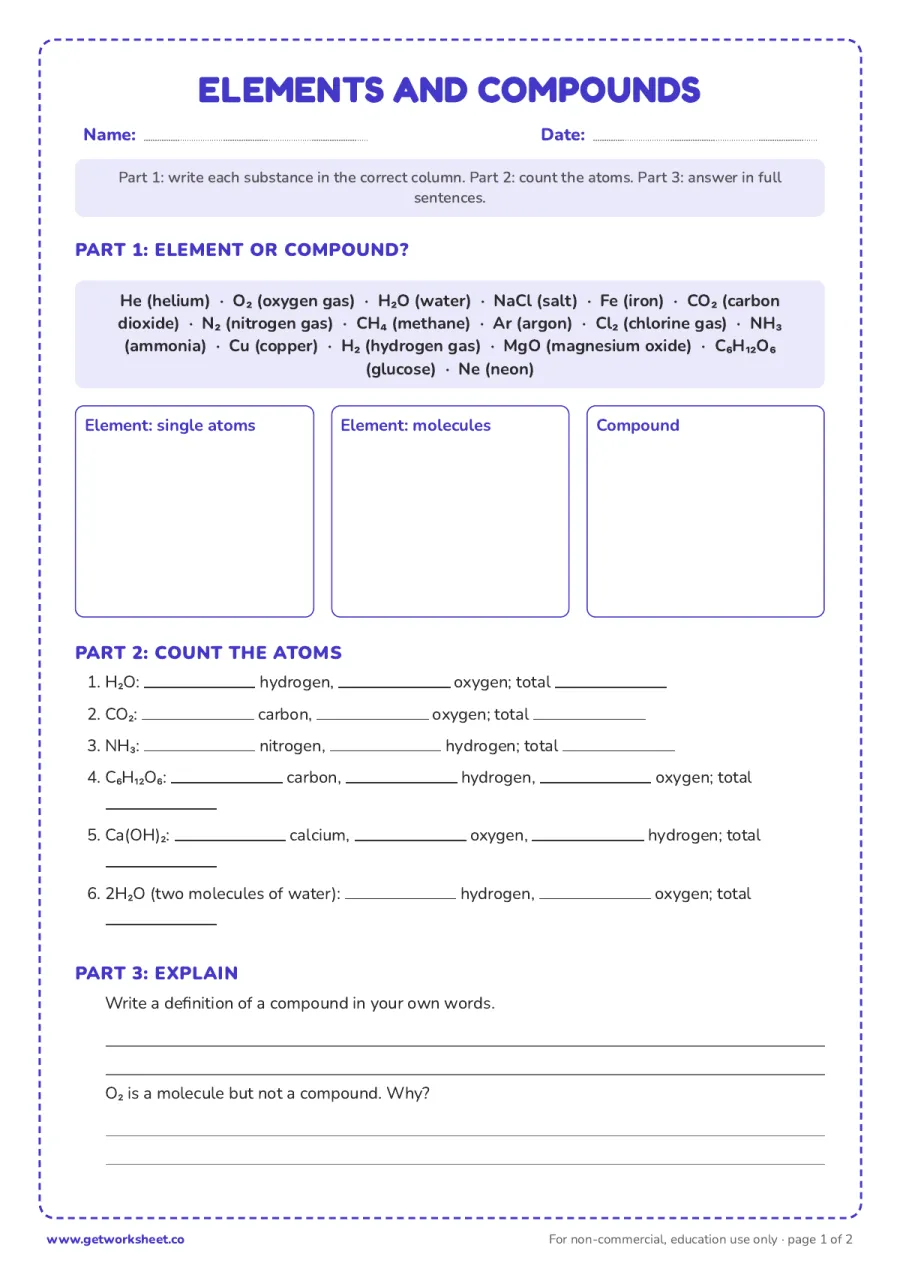
Elements and compounds: sort 16 substances, then count the atoms in 6 formulas
Sort sixteen substances (O₂, H₂O, He, NaCl, Fe, CO₂ ...) into elements made of single atoms, elements made of molecules, and compounds; count the atoms of each element in six formulas including C₆H₁₂O₆ and Ca(OH)₂; then two definitions. Answer key on page 2.
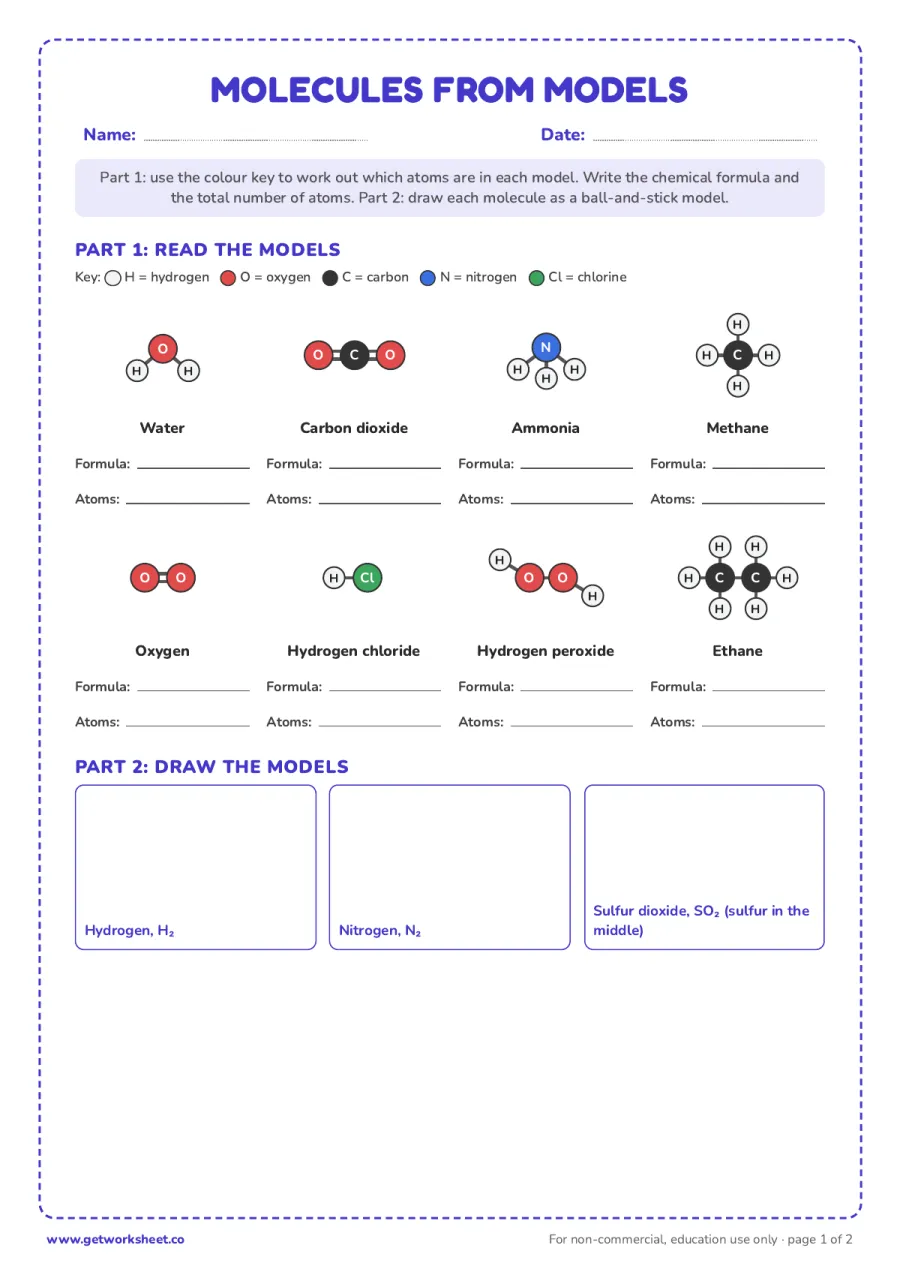
Molecules from models: read 8 ball-and-stick models, draw 3
Using a colour key (H, O, C, N, Cl), write the formula and atom count for water, CO2, ammonia, methane, O2, HCl, H2O2 and ethane; draw H2, N2, SO2.
AI worksheet generator
Make a worksheet like this for your class
The 5 sheets above are fixed. The generator writes a new atoms and molecules worksheet for your grade, with the question types and count you choose, in about 20 seconds. Pick a grade to start:
What you get
- A fresh set of questions on atoms and molecules, not a copy of the sheets above
- Multiple choice, fill in the blanks, true or false, open ended
- Answer key and print-ready PDF with Pro
Free account, 1 worksheets a week. No card.
Atomic structure is the point where chemistry stops being descriptions and starts being explanations. Students who can say why sodium has 11 electrons, why carbon-12 and carbon-14 are the same element and why O₂ is a molecule but not a compound have the foundation for bonding, the periodic table and reactions. These five worksheets take that route in order: the parts of one atom, the counting rules, drawing Bohr models, telling elements from compounds, and reading molecular models.
What's in this set
- Parts of an atom. A labelled Bohr diagram of carbon-12 with letters on the nucleus, a proton, a neutron, an electron and a shell; a table to name each part and give its charge and location; the proton/neutron/electron summary table with blanks; and four sentences on atomic number, mass number and neutral atoms.
- Protons, neutrons and electrons. Twelve elements (hydrogen to calcium) in a table with a different mix of gaps on each row, so students use atomic number = protons = electrons and neutrons = mass number − protons in both directions; then two questions: identify an element from its particle counts, and explain why carbon-12 and carbon-14 are the same element.
- Draw Bohr models. Six atoms with their shells already drawn (hydrogen, helium, carbon, oxygen, sodium, chlorine): write p and n in the nucleus and draw the electrons, filling 2 then 8 then 8; then write the electron configuration of four more elements.
- Elements and compounds. Sixteen formulas to sort into three columns (element: single atoms; element: molecules; compound), six formulas to break down into atoms of each element and a total (including a bracket and a coefficient), and two short written answers on what a compound is and why O₂ is not one.
- Molecules from models. Eight color-coded ball-and-stick models to read (write the formula and the number of atoms), then three boxes to draw hydrogen, nitrogen and sulfur dioxide from their formulas using the same color key.
What students will practice
- Naming the nucleus, protons, neutrons, electrons and shells on a Bohr diagram, with their charges and locations (NGSS MS-PS1-1)
- Using atomic number = protons = electrons and neutrons = mass number − atomic number, in both directions
- Recognizing isotopes: same protons, different neutrons, same element
- Drawing Bohr models with the 2, 8, 8 shell rule for the first 20 elements and writing electron configurations
- Classifying substances as elements (single atoms or molecules) or compounds from their formulas
- Counting atoms in formulas with subscripts, brackets and coefficients
- Reading ball-and-stick models and translating between model, name and formula
Free printable makers
Make your own atoms and molecules sheets
Type your own words or numbers and print in about 30 seconds. No account, no AI, answer key where it applies.
AI worksheet generator
Need a different atoms and molecules worksheet?
Generate a custom atoms and molecules worksheet: pick the grade, question types and count, and print it in about 20 seconds. Free accounts get 1 generation a week.
How to use these worksheets in class
- Start with one atom. Parts of an atom uses carbon-12 because it is the first atom most students can draw from memory and it shows two shells. The aside on the sheet says the diagram is not to scale; make that point aloud, because the "planet" picture is the source of most later misconceptions.
- Make the counting rules a routine. Protons, neutrons and electrons mixes the gaps so students cannot copy down a column. Time it: most students who understand the three rules finish the twelve rows in under ten minutes.
- Bohr models with counters first. Before Draw Bohr models, have students place counters on a large printed set of rings (2, then 8, then 8). Sodium's single outer electron and chlorine's seven are the images they will need for ionic bonding later.
- The sort settles a vocabulary problem. Element, molecule and compound overlap in ways students find slippery. The three-column sort in Elements and compounds forces the distinction: O₂ is an element and a molecule; He is an element and not a molecule; H₂O is a molecule and a compound.
- Models with molecular model kits. If you have kits, build the eight molecules from Molecules from models before writing the formulas. Ethane is included because eight atoms make students count carefully.
- Middle school to early high school. Grades 6 and 7 can complete the first, fourth and fifth sheets; grades 8 and 9 should do all five and the isotope question.
Answer key
Every practice sheet carries its own answer key on page 2 of the PDF. The keys are repeated here for quick marking.
- Parts of an atom: Part 1: name the parts: A = Nucleus; B = Proton; C = Neutron; D = Electron; E = Electron shell (energy level) A | Nucleus | positive overall | the center of the atom B | Proton | + | in the nucleus C | Neutron | none | in the nucleus D | Electron | − | moving around the nucleus in a shell E | Electron shell (energy level) | not a particle | a ring around the nucleus where electrons are found Part 2: the three subatomic particles: Proton | +1 | 1 | nucleus Neutron | 0 | 1 | nucleus Electron | −1 | almost 0 (about 1/1840) | shells around the nucleus Part 3: complete the sentences: 1. protons 2. protons 3. neutrons 4. nucleus
- Protons, neutrons and electrons: Complete the table: Hydrogen | H | 1 | 1 | 1 | 0 | 1 Helium | He | 2 | 4 | 2 | 2 | 2 Carbon | C | 6 | 12 | 6 | 6 | 6 Nitrogen | N | 7 | 14 | 7 | 7 | 7 Oxygen | O | 8 | 16 | 8 | 8 | 8 Fluorine | F | 9 | 19 | 9 | 10 | 9 Sodium | Na | 11 | 23 | 11 | 12 | 11 Magnesium | Mg | 12 | 24 | 12 | 12 | 12 Aluminium | Al | 13 | 27 | 13 | 14 | 13 Chlorine | Cl | 17 | 35 | 17 | 18 | 17 Potassium | K | 19 | 39 | 19 | 20 | 19 Calcium | Ca | 20 | 40 | 20 | 20 | 20 Think about it: 1. Phosphorus (atomic number 15); mass number 15 + 16 = 31. 2. Yes. Both have 6 protons, and the number of protons decides the element. They are isotopes of carbon (carbon-12 and carbon-14).
- Draw Bohr models: Part 1: complete the models: Hydrogen: 1 protons, 0 neutrons, electrons 1 Helium: 2 protons, 2 neutrons, electrons 2 Carbon: 6 protons, 6 neutrons, electrons 2, 4 Oxygen: 8 protons, 8 neutrons, electrons 2, 6 Sodium: 11 protons, 12 neutrons, electrons 2, 8, 1 Chlorine: 17 protons, 18 neutrons, electrons 2, 8, 7 Part 2: electron configurations (for example, carbon = 2, 4): 1. 2, 5 2. 2, 8 3. 2, 8, 2 4. 2, 8, 8
- Elements and compounds: Part 1: element or compound?: Element: single atoms: He (helium), Fe (iron), Ar (argon), Cu (copper), Ne (neon) Element: molecules: O₂ (oxygen gas), N₂ (nitrogen gas), Cl₂ (chlorine gas), H₂ (hydrogen gas) Compound: H₂O (water), NaCl (salt), CO₂ (carbon dioxide), CH₄ (methane), NH₃ (ammonia), MgO (magnesium oxide), C₆H₁₂O₆ (glucose) Part 2: count the atoms: 1. 2 H, 1 O; total 3 2. 1 C, 2 O; total 3 3. 1 N, 3 H; total 4 4. 6 C, 12 H, 6 O; total 24 5. 1 Ca, 2 O, 2 H; total 5 6. 4 H, 2 O; total 6 Part 3: explain: 1. Sample: a substance made of two or more different elements chemically joined together in a fixed ratio. 2. It contains atoms of only one element (oxygen); a compound needs at least two different elements.
- Molecules from models: Part 1: read the models: Water: H₂O, 3 atoms; Carbon dioxide: CO₂, 3 atoms; Ammonia: NH₃, 4 atoms; Methane: CH₄, 5 atoms; Oxygen: O₂, 2 atoms; Hydrogen chloride: HCl, 2 atoms; Hydrogen peroxide: H₂O₂, 4 atoms; Ethane: C₂H₆, 8 atoms Part 2: draw the models: Drawings: H₂ two white balls joined by one stick; N₂ two blue balls joined by three sticks (triple bond); SO₂ a yellow ball in the middle joined to two red balls.
Common mistakes to watch for
- Neutrons = atomic number. True for carbon, oxygen and a few others, which is why students believe it. Fluorine (9 protons, 10 neutrons) and chlorine (17 and 18) are in the table to break the habit.
- Putting electrons in the nucleus. Electrons are on the rings only. If a Bohr model has more than two dots on the inner ring, the student has not applied the shell rule.
- Counting the subscript once. In C₆H₁₂O₆ there are 24 atoms, not 3; in Ca(OH)₂ the bracket doubles both the O and the H.
- "Compound" for anything with a subscript. O₂, N₂, Cl₂ and H₂ are elements. A compound needs two different elements.
- Mass number versus atomic mass. Mass number is a whole number for one atom (protons + neutrons); the decimal on the periodic table is an average. The worksheets use mass number throughout.
Frequently asked questions
What grade are these atoms and molecules worksheets for?
Grades 6 to 9. Middle school students (grades 6 to 8) meet atoms, elements and compounds under NGSS MS-PS1-1; grade 9 or first-year high school chemistry revisits the same ideas with electron configurations, which the Bohr model sheet covers.
Do the worksheets include answer keys?
Yes. Every sheet has its answer key on the last page of the PDF, and the keys are repeated on this page.
Why do the Bohr models use the 2, 8, 8 rule?
It is the model taught in middle school and early high school and it gives the correct number of outer electrons for the first 20 elements, which is what matters for understanding groups of the periodic table and bonding. The full sub-shell model comes later.
What is the difference between a molecule and a compound?
A molecule is two or more atoms bonded together; a compound is a substance made of two or more different elements. O₂ is a molecule but not a compound. H₂O is both. Helium is neither: it exists as single atoms.
Do students need a periodic table?
The protons, neutrons and electrons sheet gives the atomic numbers and mass numbers needed, so no. For the Bohr model sheet, the atomic numbers are printed above each template.
Related chemistry worksheets
Next, the periodic table worksheets show how atomic number arranges the elements into groups and periods. The chemical reactions worksheets count atoms on both sides of an equation, and the balancing equations worksheets take that further. For the particle model of solids, liquids and gases, see the states of matter worksheets.