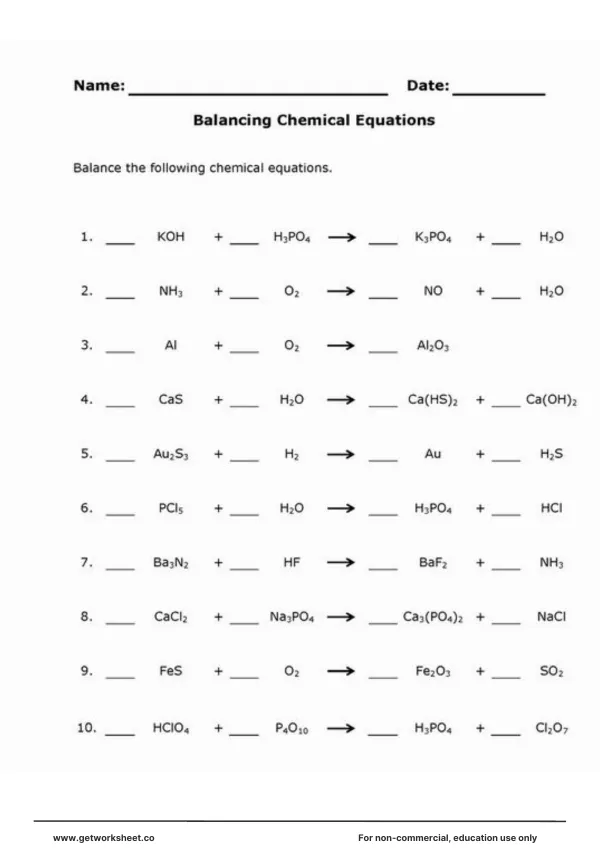
Chemistry · Grades 8–10
Free chemical reactions worksheets
Five printable chemical reactions worksheets for grades 8 to 10: physical or chemical change, writing word equations, classifying twelve equations into the five reaction types and more. Answer keys included.
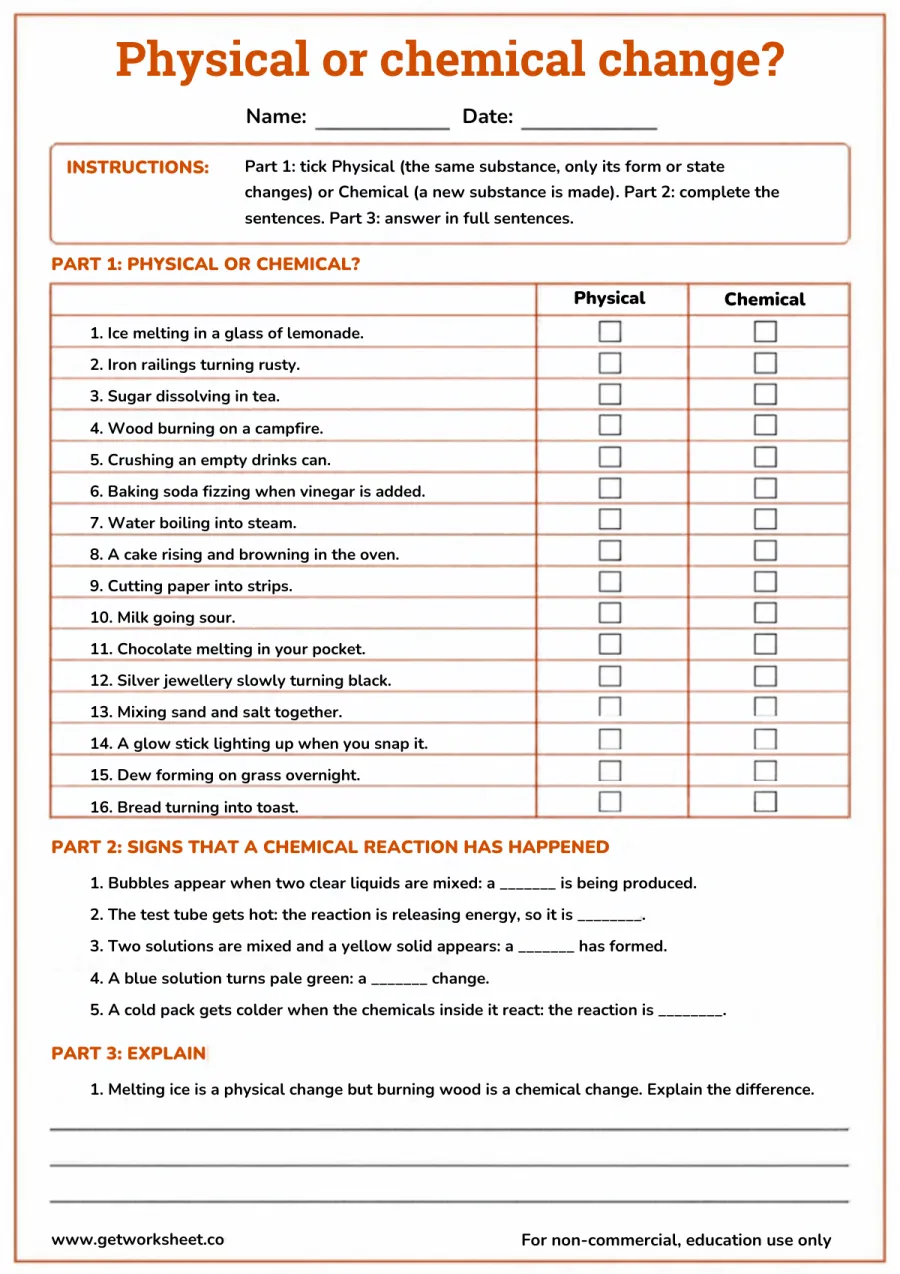
Physical or chemical change? 16 examples, then the 5 signs of a reaction
Sixteen everyday changes to classify as physical or chemical, five sentences on the evidence of a chemical reaction (gas, colour change, precipitate, temperature change), and one explanation question. Answer key on page 2.
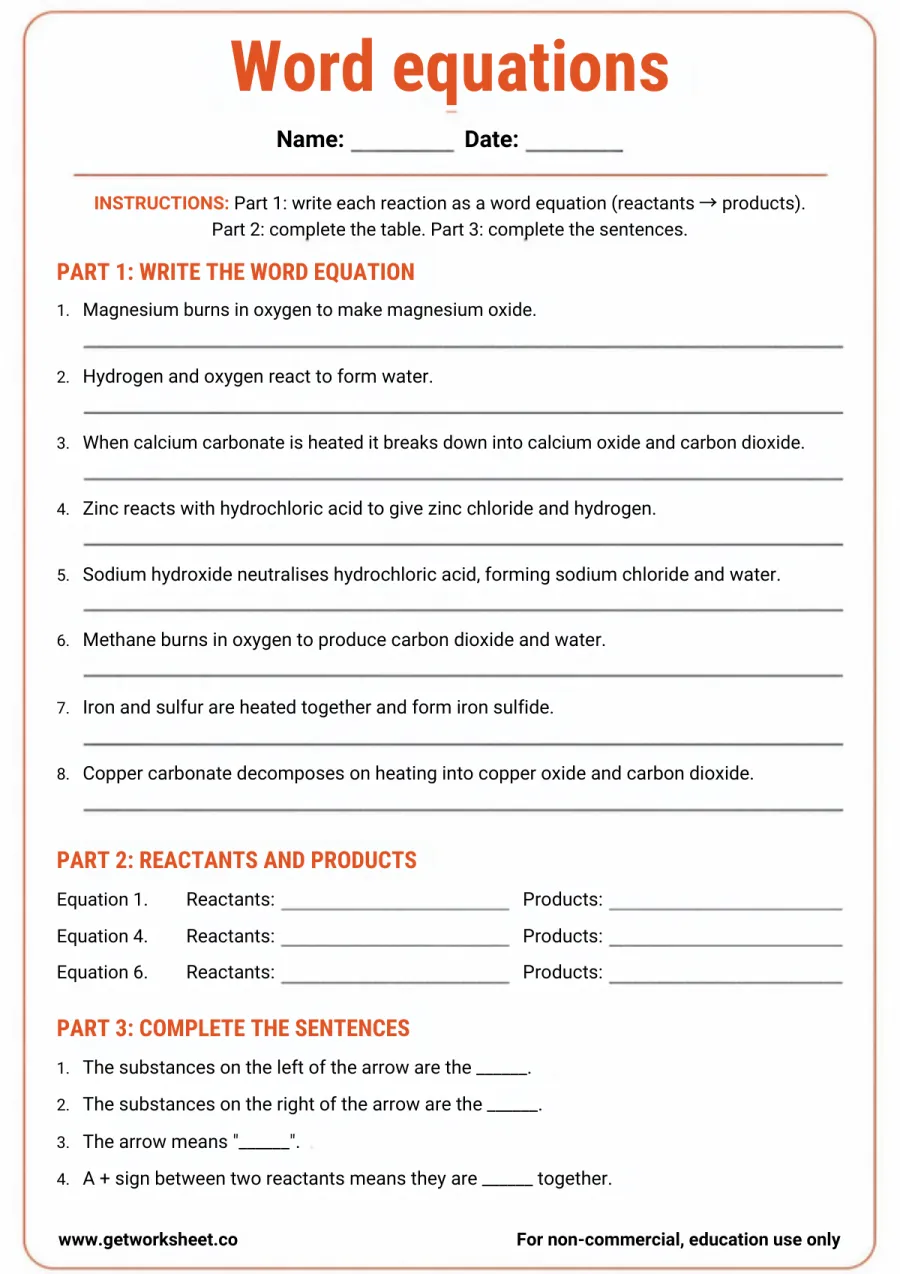
Word equations: write 8 equations from descriptions, then reactants and products
Eight reactions described in a sentence (magnesium burning, calcium carbonate decomposing, zinc with hydrochloric acid ...) to write as word equations, a reactants-and-products table, and four sentences on what the arrow and plus signs mean. Answer key on page 2.
Whole set
All 5 sheets in one PDF
Instant and ad-free. No account needed.
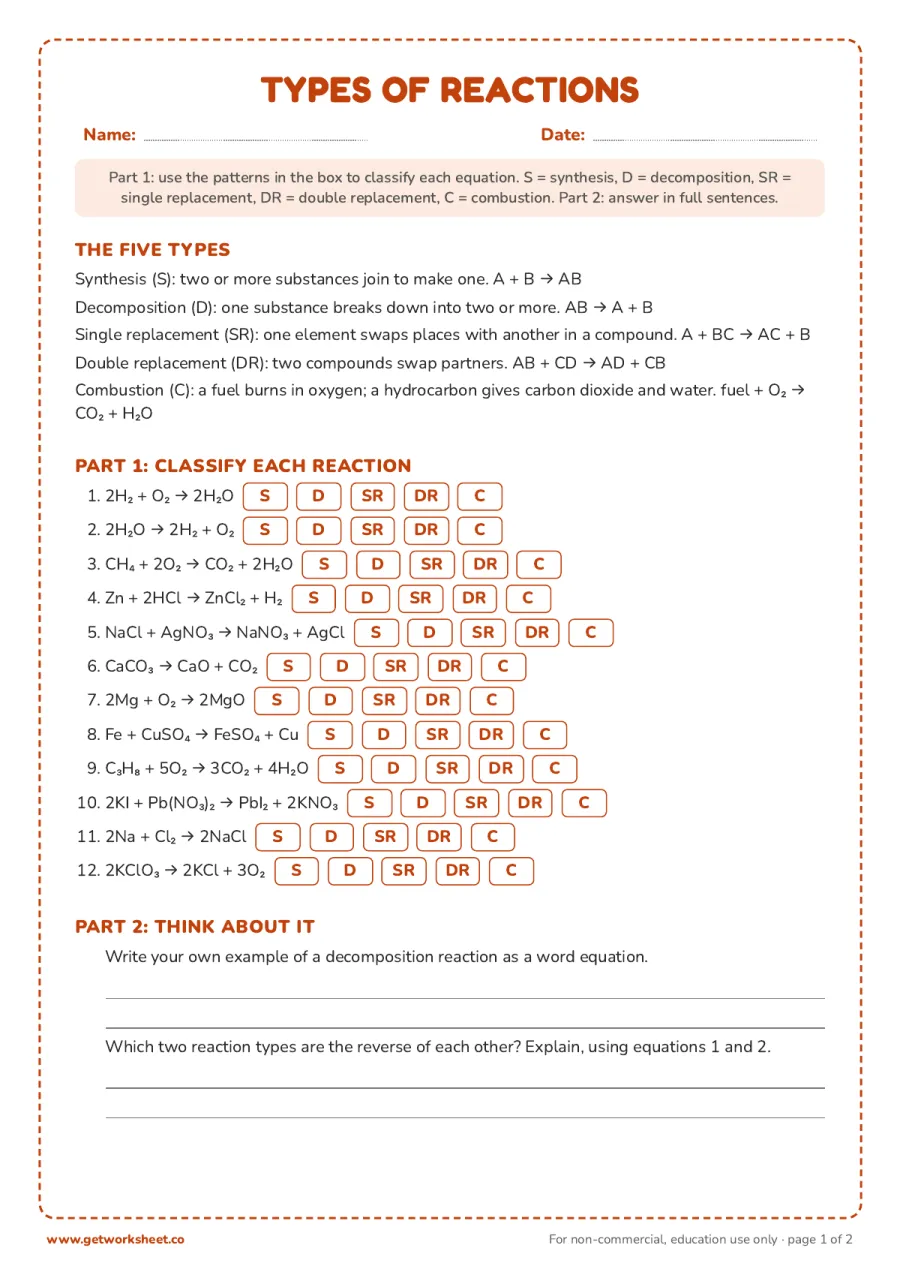
Types of reactions: classify 12 equations as synthesis, decomposition, replacement or combustion
The five reaction types with their general patterns, twelve balanced equations to classify (synthesis, decomposition, single replacement, double replacement, combustion), and two written questions. Answer key on page 2.
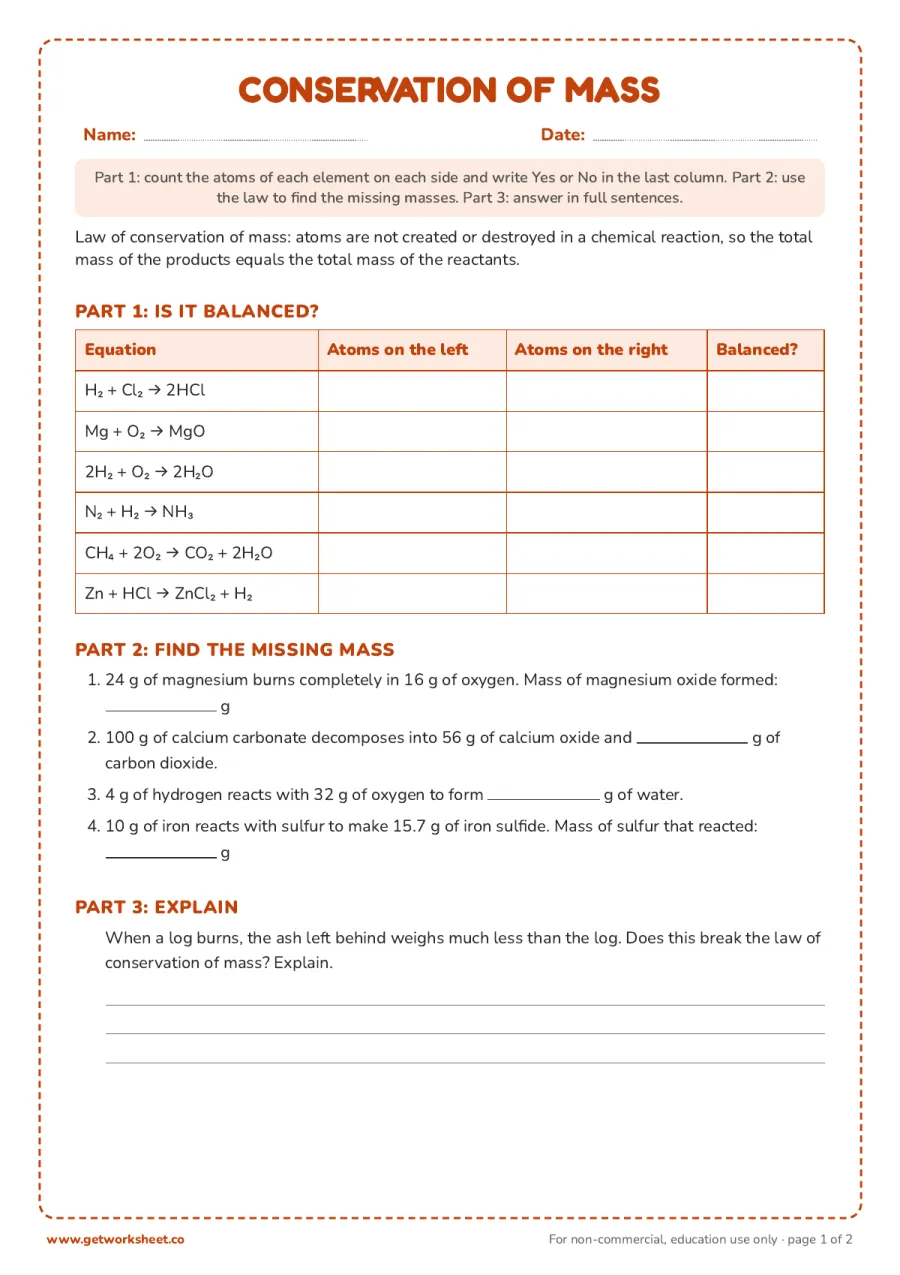
Conservation of mass: count atoms on both sides of 6 equations, then 4 mass calculations
Count the atoms of each element on both sides of six equations and decide whether each is balanced, then four conservation-of-mass calculations and an explanation of why ash weighs less than the wood it came from. Answer key on page 2.
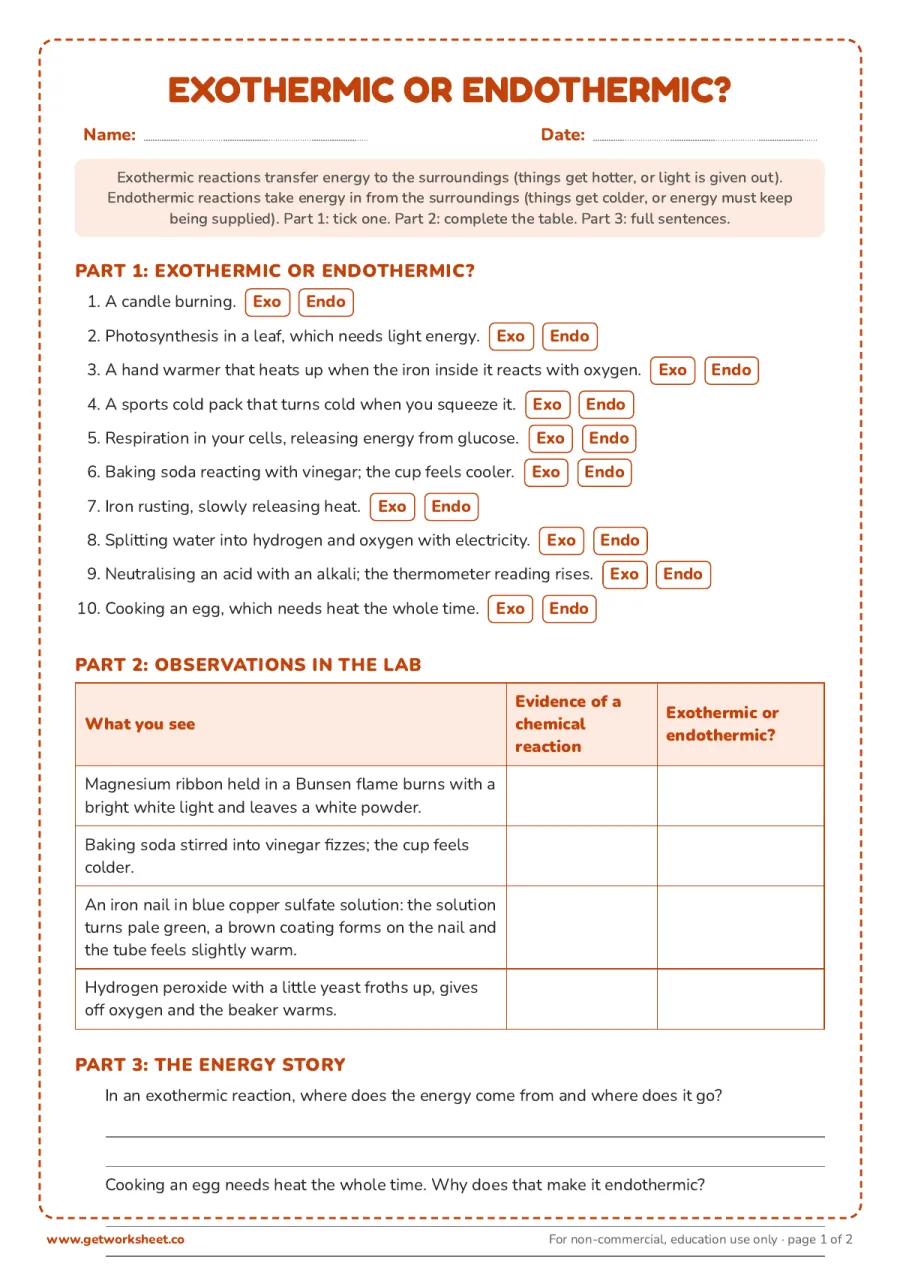
Exothermic or endothermic? 10 examples, 4 lab observations and the energy story
Ten reactions and processes to classify as exothermic or endothermic, four lab observations to interpret (evidence of reaction and energy change), and two questions on where the energy comes from and goes. Answer key on page 2.
AI worksheet generator
Make a worksheet like this for your class
The 5 sheets above are fixed. The generator writes a new chemical reactions worksheet for your grade, with the question types and count you choose, in about 20 seconds. Pick a grade to start:
What you get
- A fresh set of questions on chemical reactions, not a copy of the sheets above
- Multiple choice, fill in the blanks, true or false, open ended
- Answer key and print-ready PDF with Pro
Free account, 1 worksheets a week. No card.
Chemical reactions are where students first have to reason with chemistry rather than describe it: decide whether a change made a new substance, write it as an equation, classify it, check that atoms are conserved and say where the energy went. These five worksheets follow that sequence. Each uses real reactions that appear in school practicals (magnesium in a flame, zinc in acid, iron in copper sulfate, baking soda and vinegar), so the equations connect to things students have seen.
What's in this set
- Physical or chemical change? Sixteen changes from melting ice to toasting bread to classify, five fill-in sentences that name the signs of a chemical reaction (gas produced, exothermic, precipitate, color change, endothermic), and a written explanation of why melting is physical but burning is chemical.
- Word equations. Eight descriptions to turn into word equations with reactants on the left, an arrow, and products on the right; a table to separate reactants from products for three of them; and four fill-in sentences on the meaning of the arrow, the plus sign, reactants and products.
- Types of reactions. A reference box with the general pattern of each type (A + B → AB and so on), twelve real equations from 2H₂ + O₂ → 2H₂O to 2KClO₃ → 2KCl + 3O₂ to classify by ticking S, D, SR, DR or C, and two questions: write your own decomposition example and explain which two types are reverses of each other.
- Conservation of mass. A statement of the law, six equations to count atom by atom (three balanced, three not), four mass calculations (magnesium oxide, calcium carbonate, water, iron sulfide) and a written explanation of the burning-wood puzzle.
- Exothermic or endothermic? Ten examples from a burning candle to a cold pack to classify, a table of four lab observations (burning magnesium, vinegar and baking soda, iron in copper sulfate, hydrogen peroxide with yeast) asking for the evidence of a reaction and the energy change, and two written questions on energy transfer.
What students will practice
- Distinguishing physical from chemical changes and naming the evidence of a reaction: gas, color change, precipitate, temperature change (NGSS MS-PS1-2)
- Writing word equations with reactants, an arrow and products
- Recognizing the five reaction types from their patterns: synthesis, decomposition, single replacement, double replacement, combustion
- Counting atoms on both sides of an equation and deciding whether it is balanced (MS-PS1-5, HS-PS1-7)
- Applying the law of conservation of mass to find a missing mass
- Classifying reactions as exothermic or endothermic from temperature observations and describing the energy transfer (MS-PS1-6)
Free printable makers
Make your own chemical reactions sheets
Type your own words or numbers and print in about 30 seconds. No account, no AI, answer key where it applies.
AI worksheet generator
Need a different chemical reactions worksheet?
Generate a custom chemical reactions worksheet: pick the grade, question types and count, and print it in about 20 seconds. Free accounts get 1 generation a week.
How to use these worksheets in class
- Physical or chemical as a starter. Students complete part 1 of Physical or chemical change? in five minutes, then argue the borderline cases. Dissolving sugar and toasting bread cause the most disagreement; both are on the sheet for that reason.
- Word equations before symbols. Word equations is deliberately symbol-free. Students who can write "zinc + hydrochloric acid → zinc chloride + hydrogen" have understood the reaction; the formulas come next. Every equation on the sheet also appears in symbol form on Types of reactions or Conservation of mass, so the sheets can be used in sequence.
- Classify by pattern, not memory. Keep the reference box on Types of reactions visible. Students should match each equation to a pattern (one reactant means decomposition; oxygen plus a hydrocarbon means combustion) rather than recall the reaction.
- Counting atoms leads into balancing. Conservation of mass asks students to count, not balance. Once the three unbalanced equations are found, the balancing equations worksheets are the natural next lesson.
- Pair the energy sheet with a practical. The four observations in Exothermic or endothermic? are the standard demonstrations. Run one or two with a thermometer before the sheet; the temperature readings make the classification concrete.
- Homework or revision. Each sheet is self-contained with its key on the last page, so they also work as independent revision before an end-of-unit test.
Answer key
Every practice sheet carries its own answer key on page 2 of the PDF. The keys are repeated here for quick marking.
- Physical or chemical change?: Part 1: physical or chemical?: 1. Physical 2. Chemical 3. Physical 4. Chemical 5. Physical 6. Chemical 7. Physical 8. Chemical 9. Physical 10. Chemical 11. Physical 12. Chemical 13. Physical 14. Chemical 15. Physical 16. Chemical Part 2: signs that a chemical reaction has happened: 1. gas 2. exothermic 3. precipitate 4. color 5. endothermic Part 3: explain: 1. Melting only changes the state: it is still water and it can freeze again. Burning makes new substances (carbon dioxide, water vapour, ash) with different properties, and the wood cannot be recovered.
- Word equations: Part 1: write the word equation: 1. magnesium + oxygen → magnesium oxide 2. hydrogen + oxygen → water 3. calcium carbonate → calcium oxide + carbon dioxide 4. zinc + hydrochloric acid → zinc chloride + hydrogen 5. sodium hydroxide + hydrochloric acid → sodium chloride + water 6. methane + oxygen → carbon dioxide + water 7. iron + sulfur → iron sulfide 8. copper carbonate → copper oxide + carbon dioxide Part 2: reactants and products: 1 | magnesium, oxygen | magnesium oxide 4 | zinc, hydrochloric acid | zinc chloride, hydrogen 6 | methane, oxygen | carbon dioxide, water Part 3: complete the sentences: 1. reactants 2. products 3. reacts to make (produces) 4. reacting (mixed)
- Types of reactions: Part 1: classify each reaction: 1. S 2. D 3. C 4. SR 5. DR 6. D 7. S 8. SR 9. C 10. DR 11. S 12. D Part 2: think about it: 1. Sample: copper carbonate → copper oxide + carbon dioxide (any AB → A + B example). 2. Synthesis and decomposition. In equation 1 hydrogen and oxygen join to make water; in equation 2 water breaks apart into hydrogen and oxygen, the same equation read backwards.
- Conservation of mass: Part 1: is it balanced?: H₂ + Cl₂ → 2HCl | H 2, Cl 2 | H 2, Cl 2 | Yes Mg + O₂ → MgO | Mg 1, O 2 | Mg 1, O 1 | No 2H₂ + O₂ → 2H₂O | H 4, O 2 | H 4, O 2 | Yes N₂ + H₂ → NH₃ | N 2, H 2 | N 1, H 3 | No CH₄ + 2O₂ → CO₂ + 2H₂O | C 1, H 4, O 4 | C 1, H 4, O 4 | Yes Zn + HCl → ZnCl₂ + H₂ | Zn 1, H 1, Cl 1 | Zn 1, Cl 2, H 2 | No Part 2: find the missing mass: 1. 40 g 2. 44 g 3. 36 g 4. 5.7 g Part 3: explain: 1. No. The wood reacts with oxygen from the air and most of the products (carbon dioxide and water vapour) escape as gases. Ash + gases = wood + oxygen used, so mass is conserved.
- Exothermic or endothermic?: Part 1: exothermic or endothermic?: 1. Exo 2. Endo 3. Exo 4. Endo 5. Exo 6. Endo 7. Exo 8. Endo 9. Exo 10. Endo Part 2: observations in the lab: Magnesium | light and heat given out; a new white substance forms | exothermic Baking soda and vinegar | gas produced (bubbles); temperature falls | endothermic Iron in copper sulfate | color change; a new solid (copper) forms; temperature rises | exothermic Hydrogen peroxide and yeast | gas produced (froth); temperature rises | exothermic Part 3: the energy story: 1. Energy stored in the chemical bonds of the reactants is transferred to the surroundings as heat (and sometimes light), so the surroundings warm up. 2. The reaction takes in energy from the surroundings (the pan); if the heat supply stops, the reaction stops.
Common mistakes to watch for
- "Dissolving is a chemical change because the sugar disappears." The sugar is still there and can be recovered by evaporation. No new substance means physical.
- Reversing the equation. Reactants go on the left. "Magnesium oxide → magnesium + oxygen" describes a different reaction.
- Calling every reaction with oxygen a combustion. 2Mg + O₂ → 2MgO is a synthesis (two substances form one). Combustion on this sheet means a fuel burning to give carbon dioxide and water.
- Counting subscripts as coefficients. In 2H₂O there are 4 hydrogen atoms and 2 oxygen atoms. The coefficient multiplies everything in the formula.
- Endothermic means "gives out cold". Nothing is given out. The reaction takes energy in from the surroundings, which is why the surroundings cool.
Frequently asked questions
What grade are these chemical reactions worksheets for?
Grades 8 to 10. Physical or chemical change? and Word equations suit grade 7 or 8; Types of reactions and Conservation of mass use symbol equations and suit grades 9 and 10 or a strong grade 8 class.
Do the worksheets include answer keys?
Yes. Each PDF has the key on its last page and the keys are repeated on this page. The written questions show a model answer; accept any answer that makes the same point.
Which reaction types are covered?
The five taught in most middle and high school courses: synthesis (combination), decomposition, single replacement (displacement), double replacement and combustion. Acid-base neutralisation appears as an example of double replacement.
Do students need to balance equations?
Not on these sheets. Conservation of mass asks students to count atoms and say whether an equation is balanced, which is the skill that comes before balancing. Use the balancing equations worksheets for the next step.
Are the reactions safe to demonstrate?
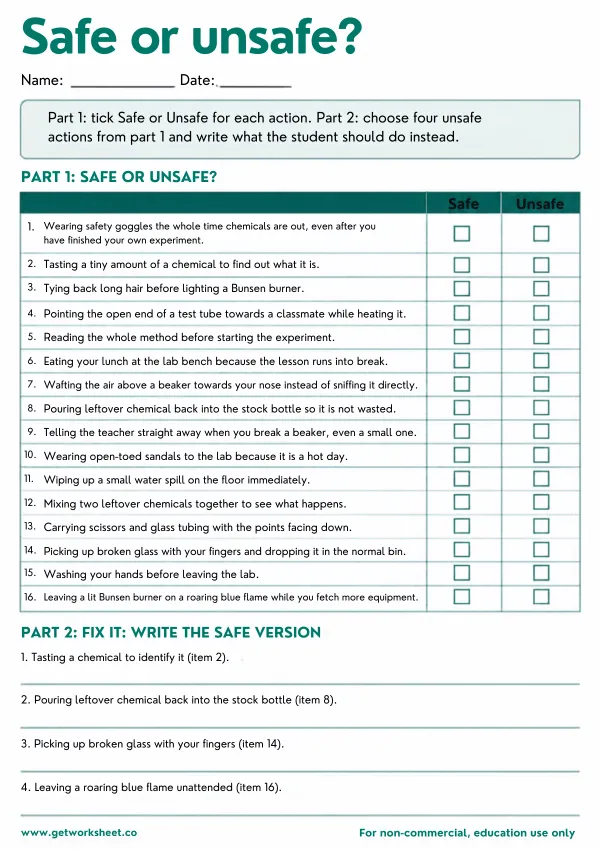
The four observations on the energy sheet (magnesium in a flame, baking soda and vinegar, an iron nail in copper sulfate, hydrogen peroxide with yeast) are standard school demonstrations. Magnesium needs eye protection and students should not look directly at the flame. Review the lab safety worksheets first.
Related chemistry worksheets
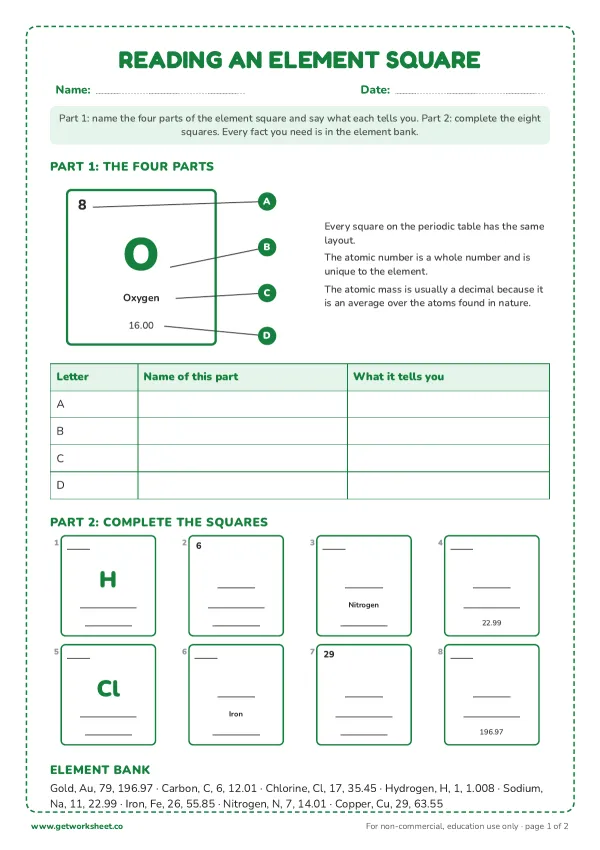
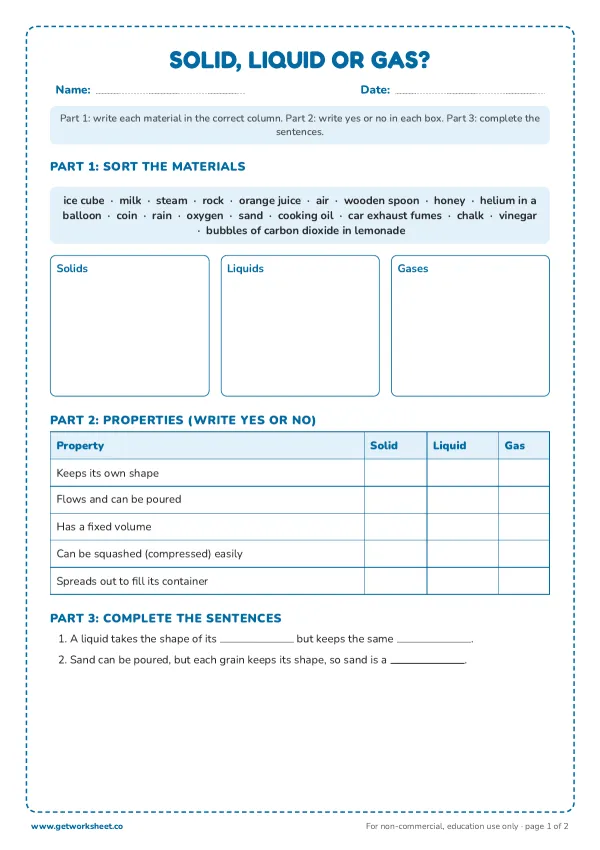
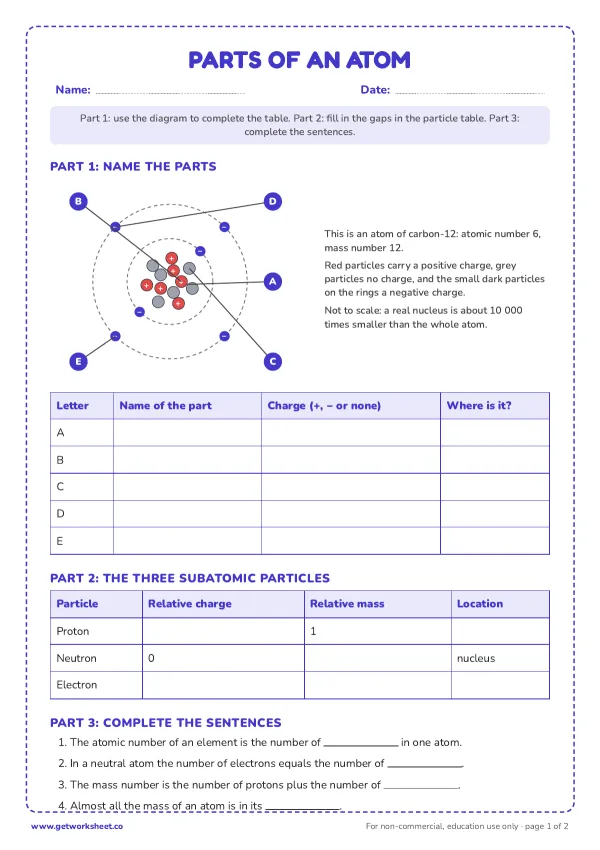
Before this set, the atoms and molecules worksheets teach students to count atoms in a formula, and the states of matter worksheets cover the physical changes (melting, boiling, condensing) that students must tell apart from reactions. The periodic table worksheets introduce the elements in these equations.