Multiplication Word Problems Worksheets
Free multiplication word problems worksheets with answer keys. Practice real-world multiplication scenarios — printable PDFs for grades 2-5 math.
Knowing that 6 x 8 = 48 is one thing. Knowing that you need to multiply when a problem says "Each shelf holds 8 books and there are 6 shelves" is something else entirely. These worksheets bridge the gap between computation and application — giving students practice recognizing when multiplication is the right operation and setting up the math correctly from a word problem.
What Students Will Practice
- Identifying multiplication situations in word problems — equal groups, arrays, area, and repeated addition scenarios
- Translating words into multiplication expressions (e.g., "5 bags with 7 apples each" = 5 x 7)
- Solving one-step multiplication word problems with single-digit and multi-digit numbers
- Solving two-step word problems that combine multiplication with addition or subtraction
- Interpreting remainders and deciding whether to round up or down based on context
- Writing their own multiplication word problems from given equations (e.g., write a story for 4 x 9 = 36)
Word problem skills align with grades 2-5 math standards that emphasize applying operations to real-world situations. These problems test conceptual understanding, not just computational speed.

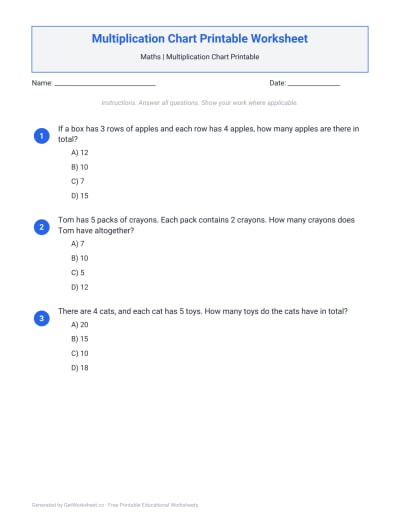
Multiplication Word Problems Worksheet
Free printable multiplication word problems worksheets with answer keys. Perfect for extra practice, homework help, or reinforcing math skills at home.
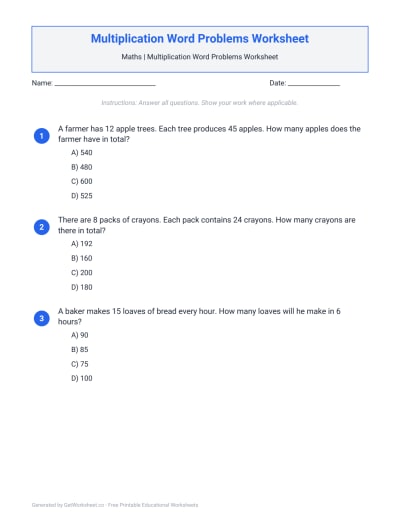
Multiplication Word Problems Worksheet
Free printable multiplication word problems worksheets with answer keys. Perfect for homework, extra practice, or helping kids grasp multiplication in real-life contexts.
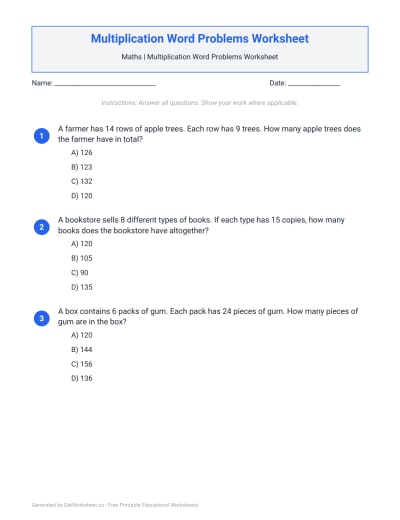
Multiplication Word Problems Worksheet
Free printable multiplication word problems worksheets with answer keys. Great for extra practice at home or in the classroom to boost math skills.
How to Use These Worksheets
Word problems require reading comprehension AND math — both skills need practice.
- Teach the "read, underline, set up, solve, check" process. Read the problem once for understanding. Read it again and underline the key numbers and action words ("each," "per," "every," "total" — these signal multiplication). Set up the equation. Solve. Then check: does the answer make sense?
- Have your child identify the "groups" and "items per group" in each problem. Multiplication word problems always involve equal groups. "3 boxes with 12 crayons each" means 3 groups of 12. Once students can spot the groups structure, setting up the equation is straightforward.
- For two-step problems, have your child solve one step at a time and write down the intermediate answer before moving to the next step. Students who try to do everything in their head often lose track of numbers and make errors.
- The "write your own word problem" exercises are especially valuable. Creating a story for 7 x 5 = 35 requires deep understanding of what multiplication means. If your child can write a sensible word problem, they truly understand the concept.
Common Mistakes to Watch For
- Adding when they should multiply: "There are 4 tables with 6 chairs each. How many chairs?" Some students add 4 + 6 = 10 instead of multiplying 4 x 6 = 24. Look for keywords: "each," "every," "per" almost always signal multiplication. "In all" or "total" signal that the answer should be bigger than both numbers.
- Multiplying the wrong numbers: In multi-step problems, students sometimes multiply numbers that shouldn't be multiplied. Underlining the relevant numbers and labeling what each one represents (groups, items per group, extra amount) prevents this.
- Ignoring the question being asked: A problem might give information about 3 classrooms with 25 students each, but ask how many students are NOT in classroom A. Students multiply 3 x 25 = 75 and stop, missing the second step. Always re-read the question after calculating to make sure you've actually answered what was asked.
- Not checking if the answer is reasonable: If a problem asks how many apples 3 children have with 4 each, and a student writes 34 instead of 12, a quick sense check would catch it — 3 kids can't have 34 apples if each only has 4.
Frequently Asked Questions
My child can do multiplication drills but freezes on word problems. Why?
Word problems require two skills: reading comprehension (understanding what's being asked) and computation (doing the math). Many students are strong at computation but haven't practiced translating words into equations. The fix is structured practice with the "underline key information, identify the groups, set up the equation" process.
How do I know if a word problem needs multiplication or addition?
Multiplication involves equal groups: "5 bags with 8 apples each" is multiplication. Addition involves combining different amounts: "5 apples and 8 oranges" is addition. The key question is: "Are the groups the same size?" If yes, multiply. If you're combining different things, add.
When should my child encounter word problems?
Word problems should be introduced alongside computation, not after. Students should practice word problems from the very first week they learn multiplication. Waiting until they've "mastered" the facts before introducing word problems creates a disconnect between knowing how to multiply and knowing when to multiply.
Should my child draw pictures for word problems?
Yes, especially at first. Drawing 4 groups of 6 dots takes longer than writing 4 x 6, but it builds understanding of why multiplication works. Encourage drawings for new problem types, then transition to equations as confidence builds. Many strong math students continue sketching quick diagrams even in high school.
After mastering multiplication word problems, students are ready for multi-step word problems involving all four operations, problems with larger numbers and decimals, and eventually algebraic word problems where the unknown quantity is represented by a variable.