Free unit conversion worksheets
Free printable unit conversion worksheets with answer keys. Practice converting length, weight, volume, and temperature units. PDF for grades 4-6.
Unit conversion worksheets teach students to change measurements from one unit to another — inches to feet, grams to kilograms, cups to liters. The underlying skill is multiplying or dividing by conversion factors, but the real challenge is knowing which direction to go. Does converting from meters to centimeters make the number bigger or smaller? Students who understand that smaller units produce bigger numbers (100 cm = 1 m) make far fewer errors.
What Students Will Practice
- Converting within the metric system (e.g., 3.5 kg = 3,500 g by multiplying by 1,000)
- Converting within customary units (e.g., 5 feet = 60 inches by multiplying by 12)
- Converting between units of length, weight/mass, and volume/capacity
- Deciding whether to multiply or divide based on whether you are going to a smaller or larger unit
- Solving word problems that require unit conversion (e.g., "A recipe calls for 2 cups of milk. How many fluid ounces is that?")
Unit conversion is covered in grades 4-6 and is essential for science classes, cooking, construction, and everyday problem-solving with measurements.
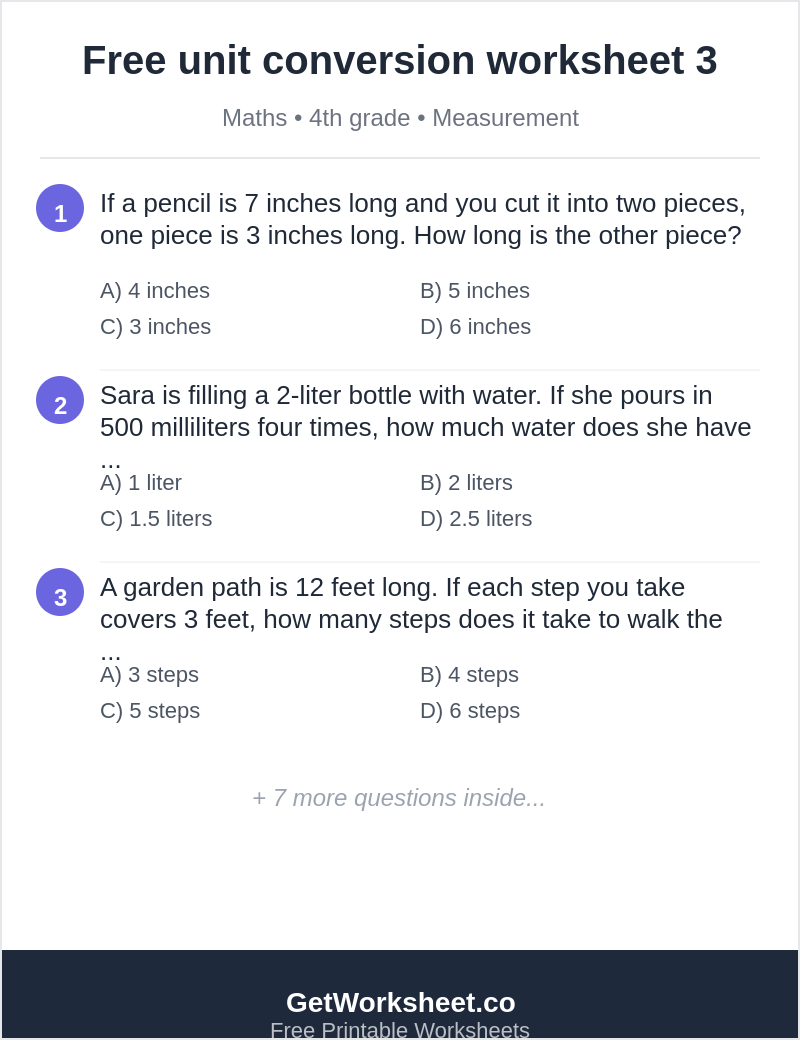
Free unit conversion worksheet 3
Explore our 4th grade measurement worksheets to master unit conversion with engaging exercises designed to enhance understanding and skills.
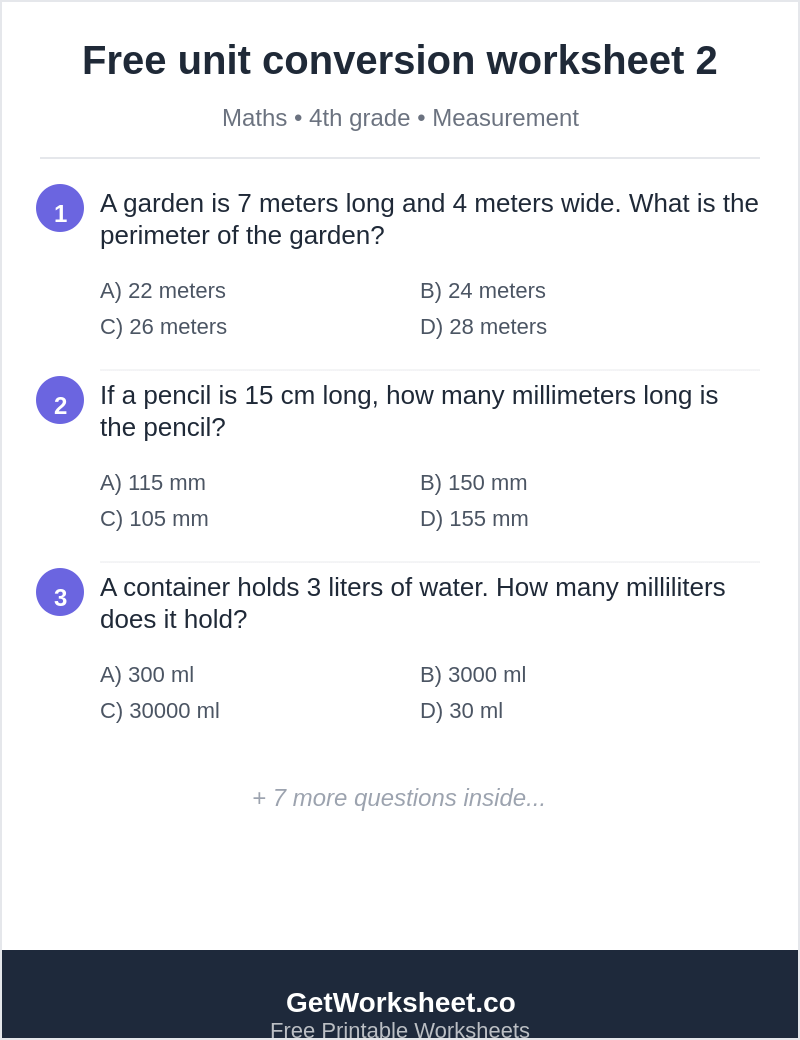
Free unit conversion worksheet 2
Explore our 4th grade measurement worksheets to master unit conversion with engaging exercises designed to enhance understanding and skills.

Free unit conversion worksheet
Explore our 4th grade measurement worksheets to master unit conversion with engaging exercises designed to enhance understanding and skills.
How to Use These Worksheets
Strategies for mastering unit conversions.
- Post a conversion reference chart on the wall while your child practices. Memorizing every conversion factor takes time — having a reference available lets them focus on the process (multiply or divide?) while gradually memorizing the factors through repeated use.
- Teach the "bigger unit = smaller number" rule. Converting from feet to inches? Inches are smaller, so the number gets bigger (3 feet = 36 inches). Converting from grams to kilograms? Kilograms are bigger, so the number gets smaller (5,000 g = 5 kg). This rule prevents the most common error.
- Use real measurements. Have your child measure their height in inches, then convert to feet and inches. Weigh a bag of apples in grams, then convert to kilograms. Real conversions make the math meaningful and memorable.
Common Mistakes to Watch For
- Multiplying when they should divide, or vice versa. Converting 5,000 meters to kilometers, a student might multiply by 1,000 and get 5,000,000 km instead of dividing to get 5 km. Always ask: "Should the answer be bigger or smaller than the starting number?"
- Confusing metric prefixes. Kilo means 1,000, centi means 1/100, milli means 1/1,000. Students mix up centi and milli frequently. A centimeter is bigger than a millimeter — practice comparing with a ruler to make it concrete.
- Mixing up customary and metric systems. A student might try to convert inches directly to centimeters using a metric-only conversion factor. Make sure they know which system each unit belongs to before starting.
- Forgetting to convert all units in a multi-step problem. If a recipe calls for 1.5 liters and they have a 250 mL measuring cup, they need to convert liters to mL first. Missing this step leads to wildly wrong answers.
Frequently Asked Questions
Should my child memorize conversion factors?
Memorize the most common ones: 12 inches = 1 foot, 3 feet = 1 yard, 16 ounces = 1 pound, 8 ounces = 1 cup, and the metric prefixes (kilo = 1,000, centi = 1/100, milli = 1/1,000). Less common conversions can be looked up, but these core ones come up constantly.
Which system should we focus on — metric or customary?
Both. In the US, customary units are used daily (feet, pounds, cups), while metric is used in science. Most math curricula test both systems. Start with whichever your child encounters more in daily life, then add the other system.
How do unit conversions help in real life?
Cooking (doubling a recipe and converting cups to quarts), shopping (comparing prices per ounce vs per pound), travel (understanding kilometers vs miles), and science labs all require unit conversion. It is one of the most practical math skills students learn.
What if my child understands the concept but makes arithmetic errors?
That is normal and usually means the conversion process itself is solid but basic multiplication and division need more practice. Have them estimate the answer first ("roughly how big should this number be?") and check if their calculated answer matches the estimate.
After mastering unit conversions, students apply this skill in ratio and proportion problems, where they compare rates with different units — like speed (miles per hour) or density (grams per cubic centimeter).