Free two step equations worksheets
Free printable two-step equations worksheets with answer keys. Practice solving equations with addition, subtraction, multiplication, and division. PDF.
Two-step equations require students to perform two operations to isolate the variable — typically undoing addition or subtraction first, then undoing multiplication or division. For example, to solve 3x + 5 = 20, you subtract 5 from both sides to get 3x = 15, then divide both sides by 3 to find x = 5. This is the first time most students work with equations that need more than one move.
What Students Will Practice
- Solving equations like 2x + 7 = 15 by subtracting 7 then dividing by 2 (answer: x = 4)
- Solving equations with subtraction like 5x - 3 = 22 by adding 3 then dividing by 5 (answer: x = 5)
- Working with negative results (e.g., 4x + 10 = 2 gives x = -2)
- Solving equations where the variable has a coefficient of a fraction (e.g., x/3 + 4 = 10 gives x = 18)
- Checking solutions by substituting the answer back into the original equation
Two-step equations are a core algebra skill introduced in 6th-7th grade and are essential for all future equation solving, including multi-step equations, inequalities, and systems of equations.
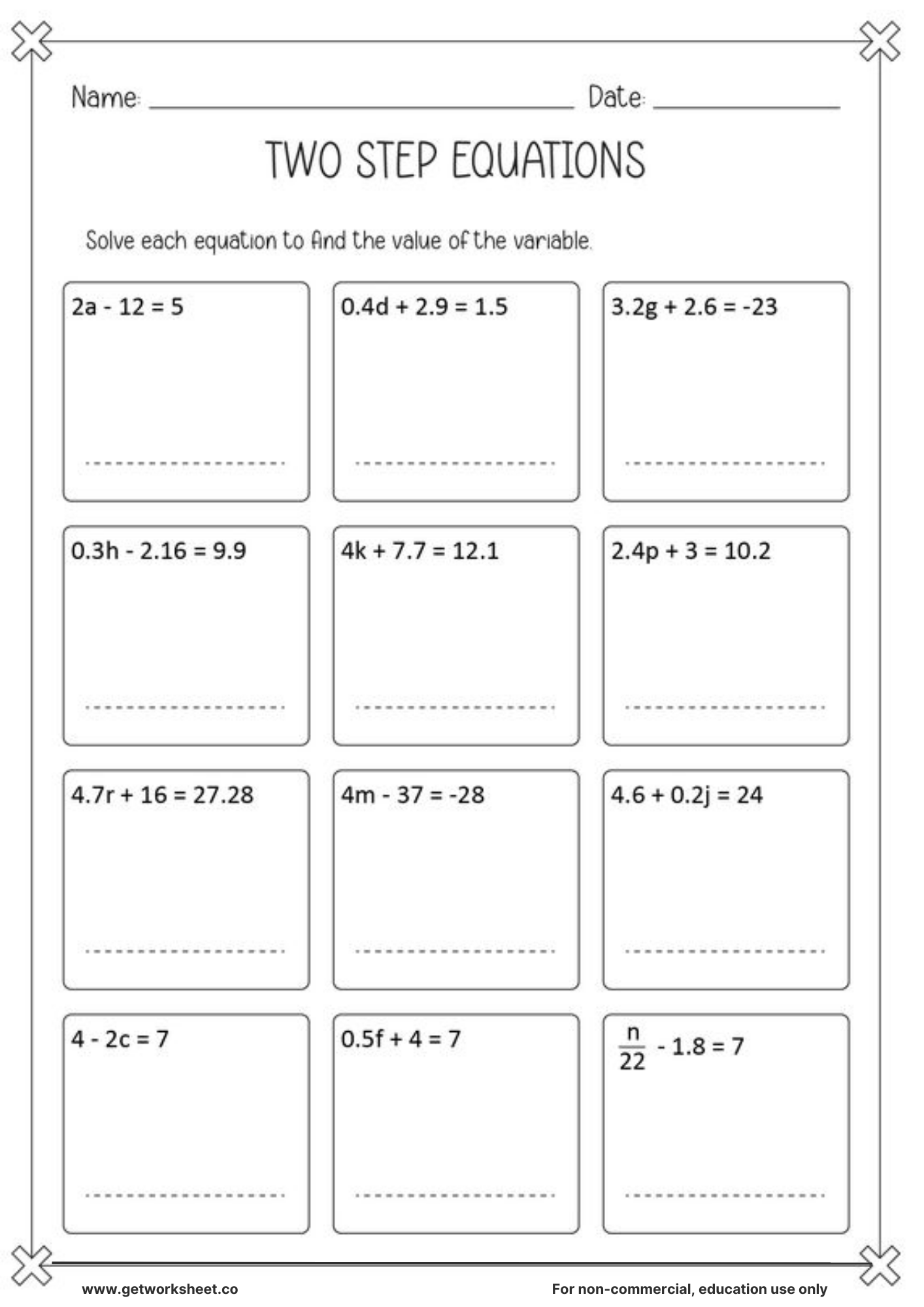
Two step equations worksheet 5
Two step equations worksheet 5
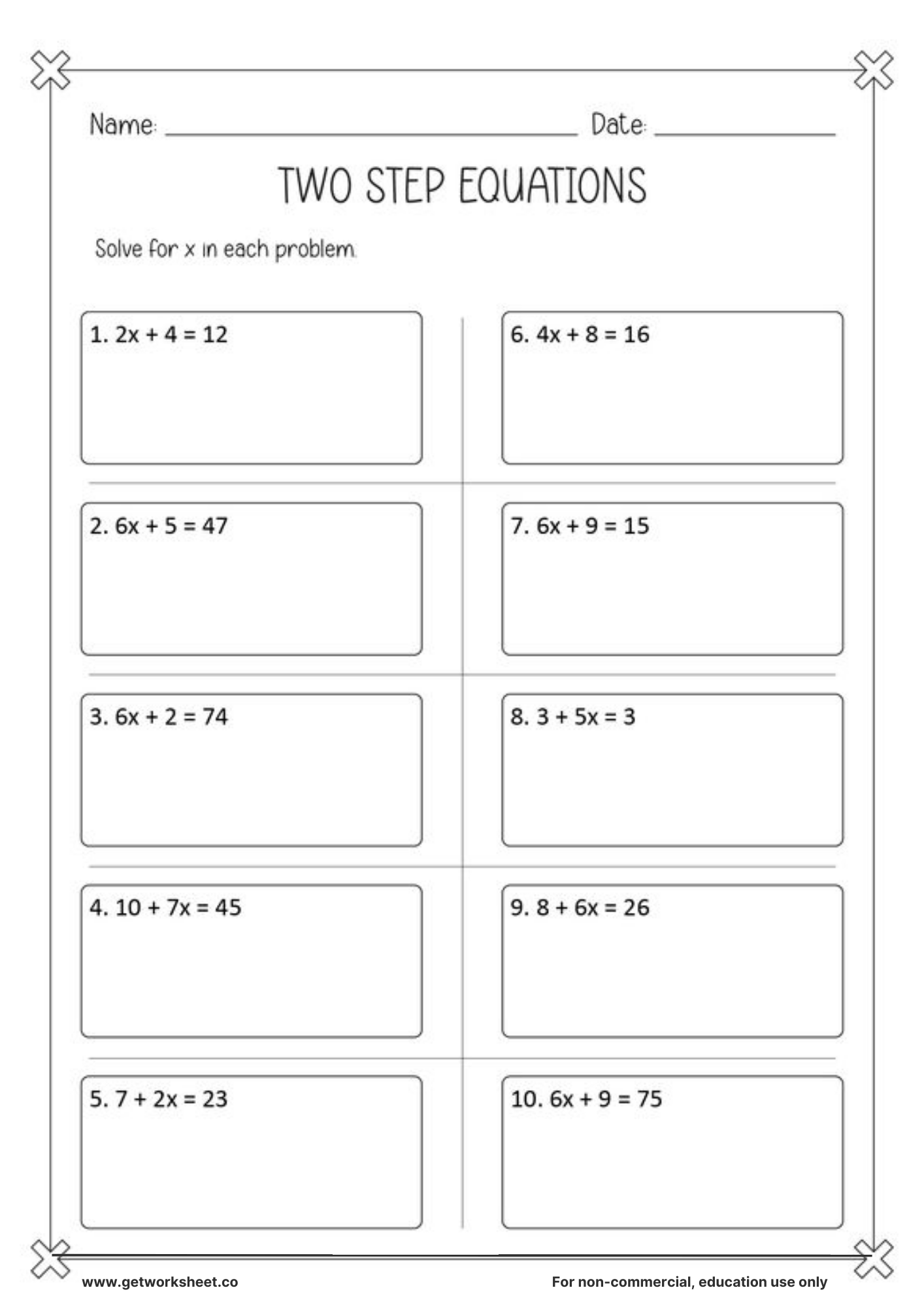
Two step equations worksheet 4
Two step equations worksheet 4
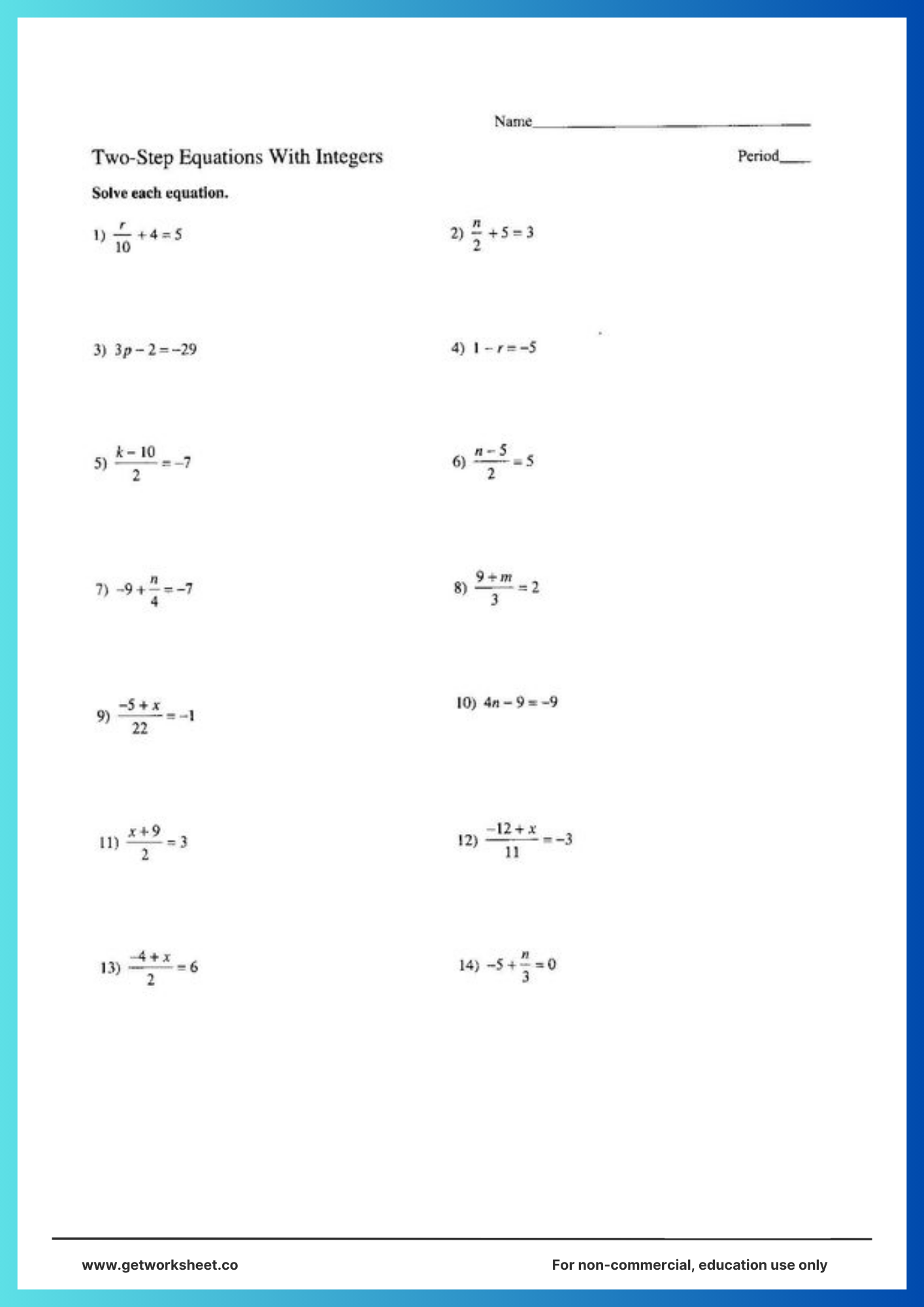
Two step equations worksheet 3
Two step equations worksheet 3
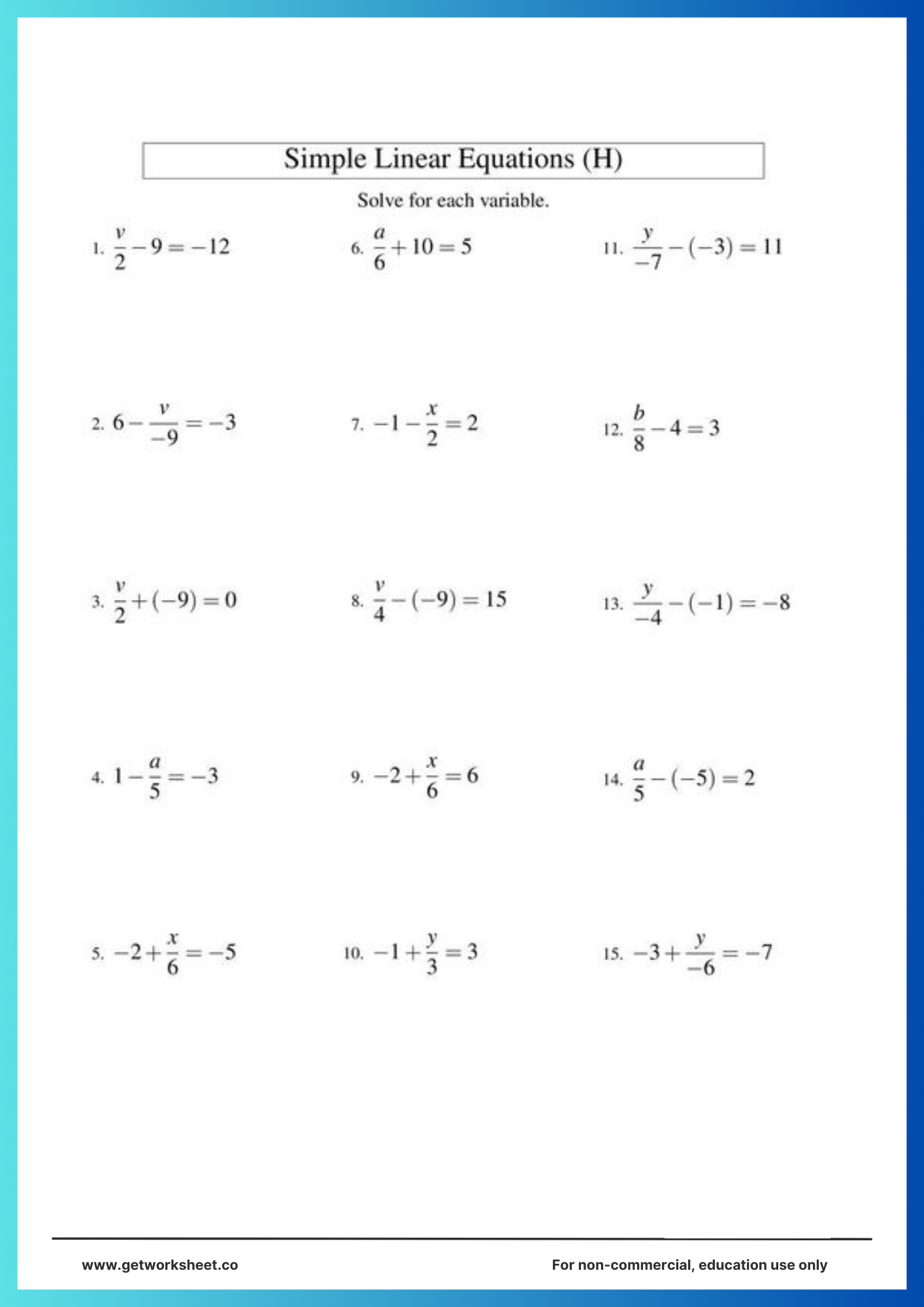
Two step equations worksheet 2
Two step equations worksheet 2
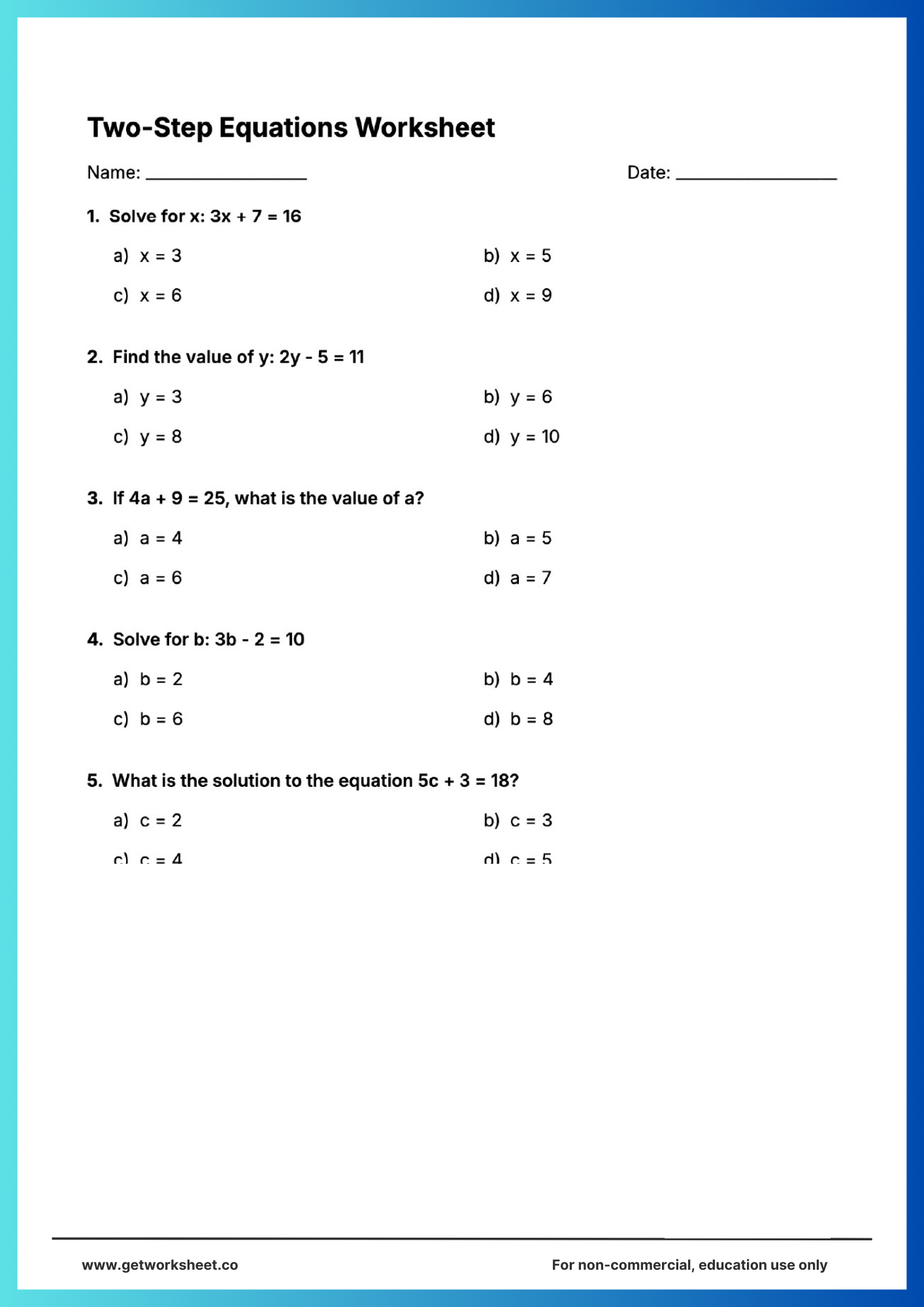
Two step equations worksheet 1
Two step equations worksheet 1
How to Use These Worksheets
Tips to help students build confidence with two-step equations.
- Teach the "reverse order of operations" rule: whatever was done last to build the expression gets undone first. In 3x + 5, the 5 was added last, so subtract it first. Then undo the multiplication by 3. This gives students a reliable method instead of guessing.
- Have your child write each step on a separate line and show what they did to both sides. Writing "subtract 5 from both sides" before doing it slows them down enough to avoid careless errors.
- After solving, always substitute the answer back into the original equation to verify. If 3(5) + 5 = 20 checks out, they know the answer is correct. This habit catches mistakes before they become patterns.
Common Mistakes to Watch For
- Performing operations on only one side of the equation. A student might subtract 5 from the left side but forget to subtract it from the right, writing 3x = 20 instead of 3x = 15. Stress that both sides must always stay equal.
- Doing the steps in the wrong order — dividing before subtracting. In 3x + 5 = 20, dividing everything by 3 first gives x + 5/3 = 20/3, which is messy and confusing. Always undo addition/subtraction before multiplication/division.
- Sign errors with negative numbers. In 2x - 8 = -4, students add 8 to both sides to get 2x = 4 (correct), but some write 2x = -12 because they subtracted instead of added. Highlight the inverse operation each time.
- Forgetting that dividing a negative by a positive gives a negative result. In -3x = 12, the answer is x = -4, not x = 4. Students often drop the negative sign during the final step.
Frequently Asked Questions
What should my child know before starting two-step equations?
They need to be comfortable with one-step equations (x + 5 = 12 or 3x = 21) and basic operations with negative numbers. If one-step equations feel shaky, review those first — two-step equations build directly on that foundation.
How do I explain why we do the same thing to both sides?
Use a balance scale analogy. The equals sign is the center of the scale. If you take something off one side, you must take the same amount off the other side, or the scale tips. This visual helps the concept stick.
How many problems per practice session?
Start with 6-8 problems. If your child is getting them right consistently, add problems with negatives or fractions to increase the challenge. If they are making the same mistake, pause and fix that specific error before continuing.
When should I let my child use a calculator?
Not for these problems. Two-step equations involve basic arithmetic (addition, subtraction, multiplication, division with small numbers), and doing the math by hand reinforces number sense. Calculators become appropriate for multi-step equations with larger numbers.
After mastering two-step equations, students move on to multi-step equations that involve combining like terms and using the distributive property before isolating the variable.