Free subtraction worksheet
Free subtraction worksheets with answer keys. Practice single-digit and multi-digit subtraction with regrouping — printable PDFs for grades K-3 math.
Subtraction is addition's partner — and for most students, the harder one to master. Taking away, finding the difference, comparing two amounts — subtraction shows up in many forms, and these worksheets cover them all. From basic single-digit facts through multi-digit subtraction with borrowing (regrouping), students build the skills they need for everyday math and more complex operations ahead.
What Students Will Practice
- Subtracting single-digit numbers within 10 (e.g., 9 - 4 = 5) and within 20 (e.g., 15 - 8 = 7)
- Using strategies like counting back, using related addition facts ("think addition"), and making a ten
- Subtracting two-digit numbers without regrouping (e.g., 68 - 23 = 45)
- Subtracting two-digit numbers with regrouping/borrowing (e.g., 72 - 38 = 34)
- Subtracting three-digit numbers with regrouping across multiple columns
- Solving subtraction word problems involving taking away, comparing, and finding how many more or fewer
Subtraction fluency is a core standard from kindergarten through 3rd grade. Single-digit facts should be automatic by end of 2nd grade, and multi-digit subtraction with regrouping is expected by end of 3rd grade.
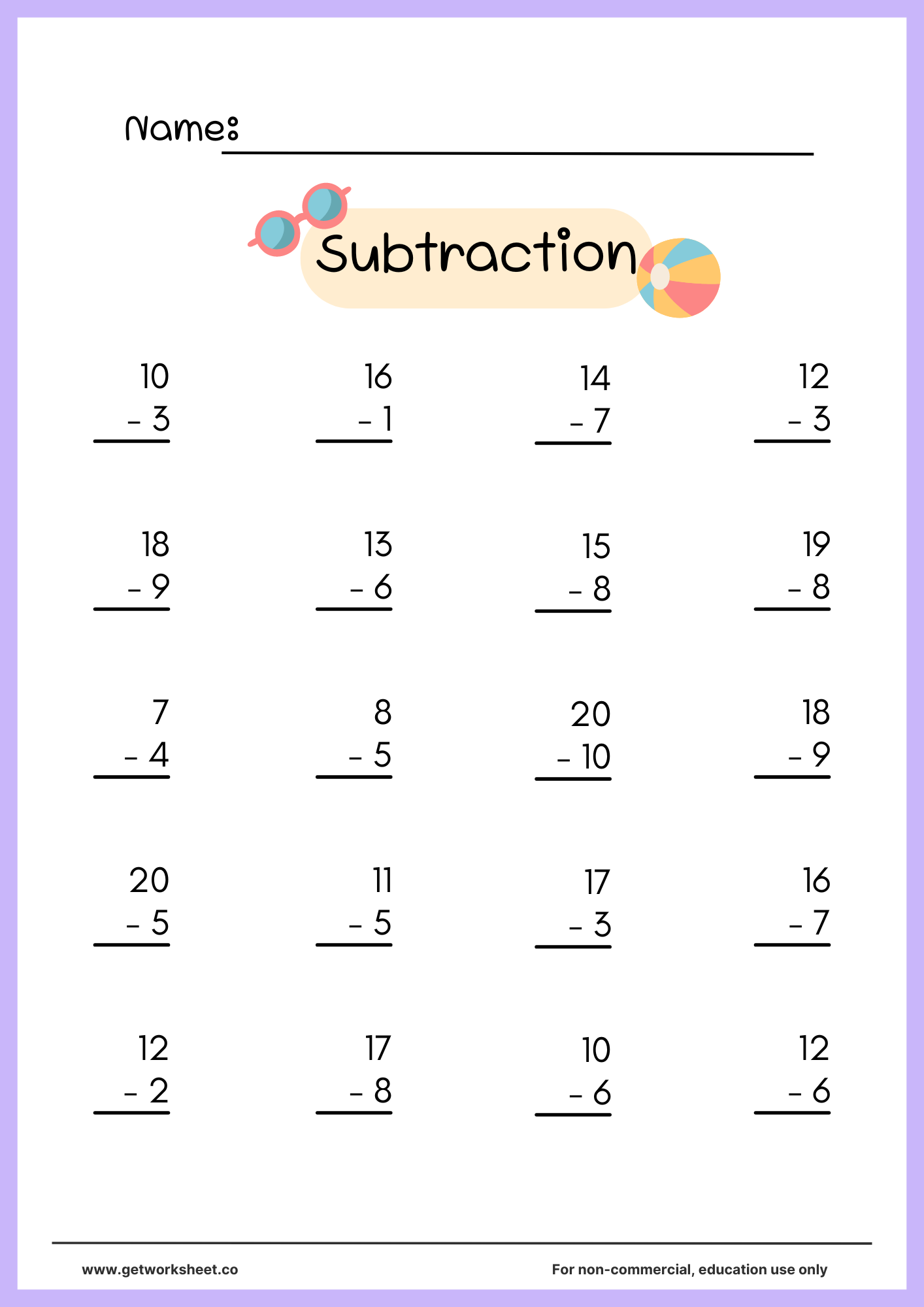
Substraction worksheet 5
Substraction worksheet 5
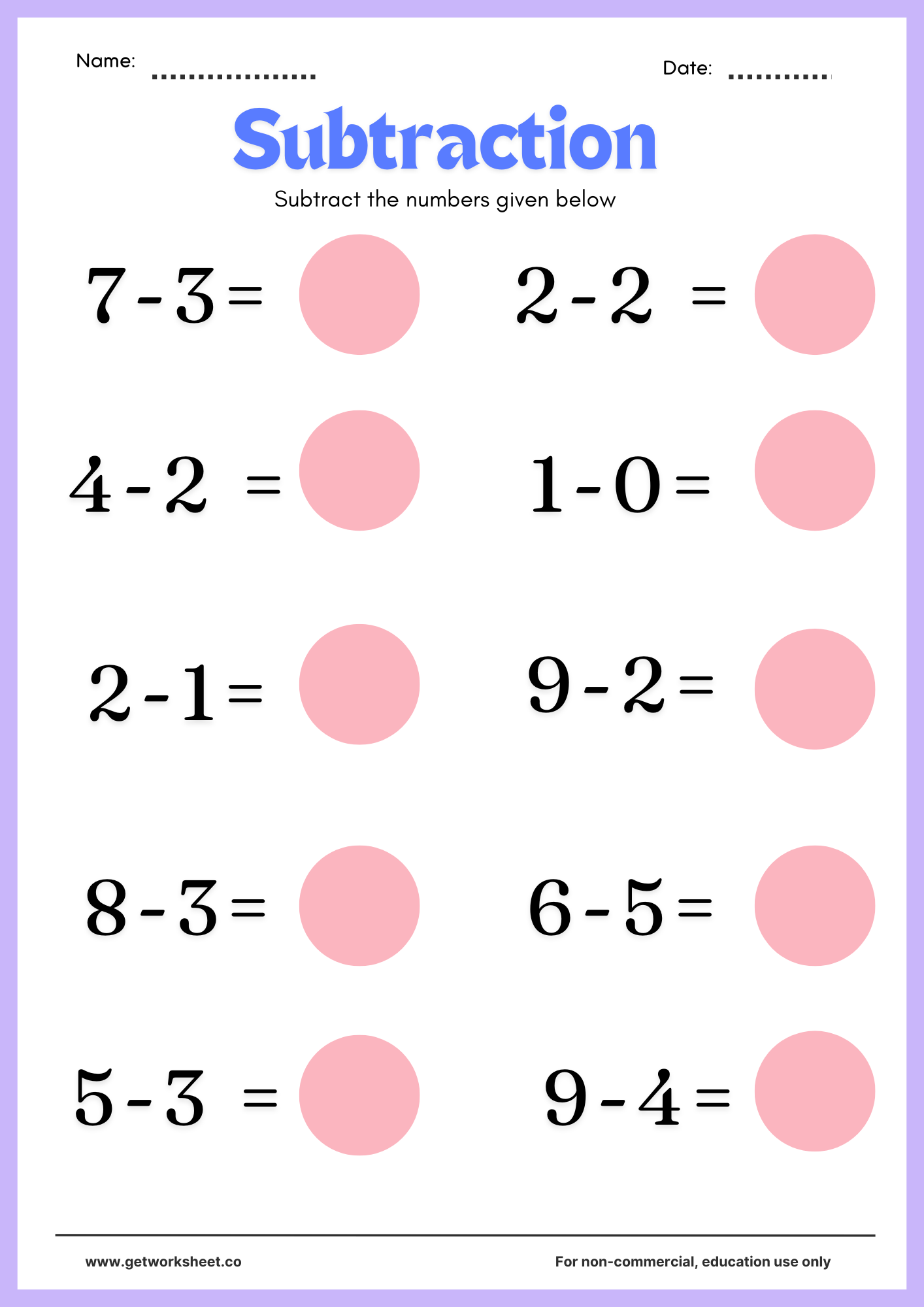
Substraction worksheet 4
Substraction worksheet 4
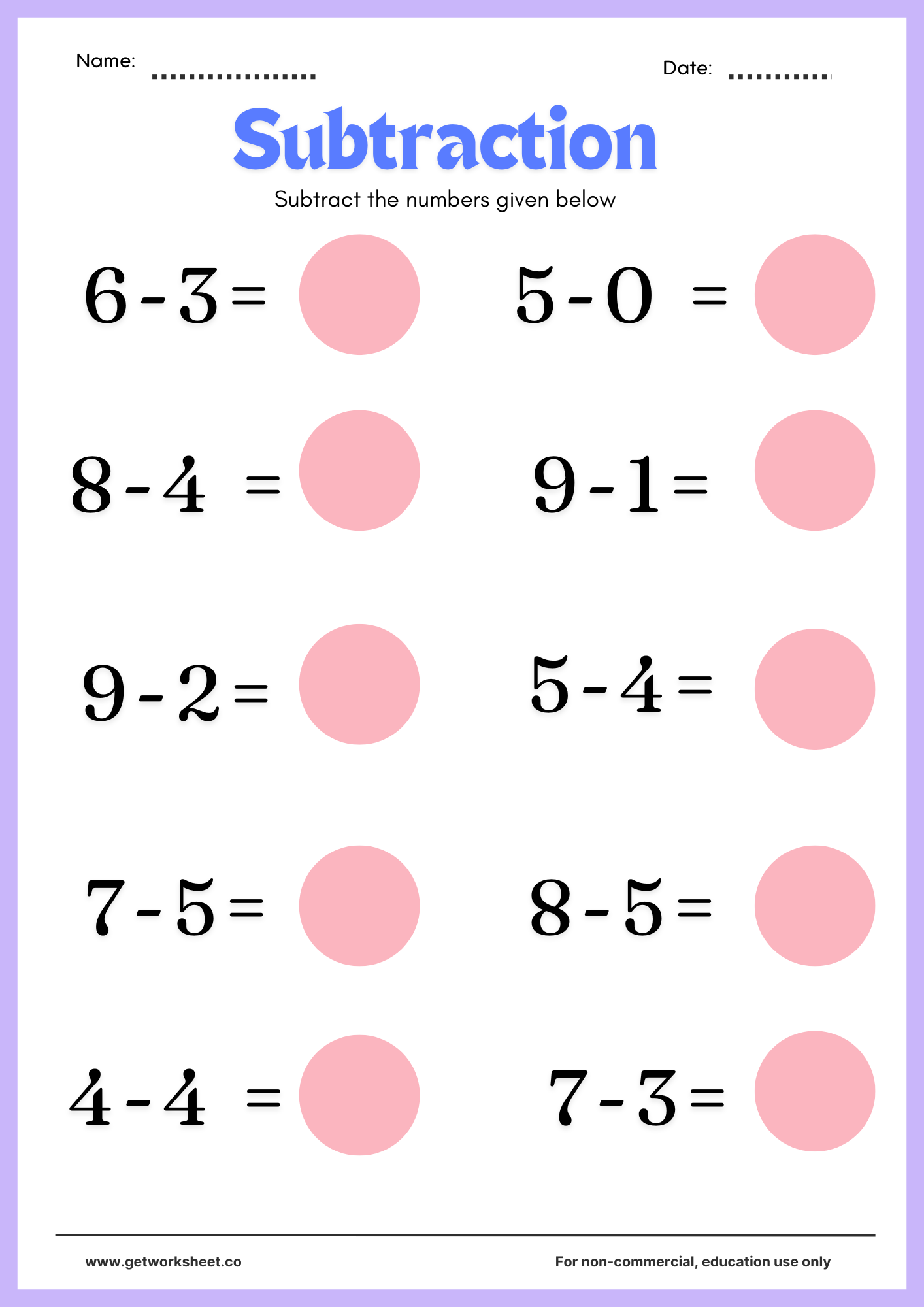
Substraction worksheet 3
Substraction worksheet 3
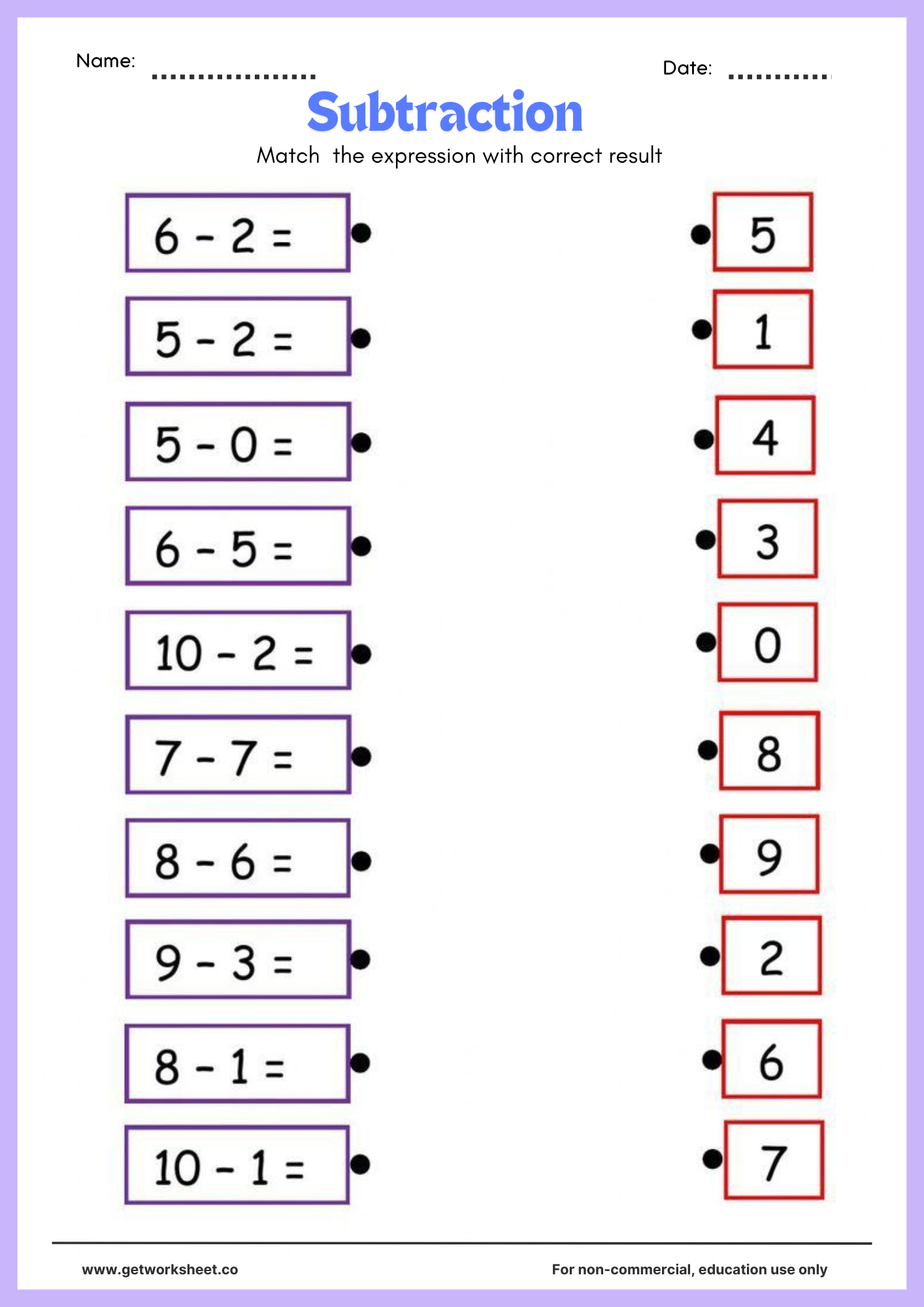
Substraction worksheet 2
Substraction worksheet 2
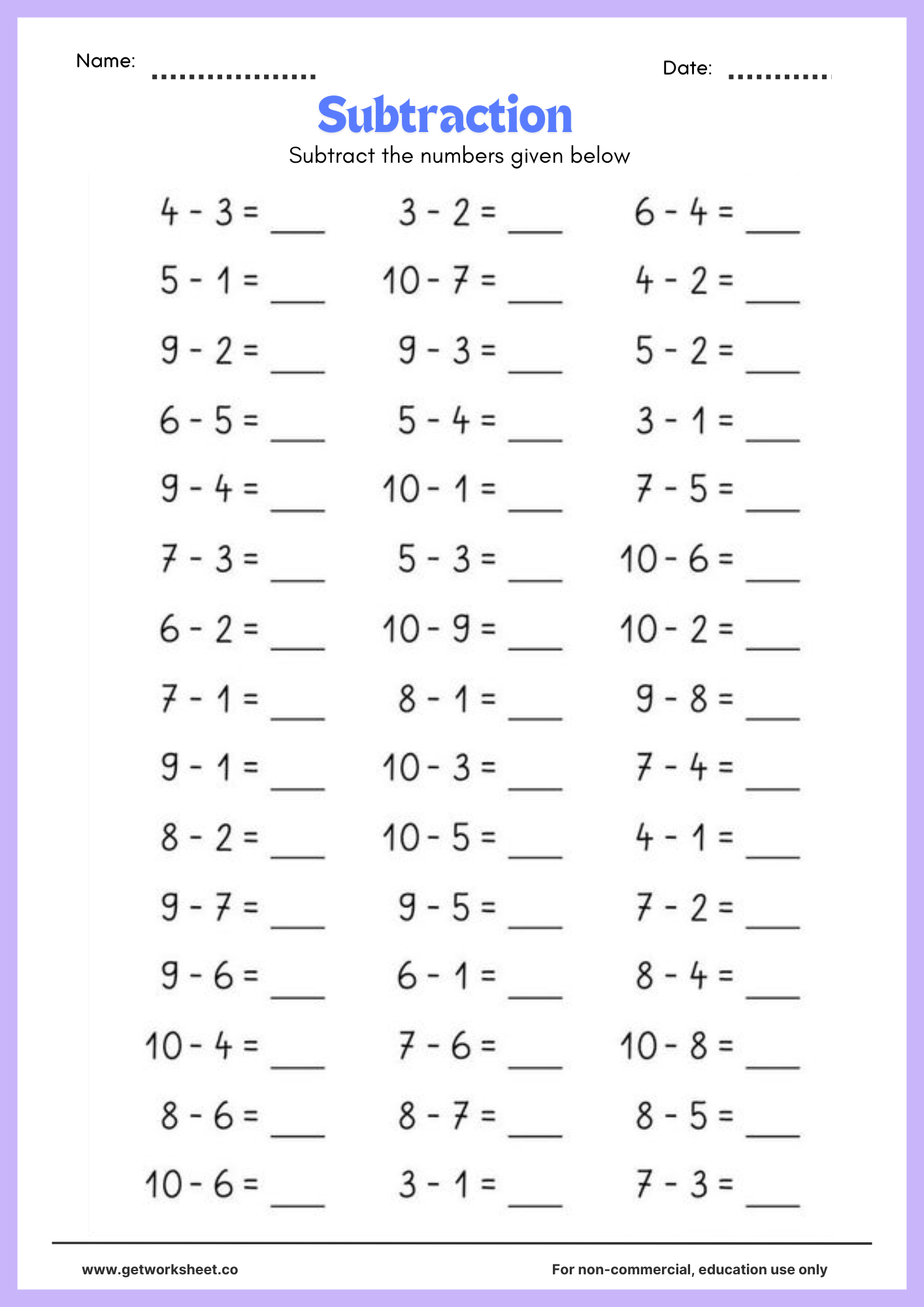
Substraction worksheet 1
Substraction worksheet 1
How to Use These Worksheets
Subtraction builds directly on addition — use that connection.
- Teach the "think addition" strategy: for 13 - 5, instead of counting backward, think "5 plus what equals 13?" If your child knows 5 + 8 = 13, they immediately know 13 - 5 = 8. This makes every subtraction fact a product of addition knowledge they already have.
- For multi-digit subtraction, teach regrouping (borrowing) with physical manipulations first. Use base-ten blocks: to subtract 38 from 72, you can't take 8 ones from 2 ones, so exchange one ten-rod for 10 ones (making 6 tens and 12 ones), then subtract. This physical process makes the abstract algorithm concrete.
- Use graph paper for multi-digit problems to keep columns aligned. Borrowing requires changing digits in the tens or hundreds column, and misaligned numbers lead to errors. Neat setup prevents most careless mistakes.
- Always practice subtraction alongside addition, not in isolation. Mixed practice (some addition, some subtraction) forces students to think about which operation is happening, which builds real mathematical understanding rather than procedural habits.
Common Mistakes to Watch For
- Subtracting the smaller digit from the larger regardless of position: In 72 - 38, students might write 72 - 38 = 46 (doing 8-2=6 in the ones column instead of borrowing). They subtract the smaller from the larger in each column rather than learning to regroup. This is the single most common subtraction error.
- Borrowing but forgetting to reduce the tens digit: In 72 - 38, after borrowing, the 7 tens becomes 6 tens (and the 2 ones becomes 12 ones). Students sometimes borrow the ten to make 12 ones but forget to cross out the 7 and write 6. This gives an answer that's 10 too large.
- Counting backward errors: Subtracting by counting back (for 11 - 3: "11... 10, 9, 8") requires careful tracking of how many numbers you've counted back. Students often count the starting number as one of their steps, getting 9 instead of 8.
- Not checking with addition: Every subtraction can be checked: if 72 - 38 = 34, then 34 + 38 should equal 72. Teaching students to verify by adding back catches most errors. This takes 10 seconds and should become a routine habit.
Frequently Asked Questions
Why is subtraction harder than addition for most kids?
Addition builds up (combining groups), which feels natural. Subtraction works backward (taking apart), which requires a different kind of thinking. Regrouping adds another layer of complexity. Additionally, subtraction facts get less practice time in most curricula than addition facts. More targeted practice closes the gap.
When should my child stop using fingers for subtraction?
Finger counting is fine in kindergarten and early 1st grade. By mid-2nd grade, students should be transitioning to mental strategies (think addition, counting back from the larger number). If fingers are still the primary strategy in 3rd grade, focus on building the addition-subtraction connection through fact families.
How do I explain regrouping/borrowing?
Use money or base-ten blocks. "You have 7 dimes and 2 pennies (72 cents). You need to give away 8 pennies, but you only have 2. So trade one dime for 10 pennies. Now you have 6 dimes and 12 pennies. Take away 8 pennies: 4 left. Take away 3 dimes: 3 left. You have 34 cents." The physical exchange makes borrowing logical.
Should I teach subtraction as "take away" or "find the difference"?
Both. "Take away" (I had 8 cookies, ate 3, how many left?) is the most intuitive meaning but not the only one. "Find the difference" (you have 8 stickers, I have 5, how many more do you have?) and "how many more to get to" (I have $5, need $8, how much more?) are equally important subtraction situations. Exposure to all three prevents narrow thinking.
After mastering subtraction, students combine it with addition for mixed operations, apply it in money and measurement contexts, and eventually use it as the foundation for division (which is repeated subtraction) and algebraic equation solving.