Free decimal division worksheets
Free printable decimal division worksheets with answer keys. Practice dividing decimals by whole numbers and decimals. PDF download for grades 4-6.
Dividing decimals is one of those skills that trips students up because it combines two things they have already learned — long division and decimal place value — into one operation. The key step most kids miss is moving the decimal point in the divisor to make it a whole number, then shifting the dividend by the same amount. Once that click happens, the rest is just long division.
What Students Will Practice
- Dividing a decimal by a whole number (e.g., 4.56 ÷ 3 = 1.52)
- Dividing a decimal by another decimal by shifting decimal points (e.g., 7.2 ÷ 0.6 — shift both to get 72 ÷ 6 = 12)
- Placing the decimal point correctly in the quotient — directly above its position in the dividend
- Handling remainders that require adding zeros to continue dividing (e.g., 5 ÷ 4 = 1.25)
- Estimating quotients before solving to check if the answer makes sense (e.g., 8.4 ÷ 2 should be around 4)
- Solving word problems that require decimal division (e.g., splitting a $15.75 bill among 3 people)
These skills are typically covered in 4th through 6th grade and form the foundation for working with fractions, percentages, and algebra equations later on.
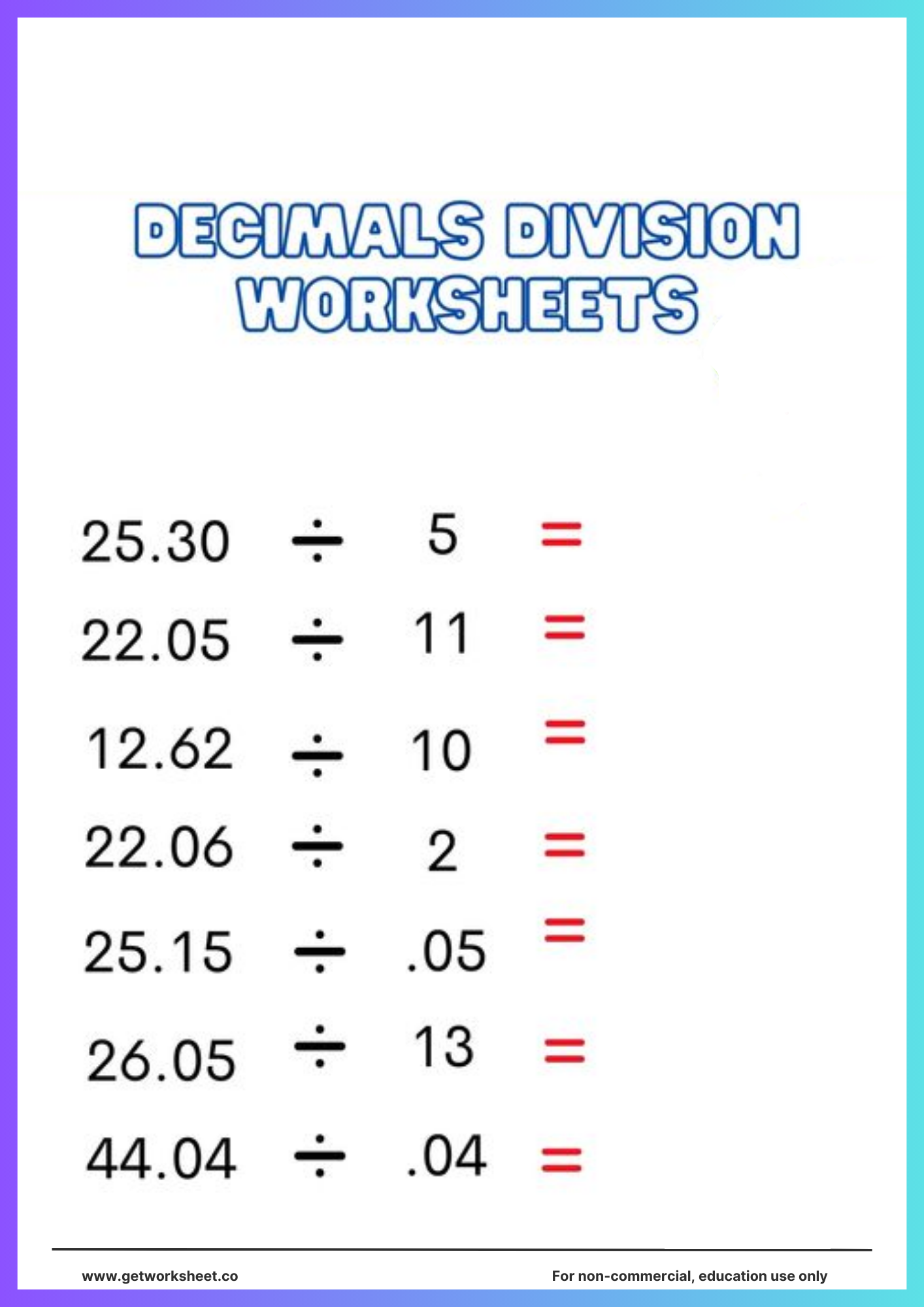
Decimal division worksheet 5
Decimal division worksheet 5
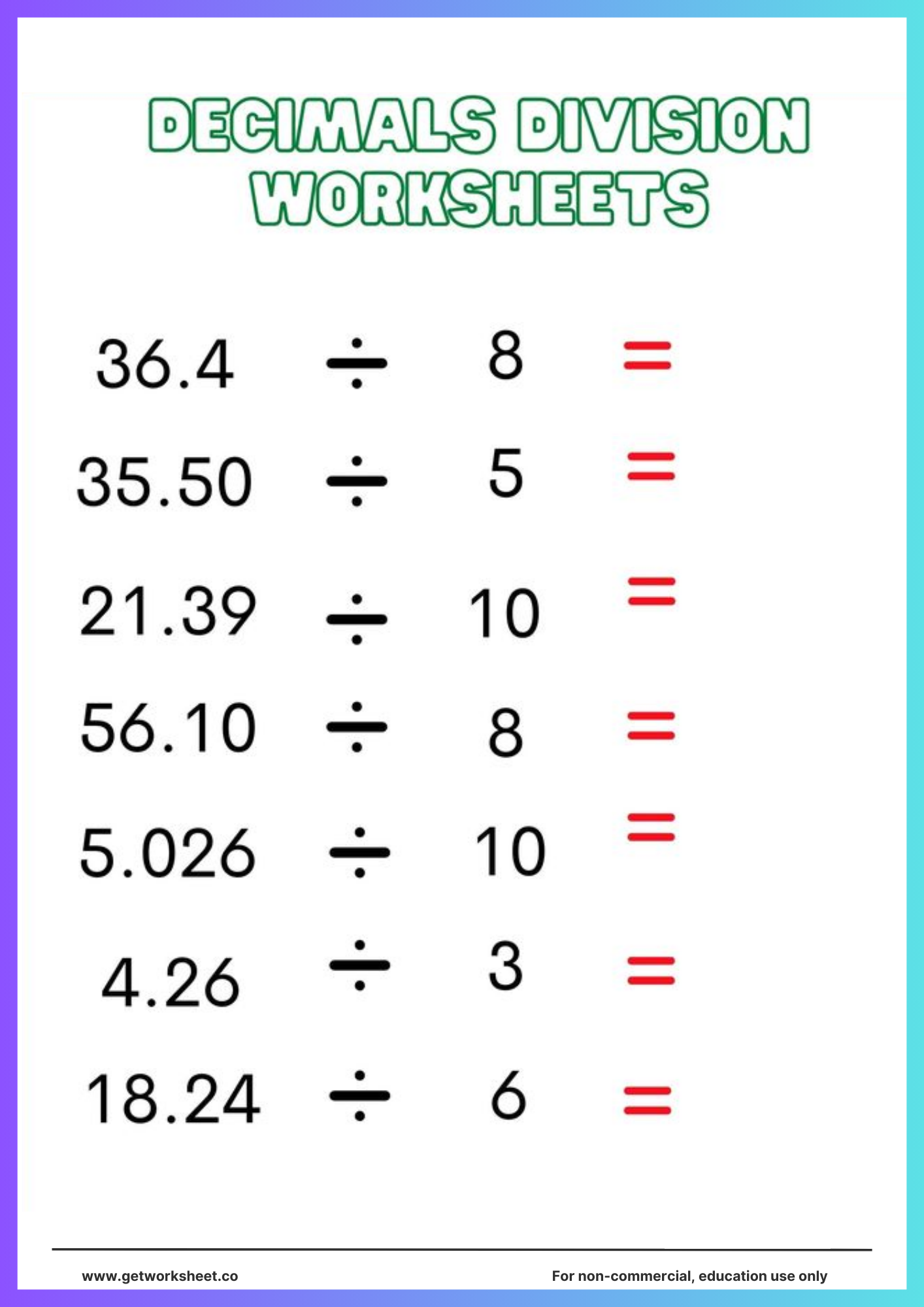
Decimal division worksheet 4
Decimal division worksheet 4
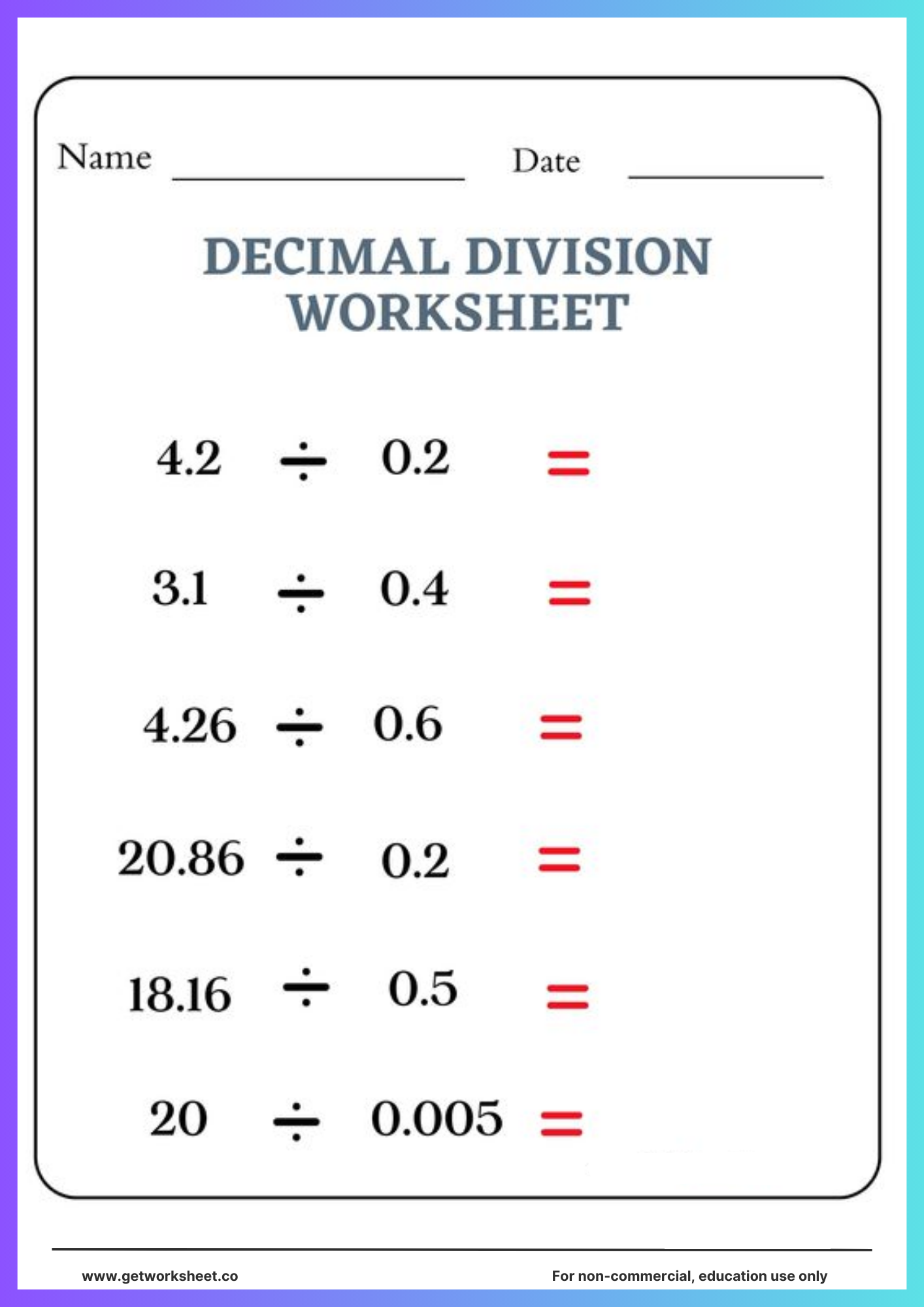
Decimal division worksheet 3
Decimal division worksheet 3
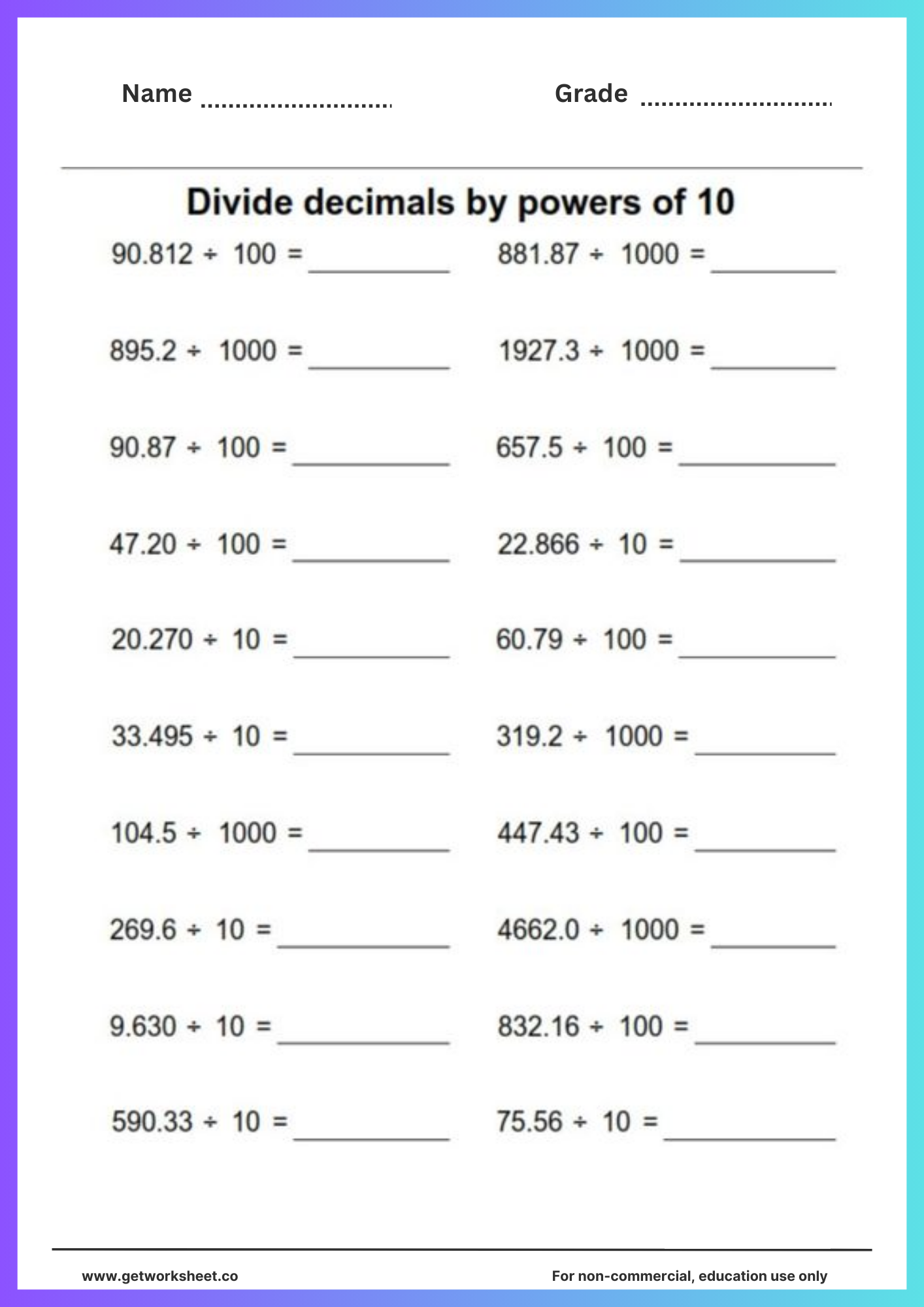
Decimal division worksheet 2
Decimal division worksheet 2
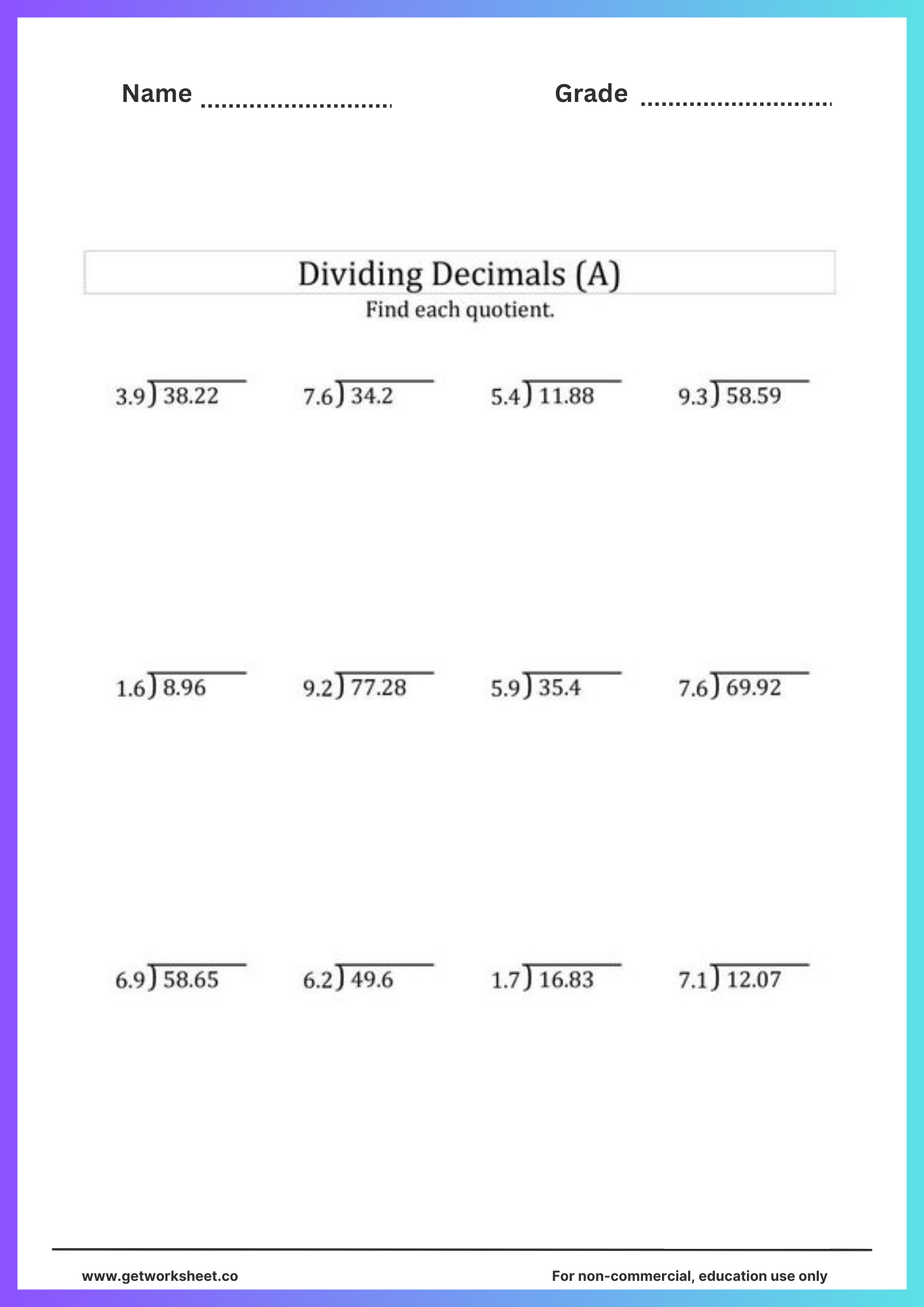
Decimal division worksheet 1
Decimal division worksheet 1
How to Use These Worksheets
A few strategies to help your child work through decimal division problems.
- Before solving each problem, have your child estimate the answer by rounding both numbers. For example, 9.6 ÷ 3.2 is roughly 10 ÷ 3, which is about 3.3. This catches major errors — if they get 33, they will know something went wrong.
- Use graph paper or turn lined paper sideways so each digit sits in its own column. Decimal division errors often come from misaligned digits, not from wrong math. Keeping columns neat prevents this.
- Have your child circle the decimal point in the divisor first, then count how many places they need to shift it. Then shift the dividend the same number of places. Making this step explicit prevents the most common error in decimal division.
Common Mistakes to Watch For
- Forgetting to move the decimal point in both the divisor and the dividend. A student might convert 4.8 ÷ 0.6 to 4.8 ÷ 6 instead of 48 ÷ 6, getting 0.8 instead of the correct answer of 8.
- Placing the decimal point in the wrong spot in the quotient. The decimal in the answer must line up directly above the decimal in the dividend after shifting. Students who skip this step end up with answers that are 10x too big or too small.
- Stopping the division too early when there is a remainder. Some students write "7 remainder 2" instead of adding a zero and continuing to get 7.2 or 7.25. Remind them that decimal division should not have remainders — keep dividing.
- Not adding enough trailing zeros to the dividend. In a problem like 5 ÷ 8, kids need to write it as 5.000 ÷ 8 to get 0.625. Without those zeros, they get stuck.
Frequently Asked Questions
How do I explain decimal division to my child in simple terms?
Start with money. Ask "if you have $8.40 and split it equally among 4 friends, how much does each person get?" Kids understand splitting money, and it naturally involves dividing decimals. Once the concept clicks with money, move to abstract problems.
Should my child use a calculator to check decimal division answers?
Yes, but only after they have solved the problem by hand first. Checking with a calculator builds confidence and helps them catch their own mistakes. It also teaches them what a reasonable answer looks like for future problems.
What comes before decimal division — what should my child already know?
They need solid long division with whole numbers (no hesitation on problems like 156 ÷ 12) and a clear understanding of place value in decimals (knowing that 0.3 is the same as 3 tenths). If either of those is shaky, review them first.
How many practice problems should my child do per session?
Start with 5-8 problems and increase as they gain confidence. If they are getting most problems right, move to harder variations. If they are making the same mistake repeatedly, stop and reteach that specific step before continuing.
After mastering decimal division, students are ready to tackle converting between fractions and decimals, which relies heavily on dividing the numerator by the denominator.