Free composite number worksheets
Free printable composite number worksheets with answer keys. Practice identifying composite numbers and finding factors. PDF for grades 4-6.
Composite numbers are whole numbers greater than 1 that have more than two factors. For example, 12 is composite because it can be divided by 1, 2, 3, 4, 6, and 12 — not just 1 and itself. Understanding composite numbers goes hand in hand with learning primes, since every whole number greater than 1 is either one or the other.
What Students Will Practice
- Identifying composite numbers by finding at least one factor besides 1 and the number itself (e.g., 15 is composite because 3 × 5 = 15)
- Listing all factor pairs of a composite number (e.g., factors of 24: 1×24, 2×12, 3×8, 4×6)
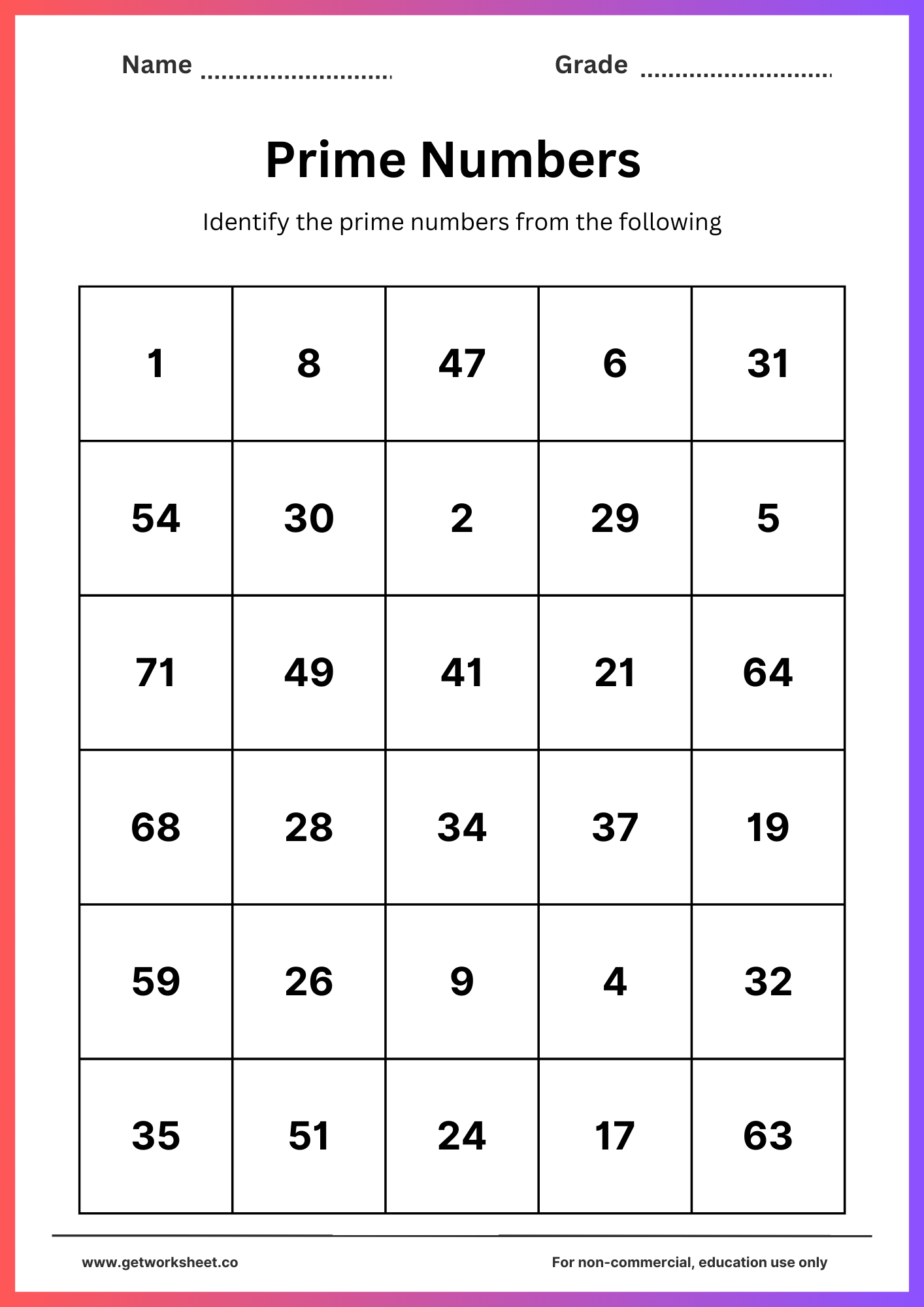
- Distinguishing between prime and composite numbers in a mixed set
- Using divisibility rules to quickly test if a number is composite (even? divisible by 3? ends in 0 or 5?)
- Finding the prime factorization of composite numbers using factor trees
These skills are essential for grades 4-6 math, particularly for finding GCF and LCM, simplifying fractions, and building number sense.
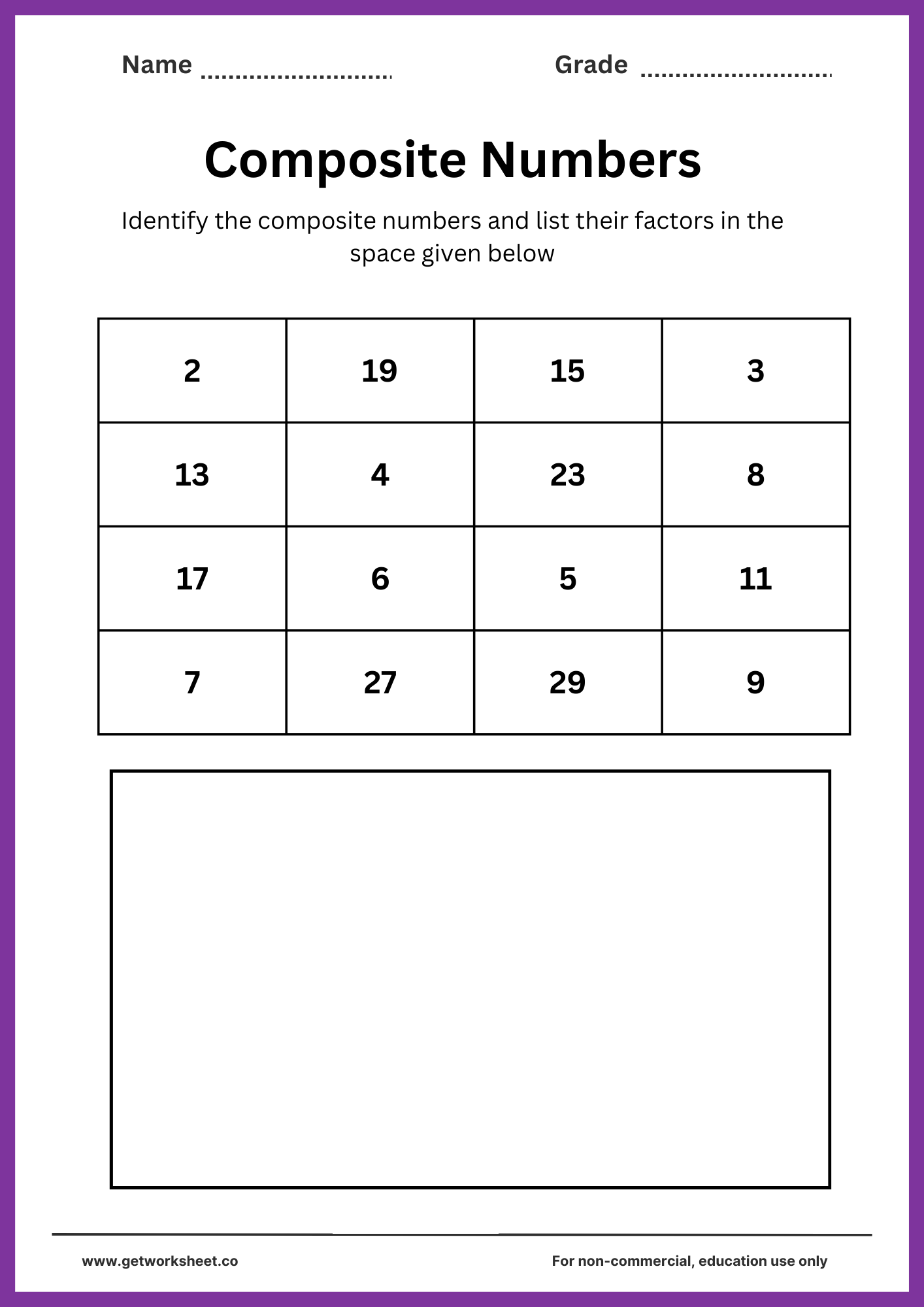
Composite number worksheet 5
Composite number worksheet 5
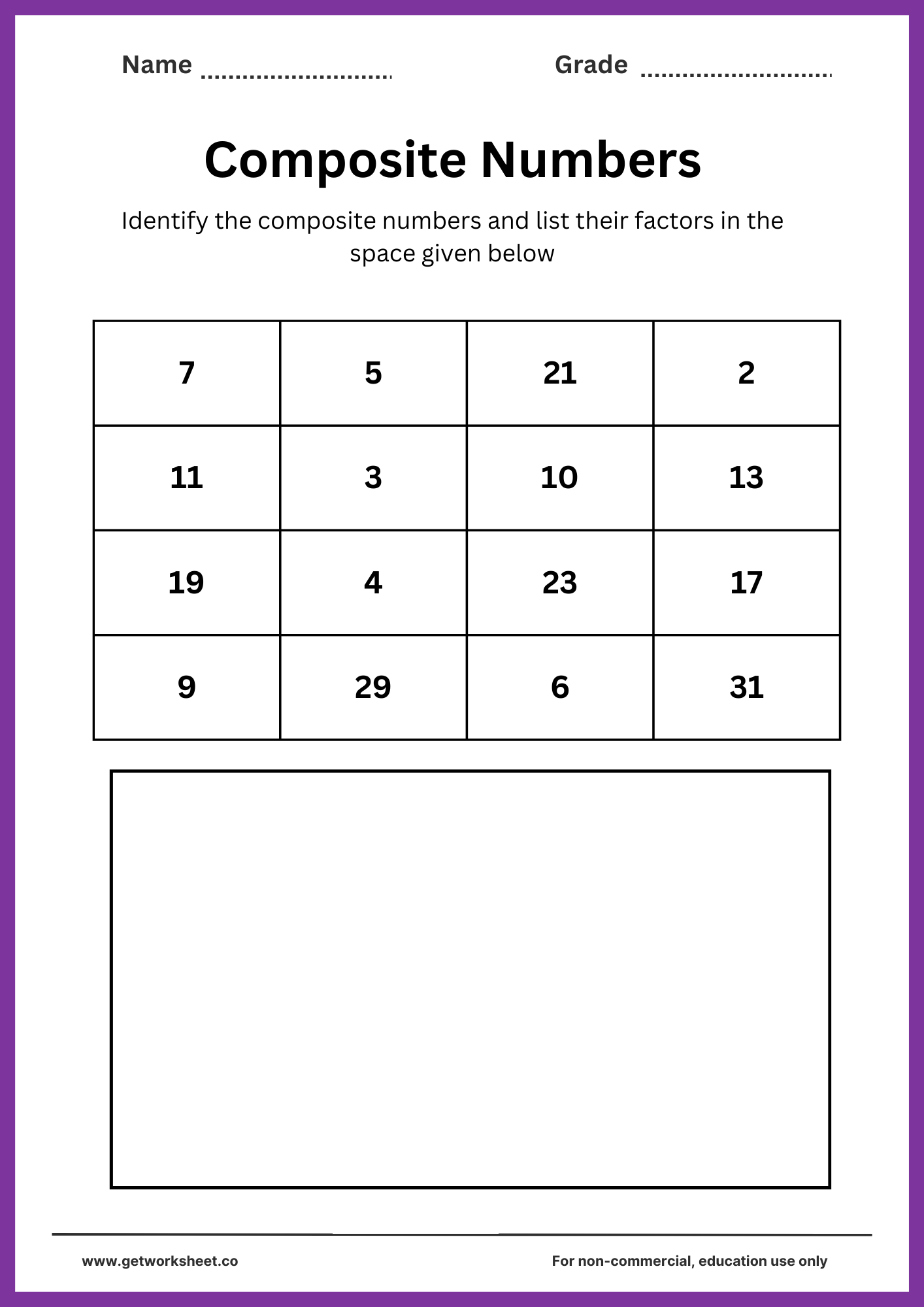
Composite number worksheet 4
Composite number worksheet 4
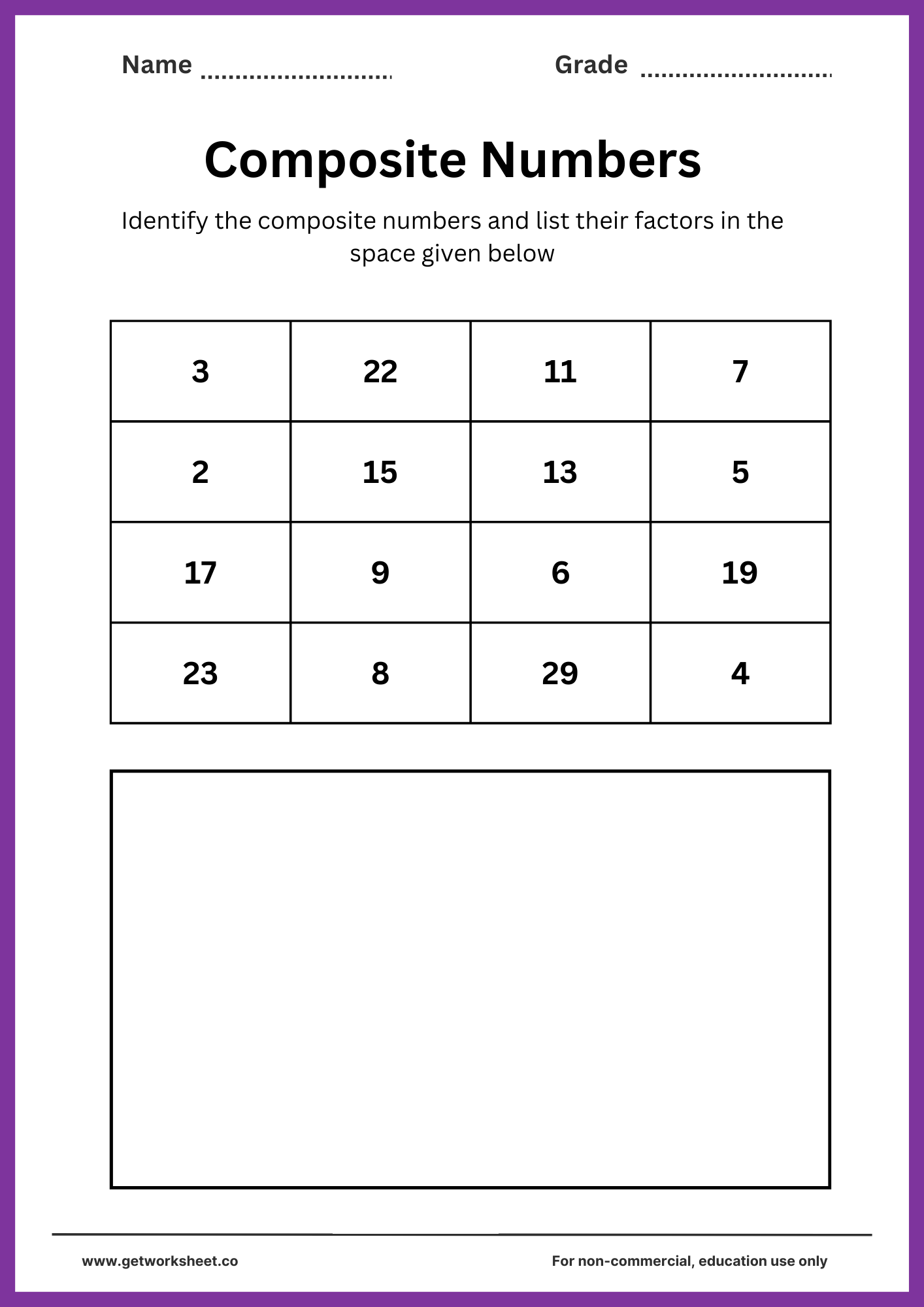
Composite number worksheet 3
Composite number worksheet 3
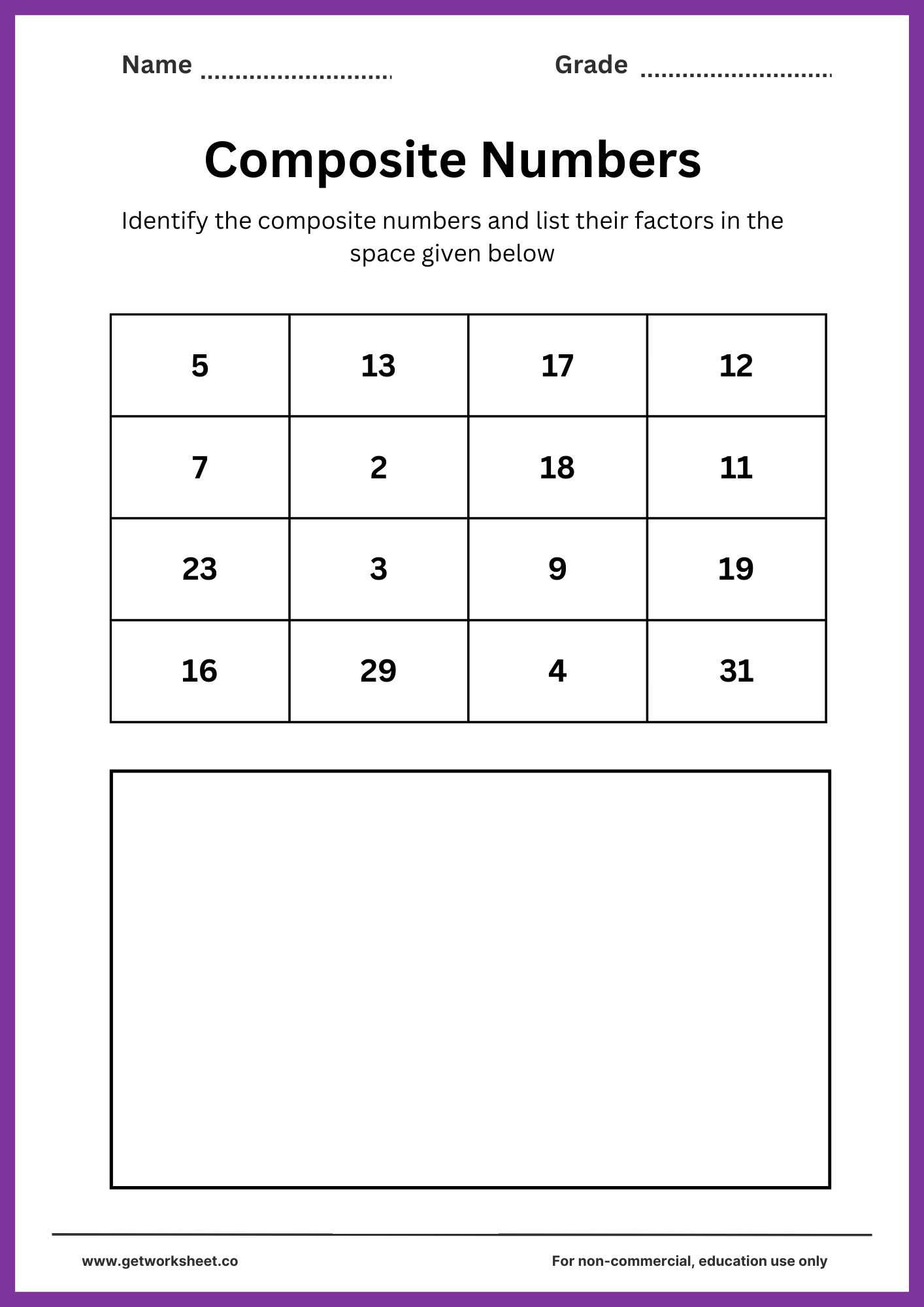
Composite number worksheet 2
Composite number worksheet 2
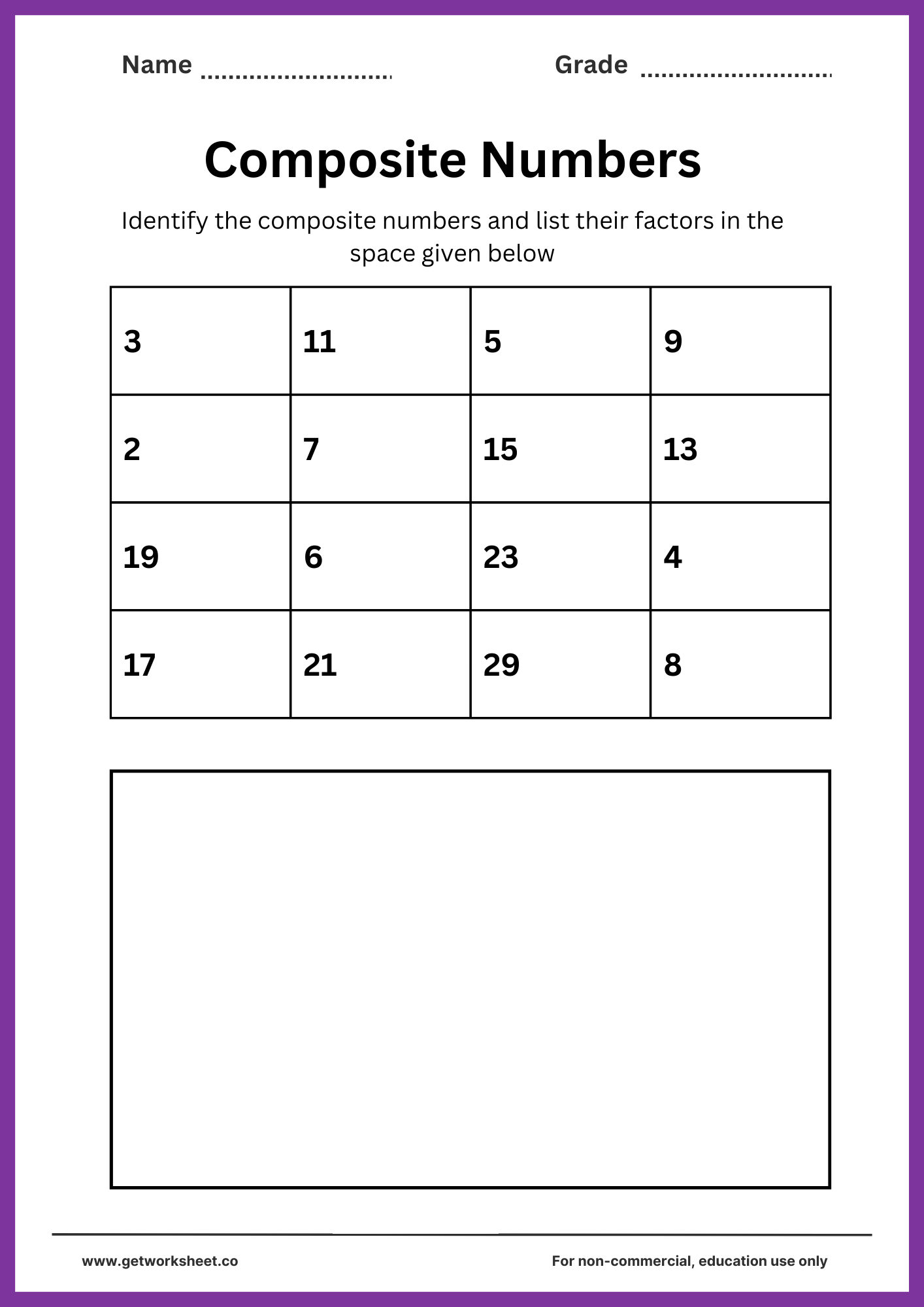
Composite number worksheet 1
Composite number worksheet 1
How to Use These Worksheets
Tips for learning composite numbers effectively.
- Always teach composite and prime together — they are two sides of the same coin. After identifying a number as composite, ask your child to prove it by naming one factor pair. After identifying a number as prime, ask them to explain why no pair works.
- Use the divisibility rules as a quick-check system. Can the number be divided by 2? (Is it even?) By 3? (Do the digits add to a multiple of 3?) By 5? (Does it end in 0 or 5?) If any answer is yes, the number is composite. This is faster than testing every possible factor.
- Make factor trees a regular exercise. Pick a composite number, build the tree, and write the prime factorization. Do this for 3-5 numbers per session. The repetition makes the process automatic.
Common Mistakes to Watch For
- Calling 1 a composite number. It is neither prime nor composite — it has only one factor (itself). This special case confuses many students and shows up as a trick question on tests.
- Missing factors when listing factor pairs. For 36, students often find 1×36, 2×18, 3×12, 4×9, and 6×6 — but miss some. A systematic approach works best: start at 1 and test every integer until you reach the square root.
- Thinking all odd numbers are prime. Numbers like 9 (3×3), 15 (3×5), 21 (3×7), and 25 (5×5) are odd but composite. Reinforce that odd does not automatically mean prime.
- Confusing factors with multiples. Factors go into the number (2 is a factor of 12). Multiples are produced by the number (24 is a multiple of 12). Using the wrong term leads to solving the wrong type of problem.
Frequently Asked Questions
How do I explain the difference between prime and composite to a child?
Use rectangles. Give your child 7 blocks and ask them to arrange them into a rectangle — they can only make 1×7. Now try 12 blocks — they can make 1×12, 2×6, or 3×4. Numbers that make only one rectangle are prime. Numbers that make multiple rectangles are composite.
Why is knowing about composite numbers useful?
Finding factors of composite numbers is essential for simplifying fractions (reducing 8/12 to 2/3), finding common denominators for adding fractions, and solving problems involving GCF and LCM. These are daily math skills in grades 5 and up.
What is the smallest composite number?
4 is the smallest composite number. It has factors 1, 2, and 4. This is a common test question that students should know by heart.
Should my child memorize composite numbers?
Not a long list — instead, they should know the process for identifying them. Memorizing that 4, 6, 8, 9, 10, 12, 14, 15 are composite is less useful than knowing how to test any number quickly using divisibility rules.
After understanding composite numbers, students combine this knowledge with prime factorization to tackle greatest common factor and least common multiple problems, which are critical for fraction operations.