Free 3D Shapes worksheets
Free 3D shapes worksheets with answer keys. Practice identifying cubes, spheres, cones, cylinders, and prisms — printable PDFs for grades K-4 math.
The world is three-dimensional, and so are the shapes in it. A ball is a sphere, a box is a rectangular prism, a can is a cylinder, and an ice cream cone is — well, a cone. These worksheets help students identify, name, and describe 3D shapes (also called solid shapes), understand their properties, and connect them to real objects they encounter every day.
What Students Will Practice
- Identifying common 3D shapes: cube, rectangular prism, sphere, cylinder, cone, pyramid, and triangular prism
- Describing 3D shapes using faces (flat surfaces), edges (where faces meet), and vertices (corners)
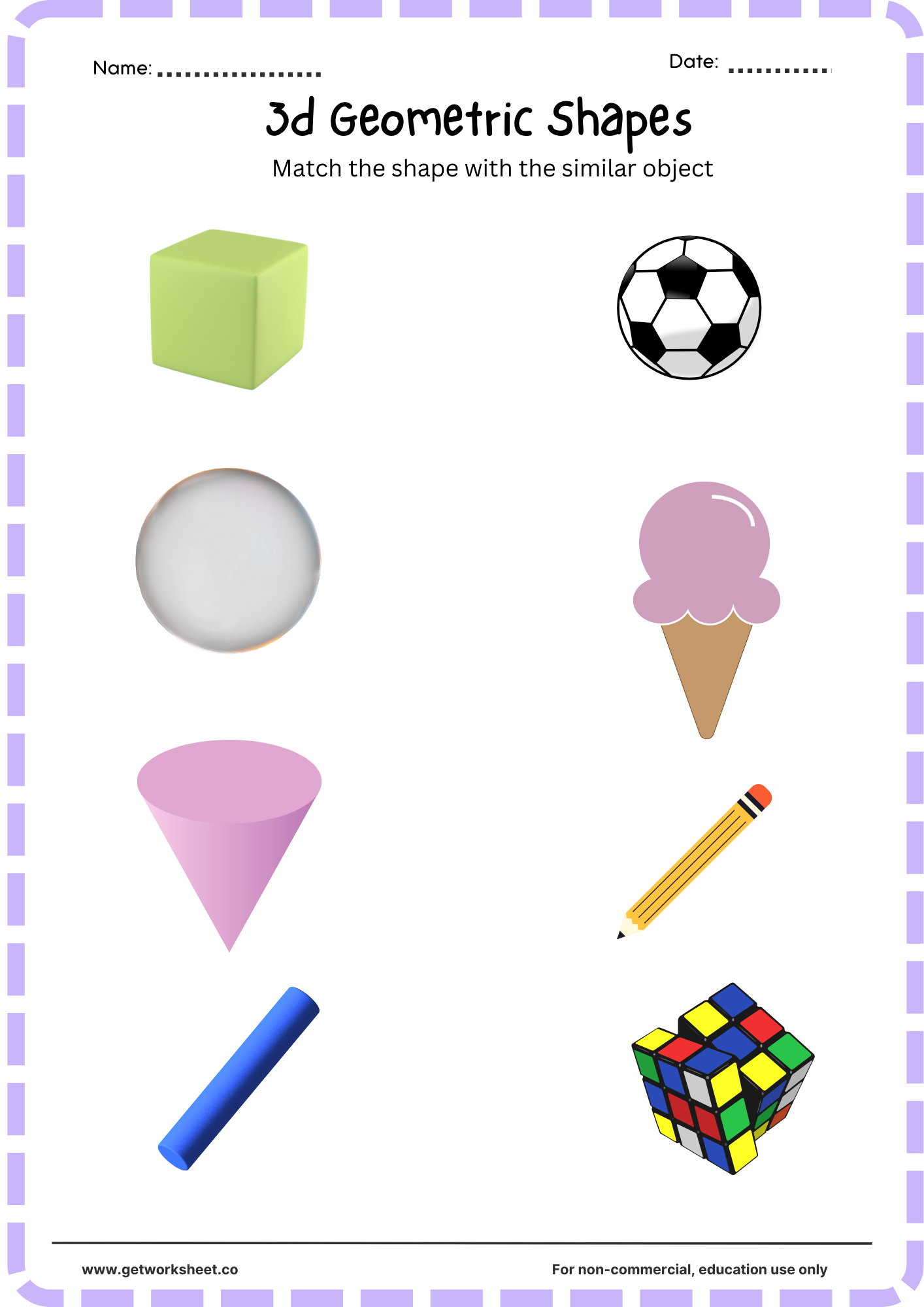
- Matching 3D shapes to real-world objects (e.g., a dice is a cube, a basketball is a sphere, a soup can is a cylinder)
- Comparing 3D shapes to their 2D counterparts (a cube has square faces, a cylinder has circular faces)
- Sorting and classifying 3D shapes by their properties (rolls vs. doesn't roll, has flat faces vs. curved surfaces)
- Drawing or identifying nets — the flat patterns that fold up into 3D shapes (e.g., a cross-shaped net folds into a cube)
3D shape knowledge is part of geometry standards from kindergarten through 4th grade. Understanding solid shapes builds spatial reasoning skills essential for math, science, engineering, and everyday problem-solving.
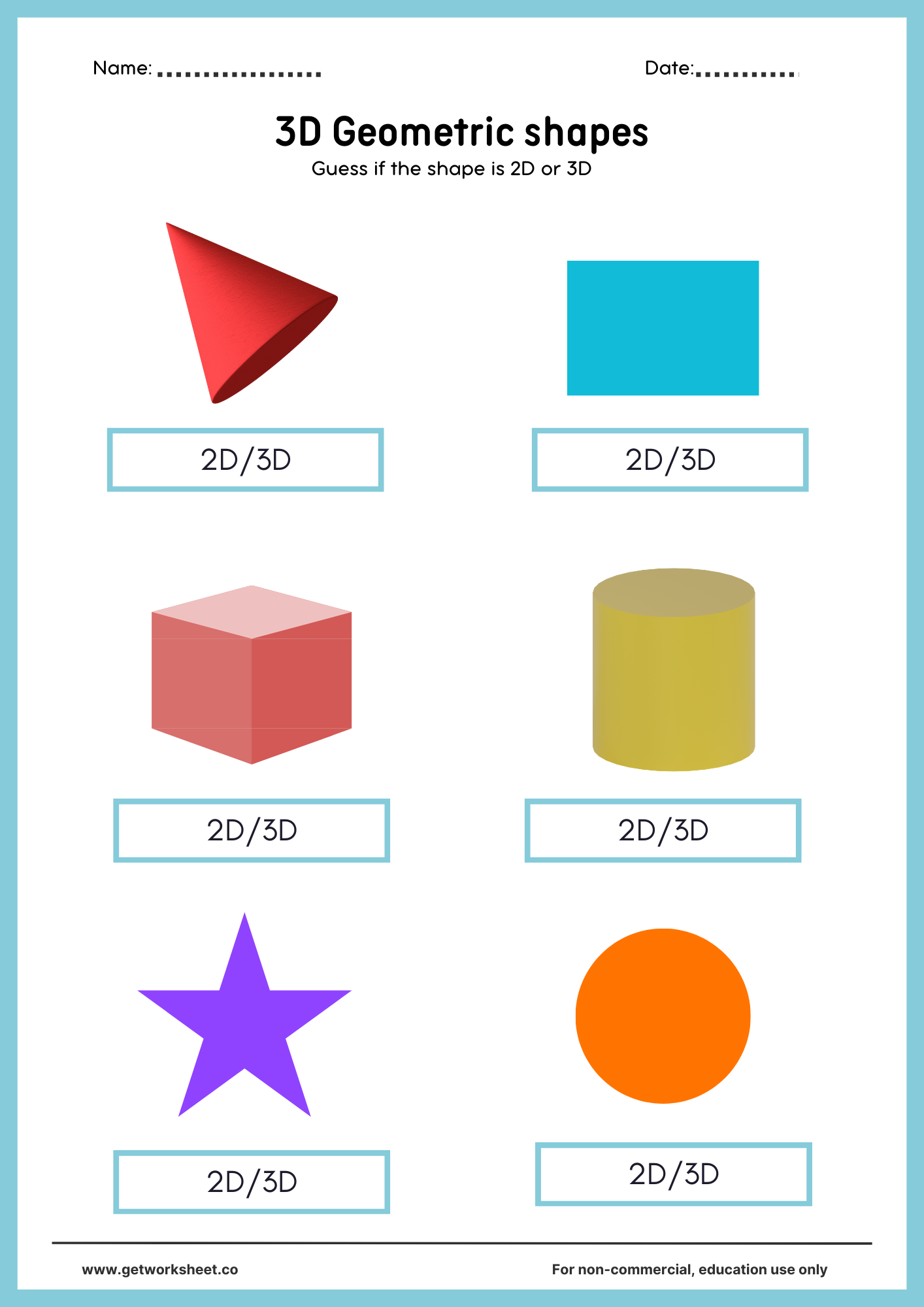
3d geometric shapes printable 5
3d geometric shapes printable 5
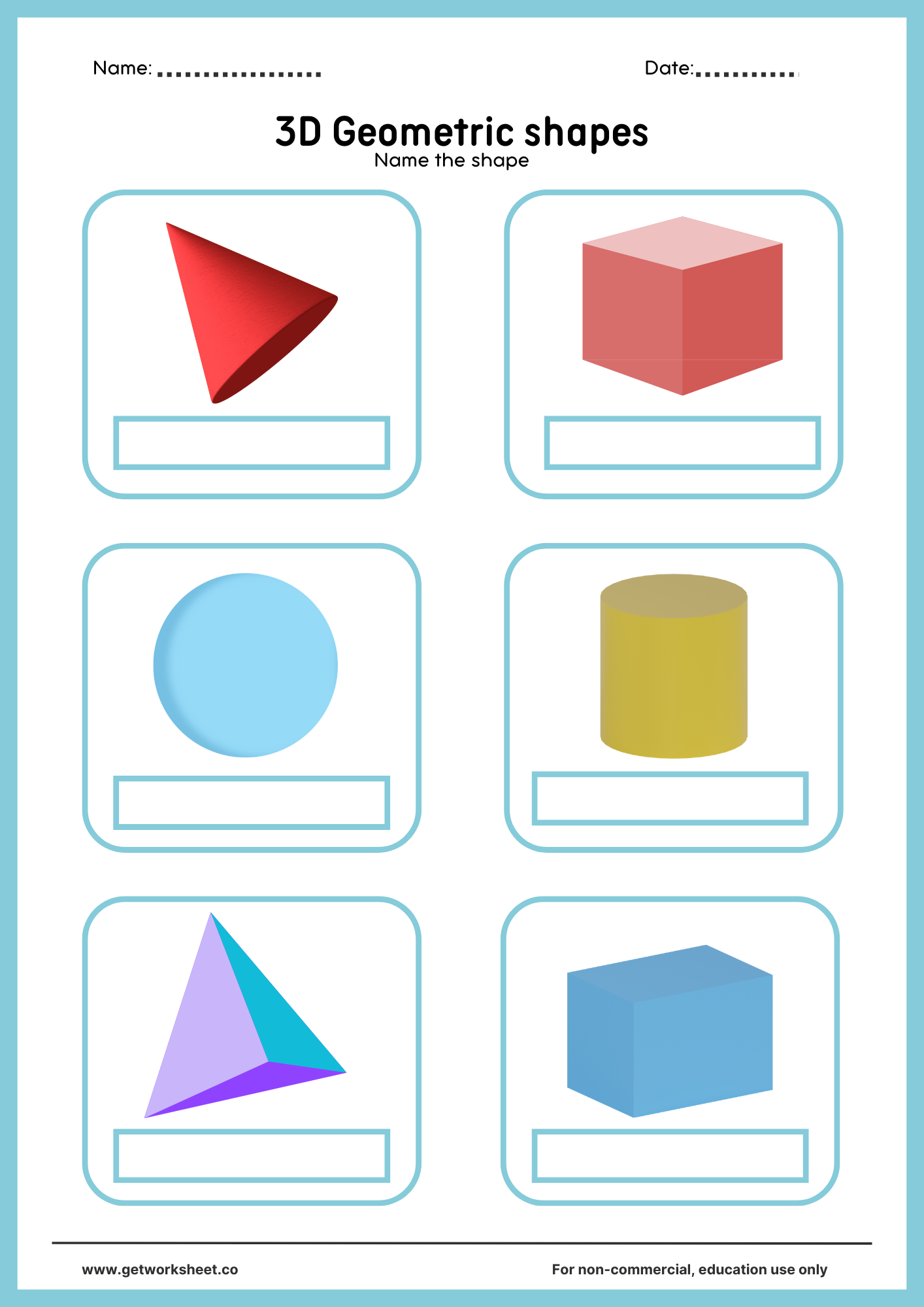
3d geometric shapes printable 4
3d geometric shapes printable 4
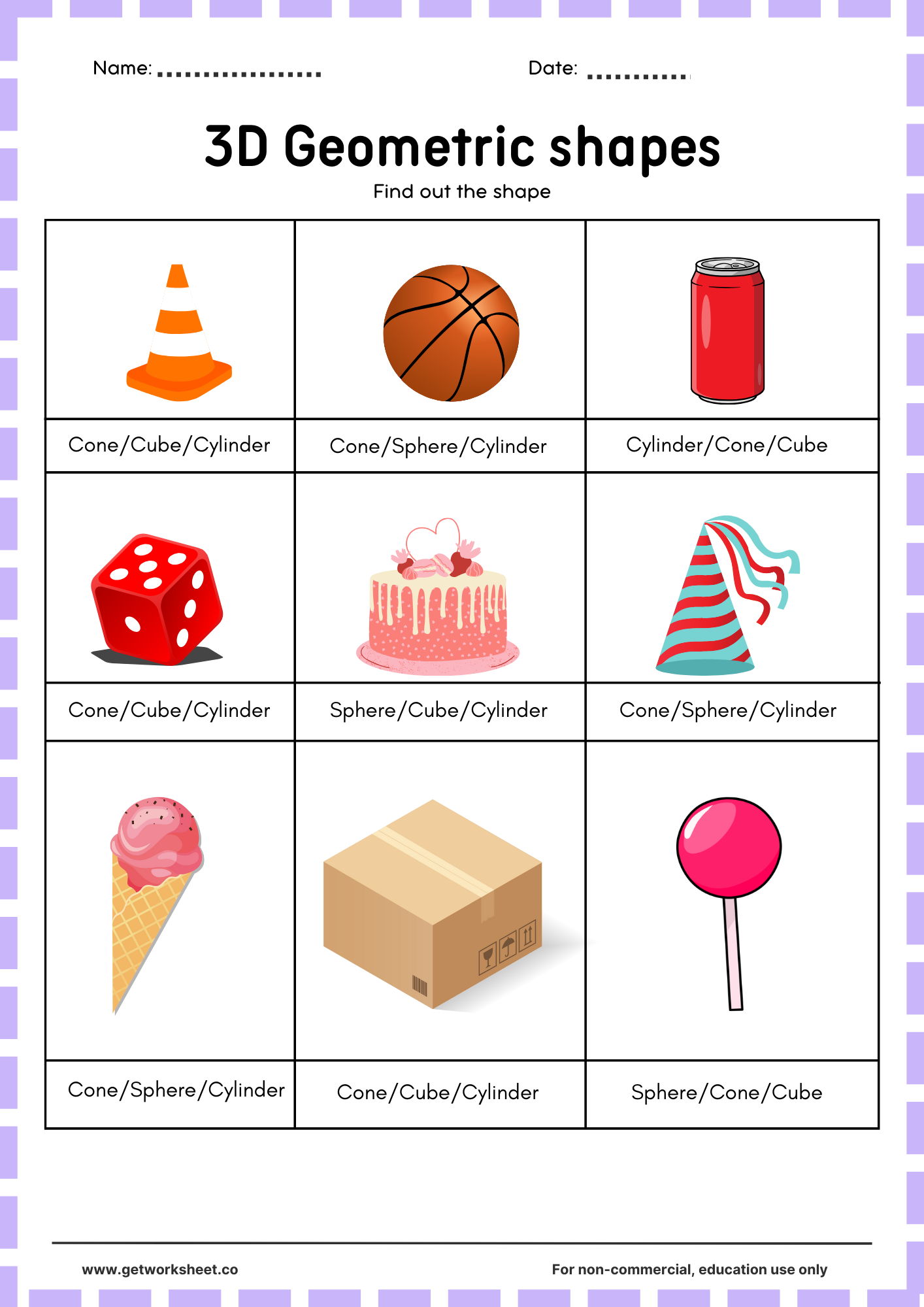
3d geometric shapes printable 3
3d geometric shapes printable 3
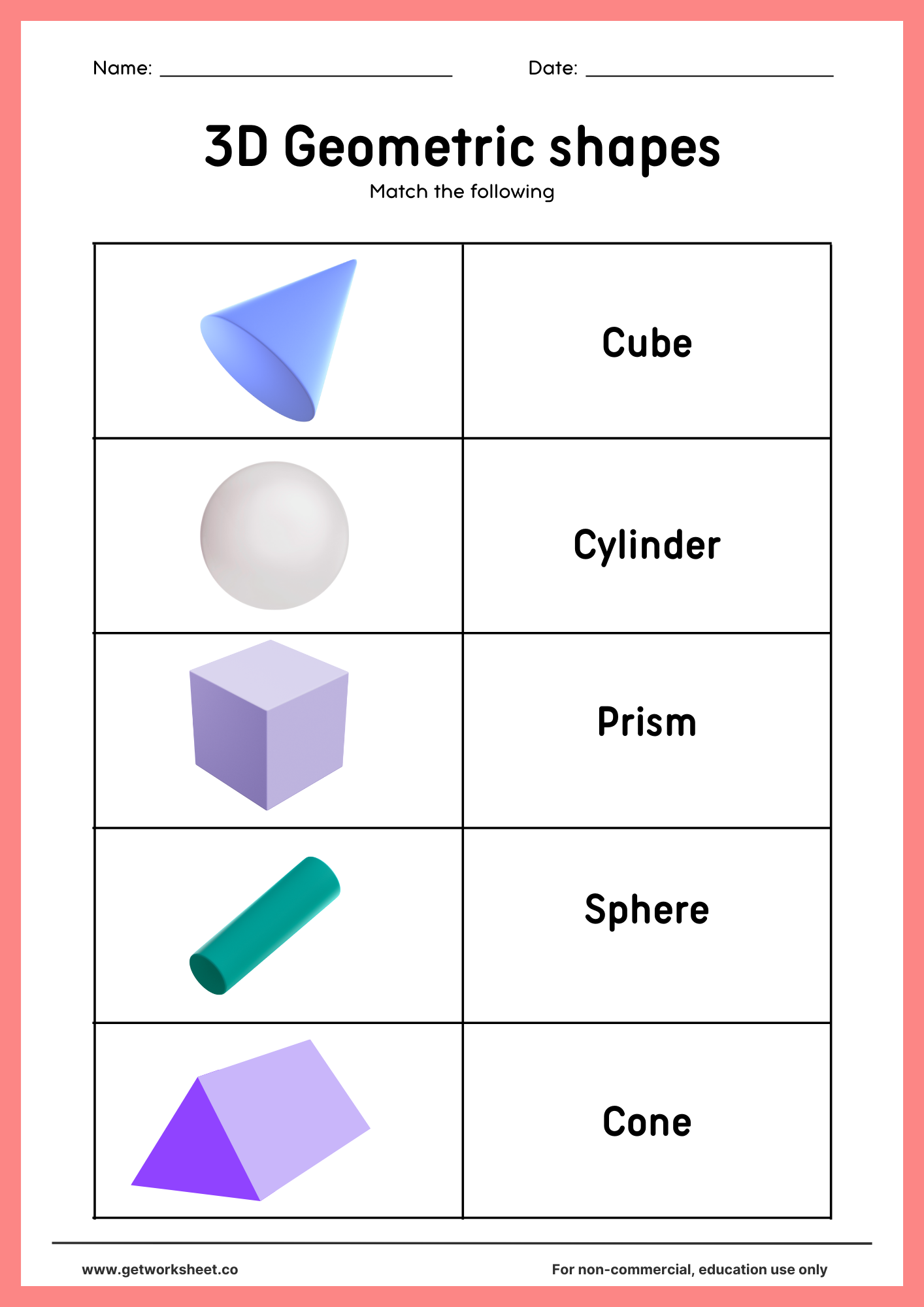
3d geometric shapes printable 2
3d geometric shapes printable 2
3d geometric shapes printable 1
3d geometric shapes printable 1
How to Use These Worksheets
3D shapes are best learned through real objects, not just pictures on paper.
- Gather real-world examples before starting the worksheets: a box (rectangular prism), a ball (sphere), a can (cylinder), a party hat (cone), a dice (cube). Let your child hold each one and count the faces, edges, and vertices by touching them. This physical experience makes the worksheet properties meaningful rather than abstract.
- Start with identification — can your child name the shape when they see it? Then move to properties — how many faces, edges, and vertices does a cube have? (6 faces, 12 edges, 8 vertices.) Properties are harder but more important for geometry later.
- Use the sorting exercises to build classification skills. Which 3D shapes can roll? (Sphere, cylinder, cone.) Which can stack? (Cube, rectangular prism, cylinder.) Why? The answers connect to the shapes' properties — curved surfaces roll, flat surfaces stack.
- For the net activities, print the nets and let your child cut them out and fold them into 3D shapes. This hands-on connection between 2D patterns and 3D objects builds powerful spatial reasoning that transfers to science, engineering, and even everyday tasks like wrapping gifts or assembling furniture.
Common Mistakes to Watch For
- Calling all boxes "cubes": A cube has six equal square faces. A cereal box is a rectangular prism (faces are rectangles, not all squares). Students often use "cube" as a generic term for any box shape. Point out the difference: are all six faces the same size and shape?
- Confusing faces with edges: Faces are the flat surfaces (a cube has 6). Edges are the lines where faces meet (a cube has 12). Students mix these terms up constantly. Use a physical box and have them touch each face (flat part) and trace each edge (line/crease).
- Thinking spheres have faces: A sphere has zero faces, zero edges, and zero vertices — it's entirely curved. Students sometimes say it has one face (the surface). Clarify: in geometry, a face must be flat. A curved surface is not a face.
- Struggling to count vertices on complex shapes: A rectangular prism has 8 vertices and students often count 4 (the front corners only) because they forget the back. Use a real box and put a sticker on each corner to make all 8 visible.
Frequently Asked Questions
When do kids learn about 3D shapes?
Basic 3D shape recognition (naming spheres, cubes, cones, cylinders) starts in kindergarten. Counting faces, edges, and vertices is a 1st-2nd grade standard. Nets and more complex properties come in 3rd-4th grade. Real-world connections should be made at every level.
What's the difference between 2D and 3D shapes?
2D shapes (circle, square, triangle) are flat — they have length and width but no depth. 3D shapes (sphere, cube, pyramid) have depth — you can hold them. A useful way to explain it to kids: 2D shapes live on paper, 3D shapes live in the real world. A square is 2D; a cube is the 3D version of a square.
Do kids need to memorize faces, edges, and vertices counts?
Memorizing the exact counts isn't as important as understanding how to count them. A student who can look at any shape and systematically count its faces, edges, and vertices has a more useful skill than one who memorized that a cube has 6-12-8 but can't apply the method to a triangular prism.
How do 3D shapes connect to real-world skills?
Spatial reasoning built through 3D shape study transfers to architecture, engineering, packaging design, art, and even navigation. Understanding that a net folds into a box is the same thinking used by engineers designing packaging or builders reading blueprints. It's one of the most practical geometry skills there is.
After mastering 3D shape identification and properties, students advance to calculating surface area and volume — measuring how much material covers a shape and how much space it contains — which are core skills in upper elementary and middle school math.