Division Facts Worksheets
Free division facts worksheets with answer keys. Practice basic division from ÷1 through ÷12 with drills and word problems — printable PDFs for grades 3-5.
Division facts are the flip side of multiplication — if you know that 6 × 8 = 48, you also know that 48 ÷ 8 = 6 and 48 ÷ 6 = 8. These worksheets build division fluency by connecting it directly to the multiplication facts students already know, then pushing toward the automatic recall needed for long division, fractions, and everyday problem solving.
What Students Will Practice
- Basic division facts from ÷1 through ÷12, building recall speed for facts like 72 ÷ 9 = 8 and 56 ÷ 7 = 8
- Understanding division as the inverse of multiplication (using fact families: 5 × 7 = 35, 7 × 5 = 35, 35 ÷ 5 = 7, 35 ÷ 7 = 5)
- Solving division word problems involving equal sharing and grouping (e.g., "24 stickers shared equally among 6 children — how many each?")
- Dividing by 1 (any number ÷ 1 = itself) and dividing a number by itself (any number ÷ itself = 1)
- Understanding that division by zero is undefined — you can't split something into zero groups
- Connecting division facts to fractions (12 ÷ 4 = 3 is the same as 12/4 = 3)
Division fact fluency is a 3rd-5th grade standard and is essential for long division, simplifying fractions, finding averages, and solving rate/ratio problems.

Division Facts Worksheet
Free printable division facts worksheets with answer keys. Perfect for homework, extra practice, or to support your math curriculum.
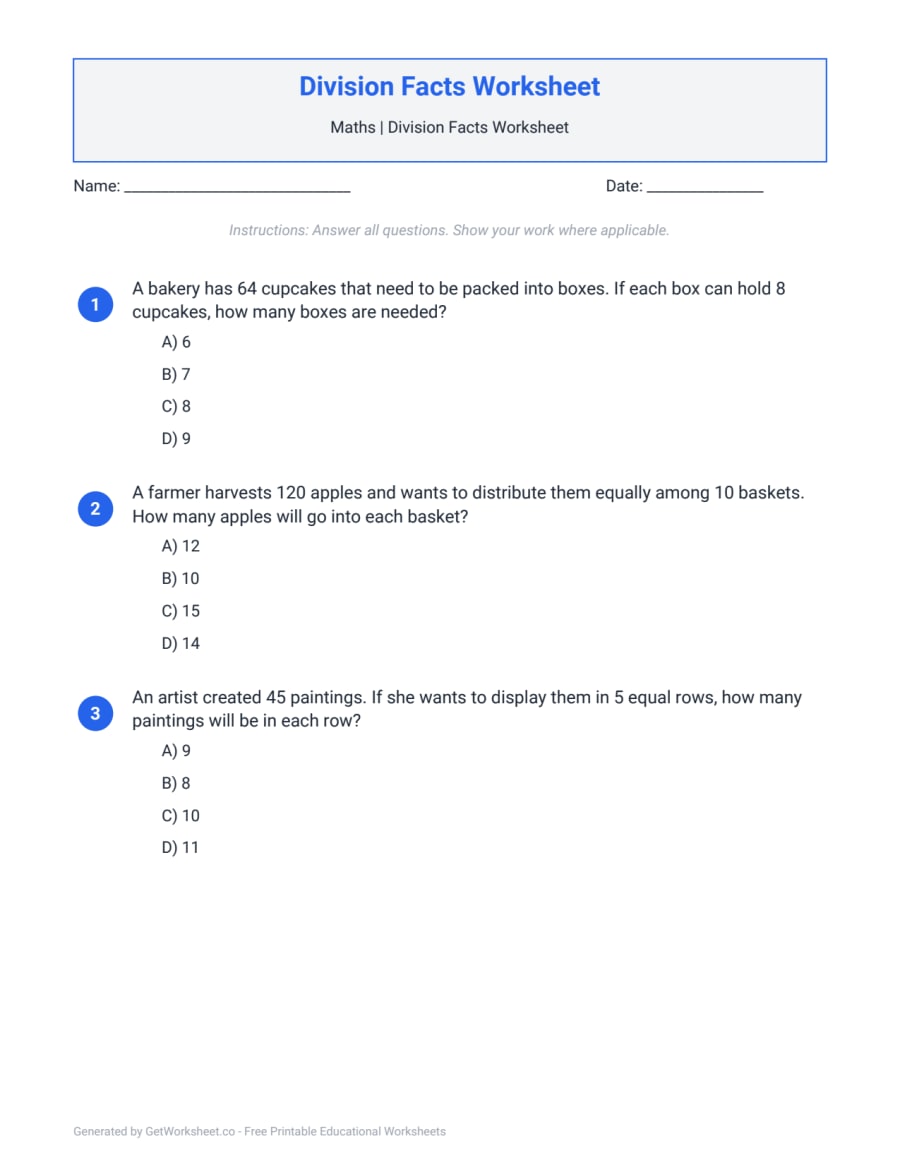
Division Facts Worksheet
Free printable division facts worksheets with answer keys. Perfect for practice at home, homework help, or supplementing math curriculum.

Division Facts Worksheet
Free printable division facts worksheets with answer keys. Perfect for homework, extra practice, or building confidence in math skills.
How to Use These Worksheets
The fastest path to division fluency goes through multiplication — use what your child already knows.
- Before starting a division drill, warm up with the related multiplication table. If today's worksheet focuses on dividing by 7, spend 2 minutes reviewing the 7 times table first. This primes the connection: "I know 7 × 6 = 42, so 42 ÷ 7 = 6." Division becomes a lookup, not a calculation.
- For students who freeze on division problems, teach the "think multiplication" strategy explicitly. When they see 54 ÷ 9, they should think: "9 times what equals 54?" This reframes every division problem as a multiplication problem they may already know.
- Use the word problems to build conceptual understanding alongside procedural speed. There's a difference between knowing 24 ÷ 6 = 4 and recognizing that "24 cookies shared among 6 friends" is a division situation. Both skills matter.
- Track progress with timed drills — but compare your child to their own previous times, not to others. Division facts take longer to automate than multiplication because students are working backwards from a known product. Patience and daily short practice (5-10 minutes) are key.
Common Mistakes to Watch For
- Confusing the dividend and divisor: In 48 ÷ 6, the 48 is the dividend (total being divided) and 6 is the divisor (size of each group or number of groups). Students sometimes reverse these, writing 6 ÷ 48 instead. Use consistent language: "48 divided by 6" or "48 split into groups of 6."
- Guessing instead of using multiplication: A student sees 63 ÷ 9 and guesses 8 because "it's close." If they checked: 9 × 8 = 72, not 63. Teach them to always verify by multiplying their answer by the divisor. 9 × 7 = 63 ✓.
- Thinking division always makes numbers smaller: For whole numbers greater than 1, yes. But this belief causes problems later when dividing fractions (dividing by 1/2 doubles the number). It's fine for now, but don't state it as a universal rule.
- Struggling with "hard" facts like 56 ÷ 7 and 72 ÷ 8: These facts are consistently the hardest because 7s and 8s are the hardest multiplication tables. Give these extra drill time — flashcards, sticky notes on the mirror, verbal quizzes during car rides. Targeted repetition works.
Frequently Asked Questions
Should my child memorize division facts or derive them from multiplication?
Both. Initially, "think multiplication" is the most reliable strategy. Over time, with repeated practice, common division facts become automatic — your child will just know that 42 ÷ 7 = 6 without consciously thinking about the 7 times table. The transition from derived to automatic is what these drill worksheets build.
My child knows multiplication but struggles with division. Why?
Division requires working backwards — given a product, find a missing factor. This is cognitively harder than forward multiplication. It's also less practiced: students spend more time on multiplication in school. Extra division-specific practice closes the gap. Use fact family worksheets to make the connection explicit.
How many division facts should my child practice per day?
A 5-10 minute session covering 20-30 problems is ideal. Focus on one divisor per session (all the ÷6 facts, then all the ÷7 facts) rather than mixing everything at once. Once individual tables are solid, mix them for comprehensive review.
When will my child need division facts in school?
Division facts are used constantly from 4th grade onward: long division, simplifying fractions (36/48 — what's the GCF?), converting between units, finding averages, solving rate problems, and algebra. Fluent recall saves enormous time and mental energy on multi-step problems.
Once division facts are fluent, students are ready for long division with multi-digit numbers, division with remainders, and eventually division of decimals and fractions — all of which rely on quick recall of basic division facts.