Life skills · Grades 3–6
Cooking Basics Worksheets
Three cooking basics worksheets for grades 3 to 6, each with three multiple-choice recipe problems: doubling a batch, scaling flour and sugar, counting cups and pieces of fruit.
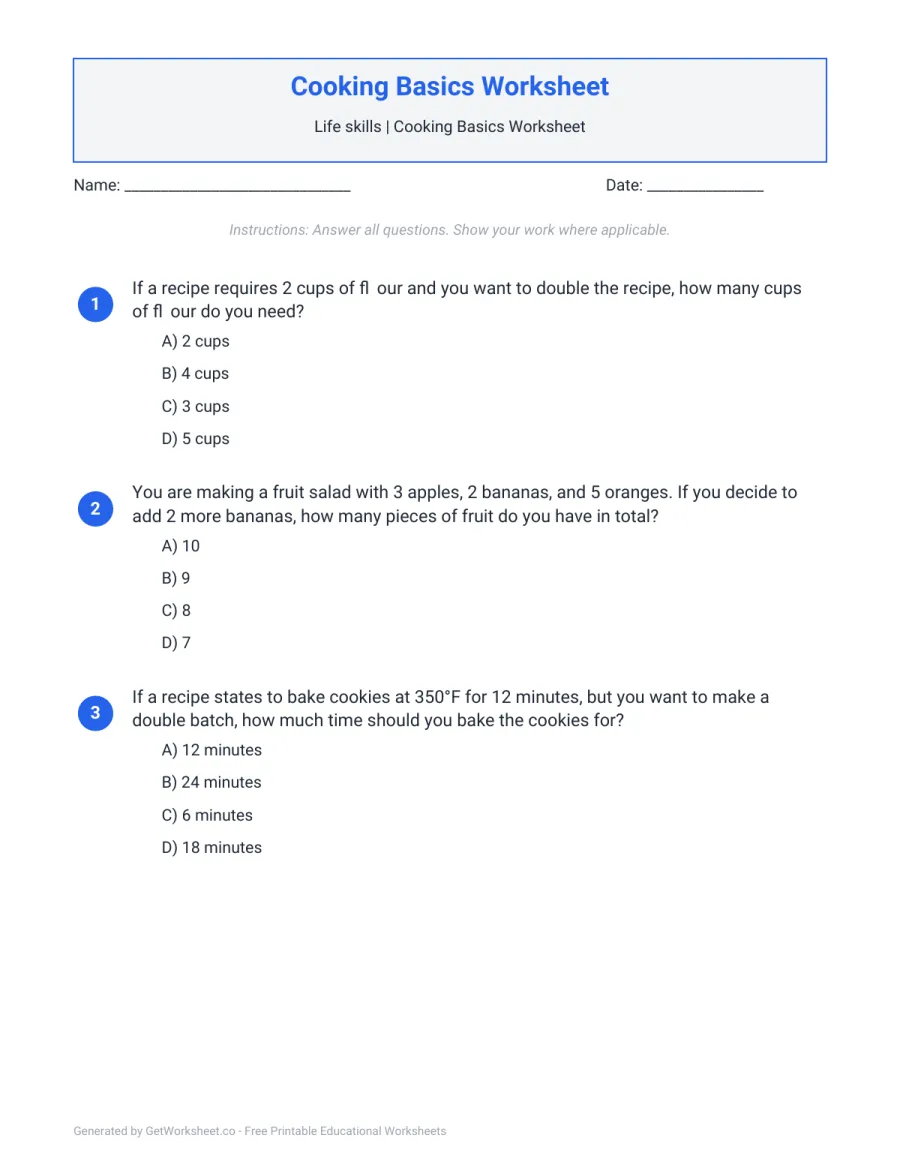
Cooking basics: 3 recipe math problems on doubling a batch
Three multiple-choice problems: double 2 cups of flour, count fruit salad pieces after adding bananas, and time a double batch of cookies. Free printable PDF.
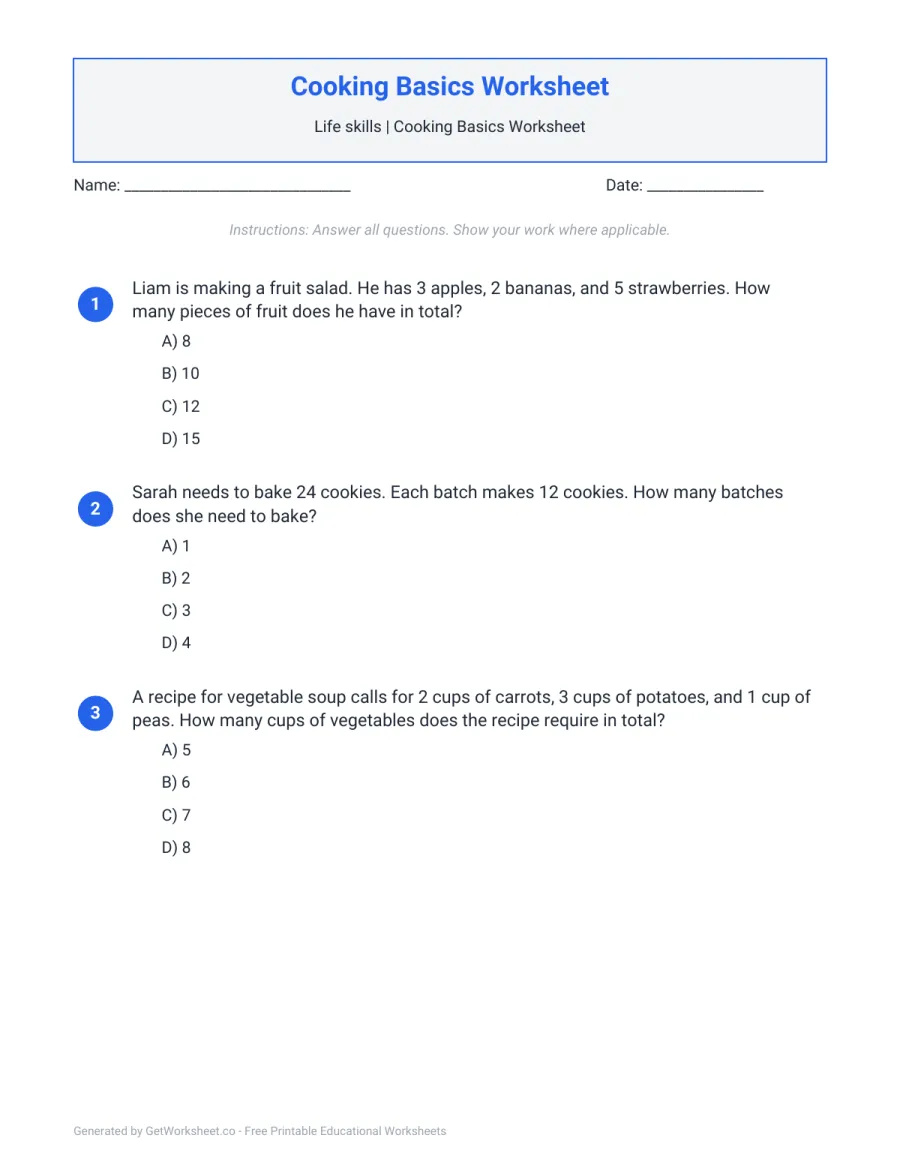
Cooking basics: 3 recipe problems on fruit, batches and cups
Three multiple-choice problems: total fruit in Liam's salad, how many 12-cookie batches make 24, and cups of vegetables in a soup recipe. Free printable PDF.
Whole set
All 3 sheets in one PDF
Instant and ad-free. No account needed.
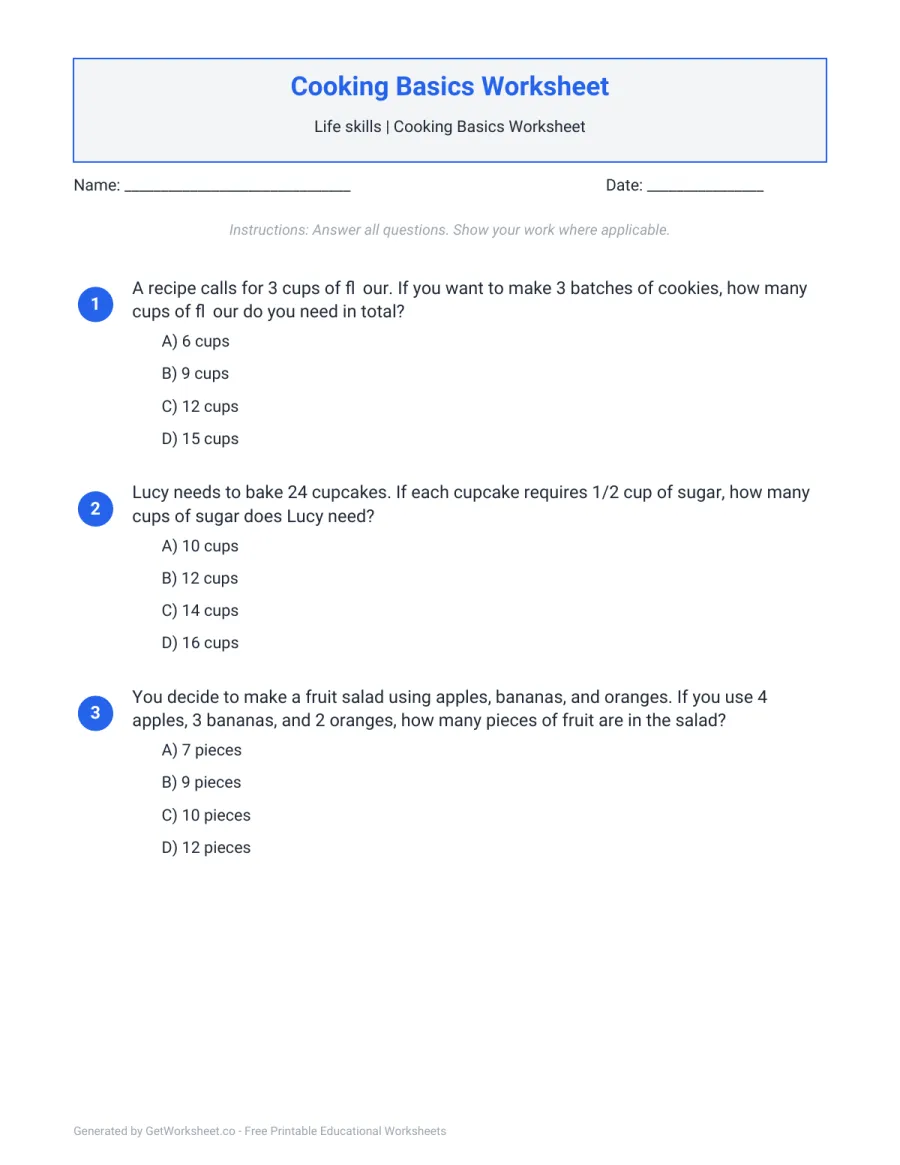
Cooking basics: 3 problems scaling flour, sugar and fruit
Three multiple-choice problems: flour for 3 batches of cookies, sugar for 24 cupcakes at half a cup each, and pieces of fruit in a salad. Free printable PDF.
AI worksheet generator
Make a worksheet like this for your class
The 3 sheets above are fixed. The generator writes a new cooking basics worksheet for your grade, with the question types and count you choose, in about 20 seconds. Pick a grade to start:
What you get
- A fresh set of questions on cooking basics, not a copy of the sheets above
- Multiple choice, fill in the blanks, true or false, open ended
- Answer key and print-ready PDF with Pro
Free account, 1 worksheets a week. No card.
This set has three cooking basics worksheets for grades 3 to 6, and every one is recipe math. Each sheet asks three multiple-choice questions with four answers to choose from: the first doubles 2 cups of flour, counts the pieces in a fruit salad after bananas are added and works out how long a double batch of cookies takes; the second totals the fruit in a salad, asks how many 12-cookie batches make 24 and counts the cups of vegetables in a soup; the third scales flour for three batches, finds the sugar for 24 cupcakes at half a cup each and counts fruit again. There are no pictures, no kitchen tools to match and no answer key, so a child works the numbers on paper and circles a letter.
Scaling a recipe is the first real use most children find for multiplication and fractions, which is why these problems sit in a life skills set rather than a math one. Read a recipe together first so the words cups, batch and half a cup mean something before the questions start.
What Students Will Practice
- Doubling and tripling ingredient amounts such as 2 cups of flour for one batch
- Working with halves: half a cup of sugar per cupcake across 24 cupcakes
- Counting and adding pieces of fruit or cups of vegetables in a recipe
- Reading a short word problem and choosing the one correct answer from four
Free printable makers
Make your own cooking basics sheets
Type your own words or numbers and print in about 30 seconds. No account, no AI, answer key where it applies.
 Visual schedule makerPicture schedules, First/Then and token boards. Free to print.
 Flashcard makerVocabulary, math fact or sight word cards, 2-8 a page, two-sided or fold-over. Free to print.
 Reward chart and chore chart makerReward or sticker chart with a goal, Mon-Sun chore chart with pictures, behavior chart. Free to print.
AI worksheet generator
Need a different cooking basics worksheet?
Generate a custom cooking basics worksheet: pick the grade, question types and count, and print it in about 20 seconds. Free accounts get 1 generation a week.
How to use these worksheets
Print at 100% on A4 or US Letter so all three questions and their four answer choices fit on one page with room to work. There is no answer key on any of the three sheets, so work the problems yourself first, or better, check them together in the kitchen with a measuring cup. Each sheet is only three problems, which makes it a ten-minute warm up rather than a whole lesson.
- Doubling a batch, sheet one. Start here, and start with real cups. Have your child pour 2 cups of flour, then ask what doubling looks like on the counter before circling an answer. The same sheet asks how long a double batch of cookies takes, which is a good moment to say that doubling ingredients does not double baking time.
- Fruit, batches and cups, sheet two. This one hides a division problem: how many 12-cookie batches make 24. Ask "how many twelves fit in 24" rather than letting your child reach for multiplication out of habit.
- Scaling flour, sugar and fruit, sheet three. The hardest of the three. Flour for 3 batches is repeated addition or multiplication, and sugar for 24 cupcakes at half a cup each is a fraction problem worth acting out with a measuring cup, twice into one cup, before the pencil moves.
- All three sheets together. Read a real recipe before you hand any of them over, so cups, batch and half a cup already mean something. If you cook the recipe afterwards, the answers check themselves.
Common mistakes to watch for
- Scaling only one ingredient. Children double the flour and forget the sugar. When a recipe doubles, every ingredient doubles, so list them before calculating.
- Multiplying when the question divides. Going from 24 cookies to the number of 12-cookie batches means dividing. Ask what the question is counting, cookies or batches, before choosing an operation.
- Losing the halves. Half a cup for each of 24 cupcakes is 12 cups, not 48 or 24. Two halves make one whole, so 24 halves make 12.
- Working backwards from the four choices. Multiple choice invites guessing. Ask your child to write the calculation in the margin and only then look at the options.
Frequently asked questions
What grade are these cooking worksheets for?
Grades 3 to 6. A third grader can handle the doubling and the batch counting. The half cup scaling on the third sheet suits fourth grade and up, once fractions have been introduced.
Are the answers included?
No. The sheets give three multiple-choice questions each, with no answer key attached, so an adult needs to check the work or cook the recipe alongside it.
Do these teach actual cooking?
They teach recipe math: doubling, scaling and measuring. There are no pictures of kitchen tools, no method steps and no safety content. Pair them with a real recipe so the numbers connect to a mixing bowl.
Is a kitchen required?
No. Every problem can be answered with a pencil. Measuring cups make the fraction question far easier to understand, so bring them out if you have them.
Can I print them for a class?
Yes. Print as many copies as you need for your classroom or home at no cost. Three questions a sheet also works as a bell ringer for a cooking or life skills unit.
More practice
Recipe math leans on times tables, so shore those up with multiplication worksheets if scaling a batch is slow going. For the rest of a life skills unit, try the money management worksheets for shopping and budgeting, time management worksheets for planning a bake around baking time, and safety signs worksheets before anyone touches an oven.
Free library