Life skills · Kindergarten–Grade 3
Free safety signs worksheets
Free printable safety signs worksheets for K to grade 3 with real drawn signs: match twelve signs to meanings, sort by color, color the signs, choose the safe action in eight scenes, trace the shapes, a word search. Keys included.
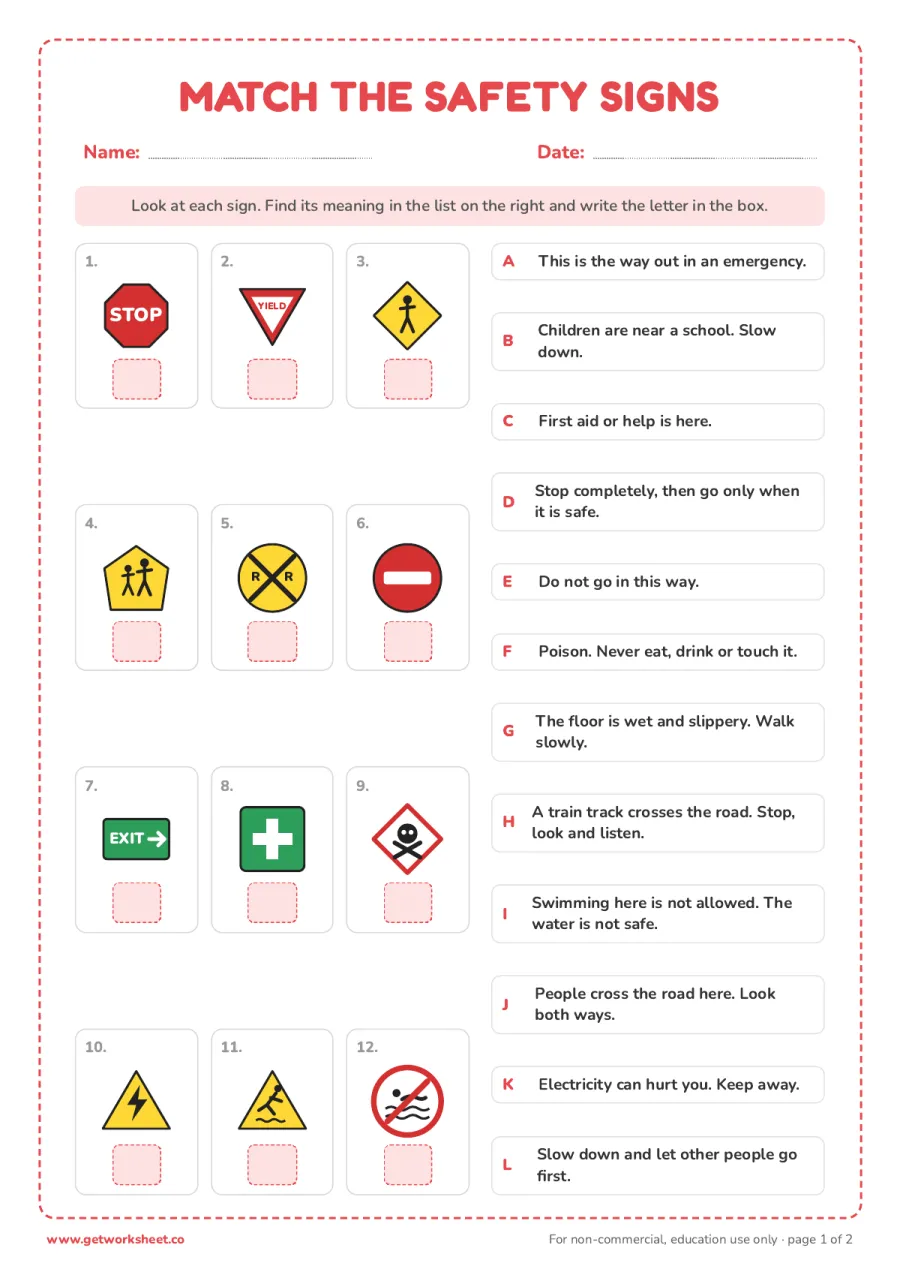
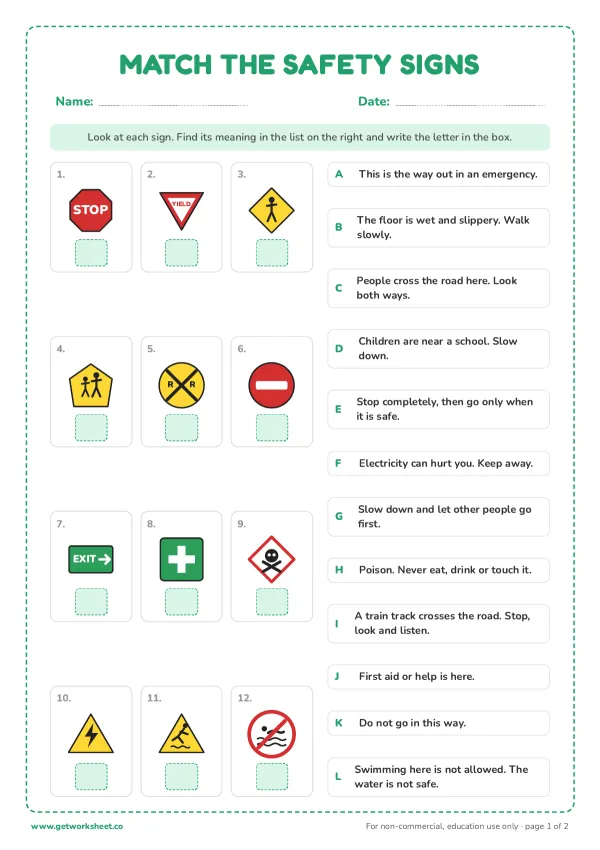
Match 12 safety signs to their meanings
Twelve drawn signs (stop, yield, crossing, school zone, railroad, do not enter, exit, first aid, poison, high voltage, wet floor, no swimming) to match to their meanings by letter. Answer key on page 2. Free printable PDF.
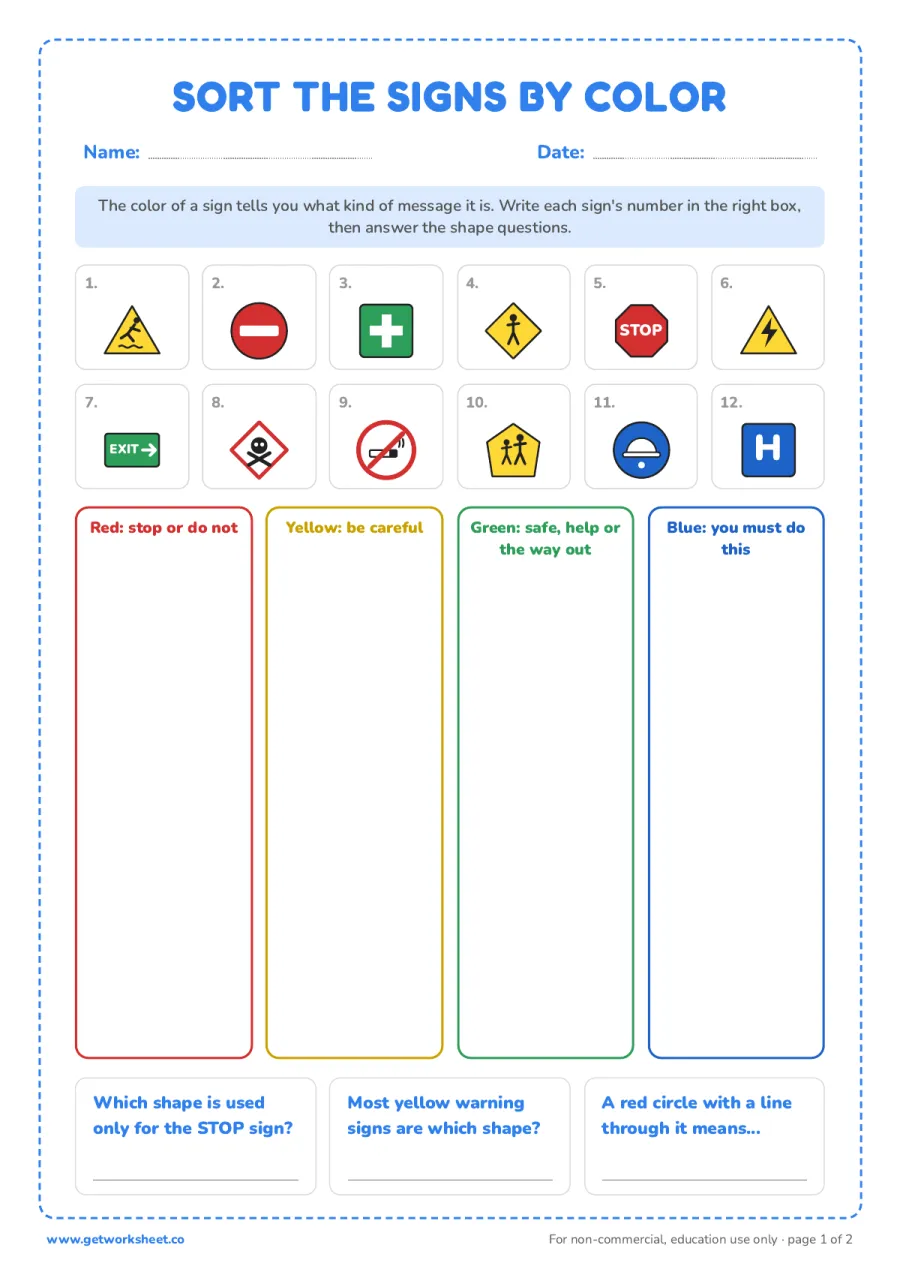
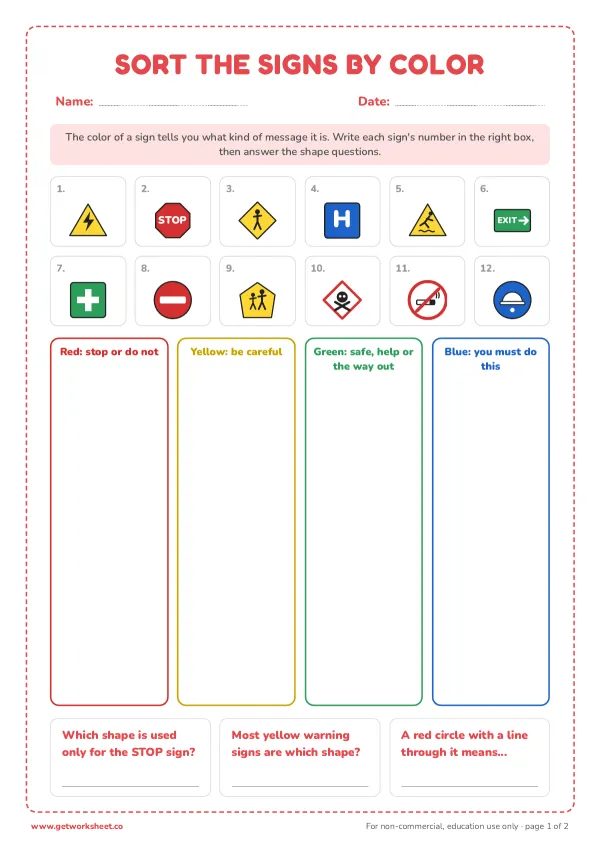
Sort the signs by color: red, yellow, green, blue
Twelve pictured signs to sort into four boxes by what their color means (stop or do not, be careful, safe or help, you must), plus three questions about sign shapes. Answer key on page 2. Free printable PDF.
Complete pack
All 7 sheets + 4 bonus sheets in one PDF
Instant and ad-free. No account needed.
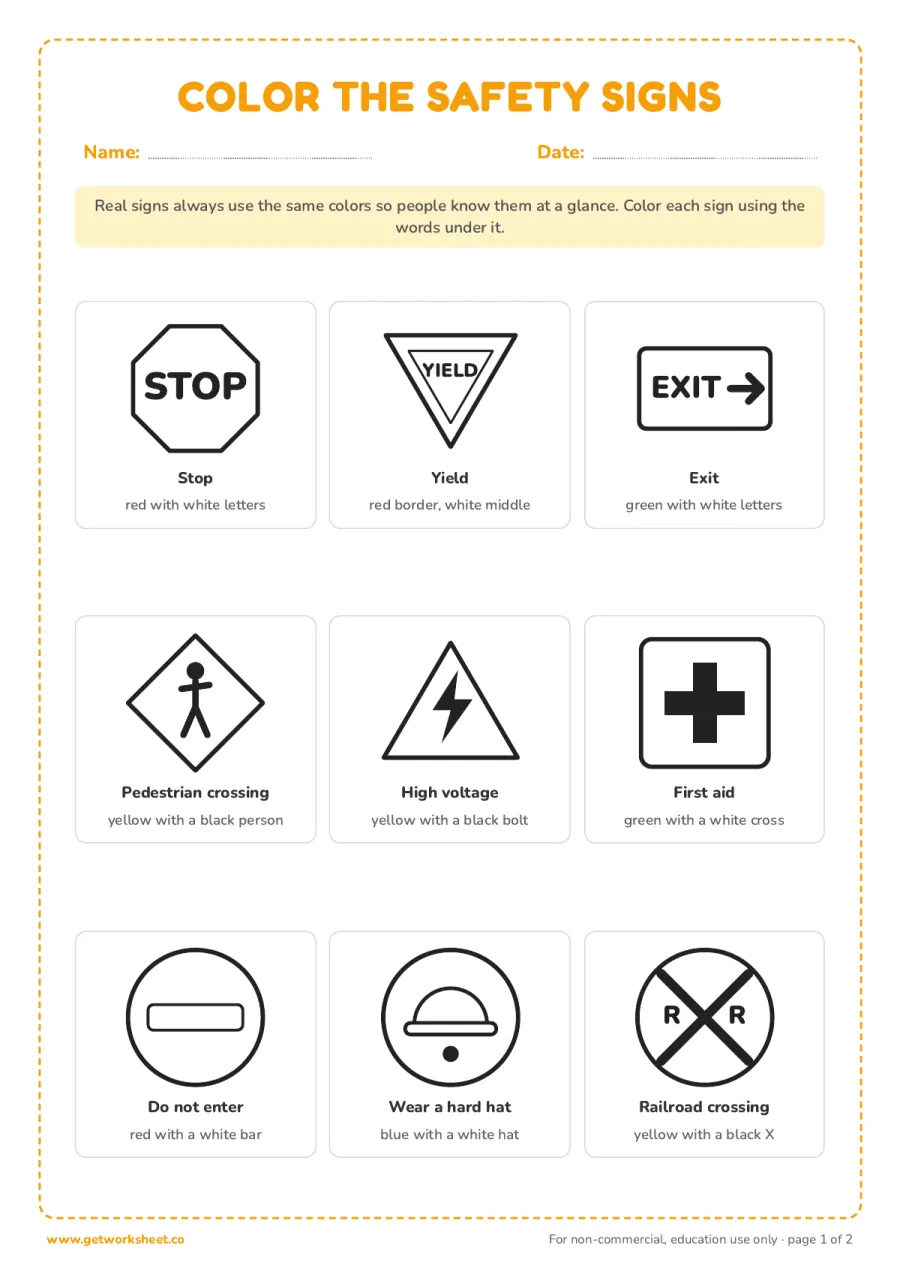
Color the safety signs the right colors
Nine outline signs (stop, yield, exit, crossing, high voltage, first aid, do not enter, hard hat, railroad) with the real color rule written under each. The key on page 2 shows the finished signs. Free printable PDF.
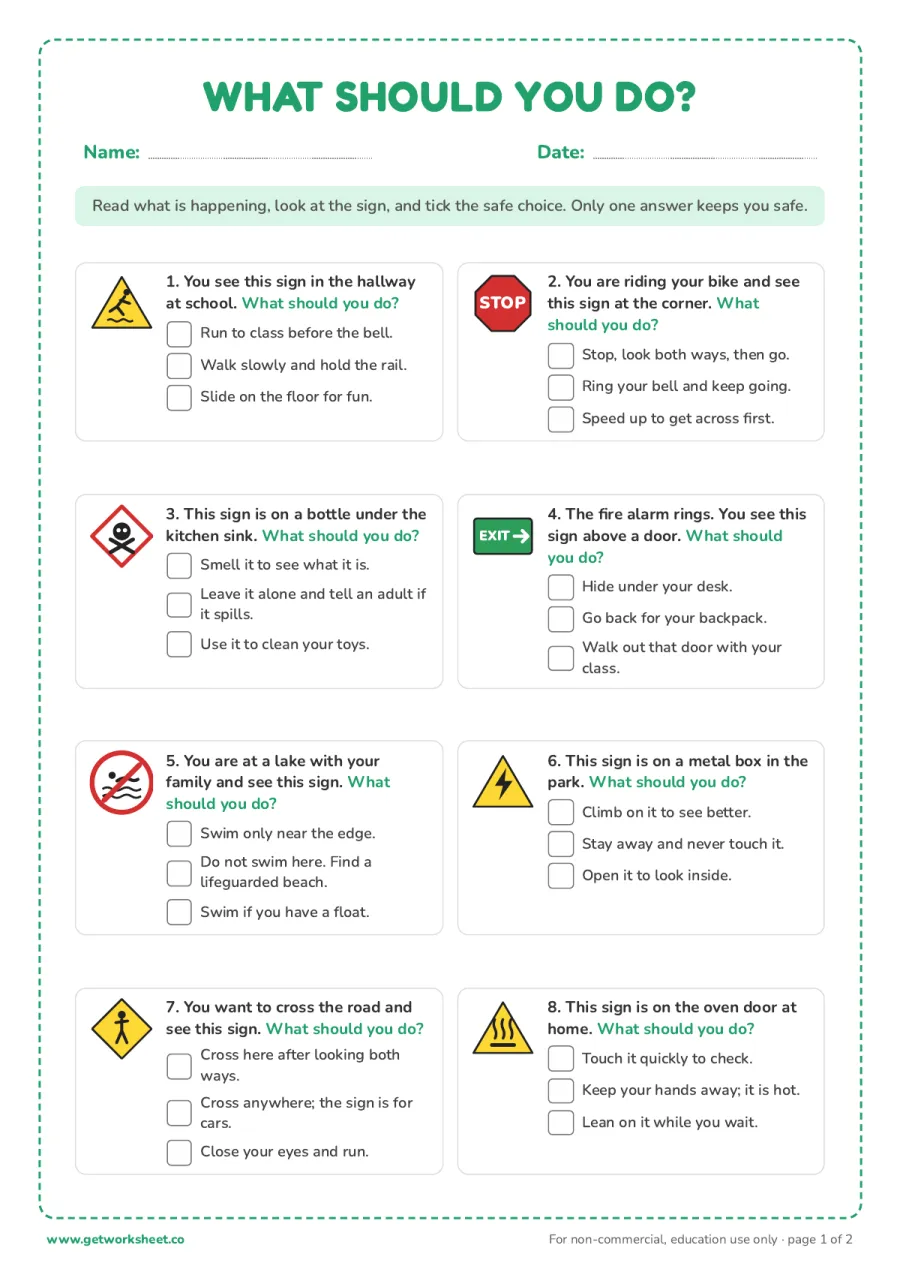
What should you do? 8 sign scenes
Eight everyday situations (wet hallway, bike at a stop sign, bottle under the sink, fire alarm, lake, electrical box, crosswalk, hot oven), each with the sign and three choices to tick. Answer key on page 2. Free printable PDF.
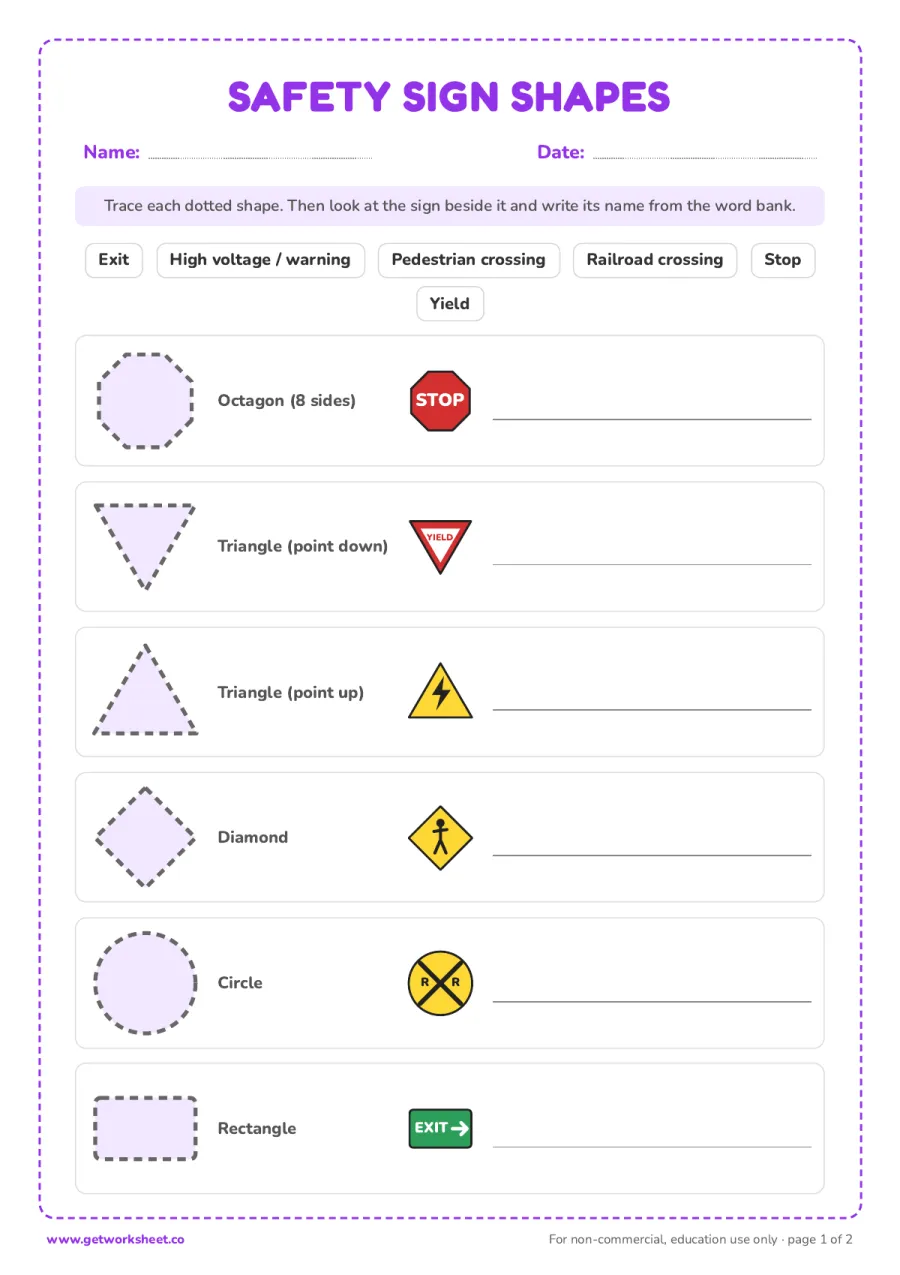
Sign shapes: trace and name
Trace the six sign shapes (octagon, two triangles, diamond, circle, rectangle) and write the name of the sign that uses each one from a word bank. Answer key on page 2. Free printable PDF.
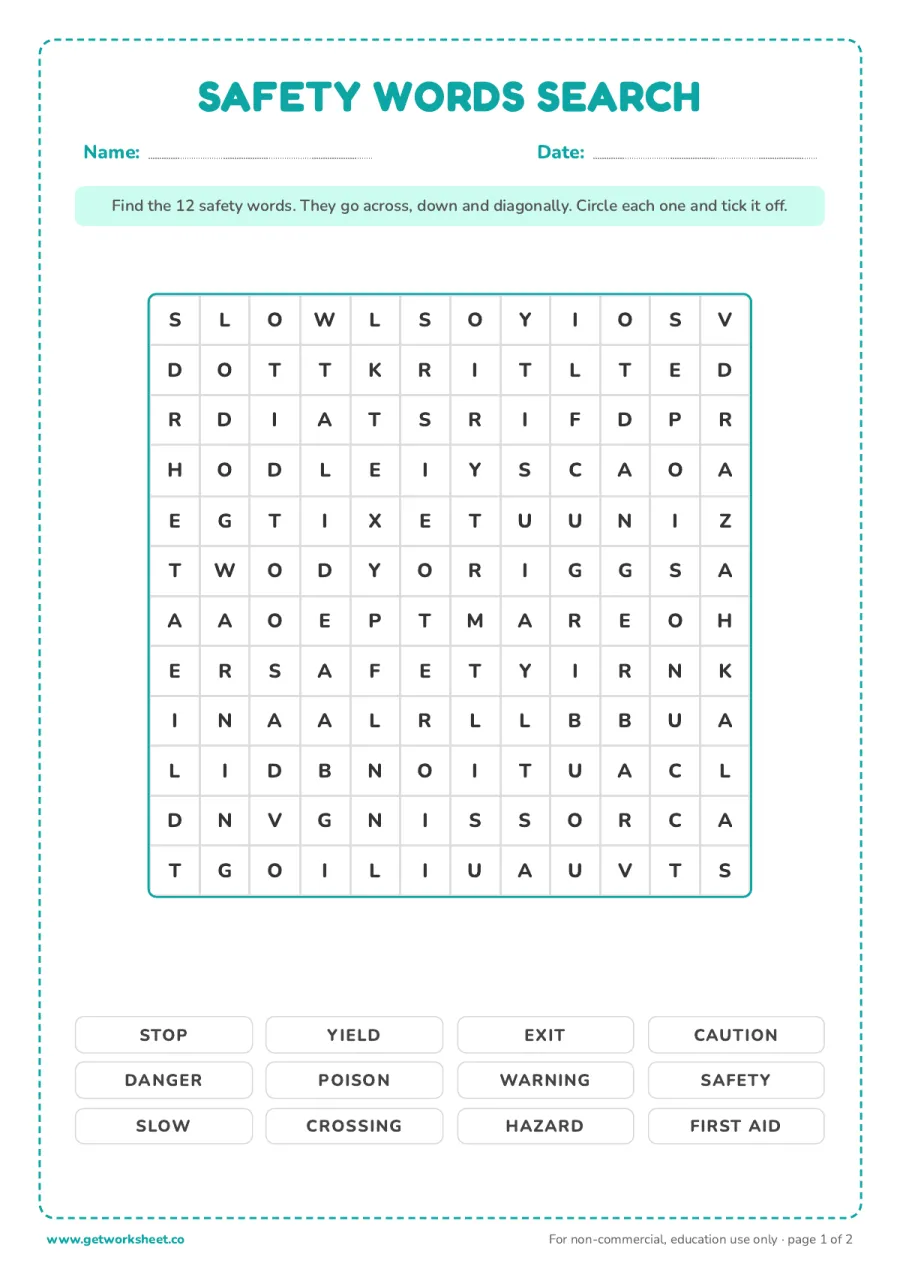
Safety words word search
Twelve safety words hidden in a 12 by 12 grid: stop, yield, exit, caution, danger, poison, warning, safety, slow, crossing, hazard, first aid. Solution on page 2. Free printable PDF.
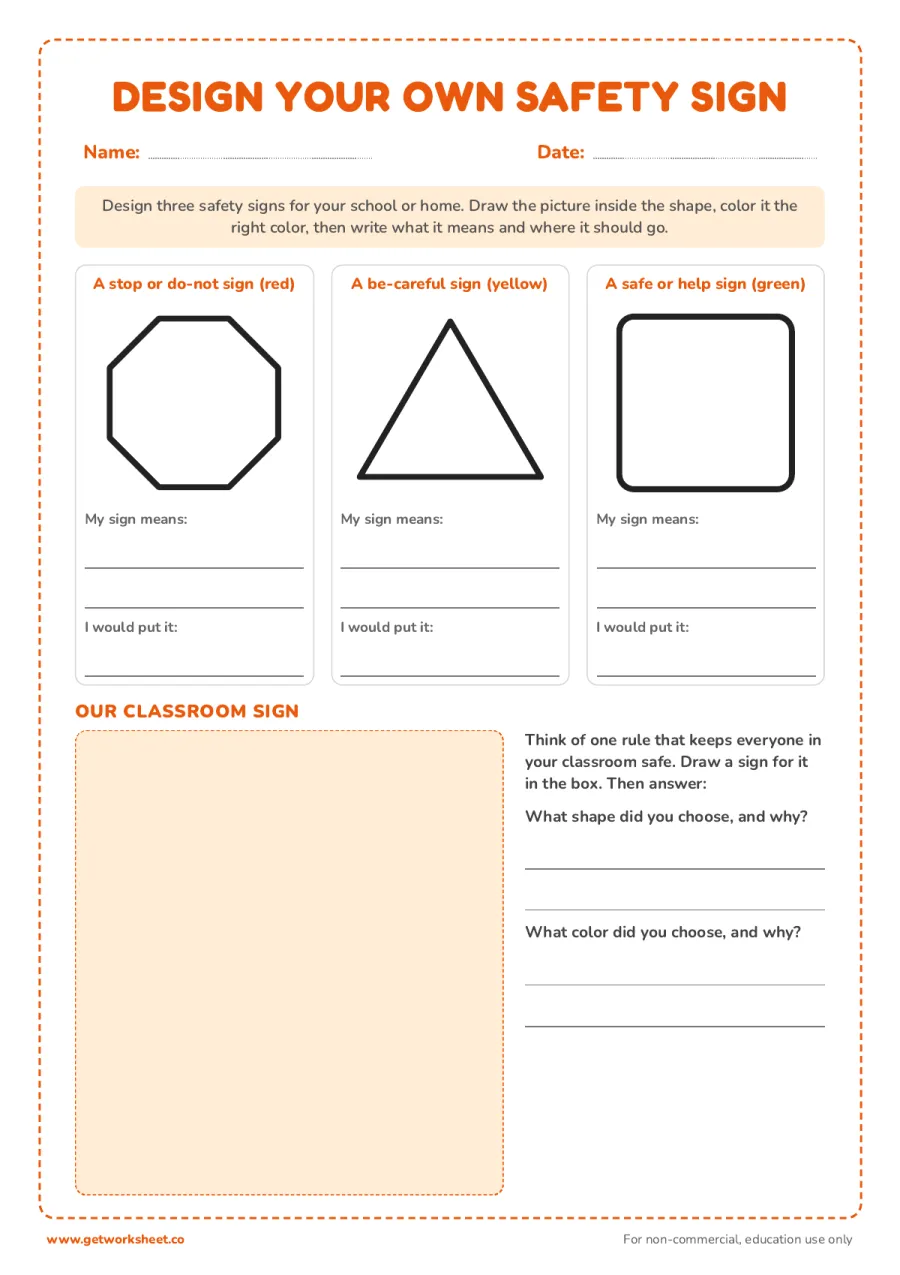
Design your own safety sign
Three blank sign shapes (octagon, triangle, square) to draw, color and explain, then a box to design a sign for one classroom rule with two writing prompts. Free printable PDF.
AI worksheet generator
Make a worksheet like this for your class
The 7 sheets above are fixed. The generator writes a new safety signs worksheet for your grade, with the question types and count you choose, in about 20 seconds. Pick a grade to start:
What you get
- A fresh set of questions on safety signs, not a copy of the sheets above
- Multiple choice, fill in the blanks, true or false, open ended
- Answer key and print-ready PDF with Pro
Free account, 1 worksheets a week. No card.
Children meet safety signs long before they can read them: the red octagon at the corner, the yellow triangle on the wet hallway floor, the green EXIT over the classroom door. These seven worksheets teach the system behind the signs, not just the signs one by one. Every sheet uses drawn signs in their real shapes and colors, so a child who has done the set recognizes a new sign by its shape and color even when the words are unfamiliar. Six sheets have an answer key on page 2; the design sheet is open-ended.
What's in this set
- Match the safety signs. Twelve signs (stop, yield, pedestrian crossing, school zone, railroad crossing, do not enter, exit, first aid, poison, high voltage, wet floor, no swimming) and twelve meanings in a mixed-up list. Write the letter of the meaning under each sign.
- Sort the signs by color. Twelve pictured signs to sort into four boxes: red means stop or do not, yellow means be careful, green means safe or help, blue means you must. Three questions about shapes finish the page.
- Color the safety signs. Nine outline signs with the real color rule written under each (stop is red with white letters, first aid is green with a white cross). The key shows the finished signs.
- What should you do? Eight everyday scenes with the sign shown: a wet hallway, a stop sign on a bike ride, a bottle under the sink, a fire alarm, a lake, an electrical box, a crosswalk, a hot oven. Tick the one safe choice.
- Sign shapes: trace and name. Trace the octagon, both triangles, the diamond, the circle and the rectangle, then name the sign that uses each shape from a word bank.
- Safety words word search. Twelve words (stop, yield, exit, caution, danger, poison, warning, safety, slow, crossing, hazard, first aid) in a 12 by 12 grid, with the solution on page 2.
- Design your own safety sign. Three blank shapes to draw, color and explain, then a box to design a sign for one classroom rule.
What students will practice
- Recognizing the twelve most common safety signs by picture, shape and color
- Reading the color code: red for stop and prohibition, yellow for caution, green for safety and exits, blue for mandatory actions
- Reading the shape code: the octagon is only ever a stop sign, a point-down triangle means yield, point-up triangles warn
- Choosing a safe action in a real situation and explaining why (health and safety standards for K to 3)
- Safety vocabulary: caution, danger, hazard, warning, yield
- Fine motor work: coloring inside a shape, tracing shapes, drawing a sign
Free printable makers
Make your own safety signs sheets
Type your own words or numbers and print in about 30 seconds. No account, no AI, answer key where it applies.
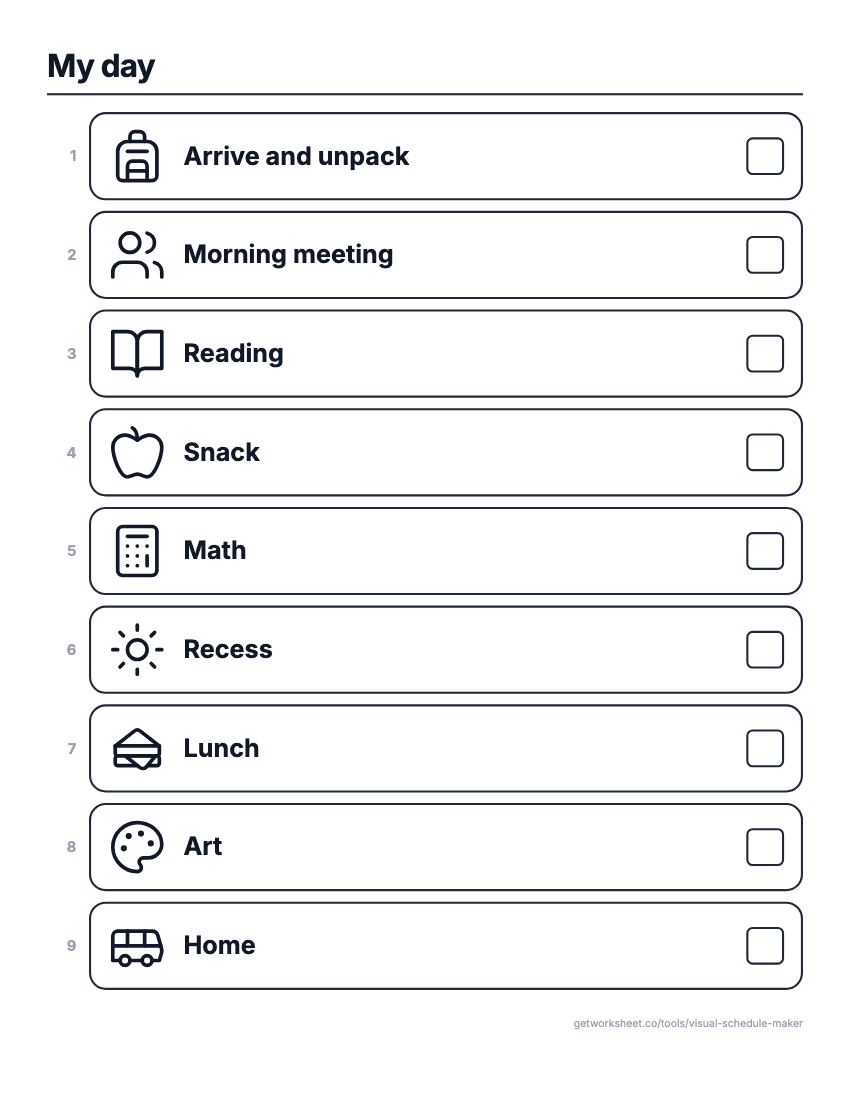 Visual schedule makerPicture schedules, First/Then and token boards. Free to print.
 Flashcard makerVocabulary, math fact or sight word cards, 2-8 a page, two-sided or fold-over. Free to print.
 Reward chart and chore chart makerReward or sticker chart with a goal, Mon-Sun chore chart with pictures, behavior chart. Free to print.
AI worksheet generator
Need a different safety signs worksheet?
Generate a custom safety signs worksheet: pick the grade, question types and count, and print it in about 20 seconds. Free accounts get 1 generation a week.
Complete pack · $1.99
All 7 sheets above, plus 4 bonus sheets you will not find on this page
7 free sheets + 4 bonus sheets in one print-ready PDF with a contents page. Instant, no ads, no account; the link is emailed to you so it works on any device. The 7 sheets above stay free.
- BonusMatch the safety signs, set 2
- BonusSort the signs by color, set 2
- BonusWhat should you do? Set 2
- BonusSafety words word search, set 2
One-time payment of $1.99. Card, Apple Pay or Google Pay. For home and classroom use.
- Bonus
 Match the safety signs, set 2
 - Bonus
 Sort the signs by color, set 2
 - Bonus
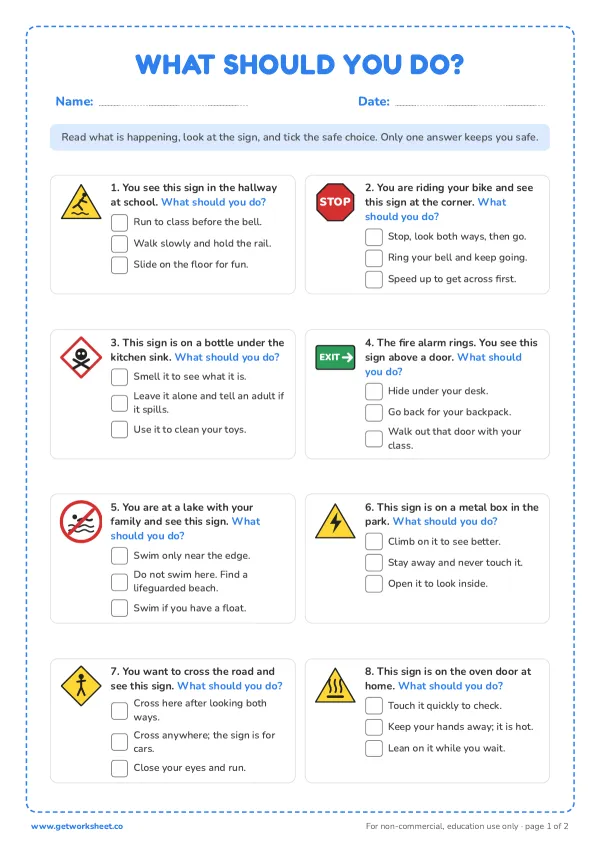 What should you do? Set 2
 - Bonus
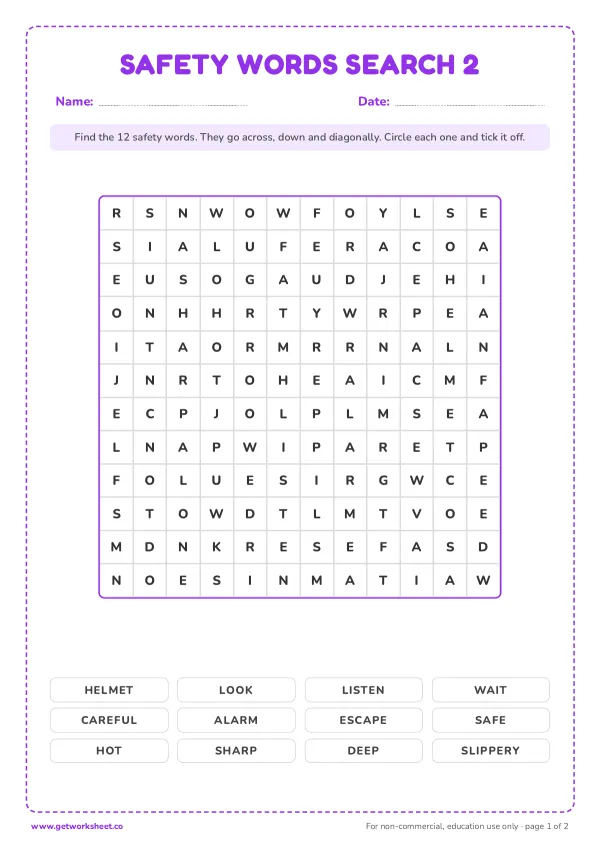 Safety words word search, set 2
How to use these worksheets
Print at 100% on A4 or US Letter. Print page 1 for children and keep page 2 as the key; the design sheet is a single page. The color sheet needs red, yellow, green, blue and black crayons. Do the sheets in order over a week: recognize, sort, color, decide, then design.
- Match the signs. Before writing, ask children to name any signs they already know and say where they have seen them. Then read the twelve meanings aloud together once so weaker readers can match by listening.
- Sort by color. The rule is the point: red says no, yellow says careful, green says safe, blue says must. Have children say the rule out loud as they write each number.
- Color the signs. Insist on the real colors. A blue stop sign is the one wrong answer on this page, and the reason is the lesson: everyone must recognize a stop sign in a split second.
- What should you do? Read each scene aloud and let children vote before they tick, then ask one child to explain why the other two choices are unsafe. This is where the set turns into a safety lesson.
- Sign shapes. Trace first, then name. Ask which shape they would never see on a warning sign (the octagon) and why.
- Word search. Good for early finishers; ask them to use three of the words in a sentence afterwards.
- Design your own. Display the finished signs by the classroom door and use them as the class rules for the week.
Making it a lesson
- Sign walk. Take the class around the school and photograph or sketch every sign. Sort the finds by color when you are back.
- Home hunt. Send the sort sheet home: children list the signs they find on the way home and on household products (poison, hot, no smoking).
- Road safety week. Pair the scenes sheet with a crossing practice in the playground: stop at the edge, look left, right, left, listen, then walk.
Common mistakes to watch for
- Yield and warning triangles confused. Yield points down and is red; warning triangles point up and are yellow. The shapes sheet makes this explicit.
- Treating the bar as decoration. A red circle with a line through it always means not allowed. Have children draw the bar first when they color a no-swimming or no-smoking sign.
- Choosing the brave answer. On the scenes sheet children sometimes tick the daring option. Ask what a grown-up would do, then what a firefighter would do.
Frequently asked questions
What age are these safety signs worksheets for?
Kindergarten to grade 3, ages 5 to 9. The color and shapes sheets suit kindergarten and first grade; the matching and scenes sheets suit first to third grade; the word search and design sheet work across the range. Older children with additional needs also use the set for community safety vocabulary.
Are the signs real signs?
They are drawn in the real shapes and colors used on US roads and in buildings: the red octagon stop, the point-down red yield, yellow warning triangles and diamonds, green exit and first aid, blue mandatory signs. Small details are simplified so they print clearly and are easy to color.
Do the worksheets include answer keys?
Yes. Six of the seven sheets have the answers on page 2; the color sheet's key shows the finished signs in color. The design sheet has no key because every answer is different.
Can I print in black and white?
Yes for six sheets. The color sheet is meant to be printed in black and white and colored by hand; its key page is the only page that needs a color printer, and it is optional.
Is this set free to use in class?
Yes, for non-commercial educational use: class sets, homeschool groups and safety weeks are all fine.
More practice
The cooking basics worksheets cover kitchen safety, and the lab safety worksheets teach the hazard symbols older students meet in science. For the shapes on their own, see the shapes flashcards and the triangle tracing worksheets. The all about me worksheets include an emergency contact page that pairs well with a safety week.
Free library
Related collections
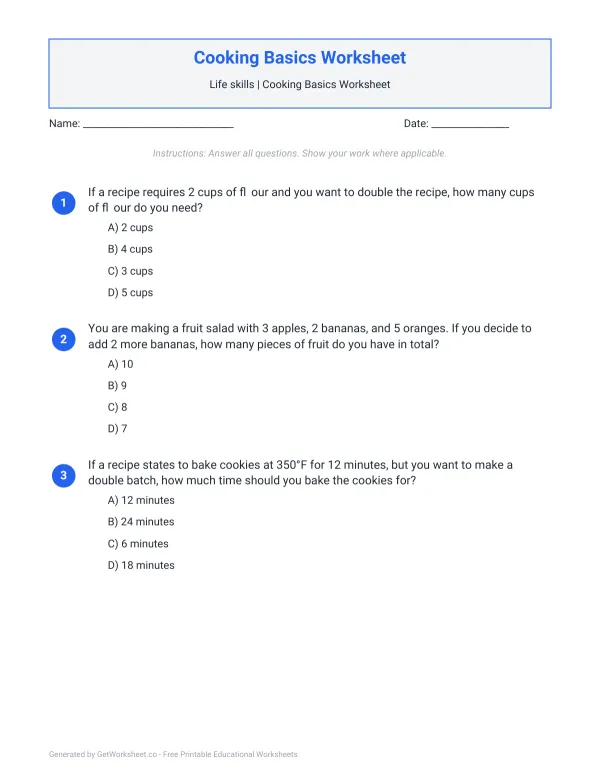
Cooking Basics Worksheets
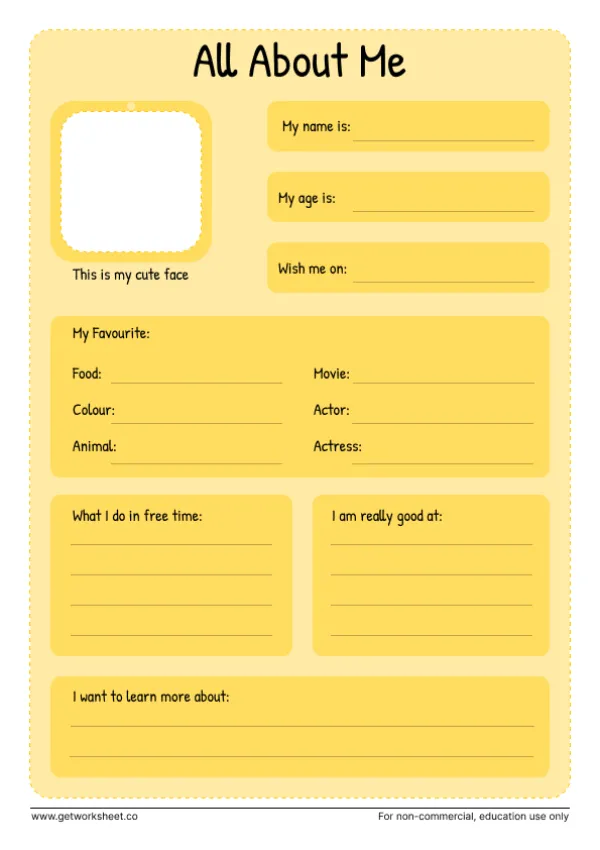
Free all about me worksheets
Free lab safety worksheets
Free shapes flashcards
Free triangle tracing worksheets
Free kindergarten reading comprehension worksheets
Free number line printables
Free handwriting paper printables
More worksheets
- Free word families worksheets
- Free sight words worksheets (Dolch and Fry)
- Free CVC words worksheets
- Free Halloween math worksheets
- Free Christmas worksheets: word searches, letter to Santa and writing
- Free Christmas math worksheets
- Free hundreds chart worksheets
- Free ten frame worksheets
- Free Montessori teen board and ten board worksheets
- Free Montessori place value worksheets (golden beads)
- Free Montessori hundred board worksheets
- Free handwriting worksheets