English · Grades 2–5
Free synonyms and antonyms worksheets
Five printable synonyms and antonyms worksheets for grades 2 to 5: synonym match with an overused-word swap, antonym match with opposite sentences, a synonym-or-antonym sort of eighteen pairs and more. Answer keys on page 2 of each PDF.
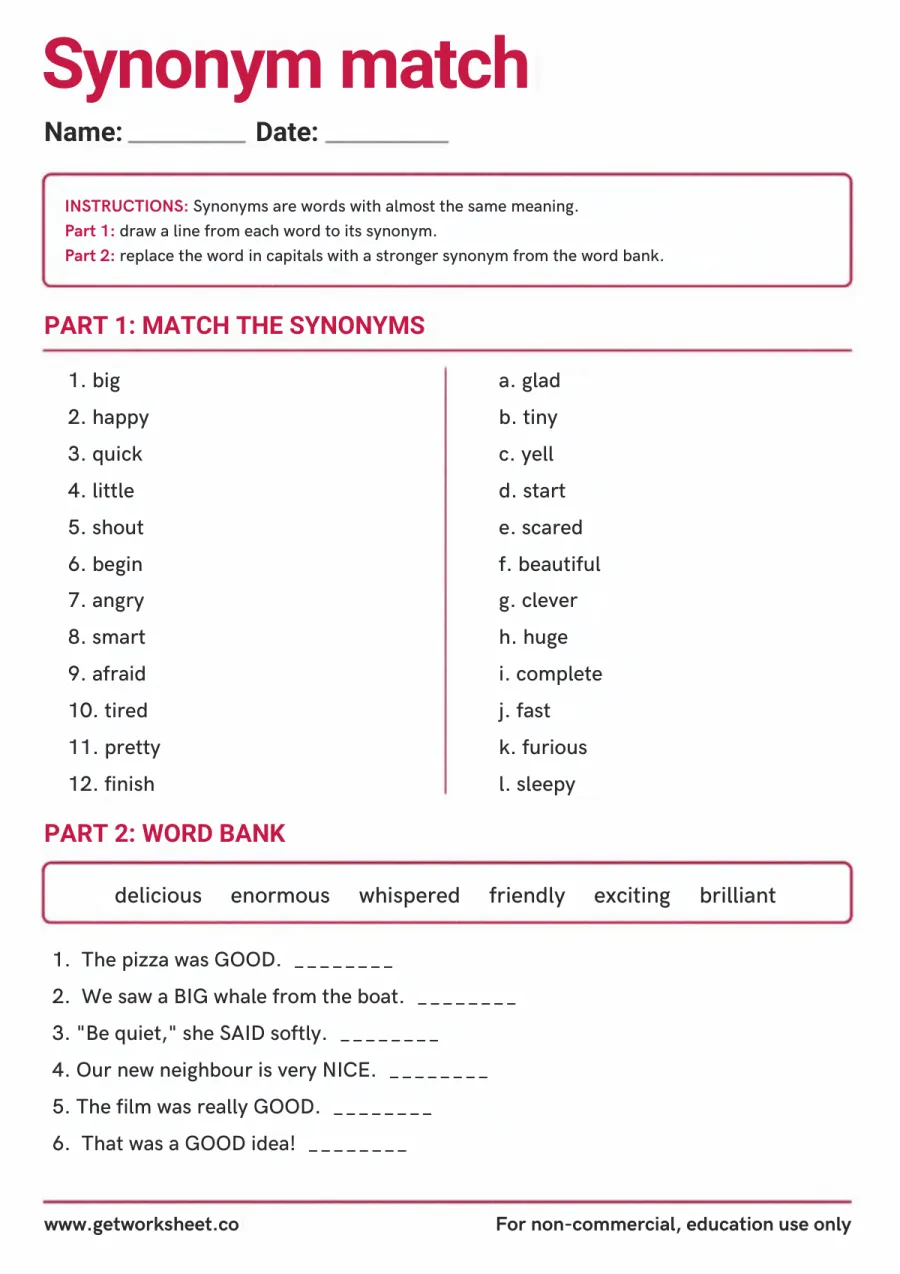
Synonym match: 12 pairs plus a word-bank swap
Match twelve words to their synonyms, then replace the overused word in six sentences with a stronger synonym from the bank. Answer key on page 2.
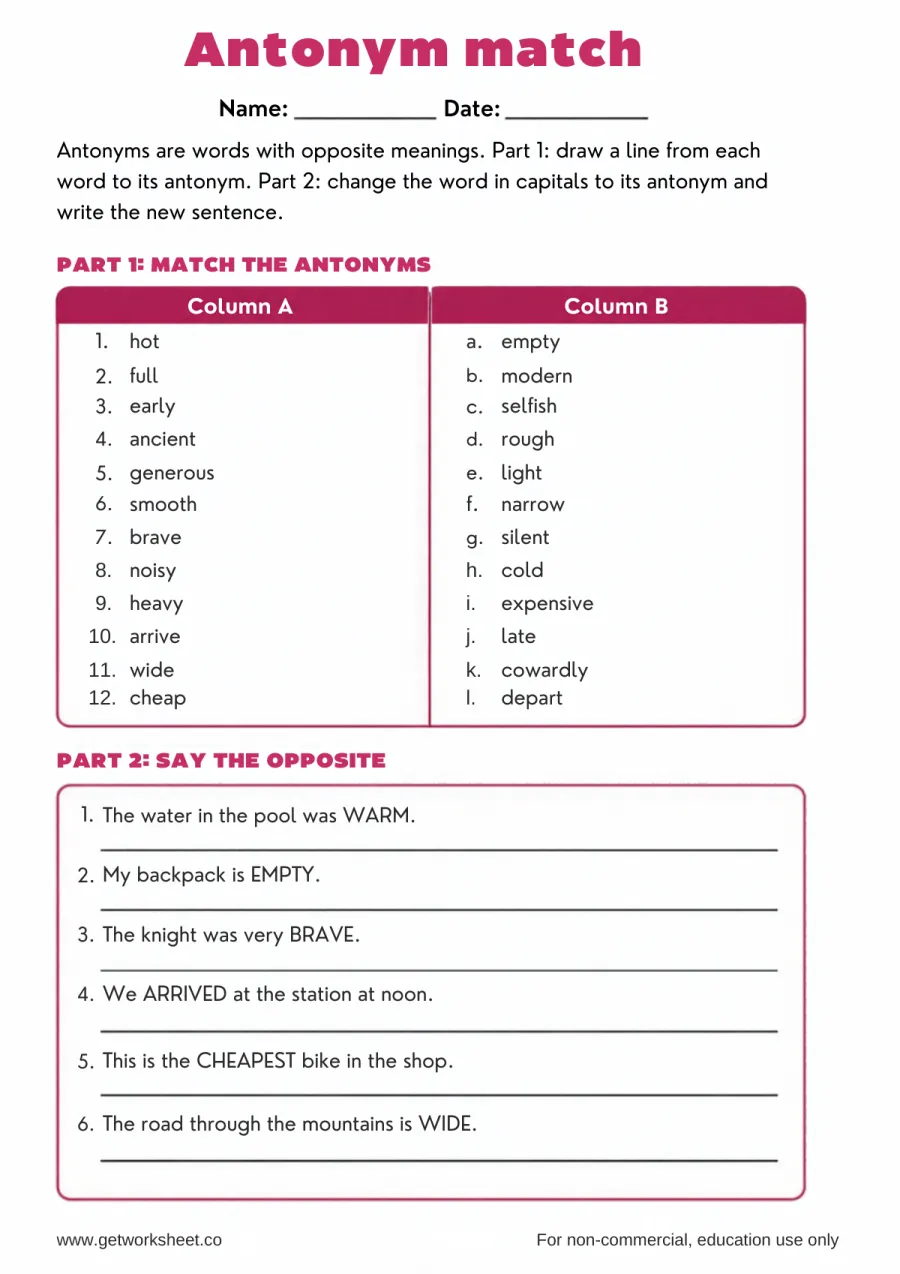
Antonym match: 12 pairs plus opposite sentences
Match twelve words to their antonyms, then rewrite six sentences so they mean the opposite. Answer key on page 2.
Whole set
All 5 sheets in one PDF
Instant and ad-free. No account needed.
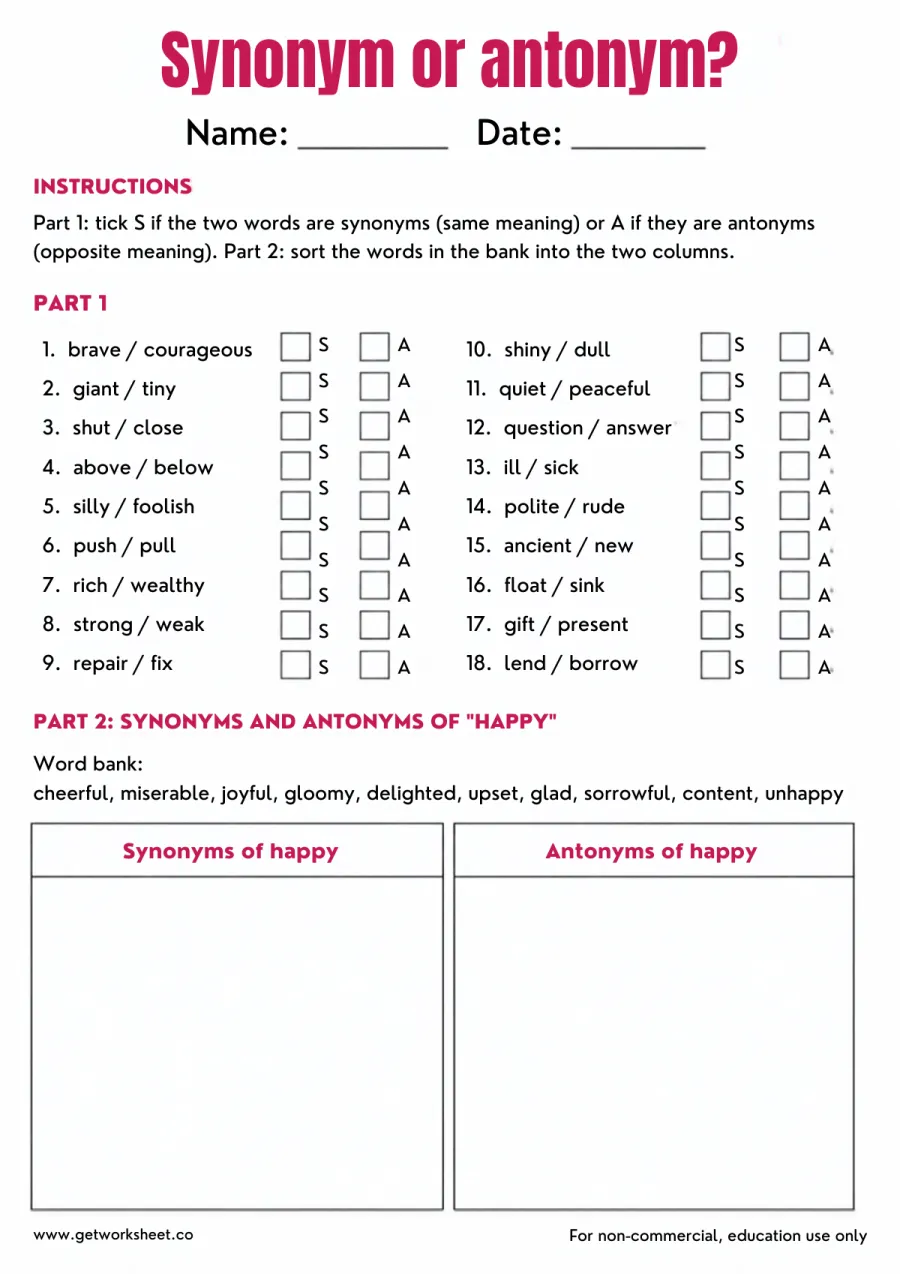
Synonym or antonym? Sort 18 word pairs
Eighteen word pairs to label S (synonyms) or A (antonyms), then a sort of ten words into synonyms and antonyms of "happy". Answer key on page 2.
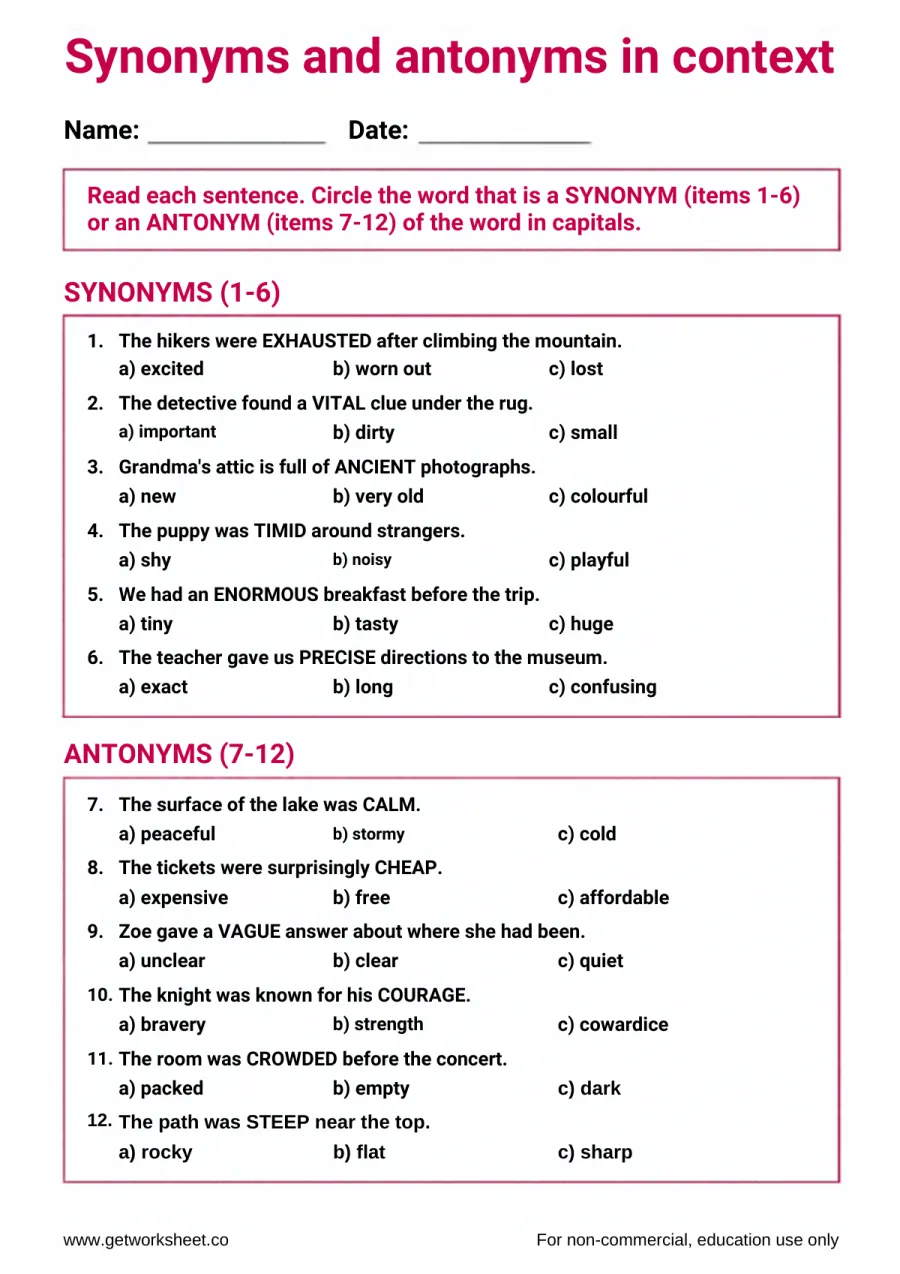
Synonyms and antonyms in context (multiple choice, grades 4-5)
Twelve sentences; students choose the synonym or antonym of the word in capitals that fits the sentence. Answer key on page 2.
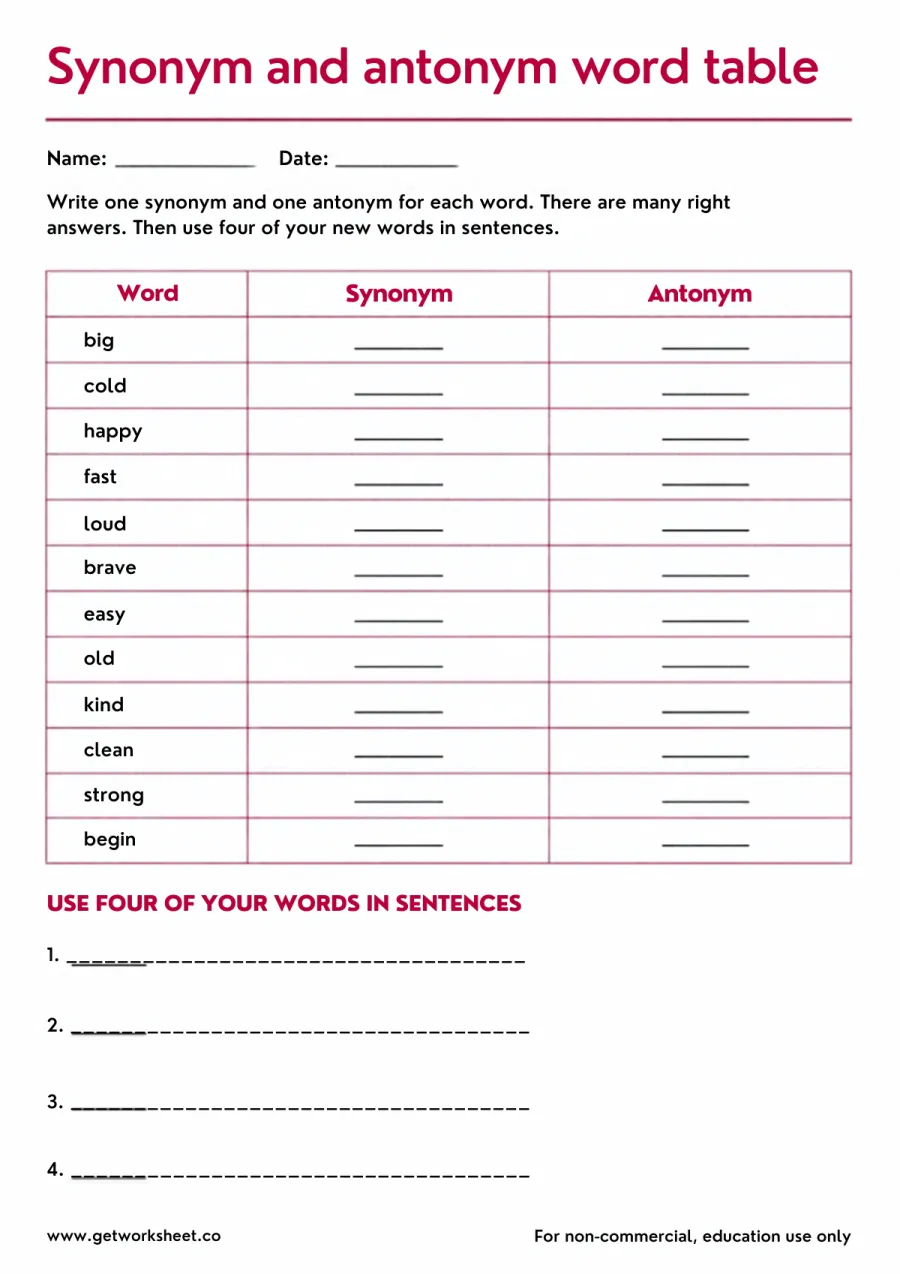
Synonym and antonym word table plus sentence writing
A table of twelve words to complete with one synonym and one antonym each, then four sentences using the new words. Sample answers on page 2.
AI worksheet generator
Make a worksheet like this for your class
The 5 sheets above are fixed. The generator writes a new synonyms and antonyms worksheet for your grade, with the question types and count you choose, in about 20 seconds. Pick a grade to start:
What you get
- A fresh set of questions on synonyms and antonyms, not a copy of the sheets above
- Multiple choice, fill in the blanks, true or false, open ended
- Answer key and print-ready PDF with Pro
Free account, 1 worksheets a week. No card.
Synonyms are words with nearly the same meaning (happy, glad, cheerful); antonyms are opposites (happy, sad). Knowing both gives children choices when they write, and it is the fastest way to grow a reading vocabulary because every new word arrives attached to one they already know. These five worksheets move from matching to sorting to using words in context, and end with an open table that shows what a child can produce without a word bank.
What's in this set
- Synonym match. Twelve words to match with their synonyms (big/large, happy/glad, quick/fast ...), then six sentences in which "good", "big", "said" and "nice" are swapped for a better word from a bank.
- Antonym match. Twelve words to match with their opposites (hot/cold, full/empty, ancient/modern ...), then six short sentences to rewrite with the opposite meaning.
- Synonym or antonym? Eighteen word pairs (brave/courageous, giant/tiny, ...) to label S or A, then ten words to sort into synonyms and antonyms of "happy".
- Synonyms and antonyms in context. Twelve multiple-choice sentences: six ask for a synonym of the word in capitals and six for an antonym, with the context deciding which option fits. Grades 4-5.
- Synonym and antonym word table. A twelve-row table (big, cold, happy, fast, loud, brave, ...) to complete with a synonym and an antonym for each word without a word bank, then four sentences using words from the table.
What students will practice
- Matching common words to synonyms and antonyms (Common Core L.2.5, L.4.5.c)
- Replacing overused words (good, big, said, nice) with more precise ones in their own writing
- Deciding whether two words are similar or opposite in meaning, including near-synonyms such as quiet/peaceful
- Using sentence context to choose the synonym or antonym that fits
- Producing synonyms and antonyms from memory, the step that shows vocabulary has become active
Free printable makers
Make your own synonyms and antonyms sheets
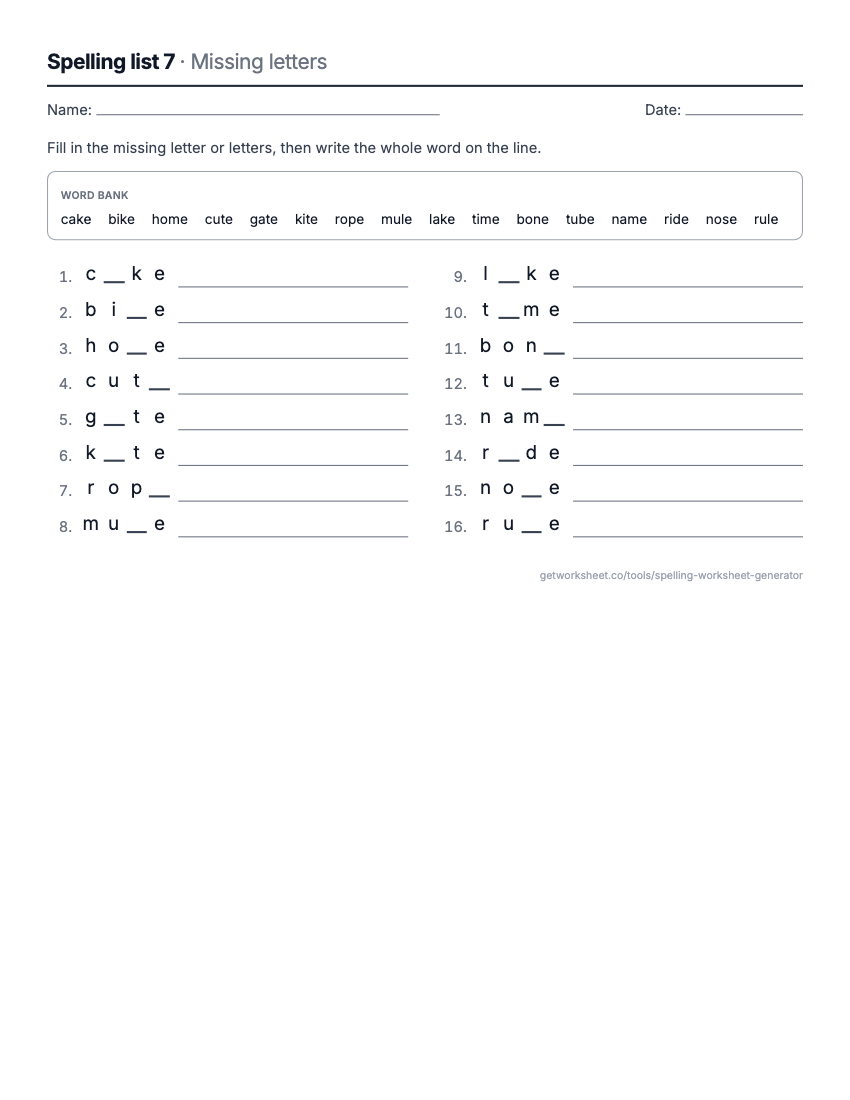
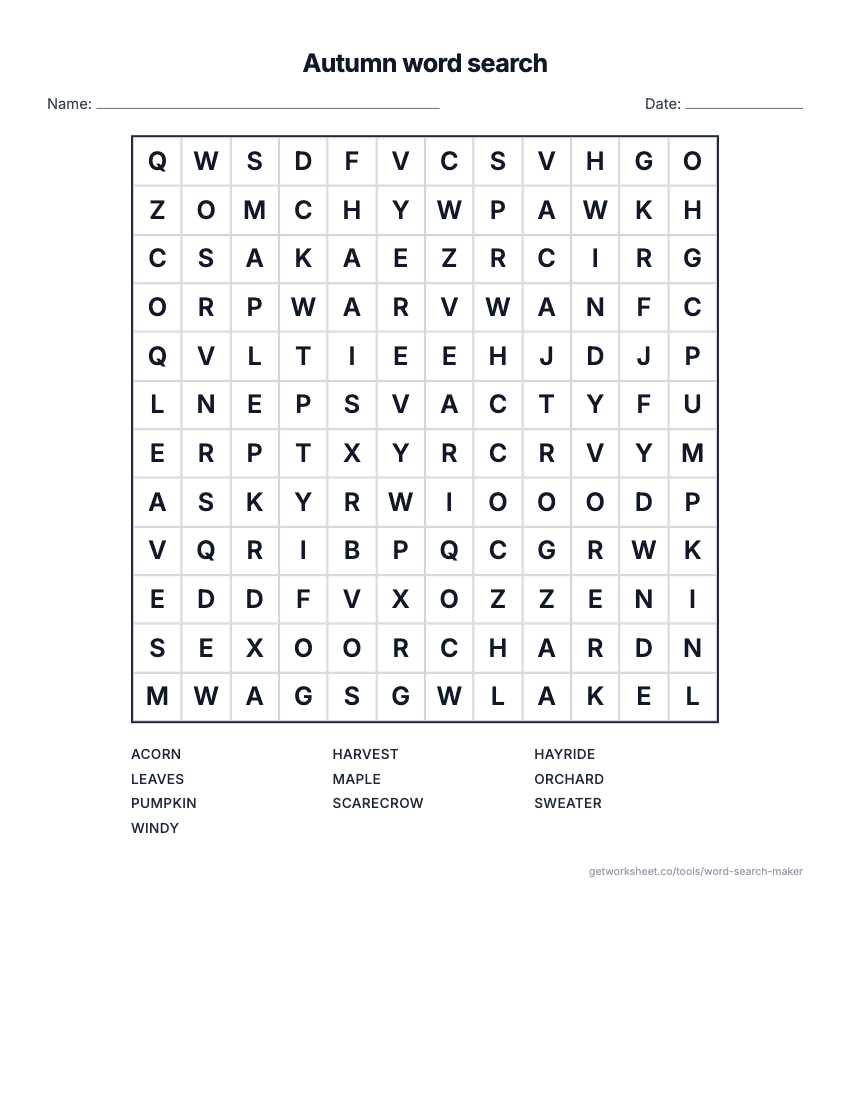
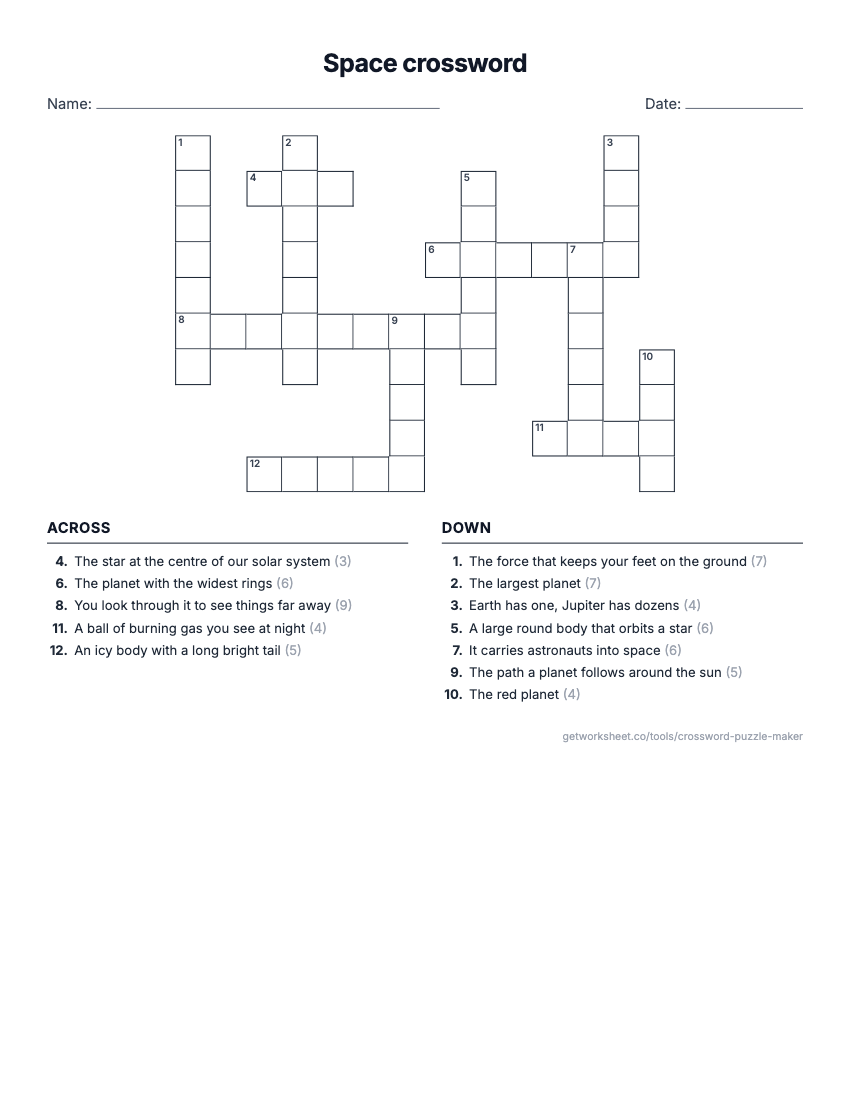
Type your own words or numbers and print in about 30 seconds. No account, no AI, answer key where it applies.
AI worksheet generator
Need a different synonyms and antonyms worksheet?
Generate a custom synonyms and antonyms worksheet: pick the grade, question types and count, and print it in about 20 seconds. Free accounts get 1 generation a week.
How to use these worksheets in class
- Grade 2 to 3: matching. Synonym match and Antonym match are the introductions. Do the first three pairs together, then let children finish alone. Part 2 of each sheet moves straight into writing so the words are used, not just connected.
- The overused-word swap. Part 2 of the synonym sheet retires "good", "big", "said" and "nice". Keep the word bank on the wall afterwards as a "words we don’t use any more" chart and add to it through the year.
- Sorting. Synonym or antonym? has eighteen pairs and takes about ten minutes. Pair 11 (quiet/peaceful) is a near-synonym rather than an exact one, which is worth saying out loud: synonyms are almost the same, rarely identical.
- Grade 4 to 5: context. The multiple-choice sheet uses harder words (vital, timid, precise, vague). Have students cover the options and guess the meaning from the sentence first; the options then confirm or correct the guess.
- Assessment. The word table has no bank. A child who fills eight or more rows with sensible words has an active vocabulary for these adjectives; the rows left blank tell you which words to teach next.
Answer key
Every practice sheet carries its own answer key on page 2 of the PDF. The keys are repeated here for quick marking.
- Synonym match: Part 1: match the synonyms: big = huge; happy = glad; quick = fast; little = tiny; shout = yell; begin = start; angry = furious; smart = clever; afraid = scared; tired = sleepy; pretty = beautiful; finish = complete 1. delicious 2. enormous 3. whispered 4. friendly 5. exciting (accept brilliant) 6. brilliant (accept exciting)
- Antonym match: Part 1: match the antonyms: hot = cold; full = empty; early = late; ancient = modern; generous = selfish; smooth = rough; brave = cowardly; noisy = silent; heavy = light; arrive = depart; wide = narrow; cheap = expensive Part 2: say the opposite: 1. The water in the pool was cold (cool). 2. My backpack is full. 3. The knight was very cowardly. 4. We departed from (left) the station at noon. 5. This is the most expensive bike in the shop. 6. The road through the mountains is narrow.
- Synonym or antonym?: Part 1: 1. S 2. A 3. S 4. A 5. S 6. A 7. S 8. A 9. S 10. A 11. S 12. A 13. S 14. A 15. A 16. A 17. S 18. A Part 2: synonyms and antonyms of "happy": Synonyms of happy: cheerful, joyful, delighted, glad, content Antonyms of happy: miserable, gloomy, upset, sorrowful, unhappy
- Synonyms and antonyms in context: Synonyms (1-6): 1. b) worn out 2. a) important 3. b) very old 4. a) shy 5. c) huge 6. a) exact Antonyms (7-12): 1. b) stormy 2. a) expensive 3. b) clear 4. c) cowardice 5. b) empty 6. b) flat
- Synonym and antonym word table: big | large, huge, enormous | small, little, tiny cold | chilly, cool, freezing | hot, warm happy | glad, cheerful, joyful | sad, unhappy, miserable fast | quick, rapid, speedy | slow loud | noisy, deafening | quiet, silent, soft brave | courageous, bold, fearless | cowardly, timid easy | simple, effortless | hard, difficult old | ancient, aged, elderly | new, young, modern kind | caring, gentle, generous | cruel, unkind, mean clean | spotless, tidy | dirty, filthy, messy strong | powerful, sturdy, tough | weak, feeble begin | start, commence | end, finish, stop Use four of your words in sentences: Any four sentences that use a synonym or antonym from the table correctly.
Common mistakes to watch for
- Giving a related word instead of a synonym. "Dog" is not a synonym of "puppy", and "night" is not an antonym of "dark". Synonyms and antonyms must be the same part of speech and on the same scale.
- Using "not" to make an antonym. "Not happy" is not an antonym; "sad" is. Accept "unhappy" because it is a real word, but push for a different word.
- Treating every synonym as interchangeable. "The pizza was brilliant" is odd; "delicious" fits. The context sheet exists for exactly this.
- Confusing the two terms. A simple hook: synonym starts with S like same; antonym starts with A like against.
Frequently asked questions
What grade are these synonyms and antonyms worksheets for?
Synonym match, Antonym match and Synonym or antonym? suit grades 2 and 3. Synonyms and antonyms in context and the word table suit grades 4 and 5. The set covers Common Core L.2.5, L.3.5 and L.4.5.c.
Do the worksheets include answer keys?
Yes, on page 2 of each PDF and in the "Answer key" section above. The word table lists several acceptable answers per row; accept any sensible word of the same part of speech.
What is the difference between a synonym and an antonym?
A synonym has nearly the same meaning as another word (big, large). An antonym has the opposite meaning (big, small). The third worksheet practices telling them apart.
Are synonyms exactly the same in meaning?
Rarely. "Big" and "enormous" are both synonyms of "large", but enormous is stronger. Older students should be encouraged to notice these shades of meaning, which is what the context sheet is for.
How can I extend the worksheets?
Ask students to write a short paragraph and then swap five words for synonyms, or to rewrite a paragraph so it means the opposite by replacing words with antonyms.
Related vocabulary worksheets
The context clues worksheets practice working out an unknown word from the sentence around it, which is the skill behind the fourth sheet. For grammar alongside vocabulary, see the sentence fragments worksheets and subject and predicate worksheets.
Free library
Related collections
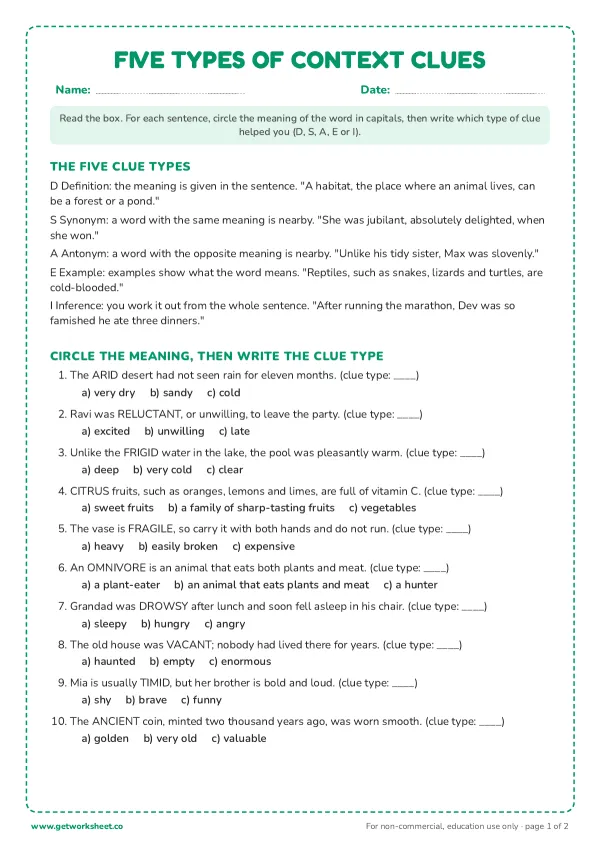
Free context clues worksheets
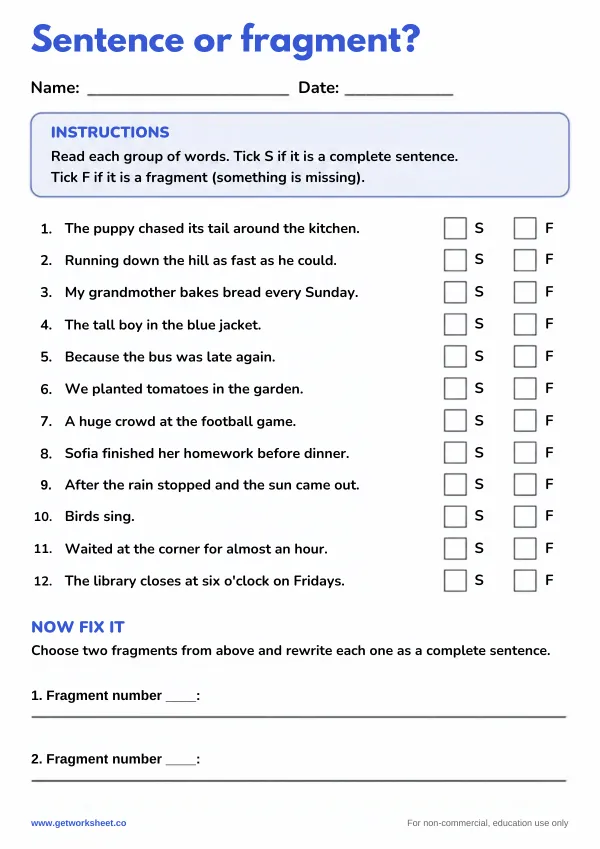
Free sentence fragments worksheets
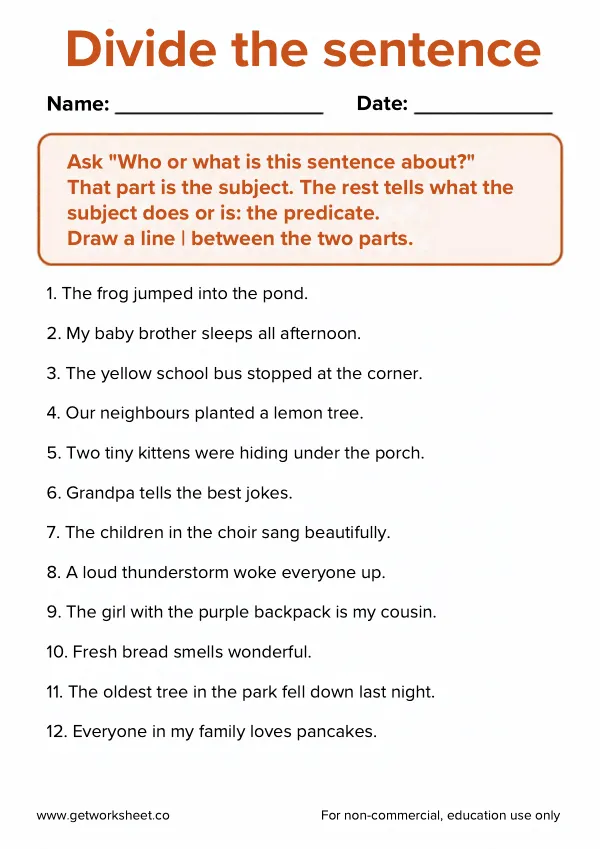
Free subject and predicate worksheets
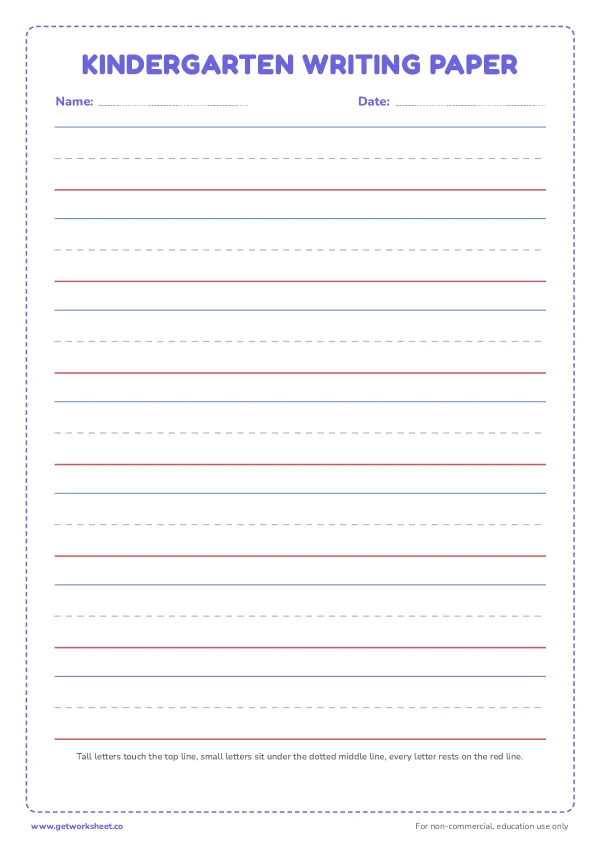
Free handwriting paper printables
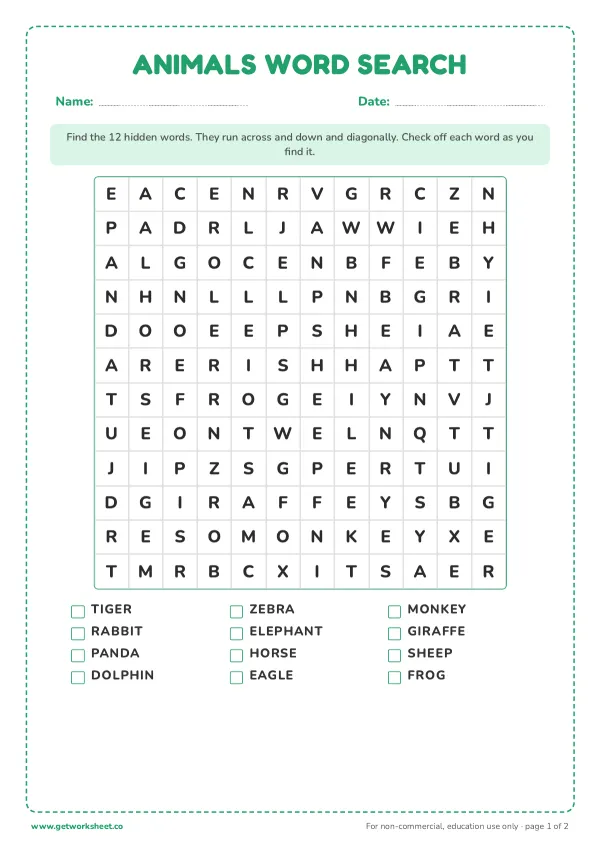
Free word search printables
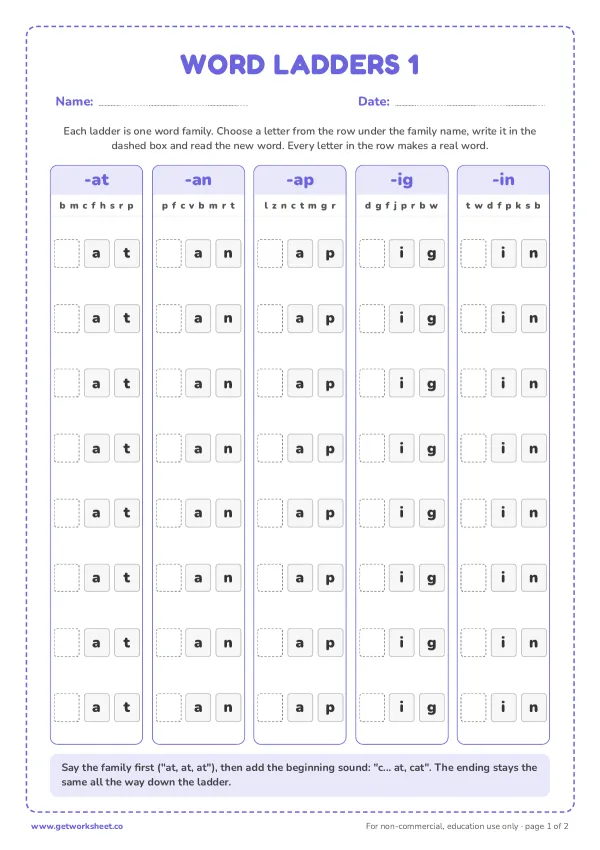
Free word families worksheets
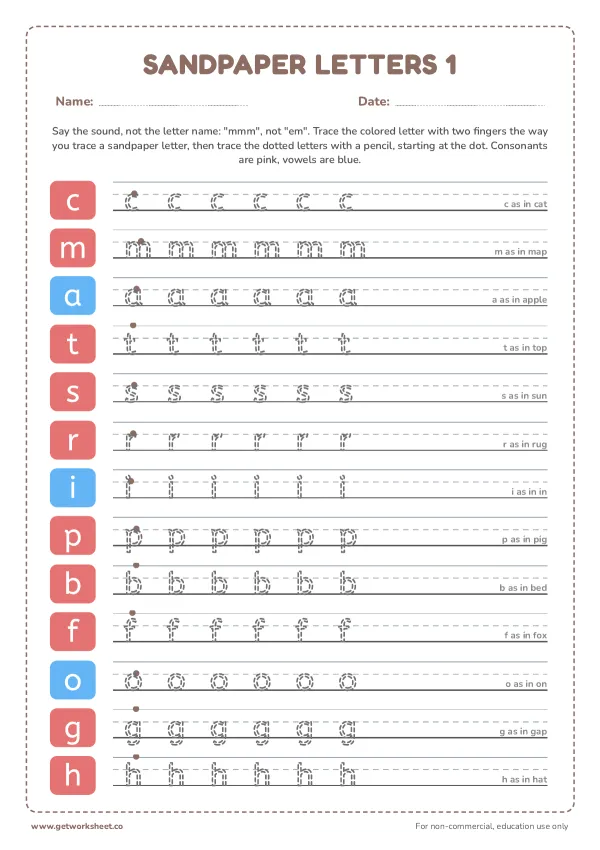
Free Montessori language worksheets
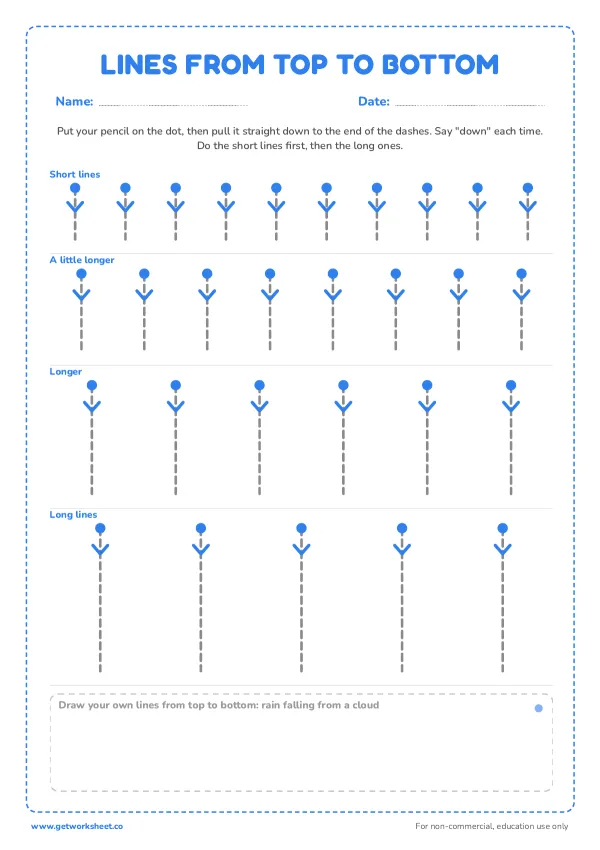
Free pre-writing worksheets
More worksheets
- Free sight words worksheets (Dolch and Fry)
- Free CVC words worksheets
- Free name tracing worksheets
- Free letter Z tracing worksheets
- Free letter Y tracing worksheets
- Free letter X tracing worksheets
- Free letter W tracing worksheets
- Free letter V tracing worksheets
- Free letter U tracing worksheets
- Free letter T tracing worksheets
- Free letter S tracing worksheets
- Free letter R tracing worksheets