English · Grades 2–5
Free story elements worksheets
Five printable story elements worksheets for grades 2 to 5: the five elements matched and found in a short story, a blank story map for any book, a characters-and-setting sheet with a character table and more. Answer keys included.
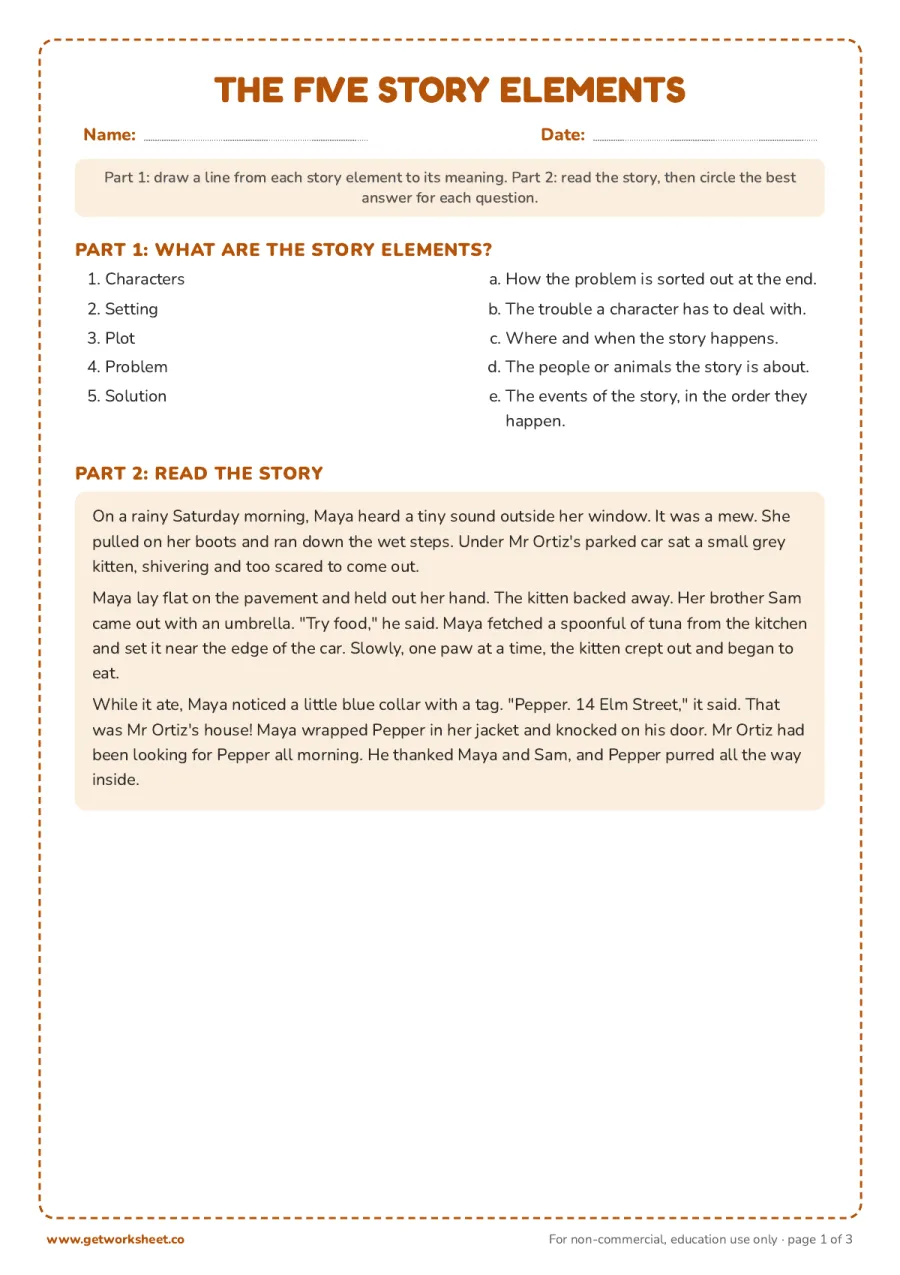
The five story elements: match the definitions, then find them in a story
Match characters, setting, plot, problem and solution to their definitions, read a 150-word story about a lost kitten, and answer five questions that identify each element in it. Answer key on page 2.
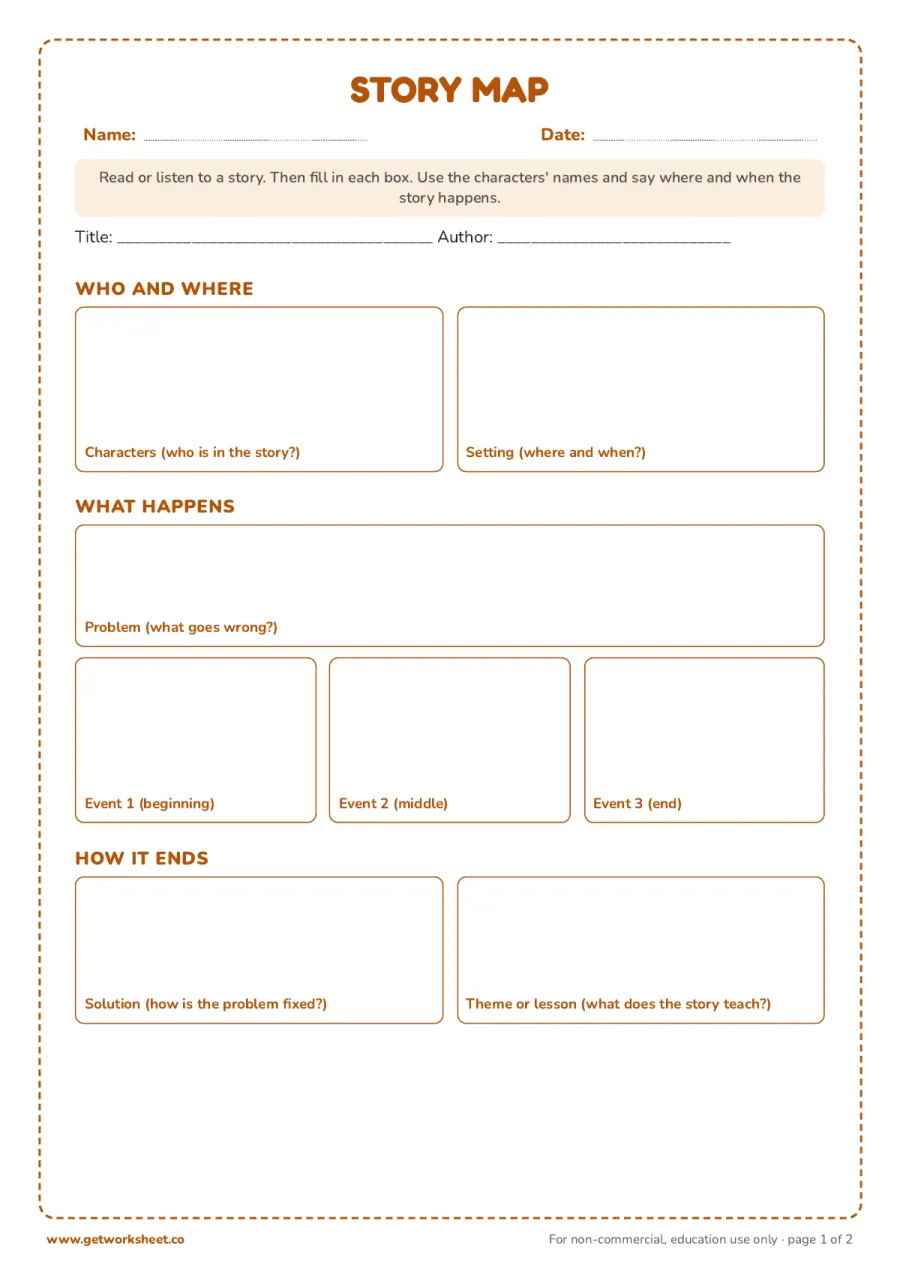
Story map: a graphic organiser for any book or story
A one-page story map to fill in after reading any story: title and author, characters, setting, problem, three main events, solution and the lesson or theme. Works with picture books, chapter books and class read-alouds.
Whole set
All 5 sheets in one PDF
Instant and ad-free. No account needed.
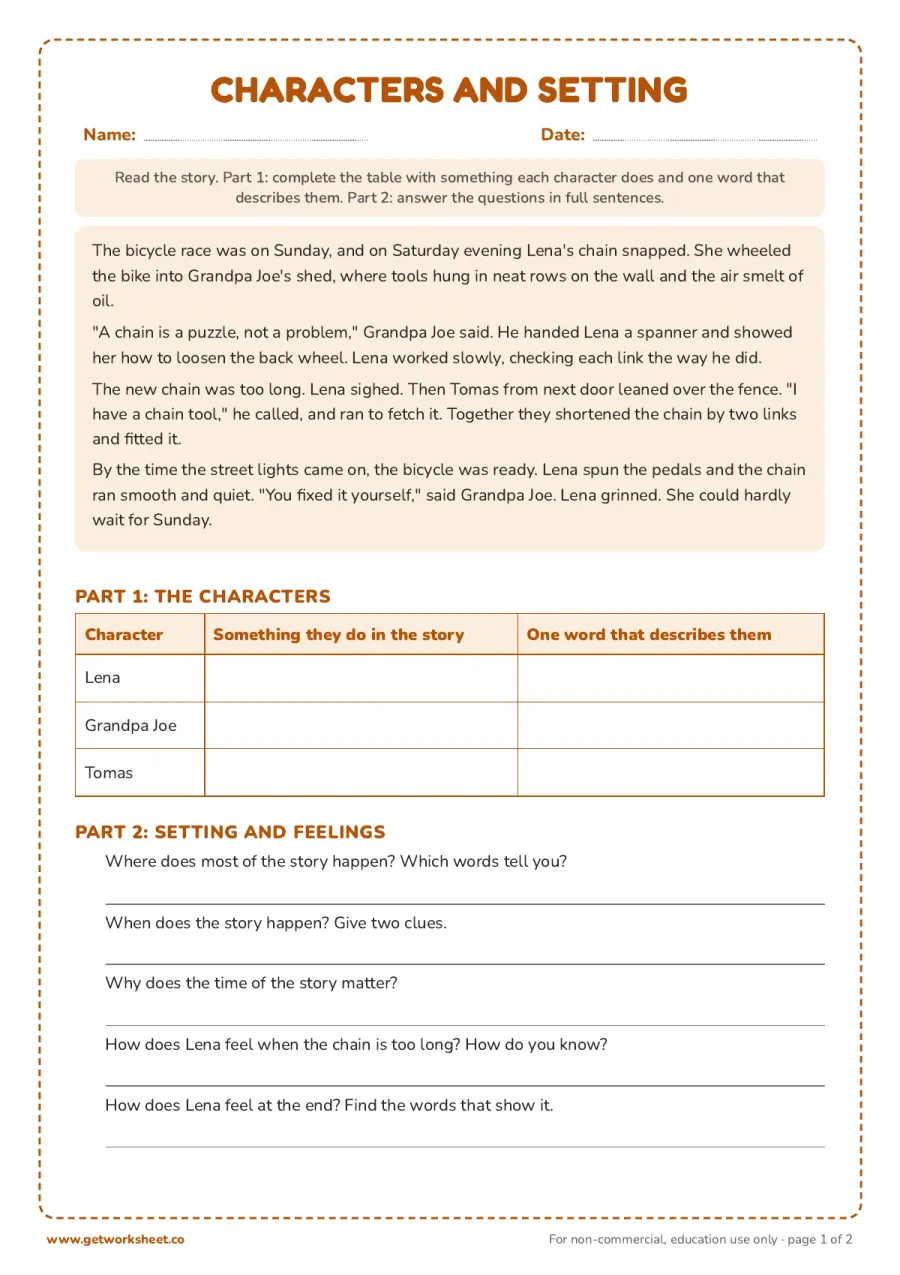
Characters and setting: describe 3 characters with evidence from the text
A short story about a girl who repairs a bicycle with her grandfather, a character table (what each character does and a word that describes them), and five questions on setting and feelings. Answer key on page 2.
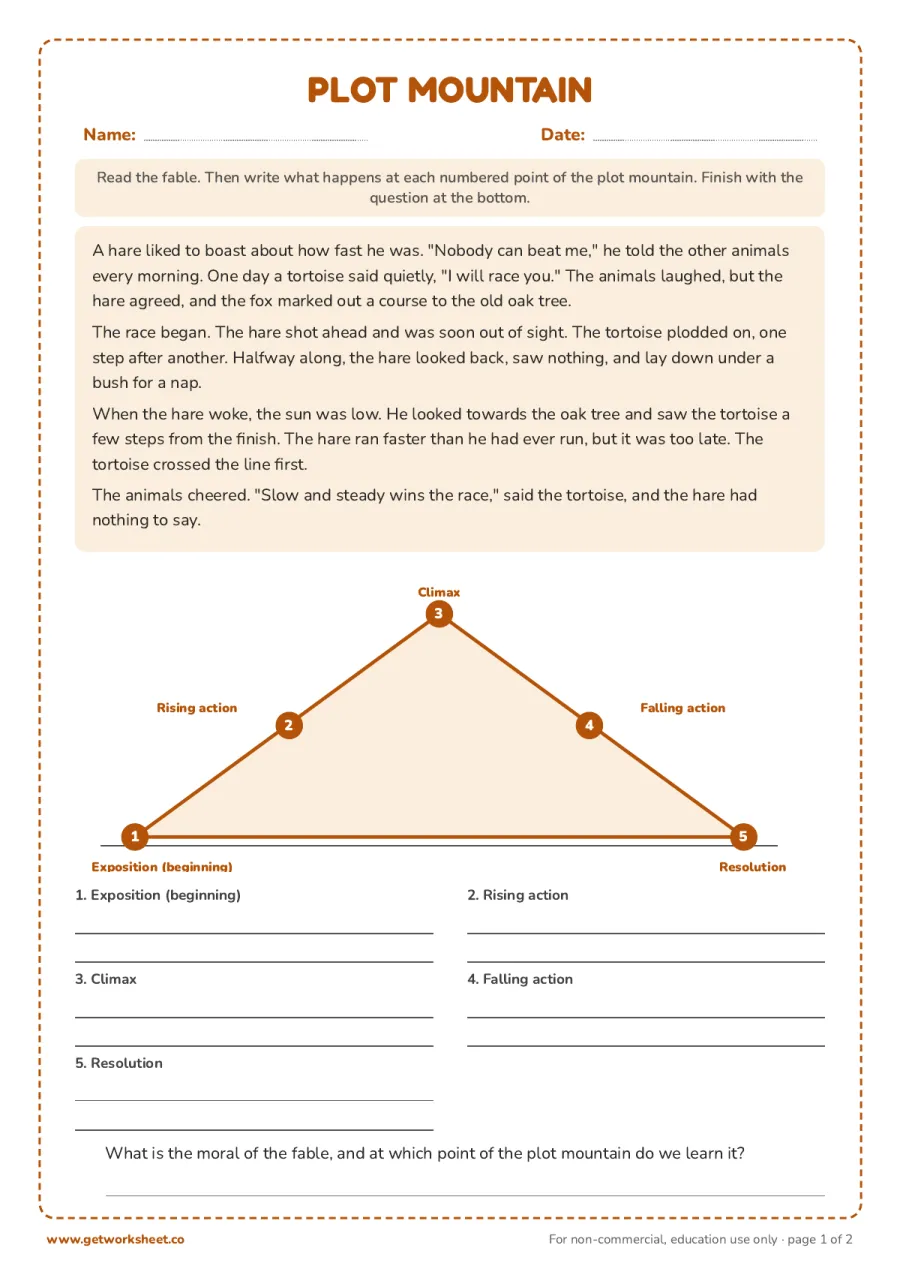
Plot mountain: map the plot of The Tortoise and the Hare
A retelling of The Tortoise and the Hare and a plot mountain diagram with five numbered parts (exposition, rising action, climax, falling action, resolution) to fill in, plus a question on the moral. Answer key on page 2.
Problem, solution and theme: 6 mini stories to analyse
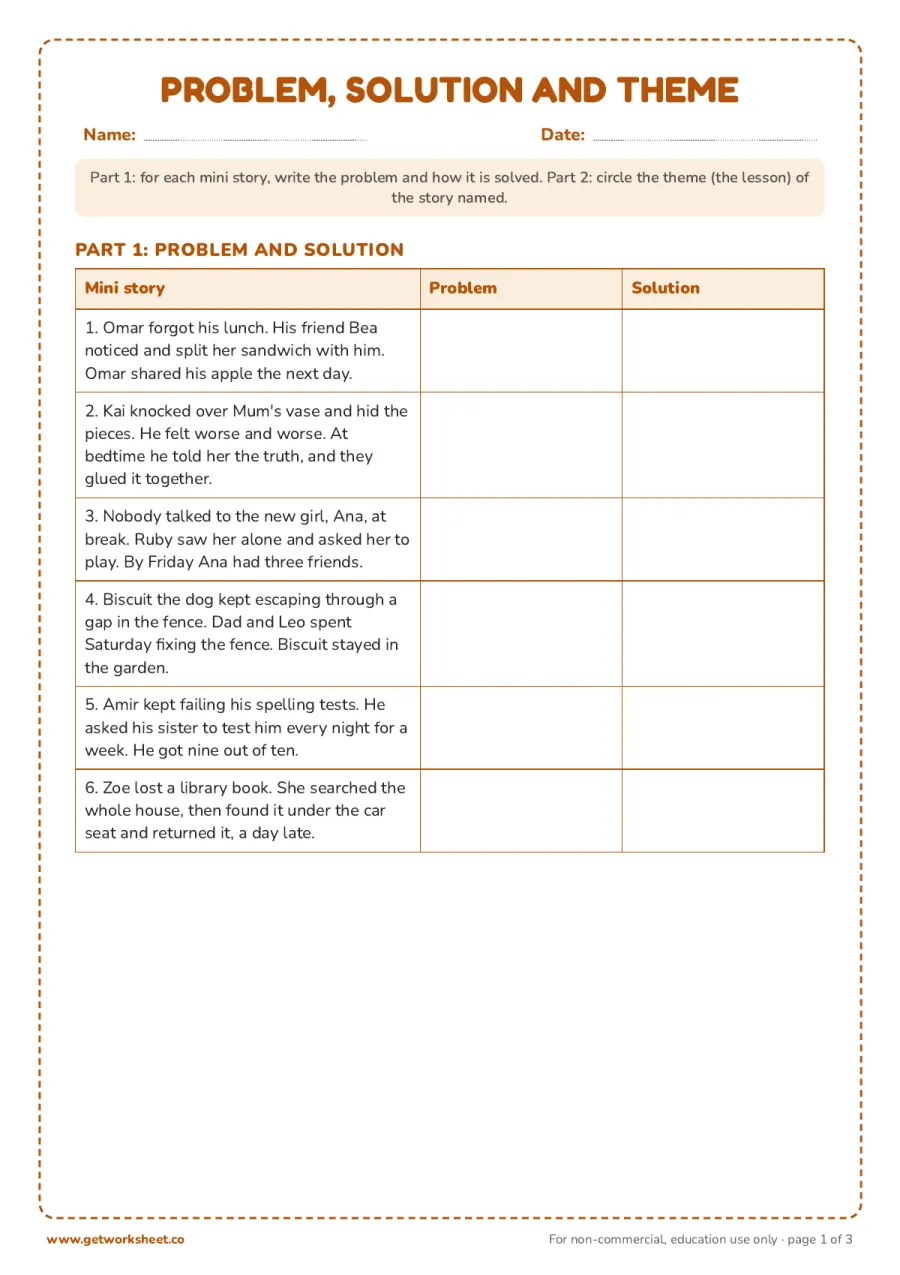
Six three-sentence stories: write the problem and the solution for each, then choose the theme of four of them from a list. Answer key on page 2.
AI worksheet generator
Make a worksheet like this for your class
The 5 sheets above are fixed. The generator writes a new story elements worksheet for your grade, with the question types and count you choose, in about 20 seconds. Pick a grade to start:
What you get
- A fresh set of questions on story elements, not a copy of the sheets above
- Multiple choice, fill in the blanks, true or false, open ended
- Answer key and print-ready PDF with Pro
Free account, 1 worksheets a week. No card.
Characters, setting, plot, problem and solution are the first tools children get for talking about what they read. Once they can name them, retelling becomes organized, predictions get sharper, and their own writing gains a shape. These five worksheets move from naming the elements in a short story, through a reusable story map, to the plot mountain and the harder idea of theme. All the passages are short originals or a classic fable, so no book is needed.
What's in this set
- The five story elements. A five-pair matching exercise for the elements, a short original story (Maya and the gray kitten) and five multiple-choice questions that ask for the main character, the setting, the problem, the solution and the order of events.
- Story map. A blank graphic organizer with boxes for title and author, characters, setting (where and when), the problem, events 1 to 3, the solution and the theme or lesson. No answer key; use it with any book.
- Characters and setting. An original story (Lena, Grandpa Joe and neighbor Tomas fix a bicycle before a race), a three-row character table asking for an action and a trait for each character, and five questions on where, when, how the setting matters and how a character feels.
- Plot mountain. A 150-word retelling of the fable, a plot mountain with two writing lines for each of the five parts, and a final question on the moral and where it appears in the plot.
- Problem, solution and theme. Six mini stories (a forgotten lunch, a broken vase, a shy new student, a dog that keeps escaping, a spelling test, a lost library book) with a problem/solution table, then four multiple-choice theme questions.
What students will practice
- Defining the five story elements and identifying them in a text (CCSS RL.2.5, RL.3.3)
- Describing characters by what they do and choosing a trait word backed by evidence (RL.3.3, RL.4.3)
- Describing setting as both place and time, and explaining why it matters
- Mapping a plot on a plot mountain: exposition, rising action, climax, falling action, resolution (RL.5.5)
- Stating a problem and its solution in one sentence each
- Choosing the theme or lesson of a story and telling it apart from a detail (RL.2.2, RL.3.2, RL.4.2)
Free printable makers
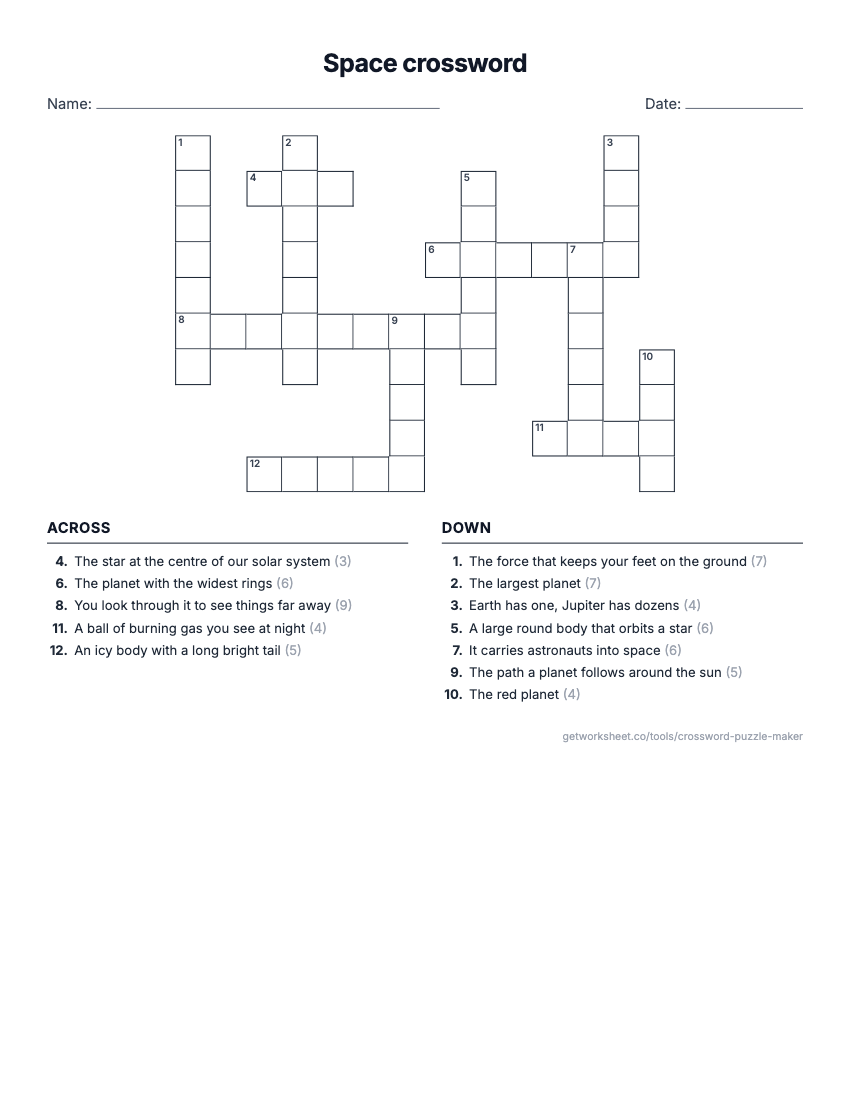
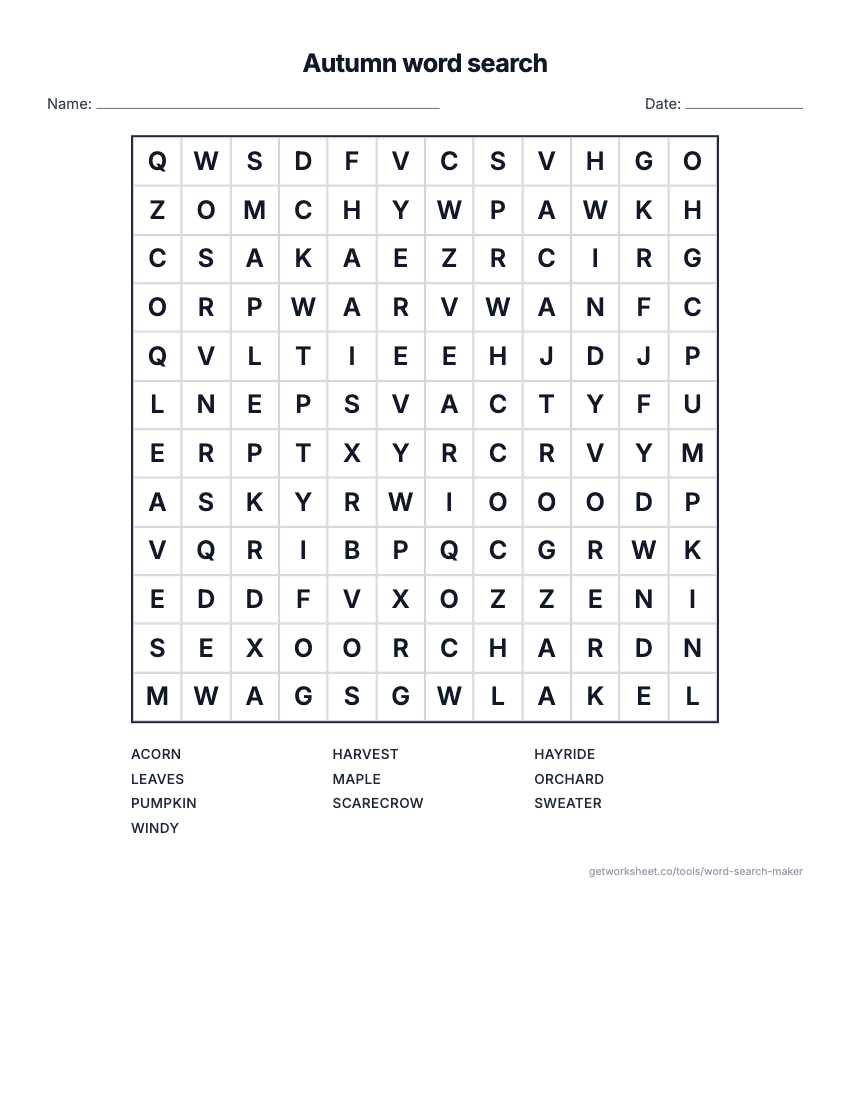
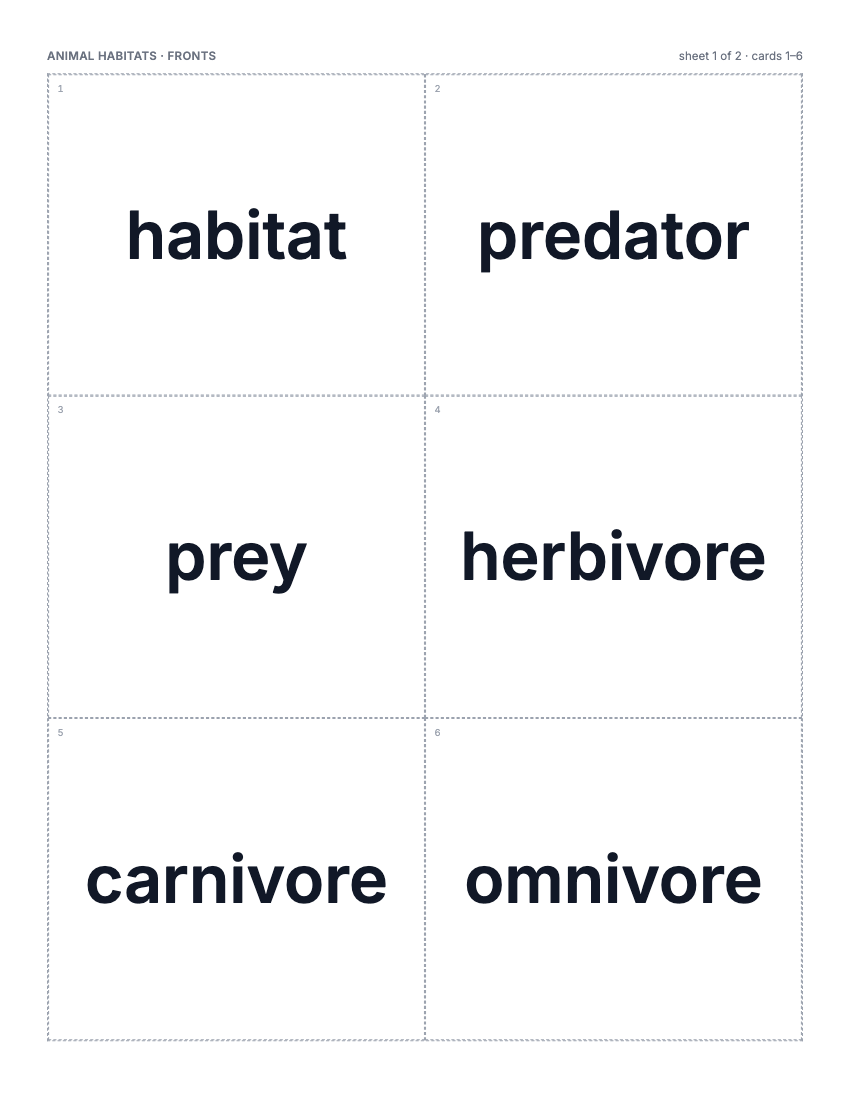
Make your own story elements sheets
Type your own words or numbers and print in about 30 seconds. No account, no AI, answer key where it applies.
AI worksheet generator
Need a different story elements worksheet?
Generate a custom story elements worksheet: pick the grade, question types and count, and print it in about 20 seconds. Free accounts get 1 generation a week.
How to use these worksheets in class
- Introduce with the kitten story. The five story elements is the starter: match the definitions as a class, read the story aloud, then let students answer the five questions alone. It takes about 20 minutes.
- Story map for every read-aloud. Print Story map in bulk. After any class novel chapter or picture book, students fill it in; the same map used weekly builds the habit faster than any single lesson.
- Trait words need evidence. In Characters and setting, insist that the "one word" column is backed by an action from the "something they do" column. "Kind" is only acceptable if the student can point to Tomas fetching his tool.
- Act out the plot mountain. Before Plot mountain, have five students stand in a row as the five parts and retell the fable one part each. Then the diagram writes itself.
- Theme versus detail. The wrong options in Problem, solution and theme are details or facts ("Vases break easily"). Ask students to say why each wrong option is not a lesson.
- Grades 2 to 5. Grade 2 and 3 use the first three sheets; grades 4 and 5 add the plot mountain and theme sheets.
Answer key
Every practice sheet carries its own answer key on page 2 of the PDF. The keys are repeated here for quick marking.
- The five story elements: Part 1: what are the story elements?: Characters = The people or animals the story is about.; Setting = Where and when the story happens.; Plot = The events of the story, in the order they happen.; Problem = The trouble a character has to deal with.; Solution = How the problem is sorted out at the end. Questions about the story: 1. b) Maya 2. b) Maya's street on a rainy Saturday morning 3. c) A scared kitten is stuck under a car. 4. c) Maya tempts the kitten out with tuna, reads its tag and takes it home. 5. b) Maya hears a mew outside her window.
- Story map: How it ends: Open-ended: the map works with any story. Check that the setting gives both a place and a time, and that the solution answers the problem written above it.
- Characters and setting: Part 1: the characters: Lena | loosens the wheel, checks each link, fits the chain | careful / determined Grandpa Joe | hands her the spanner and shows her how | patient / calm Tomas | fetches his chain tool and helps shorten the chain | helpful / kind Part 2: setting and feelings: 1. In Grandpa Joe's shed: "tools hung in neat rows on the wall and the air smelt of oil". 2. Saturday evening, the day before the race; the street lights come on at the end. 3. The race is the next day, so the chain has to be fixed that evening. 4. Disappointed or frustrated: she sighs. 5. Proud and excited: she grins and can hardly wait for Sunday.
- Plot mountain: 1. The hare boasts about his speed; the tortoise challenges him and the fox sets the course. 2. The race starts; the hare races ahead, the tortoise plods on, and the hare stops for a nap. 3. The hare wakes to see the tortoise a few steps from the finish and sprints. 4. It is too late; the tortoise crosses the line first. 5. The animals cheer; the tortoise says "Slow and steady wins the race." 1. Slow and steady wins the race (keep going and do not be careless); it is stated in the resolution.
- Problem, solution and theme: Part 1: problem and solution: 1 | Omar has no lunch | Bea shares her sandwich (and Omar shares his apple) 2 | Kai broke the vase and hid it | He tells the truth and they repair it together 3 | Ana is new and alone | Ruby asks her to play and she makes friends 4 | Biscuit keeps escaping | Dad and Leo fix the fence 5 | Amir fails spelling tests | He practices every night with his sister 6 | Zoe has lost a library book | She searches, finds it and returns it Part 2: what is the theme?: 1. b) Telling the truth feels better than hiding a mistake. 2. c) A small act of kindness can change someone's week. 3. a) Practice and asking for help lead to improvement. 4. b) Friends look out for each other and return kindness.
Common mistakes to watch for
- Setting = place only. Ask for the time as well (Saturday evening, a rainy morning). The table on the characters sheet has a column for both.
- Retelling the whole story as the "problem". A problem is one sentence: what goes wrong. The mini stories are three sentences long precisely so the problem is easy to isolate.
- Naming the climax too early. The climax is the moment of highest tension (the hare sees the tortoise near the finish), not the start of the race.
- Theme as a topic word. "Friendship" is a topic; "friends look out for each other" is a theme. Ask for a full sentence.
Frequently asked questions
What grade are these story elements worksheets for?
Grades 2 to 5. The five elements and the story map suit grades 2 and 3; the plot mountain and theme sheets are grade 4 and 5 skills (CCSS RL.4.2, RL.5.5).
Do the worksheets include answer keys?
Yes. Every sheet except the blank story map has its key on page 2 of the PDF, and the keys are repeated on this page. Written answers show a model; accept any answer that uses evidence from the text.
Which stories are used?
Two short original stories (a lost kitten; fixing a bicycle before a race), six three-sentence mini stories, and a retelling of Aesop's The Tortoise and the Hare. Nothing on the sheets requires a book, though the story map is meant to be used with one.
What is the difference between plot and problem?
The plot is the whole chain of events; the problem is the trouble that drives it. On the plot mountain, the problem usually appears at the end of the exposition and the solution in the resolution.
Related English worksheets
The 3rd grade reading comprehension worksheets ask the same questions about longer passages, and the context clues worksheets cover the vocabulary side of reading. For writing, the persuasive writing worksheets and sentence fragments worksheets follow on.
Free library
Related collections
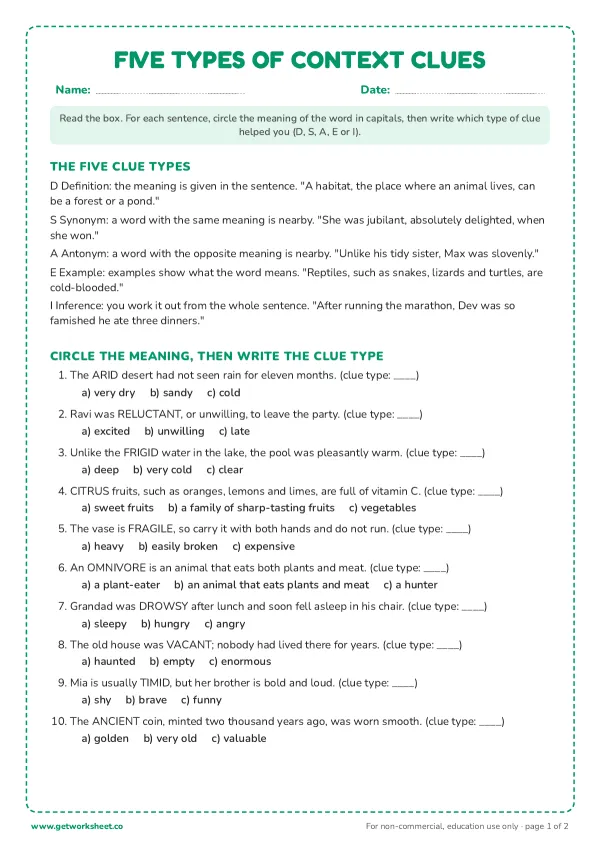
Free context clues worksheets
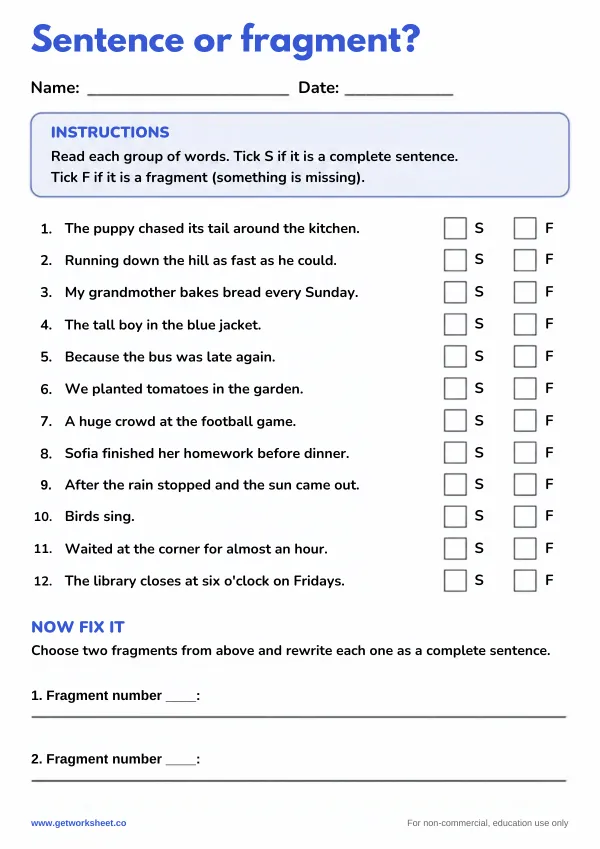
Free sentence fragments worksheets
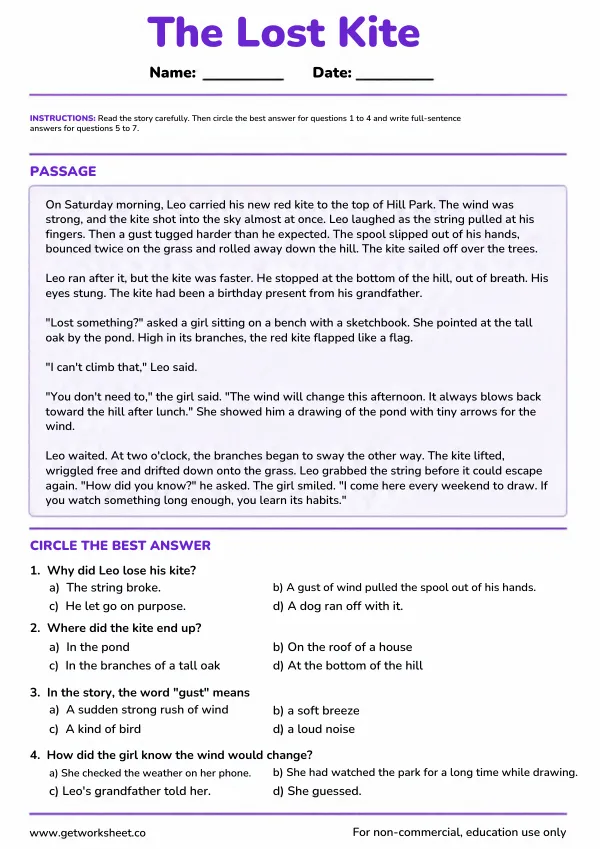
Free third grade reading comprehension worksheets
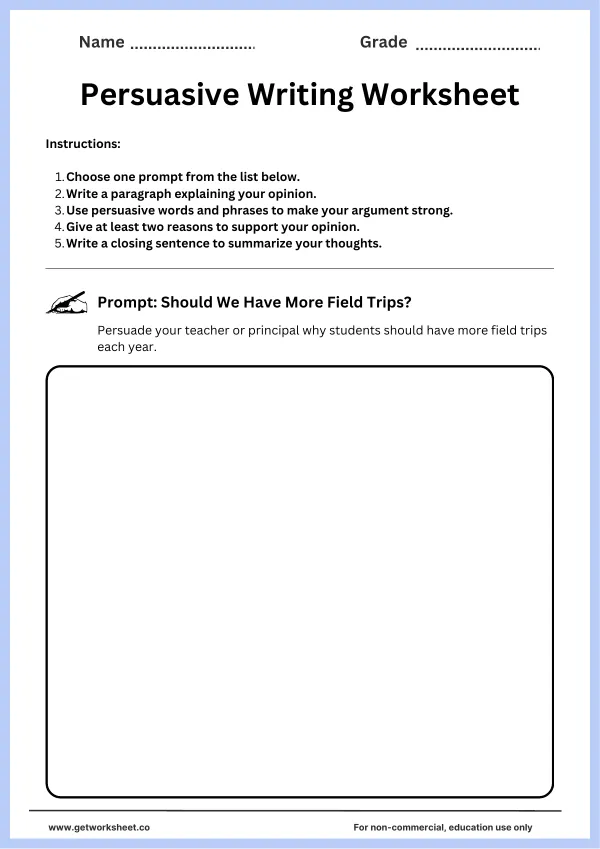
Free persuasive writing worksheets
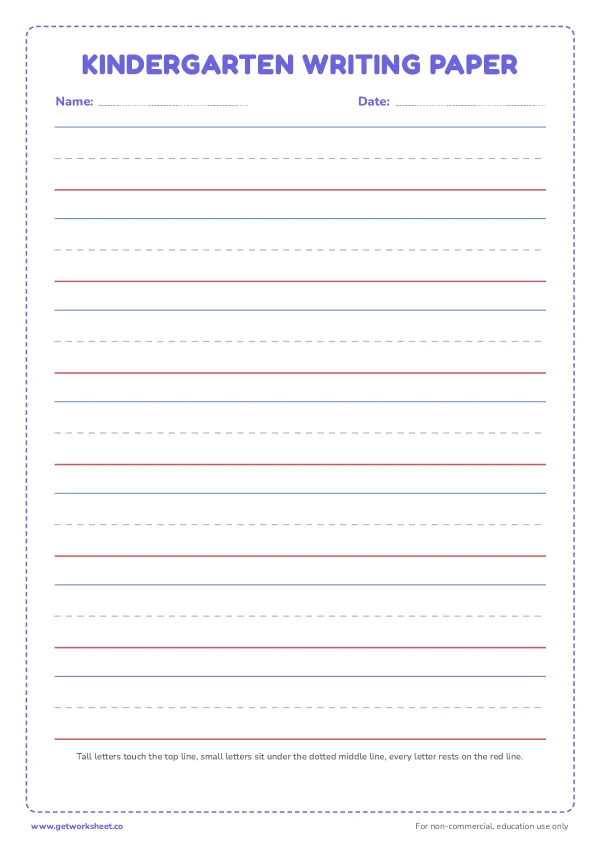
Free handwriting paper printables
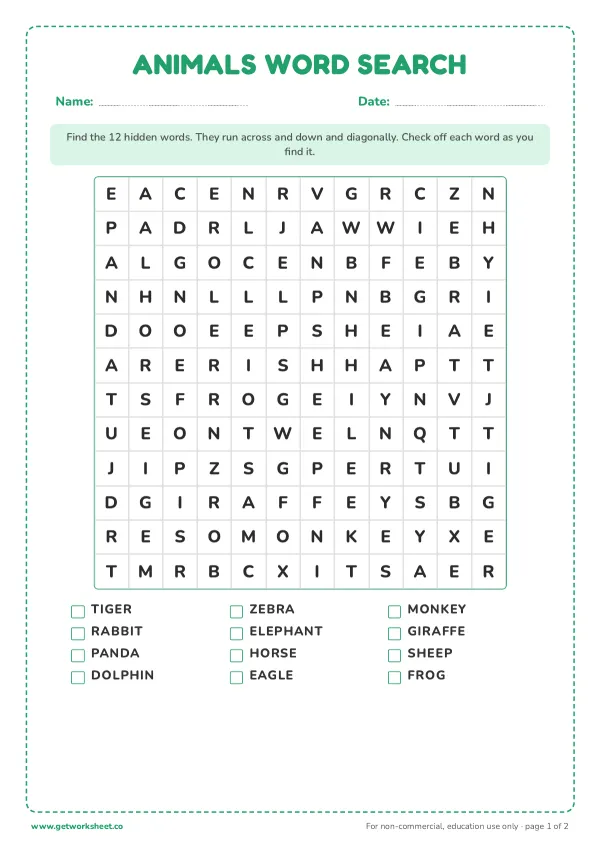
Free word search printables
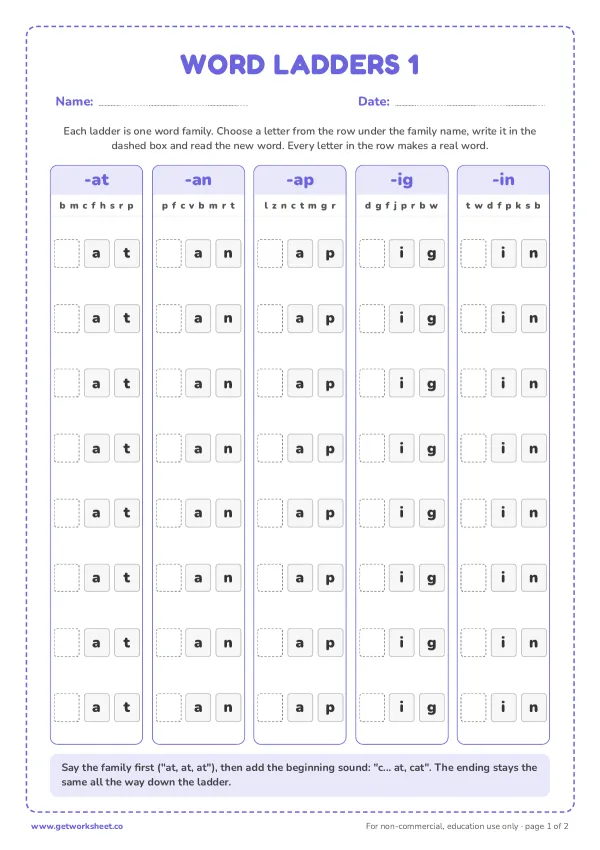
Free word families worksheets
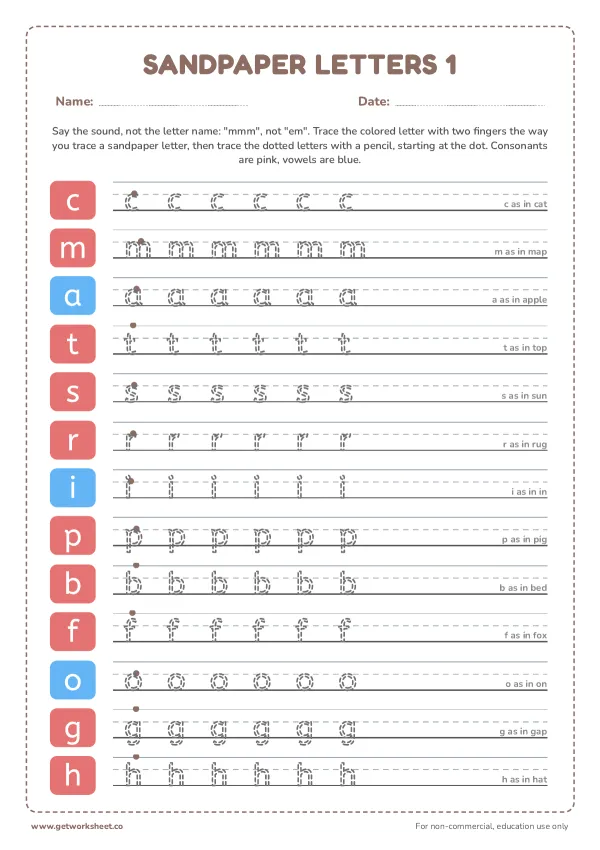
Free Montessori language worksheets
More worksheets
- Free pre-writing worksheets
- Free sight words worksheets (Dolch and Fry)
- Free CVC words worksheets
- Free name tracing worksheets
- Free letter Z tracing worksheets
- Free letter Y tracing worksheets
- Free letter X tracing worksheets
- Free letter W tracing worksheets
- Free letter V tracing worksheets
- Free letter U tracing worksheets
- Free letter T tracing worksheets
- Free letter S tracing worksheets