Free persuasive writing worksheets
Free printable persuasive writing worksheets with examples. Practice opinion writing, arguments, and supporting evidence. PDF for grades 3-6.
Persuasive writing asks students to take a position on a topic and convince the reader to agree with them using reasons and evidence. At this level, kids move from stating opinions ("I like dogs") to building structured arguments ("Dogs make the best family pets because they are loyal, they encourage exercise, and they reduce stress — here is why"). It is a critical thinking skill wrapped in a writing exercise.
What Students Will Practice
- Writing a clear opinion statement that takes a specific side (e.g., "Schools should have longer recess" not "Recess is good")
- Supporting opinions with at least 3 reasons backed by evidence or examples
- Using persuasive language and transition words ("furthermore," "for this reason," "the evidence shows")
- Addressing a counterargument — acknowledging the other side and explaining why their position is still stronger
- Organizing writing with an introduction, body paragraphs, and a strong conclusion
Persuasive writing is a core English Language Arts standard starting in 3rd grade and develops skills used in essays, debates, and real-world communication throughout school and beyond.
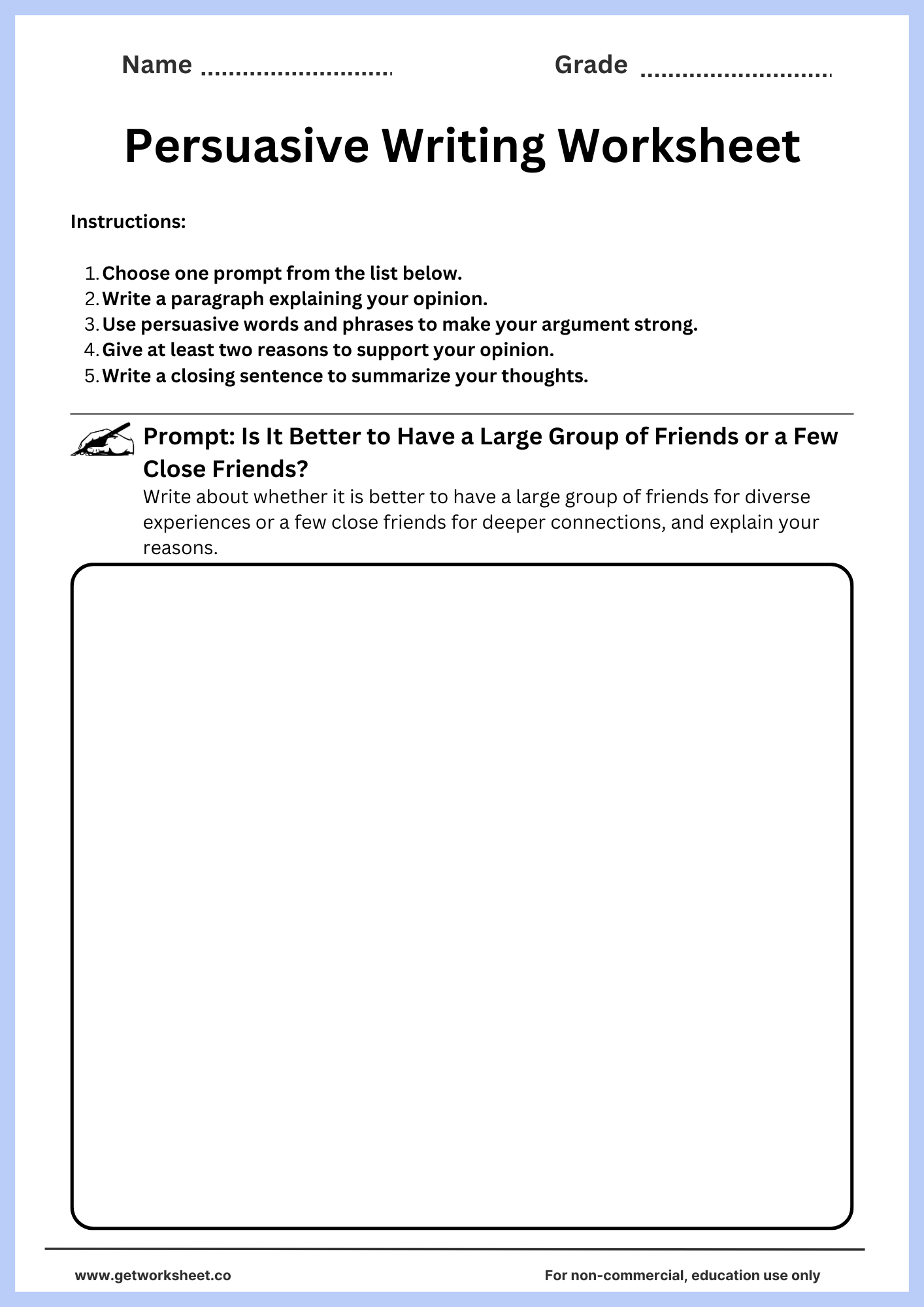
Persuasive writing worksheet 5
Persuasive writing worksheet 5
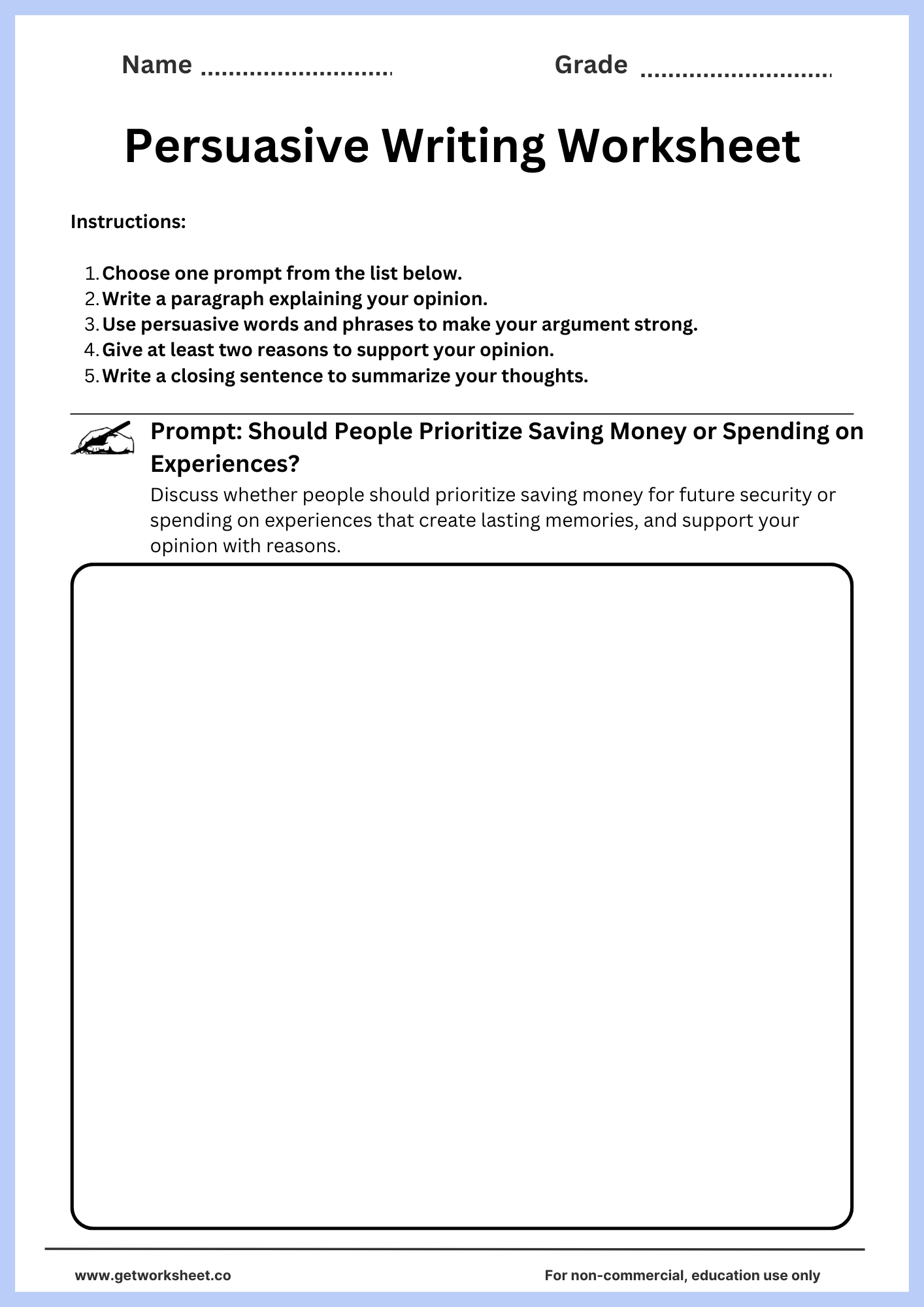
Persuasive writing worksheet 4
Persuasive writing worksheet 4
Persuasive writing worksheet 3
Persuasive writing worksheet 3
Persuasive writing worksheet 2
Persuasive writing worksheet 2
Persuasive writing worksheet 1
Persuasive writing worksheet 1
How to Use These Worksheets
Strategies for building persuasive writing skills.
- Start with topics your child actually cares about — "Should kids get a later bedtime on weekends?" or "Should our family get a pet?" Real stakes make persuasive writing feel purposeful rather than pointless. Kids write more convincingly when they genuinely want to persuade someone.
- Use the "because, because, because" method for brainstorming. Have your child state their opinion and then say "because" three times, filling in a different reason each time. This generates their three body paragraph topics quickly.
- Before writing, ask your child to think about what someone who disagrees would say. Writing a one-sentence counterargument and then explaining why it is wrong strengthens their essay dramatically and teaches fair-minded thinking.
Common Mistakes to Watch For
- Stating the opinion but never explaining why. "Pizza is the best food" is an opinion, not a persuasive argument. Each reason needs a "because" followed by specific evidence: "Pizza is versatile because you can top it with vegetables, meats, or just cheese to suit any preference."
- Repeating the same reason in different words across multiple paragraphs. Kids sometimes write "dogs are fun," "dogs are enjoyable," and "dogs bring happiness" as three separate reasons — but it is really one reason restated. Push for genuinely different supporting points.
- Using only personal experience as evidence. "I like it" is not persuasive to someone who does not know you. Encourage facts, statistics, and examples that would convince a stranger: "Studies show that students who have recess perform better on afternoon tests."
- Ending with a weak conclusion that just repeats the introduction. Instead of restating the opinion word for word, teach kids to end with a call to action: "Next time you see your principal, ask about adding 10 minutes to recess — you might be surprised by the answer."
Frequently Asked Questions
What is the difference between persuasive writing and opinion writing?
They overlap significantly. Opinion writing (grades K-2) focuses on stating and supporting a preference. Persuasive writing (grades 3-6) adds the expectation of structured arguments, evidence, counterarguments, and rhetorical techniques. Think of persuasive writing as opinion writing that has grown up.
How long should a persuasive essay be at this level?
For 3rd-4th grade, 3-4 paragraphs (introduction, 2 body paragraphs, conclusion) totaling about 150-250 words. For 5th-6th grade, 5 paragraphs (introduction, 3 body paragraphs, conclusion) totaling 300-500 words. Quality of reasoning matters more than length.
My child has strong opinions but struggles to write them down. How can I help?
Have them talk through their argument first while you jot down their key points. Many kids can argue verbally but freeze when writing. Seeing their own spoken ideas as bullet points gives them a writing outline to follow. Gradually, they will internalize this planning step.
Should I let my child choose their own persuasive topics?
Yes, whenever possible. Kids write more passionately about topics they care about. If the teacher assigns a topic, help your child find a personal connection to it. Even "Should schools require uniforms?" becomes engaging if they think about how it would affect their morning routine.
After persuasive writing, students progress to argumentative essays in middle school, which require even stronger evidence, formal tone, and thorough examination of opposing viewpoints.