English · Kindergarten–Grade 2
Free cl blend worksheets
Five printable cl blend worksheets for kindergarten to grade 2: trace and write eight cl words on handwriting guides, sort sixteen words by whether they start with cl and more. Answer keys included.
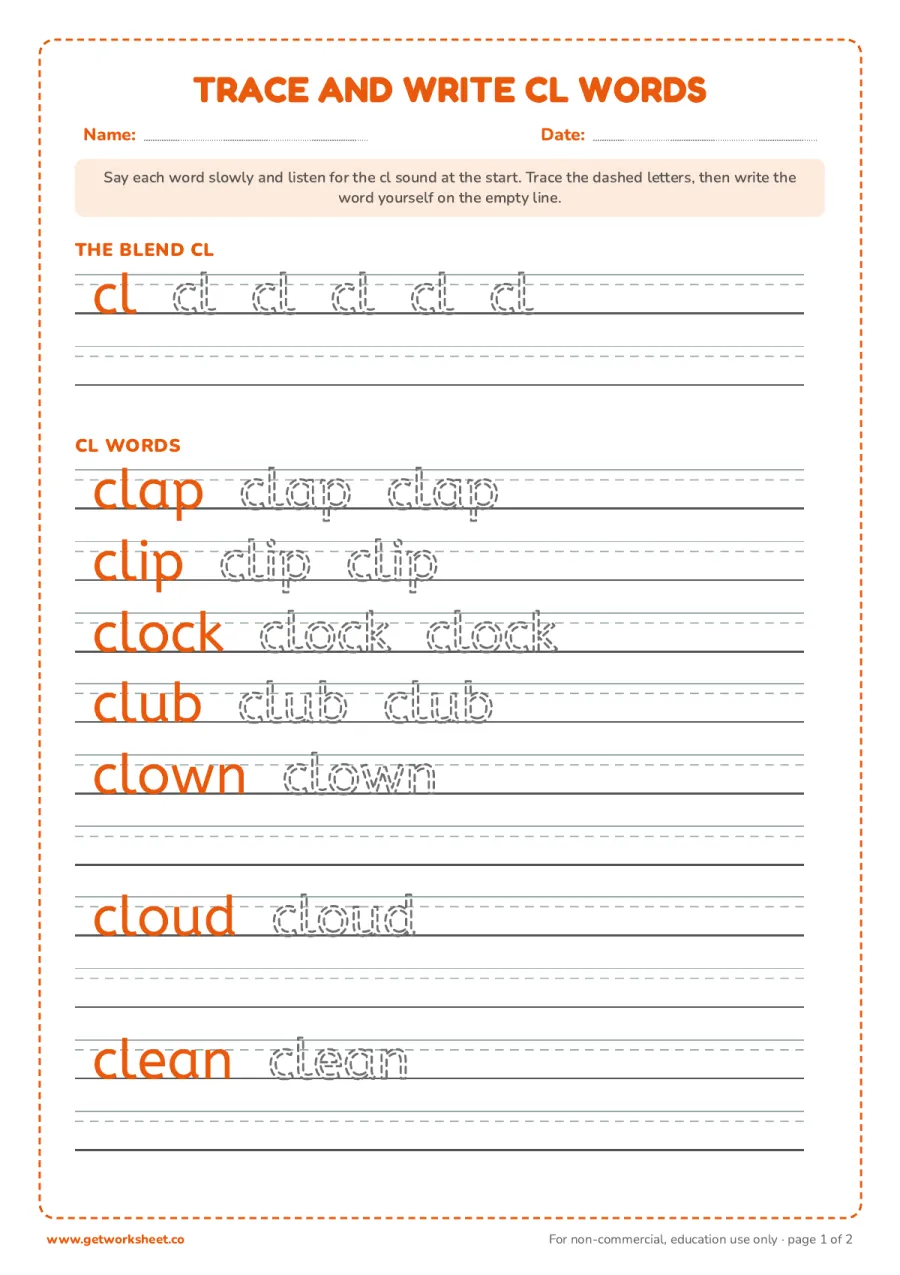
Trace and write cl words: cl, clap, clip, clock, club, clown, cloud, clean
Handwriting rows for the cl blend: trace the letters cl, then trace and copy eight cl words (clap, clip, clock, club, clown, cloud, clean, class) on three-line guides. No answer key needed.
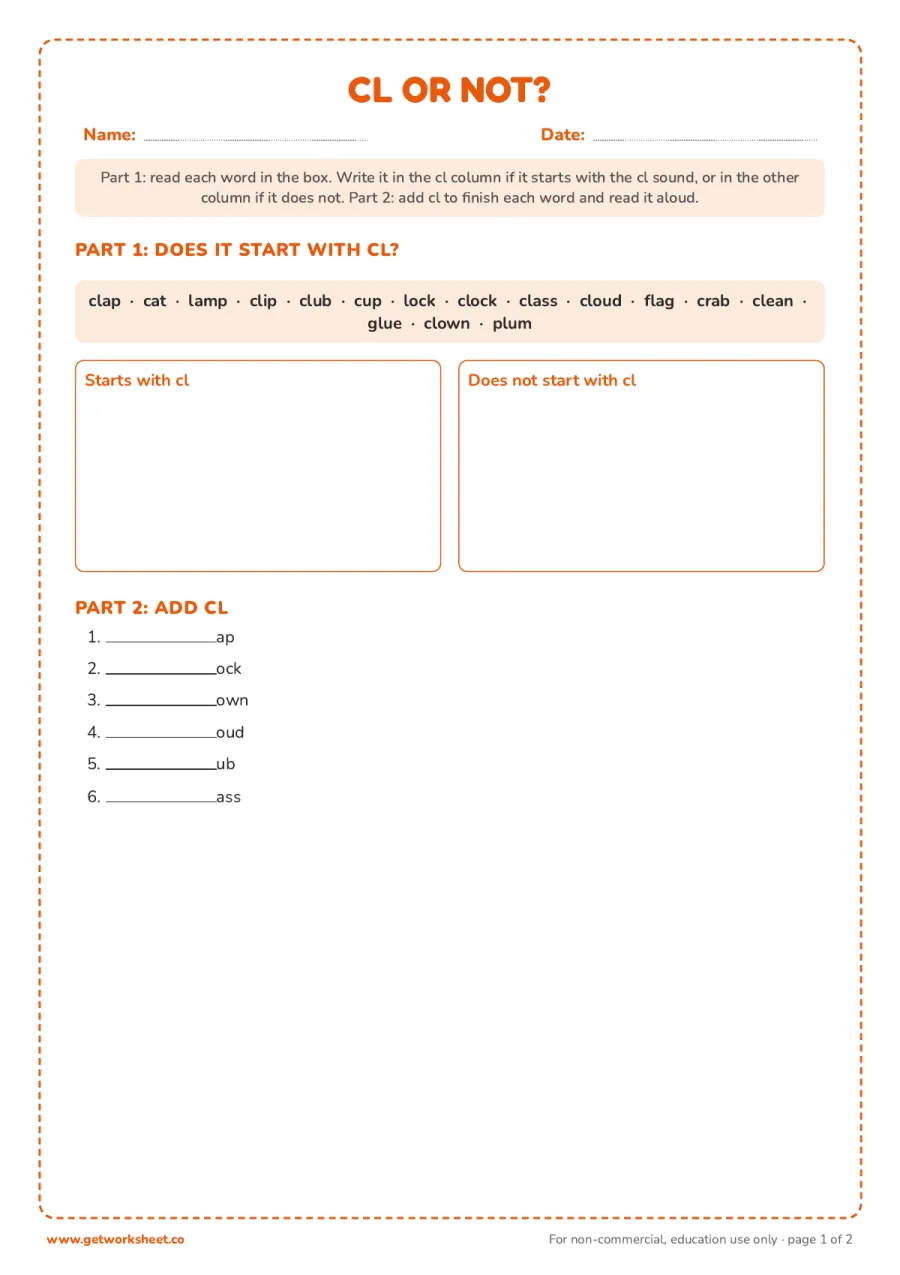
cl or not? Sort 16 words, then add cl to finish 6 words
Sixteen words to sort into "starts with cl" and "does not" (clap, cat, lamp, clip, club, cup ...), then six words with the cl missing to complete. Answer key on page 2.
Whole set
All 5 sheets in one PDF
Instant and ad-free. No account needed.
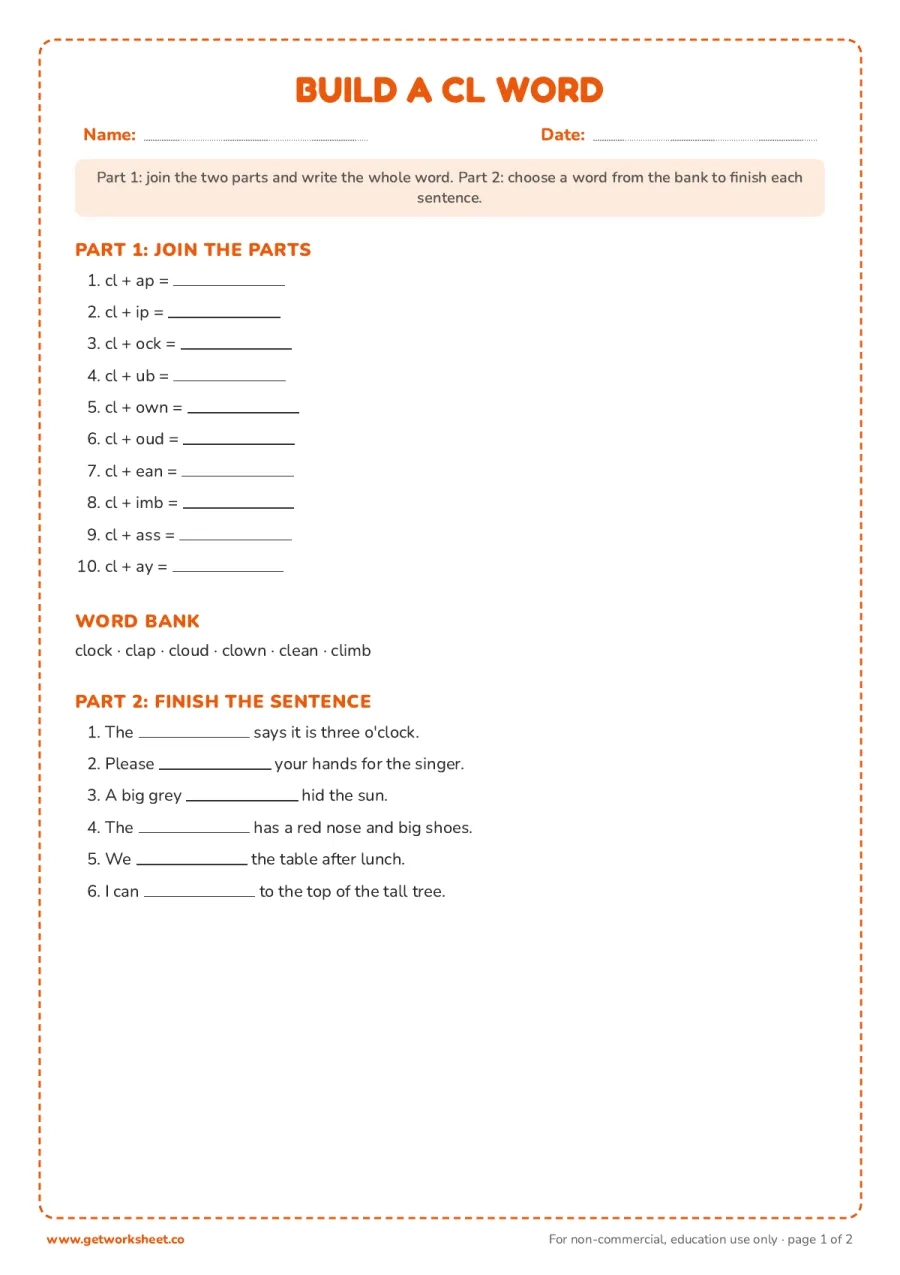
Build a cl word: 10 blends to join, then 6 sentences to complete
Join cl to ten word endings (cl + ap = clap), then choose the right cl word from the bank to complete six sentences. Answer key on page 2.
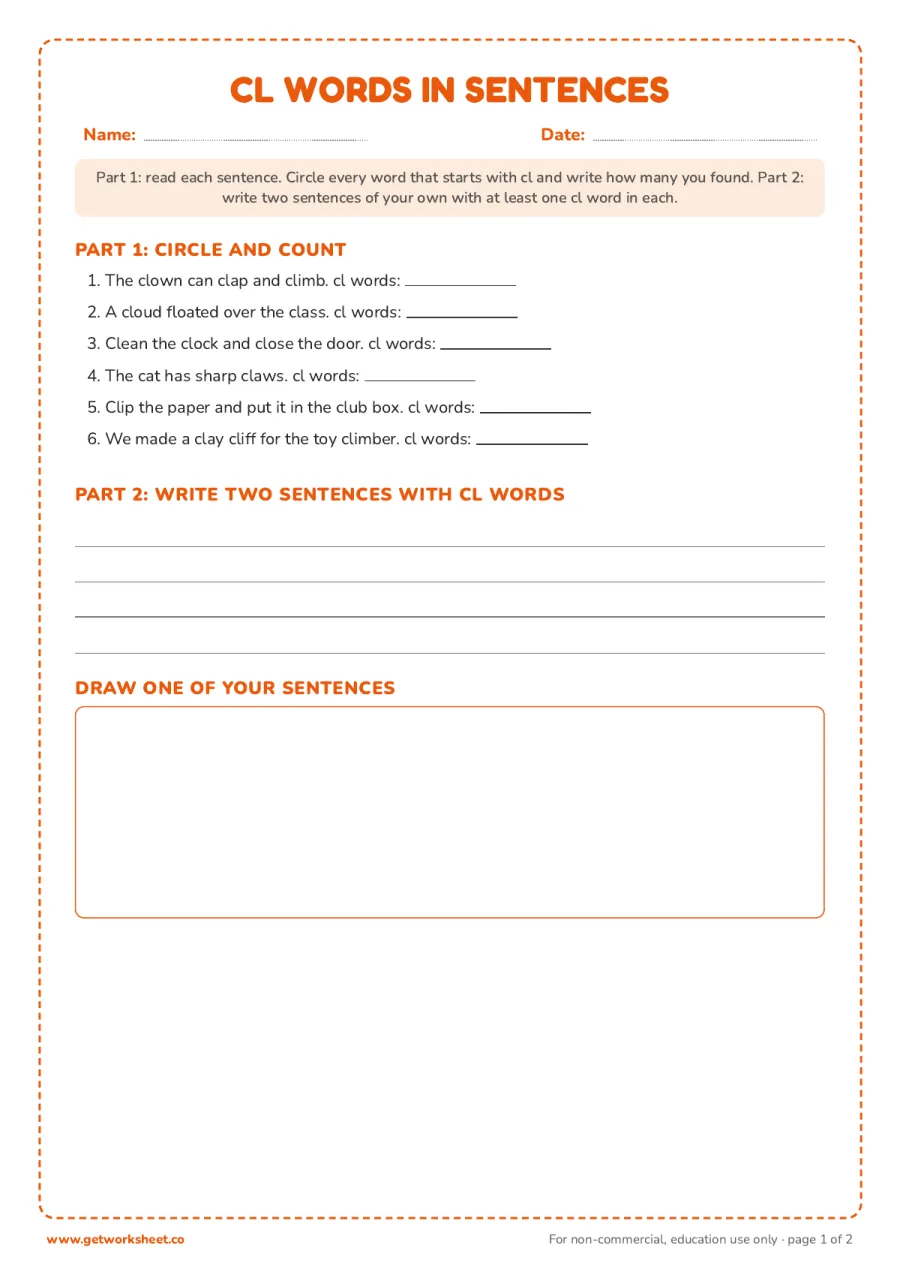
cl words in sentences: circle and count the cl words, then write your own
Six sentences packed with cl words to read, circle and count, then four lines to write two sentences of your own using cl words. Answer key on page 2.
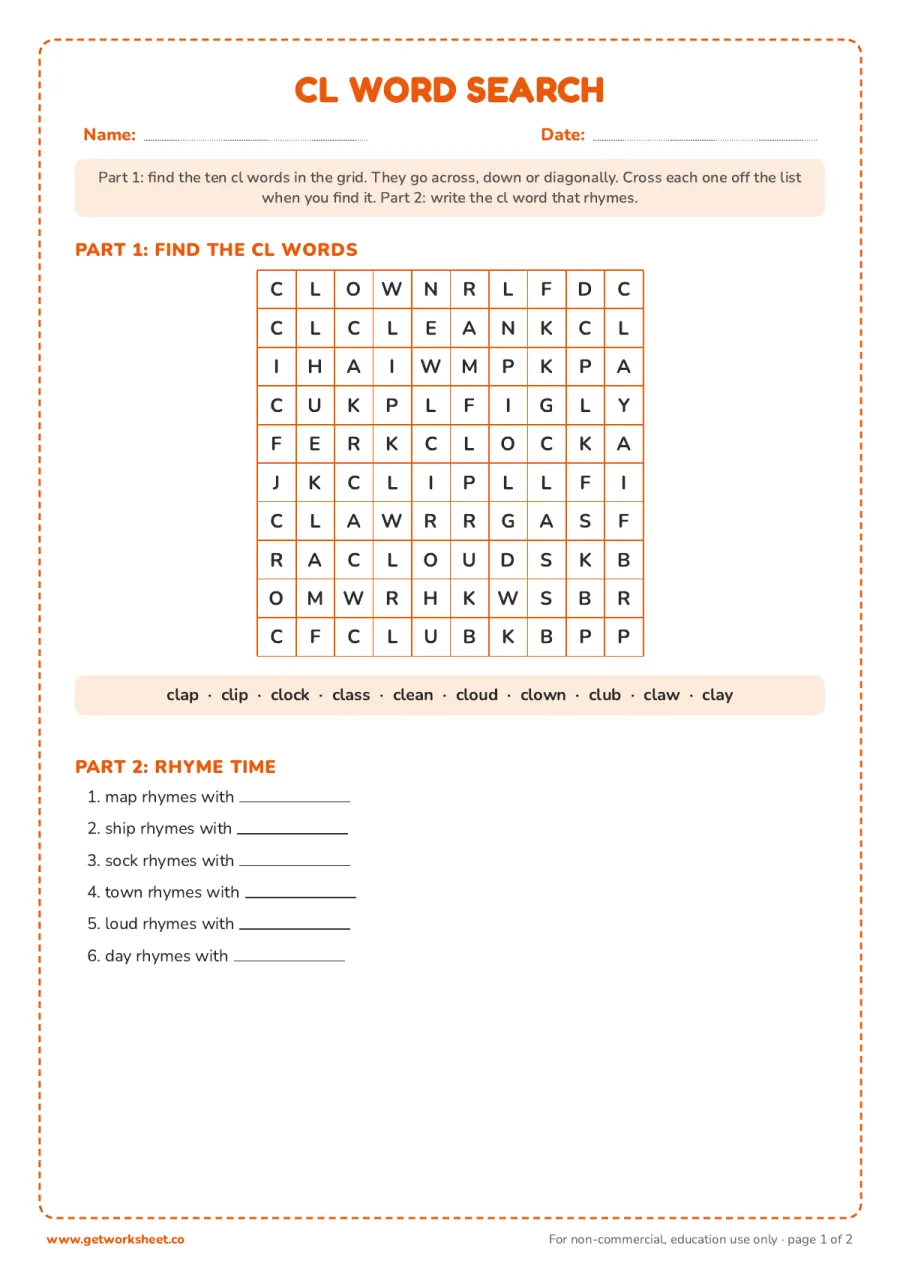
cl word search: find 10 cl words, then rhyme them
A 10 by 10 word search hiding ten cl words (clap, clip, clock, class, clean, cloud, clown, club, claw, clay), then six rhymes to complete with a cl word. The key shows the hidden words highlighted.
AI worksheet generator
Make a worksheet like this for your class
The 5 sheets above are fixed. The generator writes a new cl blend worksheet for your grade, with the question types and count you choose, in about 20 seconds. Pick a grade to start:
What you get
- A fresh set of questions on cl blend, not a copy of the sheets above
- Multiple choice, fill in the blanks, true or false, open ended
- Answer key and print-ready PDF with Pro
Free account, 1 worksheets a week. No card.
The cl blend is one of the first consonant blends children meet: two sounds, /k/ and /l/, said so close together that they feel like one. Children who are used to sounding out one letter at a time often say "c-l-ap" as three beats. These five worksheets give the blend a lot of repetition in different forms: writing it, hearing it against words that do not have it, building it onto endings, finding it in sentences and hunting for it in a grid.
What's in this set
- Trace and write cl words. Three-line handwriting guides: the blend cl to trace and write, then clap, clip, clock, club, clown, cloud, clean and class, each shown solid, then dashed to trace, with an empty row to copy the harder ones.
- cl or not? A two-column sort that separates cl words from words starting with c, l or another blend (crab, flag, glue, plum), then six word stems (__ap, __ock, __own, __oud, __ub, __ass) to finish with cl.
- Build a cl word. Ten word-building sums (cl + ap, cl + ip, cl + ock, cl + ub, cl + own, cl + oud, cl + ean, cl + imb, cl + ass, cl + ay) and six sentences with a word bank of cl words to fill.
- cl words in sentences. Six read-aloud sentences (for example "The clown can clap and climb") with a space to record how many cl words each contains, and writing lines for two original sentences.
- cl word search. A word search with ten cl words across, down and diagonally, the word list underneath, and six rhyming pairs to finish (map and clap, ship and clip, sock and clock ...).
What students will practice
- Hearing and saying the cl blend as one smooth sound at the start of a word (CCSS RF.K.3, RF.1.3)
- Reading and writing common cl words: clap, clip, clock, class, clean, climb, close, clown, cloud, club, claw, clay
- Telling cl words from words that start with c, l or another blend (crab, flag, glue, plum)
- Blending an onset and a rime: cl + ap = clap (RF.1.2)
- Using cl words in sentences and recognizing them in connected text
- Rhyming and visual word recognition in the word search
Free printable makers
Make your own cl blend sheets
Type your own words or numbers and print in about 30 seconds. No account, no AI, answer key where it applies.
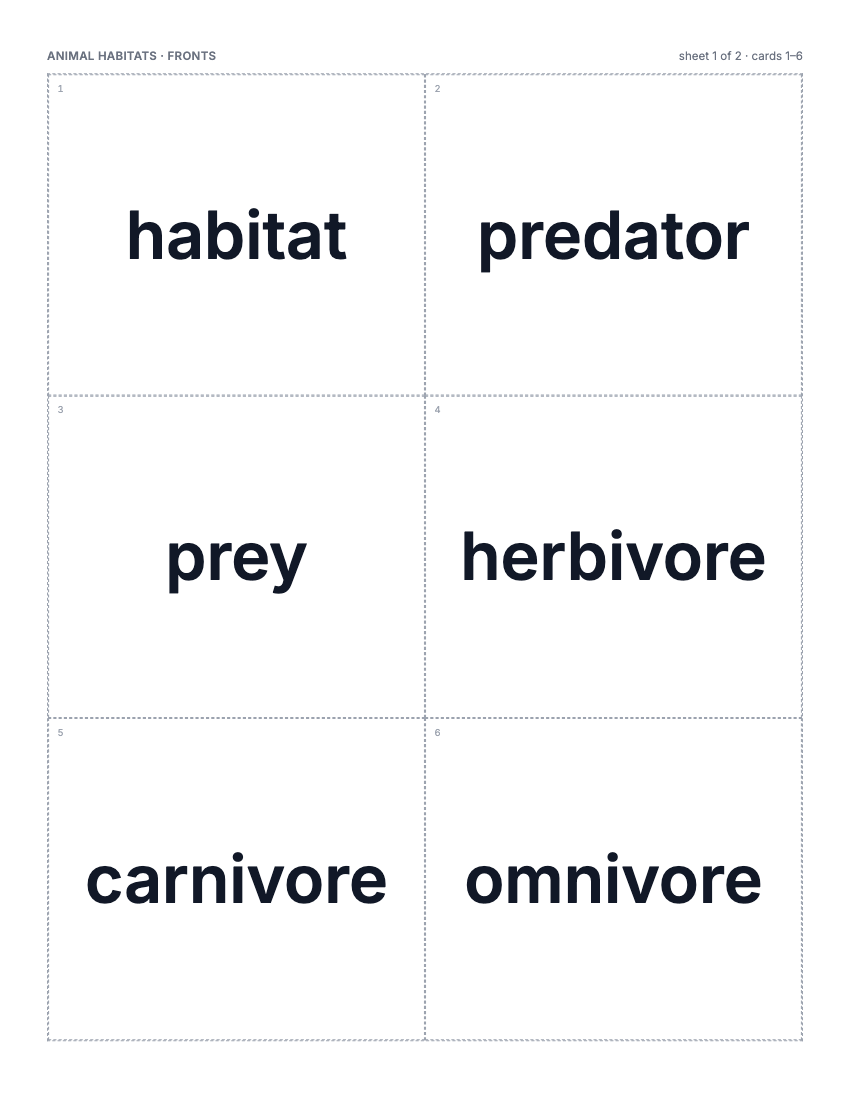 Flashcard makerVocabulary, math fact or sight word cards, 2-8 a page, two-sided or fold-over. Free to print.
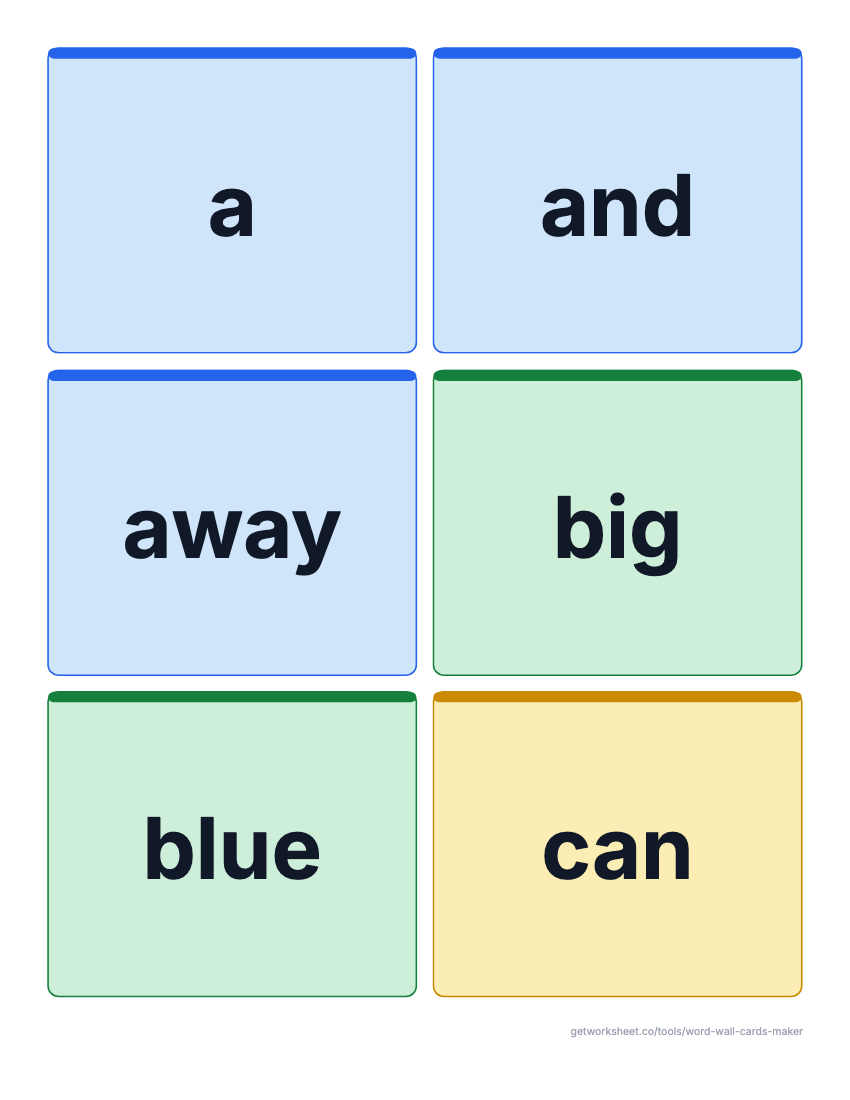 Word wall cards makerDolch, Fry or your own words as big-print cards, colour-coded, with A-Z headers. Free to print.
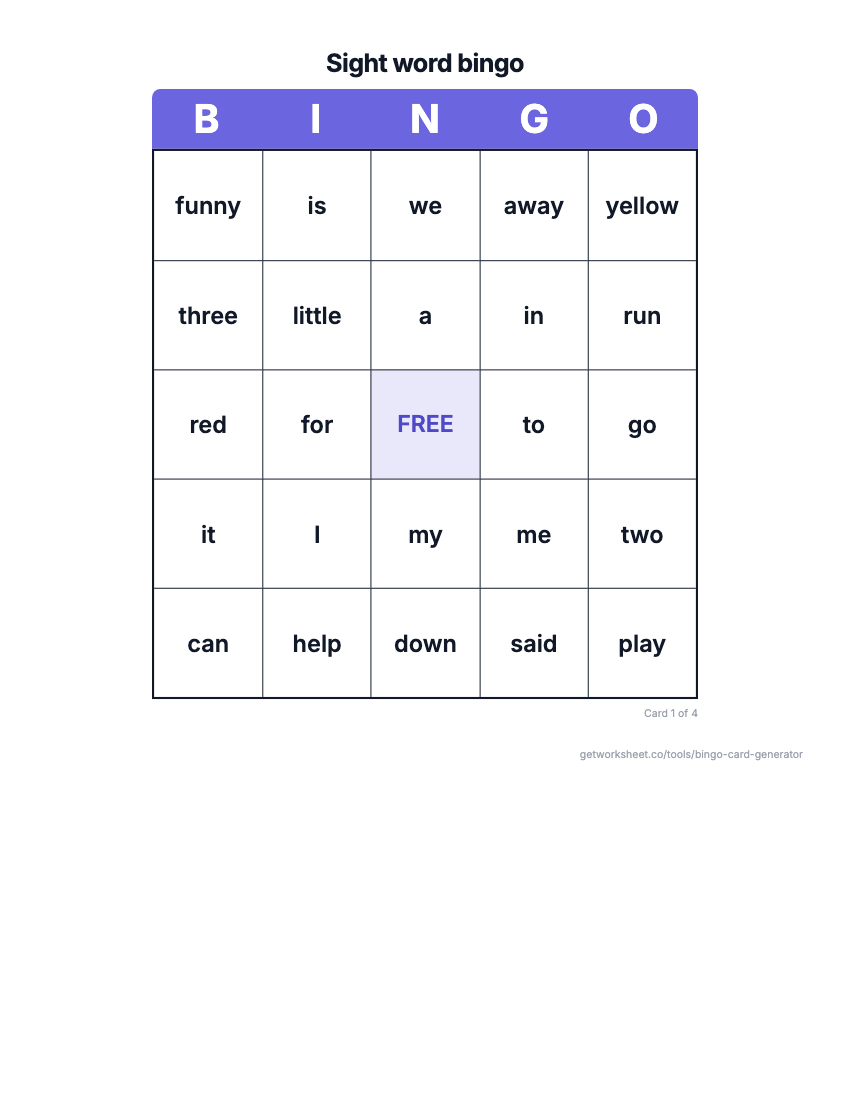 Bingo card generatorSight word, number, math fact or custom bingo cards with a call sheet. Free to print.
AI worksheet generator
Need a different cl blend worksheet?
Generate a custom cl blend worksheet: pick the grade, question types and count, and print it in about 20 seconds. Free accounts get 1 generation a week.
How to use these worksheets in class
- Say it before you write it. Start every sheet by saying the words aloud together, stretching the blend: "cl-l-l-ap". Trace and write cl words is the first sheet because writing the letters together fixes the idea that they belong together.
- Sorting is listening. Read the sixteen words on cl or not? aloud one at a time without showing them, and have children point to the column before they write. The distractors (crab, flag, glue, plum) are other blends on purpose.
- Onset and rime. Build a cl word is the sheet to pair with letter tiles or magnetic letters: move the cl tile along the row of endings.
- Read, then hunt. On cl words in sentences, the drawing box at the bottom gives early finishers something to do while the class catches up, and the picture shows whether they understood the sentence.
- Word search as the reward. cl word search works for pairs; the rhymes at the bottom can be done as a chant.
- Kindergarten to grade 2. Kindergarten uses the tracing and sorting sheets with an adult reading the words; grades 1 and 2 use all five independently.
Answer key
Every practice sheet carries its own answer key on page 2 of the PDF. The keys are repeated here for quick marking.
- Trace and write cl words: cl words: Handwriting sheet; no answer key.
- cl or not?: Part 1: does it start with cl?: Starts with cl: clap, clip, club, clock, class, cloud, clean, clown Does not start with cl: cat, lamp, cup, lock, flag, crab, glue, plum Part 2: add cl: 1. clap 2. clock 3. clown 4. cloud 5. club 6. class
- Build a cl word: Part 1: join the parts: 1. clap 2. clip 3. clock 4. club 5. clown 6. cloud 7. clean 8. climb 9. class 10. clay Part 2: finish the sentence: 1. clock 2. clap 3. cloud 4. clown 5. clean 6. climb
- cl words in sentences: Part 1: circle and count: 1. 3 (clown, clap, climb) 2. 2 (cloud, class) 3. 3 (clean, clock, close) 4. 1 (claws) 5. 2 (clip, club) 6. 3 (clay, cliff, climber) Part 2: write two sentences with cl words: Open-ended; check each sentence has a word that starts with cl.
- cl word search: Part 1: find the cl words: Hidden words: clap, clip, clock, class, clean, cloud, clown, club, claw, clay (highlighted on the key grid). Part 2: rhyme time: 1. clap 2. clip 3. clock 4. clown 5. cloud 6. clay
Common mistakes to watch for
- Adding a vowel between the sounds. "Culap" for clap. Have the child hold the /l/ and slide straight into the vowel.
- Dropping the l. Writing "cap" for clap or "cock" for clock. The tracing sheet and the word-building sheet both make the l visible.
- Mixing up cl and gl. Glue is on the sort sheet for this reason. Both are blends; only one starts with the hard c sound.
- Silent letters. Climb ends in a silent b. Point it out rather than letting children sound it.
Frequently asked questions
What age or grade are these cl blend worksheets for?
Kindergarten to grade 2, ages 5 to 7, when consonant blends are taught (CCSS RF.K.3, RF.1.3). Older children who still separate the sounds can use the sorting and word-building sheets.
Do the worksheets include answer keys?
Yes, on page 2 of every sheet except the handwriting sheet, which has no answers. The word search key shows the ten words highlighted in the grid.
Which cl words are used?
Clap, clip, clock, class, clean, climb, close, clown, cloud, club, claw, clay, cliff and clam, all short and decodable except for the silent b in climb.
What is a consonant blend?
Two or three consonants at the start or end of a word whose sounds are each heard but said together, like cl, br, st or nd. It is different from a digraph (ch, sh, th), where two letters make one new sound.
Related English worksheets
The phonics worksheets cover the other blends and digraphs, and the letter worksheets come before them. For more letter formation practice, use the handwriting worksheets, and for spelling the same words, the spelling worksheets.
Free library
Related collections
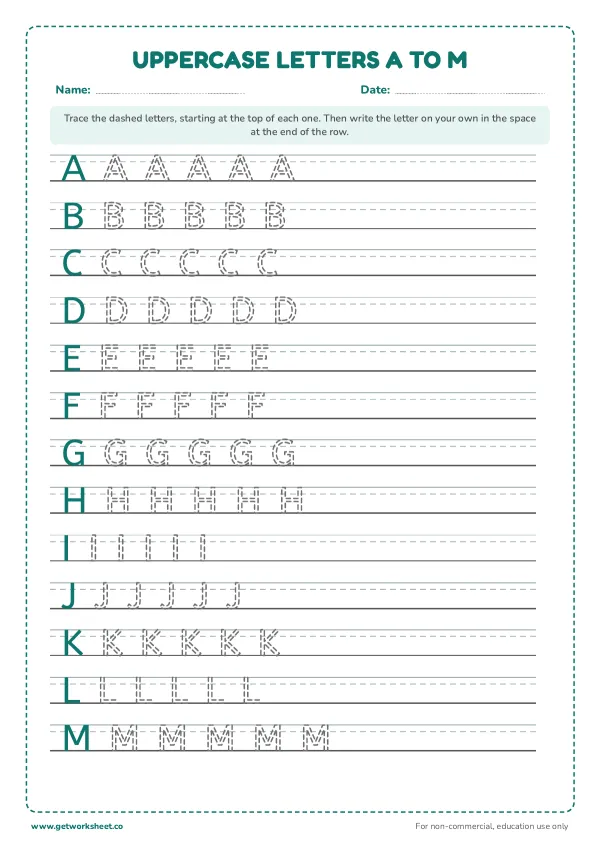
Free handwriting worksheets
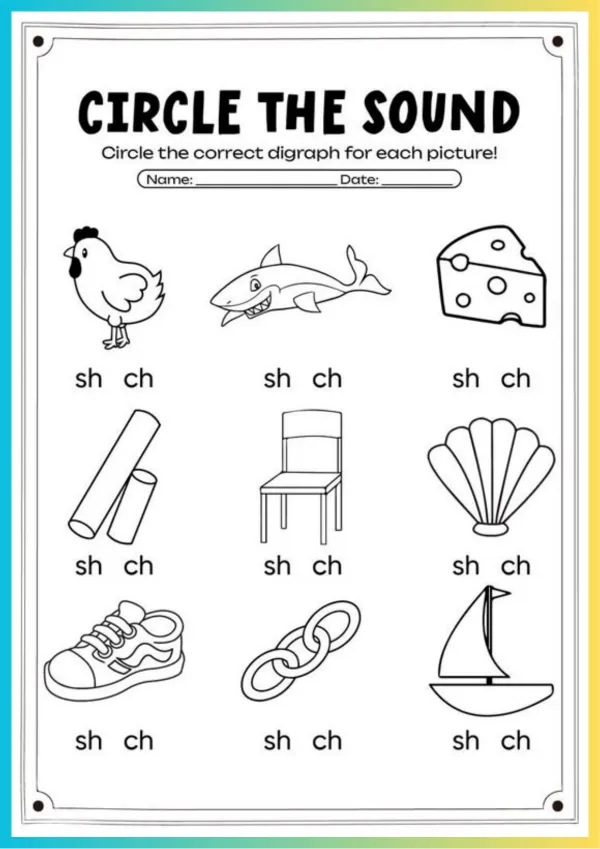
Free phonics worksheets
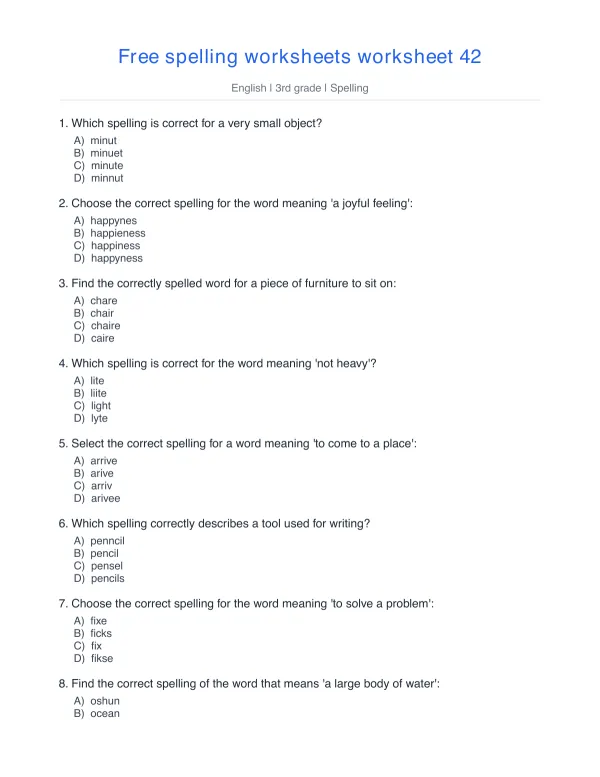
Free spelling worksheets
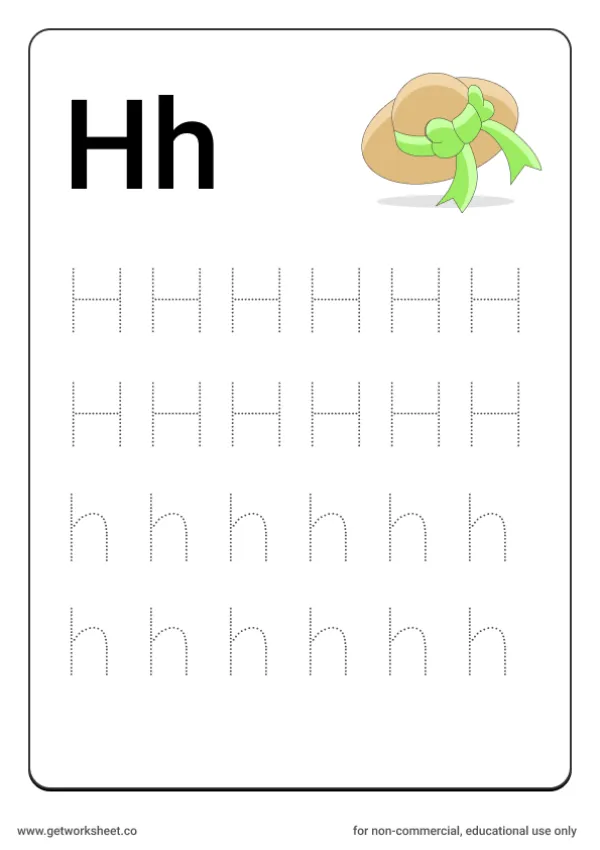
Free letter worksheets
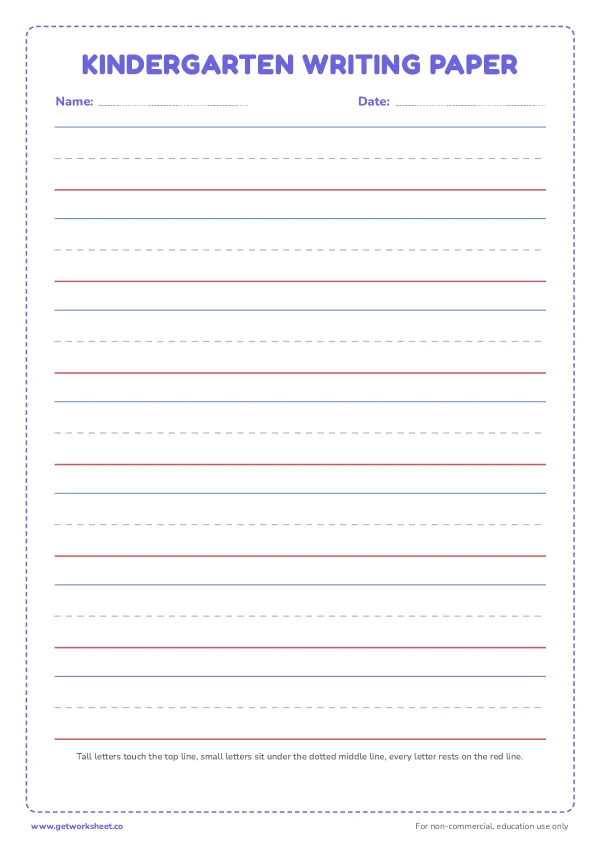
Free handwriting paper printables
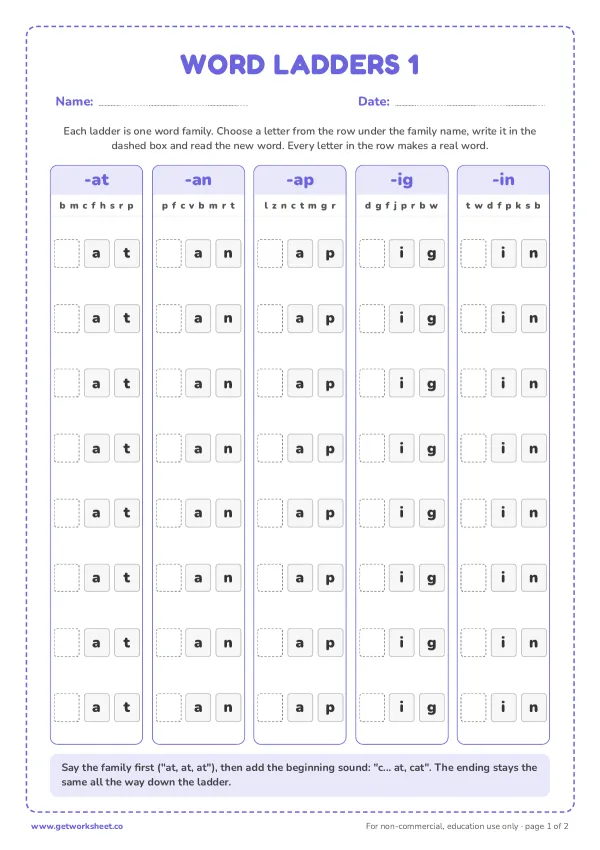
Free word families worksheets
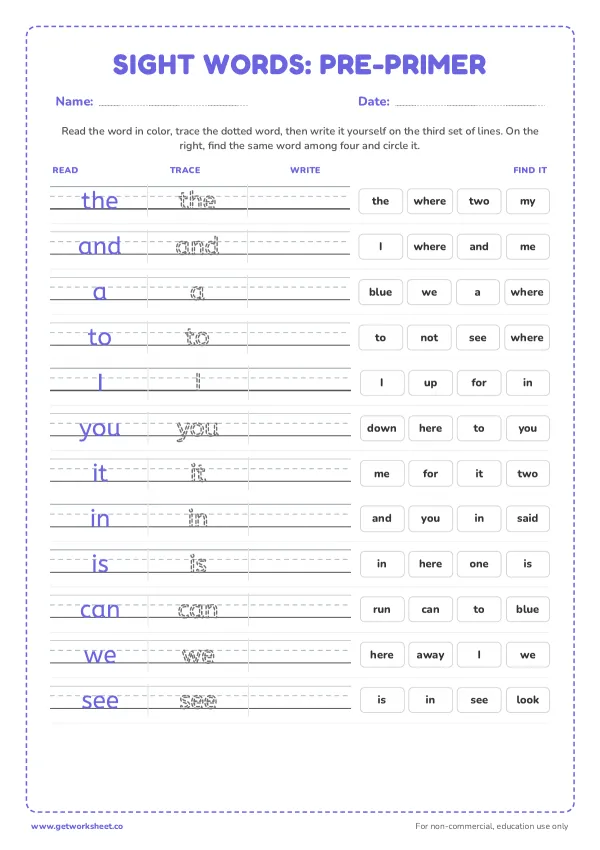
Free sight words worksheets (Dolch and Fry)
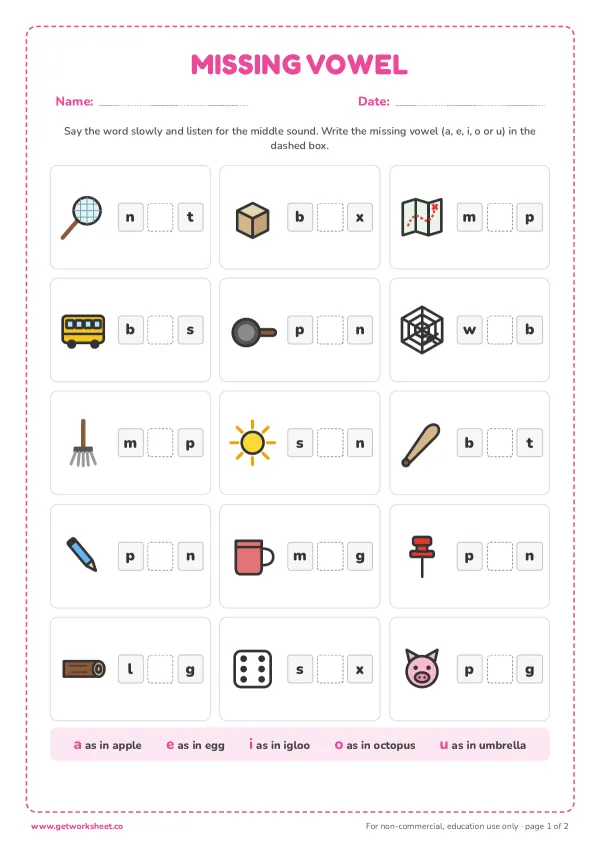
Free CVC words worksheets
More worksheets
- Free Christmas worksheets: word searches, letter to Santa and writing
- Free number line printables
- Free Halloween math worksheets
- Free Christmas math worksheets
- Free hundreds chart worksheets
- Free ten frame worksheets
- Free Montessori teen board and ten board worksheets
- Free Montessori place value worksheets (golden beads)
- Free Montessori hundred board worksheets
- Free safety signs worksheets
- Free copy the picture worksheets
- Free repeating patterns worksheets