Arts · Grades 3–8
Free elements of art worksheets
Seven printable elements of art worksheets for grades 3 to 8: a match-the-definitions reference sheet, a drawing sheet for each element (line, shape and form, value, color, texture and space) and a seven-element artwork analysis.
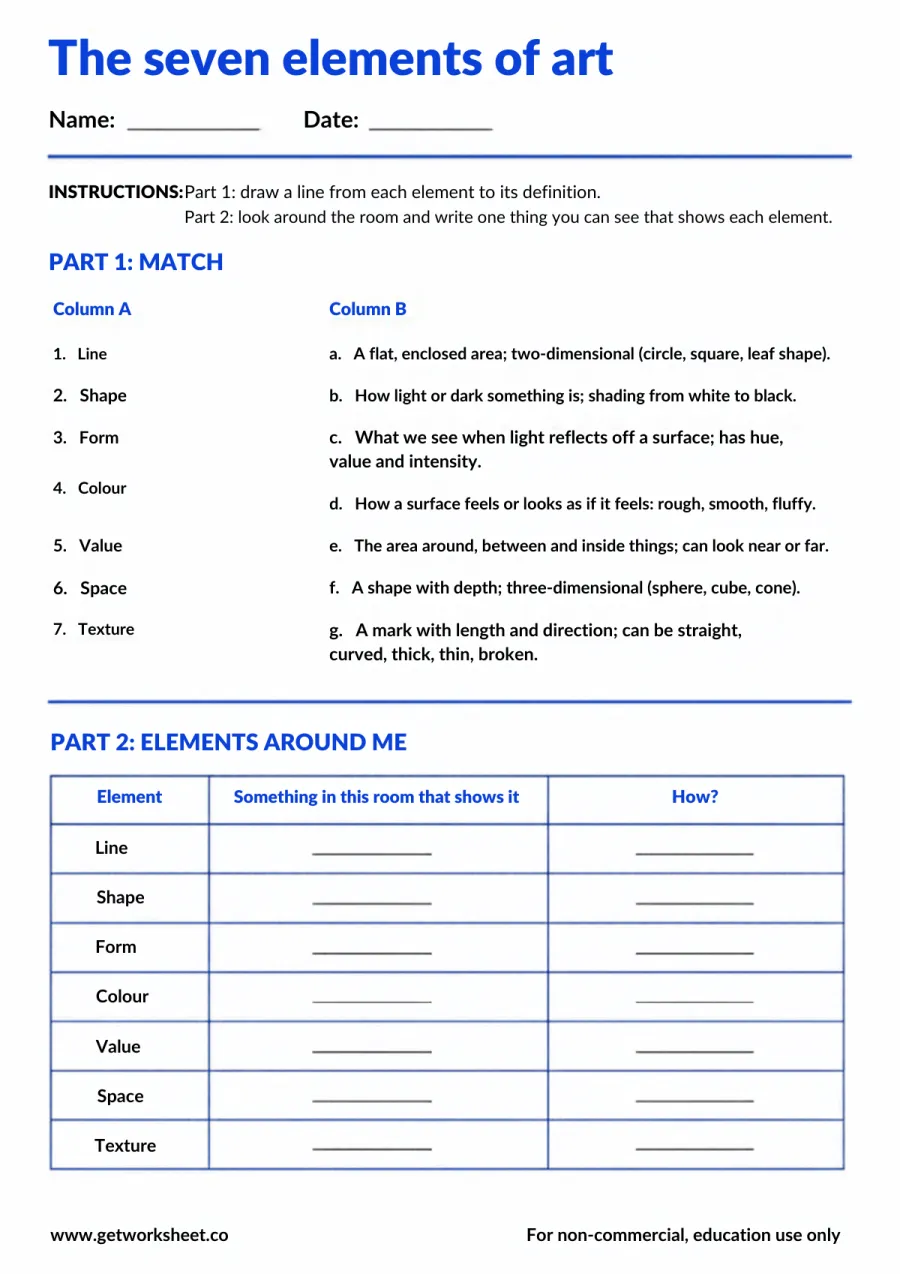
The seven elements of art: match the definitions (reference sheet)
Match the seven elements of art to their definitions, then find an example of each element in the room. Answer key on page 2.
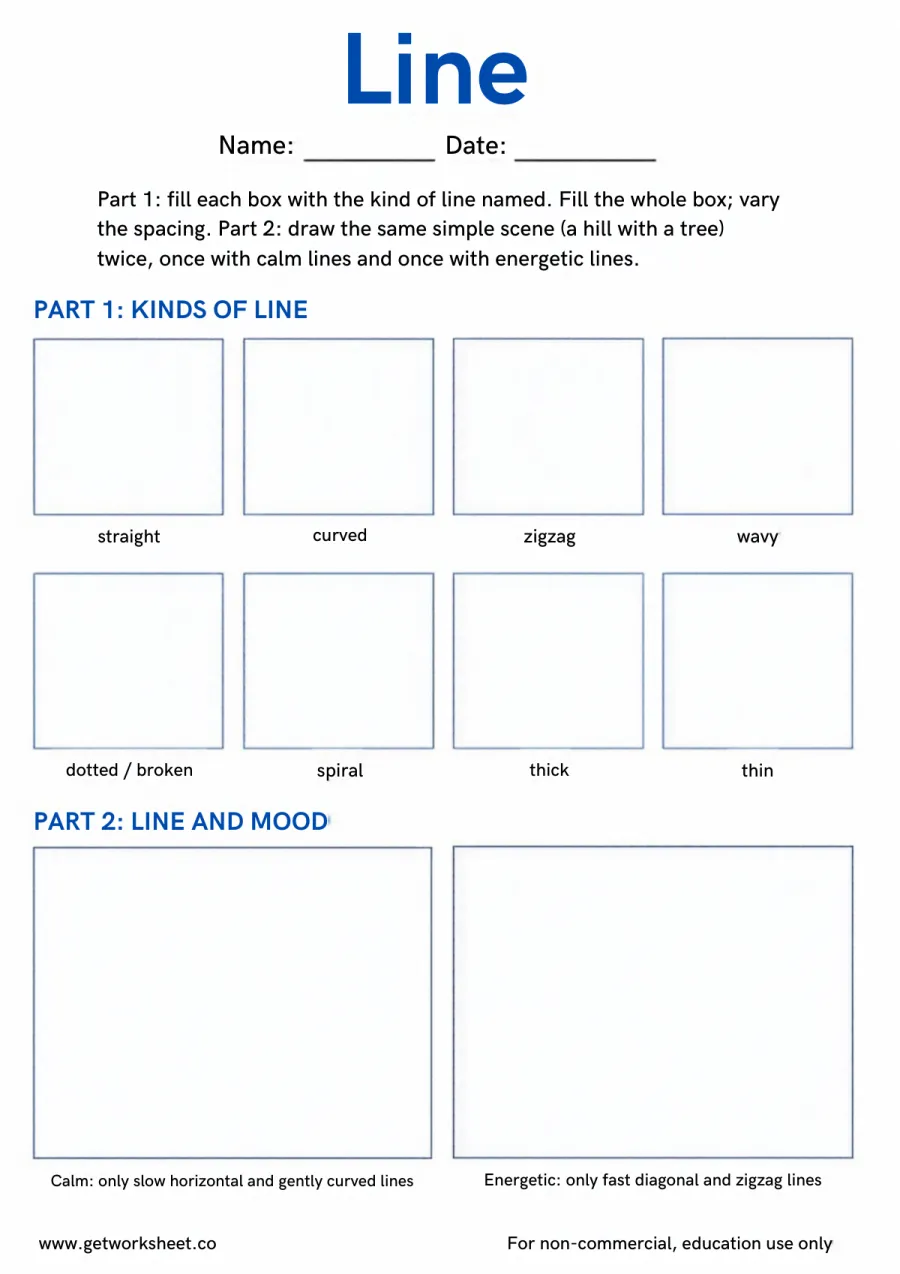
Line: draw 8 kinds of line, then a calm and an energetic drawing
Eight boxes for drawing different types of line (straight, curved, zigzag, wavy, dotted, spiral, thick, thin) and two boxes for a drawing made only of calm lines and one only of energetic lines.
Whole set
All 7 sheets in one PDF
Instant and ad-free. No account needed.
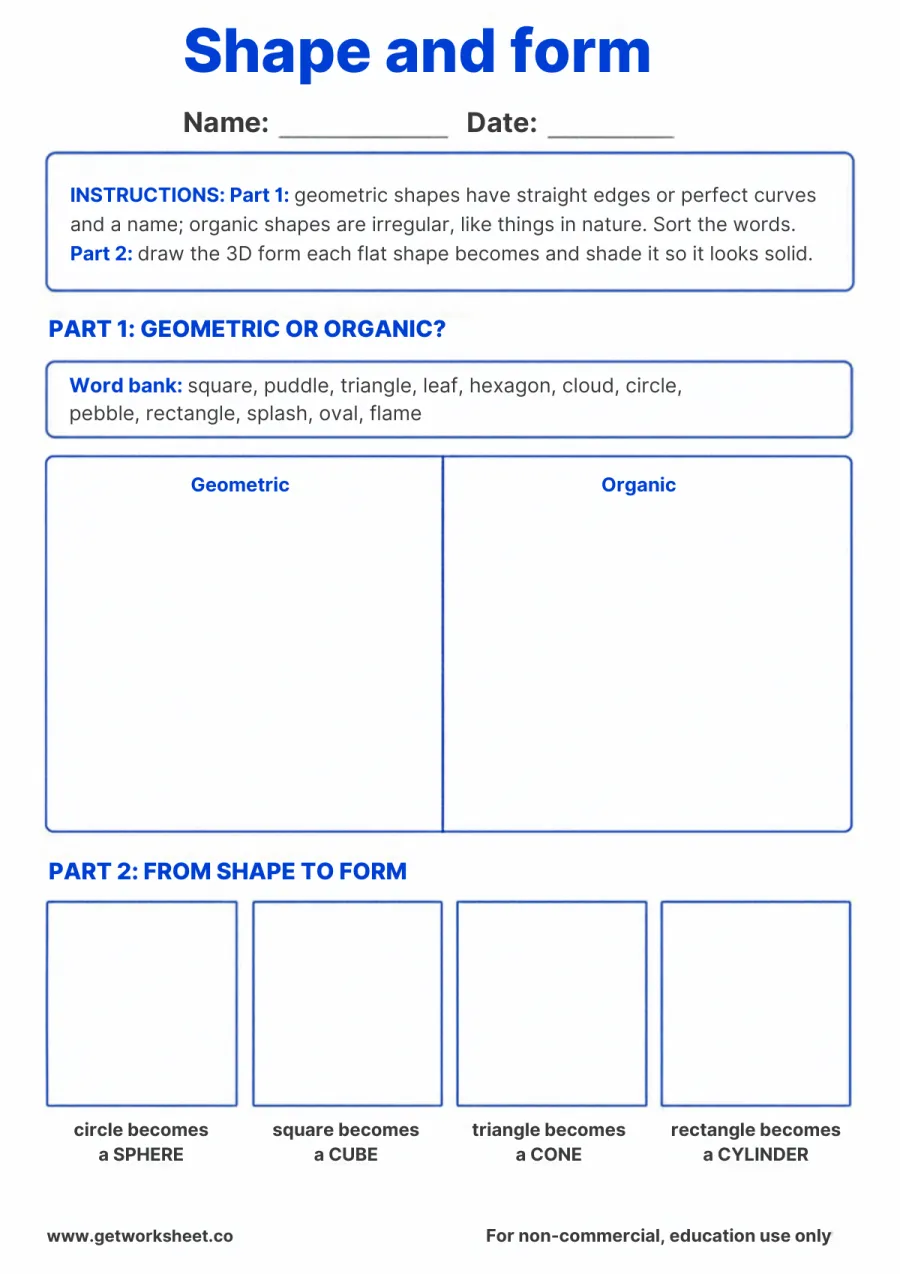
Shape and form: geometric or organic, then turn shapes into forms
Sort twelve shape words into geometric and organic, then turn four 2D shapes into 3D forms with shading. Answer key for the sort on page 2.
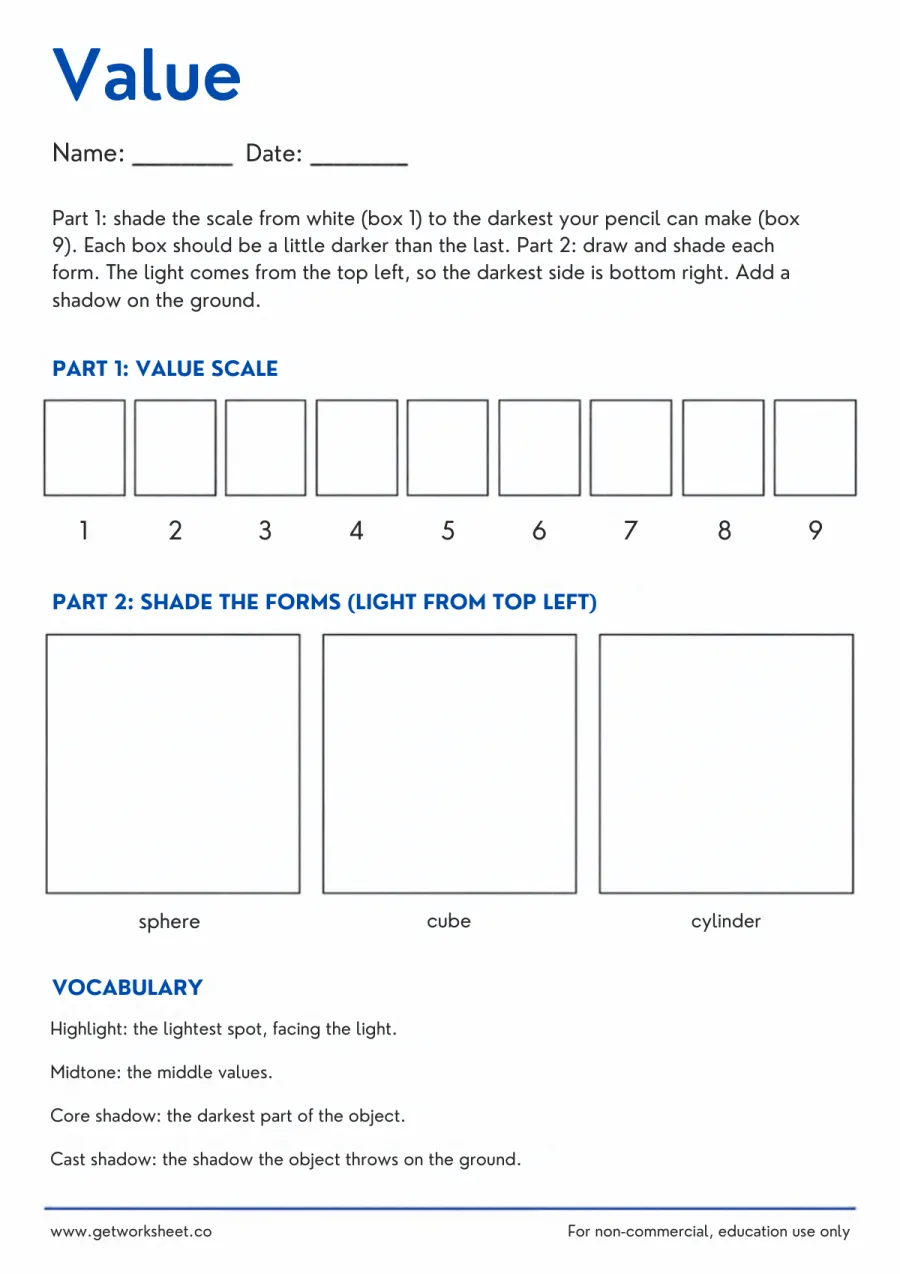
Value: a 9-step value scale and shading three forms
A nine-box value scale to fill from white to black with one pencil, then a sphere, a cube and a cylinder to shade with the light coming from the top left.
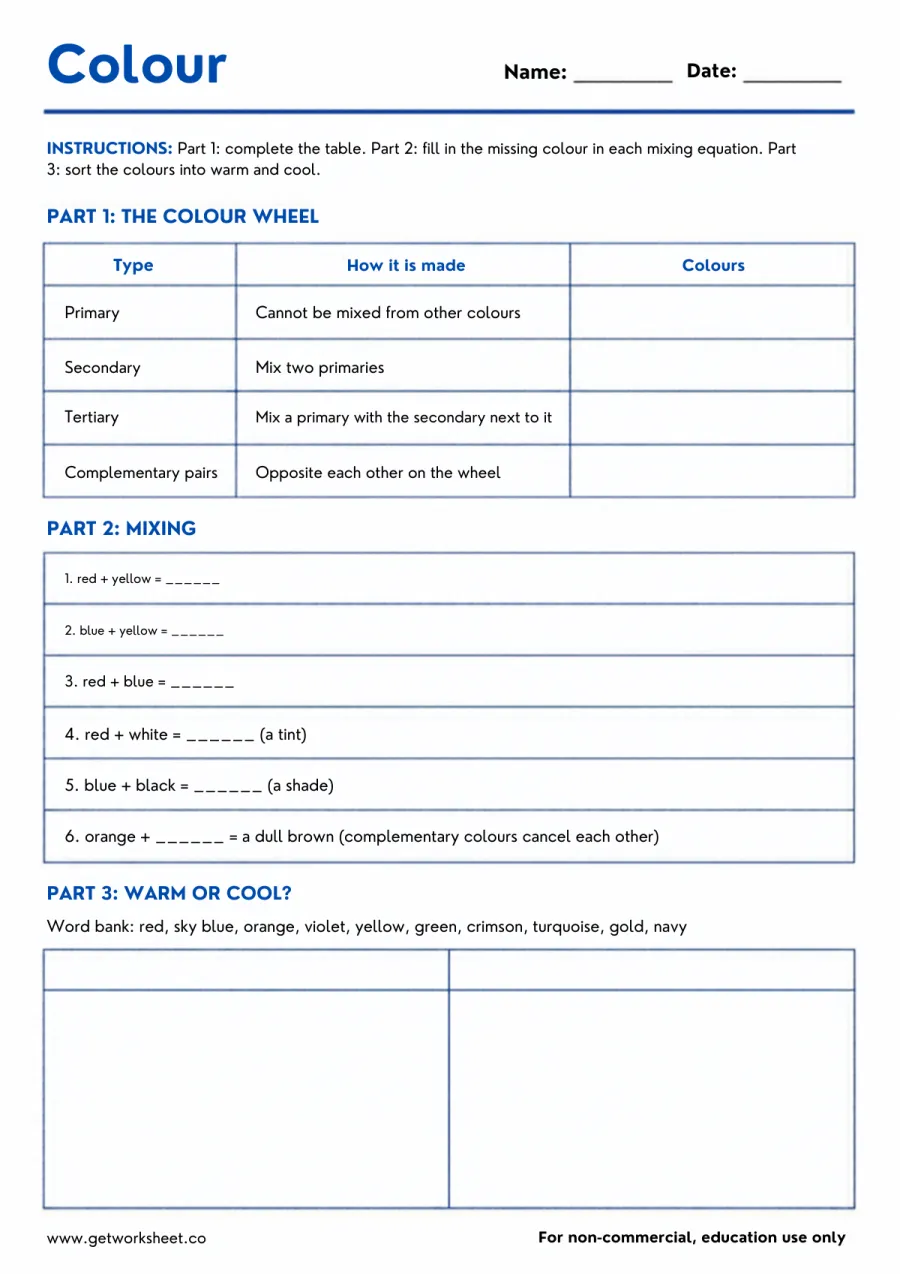
Colour: colour wheel, mixing and warm/cool sort
Fill in the colour wheel (primary, secondary), complete six mixing equations, and sort ten colours into warm and cool. Answer key on page 2.
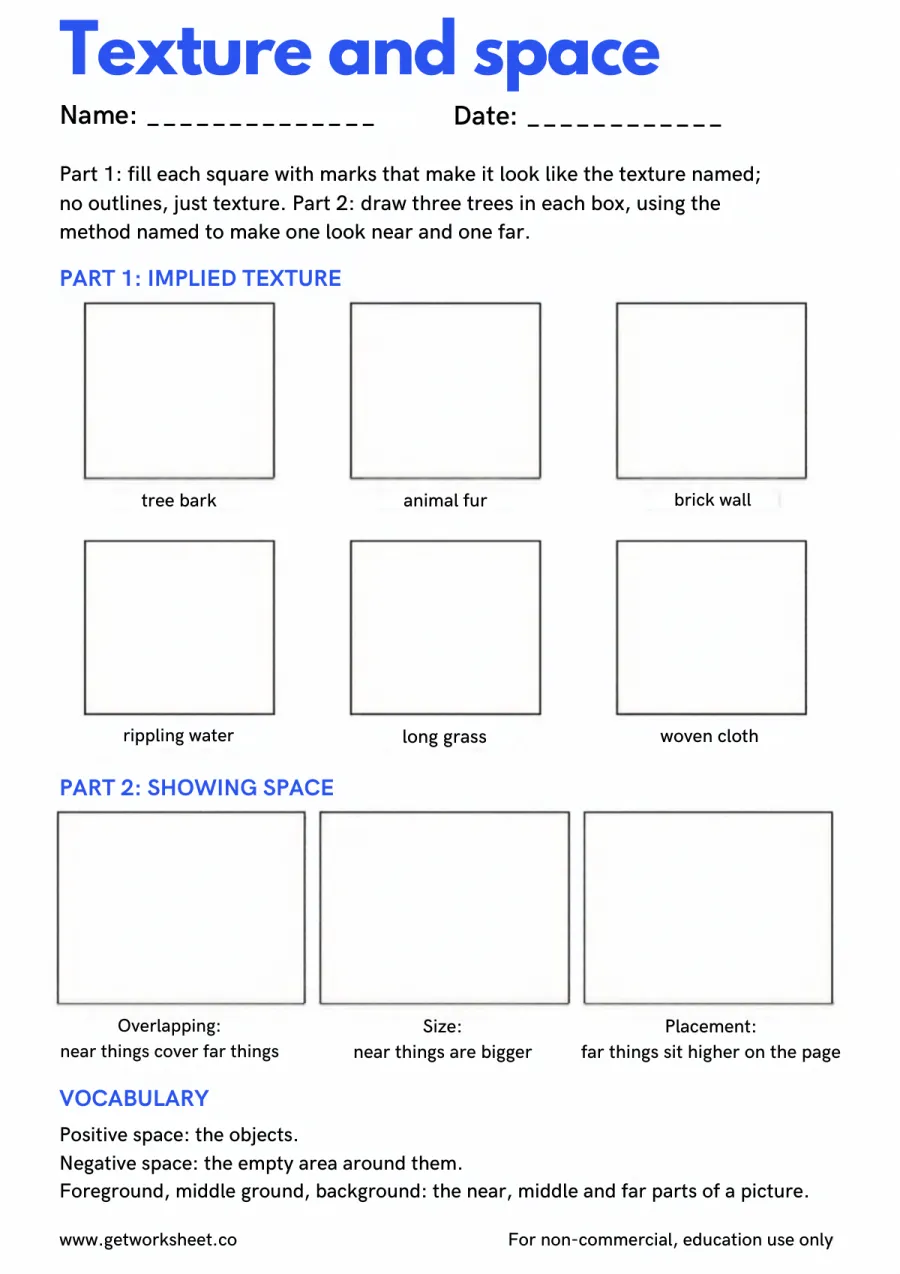
Texture and space: six texture squares and three ways to show depth
Six boxes for drawing implied textures (bark, fur, brick, water, grass, woven cloth) and three boxes showing depth through overlapping, size and placement.
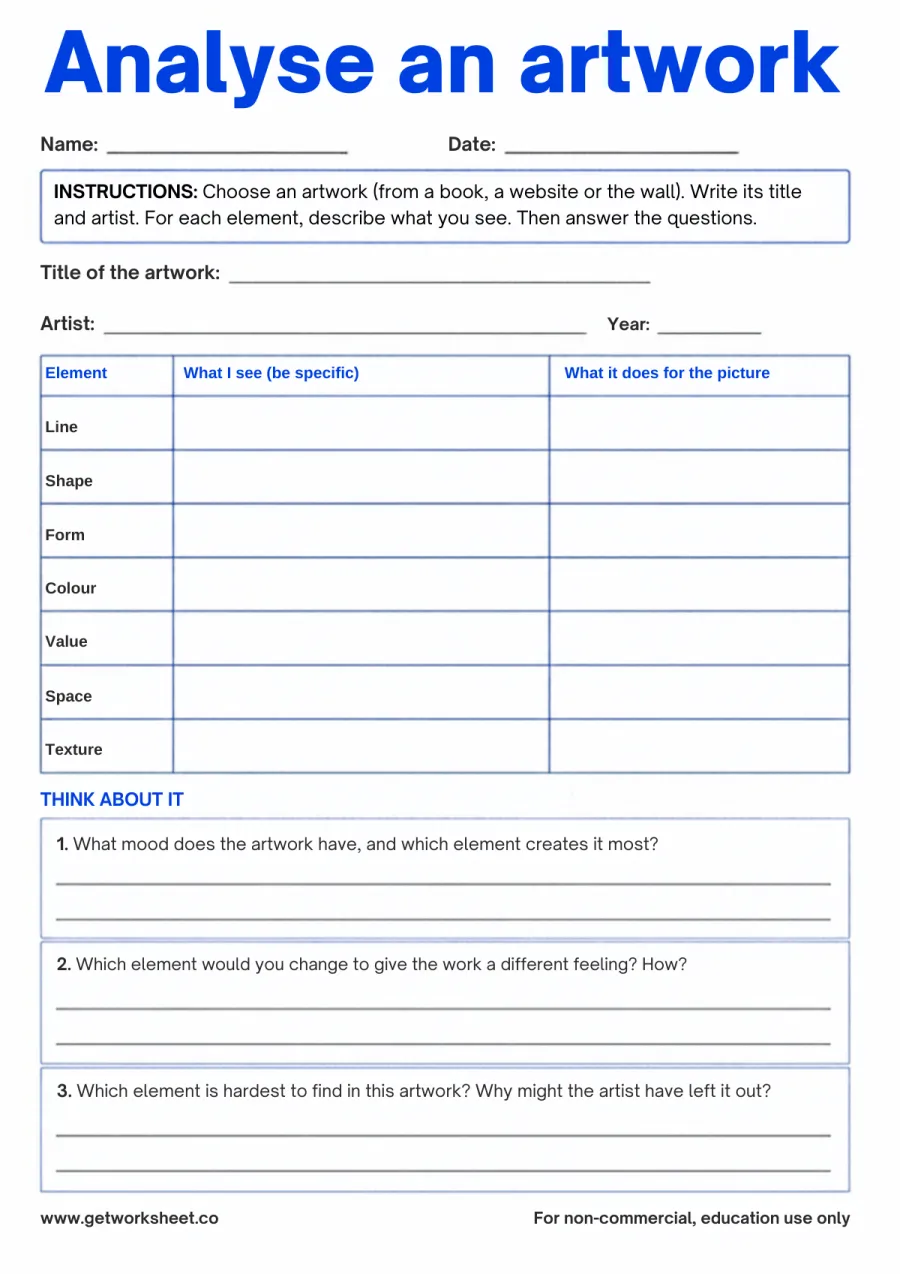
Analyse an artwork with the seven elements (any painting)
A structured sheet for looking at any artwork: record what you see for each of the seven elements, then answer three questions about mood and meaning. Works with any painting from a book, website or gallery.
AI worksheet generator
Make a worksheet like this for your class
The 7 sheets above are fixed. The generator writes a new elements of art worksheet for your grade, with the question types and count you choose, in about 20 seconds. Pick a grade to start:
What you get
- A fresh set of questions on elements of art, not a copy of the sheets above
- Multiple choice, fill in the blanks, true or false, open ended
- Answer key and print-ready PDF with Pro
Free account, 1 worksheets a week. No card.
The seven elements of art, line, shape, form, color, value, space and texture, are the vocabulary of every art lesson from grade 3 to high school. Students learn them fastest by making them: drawing eight kinds of line, shading a nine-step value scale, sorting geometric from organic shapes. This set has one reference sheet, one making sheet per element, and an analysis sheet for looking at real artworks with the vocabulary in hand.
What's in this set
- The seven elements of art. Match line, shape, form, color, value, space and texture to their definitions, then a table to record one example of each element seen in the classroom.
- Line. Eight labelled boxes for line types (straight, curved, zigzag, wavy, dotted, spiral, thick, thin), then two larger boxes: a calm picture using only slow, horizontal lines and an energetic picture using only fast, diagonal lines.
- Shape and form. Sort twelve words (square, puddle, triangle, leaf, hexagon, cloud ...) into geometric and organic shapes, then draw the form that each of four flat shapes becomes (circle to sphere, square to cube, triangle to cone, rectangle to cylinder) using shading.
- Value. A nine-step value scale (box 1 white, box 9 as dark as the pencil goes), then three boxes for shading a sphere, a cube and a cylinder with light from the top left, including a cast shadow.
- Color. A twelve-segment color wheel table to fill (three primaries, three secondaries, six tertiaries), six color-mixing equations to complete, and a warm/cool sort of ten colors.
- Texture and space. Six texture squares to fill with marks that look like bark, fur, brick, rippling water, grass and woven cloth, then three boxes for three ways to show space: overlapping, changing size, and placing far things higher on the page.
- Analyze an artwork. A seven-row table (one row per element) to describe how a chosen artwork uses line, shape, form, color, value, space and texture, then three short-answer questions about the mood of the work and which element matters most.
What students will practice
- Defining the seven elements and finding them in the classroom and in artworks (National Core Arts Standards VA:Re7.1, VA:Re8.1)
- Drawing line types and using line to create mood
- Distinguishing geometric from organic shapes, and 2D shapes from 3D forms
- Controlling pencil pressure to produce a value scale and shading forms with a consistent light source (VA:Cr2.1)
- Color wheel relationships: primary, secondary, tertiary, complementary, tints and shades, warm and cool
- Implying texture with marks and creating depth with overlapping, size and placement
- Describing an artwork element by element, then interpreting its mood (VA:Re8.1)
Free printable makers
Make your own elements of art sheets
Type your own words or numbers and print in about 30 seconds. No account, no AI, answer key where it applies.
AI worksheet generator
Need a different elements of art worksheet?
Generate a custom elements of art worksheet: pick the grade, question types and count, and print it in about 20 seconds. Free accounts get 1 generation a week.
How to use these worksheets in class
- Week 1: the vocabulary. Start with The seven elements of art. Do the matching together, then send students on the room hunt in part 2. A window frame is line, a clock face is shape, a globe is form, the shadow under a desk is value.
- Weeks 2 to 6: one element a week. Each making sheet is a 40-minute lesson: a five-minute demonstration, then independent work. Line needs only a pencil. Value works best with a soft pencil (2B or softer); a hard pencil cannot reach box 9. Color can be completed with colored pencils, or done alongside real paint mixing so the equations are tested, not memorized. Texture and space is a good sheet for fine-liner pens.
- Week 7: analysis. Project one artwork for the whole class the first time and fill the table together; then let students choose their own. The famous artists worksheets name specific paintings that work well (The Starry Night for line and value, Water Lilies for color and texture, Guernica for value and shape).
- Middle school. Grades 6 to 8 can complete the whole set in two or three lessons as revision, then use the analysis sheet on their own work in a critique.
- Display. The value scales and texture squares make a strong wall display when cut out and mounted together; students see the range of the class at a glance.
Answer key
Every practice sheet carries its own answer key on page 2 of the PDF. The keys are repeated here for quick marking.
- The seven elements of art: Part 1: match: Line = A mark with length and direction; can be straight, curved, thick, thin, broken.; Shape = A flat, enclosed area; two-dimensional (circle, square, leaf shape).; Form = A shape with depth; three-dimensional (sphere, cube, cone).; Color = What we see when light reflects off a surface; has hue, value and intensity.; Value = How light or dark something is; shading from white to black.; Space = The area around, between and inside things; can look near or far.; Texture = How a surface feels or looks as if it feels: rough, smooth, fluffy.
- Shape and form: Part 1: geometric or organic?: Geometric: square, triangle, hexagon, circle, rectangle, oval Organic: puddle, leaf, cloud, pebble, splash, flame
- Color: Part 1: the color wheel: Primary | | red, yellow, blue Secondary | | orange, green, violet (purple) Tertiary | | red-orange, yellow-orange, yellow-green, blue-green, blue-violet, red-violet Complementary pairs | | red and green; yellow and violet; blue and orange Part 2: mixing: 1. orange 2. green 3. violet (purple) 4. pink 5. navy / dark blue 6. blue Part 3: warm or cool?: Warm colors: red, orange, yellow, crimson, gold Cool colors: sky blue, violet, green, turquoise, navy
- Analyze an artwork: Think about it: 1. Open-ended. 2. Open-ended. 3. Open-ended.
Common mistakes to watch for
- Outlining textures. Students draw a brick outline instead of making marks that read as brick. Cover the label and ask a partner to guess the texture; if they cannot, more marks are needed.
- Value scales that jump. Boxes 1 to 4 pale, then a jump to black. Ask for nine distinct steps and check by squinting.
- Shading with a moving light source. The dark side of the cube and the sphere must be on the same side. The sheet fixes the light at top left for this reason.
- Calling form "shape". A drawn circle is a shape; once shaded to look round, it is a form. The shape-and-form sheet makes the transition visible.
- Purple and violet. Both are accepted for the secondary color; violet is the term on the wheel.
Frequently asked questions
What grade are these elements of art worksheets for?
Grades 3 to 8. The matching, line, shape and color sheets suit grades 3 to 5; the value, texture and space, and analysis sheets suit grades 5 to 8, or younger students with demonstration first.
What are the seven elements of art?
Line, shape, form, color, value, space and texture. Some programs list six by combining shape and form, or add "color" and "value" as one; this set uses the seven-element list that most US and UK curricula follow.
Do the worksheets have answer keys?
The matching sheet, the shape sort and the color sheet have keys on page 2 and in the "Answer key" section above. The drawing sheets (line, value, texture and space) and the analysis sheet are open-ended; the "Common mistakes" section describes what good work looks like.
What materials are needed?
A pencil for everything; a soft (2B) pencil for the value sheet; colored pencils or paint for the color sheet. Fine-liner pens improve the texture squares but are optional.
What is the difference between shape and form?
A shape is flat, with height and width only (a circle). A form has depth as well (a sphere). In a drawing, shading turns a shape into a form; the shape-and-form worksheet asks students to do exactly that four times.
Related art worksheets
The color theory worksheets go deeper into the color wheel. For the artists to analyze, use the famous artists worksheets; for drawing practice, the copy the picture worksheets.
Free library
Related collections
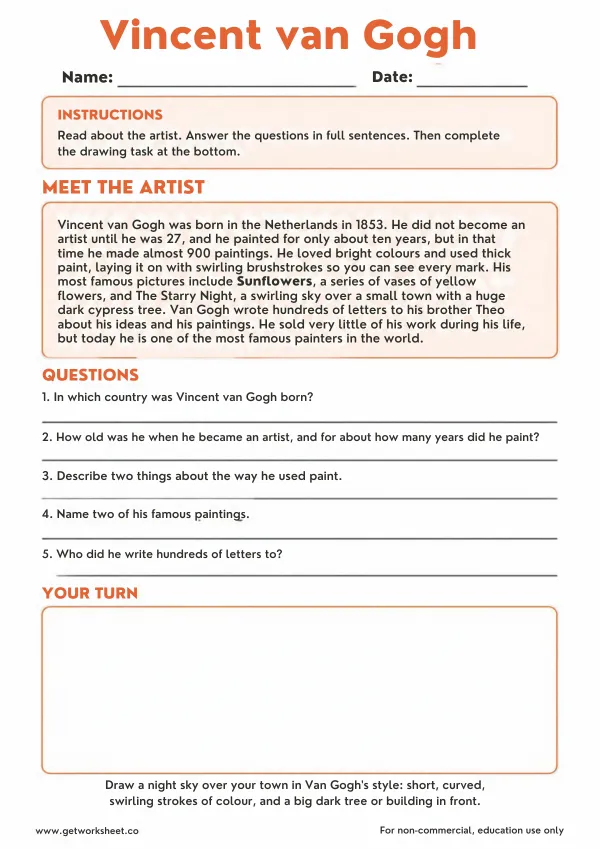
Free famous artists worksheets
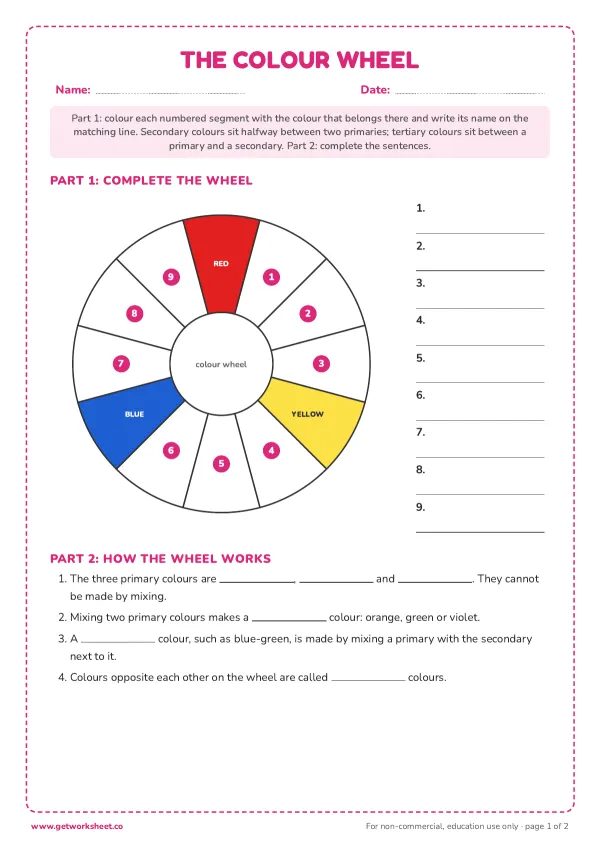
Free color theory worksheets
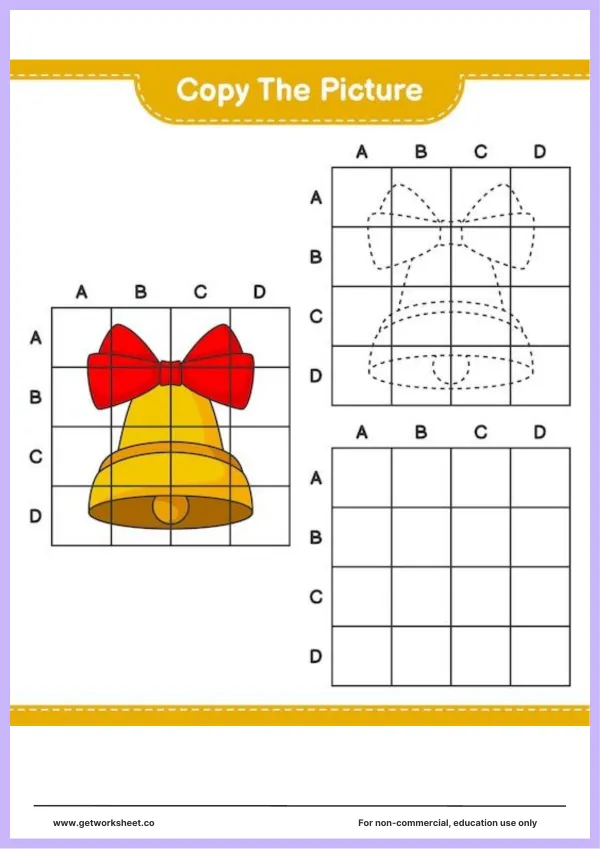
Free copy the picture worksheets
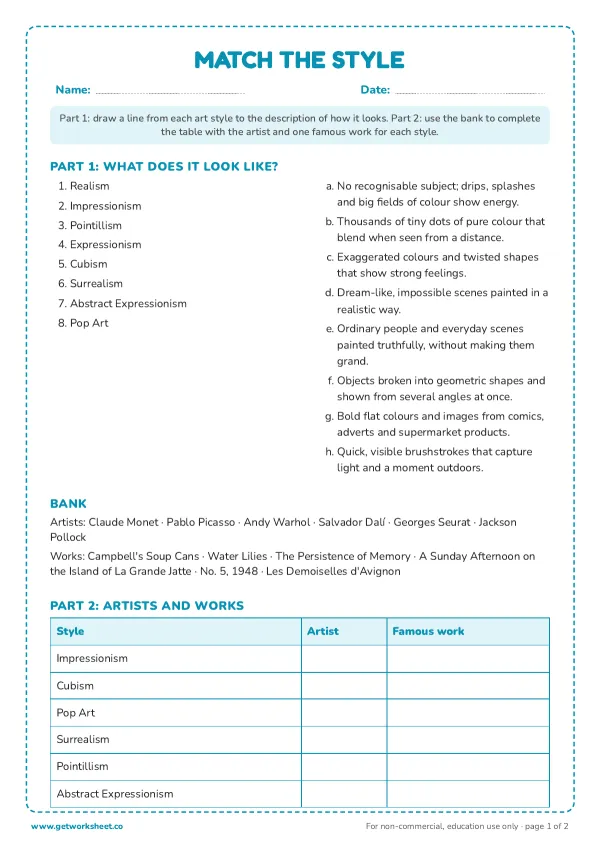
Free art styles worksheets
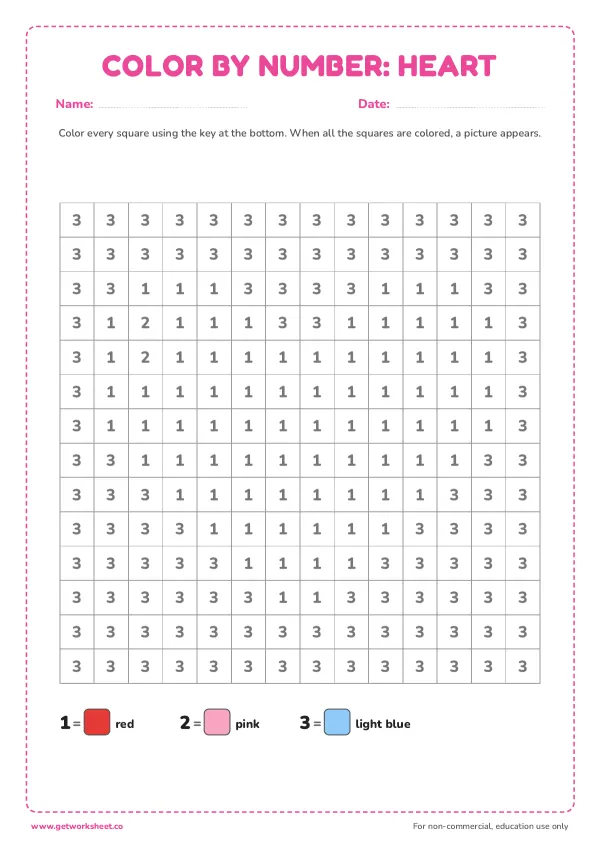
Free color by number worksheets
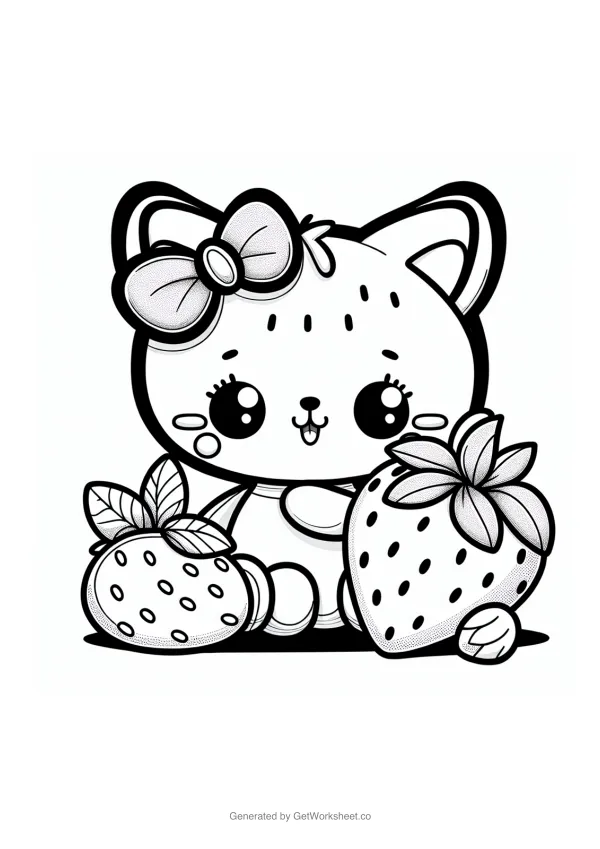
Free hello kitty coloring pages
Free Halloween coloring pages
Free leprechaun coloring pages
More worksheets
- Free spring coloring pages
- Free summer coloring pages
- Free winter coloring pages
- Free fire truck coloring page printable
- Free Merry Christmas coloring pages
- Free connect the dots printable worksheets
- Free printable vehicle coloring pages
- Free printable animal coloring pages
- Free printable number coloring pages