Arts · Preschool–Grade 2
Free connect the dots printable worksheets
Twenty connect the dots printables for preschool to grade 2: ten animals (bumblebee, cat, T-rex, dragon and more) with 32 to 70 dots, and ten fruits with 20 to 36 dots.
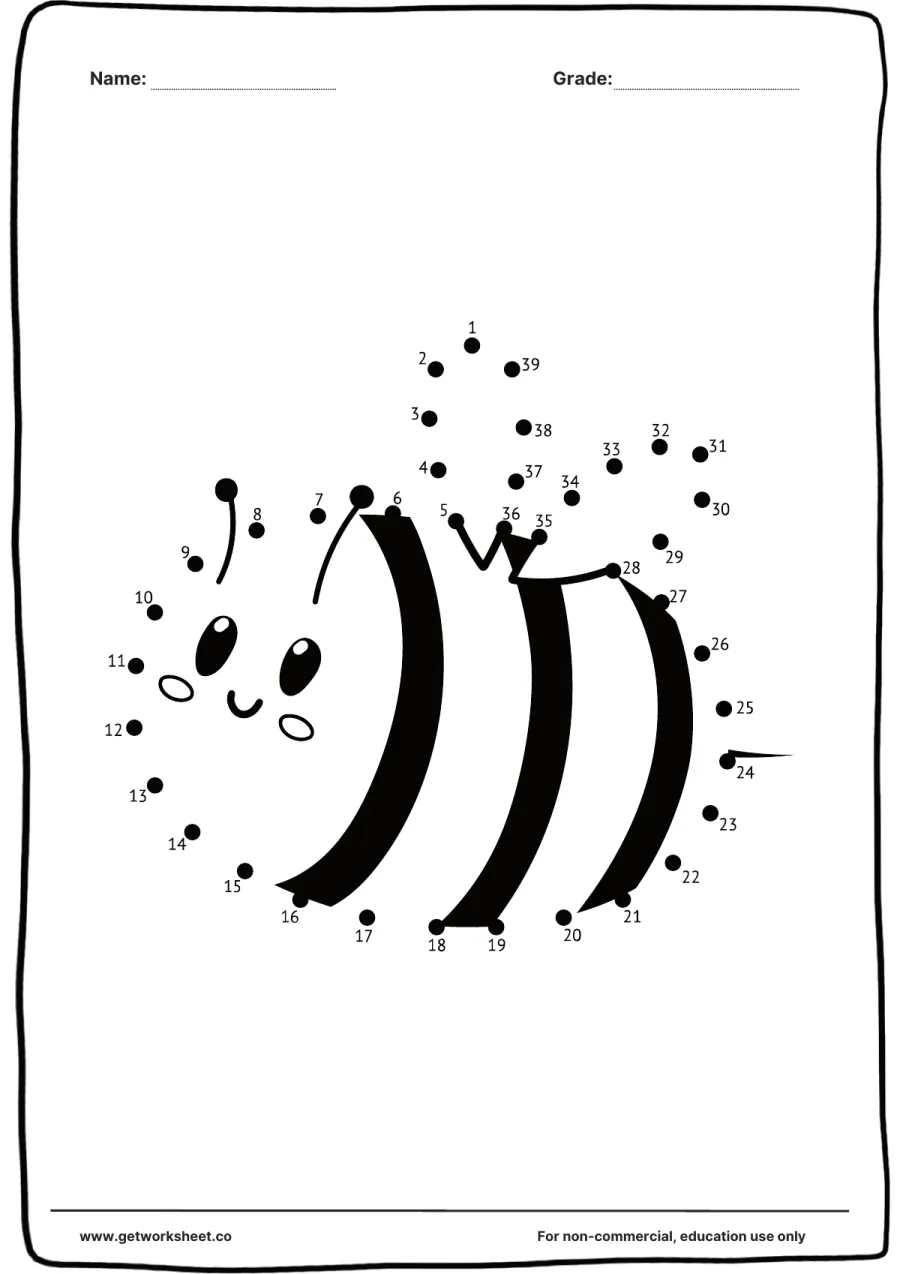
Connect the dots: striped bumblebee (1–39)
Join the numbered dots from 1 to 39 to finish a smiling bumblebee with striped body, wings and antennae, then color it in.
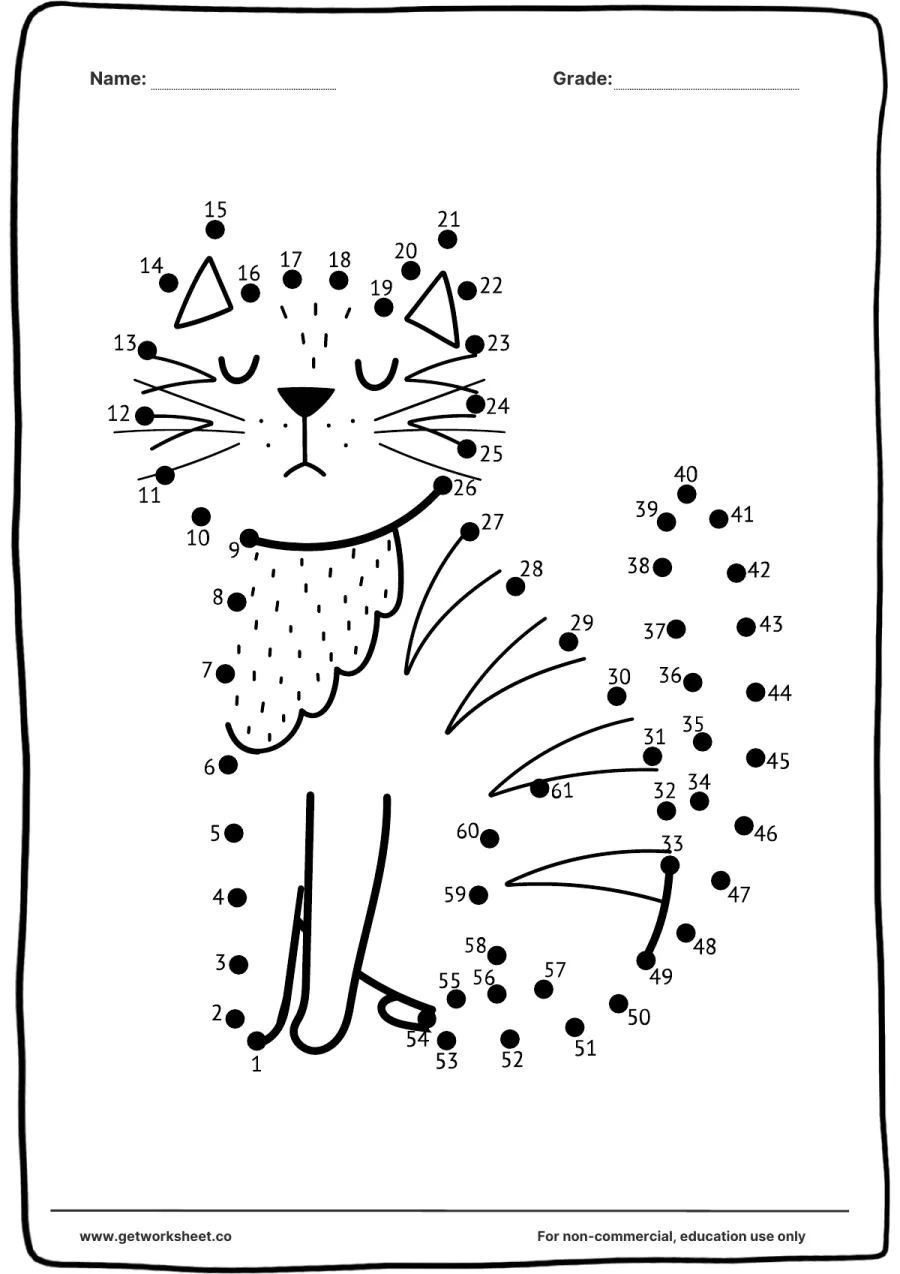
Connect the dots: sitting cat with whiskers (1–61)
Join the dots from 1 to 61 to draw a sitting cat with pointed ears, whiskers and a curled tail; the face is already printed.
Whole set
All 20 sheets in one PDF
Instant and ad-free. No account needed.
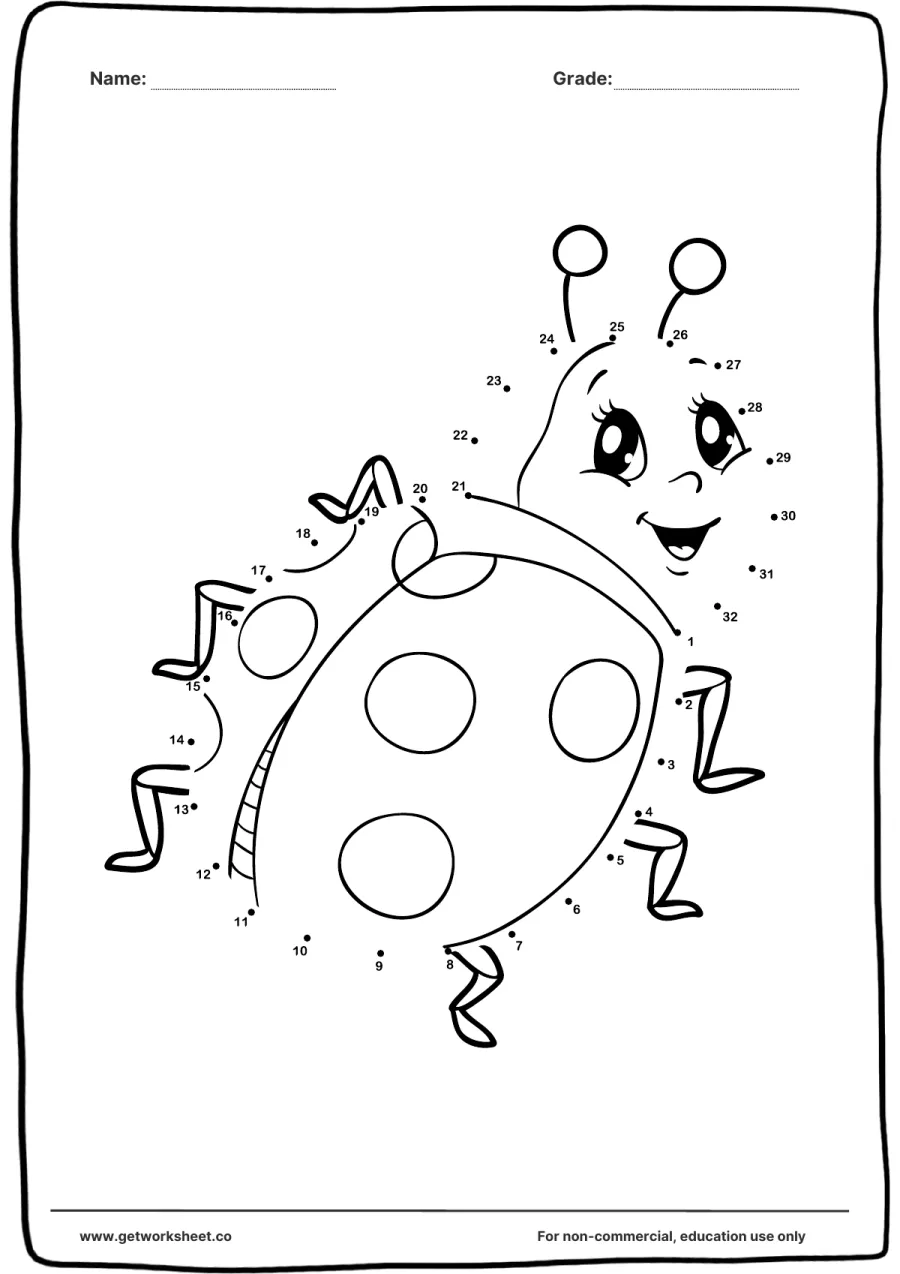
Connect the dots: spotted ladybug (1–32)
Join the dots from 1 to 32 around a cartoon ladybug with spots, antennae and a smiling face, then color the finished bug.
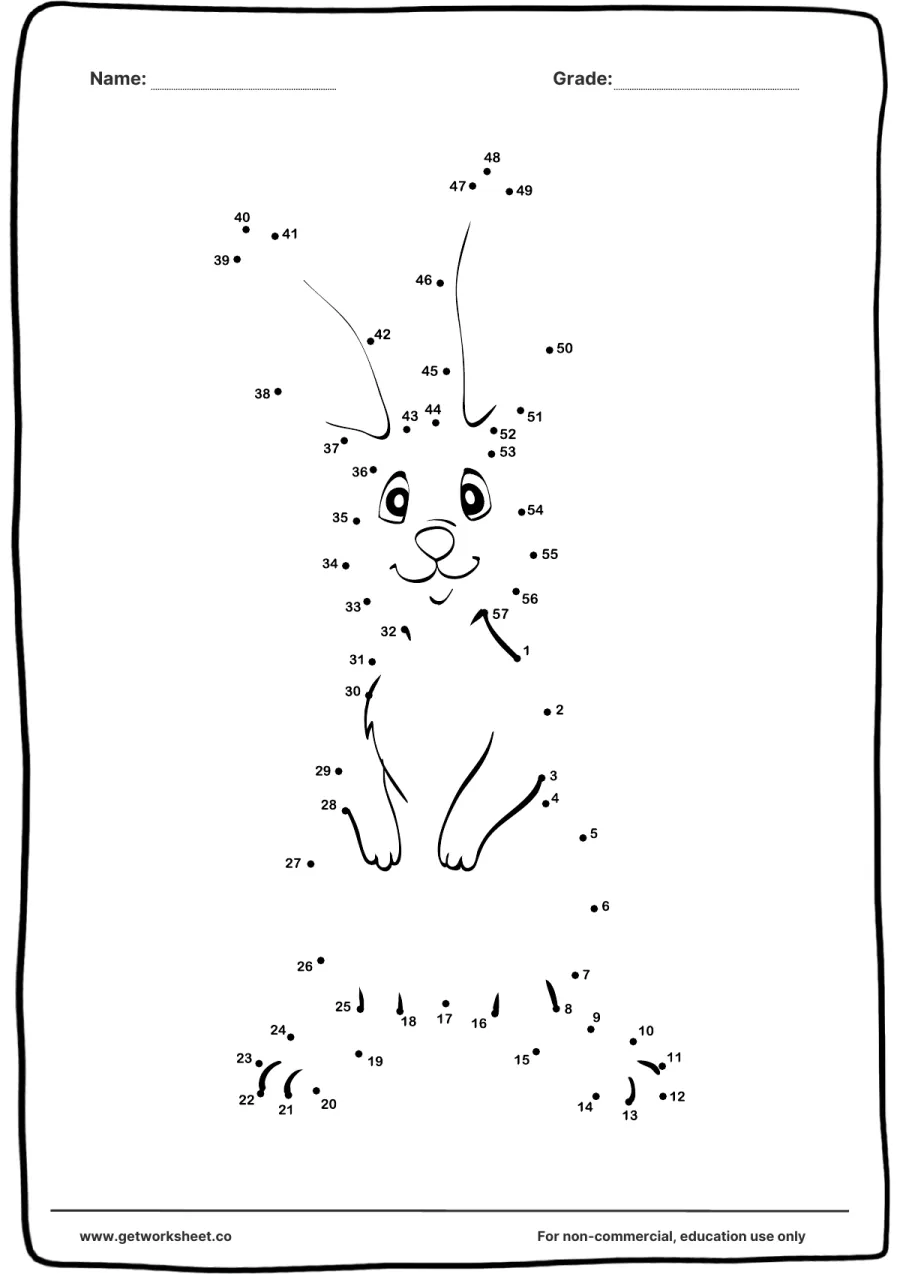
Connect the dots: long-eared rabbit (1–57)
Join the dots from 1 to 57 to outline a sitting rabbit with tall ears, paws and whiskers; only the face is drawn for you.
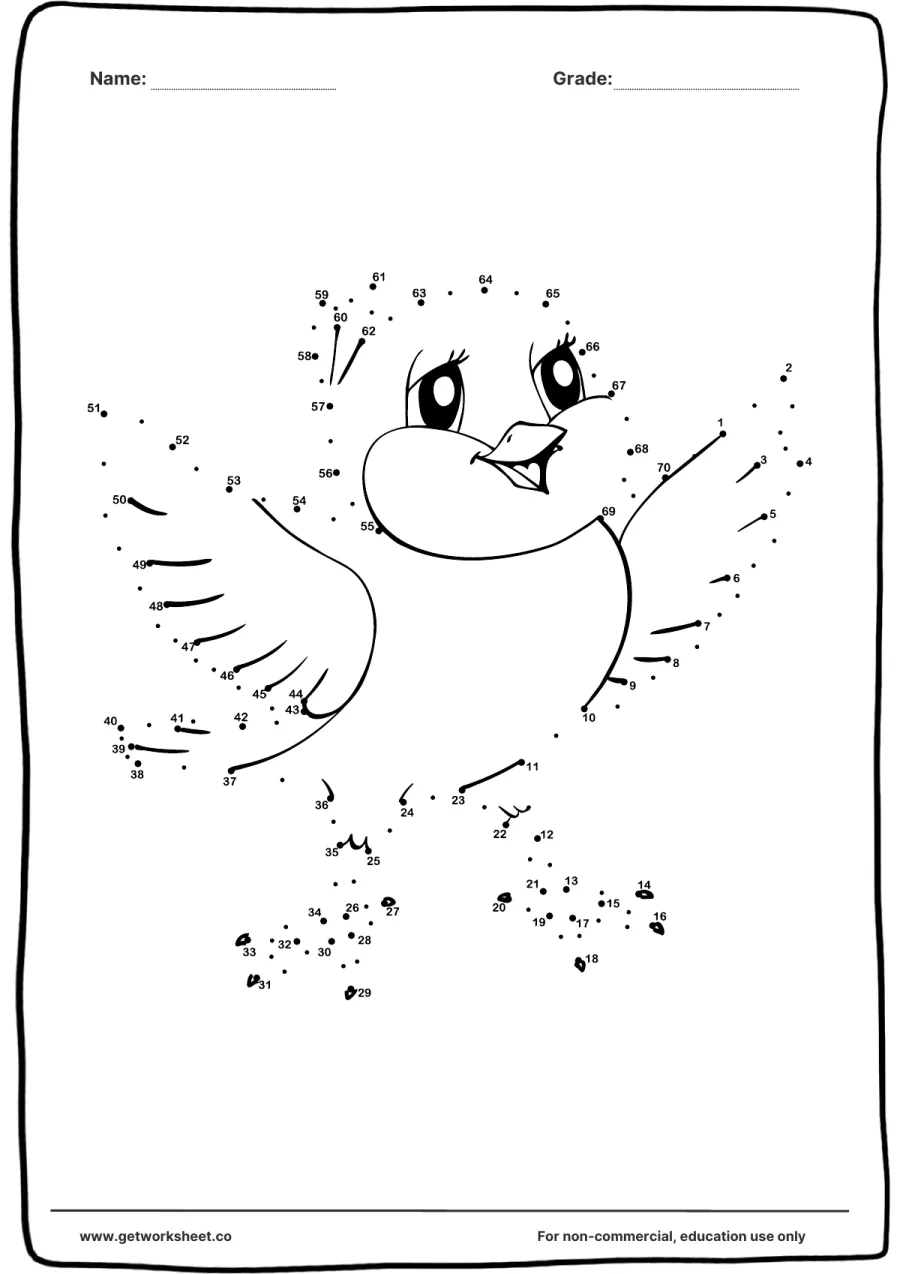
Connect the dots: flying bird with wings out (1–70)
Join the dots from 1 to 70 to complete a cartoon bird with spread wings, big eyes and open beak, the longest sheet in the set.
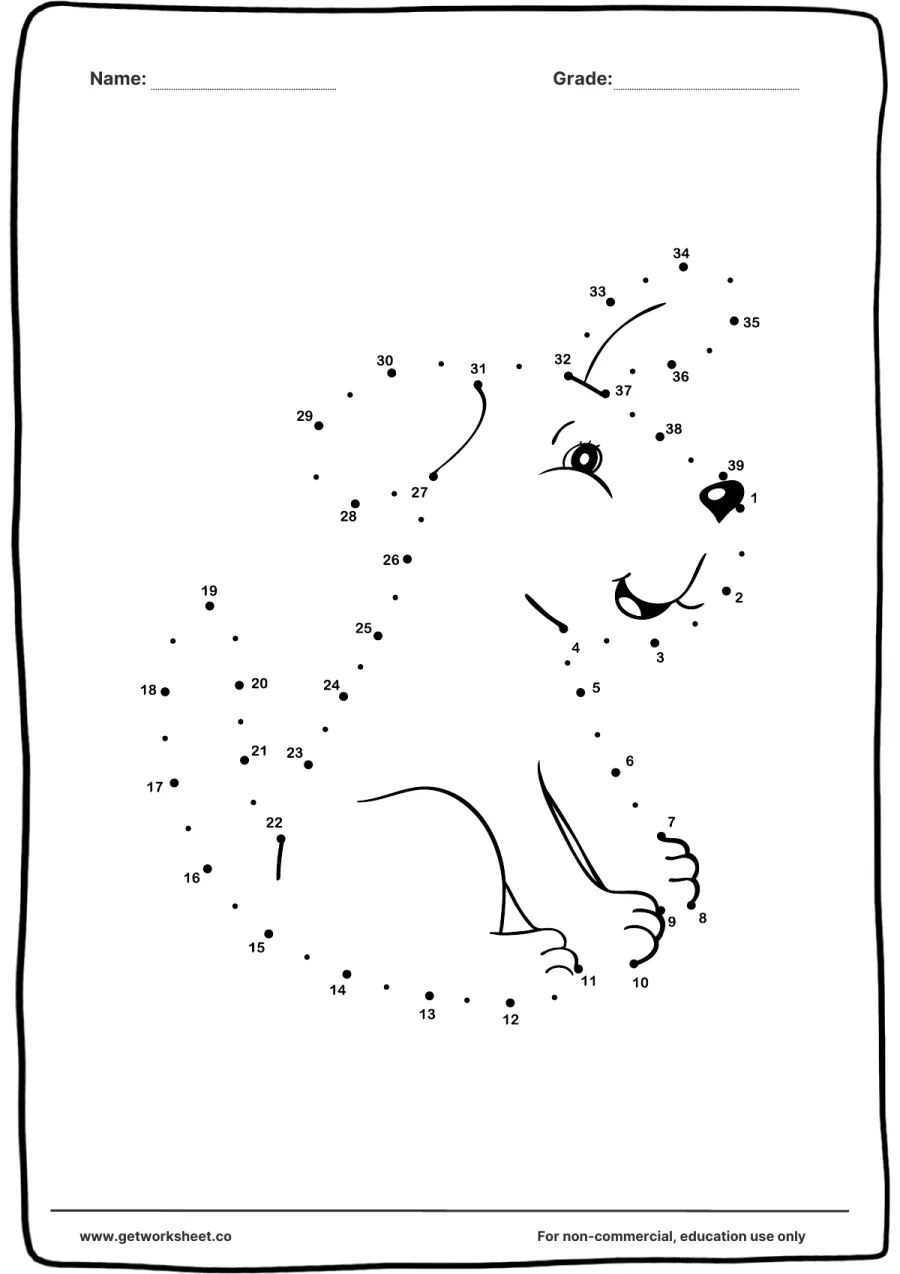
Connect the dots: sitting bear cub (1–39)
Join the dots from 1 to 39 to draw a sitting bear cub with round ears and paws; its eyes, nose and smile are printed.
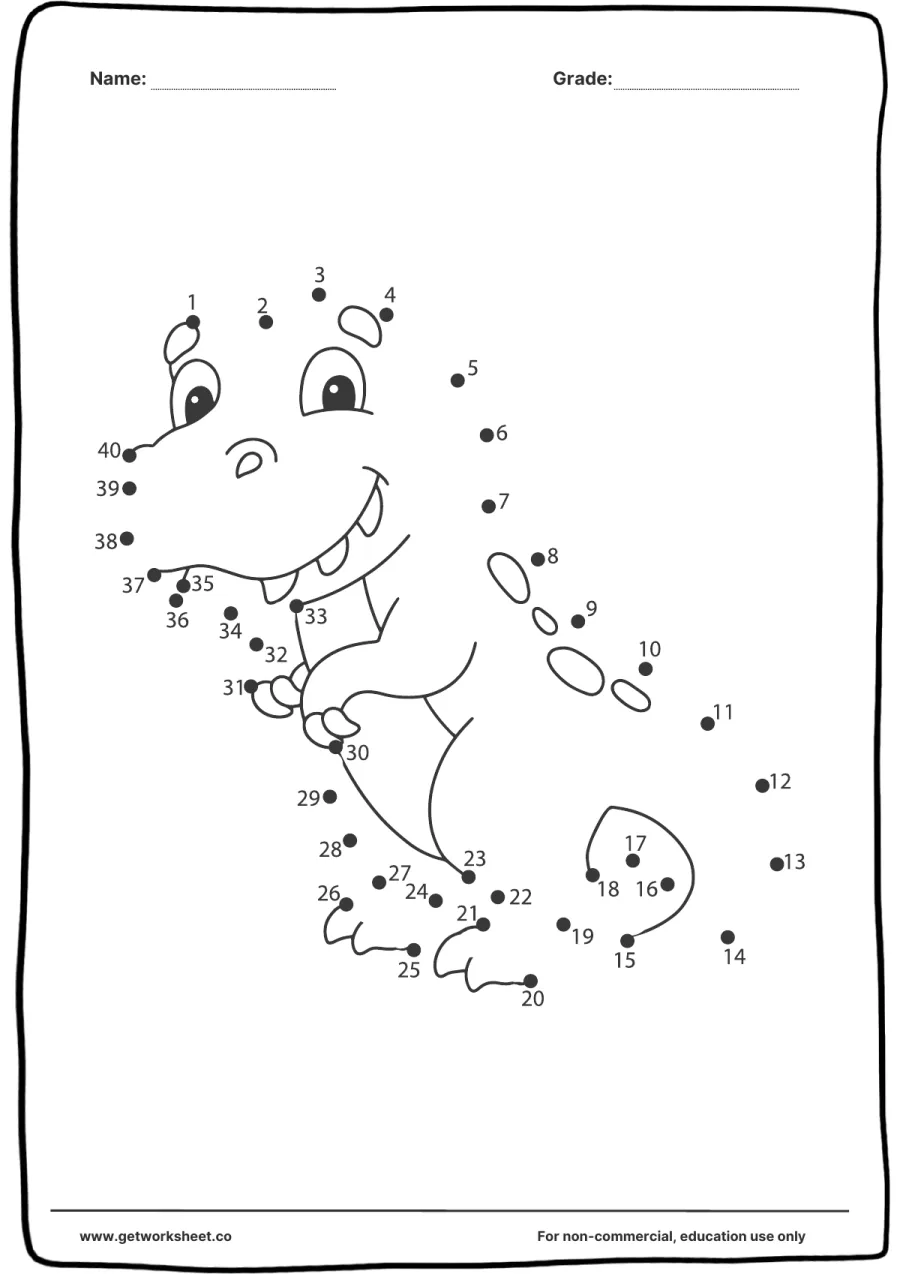
Connect the dots: smiling T-rex dinosaur (1–40)
Join the dots from 1 to 40 to finish a cartoon T-rex with big eyes, sharp teeth, short arms and a long tail, then color it.
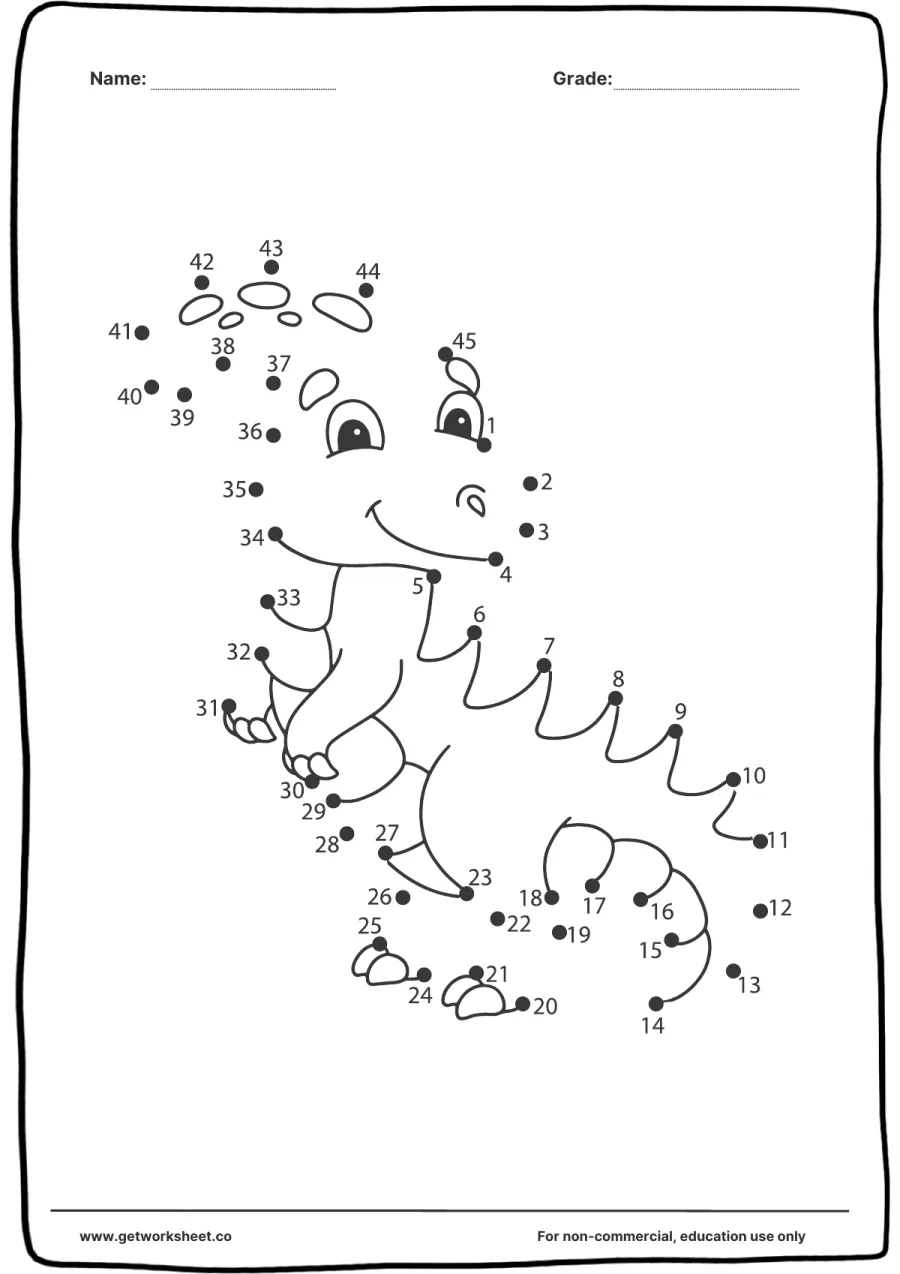
Connect the dots: baby dragon with back spikes (1–45)
Join the dots from 1 to 45 to outline a cartoon baby dragon with a row of back spikes, claws and a curled tail.
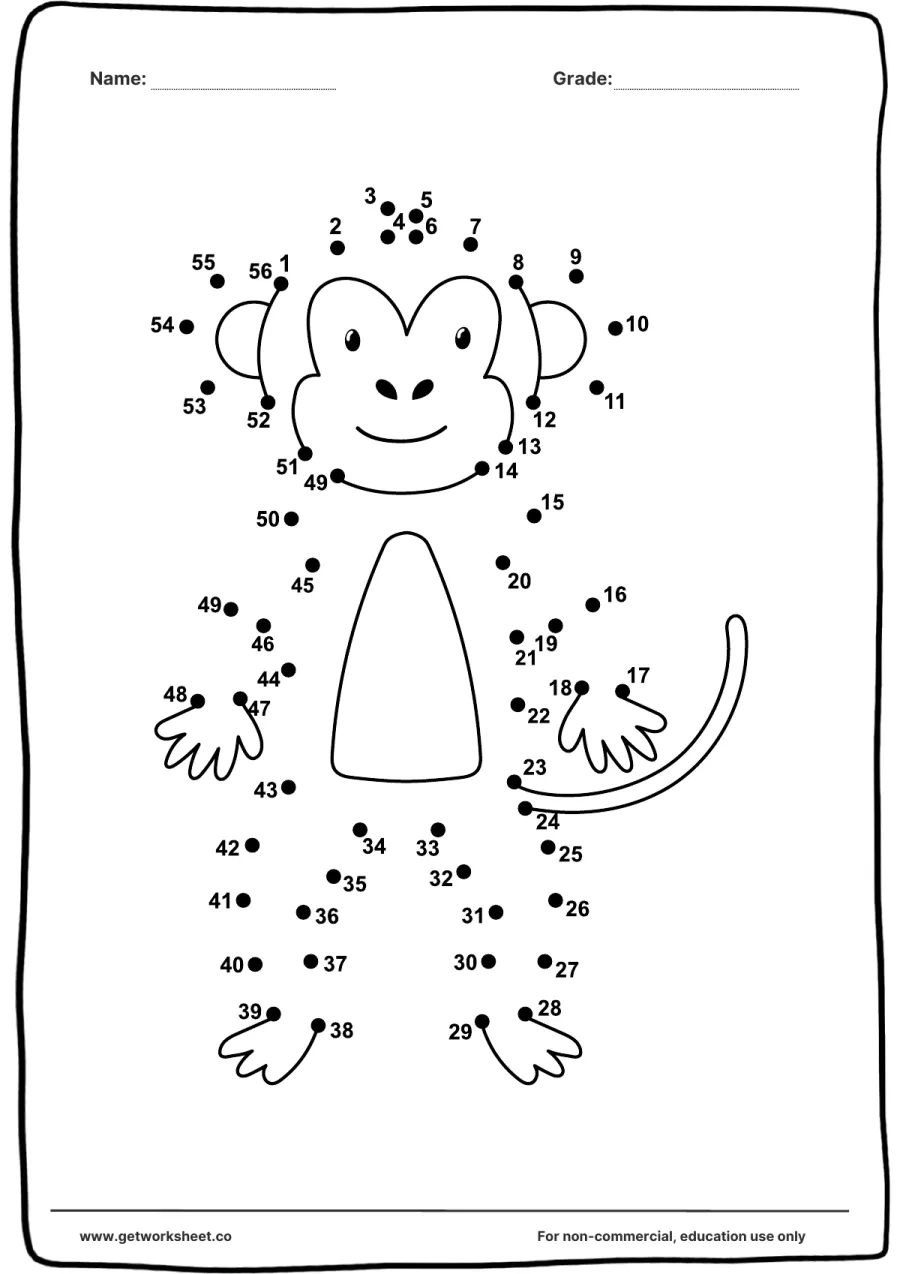
Connect the dots: standing monkey (1–56)
Join the dots from 1 to 56 to draw a standing monkey with round ears, a curly tail and outstretched hands and feet.
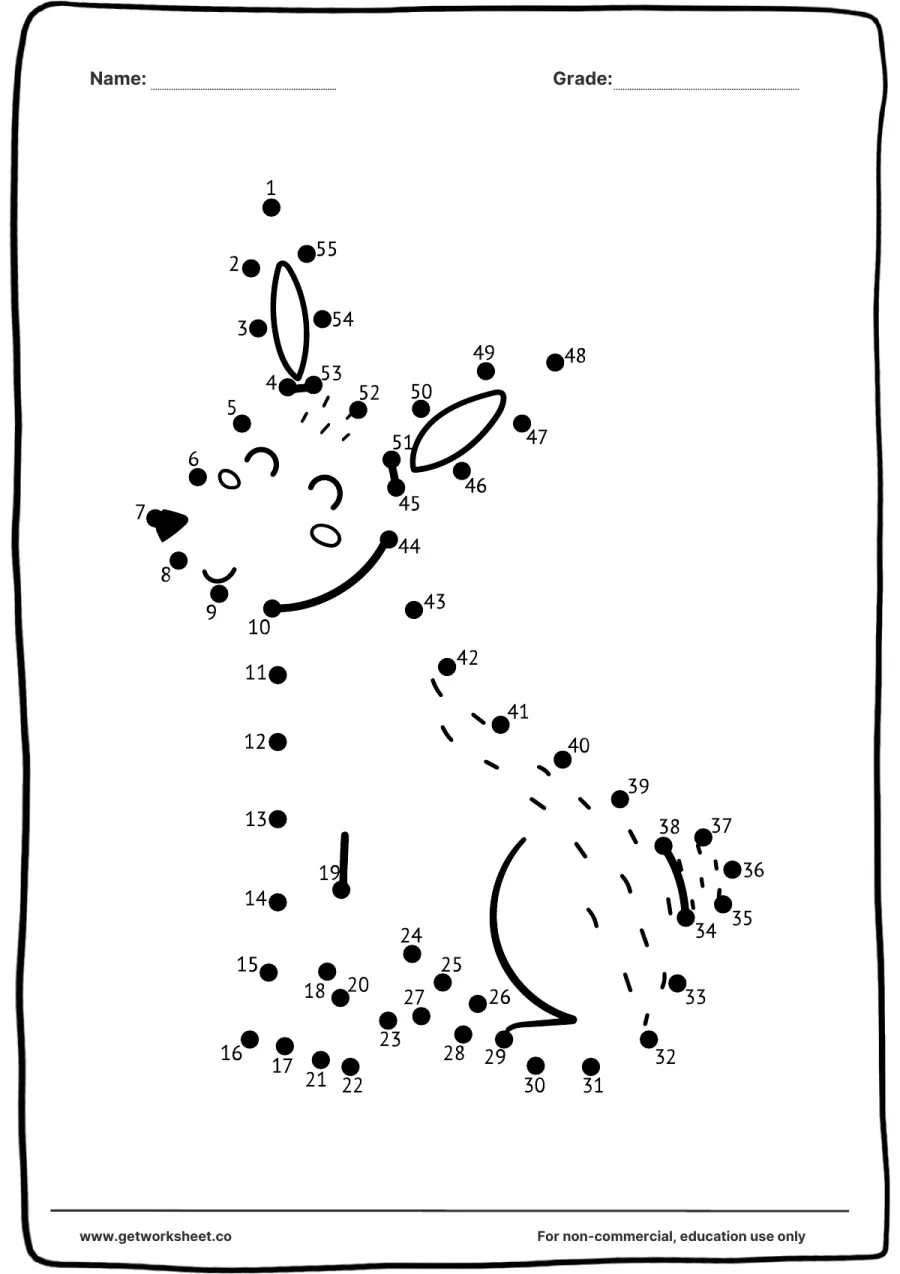
Connect the dots: kitten with a curled tail (1–55)
Join the dots from 1 to 55 to complete a kitten with pointed ears, whiskers, a long curling tail and a striped chest.
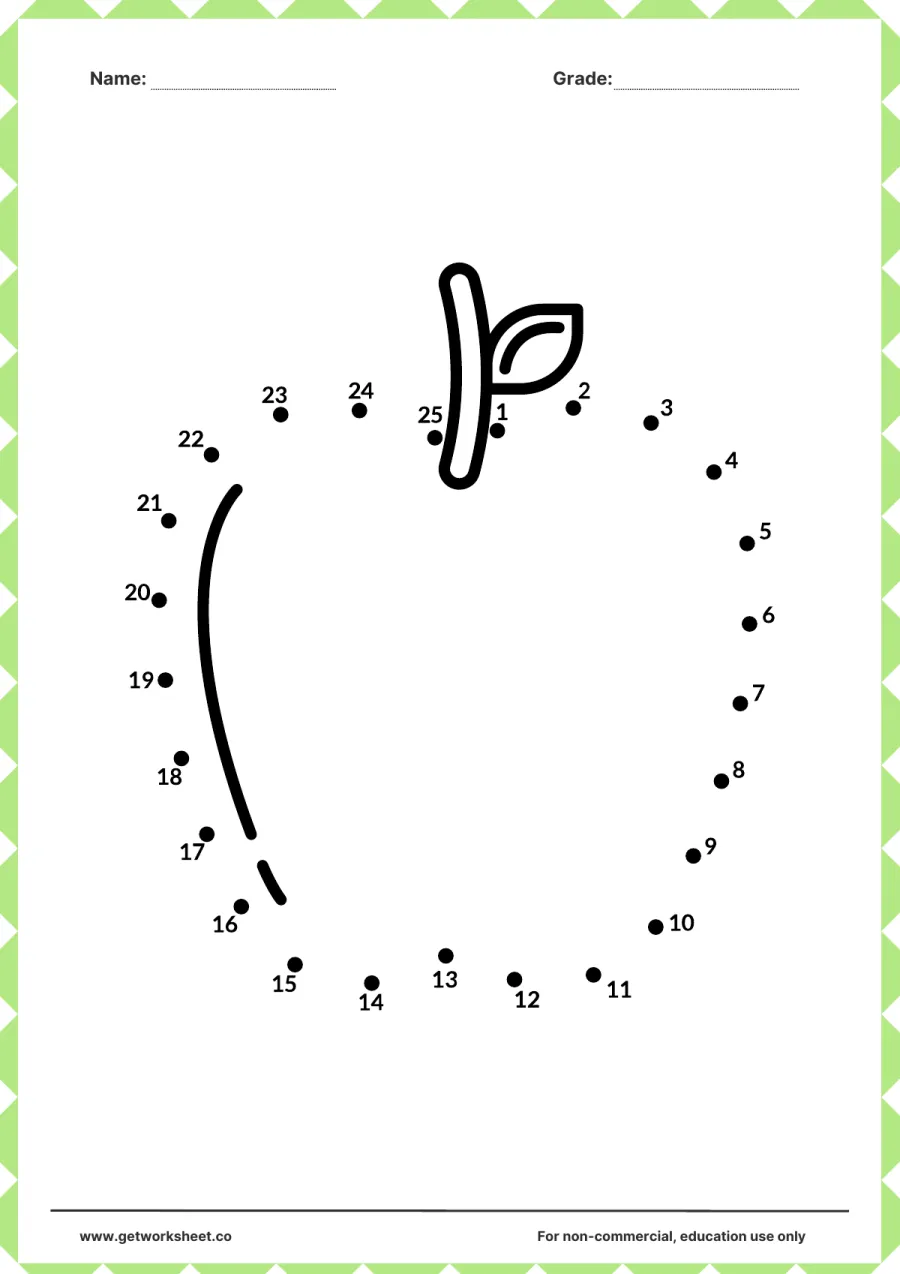
Connect the dots: apple with a leaf (1–25)
Join the dots from 1 to 25 to draw a round apple; the stem and leaf are already printed, so the child completes the fruit.
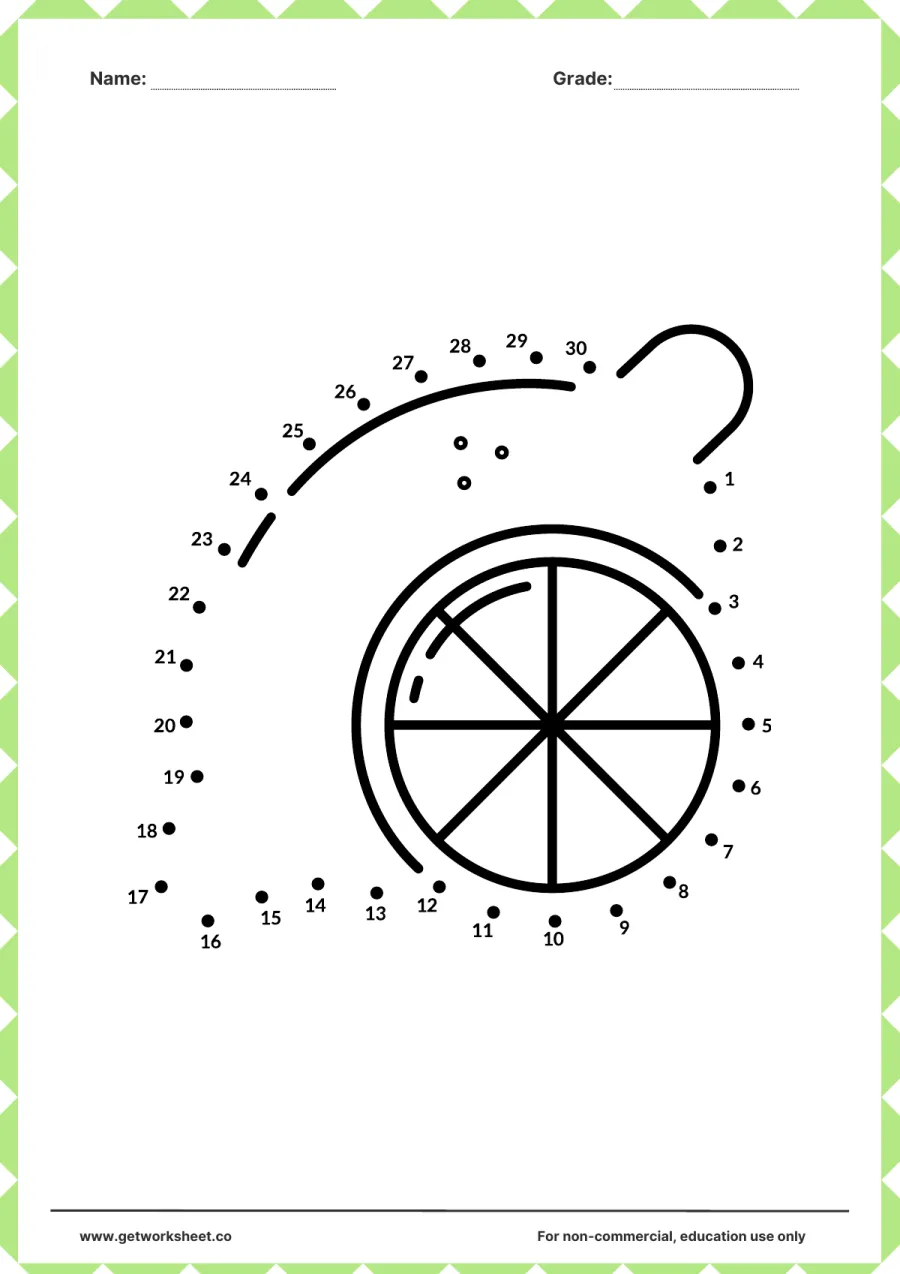
Connect the dots: lemon with a cut slice (1–30)
Join the dots from 1 to 30 to outline a whole lemon and peel curl beside a printed cross-section slice with eight segments.
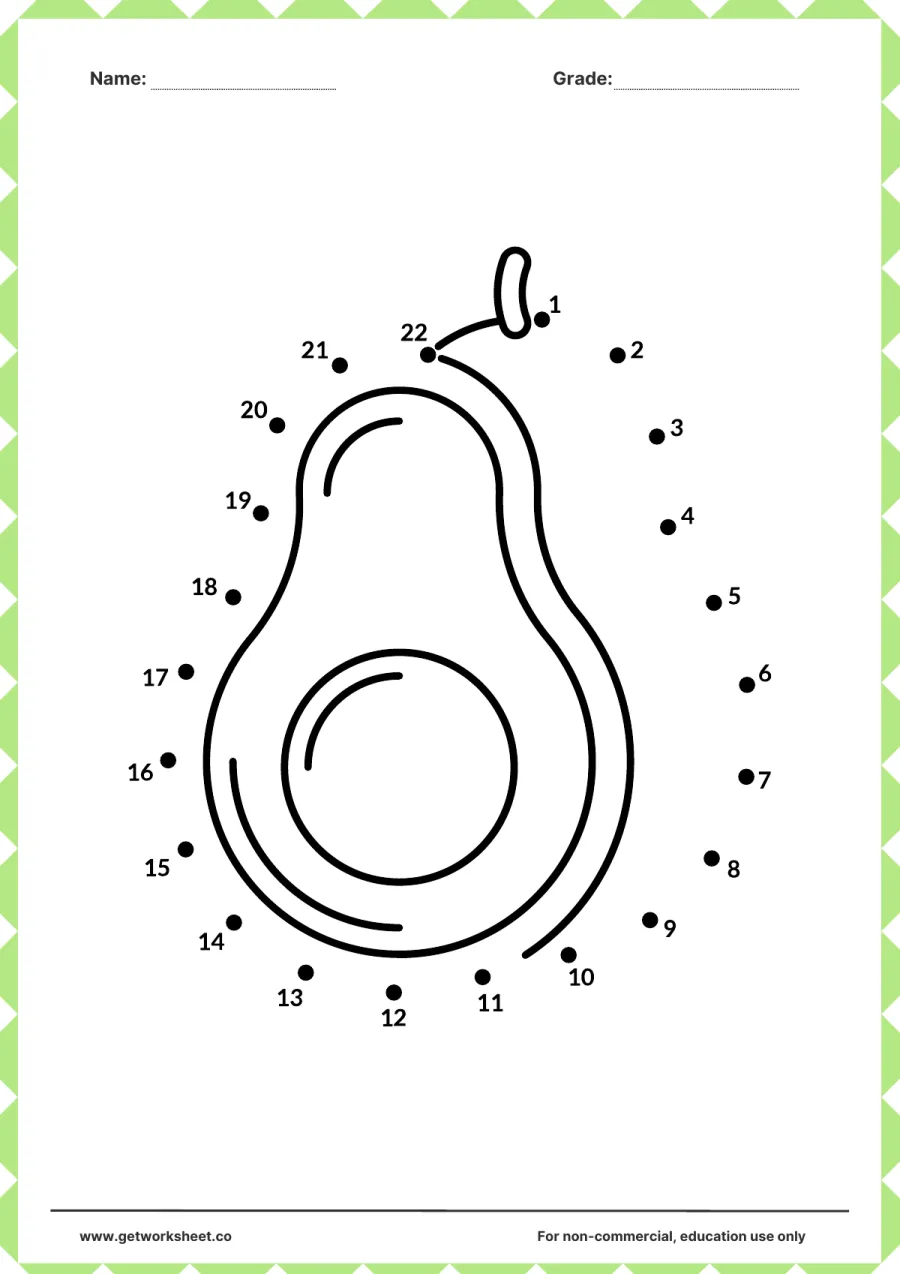
Connect the dots: halved avocado (1–22)
Join the dots from 1 to 22 to draw the outside of an avocado; the inside half with its round pit is printed on the page.
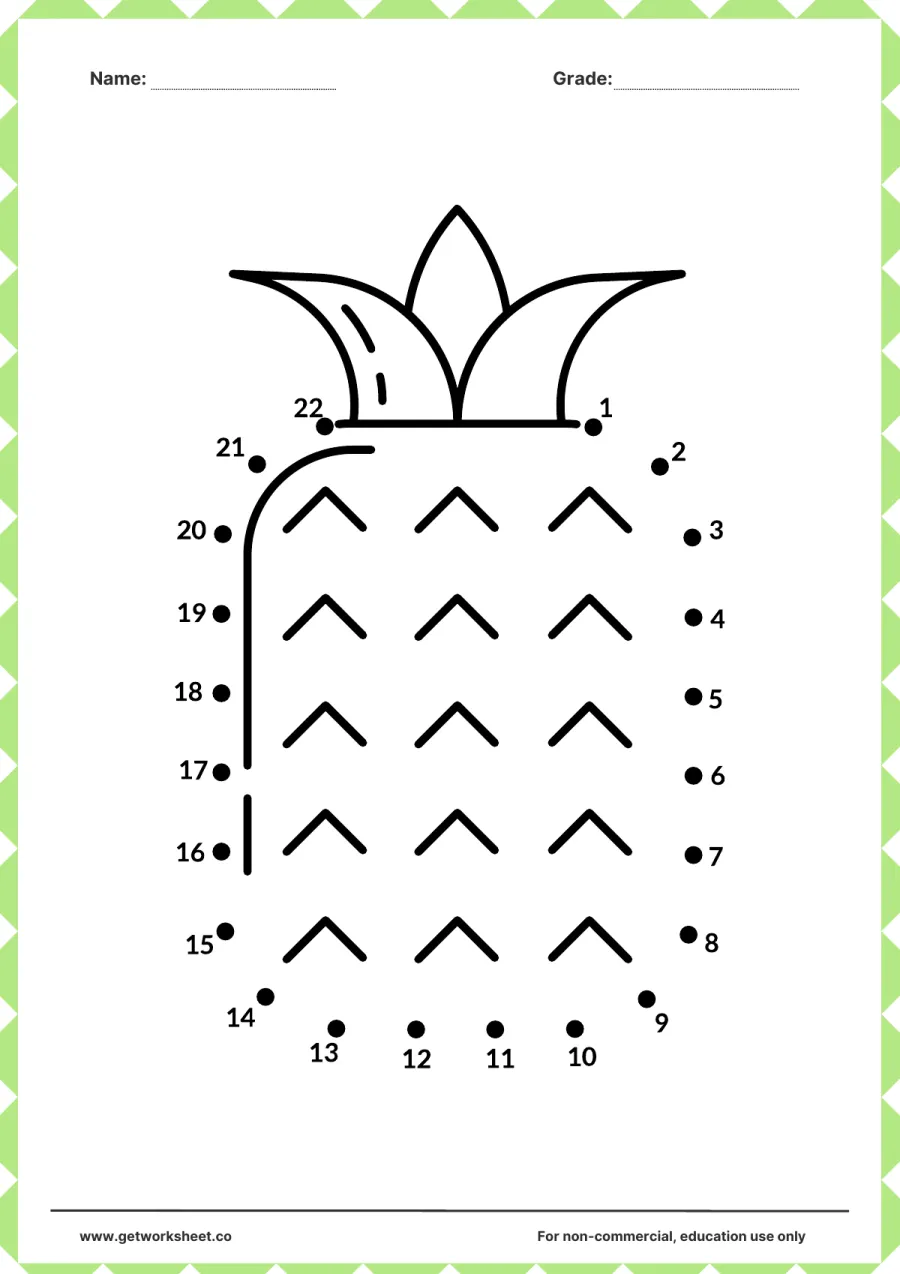
Connect the dots: pineapple with crown leaves (1–22)
Join the dots from 1 to 22 around a pineapple body patterned with chevrons; the leafy crown is already drawn.
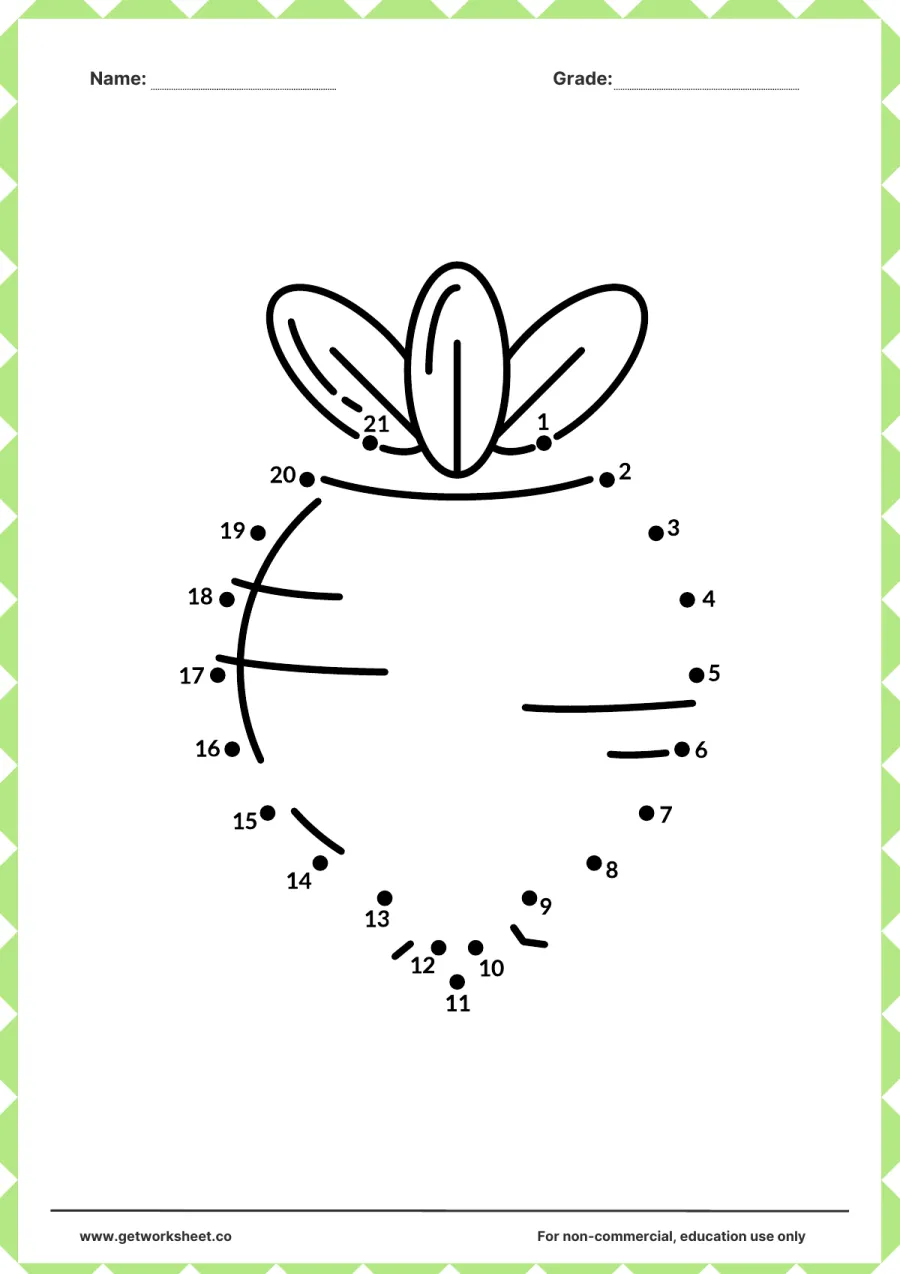
Connect the dots: strawberry with leaves (1–21)
Join the dots from 1 to 21 to complete a strawberry with dashes for seeds and a printed leafy top, then color it red.
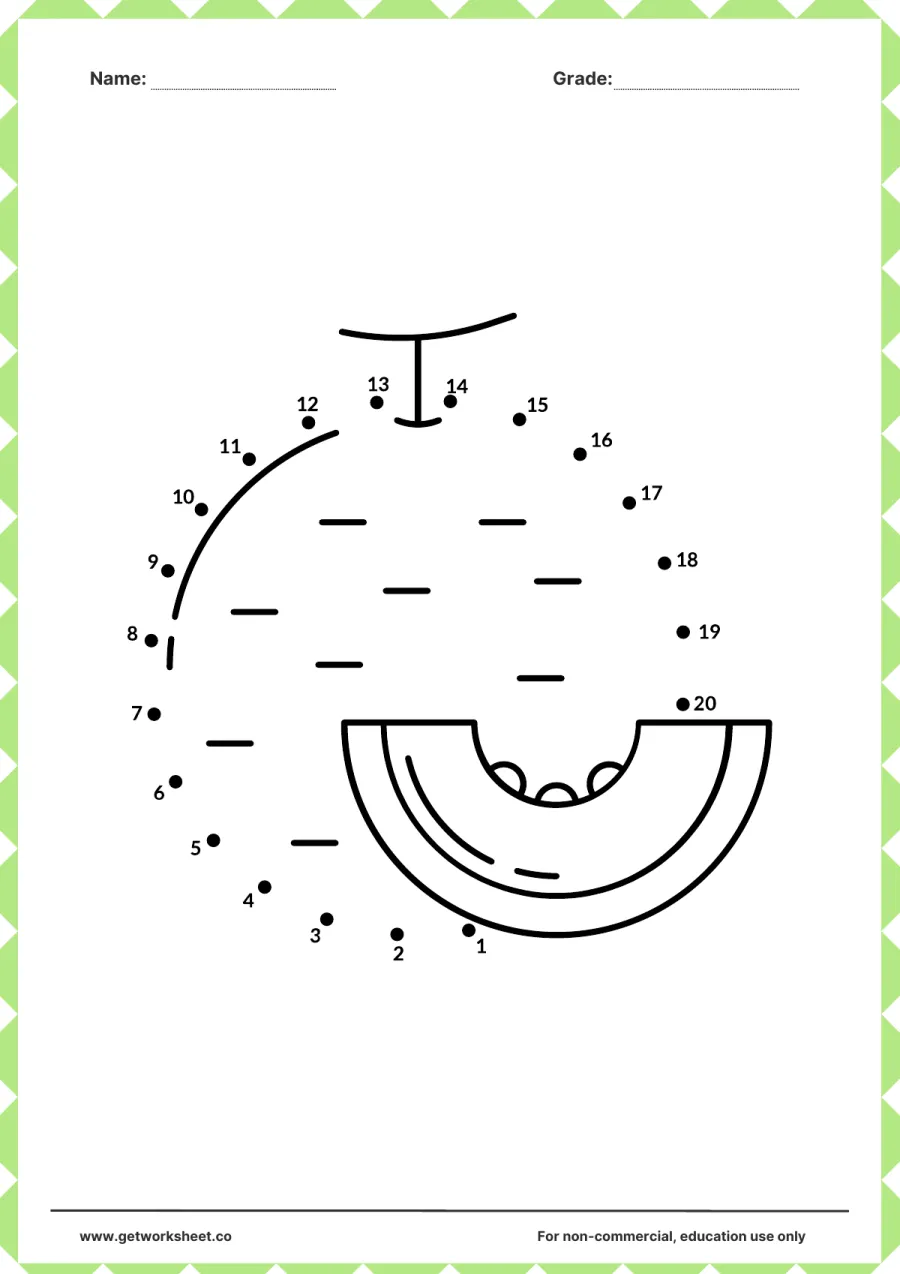
Connect the dots: round melon with a wedge (1–20)
Join the dots from 1 to 20 to outline a whole melon with a stem; a cut wedge showing seeds is printed at the bottom.
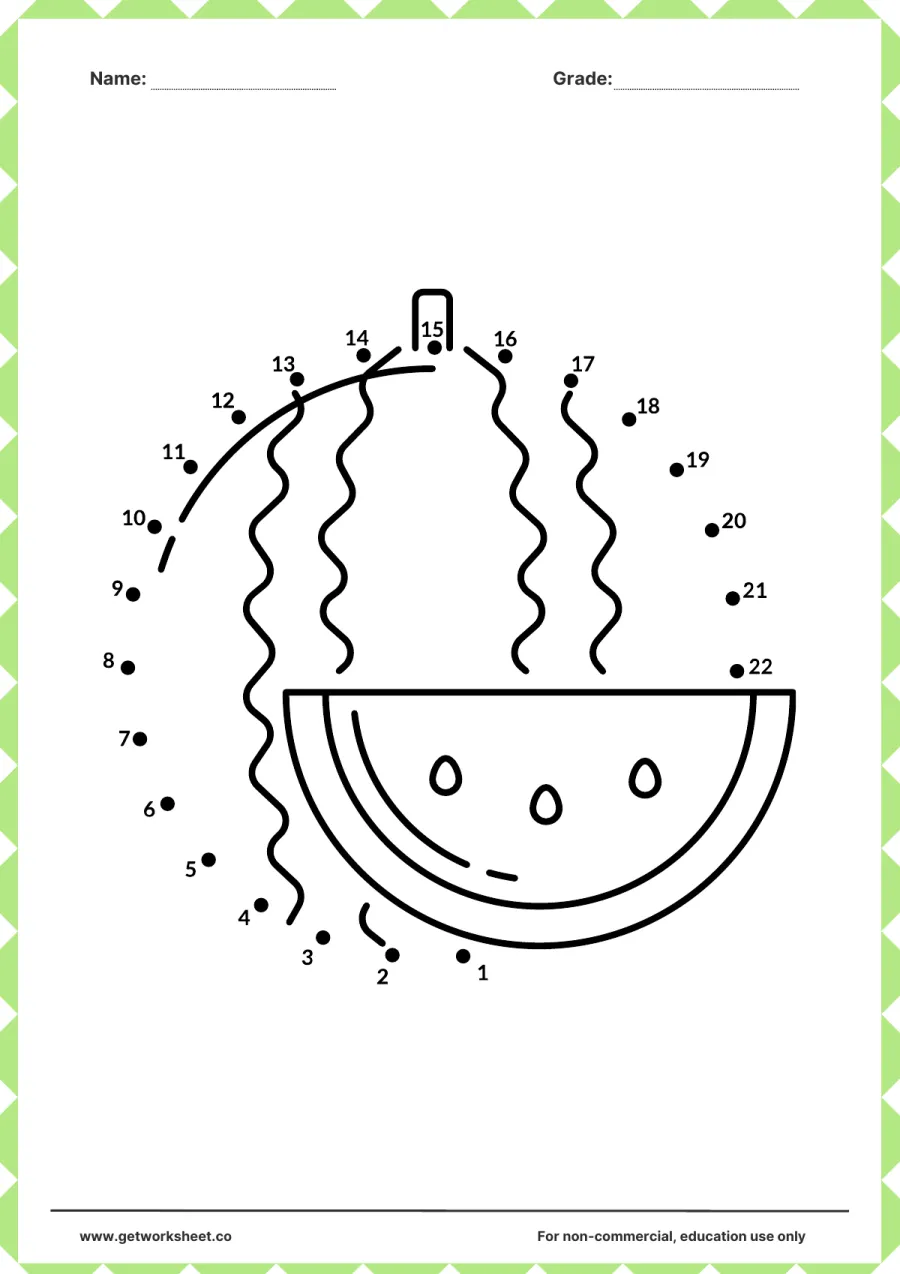
Connect the dots: watermelon with wavy stripes (1–22)
Join the dots from 1 to 22 to draw a whole watermelon with wavy stripes; a cut slice with seeds is printed below.
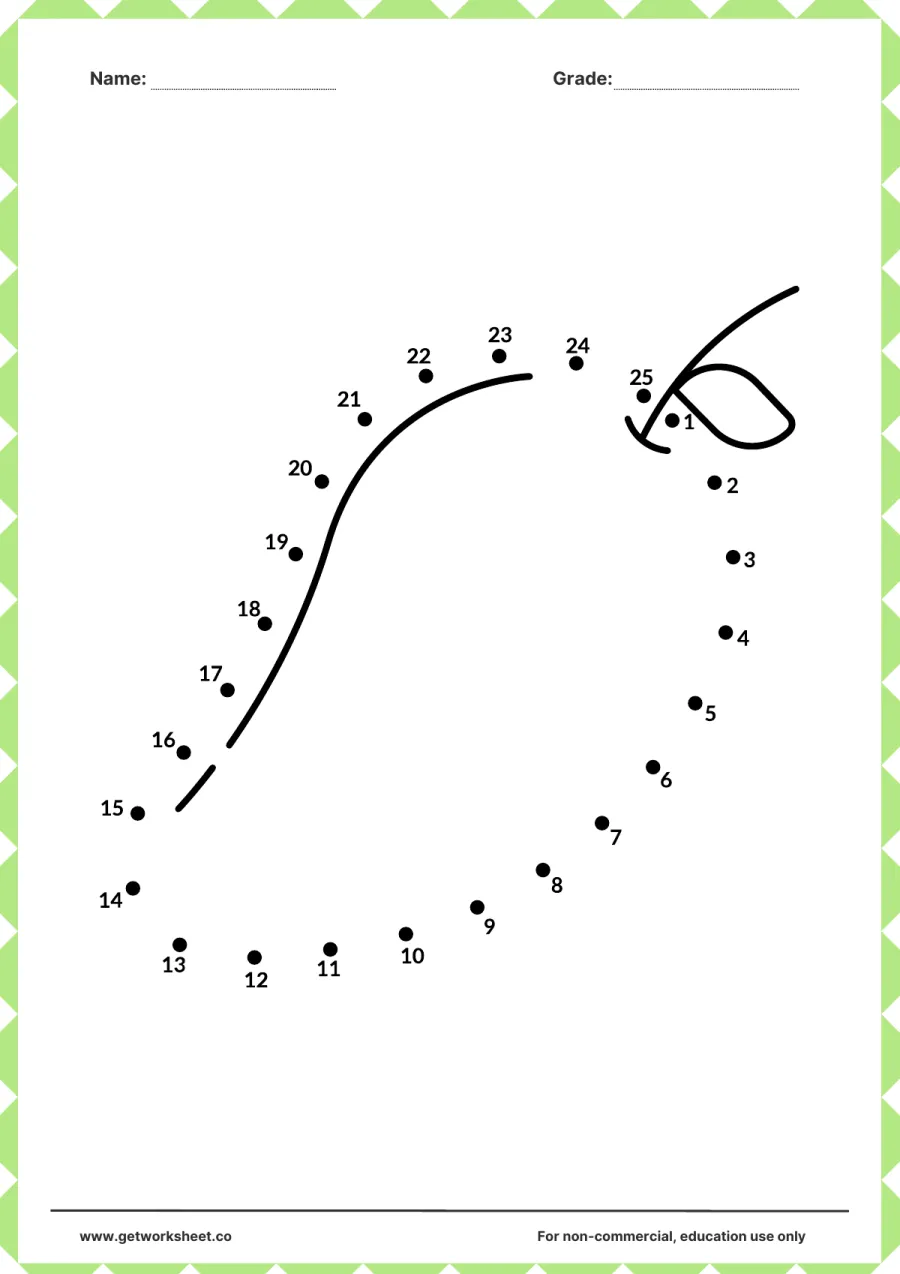
Connect the dots: curved banana (1–25)
Join the dots from 1 to 25 to draw a long curved banana; the stem end and a small leaf are printed to start from.
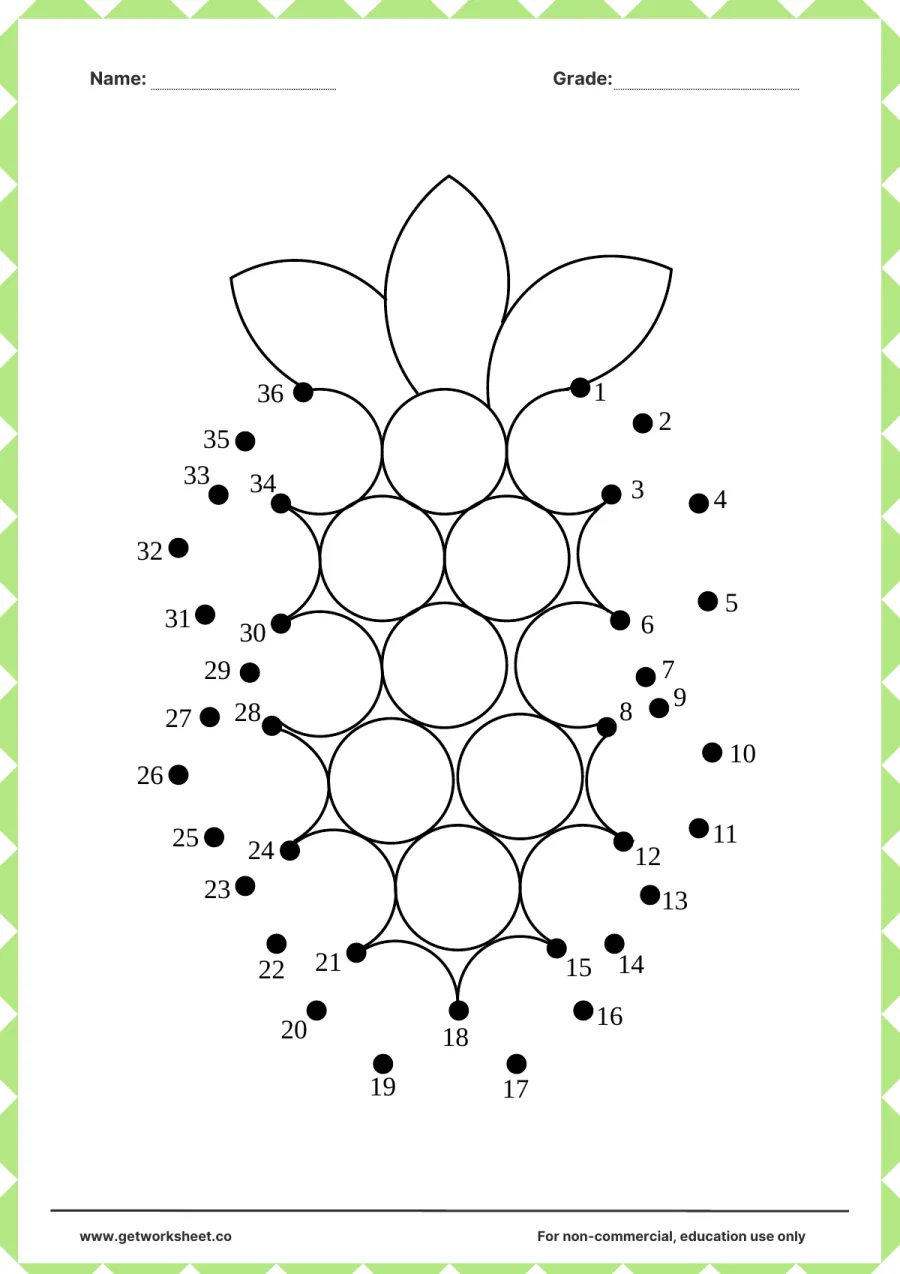
Connect the dots: pineapple with diamond skin (1–36)
Join the dots from 1 to 36 around a pineapple whose skin is drawn as rows of circles, with the crown leaves printed.
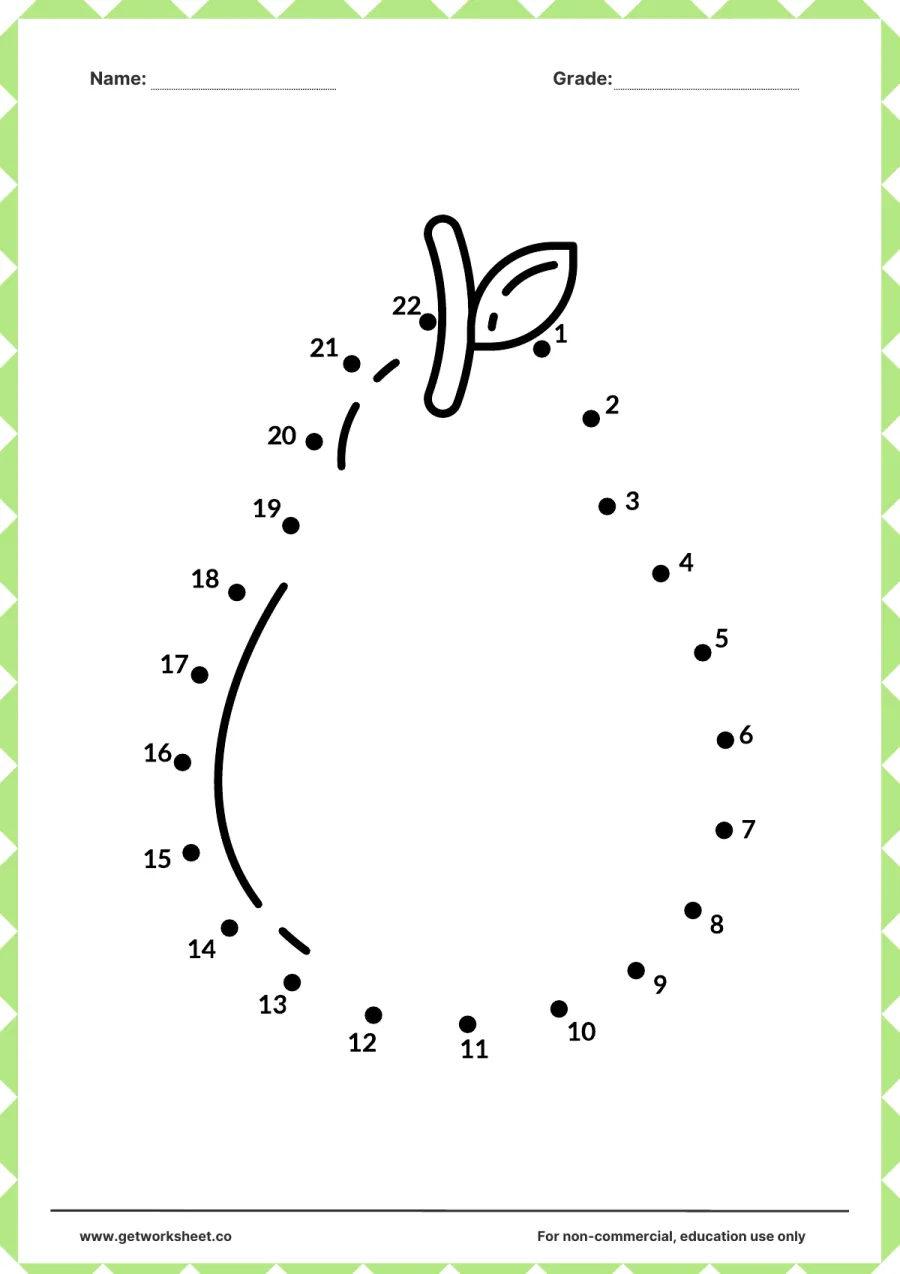
Connect the dots: pear with a stem and leaf (1–22)
Join the dots from 1 to 22 to draw a pear shape; the stem and leaf are printed at the top to guide the child.
AI worksheet generator
Make a worksheet like this for your class
The 20 sheets above are fixed. The generator writes a new connect the dots worksheet for your grade, with the question types and count you choose, in about 20 seconds. Pick a grade to start:
What you get
- A fresh set of questions on connect the dots, not a copy of the sheets above
- Multiple choice, fill in the blanks, true or false, open ended
- Answer key and print-ready PDF with Pro
Free account, 1 worksheets a week. No card.
These 20 connect the dots printables come in two groups. The first ten are animals: a striped bumblebee (1 to 39), a sitting cat (1 to 61), a spotted ladybug (1 to 32), a long-eared rabbit (1 to 57), a flying bird (1 to 70, the longest sheet in the set), a bear cub (1 to 39), a smiling T-rex (1 to 40), a baby dragon with back spikes (1 to 45), a standing monkey (1 to 56) and a kitten with a curled tail (1 to 55). The second ten are fruit and are shorter, from 20 to 36 dots: apple, lemon, avocado, two pineapples, strawberry, melon, watermelon, banana and pear. On most fruit sheets part of the picture, such as a stem, leaf or cut slice, is already printed, so the child only draws the outline.
Joining numbered dots turns counting into a picture. A child who can count to 20 can start with the melon or strawberry; a child who is confident past 50 can try the cat, rabbit or bird. Every finished picture can then be colored in.
What Students Will Practice
- Counting in order from 1 to 20 (melon) up to 1 to 70 (flying bird), with every sheet starting at 1
- Finding the next numeral among nearby dots, which gets harder on the 55 to 70 dot animal sheets
- Drawing straight lines between two points
- Completing a shape when part of it, such as the pineapple crown or the lemon slice, is already drawn
- Coloring the finished bumblebee, ladybug, strawberry or watermelon
Free printable makers
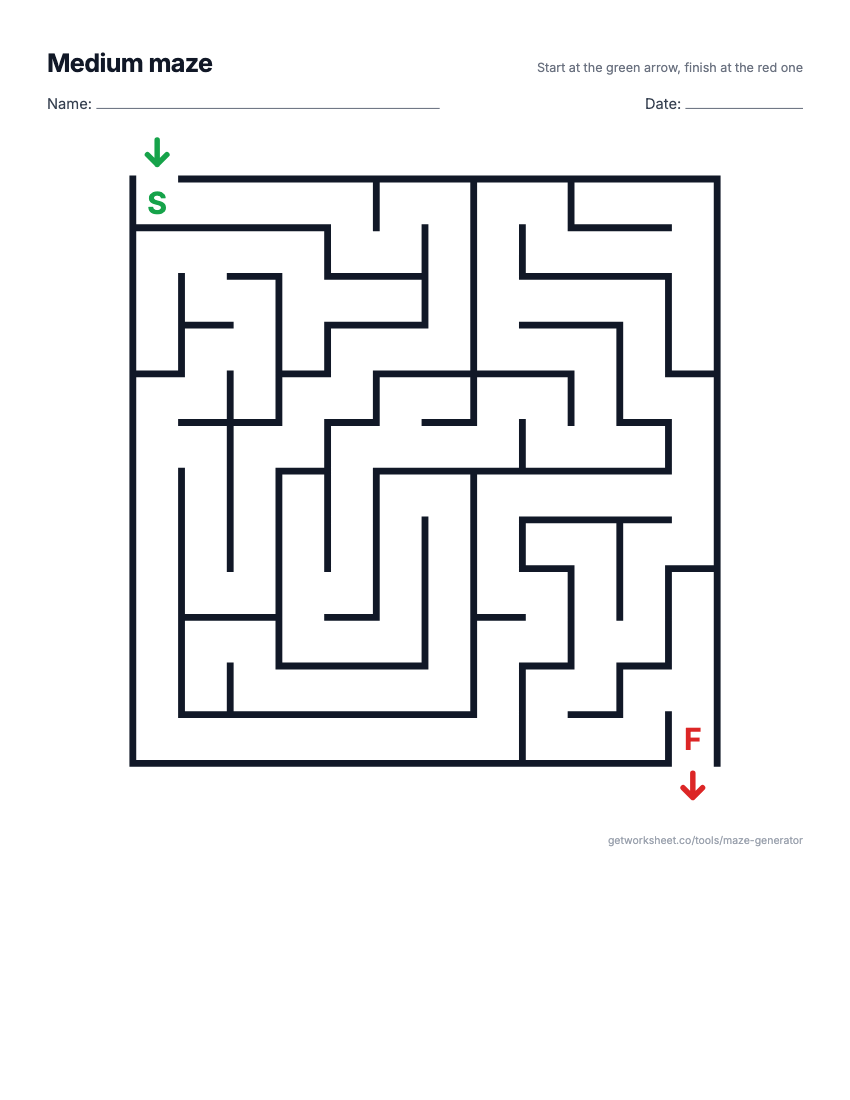
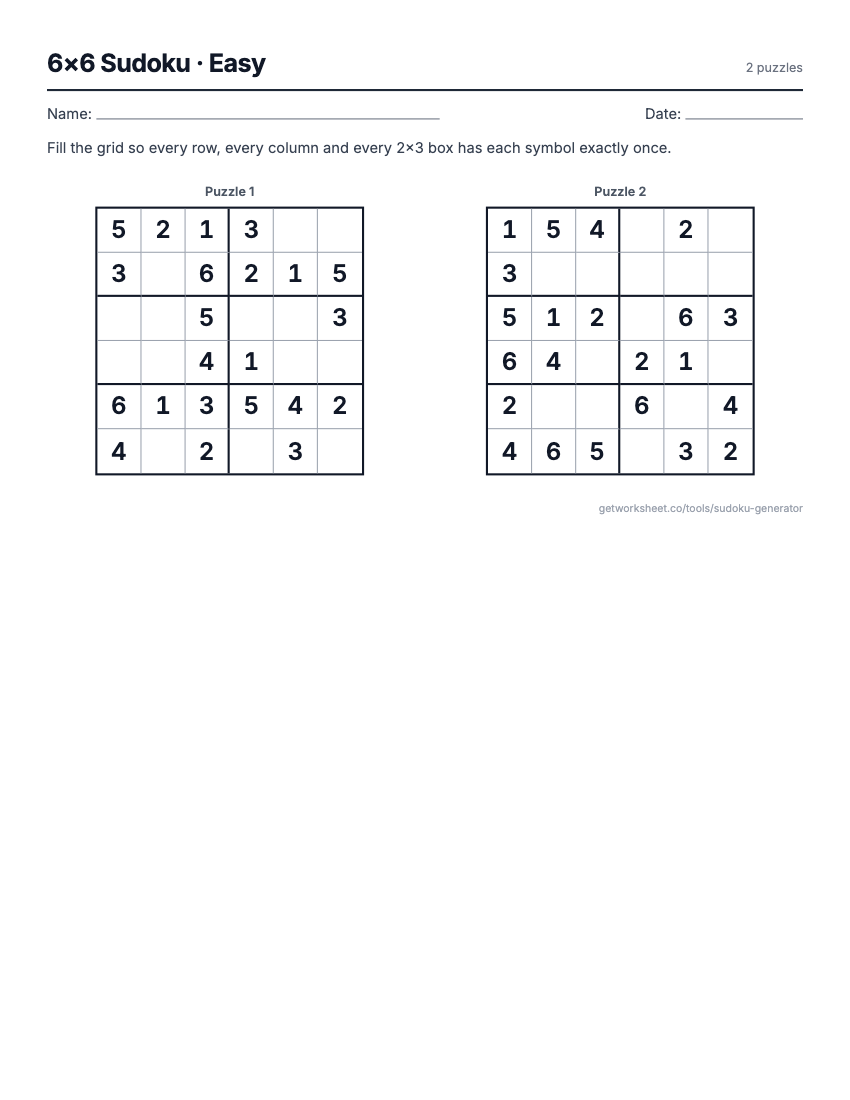
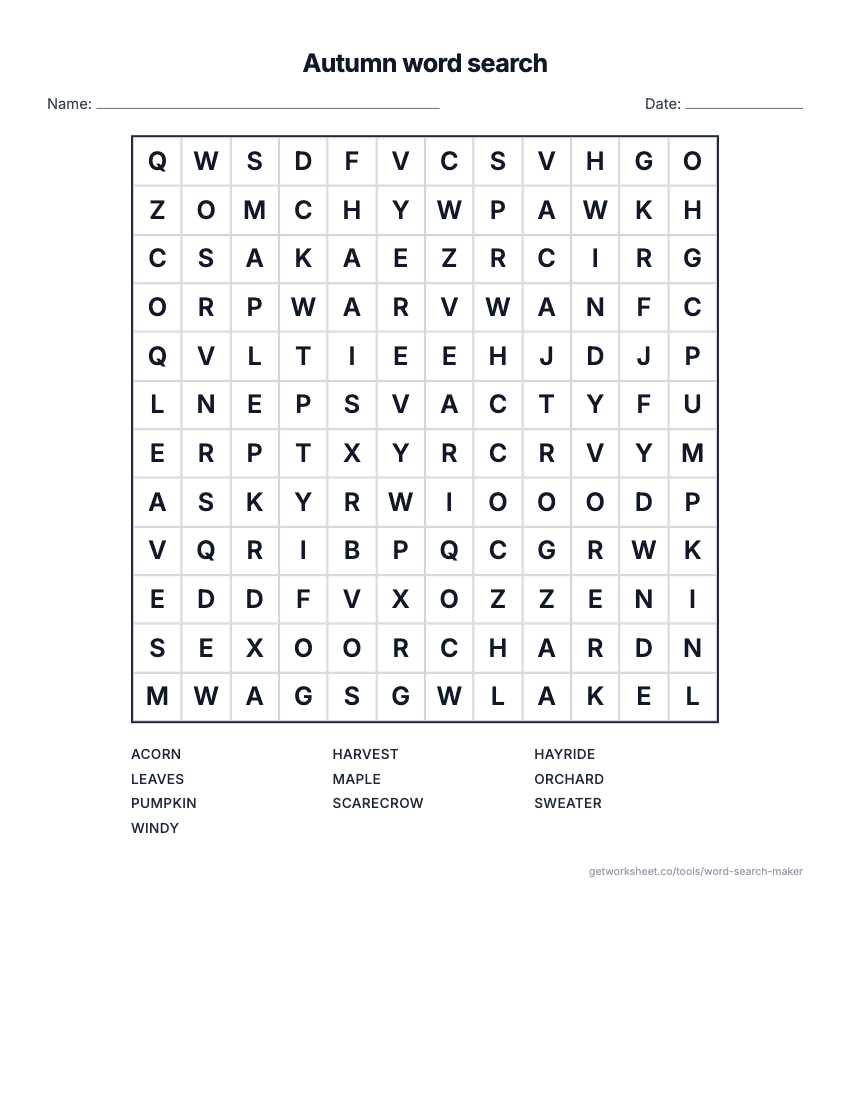
Make your own connect the dots sheets
Type your own words or numbers and print in about 30 seconds. No account, no AI, answer key where it applies.
AI worksheet generator
Need a different connect the dots worksheet?
Generate a custom connect the dots worksheet: pick the grade, question types and count, and print it in about 20 seconds. Free accounts get 1 generation a week.
How to Use These Worksheets
The hidden picture is the motivation, use it to drive careful counting.
- Match the dot count to your child's counting ability. If they can count to 20 but not to 40, start with the melon (1-20), the strawberry (1-21) or one of the 22-dot fruit sheets. Success builds confidence. A puzzle that's too hard (dots they can't count to) leads to frustration and guessing.
- Have your child say each number aloud as they connect the dots: "One... two... three..." Hearing the number sequence reinforces it audibly while the hand draws the visual connection. This multi-sensory approach strengthens number memory.
- Encourage straight, deliberate lines between dots rather than curving or looping. The quality of the final picture depends on clean connections. This is also good pencil control practice, drawing a straight line between two specific points is a pre-writing skill.
- After the picture is revealed, let your child color it in. This doubles the activity time and adds a creative element. Ask them to guess what the picture is partway through, this builds prediction skills and keeps them motivated to continue.
Common Mistakes to Watch For
- Skipping a number: Jumping from 7 to 9 (missing 8) creates a misshapen picture. If your child skips numbers frequently, they may need more practice with that number range outside of connect-the-dots. The puzzle reveals exactly where their counting breaks down.
- Connecting to the wrong dot: In dense puzzles, dots are close together and it's easy to connect to the wrong one. Teach your child to find the next number BEFORE drawing the line. Point to it with a finger first, then draw.
- Losing their place: On longer puzzles, children sometimes forget which dot they just connected. Have them circle or cross out each number after connecting it. This tracking strategy prevents backtracking and confusion.
- Rushing to see the picture: Excitement about the reveal can make children careless about connecting in order. Remind them that the picture only looks right if the dots are connected in sequence. Taking shortcuts creates a mess instead of a picture.
Frequently Asked Questions
What age should my child start connect-the-dots?
The puzzles on this page run from 20 dots (the melon) to 70 dots (the flying bird). The 20 to 30 dot fruit sheets suit ages 4-6 who can count past 20. The 39 to 45 dot animals suit ages 5-7, and the 55 to 70 dot cat, rabbit, monkey, kitten and bird challenge ages 6-8. Choose based on your child's counting ability and fine motor skills.
How do connect-the-dots help with math?
They reinforce number recognition (reading numerals), number sequencing (knowing what comes after 17), and one-to-one correspondence (each dot represents one count). Skip counting versions add multiplication readiness. The activity tests counting accuracy in a way that's immediately visible, wrong connections produce a wrong picture.
My child can count to 20 but struggles with the connect-the-dots puzzle. Why?
Reciting numbers in order is different from finding specific numerals on a page. Connect-the-dots requires visual scanning (finding "14" among other numbers) plus counting knowledge plus fine motor skills, all at once. If one of these skills is weaker, the combined task feels harder than counting alone. Practice each skill separately if needed.
Are there connect-the-dots for older kids?
Yes, though not in this set, which stops at 70 dots. Complex puzzles with 100+ dots, skip counting puzzles (by 2s, 3s, 5s), and coordinate-plane dot-to-dot puzzles exist for older students. These extend the concept into more advanced math while keeping the satisfying picture reveal.
After mastering number-sequence connect-the-dots, children can progress to skip-counting puzzles, coordinate graphing activities, and eventually plotting points on a coordinate plane, the formal math version of connect-the-dots. For seasonal coloring in the same format, see the Halloween coloring pages and leprechaun coloring pages.
Free library
Related collections
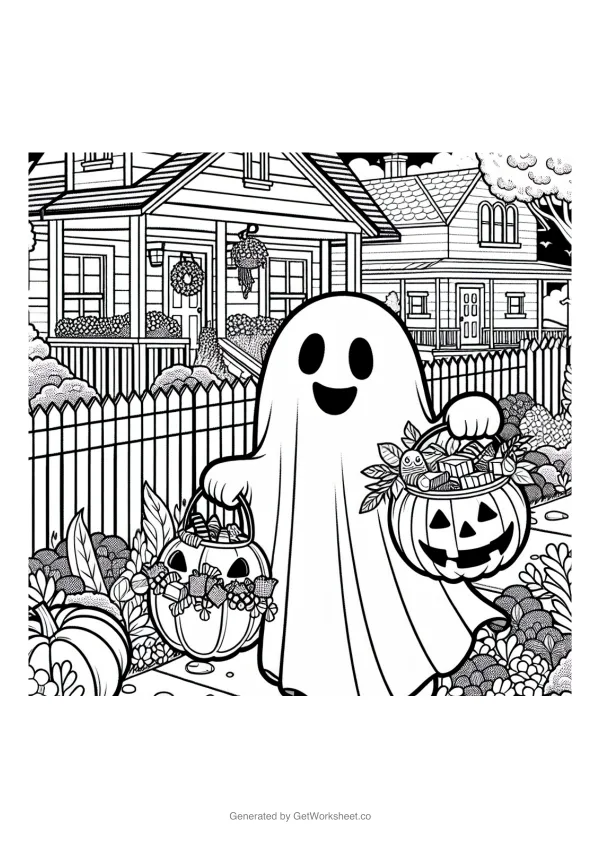
Free Halloween coloring pages
Free leprechaun coloring pages
Free color by number worksheets
Free hello kitty coloring pages
Free spring coloring pages
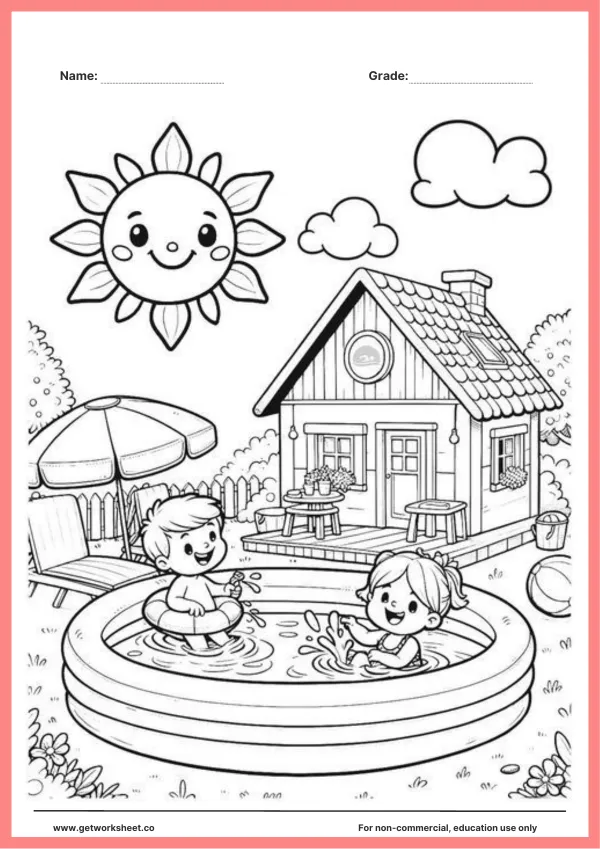
Free summer coloring pages
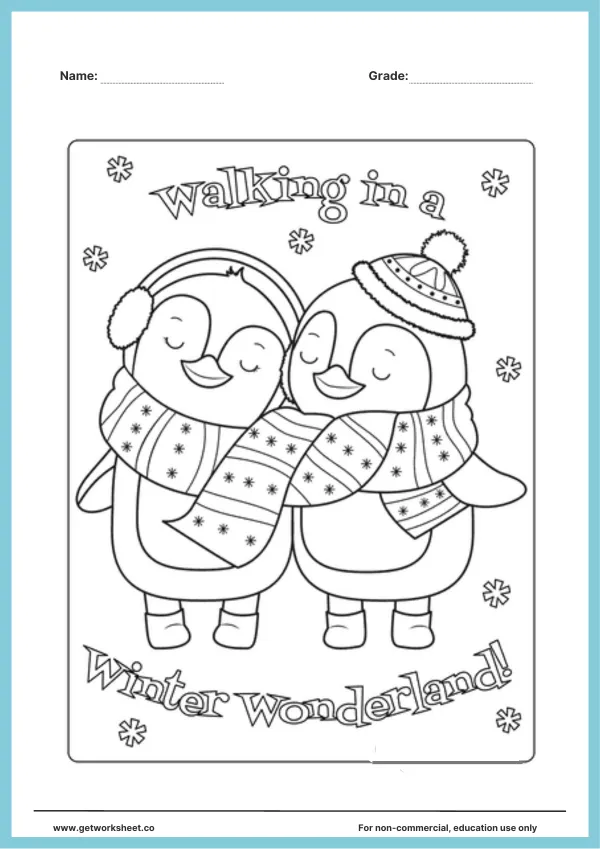
Free winter coloring pages
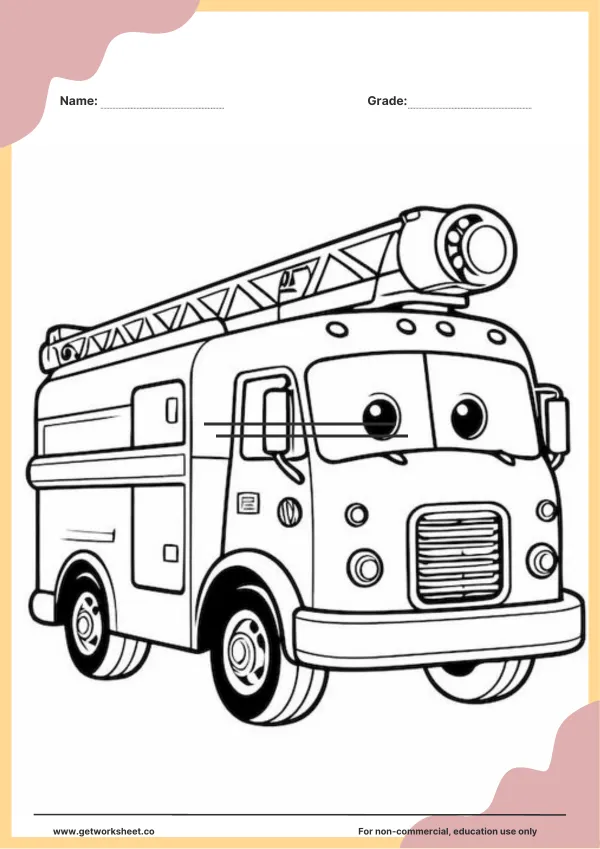
Free fire truck coloring page printable
More worksheets
- Free Merry Christmas coloring pages
- Free printable vehicle coloring pages
- Free printable animal coloring pages
- Free printable number coloring pages
- Free heart tracing worksheets
- Free Montessori language worksheets
- Free pre-writing worksheets
- Free cutting practice worksheets
- Free Montessori math worksheets: one from every material
- Free name tracing worksheets
- Free shape tracing worksheets
- Free letter Z tracing worksheets