Arts · Grades 3–8
Free color theory worksheets
Five printable color theory worksheets for grades 3 to 8: color the twelve-segment color wheel, complete ten mixing equations, sort warm and cool colors, design with color schemes, and paint tint and shade scales.
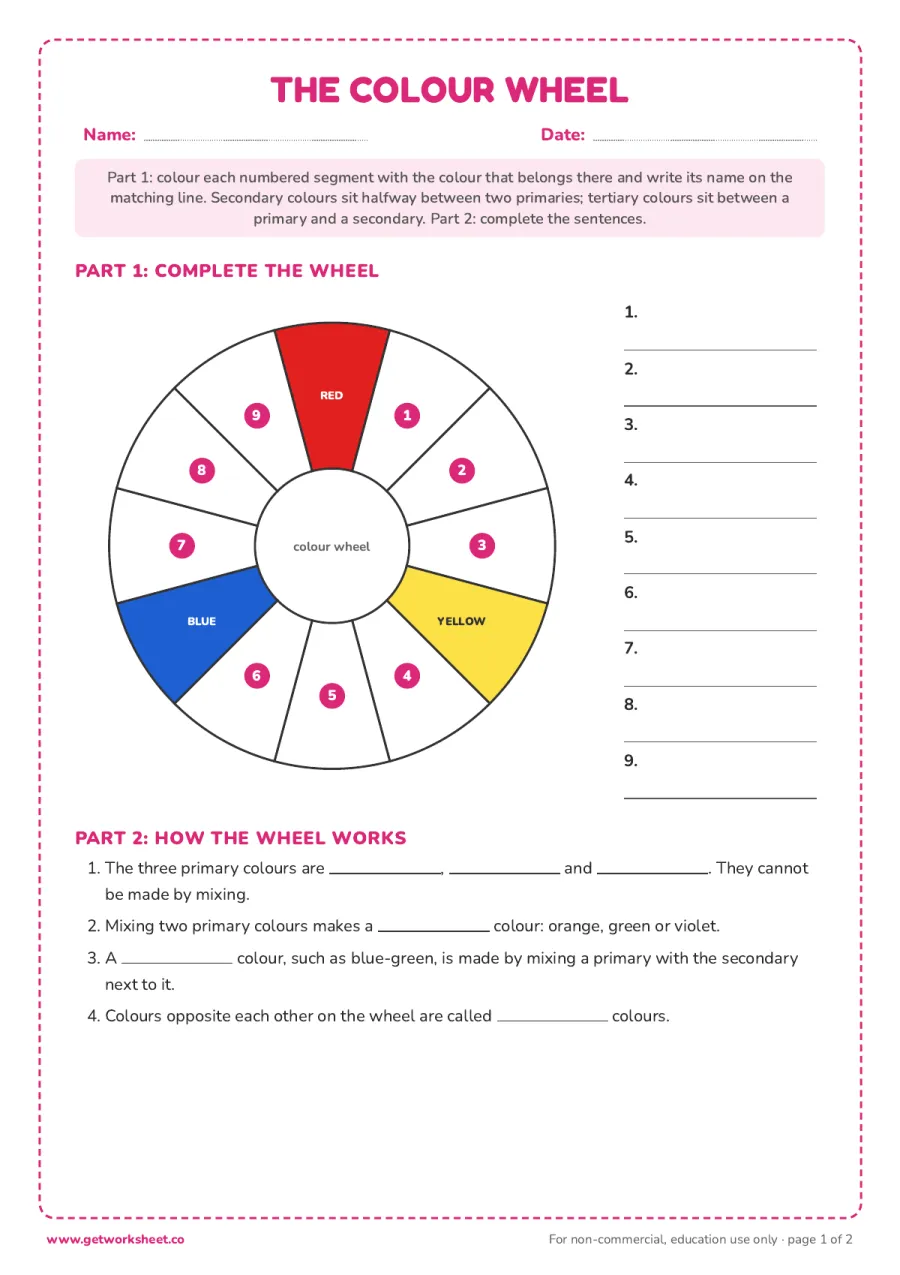
The colour wheel: colour and name the 9 missing segments
A twelve-segment colour wheel with the three primaries filled in. Students colour the nine numbered segments and write their names (secondary and tertiary colours), then complete four sentences about how the wheel is built. The key is a fully coloured, labelled wheel.
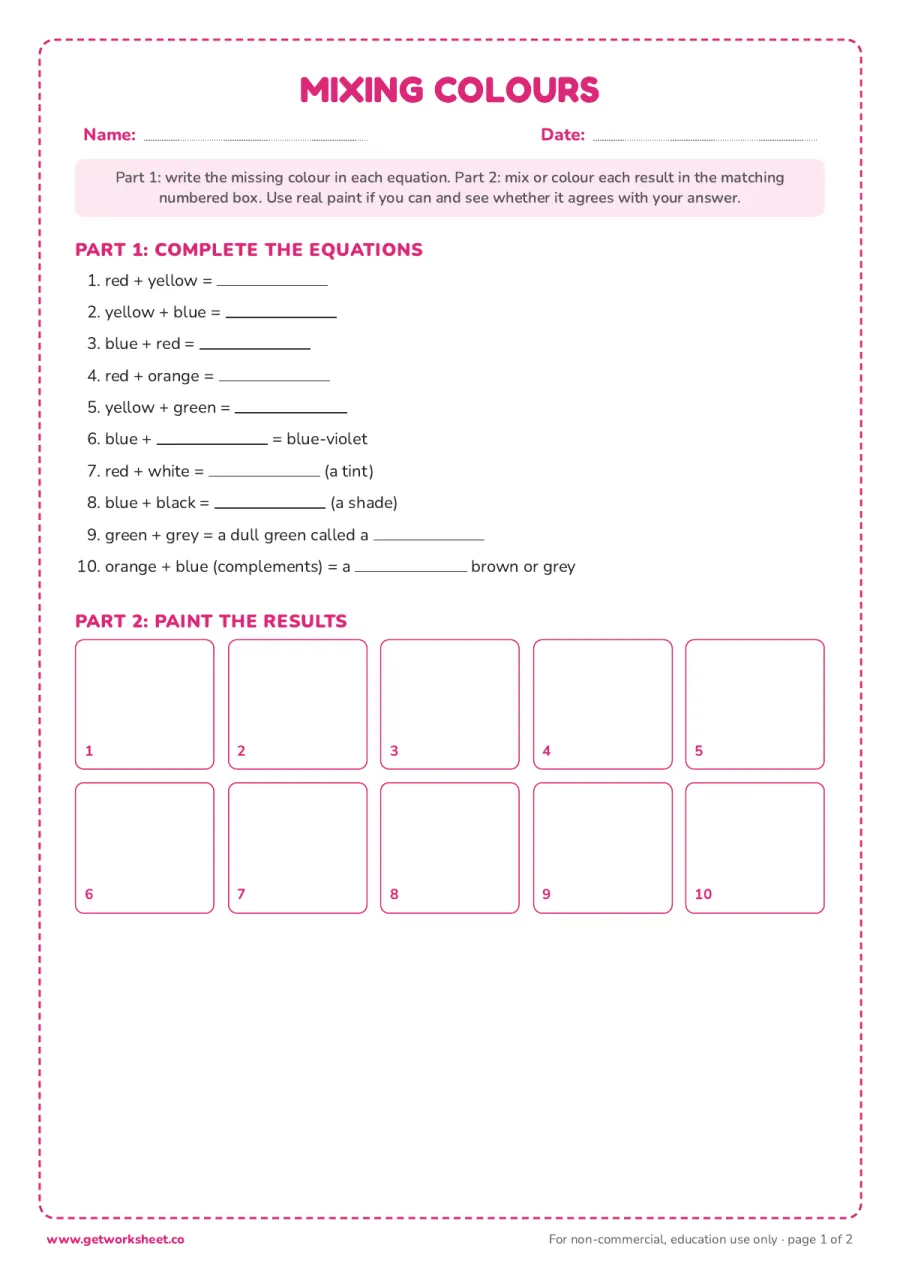
Mixing colours: 10 mixing equations, then paint the results
Ten colour-mixing equations to complete (primaries to secondaries, primary plus secondary to tertiary, adding white and black, mixing complements) and ten swatch boxes to paint or colour the results. Answer key on page 2.
Whole set
All 5 sheets in one PDF
Instant and ad-free. No account needed.
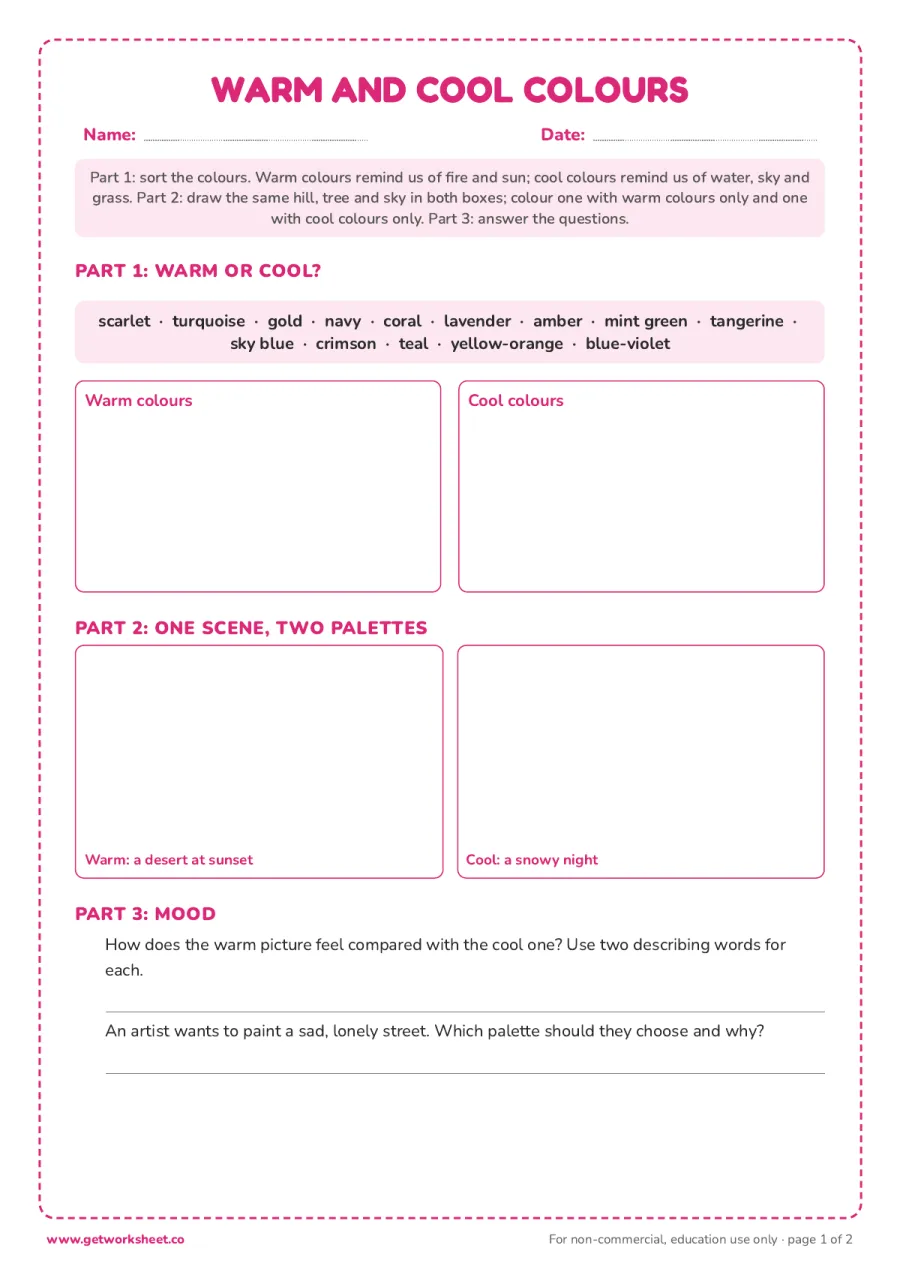
Warm and cool colours: sort 14 colours, then paint a warm and a cool scene
Sort fourteen colours into warm and cool, colour the same simple landscape twice (a desert at sunset in warm colours, a snowy night in cool colours) and answer two questions about mood. Answer key on page 2.
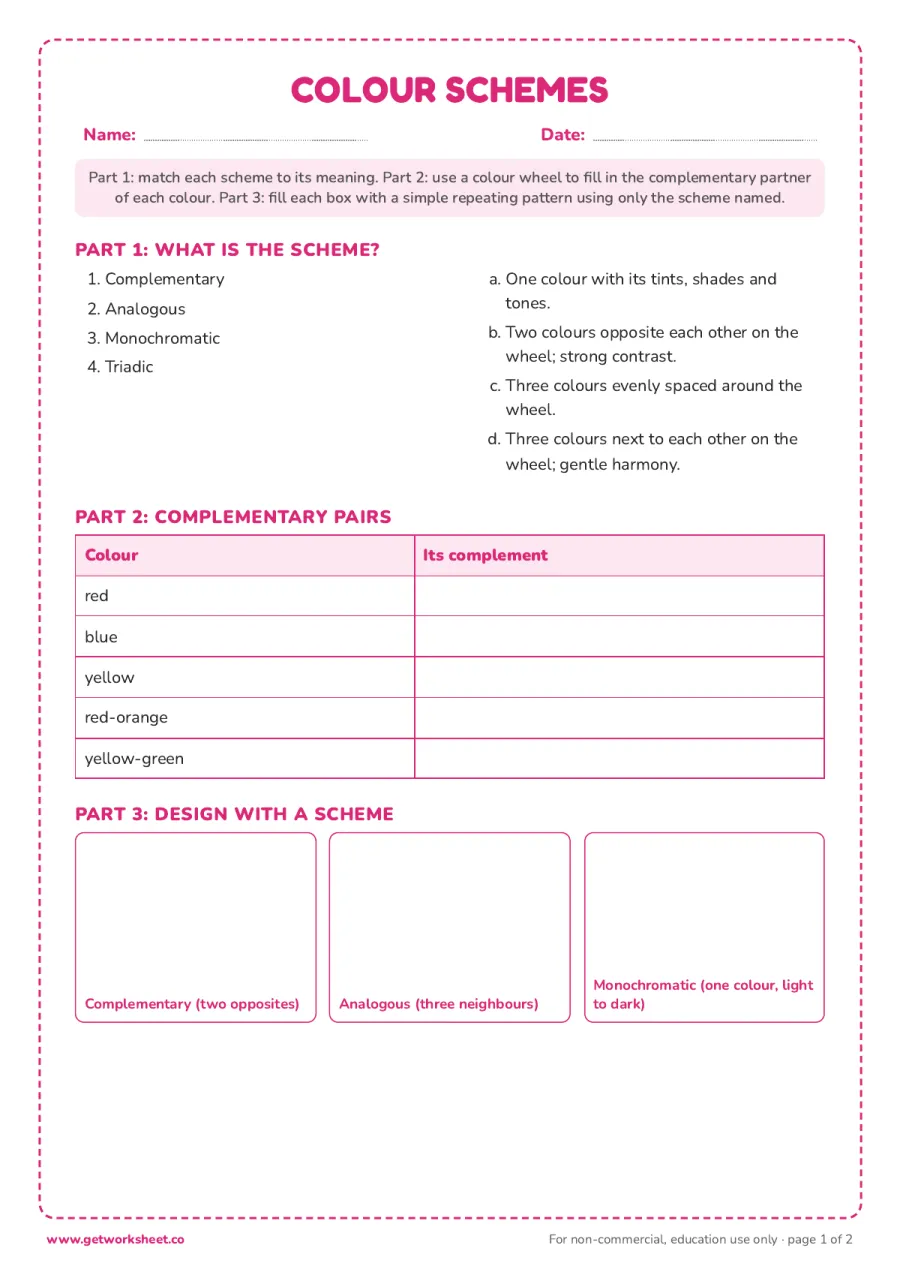
Colour schemes: complementary, analogous, monochromatic and triadic
Match four colour schemes to their definitions, complete a table of complementary pairs, and design a small pattern in each of three schemes. Answer key on page 2.
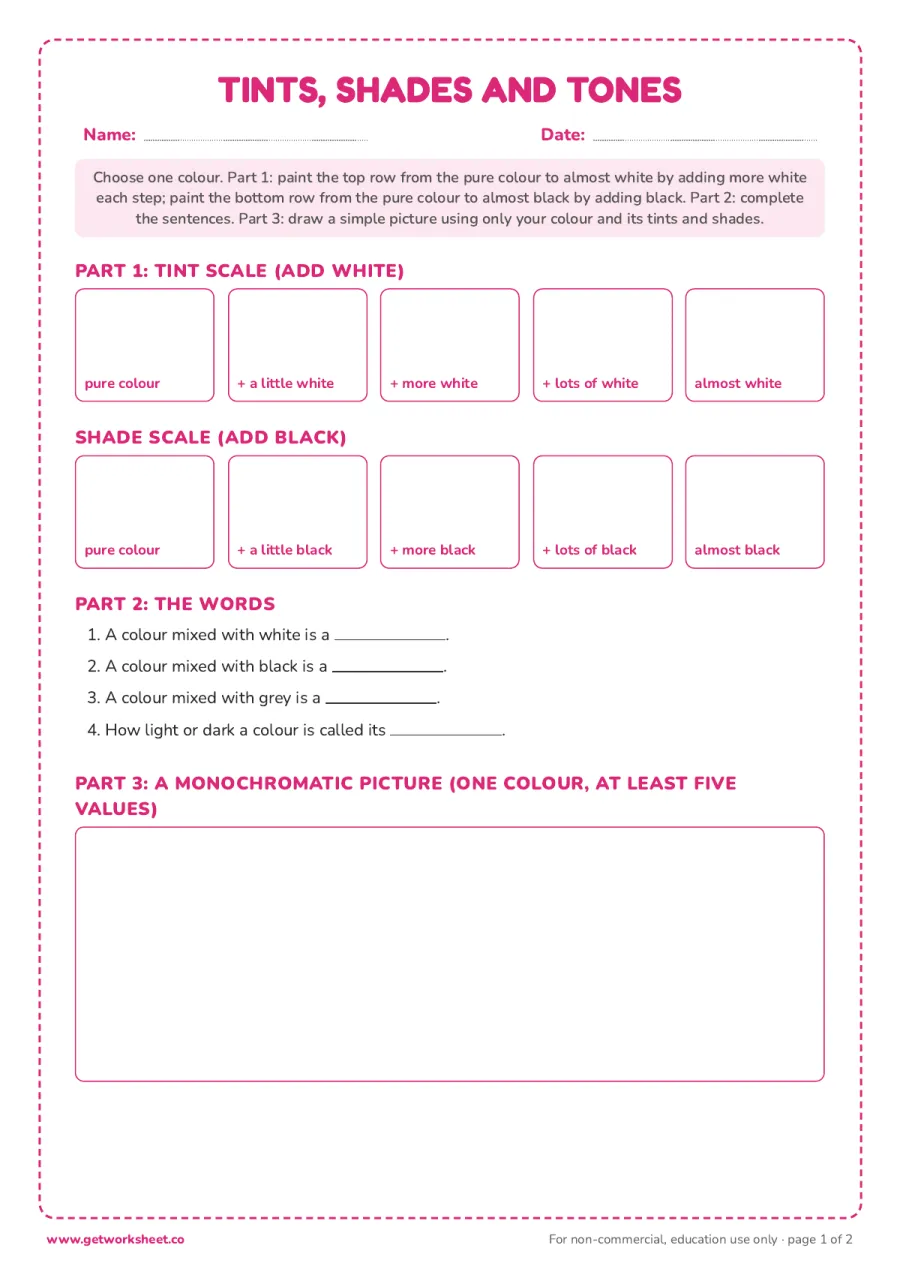
Tints, shades and tones: two 5-step scales and a monochromatic drawing
Two five-step scales to paint (a colour lightened with white, then darkened with black), four vocabulary sentences, and a box for a monochromatic drawing that uses at least five values of one colour. Answer key on page 2.
AI worksheet generator
Make a worksheet like this for your class
The 5 sheets above are fixed. The generator writes a new color theory worksheet for your grade, with the question types and count you choose, in about 20 seconds. Pick a grade to start:
What you get
- A fresh set of questions on color theory, not a copy of the sheets above
- Multiple choice, fill in the blanks, true or false, open ended
- Answer key and print-ready PDF with Pro
Free account, 1 worksheets a week. No card.
Color theory is the part of art that can be taught like a subject: there are right answers about what mixes with what, and once students know them they make deliberate choices instead of lucky ones. These five sheets are designed to be used with paint or colored pencils in hand. The wheel is completed by coloring it, the mixing equations are tested in swatch boxes, and the schemes and value scales end in small designs. Answer keys give the expected color names; the artwork is checked against the rule.
What's in this set
- The color wheel. A wheel with red, yellow and blue in place and nine numbered blank segments to color and name, plus four fill-in sentences on primary, secondary and tertiary colors.
- Mixing colors. Ten equations from red + yellow to orange + blue, with a matching row of swatch boxes so students test each answer with paint or colored pencil.
- Warm and cool colors. A fourteen-color sort (scarlet, turquoise, gold, navy, coral, lavender ...), two landscape boxes to color in warm and then cool colors, and two written questions on the mood each palette creates.
- Color schemes. A four-pair match (complementary, analogous, monochromatic, triadic), a five-row table of complementary partners to fill in from the wheel, and three design boxes for a complementary, an analogous and a monochromatic pattern.
- Tints, shades and tones. A tint scale and a shade scale of five boxes each, four fill-in sentences defining tint, shade, tone and value, and one drawing box for a monochromatic picture.
What students will practice
- Building the twelve-color wheel: three primaries, three secondaries, six tertiaries (National Core Arts Standards VA:Cr2.1)
- Predicting and testing the results of mixing colors, including tints, shades and tones
- Sorting warm and cool colors and using each palette to create a mood (VA:Cr1.2, VA:Re8.1)
- Recognizing complementary, analogous, monochromatic and triadic schemes and finding complements on the wheel
- Controlling value: painting five-step tint and shade scales and using them in a monochromatic picture
- Using the vocabulary: primary, secondary, tertiary, complementary, tint, shade, tone, value
Free printable makers
Make your own color theory sheets
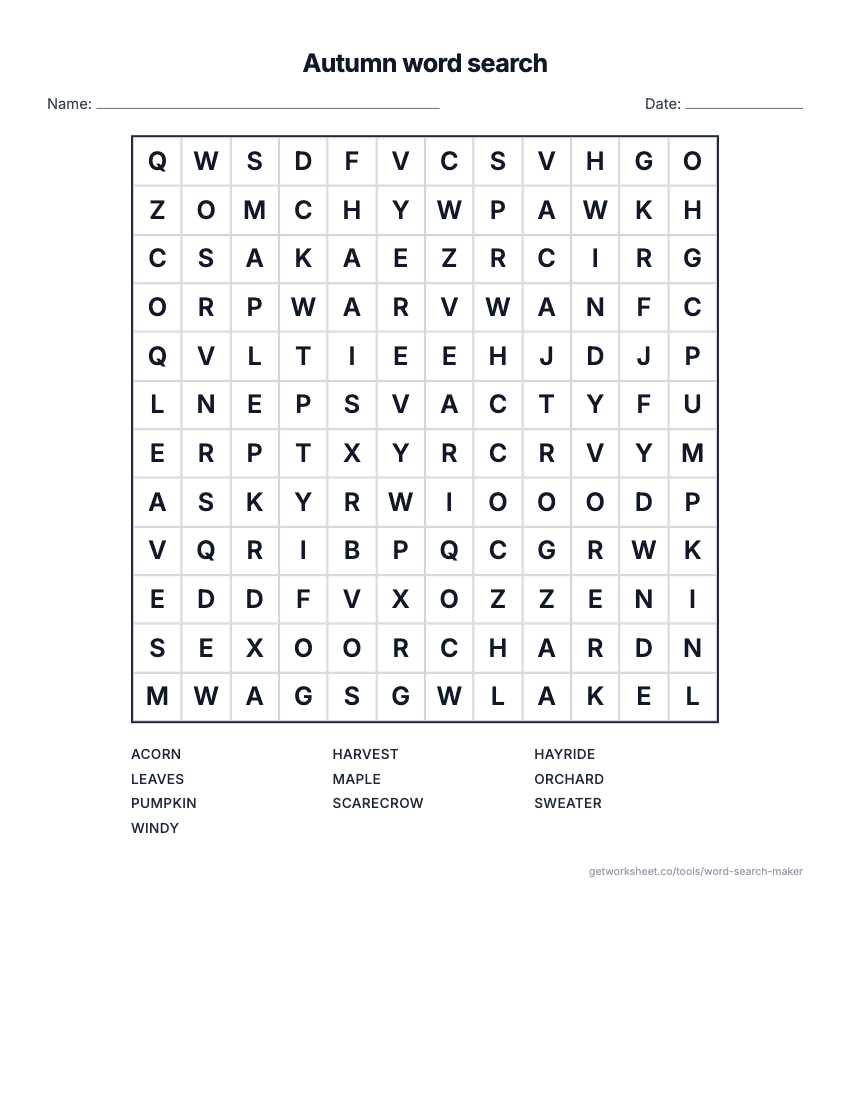
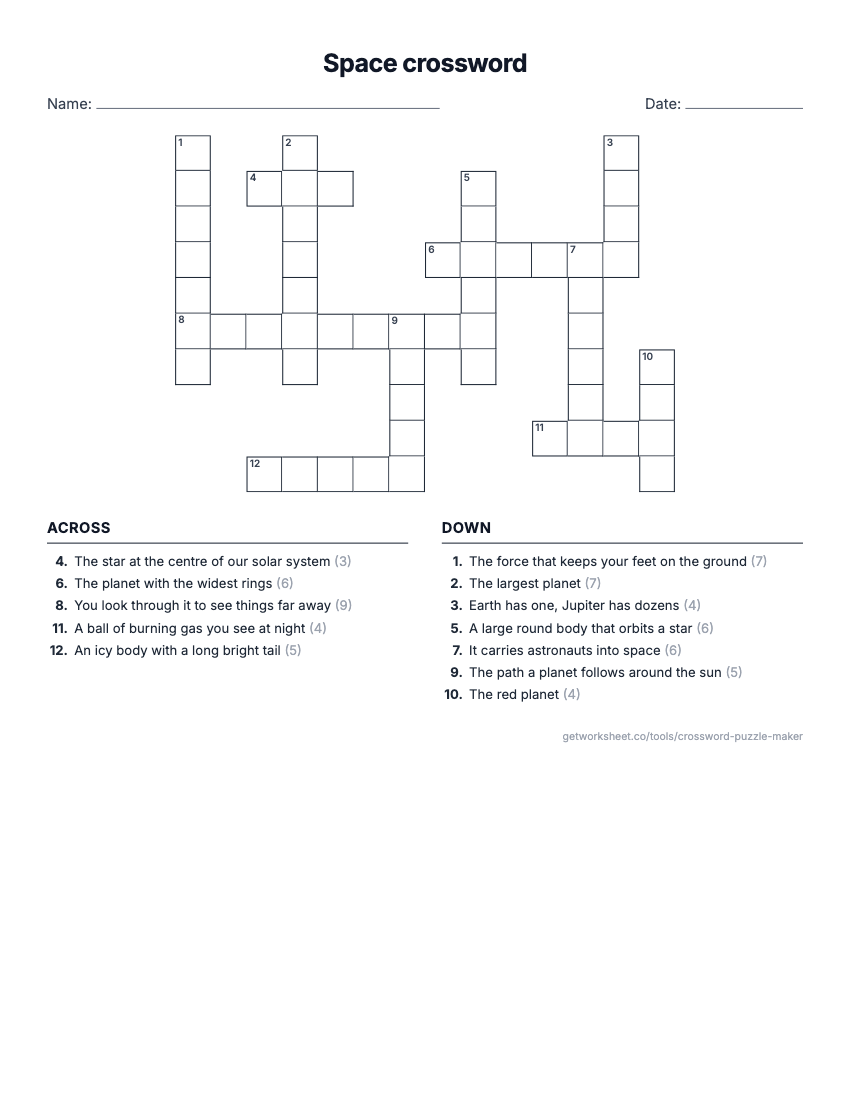
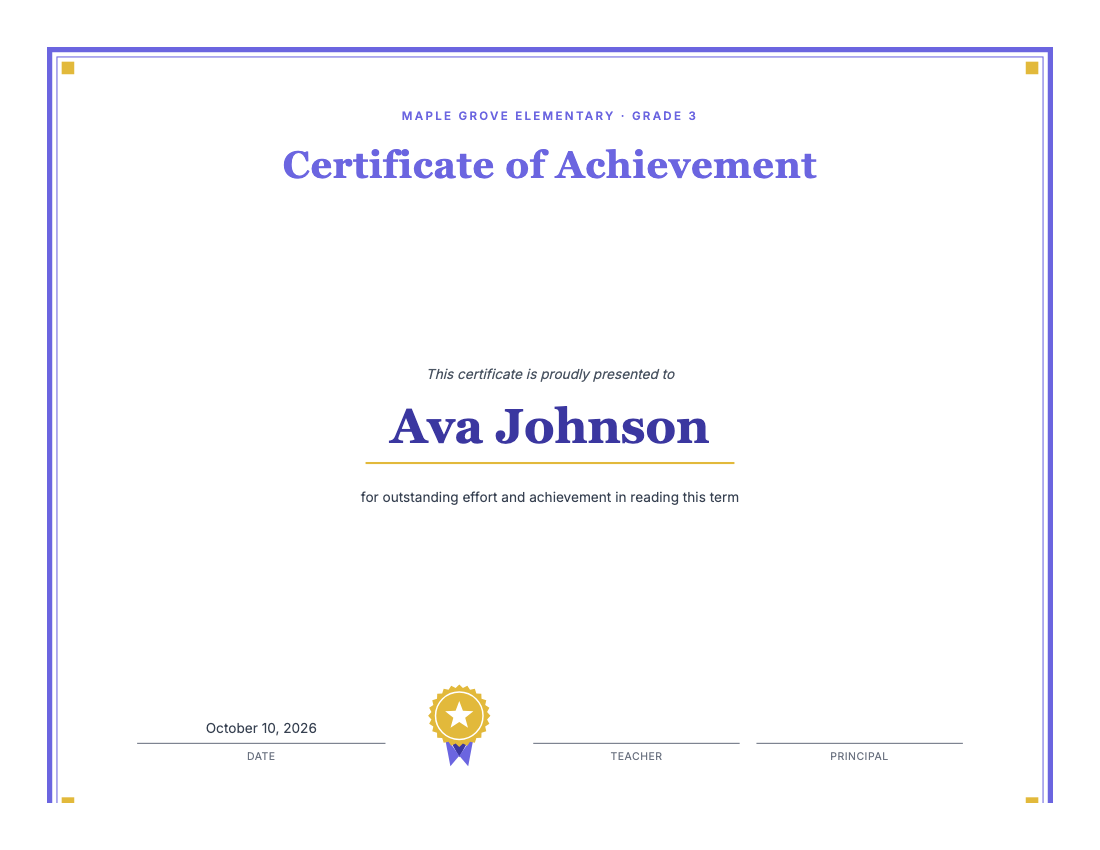
Type your own words or numbers and print in about 30 seconds. No account, no AI, answer key where it applies.
AI worksheet generator
Need a different color theory worksheet?
Generate a custom color theory worksheet: pick the grade, question types and count, and print it in about 20 seconds. Free accounts get 1 generation a week.
How to use these worksheets in class
- The wheel first, with paint. The color wheel is most useful when students mix the secondaries and tertiaries themselves from red, yellow and blue rather than using ready-made orange or green. The numbered lines beside the wheel record the names.
- Predict, then test. On Mixing colors, students write the answer to each equation before mixing it in the swatch box. Equation 10 (orange plus blue) is the surprise: complements cancel to a brown-gray.
- Same drawing, two palettes. Warm and cool colors asks for the same simple scene twice. Keep the drawing basic (a hill, a tree, a sky) so the color does all the work; the mood questions afterwards make the point.
- Schemes as a design brief. Part 3 of Color schemes works well as a homework poster or a pattern for wrapping paper. Insist on the constraint: only colors from the named scheme.
- Value with one color. Tints, shades and tones pairs with the value sheet in the elements of art set. Mix each step on a palette before painting it; the monochromatic picture is a strong display piece.
- Grades 3 to 8. Grades 3 to 5 complete the wheel, mixing and warm/cool sheets; grades 6 to 8 add schemes and value scales and can finish the set in two lessons.
Answer key
Every practice sheet carries its own answer key on page 2 of the PDF. The keys are repeated here for quick marking.
- The color wheel: Part 1: complete the wheel: Clockwise from red: Red, Red-orange, Orange, Yellow-orange, Yellow, Yellow-green, Green, Blue-green, Blue, Blue-violet, Violet, Red-violet. Numbered segments: 1 red-orange, 2 orange, 3 yellow-orange, 4 yellow-green, 5 green, 6 blue-green, 7 blue-violet, 8 violet, 9 red-violet. Part 2: how the wheel works: 1. red, yellow, blue 2. secondary 3. tertiary 4. complementary
- Mixing colors: Part 1: complete the equations: 1. orange 2. green 3. violet (purple) 4. red-orange 5. yellow-green 6. violet 7. pink 8. navy / dark blue 9. tone 10. dull / neutral Part 2: paint the results: Swatches should match the answers above; complements mixed in equal amounts give a muddy brown-gray.
- Warm and cool colors: Part 1: warm or cool?: Warm colors: scarlet, gold, coral, amber, tangerine, crimson, yellow-orange Cool colors: turquoise, navy, lavender, mint green, sky blue, teal, blue-violet Part 3: mood: 1. Sample: warm feels hot, lively, energetic, cosy; cool feels calm, quiet, cold, peaceful. 2. Cool colors: blues and greys feel calm, cold and distant, which suits a sad or lonely mood.
- Color schemes: Part 1: what is the scheme?: Complementary = Two colors opposite each other on the wheel; strong contrast.; Analogous = Three colors next to each other on the wheel; gentle harmony.; Monochromatic = One color with its tints, shades and tones.; Triadic = Three colors evenly spaced around the wheel. Part 2: complementary pairs: red | green blue | orange yellow | violet red-orange | blue-green yellow-green | red-violet Part 3: design with a scheme: Designs are open-ended; check that only colors from the named scheme were used.
- Tints, shades and tones: Part 2: the words: 1. tint 2. shade 3. tone 4. value Part 3: a monochromatic picture (one color, at least five values): Open-ended; look for at least five clearly different values of the one color.
Common mistakes to watch for
- Putting orange next to blue on the wheel. Each secondary sits between the two primaries that make it. If a student's wheel has orange between blue and yellow, the mixing rule has not landed.
- "Purple" for violet. Both are accepted as the secondary; violet is the term on the wheel.
- Green as a warm color. Green is cool on the wheel; yellow-green is the boundary and can be argued either way. The sort sheet uses mint green and teal to avoid the argument.
- Value scales that jump. Five steps should be five clearly different values. Mix each step separately and compare it with its neighbors before painting.
- Tone confused with shade. Tone is color plus gray (duller), shade is color plus black (darker).
Frequently asked questions
What grade are these color theory worksheets for?
Grades 3 to 8. The color wheel, mixing and warm/cool sheets suit grades 3 to 5; color schemes and tint and shade scales suit grades 5 to 8 (National Core Arts Standards VA:Cr2.1, VA:Re8.1).
Do the worksheets include answer keys?
Yes. The wheel key is a fully colored, labelled twelve-segment wheel; the other keys list the color names. Drawings and designs are checked against the rule on the sheet (for example, only colors from the named scheme).
What materials are needed?
Red, yellow, blue, white and black paint give the best results, because students mix every other color themselves. Colored pencils work for the wheel, the sort and the scheme designs, but the mixing equations and value scales are best done with paint.
Why is the spelling "color" on the worksheets?
The worksheets use British spelling throughout, like the rest of the site's art sheets. Only the page title uses the American spelling, because that is the term most people search for.
Is a color wheel needed for the color schemes sheet?
The completed wheel from the first sheet is the reference: complements are opposite, analogous colors are neighbors, triadic colors are every fourth segment.
Related art worksheets
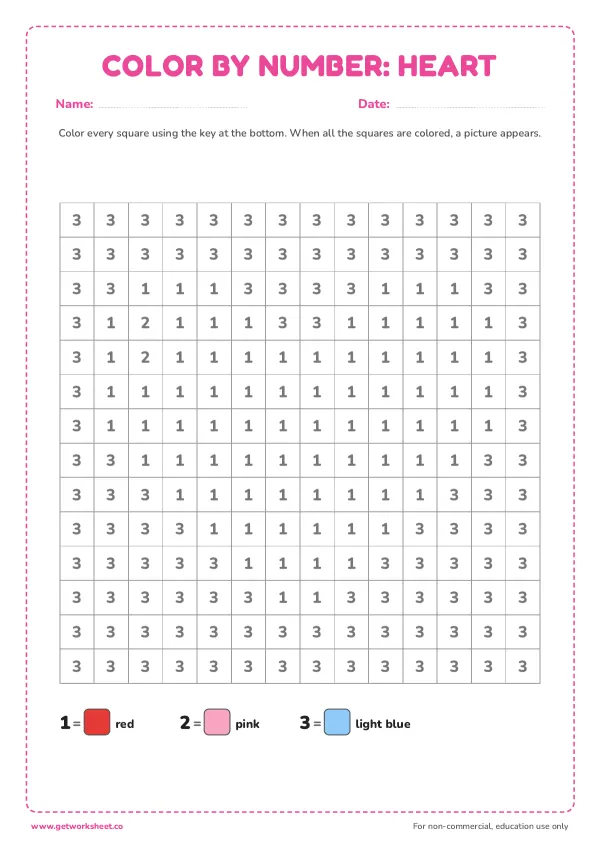
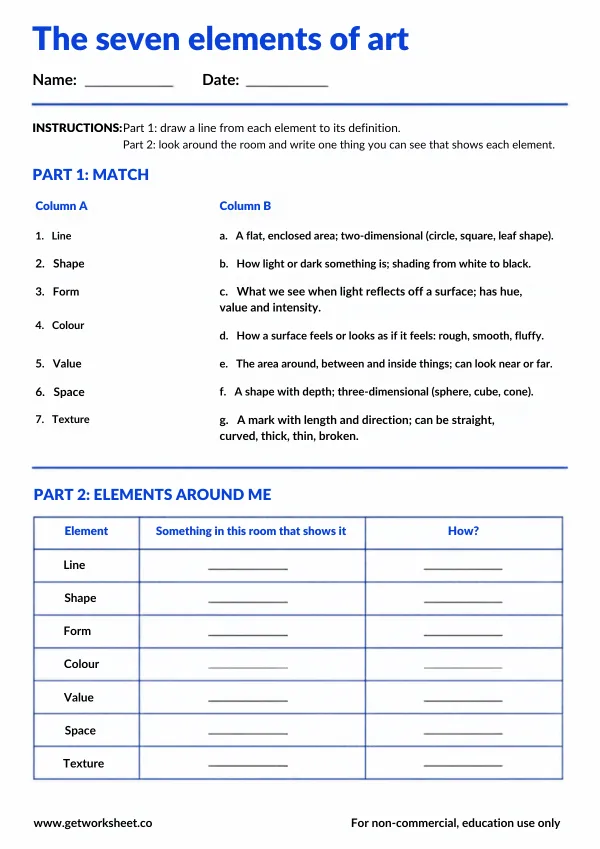
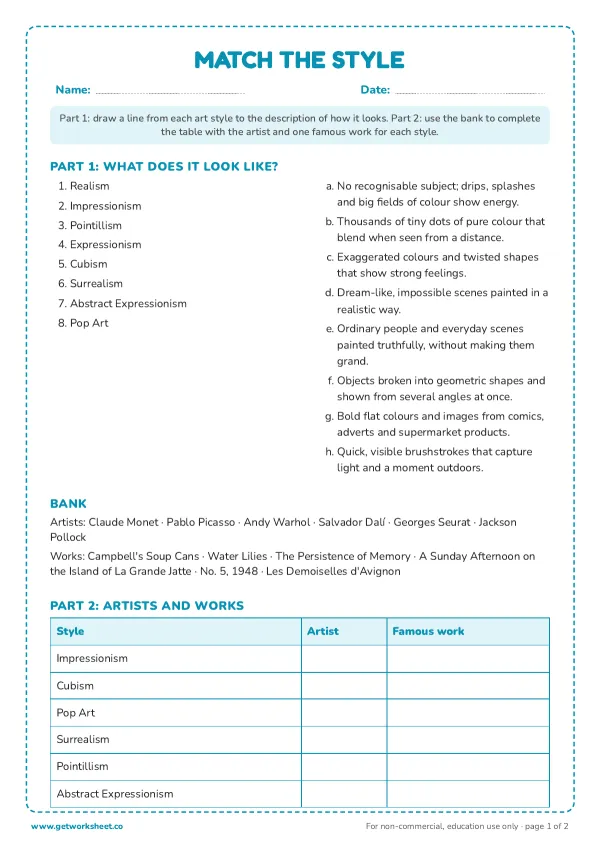
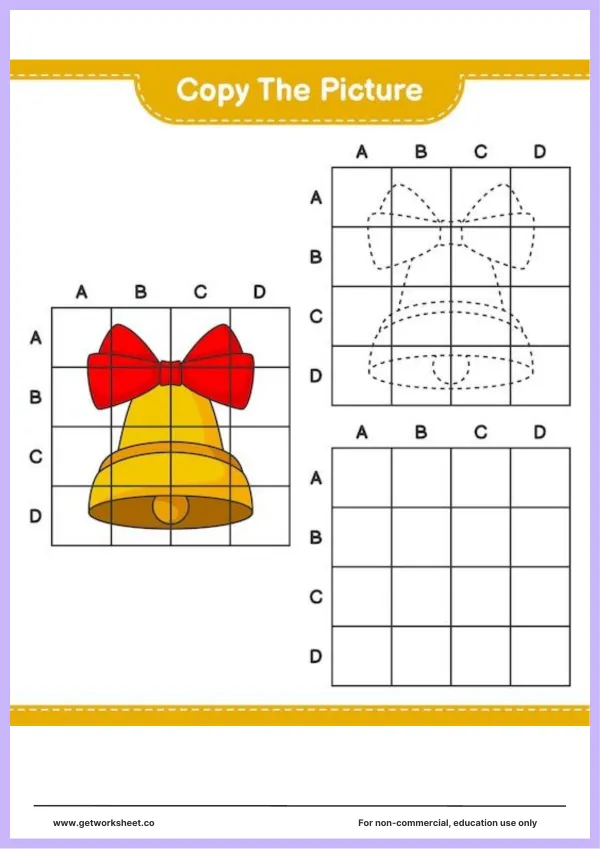
The elements of art worksheets include a color sheet and a value scale that lead into this set. For applying color to a picture, use the color by number worksheets or the copy the picture worksheets; the art styles worksheets show how Impressionists and Pop artists used color differently.
Free library
Related collections
Free color by number worksheets
Free elements of art worksheets
Free art styles worksheets
Free copy the picture worksheets
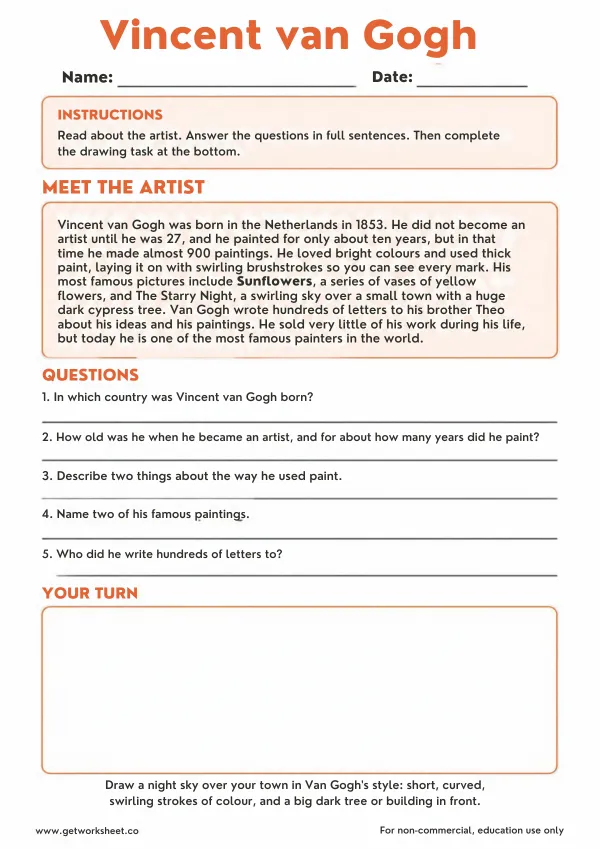
Free famous artists worksheets
Free hello kitty coloring pages
Free Halloween coloring pages
Free leprechaun coloring pages
More worksheets
- Free spring coloring pages
- Free summer coloring pages
- Free winter coloring pages
- Free fire truck coloring page printable
- Free Merry Christmas coloring pages
- Free connect the dots printable worksheets
- Free printable vehicle coloring pages
- Free printable animal coloring pages
- Free printable number coloring pages