Telling Time To The Quarter Hour Worksheets
Free telling time to the quarter hour worksheets. Practice reading clocks at :00, :15, :30, and :45 — printable PDFs with answer keys for grades 1-3.
Quarter hours are the four landmarks on every clock face — :00, :15, :30, and :45. Once students can read these four positions confidently, they can tell time for most practical situations without needing to count every single minute mark. These worksheets build that skill step by step, from matching clock faces to written times, to drawing hands on blank clocks.
What Students Will Practice
- Reading analog clocks showing times at the hour (:00), quarter past (:15), half past (:30), and quarter to (:45)
- Understanding the language of quarter hours — "quarter past 3" means 3:15, "half past 7" means 7:30, "quarter to 5" means 4:45
- Drawing the minute hand in the correct position for each quarter hour on blank clock faces
- Matching analog clock faces to their digital equivalents (e.g., a clock showing quarter past 9 = 9:15)
- Distinguishing between the hour hand and minute hand and understanding how both move as time passes
- Sequencing events using quarter-hour times (e.g., "Lunch is at 12:00, recess is at 12:30 — which comes first?")
Telling time to the quarter hour is a 1st-2nd grade math standard and serves as the bridge between reading time to the hour and reading time to the nearest five or one minute.
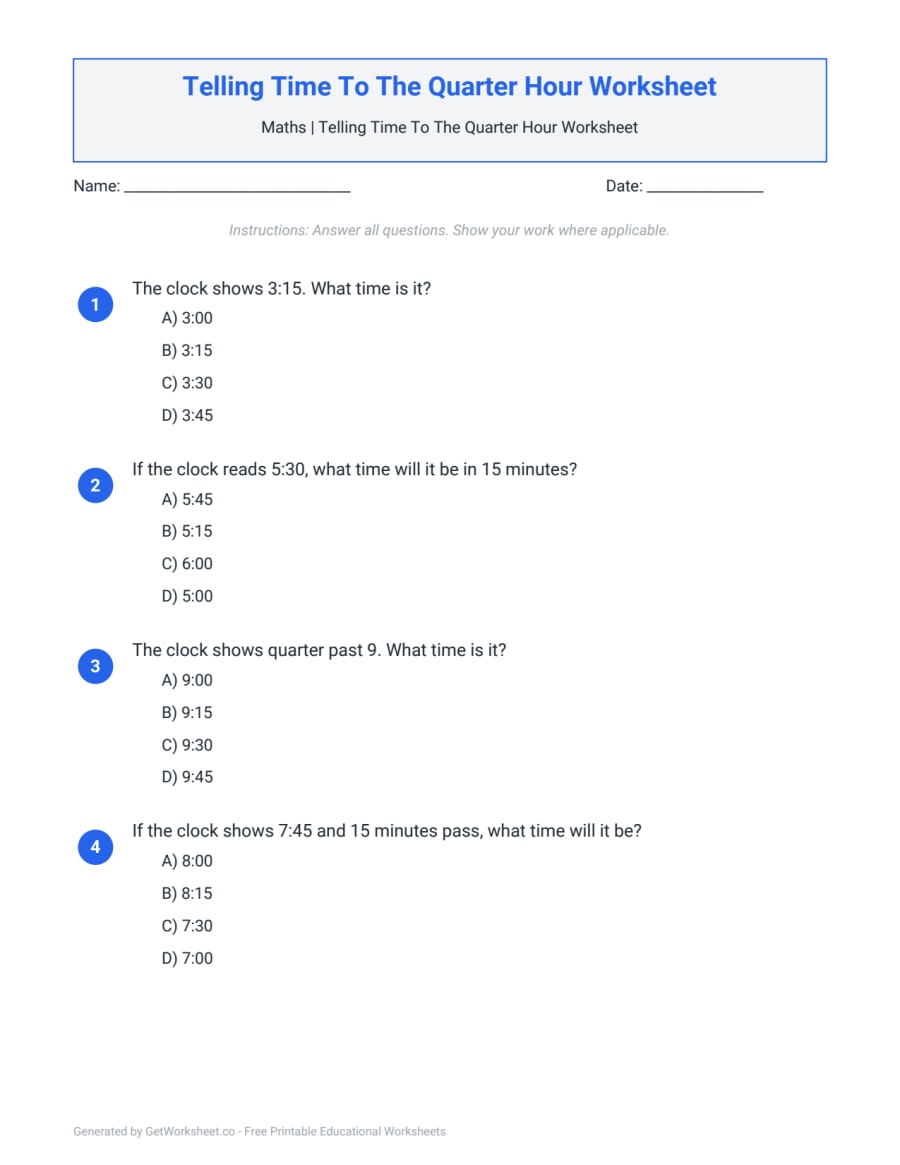
Telling Time To The Quarter Hour Worksheet
Free printable telling time to the quarter hour worksheets with answer keys. Perfect for reinforcing time skills at home or in the classroom.
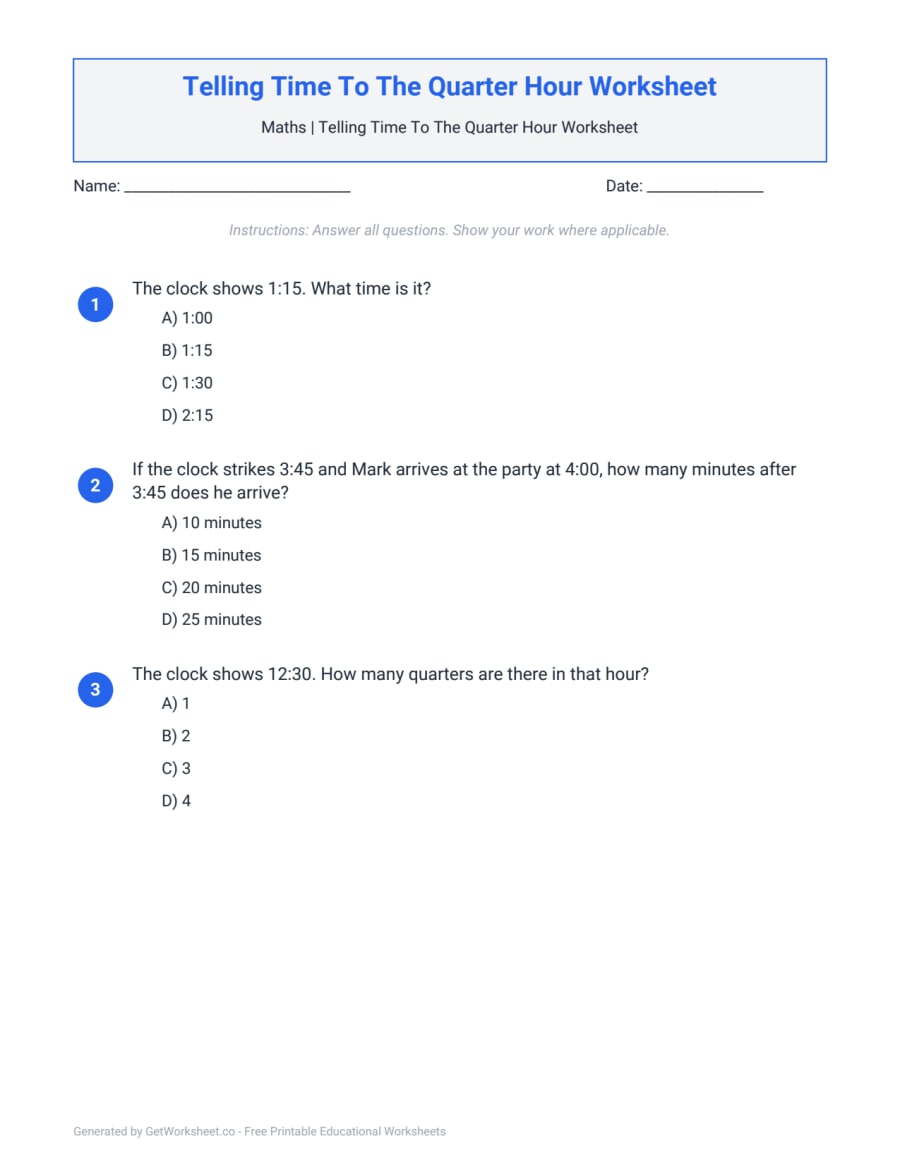
Telling Time To The Quarter Hour Worksheet
Free printable telling time to the quarter hour worksheets with answer keys. Ideal for homework, extra practice, or reinforcing math skills at home.
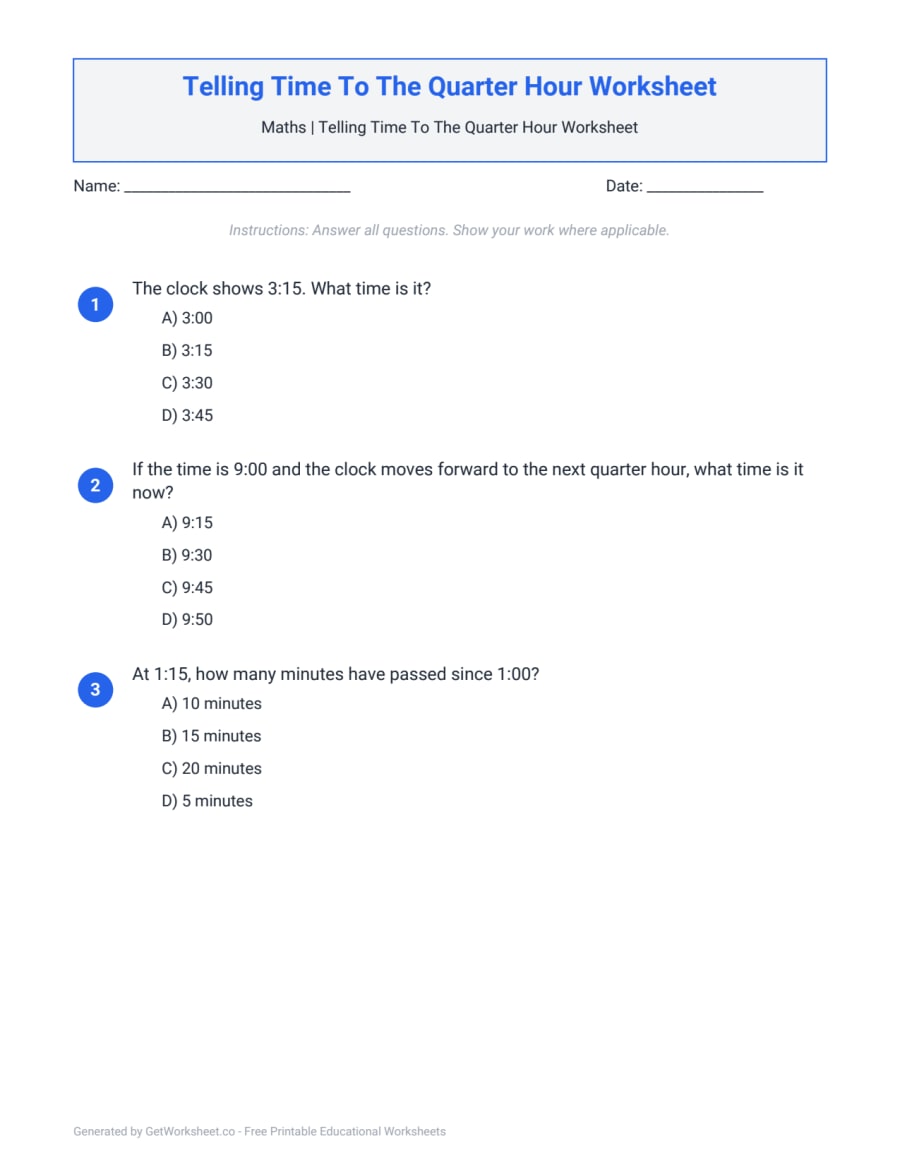
Telling Time To The Quarter Hour Worksheet
Free printable worksheet for telling time to the quarter hour, complete with an answer key. Perfect for reinforcing math skills at home or in the classroom.
How to Use These Worksheets
Clocks are visual — use real clocks alongside the worksheets whenever possible.
- Get a cheap analog clock with movable hands (or print a paper one) and set it to match each problem on the worksheet. Let your child physically move the hands and compare. The connection between the flat worksheet and a real clock face accelerates learning significantly.
- Teach the four positions as landmarks first: when the minute hand points straight up, it's :00. Straight right is :15. Straight down is :30. Straight left is :45. Once these four positions are automatic, your child has anchor points to figure out any time.
- Pay special attention to the hour hand. At :00, the hour hand points exactly at the number. At :30, it's halfway between two numbers. At :15 and :45, it's a quarter of the way past or three-quarters of the way past. Many students only look at the minute hand and ignore the hour hand, leading to off-by-one-hour errors.
- Use the "quarter to" exercises carefully — this is the hardest concept. "Quarter to 5" means 4:45, not 5:45. Students must think backward from the next hour. Practice with real-life examples: "Dinner is at 6. It's quarter to 6 — that means it's 5:45."
Common Mistakes to Watch For
- Confusing the hour and minute hands: The short hand is hours, the long hand is minutes. Students frequently reverse this, reading 3:00 as 12:15 (treating the long hand at 12 as the hour). Reinforce: short = hours, long = minutes.
- Reading :45 as the wrong hour: When the clock shows 4:45, the hour hand is almost at the 5. Students often read this as 5:45 because the hour hand is closer to 5 than 4. Teach them: the hour hand hasn't reached 5 yet, so it's still 4-something.
- Not understanding "quarter to" language: "Quarter to 8" means 7:45, not 8:45 or 8:15. The word "to" means we're approaching the next hour — there's a quarter of an hour left to go. This phrasing trips up many students and needs explicit practice.
- Thinking the minute hand jumps between positions: Students sometimes believe the minute hand only stops at :00, :15, :30, and :45. Show them that time is continuous — the hand sweeps smoothly. Quarter hours are just the four easiest-to-read positions on its journey around the clock.
Frequently Asked Questions
Why should my child learn analog clocks when everything is digital?
Analog clocks build a visual understanding of how time works — that 15 minutes is a quarter of the circle, that time is continuous, and that the relationship between hours and minutes is spatial. This understanding transfers to elapsed time problems, scheduling, and time estimation. Digital clocks show numbers; analog clocks show relationships.
My child can read :00 and :30 but struggles with :15 and :45. What helps?
This is very common. :00 and :30 are easy because the minute hand points straight up or straight down. For :15 and :45, the hand points to the 3 and the 9 — numbers students don't naturally associate with 15 and 45. Practice specifically: "When the minute hand points to the 3, it's always :15. When it points to the 9, it's always :45." Drill these two positions until they're automatic.
What comes after quarter hours in the curriculum?
After quarter hours, students learn to tell time to the nearest 5 minutes (1st-2nd grade), then to the nearest minute (2nd-3rd grade). Elapsed time problems — figuring out how much time has passed between two clock readings — typically follow in 3rd grade.
How much practice does my child need?
A few minutes per day for 2-3 weeks usually builds solid quarter-hour fluency. Supplement worksheets with real-life practice: "What time does the clock say right now?" throughout the day. Casual, frequent practice in context is the fastest path to mastery.
Once quarter hours feel automatic, students are ready to tell time to the nearest five minutes — reading every number on the clock face as a minute marker — and eventually tackle elapsed time calculations.