Multiplying Decimals Worksheets
Free multiplying decimals worksheets with answer keys. Practice decimal multiplication with step-by-step methods — printable PDFs for grades 5-7.
Multiplying decimals follows the same process as multiplying whole numbers — with one extra step at the end. You multiply as if the decimal points don't exist, then count the total decimal places from both numbers and put the point back in the answer. It's simple in concept, but students need practice to make it reliable, especially when problems involve numbers like 0.03 × 0.4 where the answer has more decimal places than either factor.
What Students Will Practice
- Multiplying a decimal by a whole number (e.g., 3.5 × 4 = 14.0) — the most straightforward type and a good starting point
- Multiplying a decimal by a decimal (e.g., 2.3 × 1.5 = 3.45) — counting total decimal places from both factors to place the point
- Multiplying decimals by 10, 100, and 1000 (shifting the decimal point right) and by 0.1, 0.01, and 0.001 (shifting left)
- Estimating products before calculating to check reasonableness (e.g., 4.8 × 3.2 ≈ 5 × 3 = 15, so the exact answer should be near 15)
- Solving word problems involving decimal multiplication — money, measurements, unit rates (e.g., "Gas costs $3.45 per gallon. How much for 12.5 gallons?")
- Handling products that require trailing zeros (e.g., 0.2 × 0.3 = 0.06, not 0.6 — you need a zero placeholder)
Multiplying decimals is a core 5th-7th grade standard and is essential for working with money, scientific measurements, percentages, and algebra.
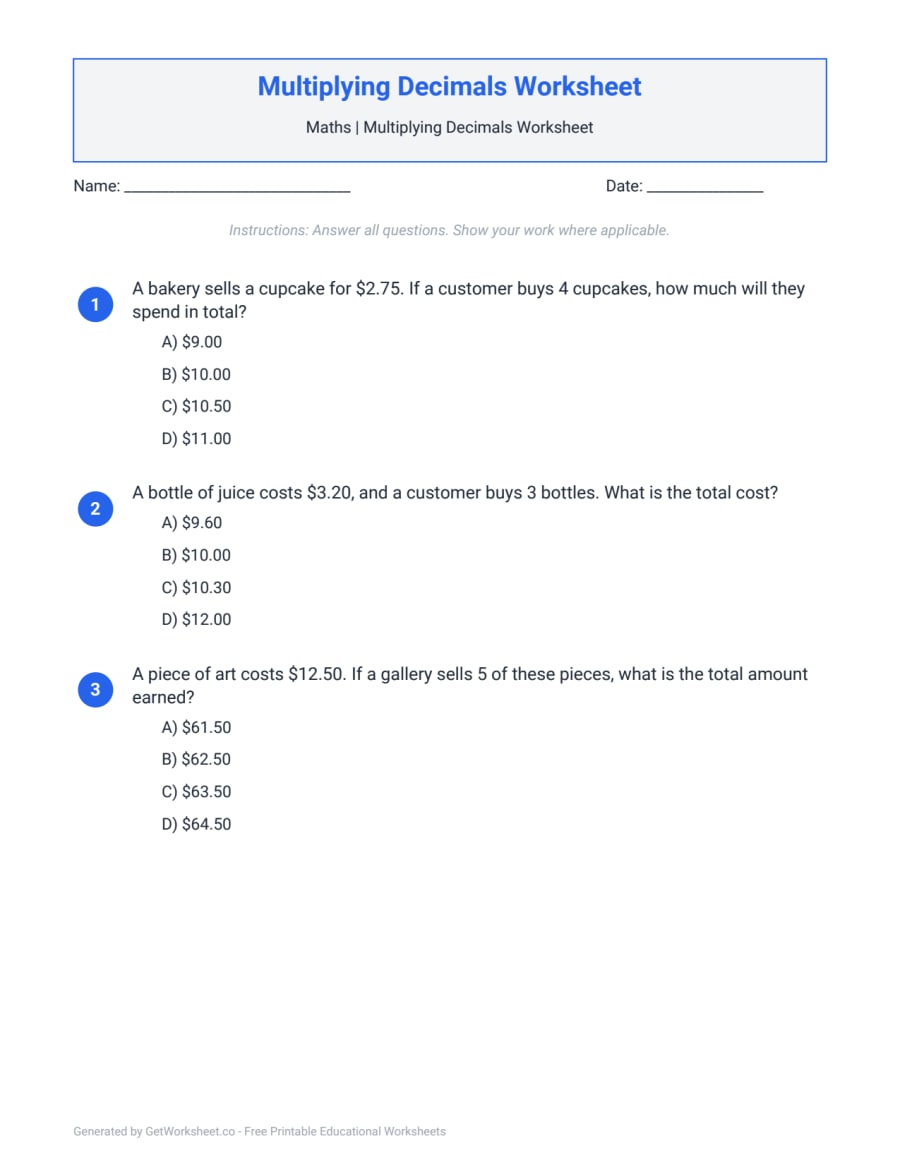
Multiplying Decimals Worksheet
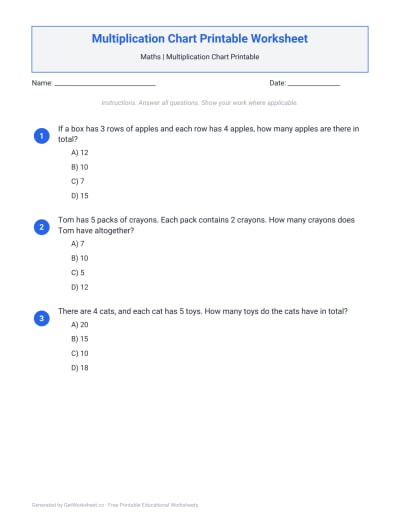
Free printable multiplying decimals worksheets with answer keys. Perfect for extra practice at home or in the classroom to boost math skills.

Multiplying Decimals Worksheet
Free printable multiplying decimals worksheets with answer keys. Ideal for homework or extra practice to enhance your child's math skills.
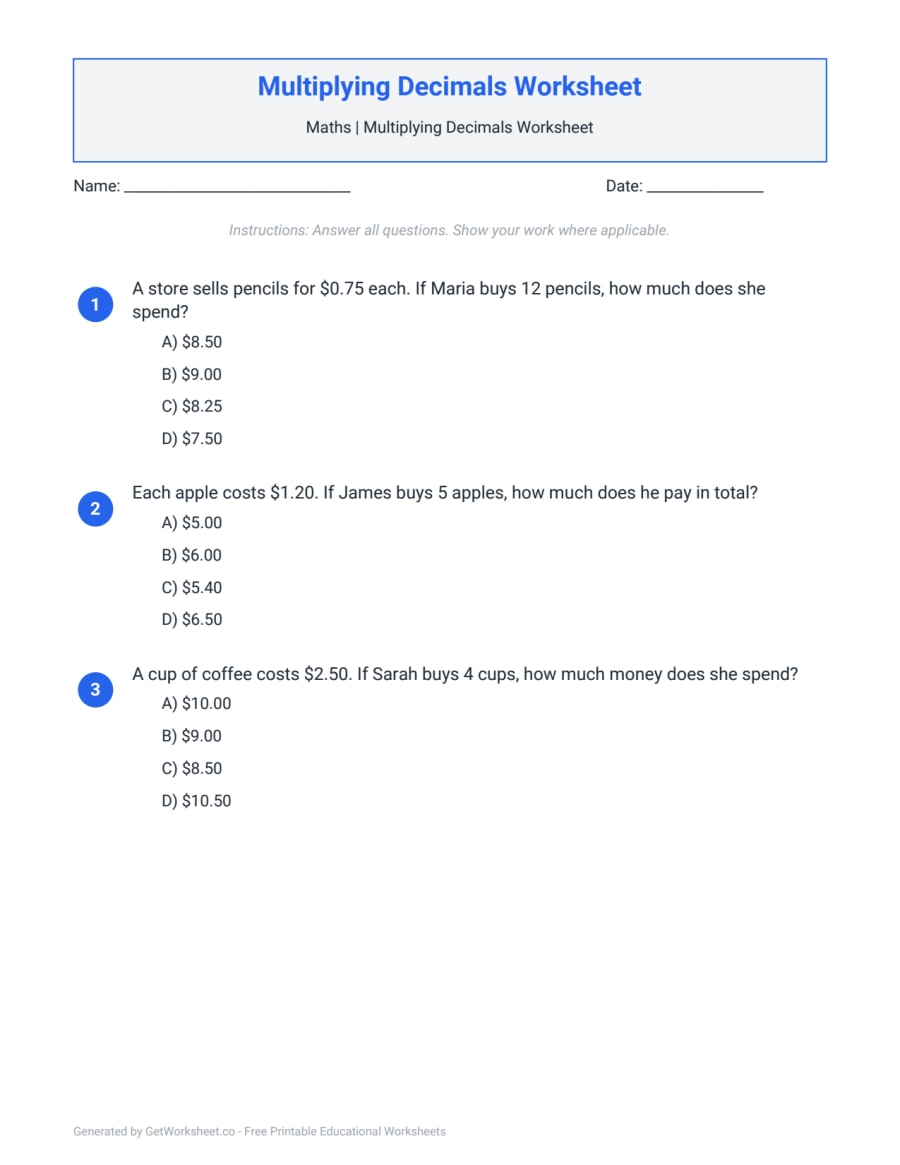
Multiplying Decimals Worksheet
Free printable multiplying decimals worksheets with answer keys. Perfect for extra practice and reinforcing maths skills at home or in class.
How to Use These Worksheets
The trick to decimal multiplication is building confidence with the decimal placement rule through lots of practice.
- Always start with estimation. Before your child calculates 6.2 × 3.8, have them round: 6 × 4 = 24. Now they know the answer should be near 24 — not 2.4 or 240. Estimation catches decimal placement errors instantly and should become an automatic first step.
- Teach the procedure explicitly: (1) Ignore the decimal points and multiply as whole numbers. (2) Count the total number of decimal places in both factors. (3) Starting from the right of the product, count left that many places and insert the decimal point. Practice this three-step process on 10+ problems before moving to word problems.
- For the special cases of multiplying by powers of 10 (× 10, × 100, × 0.1), practice the shortcut separately: multiplying by 10 shifts the decimal one place right; multiplying by 0.1 shifts it one place left. This pattern is faster than the full multiplication procedure and shows up constantly in science and unit conversions.
- Use the answer key actively. When your child gets the digits right but the decimal wrong (a very common error), go back and count decimal places together. This specific type of error responds well to focused correction because the multiplication skill is already there — only the placement needs work.
Common Mistakes to Watch For
- Miscounting decimal places: In 1.25 × 0.4, there are 2 + 1 = 3 total decimal places, so the answer is 0.500 (or 0.5). Students often count only one factor's decimal places and write 5.00 or 50.0 instead. Highlight both factors' decimal places before multiplying.
- Forgetting placeholder zeros: 0.02 × 0.3 = 0.006 (4 decimal places total — 2 + 1 = 3, but the product of 2 × 3 = 6 is only one digit, so you need two zeros before the 6). Students write 0.6 because they don't realize they need to pad with zeros.
- Aligning decimal points like in addition: In multiplication, you do NOT align decimal points. You multiply as whole numbers and place the point afterward. Students who just learned decimal addition sometimes try to align the points, which leads to completely wrong setups.
- Not checking with estimation: A student calculates 4.5 × 2.1 and gets 94.5 (forgot to place the decimal after multiplying 45 × 21 = 945). If they'd estimated first (5 × 2 = 10), they'd know 94.5 is way too big. The answer is 9.45.
Frequently Asked Questions
Why can't my child just use a calculator for decimal multiplication?
Calculators are great for checking work, but students need to understand the process for several reasons: estimating whether a calculator result is reasonable, handling decimal multiplication in algebra where calculators aren't always available, and building number sense that prevents errors in real-world situations like calculating costs or measurements.
My child multiplies the digits correctly but always gets the decimal in the wrong place. What helps?
This is the most common error. Practice the "count and place" step separately: give your child completed multiplications (digits correct) and have them only place the decimal point. Ten of these in a row builds the habit. Also, always estimate first — if 3.2 × 4.1 should be near 12, and they got 131.2, the decimal is obviously wrong.
Is there a connection between multiplying decimals and multiplying fractions?
Absolutely. 0.5 × 0.3 is the same as 1/2 × 3/10 = 3/20 = 0.15. Students who understand this connection have a deeper grasp of what decimal multiplication means — you're finding a fraction of a fraction, which is why the product is often smaller than both factors.
How much practice does my child need?
Daily practice of 10-15 problems for 2-3 weeks usually builds reliable fluency. Start with decimal × whole number, then decimal × decimal, then special cases with small decimals (0.01, 0.001). The progression matters — jumping to the hardest problems too soon causes frustration.
After mastering decimal multiplication, students are ready for dividing decimals, converting between fractions, decimals, and percentages, and applying these skills in more complex contexts like scientific notation and proportional reasoning.