Improper Fractions Worksheets
Free improper fractions worksheets with answer keys. Practice converting between improper fractions and mixed numbers — printable PDFs for grades 3-5.
An improper fraction is simply a fraction where the top number (numerator) is bigger than the bottom number (denominator) — like 7/4 or 11/3. There's nothing actually "improper" about them; they're just fractions greater than 1. The tricky part for students is learning to convert between improper fractions and mixed numbers (like changing 7/4 to 1 3/4) and understanding that both representations describe the same amount.
What Students Will Practice
- Identifying whether a fraction is proper (numerator < denominator, like 3/5) or improper (numerator ≥ denominator, like 7/5 or 5/5)
- Converting improper fractions to mixed numbers by dividing (e.g., 11/4: 11 ÷ 4 = 2 remainder 3, so 11/4 = 2 3/4)
- Converting mixed numbers back to improper fractions (e.g., 3 2/5: multiply 3 × 5 = 15, add 2 = 17, so 3 2/5 = 17/5)
- Plotting improper fractions and mixed numbers on a number line to see that they're the same point
- Comparing improper fractions by converting to mixed numbers or finding common denominators
- Adding and subtracting mixed numbers, which often requires converting to improper fractions first
Understanding improper fractions is a key 3rd-5th grade math standard and is essential for fraction operations, algebra readiness, and working with measurements in science and cooking.
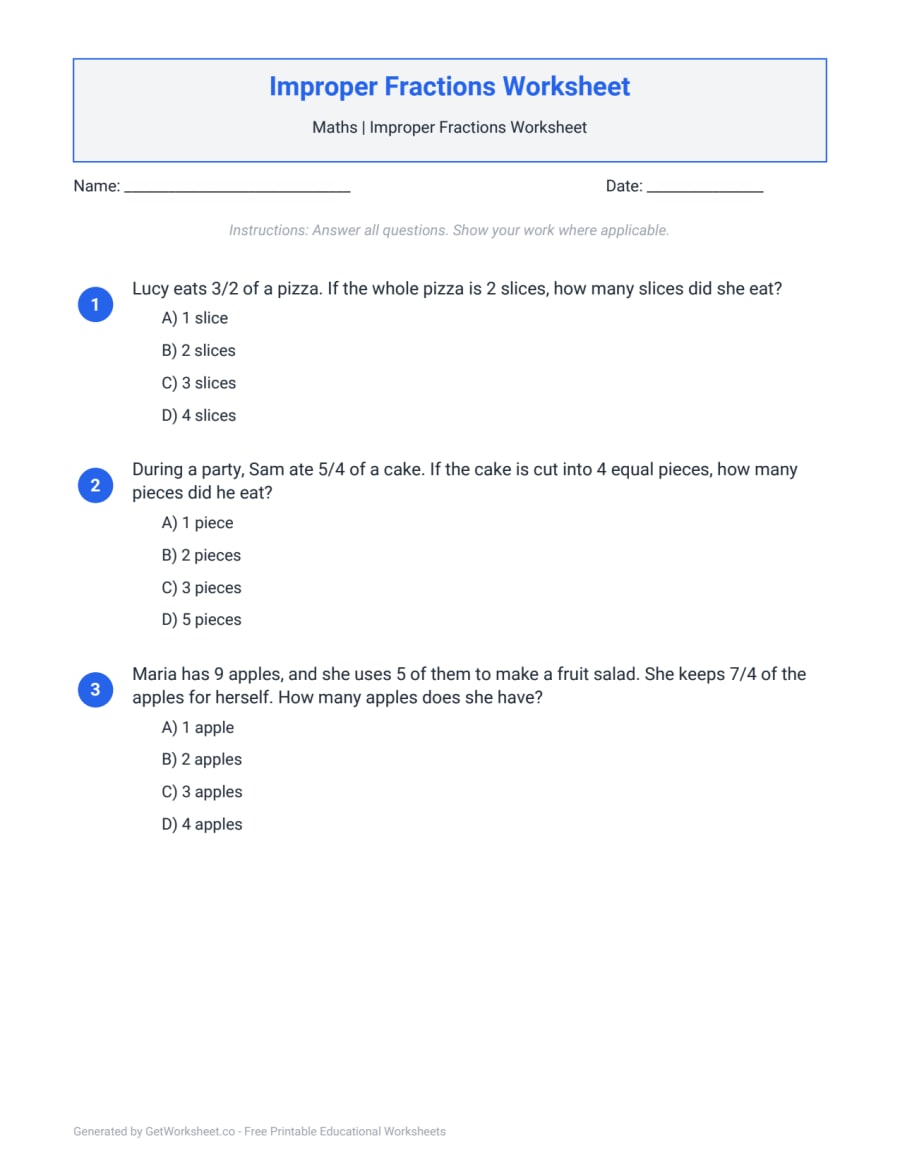
Improper Fractions Worksheet
Free printable improper fractions worksheets with answer keys. Ideal for extra practice at home or in the classroom. Download and print for engaging math activities.
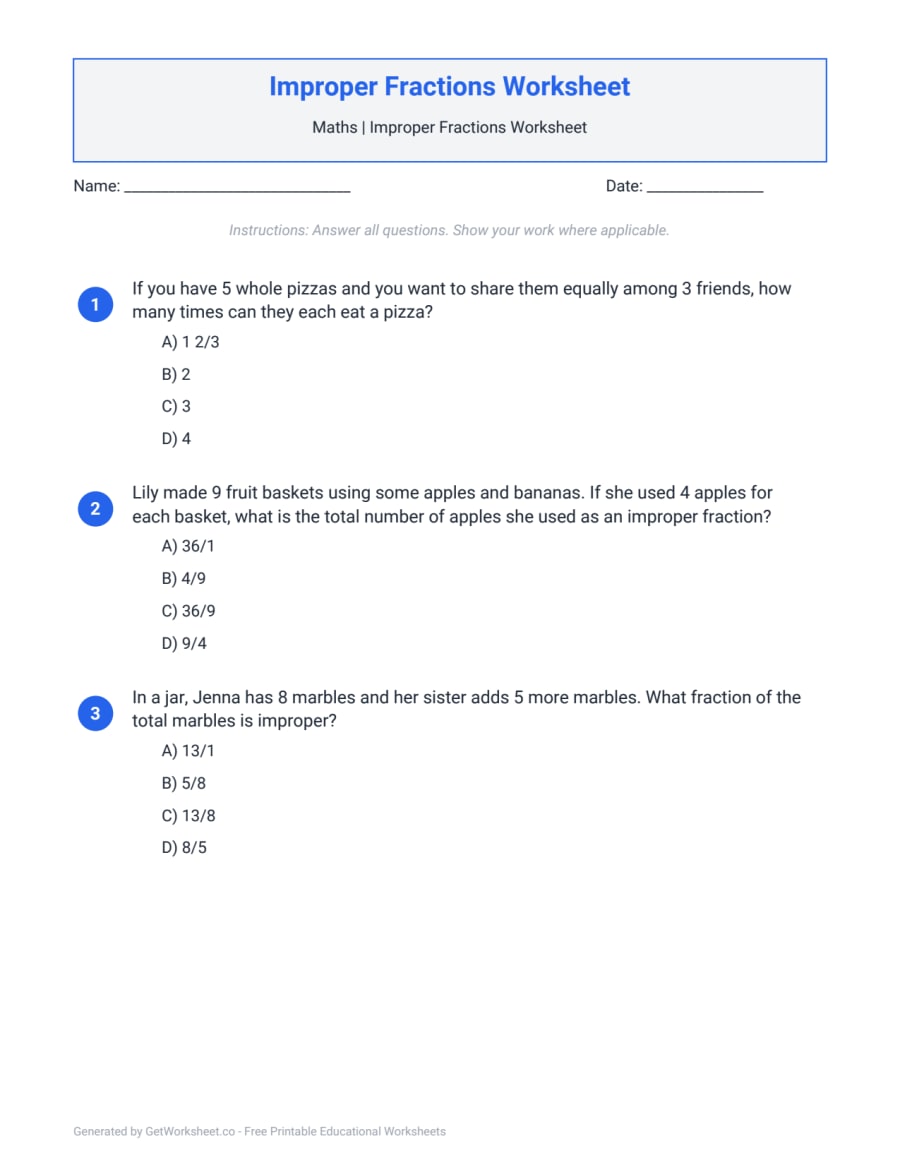
Improper Fractions Worksheet
Free printable improper fractions worksheets with answer keys. Great for practicing improper fractions and helping students build confidence in math.
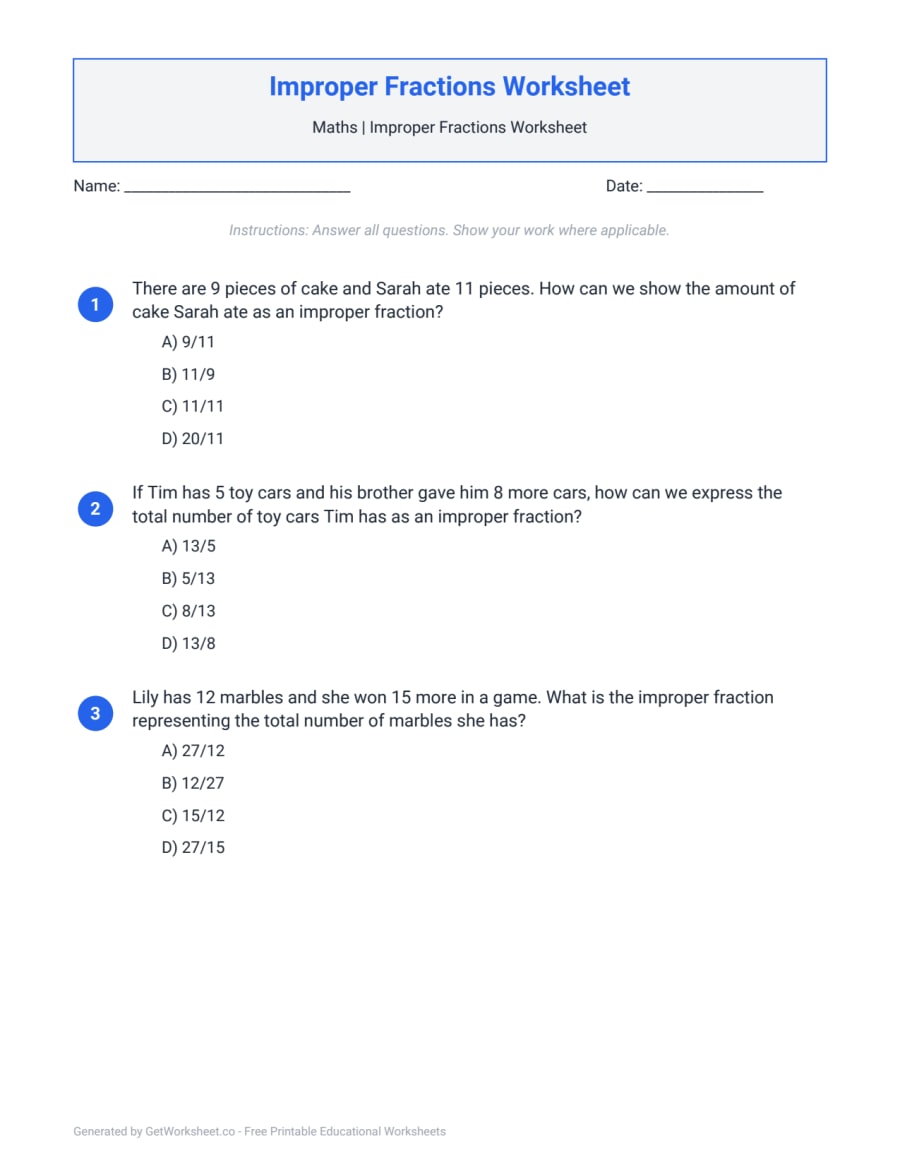
Improper Fractions Worksheet
Free printable improper fractions worksheet with answer keys. Perfect for homework, extra practice, or reinforcing fraction skills at home.
How to Use These Worksheets
The key insight students need is that improper fractions and mixed numbers are two ways to write the same number.
- Use a visual model first. Draw circles divided into 4 equal parts and shade 7 parts (across two circles). Students can see that 7/4 fills one whole circle and 3/4 of another — that's 1 3/4. Once they see it, the division procedure makes sense instead of feeling like a random trick.
- For converting improper to mixed, teach the division method step by step: divide the numerator by the denominator. The quotient is the whole number, the remainder is the new numerator, and the denominator stays the same. Practice: 17/5 → 17 ÷ 5 = 3 R 2 → 3 2/5.
- For converting mixed to improper, use the "multiply and add" method: multiply the whole number by the denominator, then add the numerator. Practice: 4 1/3 → (4 × 3) + 1 = 13 → 13/3. Have students check by converting back.
- Once conversions are comfortable, mix in comparison and ordering exercises. "Which is larger: 9/4 or 2 1/3?" Converting both to the same form (either both improper or both mixed) makes comparison straightforward.
Common Mistakes to Watch For
- Forgetting what the remainder means: When converting 13/5, a student divides 13 ÷ 5 = 2 R 3 but writes 2 3/5 with the denominator wrong — maybe 2 3/13 or 2 3/3. The remainder goes over the original denominator, always. Drill this: remainder on top, denominator stays the same.
- Multiplying wrong when converting to improper: For 3 2/7, students sometimes do 3 × 2 + 7 = 13 instead of 3 × 7 + 2 = 23. Remind them: multiply the whole number by the denominator (bottom number), then add the numerator (top number).
- Thinking improper fractions are "wrong": The name "improper" makes students think these fractions should always be converted to mixed numbers. In reality, improper fractions are often easier to work with in multiplication and algebra. Both forms are valid.
- Not simplifying the final answer: A student converts 12/8 to 1 4/8 but doesn't simplify to 1 1/2. While 1 4/8 is technically correct, most teachers expect the fraction part to be in simplest form. Add a simplification check as the last step.
Frequently Asked Questions
When should students learn improper fractions?
Improper fractions are typically introduced in 3rd grade and practiced extensively in 4th and 5th grade. Students need to be comfortable with basic fraction concepts (what numerator and denominator mean, equivalent fractions) before tackling improper fractions and mixed numbers.
Why do textbooks call them "improper"? Is there something wrong with them?
The name is misleading — there's nothing wrong or incorrect about improper fractions. The term just means the fraction represents a value of 1 or greater. In advanced math, improper fractions are actually preferred over mixed numbers because they're easier to multiply, divide, and use in equations. Both forms are perfectly valid.
My child can convert but doesn't understand why. Should I worry?
Yes — understanding matters more than procedure. If they're just following steps without knowing why, use visual models (pie charts, fraction bars, or number lines) to show that 7/4 and 1 3/4 represent the same amount. Once they see the "why," the procedure becomes a shortcut they trust rather than a magic trick they memorize.
When would my child use improper fractions in real life?
Cooking is the most common example: a recipe calls for 3/2 cups of flour (which is 1 1/2 cups). Measurements in building, sewing, and science also frequently produce improper fractions. Anytime you measure and get "more than one whole unit plus a fraction," you're working with improper fractions.
After mastering improper fractions and mixed numbers, students move on to adding and subtracting fractions with unlike denominators, multiplying fractions, and eventually dividing fractions — all of which build directly on the conversion skills practiced here.