3 Times Table Worksheets
Free 3 times table worksheets with answer keys. Practice multiplication by 3 with drills, word problems, and games — printable PDFs for kids.
The 3 times table sits right in that tricky middle ground — it's not as simple as the 2s or 5s, but it's not as intimidating as the 7s or 8s. For most students, this is where multiplication starts requiring real memorization rather than easy patterns. The good news: once the 3s are solid, kids have a strong foundation that makes learning the 6s, 9s, and 12s much easier later.
What Students Will Practice
- Recalling multiplication facts from 3 × 1 through 3 × 12 with increasing speed and accuracy
- Recognizing the pattern in the 3 times table — the ones digits cycle through 3, 6, 9, 2, 5, 8, 1, 4, 7, 0 before repeating
- Using skip counting by 3s (3, 6, 9, 12, 15, 18...) as a strategy for finding products before full memorization kicks in
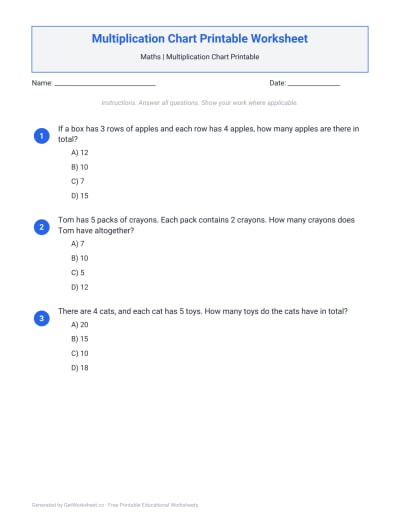
- Solving multiplication word problems involving groups of 3 (e.g., "Each tricycle has 3 wheels. How many wheels do 7 tricycles have?")
- Connecting multiplication to repeated addition (3 × 4 = 3 + 3 + 3 + 3 = 12) and to arrays (3 rows of 4 objects)
- Completing timed drills to build automatic recall — the goal is answering each fact in under 3 seconds
The 3 times table is typically introduced in 2nd or 3rd grade as part of the multiplication standards. Fluent recall of these facts is essential for multi-digit multiplication, division, and fractions work in later grades.

3 Times Table Worksheet
Free printable 3 times table worksheets with answer keys. Great for extra practice, homework, or supplementing math skills at home.

3 Times Table Worksheet
Free printable 3 times table worksheets with answer keys. Perfect for homework, extra practice, or reinforcing multiplication skills at home.

3 Times Table Worksheet
Free printable 3 times table worksheets with answer keys. Perfect for homework, extra practice, or reinforcing multiplication skills at home.
How to Use These Worksheets
Memorizing multiplication takes repetition, but it doesn't have to be boring.
- Start with the fill-in-the-table worksheets where students write out 3 × 1 through 3 × 12 in order. This builds familiarity with the sequence. Once they can fill in the table accurately, move to the randomized drills where facts appear in mixed order — that's where real memorization is tested.
- Use the skip-counting exercises as a warm-up: have your child count by 3s out loud (3, 6, 9, 12...) while touching each number on the worksheet. The combination of saying, seeing, and touching uses multiple memory pathways and speeds up retention.
- Set a gentle timer on the drill pages — not to create stress, but to track progress. If your child completes 20 problems in 3 minutes today and 2 minutes next week, that's visible improvement. Competing against their own time is motivating without the anxiety of competing against others.
- Mix in the word problems after the drills. Calculation speed is important, but understanding when to multiply is just as critical. Word problems build that "when do I use this?" recognition.
Common Mistakes to Watch For
- Confusing 3 × 4 and 4 × 3 with different values: Some students think these give different answers because the numbers switched. Reinforce that multiplication is commutative — 3 × 4 = 4 × 3 = 12. Knowing this cuts the number of facts to memorize nearly in half.
- Counting errors when skip counting: Students might go 3, 6, 9, 11, 14... instead of 3, 6, 9, 12, 15. Each skip must add exactly 3. If your child makes these errors, slow down the counting and have them verify each step by adding 3 on their fingers.
- Mixing up 3 × 7 and 3 × 8: These two facts (21 and 24) are commonly confused because they're close together and neither has an easy pattern. Extra drill on just these two facts helps — write them on a sticky note on the fridge.
- Relying on finger counting too long: Some students count by 3s on their fingers for every single problem. While this works, it's too slow for timed work and multi-step problems. The transition from counting to automatic recall needs deliberate practice through timed drills.
Frequently Asked Questions
How long does it take to memorize the 3 times table?
With daily practice of 5-10 minutes, most students achieve reliable recall within 2-3 weeks. Some facts (3 × 5, 3 × 10) are learned almost instantly. Others (3 × 7, 3 × 8) take longer. Don't expect perfection in a few days — consistency over time is what builds permanent memory.
Is it okay if my child still uses skip counting instead of memorizing?
Skip counting is a valid strategy and shows good understanding. However, for efficiency in later math (long multiplication, division, fractions), automatic recall — answering without counting — is the goal. Let skip counting be the bridge, but keep pushing toward instant answers through timed practice.
What order should my child learn the times tables?
A common and effective order is: 2s, 5s, 10s (pattern-based and easy), then 3s, 4s (building on what they know), then 6s, 7s, 8s, 9s (hardest). By the time they reach the 7s and 8s, they already know many of those facts from earlier tables (7 × 3 was learned with the 3s).
My child knows the facts but freezes on timed tests. What helps?
Test anxiety is common with timed math. Start with a generous time limit and gradually reduce it over weeks. Celebrate getting more correct answers, not just speed. Some children also benefit from practicing timed drills at home first, where the stakes feel lower, before facing classroom timed tests.
After the 3 times table is solid, students are well-prepared to tackle the 4s and 6s. The 6 times table is essentially the 3s doubled (3 × 4 = 12, so 6 × 4 = 24), which makes it much easier when the 3s are already automatic.